A Disappearing Act: Constraints From "Missing" Flares of Repeating Partial TDE Candidates
Pith reviewed 2026-06-28 00:05 UTC · model grok-4.3
The pith
Non-detections of predicted third flares show two repeating TDE candidates are actually rpTDEs from a single bound star.
A machine-rendered reading of the paper's core claim, the machinery that carries it, and where it could break.
Core claim
TDE 2022dbl and TDE 2020vdq are rpTDEs. To produce only two observable flares with similar energetics, semi-analytical modeling strongly favors a main-sequence star promptly placed on a bound orbit with a deep initial tidal encounter at pericenter.
What carries the argument
Semi-analytical modeling of rpTDE flare sequences that varies stellar type, orbital binding, and pericenter depth to match observed energetics and the absence of a third flare.
If this is right
- Most rTDEs that show multiple flares on a few-year baseline are repeating partial disruptions rather than independent full TDEs.
- A significant fraction of rpTDE systems may produce only two observable flares.
- Use of r(p)TDEs to probe TDE physics and nuclear dynamics must account for this limited flare count.
- Yield estimates for upcoming time-domain surveys should incorporate the possibility that many rpTDEs are visible for only two flares.
Where Pith is reading between the lines
- Survey cadence and depth choices may need to prioritize catching the first two flares rather than waiting for a longer sequence.
- The preference for prompt bound orbits after the first encounter could link to specific dynamical channels for placing stars near supermassive black holes.
- If only two flares are common, the overall TDE rate inferred from flare counts may be underestimated unless rpTDE demographics are folded in.
Load-bearing premise
The two observed flares are strictly periodic, so a third flare must appear at the predicted time.
What would settle it
Continued non-detection or a clear detection of a third flare around early 2026 in either source would test whether the periodicity assumption holds and whether the rpTDE classification is required.
Figures

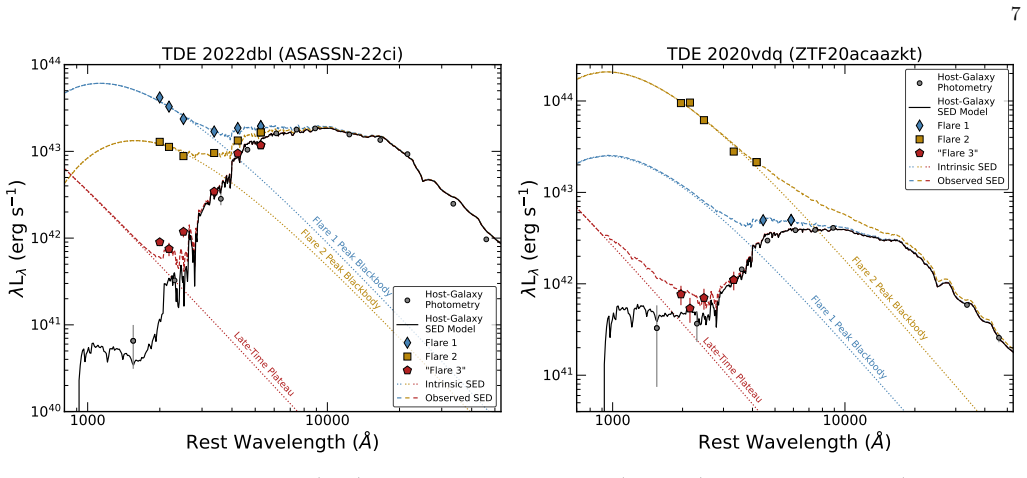

read the original abstract
Recurrent tidal disruption events (rTDEs) are sources that exhibit multiple TDE-like flares; many are likely powered by the recurring partial disruption of a bound star, in a repeating partial TDE (rpTDE). Two such sources, TDE 2022dbl (ASASSN-22ci) and TDE 2020vdq (ZTF20acaazkt), each exhibited two UV/optical flares and, under the assumption of periodicity, both were expected to exhibit a third flare in early 2026. Neither exhibited such a flare, to limits of $L_{\textrm{UV/optical}} \lesssim 10^{42}$ erg s$^{-1}$, $\sim$30$\times$ fainter than the previous flares. Here, we examine several possible explanations. Observing two independent TDEs from the same galaxy within $\sim$2 yr has a probability of $\lesssim$0.5% for measured average TDE rates and currently expected rate enhancements, unless there is extreme intrinsic dispersion in the rates. Theoretical predictions for a double TDE of both stars in a binary are inconsistent with the observed flares. We therefore conclude that TDE 2022dbl and TDE 2020vdq are rpTDEs. To produce only two observable flares with similar energetics, our semi-analytical modeling strongly favors a main-sequence star promptly placed on a bound orbit with a deep initial tidal encounter at pericenter. These results suggest that the majority of rTDEs with multiple flares over a few-year baseline are likely to be rpTDEs, and that a significant fraction of systems may produce only two observable flares. This has important implications for the use of r(p)TDEs as probes of TDE physics and dynamical processes in the nuclei of other galaxies, in addition to the expected yield from upcoming surveys.
Editorial analysis
A structured set of objections, weighed in public.
Referee Report
Summary. The paper claims that TDE 2022dbl and TDE 2020vdq are repeating partial TDEs (rpTDEs) rather than independent TDEs or binary disruptions. This follows from a ≲0.5% probability of two independent TDEs in the same galaxy within ~2 yr (using measured rates, with an 'extreme intrinsic dispersion' caveat), inconsistency with binary TDE predictions, and semi-analytical modeling that favors a main-sequence star promptly placed on a bound orbit with a deep initial pericenter encounter. The modeling is used to explain the observation of only two flares of similar energetics together with the non-detection of a third flare to L_UV/optical ≲ 10^42 erg s^{-1} (~30× fainter) in early 2026, under the assumption of periodicity for the observed flares.
Significance. If the central conclusions hold, the work constrains the demographics of rTDEs, indicating that many systems with multiple flares over a few-year baseline are rpTDEs and that a significant fraction may produce only two observable flares. This carries implications for the use of r(p)TDEs as probes of TDE physics and galactic nuclei dynamics, as well as for survey yields. Strengths include the grounding in external measured TDE rates for the probability estimates and the deployment of semi-analytical modeling to derive specific orbital and stellar-type preferences.
major comments (2)
- [Abstract] Abstract and modeling section: The conclusion that the sources are rpTDEs and that semi-analytical modeling 'strongly favors' a main-sequence star on a bound orbit with deep initial pericenter is derived specifically to explain only two observable flares given the non-detection. This non-detection supplies the key constraint only under the periodicity assumption used to predict a third flare in early 2026. The manuscript should include a quantitative assessment of how the modeling posteriors and favored parameters shift if the two flares are treated as aperiodic (or if the inferred period is allowed a broad uncertainty range), as this assumption is load-bearing for the rpTDE interpretation over the independent-TDE scenario.
- [Probability section] Probability calculation (likely §2 or equivalent): The ≲0.5% probability for two independent TDEs is presented as evidence against that scenario, but the text already notes the 'extreme intrinsic dispersion' escape clause. The manuscript should report the sensitivity of this probability to the dispersion parameter (including the value at which the probability rises above a few percent) and any error bars or Poisson uncertainties on the underlying TDE rate measurements used.
minor comments (1)
- [Abstract] The abstract states the non-detection limits but does not specify the exact observation epochs or instruments used for the 2026 limits; this should be clarified with a brief reference to the relevant data section or table.
Simulated Author's Rebuttal
We thank the referee for the constructive report. The two major comments identify load-bearing assumptions in the rpTDE interpretation. We address each below and will revise the manuscript to strengthen the presentation of uncertainties.
read point-by-point responses
-
Referee: [Abstract] Abstract and modeling section: The conclusion that the sources are rpTDEs and that semi-analytical modeling 'strongly favors' a main-sequence star on a bound orbit with deep initial pericenter is derived specifically to explain only two observable flares given the non-detection. This non-detection supplies the key constraint only under the periodicity assumption used to predict a third flare in early 2026. The manuscript should include a quantitative assessment of how the modeling posteriors and favored parameters shift if the two flares are treated as aperiodic (or if the inferred period is allowed a broad uncertainty range), as this assumption is load-bearing for the rpTDE interpretation over the independent-TDE scenario.
Authors: We agree that the periodicity assumption is central to using the non-detection as a strong constraint on the orbital parameters. The two observed flares have comparable peak luminosities and similar rise times separated by ~2 yr, which motivates the periodic interpretation, but we acknowledge that the data do not yet rule out aperiodic behavior. In revision we will add a dedicated subsection that re-runs the semi-analytical grid allowing the second flare to be either the first or second return (i.e., relaxing strict periodicity) and that marginalizes over a broad prior on the period (uniform in log P from 0.5–5 yr). We will report the resulting shifts in the posterior probability for main-sequence vs. giant stars and for deep vs. shallow encounters, together with the fraction of models that still produce only two observable flares above the survey limits. revision: yes
-
Referee: [Probability section] Probability calculation (likely §2 or equivalent): The ≲0.5% probability for two independent TDEs is presented as evidence against that scenario, but the text already notes the 'extreme intrinsic dispersion' escape clause. The manuscript should report the sensitivity of this probability to the dispersion parameter (including the value at which the probability rises above a few percent) and any error bars or Poisson uncertainties on the underlying TDE rate measurements used.
Authors: The referee correctly notes that the quoted probability depends on both the mean rate and the assumed dispersion. In the revised manuscript we will (i) tabulate the two-TDE probability as a function of the log-normal dispersion parameter σ from 0 to 2 dex, explicitly marking the σ at which the probability exceeds 5 %, and (ii) propagate the published 1σ uncertainties on the volumetric TDE rate (from the ZTF and ASAS-SN samples) through the calculation, quoting the resulting range on the joint probability. This will make the robustness (or lack thereof) to the dispersion caveat fully quantitative. revision: yes
Circularity Check
No significant circularity; derivation uses external rates and explicit assumption
full rationale
The paper's chain proceeds from observed flares, an explicitly stated periodicity assumption to predict a third flare, non-detection limits, external literature TDE rates for the ~0.5% independent-TDE probability, inconsistency with binary TDE predictions, and semi-analytical modeling favoring a specific rpTDE scenario. None of these steps reduce by the paper's own equations to quantities defined only in terms of parameters fitted from the same dataset, nor rely on self-citation load-bearing, uniqueness imported from authors, or ansatz smuggling. The periodicity assumption is flagged as such and does not create a self-definitional loop. The result is self-contained against external benchmarks.
Axiom & Free-Parameter Ledger
axioms (1)
- domain assumption The two observed flares follow a periodic orbit allowing prediction of a third flare in early 2026
Reference graph
Works this paper leans on
-
[1]
New Insights into Classical Novae. , keywords =. doi:10.1146/annurev-astro-112420-114502 , archivePrefix =. 2011.08751 , primaryClass =
-
[2]
An Explanation for the Overrepresentation of Tidal Disruption Events in Post-starburst Galaxies. , keywords =. doi:10.3847/1538-4357/ad0bfb , archivePrefix =. 2311.07040 , primaryClass =
-
[3]
Tidal Disruption Events from the Combined Effects of Two-body Relaxation and the Eccentric Kozai-Lidov Mechanism. , keywords =. doi:10.3847/1538-4357/acfee0 , archivePrefix =. 2306.05472 , primaryClass =
-
[4]
Uncovering Hidden Massive Black Hole Companions with Tidal Disruption Events. , keywords =. doi:10.3847/1538-4357/ad0234 , archivePrefix =. 2306.05510 , primaryClass =
-
[5]
Strong Scatterings Invalidate Proposed Models of Enhanced Tidal Disruption Event Rates in Post-starburst Galaxies. , keywords =. doi:10.3847/1538-4357/adc09f , archivePrefix =. 2411.05086 , primaryClass =
-
[6]
Monthly Notices of the Royal Astronomical Society , author =
Tidal disruption events in post-starburst galaxies: the importance of a complete stellar mass function. , keywords =. doi:10.1093/mnras/stac262 , archivePrefix =. 2201.08397 , primaryClass =
-
[7]
Volumetric TDE rates and the abundance of nuclear star clusters
Demographics of tidal disruption events with L-Galaxies: I. Volumetric TDE rates and the abundance of nuclear star clusters. , keywords =. doi:10.1051/0004-6361/202449470 , archivePrefix =. 2312.13242 , primaryClass =
-
[8]
Counting the Unseen. II. Tidal Disruption Event Rates in Nearby Galaxies with REPTiDE. , keywords =. doi:10.3847/1538-4357/addd1b , archivePrefix =. 2412.19935 , primaryClass =
-
[9]
Loss cone shielding. , keywords =. doi:10.1093/mnras/stad3301 , archivePrefix =. 2211.05858 , primaryClass =
-
[10]
1968 , publisher=
An Introduction to Probability Theory and Its Applications , author=. 1968 , publisher=
1968
-
[11]
A Formation Crisis of Repeating Partial Tidal Disruption Events
A Formation Crisis of Repeating Partial Tidal Disruption Events. arXiv e-prints , keywords =. doi:10.48550/arXiv.2601.22465 , archivePrefix =. 2601.22465 , primaryClass =
work page internal anchor Pith review Pith/arXiv arXiv doi:10.48550/arxiv.2601.22465
-
[12]
The La Silla Schmidt Southern Survey. , keywords =. doi:10.1088/1538-3873/ae02c5 , archivePrefix =. 2503.14579 , primaryClass =
-
[13]
Low-cost Access to the Deep, High-cadence Sky: the Argus Optical Array. , keywords =. doi:10.1088/1538-3873/ac4811 , archivePrefix =. 2107.00664 , primaryClass =
-
[14]
The Large Array Survey Telescope-System Overview and Performances. , keywords =. doi:10.1088/1538-3873/acd8f0 , archivePrefix =. 2304.04796 , primaryClass =
-
[15]
Identifying Tidal Disruption Events with an Expansion of the FLEET Machine-learning Algorithm. , keywords =. doi:10.3847/1538-4357/acc535 , archivePrefix =. 2210.10810 , primaryClass =
-
[16]
tdescore: An Accurate Photometric Classifier for Tidal Disruption Events. , keywords =. doi:10.3847/2041-8213/ad3337 , archivePrefix =. 2312.00139 , primaryClass =
-
[17]
ULTRASAT: A Wide-field Time-domain UV Space Telescope. , keywords =. doi:10.3847/1538-4357/ad2704 , archivePrefix =. 2304.14482 , primaryClass =
-
[18]
Transient Name Server AstroNote , keywords =
Release of the ATLAS Forced Photometry server for public use. Transient Name Server AstroNote , keywords =
-
[19]
Star clusters containing massive, central black holes: Monte Carlo simulations in two-dimensional phase space. , keywords =. doi:10.1086/156521 , adsurl =
-
[20]
The stellar distribution around a black hole: numerical integration of the Fokker-Planck equation. , keywords =. doi:10.1086/156685 , adsurl =
-
[21]
The distribution and consumption rate of stars around a massive, collapsed object. , keywords =. doi:10.1086/154925 , adsurl =
-
[22]
Effects of massive black holes on dense stellar systems. , keywords =. doi:10.1093/mnras/176.3.633 , adsurl =
-
[23]
Quasi-periodic eruptions from impacts between the secondary and a rigidly precessing accretion disc in an extreme mass-ratio inspiral system. , keywords =. doi:10.1051/0004-6361/202346565 , archivePrefix =. 2304.00775 , primaryClass =
-
[24]
X-Ray Quasi-periodic Eruptions Driven by Star-Disk Collisions: Application to GSN069 and Probing the Spin of Massive Black Holes. , keywords =. doi:10.3847/2041-8213/ac31aa , archivePrefix =. 2110.10855 , primaryClass =
-
[25]
Relativistic Dynamics and Extreme Mass Ratio Inspirals
Relativistic dynamics and extreme mass ratio inspirals. Living Reviews in Relativity , keywords =. doi:10.1007/s41114-018-0013-8 , archivePrefix =. 1205.5240 , primaryClass =
work page internal anchor Pith review Pith/arXiv arXiv doi:10.1007/s41114-018-0013-8
-
[26]
Mass loss through the L2 Lagrange point - Application to Main Sequence EMRI
Mass-loss through the L2 Lagrange point - application to main-sequence EMRI. , keywords =. doi:10.1093/mnras/stx1041 , archivePrefix =. 1705.01435 , primaryClass =
work page internal anchor Pith review Pith/arXiv arXiv doi:10.1093/mnras/stx1041
-
[27]
X-ray quasi-periodic eruptions from the galactic nucleus of RX J1301.9+2747. , keywords =. doi:10.1051/0004-6361/202037610 , archivePrefix =. 2002.08967 , primaryClass =
-
[28]
TOPICAL REVIEW: Intermediate and extreme mass-ratio inspirals astrophysics, science applications and detection using LISA. Classical and Quantum Gravity , keywords =. doi:10.1088/0264-9381/24/17/R01 , archivePrefix =. astro-ph/0703495 , primaryClass =
work page internal anchor Pith review Pith/arXiv arXiv doi:10.1088/0264-9381/24/17/r01
-
[29]
The more the merrier: SRG/eROSITA discovers two further galaxies showing X-ray quasi-periodic eruptions. , keywords =. doi:10.1051/0004-6361/202348881 , archivePrefix =. 2401.17275 , primaryClass =
-
[30]
QPEs from EMRI Debris Streams Impacting Accretion Disks in Galactic Nuclei. , keywords =. doi:10.3847/1538-4357/adfa0e , archivePrefix =. 2506.10096 , primaryClass =
-
[31]
EMRI + TDE = QPE: Periodic X-Ray Flares from Star-Disk Collisions in Galactic Nuclei. , keywords =. doi:10.3847/1538-4357/acf65b , archivePrefix =. 2303.16231 , primaryClass =
-
[32]
A Host Galaxy Morphology Link between Quasiperiodic Eruptions and Tidal Disruption Events. , keywords =. doi:10.3847/1538-4357/ae1745 , archivePrefix =. 2409.10486 , primaryClass =
-
[33]
X-Ray Quasi-periodic Eruptions and Tidal Disruption Events Prefer Similar Host Galaxies. , keywords =. doi:10.3847/2041-8213/ad5f1b , archivePrefix =. 2406.02678 , primaryClass =
-
[34]
Expectations for extreme-mass-ratio bursts from the Galactic Centre
Expectations for extreme-mass-ratio bursts from the Galactic Centre. , keywords =. doi:10.1093/mnras/stt1543 , archivePrefix =. 1307.7276 , primaryClass =
work page internal anchor Pith review Pith/arXiv arXiv doi:10.1093/mnras/stt1543
-
[35]
The gravitational wave background signal from tidal disruption events. , keywords =. doi:10.1093/mnras/staa2290 , archivePrefix =. 2007.13225 , primaryClass =
-
[36]
Gravitational Wave and X-ray Signals from Stellar Disruption by a Massive Black Hole
Gravitational Waves and X-Ray Signals from Stellar Disruption by a Massive Black Hole. , keywords =. doi:10.1086/424684 , archivePrefix =. astro-ph/0404173 , primaryClass =
work page internal anchor Pith review Pith/arXiv arXiv doi:10.1086/424684
-
[37]
Quasi-periodic X-ray eruptions years after a nearby tidal disruption event. , keywords =. doi:10.1038/s41586-024-08023-6 , archivePrefix =. 2409.02181 , primaryClass =
-
[38]
Discovery of extreme quasi-periodic eruptions in a newly accreting massive black hole. Nature Astronomy , keywords =. doi:10.1038/s41550-025-02523-9 , archivePrefix =. 2504.07169 , primaryClass =
-
[39]
Discovery of Quasiperiodic Eruptions in the Tidal Disruption Event and Extreme Coronal Line Emitter AT2022upj: Implications for the QPE/TDE Fraction and a Connection to ECLEs. , keywords =. doi:10.3847/2041-8213/adc2f8 , archivePrefix =. 2503.19013 , primaryClass =
-
[40]
X-ray quasi-periodic eruptions from two previously quiescent galaxies. , keywords =. doi:10.1038/s41586-021-03394-6 , archivePrefix =. 2104.13388 , primaryClass =
-
[41]
Nine-hour X-ray quasi-periodic eruptions from a low-mass black hole galactic nucleus. , keywords =. doi:10.1038/s41586-019-1556-x , archivePrefix =. 1909.04693 , primaryClass =
-
[42]
Dynamical Unification of Tidal Disruption Events. , keywords =. doi:10.3847/2041-8213/ac911f , archivePrefix =. 2206.02804 , primaryClass =
-
[43]
Modules for Experiments in Stellar Astrophysics (MESA): Time-dependent Convection, Energy Conservation, Automatic Differentiation, and Infrastructure. , keywords =. doi:10.3847/1538-4365/acae8d , archivePrefix =. 2208.03651 , primaryClass =
-
[44]
Tidal disruption event Calorimetry: Observational constraints on the physics of TDE optical flares. arXiv e-prints , keywords =. doi:10.48550/arXiv.2512.09143 , archivePrefix =. 2512.09143 , primaryClass =
-
[45]
Repeating partial disruptions and two-body relaxation. The Open Journal of Astrophysics , keywords =. doi:10.33232/001c.120086 , archivePrefix =. 2404.05786 , primaryClass =
-
[46]
Illuminating Massive Black Holes with White Dwarfs: Orbital Dynamics and High-energy Transients from Tidal Interactions. , keywords =. doi:10.1088/0004-637X/794/1/9 , archivePrefix =. 1405.1426 , primaryClass =
work page internal anchor Pith review Pith/arXiv arXiv doi:10.1088/0004-637x/794/1/9
-
[47]
2023, MNRAS, 524, 6247, doi: 10.1093/mnras/stad2203
Quasi-periodic eruptions from mildly eccentric unstable mass transfer in galactic nuclei. , keywords =. doi:10.1093/mnras/stad2203 , archivePrefix =. 2210.08023 , primaryClass =
-
[48]
Using the Hills Mechanism to Generate Repeating Partial Tidal Disruption Events and ASASSN-14ko. , keywords =. doi:10.3847/2041-8213/ac6021 , archivePrefix =. 2203.08162 , primaryClass =
-
[49]
G., 1988, @doi [ ] 10.1038/331687a0 , https://ui.adsabs.harvard.edu/abs/1988Natur.331..687H 331, 687
Hyper-velocity and tidal stars from binaries disrupted by a massive Galactic black hole. , keywords =. doi:10.1038/331687a0 , adsurl =
-
[50]
Recurring tidal disruption events a decade apart in IRAS F01004-2237. , keywords =. doi:10.1051/0004-6361/202452380 , archivePrefix =. 2410.09720 , primaryClass =
-
[51]
AT2021aeuk: A Repeating Partial Tidal Disruption Event Candidate in a Narrow-line Seyfert 1 Galaxy. , keywords =. doi:10.3847/1538-4357/adb724 , archivePrefix =. 2501.01824 , primaryClass =
-
[52]
Back from the dead: AT2019aalc as a candidate repeating TDE in an AGN. arXiv e-prints , keywords =. doi:10.48550/arXiv.2408.17419 , archivePrefix =. 2408.17419 , primaryClass =
-
[53]
Rapid evolution of the recurrence time in the repeating partial tidal disruption event eRASSt J045650.3 - 203750. , keywords =. doi:10.1051/0004-6361/202348682 , archivePrefix =. 2401.14091 , primaryClass =
-
[54]
Astronomy and Astrophysics , author =
Deciphering the extreme X-ray variability of the nuclear transient eRASSt J045650.3 - 203750. A likely repeating partial tidal disruption event. , keywords =. doi:10.1051/0004-6361/202244805 , archivePrefix =. 2208.12452 , primaryClass =
-
[55]
A Potential Second Shutoff from AT2018fyk: An Updated Orbital Ephemeris of the Surviving Star under the Repeating Partial Tidal Disruption Event Paradigm. , keywords =. doi:10.3847/2041-8213/ad57b3 , archivePrefix =. 2406.18124 , primaryClass =
-
[56]
Transient Name Server Discovery Report , keywords =
ASAS-SN Transient Discovery Report for 2022-02-22. Transient Name Server Discovery Report , keywords =
2022
-
[57]
Transient Name Server Discovery Report , keywords =
ZTF Transient Discovery Report for 2020-10-08. Transient Name Server Discovery Report , keywords =
2020
-
[58]
Hunter, J. D. , Title =. Computing in Science & Engineering , Volume =
-
[59]
Charles R. Harris and K. Jarrod Millman and St. Array programming with. 2020 , month = sep, journal =. doi:10.1038/s41586-020-2649-2 , publisher =
-
[60]
emcee: The MCMC Hammer. , keywords =. doi:10.1086/670067 , archivePrefix =. 1202.3665 , primaryClass =
work page internal anchor Pith review Pith/arXiv arXiv doi:10.1086/670067
-
[61]
HEAsoft: Unified Release of FTOOLS and XANADU
-
[62]
2024, MNRAS, 527, 2452, doi: 10.1093/mnras/stad3001
Fundamental scaling relationships revealed in the optical light curves of tidal disruption events. , keywords =. doi:10.1093/mnras/stad3001 , archivePrefix =. 2308.08255 , primaryClass =
-
[63]
Compact Accretion Disks in the Aftermath of Tidal Disruption Events: Parameter Inference from Joint X-ray Spectra and UV/Optical Photometry Fitting. arXiv e-prints , keywords =. doi:10.48550/arXiv.2510.26774 , archivePrefix =. 2510.26774 , primaryClass =
-
[64]
gPhoton: The GALEX Photon Data Archive
gPhoton: The GALEX Photon Data Archive. , keywords =. doi:10.3847/1538-4357/833/2/292 , archivePrefix =. 1609.09492 , primaryClass =
work page internal anchor Pith review Pith/arXiv arXiv doi:10.3847/1538-4357/833/2/292
-
[65]
The optical, UV-plateau, and X-ray tidal disruption event luminosity functions reproduced from first principles. , keywords =. doi:10.1093/mnras/staf938 , archivePrefix =. 2410.17087 , primaryClass =
-
[66]
Rate of Repeating Tidal Disruption Events with 5--19 years interval
Rate of Repeating Tidal Disruption Events with 5--19 years interval constrained by CRTS and ZTF. arXiv e-prints , keywords =. doi:10.48550/arXiv.2601.12691 , archivePrefix =. 2601.12691 , primaryClass =
work page internal anchor Pith review Pith/arXiv arXiv doi:10.48550/arxiv.2601.12691
-
[67]
The Unluckiest Star: A Spectroscopically Confirmed Repeated Partial Tidal Disruption Event AT 2022dbl. , keywords =. doi:10.3847/2041-8213/ad638e , archivePrefix =. 2405.10895 , primaryClass =
-
[68]
A Star's Death by a Thousand Cuts: The Runaway Periodic Eruptions of AT2023uqm. arXiv e-prints , keywords =. doi:10.48550/arXiv.2510.26561 , archivePrefix =. 2510.26561 , primaryClass =
-
[69]
Chandra, HST/STIS, NICER, Swift, and TESS Detail the Flare Evolution of the Repeating Nuclear Transient ASASSN -14ko. , keywords =. doi:10.3847/1538-4357/acd455 , archivePrefix =. 2206.11278 , primaryClass =
-
[70]
The Rapid X-Ray and UV Evolution of ASASSN-14ko. , keywords =. doi:10.3847/1538-4357/ac480c , archivePrefix =. 2104.06414 , primaryClass =
-
[71]
Rates of Stellar Tidal Disruption. , keywords =. doi:10.1007/s11214-020-00651-4 , archivePrefix =. 2003.08953 , primaryClass =
-
[72]
Revisit the Rate of Tidal Disruption Events: The Role of the Partial Tidal Disruption Event. , keywords =. doi:10.3847/1538-4357/ac71ad , archivePrefix =. 2205.09945 , primaryClass =
-
[73]
Double Tidal Disruption Events or Repeating Partial Tidal Disruption Events in AT 2020vdq. , keywords =. doi:10.3847/1538-4357/ae2bde , archivePrefix =. 2512.09204 , primaryClass =
-
[74]
AT 2023lli: A Tidal Disruption Event with Prominent Optical Early Bump and Delayed Episodic X-Ray Emission. , keywords =. doi:10.3847/2041-8213/ad319f , archivePrefix =. 2403.01686 , primaryClass =
-
[75]
Binary Stars Approaching Supermassive Black Holes: Hydrodynamics of Stellar Collisions, Mass Fallback, and Partial Tidal Disruption Events. , keywords =. doi:10.3847/1538-4357/ae032b , archivePrefix =. 2504.14146 , primaryClass =
-
[76]
Binary Stars Approaching Supermassive Black Holes: Tidal Breakup, Double Stellar Disruptions, and Stellar Collision. , keywords =. doi:10.3847/1538-4357/ad93a6 , archivePrefix =. 2409.09597 , primaryClass =
-
[77]
Streams collision as possible precursor of double tidal disruption events
Streams collision as possible precursor of double tidal disruption events. , keywords =. doi:10.1093/mnras/stz062 , archivePrefix =. 1805.09329 , primaryClass =
work page internal anchor Pith review Pith/arXiv arXiv doi:10.1093/mnras/stz062
-
[78]
Double tidal disruptions in galactic nuclei
Double Tidal Disruptions in Galactic Nuclei. , keywords =. doi:10.1088/2041-8205/805/1/L4 , archivePrefix =. 1504.02787 , primaryClass =
work page internal anchor Pith review Pith/arXiv arXiv doi:10.1088/2041-8205/805/1/l4 2041
-
[79]
Hydrodynamical simulations of the tidal stripping of binary stars by massive black holes
Hydrodynamical simulations of the tidal stripping of binary stars by massive black holes. , keywords =. doi:10.1093/mnras/stw197 , archivePrefix =. 1601.05478 , primaryClass =
work page internal anchor Pith review Pith/arXiv arXiv doi:10.1093/mnras/stw197
-
[80]
The First Systematically Identified Repeating Partial Tidal Disruption Event. , keywords =. doi:10.3847/1538-4357/adcc19 , archivePrefix =. 2310.03782 , primaryClass =
discussion (0)
Sign in with ORCID, Apple, or X to comment. Anyone can read and Pith papers without signing in.