Representation Matters: An Empirical Study of Program Representations for LLM Vulnerability Reasoning
Pith reviewed 2026-06-25 21:12 UTC · model grok-4.3
The pith
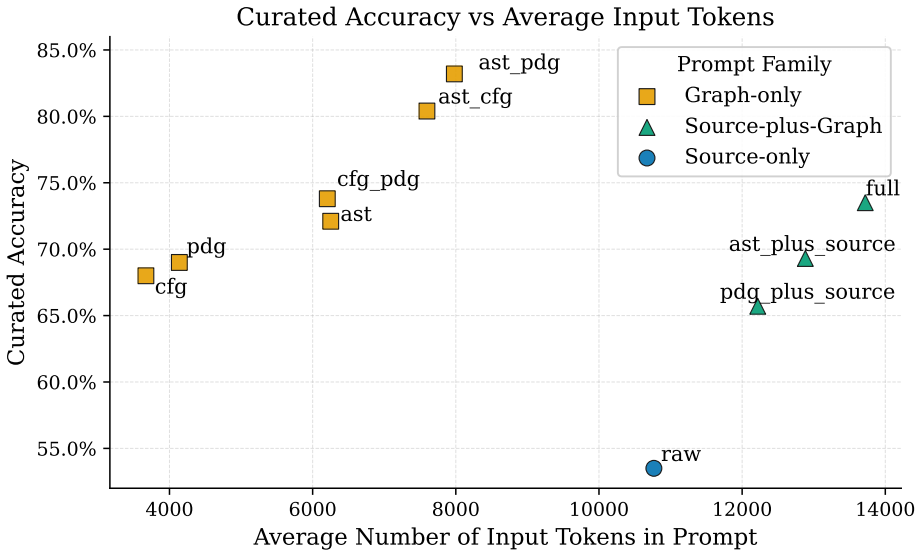
Choosing structured program representations such as AST combined with PDG raises LLM accuracy on vulnerability reasoning from 53.5 percent with raw source to 83.2 percent.
A machine-rendered reading of the paper's core claim, the machinery that carries it, and where it could break.
Core claim
Representation choice substantially affects LLM vulnerability reasoning. The strongest variant, AST+PDG, achieves 83.2% accuracy, compared with 53.5% for raw source. Graph-only prompts outperform both source-only and source-plus-graph prompts while requiring far less prompt overhead. These results reveal a context dilution effect: adding raw source code to compact structural graph evidence can degrade reasoning by making vulnerability-relevant evidence less salient.
What carries the argument
RepBench benchmark that converts the same vulnerability testcases into multiple representations (raw source, AST, CFG, PDG, their combinations, and ePDGs) and evaluates them under a fixed Chain-of-Thought and structured-output protocol.
If this is right
- Graph-only prompts deliver a better accuracy-overhead tradeoff than prompts containing raw source code.
- Static analysis can function as an effective preprocessing layer for constructing prompts in LLM-based security reasoning.
- Adding raw source code to graph representations reduces the salience of vulnerability evidence.
- The observed performance differences hold across the five CWE categories in the evaluated corpus.
Where Pith is reading between the lines
- The same representation experiments could be applied to other LLM code-reasoning tasks such as repair or summarization to test whether graph forms help there as well.
- Security tools built around LLMs could incorporate static-analysis front ends to produce shorter, more targeted prompts before model inference.
- Prompt design for code might shift emphasis from expanding context volume toward selecting compact structural signals.
Load-bearing premise
The 107 Joern-based testcases drawn from PrimeVul across five CWE categories are representative of real-world C/C++ vulnerabilities and the fixed prompting protocol provides an unbiased comparison across representation variants.
What would settle it
Re-running the identical comparison on a substantially larger or more varied collection of vulnerabilities and finding that raw source or source-plus-graph inputs achieve equal or higher accuracy than AST+PDG.
Figures



read the original abstract
Large Language Models (LLMs) are increasingly used for automated vulnerability detection, but it remains unclear how program structure and semantics should be represented for LLM-based reasoning. Most prompting-based approaches provide raw source code, implicitly assuming that more source-level context gives the model better evidence. This paper challenges that assumption through RepBench, an empirical benchmark comparing raw source code with static-analysis-based program representations. RepBench converts real-world C/C++ vulnerability testcases into multiple representations: raw source, Abstract Syntax Trees (ASTs), Control-Flow Graphs (CFGs), Program Dependence Graphs (PDGs), their combinations, and an auxiliary track of enriched PDGs (ePDGs). Using a curated PrimeVul-derived corpus of 107 Joern-based testcases across five CWE categories, we evaluate ten representation variants under a fixed Chain-of-Thought and structured-output protocol, plus 19 additional ePDG cases generated through VulChecker/Hector. Representation choice substantially affects LLM vulnerability reasoning. The strongest variant, AST+PDG, achieves 83.2% accuracy, compared with 53.5% for raw source. At the family level, graph-only prompts outperform both source-only and source-plus-graph prompts while requiring far less prompt overhead. These results reveal a context dilution effect: adding raw source code to compact structural graph evidence can degrade reasoning by making vulnerability-relevant evidence less salient. Overall, our findings show that carefully selected structural representations offer a better accuracy-overhead tradeoff than simply giving LLMs more raw input, and suggest that static analysis can serve as an effective prompt-construction layer for security-focused LLM reasoning.
Editorial analysis
A structured set of objections, weighed in public.
Referee Report
Summary. The manuscript presents RepBench, a benchmark comparing ten program representation variants (raw source, AST, CFG, PDG, combinations, and ePDG) for LLM vulnerability reasoning on a curated PrimeVul-derived corpus of 107 Joern-extracted C/C++ functions across five CWE categories, plus 19 additional ePDG cases. Under a fixed Chain-of-Thought and structured-output protocol, it reports that AST+PDG achieves 83.2% accuracy versus 53.5% for raw source, that graph-only prompts outperform source-inclusive variants with lower overhead, and that adding raw source can cause context dilution.
Significance. If the results hold under a more transparent and representative protocol, the work supplies concrete evidence that static-analysis-derived graph representations can improve LLM accuracy on vulnerability tasks while reducing prompt size, challenging the default of providing raw source code. The multi-variant comparison and identification of the dilution effect offer actionable guidance for prompt construction in security applications of LLMs.
major comments (2)
- [Abstract / Dataset] Abstract and § on dataset construction: the headline accuracy gap (AST+PDG 83.2% vs. raw source 53.5%) rests on a manually curated 107-case subset. No selection protocol, no comparison of function-size or vulnerability-location statistics to the parent PrimeVul distribution, and no error bars or cross-validation are supplied; this selection could preferentially retain cases whose signals are compactly captured by PDG edges, making the observed gap an artifact rather than a general property.
- [Abstract / Methods] Experimental protocol (abstract and methods): the manuscript supplies no information on the LLM family, number of trials per representation, temperature/sampling settings, or exact prompt templates. Without these details the controlled comparison across variants cannot be reproduced or assessed for statistical significance, leaving the central claim only moderately supported.
minor comments (2)
- [Abstract] Clarify how the 19 additional ePDG cases generated via VulChecker/Hector are integrated with the main 107-case results and whether they alter the family-level conclusions.
- Add a table or appendix listing the exact ten representation variants with token counts or prompt-length statistics to support the overhead claims.
Simulated Author's Rebuttal
We thank the referee for the constructive feedback. We address each major comment below and indicate the revisions we will make to improve transparency, reproducibility, and the strength of our claims.
read point-by-point responses
-
Referee: [Abstract / Dataset] Abstract and § on dataset construction: the headline accuracy gap (AST+PDG 83.2% vs. raw source 53.5%) rests on a manually curated 107-case subset. No selection protocol, no comparison of function-size or vulnerability-location statistics to the parent PrimeVul distribution, and no error bars or cross-validation are supplied; this selection could preferentially retain cases whose signals are compactly captured by PDG edges, making the observed gap an artifact rather than a general property.
Authors: We agree that the curation details require clarification. The 107 functions were drawn from PrimeVul and retained only if Joern successfully extracted the full set of graphs (AST, CFG, PDG) needed for all ten representation variants; this was a practical filter to ensure a uniform extraction pipeline rather than an attempt to favor PDG-friendly cases. We will revise the dataset section to state this criterion explicitly and add available descriptive statistics on function lengths and vulnerability locations. A formal statistical comparison against the full PrimeVul distribution was not performed and cannot be added retrospectively without re-running the entire extraction pipeline; we will note this as a limitation. Error bars and cross-validation were omitted because the study used a single fixed test set under identical prompting conditions to isolate representation effects; we will add a short discussion of this design choice and, if space permits, report variance from repeated LLM calls on the same set. revision: partial
-
Referee: [Abstract / Methods] Experimental protocol (abstract and methods): the manuscript supplies no information on the LLM family, number of trials per representation, temperature/sampling settings, or exact prompt templates. Without these details the controlled comparison across variants cannot be reproduced or assessed for statistical significance, leaving the central claim only moderately supported.
Authors: The referee is correct that these parameters were not reported. The experiments used a single commercial LLM family with temperature set to 0 for determinism, one trial per representation, and a fixed Chain-of-Thought template that requested structured JSON output. We will add a new subsection in Methods that names the exact model, lists all sampling settings, states the number of trials, and reproduces the prompt templates (or places them in an appendix). This will allow readers to assess statistical significance and fully reproduce the comparison. revision: yes
Circularity Check
Empirical benchmark reports direct measurements with no derivation chain
full rationale
The paper's central results are accuracy figures (AST+PDG 83.2%, raw source 53.5%) obtained by running a fixed LLM prompting protocol on an external, curated corpus of 107 PrimeVul-derived test cases. No equations, fitted parameters, or self-citations are used to derive these numbers; they are direct experimental outputs. The protocol and corpus selection are described as fixed inputs rather than outputs of the analysis itself. No self-definitional, fitted-input, or self-citation-load-bearing steps appear in the reported chain.
Axiom & Free-Parameter Ledger
axioms (2)
- domain assumption Static analysis tools such as Joern can accurately extract AST, CFG, and PDG representations from C/C++ vulnerability testcases.
- domain assumption A single fixed Chain-of-Thought and structured-output protocol yields comparable reasoning conditions across all representation variants.
Reference graph
Works this paper leans on
-
[1]
Compilers: Principles, techniques, and tools, 2006
Alfred V Aho, Monica S Lam, Ravi Sethi, and Jeffrey D Ullman. Compilers: Principles, techniques, and tools, 2006
2006
-
[2]
Yangruibo Ding, Yanjun Fu, Omniyyah Ibrahim, Chawin Sitawarin, Xinyun Chen, Basel Alomair, David Wagner, Baishakhi Ray, and Yizheng Chen. Vulnerability detection with code language models: How far are we?arXiv preprint arXiv:2403.18624, 2024
-
[3]
Detecting kernel memory leaks in specialized modules with ownership reasoning
Navid Emamdoost, Qiushi Wu, Kangjie Lu, and Stephen McCamant. Detecting kernel memory leaks in specialized modules with ownership reasoning. InThe 2021 Annual Network and Distributed System Security Symposium (NDSS’21), pages 1–15, 2021
2021
-
[4]
Ottenstein, and Joe D
Jeanne Ferrante, Karl J. Ottenstein, and Joe D. Warren. The program dependence graph and its use in optimization.ACM Trans. Program. Lang. Syst., 9(3):319–349, July 1987
1987
-
[5]
FreeRDP: A remote desktop protocol implementation.https: //github.com/FreeRDP/FreeRDP
FreeRDP and contributors. FreeRDP: A remote desktop protocol implementation.https: //github.com/FreeRDP/FreeRDP. 31
-
[6]
Jiawei Guo, Yu Nong, Zhiqiang Lin, and Haipeng Cai. FreeLens: Revealing mobile app feature differences and their security and privacy implications across geographical regions.IEEE Transactions on Dependable and Secure Computing, 2026
2026
-
[7]
VerLog: Enhancing release note generation for android apps using large language models.Proceedings of the ACM on Software Engineering, 2(ISSTA):1910–1932, 2025
Jiawei Guo, Haoran Yang, and Haipeng Cai. VerLog: Enhancing release note generation for android apps using large language models.Proceedings of the ACM on Software Engineering, 2(ISSTA):1910–1932, 2025
1910
-
[8]
CBMC–c bounded model checker
Daniel Kroening and Michael Tautschnig. CBMC–c bounded model checker. InInternational Conference on Tools and Algorithms for the Construction and Analysis of Systems (TACAS), pages 389–391, 2014
2014
-
[9]
{LLMxCPG}:{Context-Aware}vulnerability detection through code property{Graph-Guided} large language models
Ahmed Lekssays, Hamza Mouhcine, Khang Tran, Ting Yu, and Issa Khalil. {LLMxCPG}:{Context-Aware}vulnerability detection through code property{Graph-Guided} large language models. In34th USENIX Security Symposium (USENIX Security 25), pages 489–507, 2025
2025
-
[10]
A practical fuzzer for the python runtime system
Wen Li and Haipeng Cai. A practical fuzzer for the python runtime system. InACM International Conference on the Foundations of Software Engineering (FSE), Tool Demos, pages 1–5, 2026
2026
-
[11]
SV-TrustEval-C: Evaluating structure and semantic reasoning in large language models for source code vulnerability analysis
Yansong Li, Paula Branco, Alexander M Hoole, Manish Marwah, Hari Manassery Koduvely, Guy-Vincent Jourdan, and Stephan Jou. SV-TrustEval-C: Evaluating structure and semantic reasoning in large language models for source code vulnerability analysis. In2025 IEEE Symposium on Security and Privacy (SP), pages 3014–3032. IEEE, 2025
2025
-
[12]
Lost in the middle: How language models use long contexts.Transactions of the association for computational linguistics, 12:157–173, 2024
Nelson F Liu, Kevin Lin, John Hewitt, Ashwin Paranjape, Michele Bevilacqua, Fabio Petroni, and Percy Liang. Lost in the middle: How language models use long contexts.Transactions of the association for computational linguistics, 12:157–173, 2024
2024
-
[13]
Pre-training by predicting program dependencies for vulnerability analysis tasks
Zhongxin Liu, Zhijie Tang, Junwei Zhang, Xin Xia, and Xiaohu Yang. Pre-training by predicting program dependencies for vulnerability analysis tasks. InProceedings of the IEEE/ACM 46th International Conference on Software Engineering, pages 1–13, 2024
2024
-
[14]
In32nd USENIX Security Symposium (USENIX Security 23), pages 6557–6574, 2023
Yisroel Mirsky, George Macon, Michael Brown, Carter Yagemann, Matthew Pruett, Evan Downing, Sukarno Mertoguno, and Wenke Lee.{VulChecker}: Graph-based vulnerability localization in source code. In32nd USENIX Security Symposium (USENIX Security 23), pages 6557–6574, 2023
2023
-
[15]
Common Weakness Enumeration (CWE).https://cwe.mitre.org/,
MITRE Corporation. Common Weakness Enumeration (CWE).https://cwe.mitre.org/,
-
[16]
Accessed: June 8, 2026
2026
-
[17]
A controlled experiment of different code representations for learning-based bug repair
Marjane Namavar, Noor Nashid, and Ali Mesbah. A controlled experiment of different code representations for learning-based bug repair. corr abs/2110.14081 (2021).arXiv preprint arXiv:2110.14081, 2021
-
[18]
Yu Nong, Mohammed Aldeen, Long Cheng, Hongxin Hu, Feng Chen, and Haipeng Cai. Chain- of-thought prompting of large language models for discovering and fixing software vulnerabilities. arXiv preprint arXiv:2402.17230, 2024
-
[19]
Evaluating and comparing memory error vulnerability detectors.Information and Software Technology, 137:106614, 2021
Yu Nong, Haipeng Cai, Pengfei Ye, Li Li, and Feng Chen. Evaluating and comparing memory error vulnerability detectors.Information and Software Technology, 137:106614, 2021. 32
2021
-
[20]
VGX: Large-scale sample generation for boosting learning-based software vulnerability analyses
Yu Nong, Richard Fang, Guangbei Yi, Kunsong Zhao, Xiapu Luo, Feng Chen, and Haipeng Cai. VGX: Large-scale sample generation for boosting learning-based software vulnerability analyses. InIEEE/ACM International Conference on Software Engineering (ICSE), pages 1837–1849, 2024
2024
-
[21]
VulGen: Realistic vulnerable sample generation via pattern mining and deep learning
Yu Nong, Yuzhe Ou, Michael Pradel, Feng Chen, and Haipeng Cai. VulGen: Realistic vulnerable sample generation via pattern mining and deep learning. InIEEE/ACM International Conference on Software Engineering (ICSE), pages 2527–2539, 2023
2023
-
[22]
Open science in software engineering: A study on deep learning-based vulnerability detection.IEEE Transactions on Software Engineering (TSE), 49(4):1983–2005, 2022
Yu Nong, Rainy Sharma, Abdelwahab Hamou-Lhadj, Xiapu Luo, and Haipeng Cai. Open science in software engineering: A study on deep learning-based vulnerability detection.IEEE Transactions on Software Engineering (TSE), 49(4):1983–2005, 2022
1983
-
[23]
In34th USENIX Security Symposium (USENIX Security 25), pages 4481–4500, 2025
Yu Nong, Haoran Yang, Long Cheng, Hongxin Hu, and Haipeng Cai.{APPATCH}: Automated adaptive prompting large language models for{Real-World}software vulnerability patching. In34th USENIX Security Symposium (USENIX Security 25), pages 4481–4500, 2025
2025
-
[24]
Assessing and improving prompting large language models for software vulnerability analysis
Yu Nong, Guangbei Yi, Mohammed Aldeen, Long Cheng, Hongxin Hu, and Haipeng Cai. Assessing and improving prompting large language models for software vulnerability analysis. ACM Transactions on Software Engineering and Methodology (TOSEM), pages 1–53, 2026
2026
-
[25]
Ptlvd:program slicing and transformer-based line-level vulnerability detection system
Tao Peng, Shixu Chen, Fei Zhu, Junwei Tang, Junping Liu, and Xinrong Hu. Ptlvd:program slicing and transformer-based line-level vulnerability detection system. In2023 IEEE 23rd International Working Conference on Source Code Analysis and Manipulation (SCAM), pages 162–173, 2023
2023
-
[26]
Openexr project
OpenEXR project and contributors. Openexr project. https://github.com/ AcademySoftwareFoundation/openexr. Academy Software Foundation
-
[27]
Qwen3.6-Plus: Towards real world agents.https://qwen.ai/blog?id=qwen3.6, 2026
Qwen Team. Qwen3.6-Plus: Towards real world agents.https://qwen.ai/blog?id=qwen3.6, 2026
2026
-
[28]
Deep learning representations of programs: A systematic literature review.ACM Computing Surveys, 58(5):1–37, 2025
Deepika Shanmugasundaram, Pallavi Arivukkarasu, Huaming Chen, and Haipeng Cai. Deep learning representations of programs: A systematic literature review.ACM Computing Surveys, 58(5):1–37, 2025
2025
-
[29]
LLMs in software security: A survey of vulnerability detection techniques and insights.ACM Computing Surveys, 58(5):1–35, 2025
Ze Sheng, Zhicheng Chen, Shuning Gu, Heqing Huang, Guofei Gu, and Jeff Huang. LLMs in software security: A survey of vulnerability detection techniques and insights.ACM Computing Surveys, 58(5):1–35, 2025
2025
-
[30]
Repbench
SRestLabUB. Repbench. https://github.com/SRestLabUB/RepBench, 2026. GitHub reposi- tory
2026
-
[31]
Abstract syntax tree for programming language understanding and representation.ACM Transactions on Software Engineering and Methodology, 2026
Weisong Sun, Chunrong Fang, Yun Miao, Mengzhe Yuan, Zhenpeng Chen, Yuchen Chen, Quanjun Zhang, An Guo, Xiang Chen, and Zhenyu Chen. Abstract syntax tree for programming language understanding and representation.ACM Transactions on Software Engineering and Methodology, 2026
2026
-
[32]
On the impact of multiple source code representations on software engineering tasks—an empirical study.Journal of Systems and Software, 210:111941, 2024
Karthik Chandra Swarna, Noble Saji Mathews, Dheeraj Vagavolu, and Sridhar Chimalakonda. On the impact of multiple source code representations on software engineering tasks—an empirical study.Journal of Systems and Software, 210:111941, 2024. 33
2024
-
[33]
Modeling and discovering vulnerabilities with code property graphs
Fabian Yamaguchi, Nico Golde, Daniel Arp, and Konrad Rieck. Modeling and discovering vulnerabilities with code property graphs. In2014 IEEE Symposium on Security and Privacy, pages 590–604, 2014
2014
-
[34]
Learning to detect and localize multilingual bugs.Proceedings of the ACM on Software Engineering, 1(FSE):2190–2213, 2024
Haoran Yang, Yu Nong, Tao Zhang, Xiapu Luo, and Haipeng Cai. Learning to detect and localize multilingual bugs.Proceedings of the ACM on Software Engineering, 1(FSE):2190–2213, 2024
2024
-
[35]
Exploring and improving real-world vulnerability data generation via prompting large language models
Guangbei Yi, Yu Nong, Minzhang Li, and Haipeng Cai. Exploring and improving real-world vulnerability data generation via prompting large language models. InIEEE/ACM International Conference on Software Engineering (ICSE), pages 2044–2056, 2026
2044
-
[36]
Large language model for vulnerability detection and repair: Literature review and the road ahead.ACM Transactions on Software Engineering and Methodology, 34(5):1–31, 2025
Xin Zhou, Sicong Cao, Xiaobing Sun, and David Lo. Large language model for vulnerability detection and repair: Literature review and the road ahead.ACM Transactions on Software Engineering and Methodology, 34(5):1–31, 2025
2025
-
[37]
Yaqin Zhou, Shangqing Liu, Jingkai Siow, Xiaoning Du, and Yang Liu. Devign: Effective vulnerability identification by learning comprehensive program semantics via graph neural networks.Advances in Neural Information Processing Systems (NeurIPS), 32:10197–10207, 2019. 34
2019
discussion (0)
Sign in with ORCID, Apple, or X to comment. Anyone can read and Pith papers without signing in.