Rebalancing Reference Frame Dominance to Improve Motion in Image-to-Video Models
Pith reviewed 2026-05-20 05:53 UTC · model grok-4.3
The pith
Rebalancing attention from generated frames to the reference frame during early denoising increases motion in image-to-video models without retraining or loss of fidelity.
A machine-rendered reading of the paper's core claim, the machinery that carries it, and where it could break.
Core claim
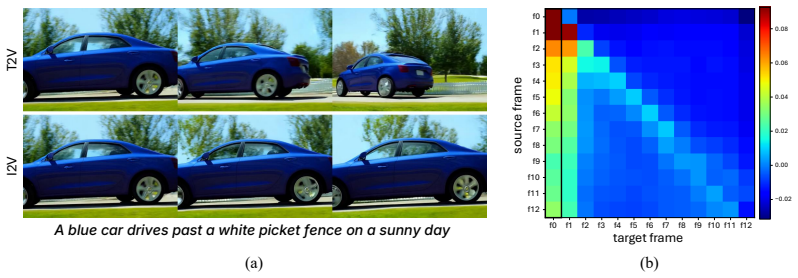
We identify reference-frame dominance as a key mechanism behind motion suppression. We observe that non-reference frames in I2V models allocate excessive self-attention to reference-frame key tokens, causing reference information to be over-propagated across time and suppressing inter-frame dynamics. Based on this finding, we propose DyMoS, a training-free and model-agnostic method that rebalances the attention pathway from generated frames to the reference frame during initial denoising steps. DyMoS leaves both the input image and model weights unchanged and introduces a single scalar parameter for continuous control over motion strength.
What carries the argument
DyMoS (Dynamic Motion Slider), the training-free scalar adjustment that reduces attention weight from non-reference frames to reference-frame keys during the first denoising steps.
If this is right
- Motion dynamics improve consistently across multiple state-of-the-art image-to-video backbones.
- Visual quality and fidelity to the reference image are preserved.
- No additional training or modification of model weights is required.
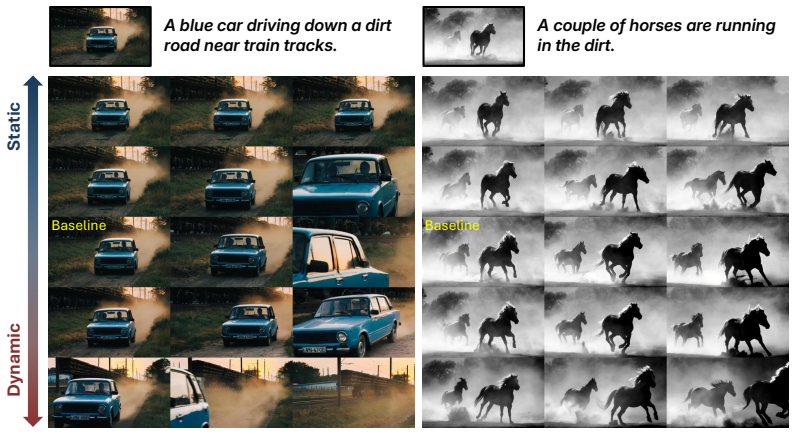
- A single scalar parameter enables continuous, user-controllable adjustment of motion strength.
- Intervention limited to initial denoising steps avoids introducing temporal inconsistencies in later steps.
Where Pith is reading between the lines
- The same attention-rebalancing idea could be tested on text-to-video models to modulate object or camera motion.
- Attention maps in the early denoising phase may serve as a general diagnostic for other temporal artifacts in diffusion video models.
- Integrating the scalar into user interfaces would let practitioners tune motion per generation without pipeline changes.
- The finding suggests that targeted early-step attention edits might generalize to controlling other conditioning signals beyond the reference image.
Load-bearing premise
Excessive self-attention from non-reference frames to reference-frame key tokens is the primary driver of motion suppression, and rebalancing it only in the initial denoising steps is sufficient to restore dynamics without later artifacts or inconsistencies.
What would settle it
Running the same set of reference images through baseline and DyMoS-augmented models and finding no measurable increase in average inter-frame optical flow magnitude while reference-image similarity scores remain unchanged.
Figures





read the original abstract
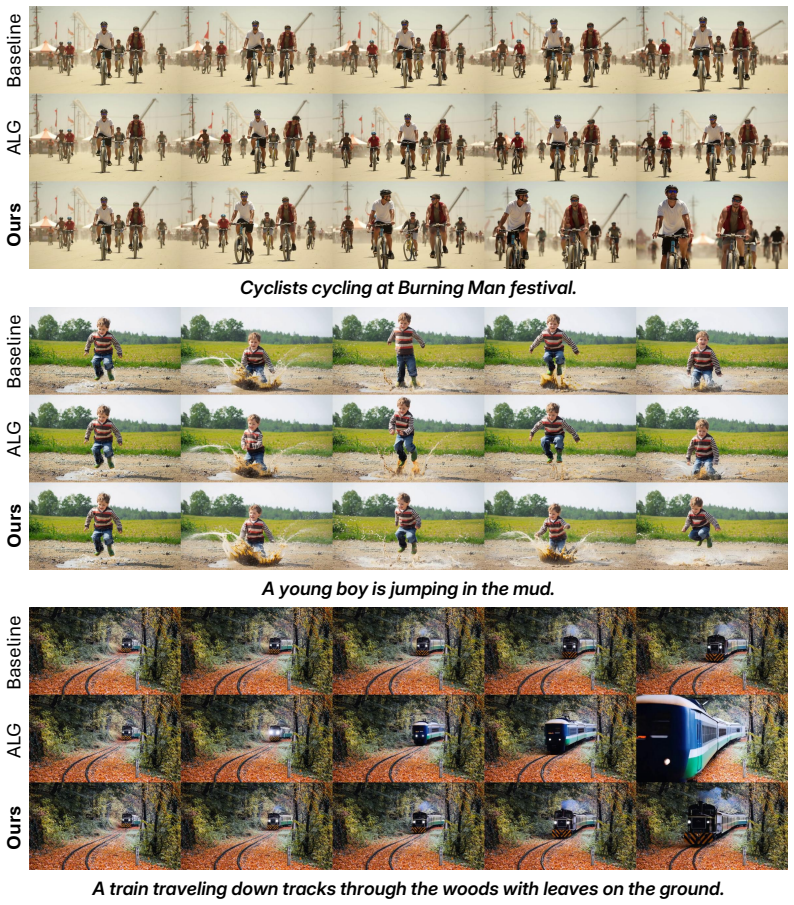
Image-to-video models often generate videos that remain overly static, compared to text-to-video models. While prior approaches mitigate this issue by weakening or modifying the image-conditioning signal, they often require additional training or sacrifice fidelity to the reference image. In this work, we identify reference-frame dominance as a key mechanism behind motion suppression. We observe that non-reference frames in I2V models allocate excessive self-attention to reference-frame key tokens, causing reference information to be over-propagated across time and suppressing inter-frame dynamics. Based on this finding, we propose DyMoS (Dynamic Motion Slider), a training-free and model-agnostic method that rebalances the attention pathway from generated frames to the reference frame during initial denoising steps. DyMoS leaves both the input image and model weights unchanged and introduces a single scalar parameter for continuous control over motion strength. Experiments across multiple state-of-the-art I2V backbones demonstrate that DyMoS consistently improves motion dynamics while maintaining visual quality and fidelity to the reference image.
Editorial analysis
A structured set of objections, weighed in public.
Referee Report
Summary. The paper identifies reference-frame dominance in image-to-video diffusion models, where non-reference frames over-allocate self-attention to reference-frame key tokens, thereby suppressing inter-frame motion. It introduces DyMoS, a training-free and model-agnostic intervention that rebalances this attention pathway only during initial denoising steps via a single scalar motion-strength parameter, claiming consistent improvements in motion dynamics across multiple state-of-the-art I2V backbones while preserving visual quality and reference-image fidelity.
Significance. If the proposed mechanism and intervention prove robust, DyMoS would supply a simple, zero-training-cost control knob for motion strength that leaves both the reference image and model weights untouched. This directly targets a widespread practical limitation of current I2V systems and could be adopted as a post-hoc module by practitioners. The training-free, model-agnostic design and explicit scalar parameter constitute clear strengths if supported by reproducible quantitative evidence.
major comments (3)
- Abstract: the central claim that excessive self-attention from non-reference frames to reference-frame keys is the primary causal mechanism for motion suppression rests on correlational observation rather than interventional evidence; no controlled perturbation of attention weights independent of the DyMoS scalar is reported to isolate this pathway from other conditioning or diffusion dynamics.
- Abstract / Experiments: the manuscript states that DyMoS 'consistently improves motion dynamics' across backbones yet supplies no quantitative metrics, error bars, ablation tables, or dataset descriptions, leaving the magnitude and reliability of the reported gains unsupported.
- Method: the decision to restrict rebalancing to initial denoising steps is motivated by the same attention observation, but the paper provides neither timestep-resolved attention maps nor ablations confirming that reference-frame dominance does not re-emerge or that later steps remain unaffected, undermining the sufficiency argument.
minor comments (2)
- Clarify the precise mathematical formulation of how the motion-strength scalar modifies the attention scores (e.g., which keys/values are scaled and by what factor) to improve reproducibility.
- Include attention-map visualizations at multiple timesteps and across generated frames to directly illustrate the claimed reference-frame dominance before and after DyMoS.
Simulated Author's Rebuttal
We thank the referee for the constructive and detailed feedback. We address each major comment below, providing clarifications and committing to revisions that strengthen the evidentiary basis for our claims about reference-frame dominance and DyMoS.
read point-by-point responses
-
Referee: Abstract: the central claim that excessive self-attention from non-reference frames to reference-frame keys is the primary causal mechanism for motion suppression rests on correlational observation rather than interventional evidence; no controlled perturbation of attention weights independent of the DyMoS scalar is reported to isolate this pathway from other conditioning or diffusion dynamics.
Authors: We agree the initial identification relies on observational attention analysis. DyMoS functions as a direct intervention by selectively scaling the reference-frame key contributions in self-attention. The method's consistent motion improvements across backbones provide supporting evidence for the mechanism. To isolate the pathway more rigorously, we will add controlled ablation experiments that apply targeted attention perturbations without using the full DyMoS scalar in the revised manuscript. revision: partial
-
Referee: Abstract / Experiments: the manuscript states that DyMoS 'consistently improves motion dynamics' across backbones yet supplies no quantitative metrics, error bars, ablation tables, or dataset descriptions, leaving the magnitude and reliability of the reported gains unsupported.
Authors: We will expand the experiments section to include quantitative motion metrics (e.g., optical flow magnitude and inter-frame difference scores), error bars from repeated runs, comprehensive ablation tables varying the motion-strength parameter and application window, and full dataset descriptions with evaluation protocols. These additions will be incorporated in the revision to substantiate the reported gains. revision: yes
-
Referee: Method: the decision to restrict rebalancing to initial denoising steps is motivated by the same attention observation, but the paper provides neither timestep-resolved attention maps nor ablations confirming that reference-frame dominance does not re-emerge or that later steps remain unaffected, undermining the sufficiency argument.
Authors: We will add timestep-resolved attention visualizations across the full denoising trajectory to demonstrate the temporal dynamics of reference-frame dominance. We will also include ablations comparing DyMoS applied only in early steps versus all steps or late steps, confirming that dominance does not re-emerge later and that restricting the intervention preserves quality without side effects. revision: yes
Circularity Check
No significant circularity: empirical observation leads to interventional method with explicit parameter
full rationale
The paper identifies reference-frame dominance via direct observation of attention allocation in existing I2V models, then introduces DyMoS as a training-free rebalancing intervention restricted to initial denoising steps. It adds a single scalar parameter for continuous motion control and validates the approach through experiments on multiple backbones while preserving image fidelity. No step reduces a claimed result to fitted inputs by construction, no self-definitional loop exists between the observed mechanism and the proposed fix, and the abstract and description contain no load-bearing self-citations, uniqueness theorems, or ansatzes imported from prior author work. The derivation remains self-contained as an observational finding followed by an explicit, testable modification rather than a closed mathematical reduction.
Axiom & Free-Parameter Ledger
free parameters (1)
- motion strength scalar
axioms (1)
- domain assumption Self-attention in I2V diffusion models propagates reference information across generated frames via key-token attention.
invented entities (1)
-
reference-frame dominance
no independent evidence
Lean theorems connected to this paper
-
IndisputableMonolith/Cost/FunctionalEquation.leanwashburn_uniqueness_aczel unclear?
unclearRelation between the paper passage and the cited Recognition theorem.
we add a scalar bias to the attention logits from non-reference-frame query tokens to reference-frame key tokens before the softmax operation: ˜L[i, j] = L[i, j]−γ·1[j∈If0]·1[i∉If0]
-
IndisputableMonolith/Foundation/ArithmeticFromLogic.leanLogicNat induction and 8-tick period forcing unclear?
unclearRelation between the paper passage and the cited Recognition theorem.
DyMoS incorporates two key design choices. First, we apply the modulation only during the first λ∈[0,1] fraction of sampling steps
What do these tags mean?
- matches
- The paper's claim is directly supported by a theorem in the formal canon.
- supports
- The theorem supports part of the paper's argument, but the paper may add assumptions or extra steps.
- extends
- The paper goes beyond the formal theorem; the theorem is a base layer rather than the whole result.
- uses
- The paper appears to rely on the theorem as machinery.
- contradicts
- The paper's claim conflicts with a theorem or certificate in the canon.
- unclear
- Pith found a possible connection, but the passage is too broad, indirect, or ambiguous to say the theorem truly supports the claim.
discussion (0)
Sign in with ORCID, Apple, or X to comment. Anyone can read and Pith papers without signing in.