ANDRE: An Attention-based Neuro-symbolic Differentiable Rule Extractor for Inductive Logic Programming
Reviewed by Pith T0 review T1 audit T2 compute T3 formal T4 kernel 2026-06-30 23:46 UTCgrok-4.3pith:USEEI4GLrecord.jsonopen to challenge →
The pith
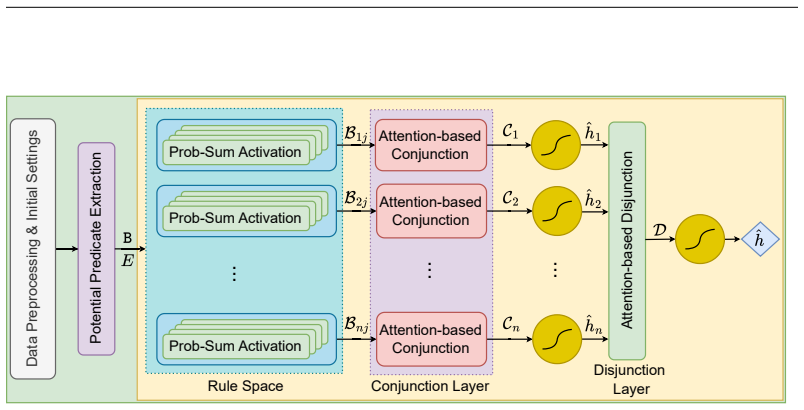
ANDRE uses attention-based operators to learn first-order logic rules from probabilistic and noisy data while recovering exact symbolic rules.
A machine-rendered reading of the paper's core claim, the machinery that carries it, and where it could break.
Core claim
ANDRE is an ILP framework that learns first-order logic programs by optimizing over a continuous rule space with attention-based logical operators. These operators approximate logical min-max semantics over probabilistic predicate valuations, enabling accurate, stable, and interpretable reasoning. By softly selecting, negating, or excluding predicates, the method supports flexible rule induction while preserving symbolic structure. Experiments on benchmarks, knowledge bases, and synthetic datasets with noise show competitive predictive performance and reliable recovery of correct symbolic rules.
What carries the argument
Attention-based conjunction and disjunction operators that approximate min-max logical semantics while softly selecting, negating, or excluding predicates.
If this is right
- ANDRE recovers correct symbolic rules under uncertainty on classical ILP benchmarks and large-scale knowledge bases.
- The method remains robust to moderate label noise while maintaining predictive performance.
- It substantially outperforms existing differentiable ILP methods in both rule extraction quality and stability.
- Flexible rule induction occurs without fixed templates through soft predicate selection via attention.
Where Pith is reading between the lines
- The same attention mechanism could replace template-based restrictions in other neuro-symbolic systems that currently rely on hand-crafted rule structures.
- If the approximation holds, similar attention operators might stabilize gradient flow in additional differentiable logic frameworks beyond ILP.
- The approach opens a path to testing whether attention can handle higher levels of noise or more complex predicate interactions than shown in the current experiments.
Load-bearing premise
Attention-based operators can accurately and stably approximate min-max logical semantics over probabilistic predicate valuations without introducing vanishing gradients or losing the ability to recover exact symbolic rules.
What would settle it
A controlled synthetic dataset with known ground-truth rules and added label noise where ANDRE fails to recover the correct rules or produces lower rule-quality scores than existing differentiable ILP baselines.
Figures



read the original abstract
Inductive Logic Programming (ILP) aims to learn interpretable first-order rules from data, but existing symbolic and neuro-symbolic approaches struggle to scale to noisy and probabilistic settings. Classical ILP relies on discrete combinatorial rule search and is brittle under uncertainty, while differentiable ILP methods typically depend on predefined rule templates or inaccurate fuzzy operators that suffer from vanishing gradients or poor approximation of logical structure when reasoning over probabilistic predicate valuations. This paper proposes an Attention-based Neuro-symbolic Differentiable Rule Extractor (ANDRE), a novel ILP framework that learns first-order logic programs by optimizing over a continuous rule space with attention-based logical operators. ANDRE replaces both rule templates and logical operators with fully differentiable, attention-driven conjunction and disjunction operators that approximate logical min-max semantics, enabling accurate, stable, and interpretable reasoning over probabilistic data. By softly selecting, negating, or excluding predicates within each rule, ANDRE supports flexible rule induction while preserving symbolic structure. Extensive experiments on classical ILP benchmarks, large-scale knowledge bases, and synthetic datasets with probabilistic predicates and noisy supervision demonstrate that ANDRE achieves competitive or superior predictive performance while reliably recovering correct symbolic rules under uncertainty. In particular, ANDRE remains robust to moderate label noise, substantially outperforming existing differentiable ILP methods in both rule extraction quality and stability.
Editorial analysis
A structured set of objections, weighed in public.
Referee Report
Summary. The paper proposes ANDRE, an attention-based neuro-symbolic differentiable ILP framework that replaces rule templates and fuzzy operators with fully differentiable attention-driven conjunction/disjunction operators. These operators are claimed to approximate min-max logical semantics over probabilistic predicate valuations, enabling template-free rule induction, stable gradient-based optimization, and post-hoc extraction of exact symbolic rules. The abstract asserts that extensive experiments on benchmarks, knowledge bases, and noisy synthetic data show competitive/superior predictive performance, reliable rule recovery under uncertainty, and robustness to moderate label noise, substantially outperforming prior differentiable ILP methods.
Significance. If the central claims hold, ANDRE would represent a meaningful advance in neuro-symbolic ILP by providing a continuous relaxation that avoids both combinatorial search and inaccurate fuzzy approximations while still permitting exact symbolic recovery. The attention mechanism for soft predicate selection/negation/exclusion is a potentially useful technical device. However, the significance is difficult to assess because the abstract supplies no quantitative results, tables, or ablation details, and the soundness of the approximation to classical logic remains unverified in the provided description.
major comments (2)
- [Abstract] Abstract: the central performance and 'reliable recovery' claims rest on the assertion of 'extensive experiments' showing 'competitive or superior predictive performance' and robustness to label noise, yet the abstract contains no tables, metrics, ablation studies, or error bars. This prevents any evaluation of whether the reported gains are load-bearing or affected by post-hoc choices.
- [Abstract] Abstract (method description): the claim that attention-based operators 'approximate logical min-max semantics' and permit 'reliable recovery of correct symbolic rules' under probabilistic valuations and noise is load-bearing, but the description provides no convergence argument, gradient analysis, or discretization procedure showing that soft attention weights provably approach 0/1 values matching classical min-max without fidelity loss or vanishing gradients. This is the precise point raised by the stress-test concern and is not addressed in the given text.
minor comments (1)
- [Abstract] Abstract: the phrase 'preserving symbolic structure' is used without specifying the exact post-hoc extraction algorithm or any fidelity metric between the continuous program and the recovered discrete rules.
Simulated Author's Rebuttal
We thank the referee for their review and comments. We address each major comment point by point below, referring to the full manuscript where the abstract serves only as a summary.
read point-by-point responses
-
Referee: [Abstract] Abstract: the central performance and 'reliable recovery' claims rest on the assertion of 'extensive experiments' showing 'competitive or superior predictive performance' and robustness to label noise, yet the abstract contains no tables, metrics, ablation studies, or error bars. This prevents any evaluation of whether the reported gains are load-bearing or affected by post-hoc choices.
Authors: We agree the abstract lacks specific quantitative results, metrics, or tables, which is due to standard length constraints on abstracts. The full manuscript details these in Section 5, including performance tables on benchmarks and knowledge bases, ablation studies, robustness experiments under label noise, and error bars. These support the abstract claims. We can add one or two key quantitative highlights to the abstract in revision. revision: partial
-
Referee: [Abstract] Abstract (method description): the claim that attention-based operators 'approximate logical min-max semantics' and permit 'reliable recovery of correct symbolic rules' under probabilistic valuations and noise is load-bearing, but the description provides no convergence argument, gradient analysis, or discretization procedure showing that soft attention weights provably approach 0/1 values matching classical min-max without fidelity loss or vanishing gradients. This is the precise point raised by the stress-test concern and is not addressed in the given text.
Authors: The abstract summarizes the approach. Sections 3 and 4 of the manuscript describe the attention-driven operators approximating min-max semantics via soft predicate selection/negation/exclusion and the discretization procedure for exact rule extraction. Experiments in Section 5 provide empirical evidence of stable gradients and reliable rule recovery. No formal convergence proof or gradient analysis is present in the manuscript, as the work prioritizes empirical validation over theoretical guarantees. revision: no
- A formal convergence argument, gradient analysis, or proof that soft attention weights provably approach 0/1 values matching classical min-max semantics without fidelity loss or vanishing gradients.
Circularity Check
No significant circularity; new attention operators introduced independently of prior results
full rationale
The paper introduces attention-based conjunction/disjunction operators as a novel replacement for templates and fuzzy logic, with performance claims resting on experimental benchmarks rather than any self-referential derivation or fitted parameter renamed as prediction. No equations, self-citations, or uniqueness theorems are invoked in the provided abstract or description that reduce the central claims to inputs by construction. The method is presented as self-contained against external ILP benchmarks.
Axiom & Free-Parameter Ledger
axioms (1)
- domain assumption Attention mechanisms can approximate logical min-max semantics over probabilistic valuations without vanishing gradients or loss of symbolic recoverability.
Reference graph
Works this paper leans on
-
[1]
Appear in at least two distinct body predicates, forming a connection between them, or
-
[2]
Be completely absent from the rule (i.e., not appear in any body predicates). This condition ensures that auxiliary variables are semantically meaningful and contribute to the logical relationship expressed in the rule. Valid example (connected auxiliary): grandparent(X1, X3):- parent(X 1, X2),parent(X 2, X3). 17 VariableX 2 does not appear in the head an...
-
[3]
grandparent(X1, X3) :- father(X1, X2) and mother(X2, X3). Training Acc: 0.6825 | Eval Acc: 0.6900 Val Coverage: (N_b=53, N_r=53, N_r/N_b=1.00) Train Coverage: (N_b=219, N_r=219, N_r/N_b=1.00)
-
[4]
grandparent(X1, X3) :- father(X1, X2) and father(X2, X3). Training Acc: 0.6725 | Eval Acc: 0.6850 Val Coverage: (N_b=52, N_r=52, N_r/N_b=1.00) Train Coverage: (N_b=211, N_r=211, N_r/N_b=1.00)
-
[5]
grandparent(X1, X3) :- mother(X1, X2) and mother(X2, X3). Training Acc: 0.6850 | Eval Acc: 0.6500 Val Coverage: (N_b=49, N_r=47, N_r/N_b=0.9592) Train Coverage: (N_b=225, N_r=223, N_r/N_b=0.9911)
-
[6]
grandparent(X1, X3) :- father(X2, X3) and mother(X1, X2). Training Acc: 0.6538 | Eval Acc: 0.65 Val Coverage: (N_b=45, N_r=45, N_r/N_b=1.00) Train Coverage: (N_b=196, N_r=196, N_r/N_b=1.00) These subrules collectively form a complete and interpretable definition of the grandparent relation, fully consistent with first-order logic and human intuition. Disc...
-
[7]
• Variable set:X={X 1, X2} • Head variable set:X h =X • Domain of constants:E={0,1,
ThePredecessorTask: Objective:Learn a rule that identifies when one number is the predecessor of another, using back- ground knowledge about numeric succession. • Variable set:X={X 1, X2} • Head variable set:X h =X • Domain of constants:E={0,1, . . . ,8} • Body predicates:b={successor(X 2, X1)} • Head predicate:h=predecessor(X 1, X2) • Background knowledg...
-
[8]
TheOddTask: Objective:Learn the logical patterns that define odd numbers using predecessor and parity relation- ships, and generalize them to unseen numerical values. • Variable set:X={X 1, X2, X3} • Head variable set:X h ={X 3} • Auxiliary variable set:X a =X\X h • Domain of constants:E={0,1, . . . ,30} • Body predicates: b={zero(X 1),zero(X 2),zero(X 3)...
-
[9]
TheEvenTask: Objective:Discover the rule structure that governs even numbers, exploiting arithmetic successor relationships and parity predicates. • Variable set:X={X 1, X2, X3} • Head variable set:X h ={X 3} • Auxiliary variable set:X a =X\X h • Domain of constants:E={0,1, . . . ,30} • Body predicates: b={zero(X 1),zero(X 2),zero(X 3),successor(X 1, X2),...
-
[10]
TheLessThanTask: Objective:Learn transitive and arithmetic rules that define the less-than relation between two inte- gers using a successor-based formulation. • Variable set:X={X 1, X2, X3} • Head variable set:X h ={X 1, X3} • Auxiliary variable set:X a ={X 2} • Domain of constants:E={0,1, . . . ,9} • Body predicates: b={successor(X 1, X2),successor(X 2,...
-
[11]
TheGrandparentTask: Objective:Learn the definition of a grandparent based on transitive parent relationships using both motherandfatherfacts provided in the background knowledge. • Variable set:X={X 1, X2, X3} • Head variable set:X h ={X 1, X3} 25 • Auxiliary variable set:X a ={X 2} • Body predicates: b={father(X 1, X2),father(X 2, X3),father(X 1, X3), mo...
-
[12]
TheSonTask: Objective:Learn how thesonrelationship can be derived fromfather,brother, andsister facts using transitivity and kinship inference. • Variable set:X={X 1, X2, X3} • Head variable set:X h ={X 1, X3} • Auxiliary variable set:X a ={X 2} • Body predicates: b={father(X 1, X2),father(X 2, X3),father(X 1, X3), brother(X1, X2),sister(X 1, X2),son(X 2,...
-
[13]
TheRelatednessTask: Objective:Determine whether two individuals are related, based on transitive closure overparent relationships and recursive definitions ofrelated. 26 • Variable set:X={X 1, X2, X3} • Head variable set:X h ={X 1, X3} • Auxiliary variable set:X a ={X 2} • Body predicates: b={parent(X 1, X2),parent(X 2, X3),parent(X 1, X3), related(X1, X2...
-
[14]
TheFatherTask: Objective:Infer thefatherrelationship using background assumptions involving marriage and motherhood. • Variable set:X={X 1, X2, X3} • Head variable set:X h ={X 1, X3} • Auxiliary variable set:X a ={X 2} • Body predicates: b={mother(X 1, X2),mother(X 2, X3),mother(X 1, X3), husband(X1, X2),husband(X 2, X3),husband(X 1, X3)} • Head predicate...
-
[15]
TheDirected EdgeTask: Objective:Determine whether two nodes are connected by a directed edge in either direction, using basic edge facts. • Variable set:X={X 1, X2} • Head variable set:X h ={X 1, X2} • Body predicates: b={edge(X 1, X2),d-edge(X 2, X1)} • Head predicate:h=d-edge(X 1, X2) • Background knowledge: B={edge(a, b),edge(b, d),edge(c, c), . . .} •...
-
[16]
TheConnectednessTask: Objective:Learn theconnectednessrelation, which holds true if there exists a direct or transi- tive path (via one or moreedgerelations) between two nodes. • Variable set:X={X 1, X2, X3} • Head variable set:X h ={X 1, X3} • Auxiliary variable set:X a ={X 2} • Body predicates: b={edge(X 1, X3),edge(X 3, X1),edge(X 2, X3), connectedness...
-
[17]
Training Acc: 0.9927 | Eval Acc: 0.9930
locatedIn(X1, X2) :- locatedIn(X3, X2) and neighborOf(X3, X1). Training Acc: 0.9927 | Eval Acc: 0.9930
-
[18]
Training Acc: 0.9926 | Eval Acc: 0.9930
locatedIn(X1, X2) :- locatedIn(X1, X3) and locatedIn(X3, X2). Training Acc: 0.9926 | Eval Acc: 0.9930
-
[19]
Training Acc: 0.9925 | Eval Acc: 0.9928
locatedIn(X1, X2) :- locatedIn(X3, X1) and neighborOf(X2, X3). Training Acc: 0.9925 | Eval Acc: 0.9928
-
[20]
Training Acc: 0.9925 | Eval Acc: 0.9928
locatedIn(X1, X2) :- locatedIn(X3, X1) and neighborOf(X3, X2). Training Acc: 0.9925 | Eval Acc: 0.9928
-
[21]
Training Acc: 0.9925 | Eval Acc: 0.9928
locatedIn(X1, X2) :- locatedIn(X1, X3) and neighborOf(X3, X2). Training Acc: 0.9925 | Eval Acc: 0.9928
-
[22]
Training Acc: 0.9925 | Eval Acc: 0.9928
locatedIn(X1, X2) :- neighborOf(X1, X3) and neighborOf(X2, X3). Training Acc: 0.9925 | Eval Acc: 0.9928
-
[23]
locatedIn(X1, X2) :- locatedIn(X2, X3) and neighborOf(X3, X1). Training Acc: 0.9925 | Eval Acc: 0.9928 I.2 NATIONSDATASET TheNationstask aims to learn semantic relations between geopolitical entities using background predicates describing economic, political, and geographic interactions. Below, we report represen- tative rules extracted by ANDRE for diffe...
-
[24]
blockpositionindex(X1, X2) :- blockpositionindex(X2, X1). Training Acc: 0.9590 | Eval Acc: 0.9620 Val Coverage: (N_b=524, N_r=488, N_r/N_b=0.9313) Train Coverage: (N_b=9668, N_r=8920, N_r/N_b=0.9226)
-
[25]
blockpositionindex(X1, X2) :-not(timesincewar(X1, X2)) and blockpositionindex(X2, X1). 29 Training Acc: 0.9474 | Eval Acc: 0.9474 Val Coverage: (N_b=486, N_r=455, N_r/N_b=0.9362) Train Coverage: (N_b=9019, N_r=8383, N_r/N_b=0.9295)
-
[26]
blockpositionindex(X1, X2) :- commonbloc0(X1, X2). Training Acc: 0.8625 | Eval Acc: 0.8568 Val Coverage: (N_b=290, N_r=270, N_r/N_b=0.9310) Train Coverage: (N_b=5394, N_r=5022, N_r/N_b=0.9310)
-
[27]
blockpositionindex(X1, X2) :- commonbloc0(X2, X1). Training Acc: 0.8627 | Eval Acc: 0.8536 Val Coverage: (N_b=284, N_r=264, N_r/N_b=0.9296) Train Coverage: (N_b=5400, N_r=5028, N_r/N_b=0.9311)
-
[28]
blockpositionindex(X1, X2) :- not(relintergovorgs(X2, X1)) and embassy(X2, X1) and not( commonbloc2(X1, X2)) and not(reltreaties(X1, X2)) and not(reldiplomacy(X1, X2)) and conferences(X2, X1). Training Acc: 0.7538 | Eval Acc: 0.7474 Val Coverage: (N_b=44, N_r=42, N_r/N_b=0.9545) Train Coverage: (N_b=803, N_r=742, N_r/N_b=0.9240) Note.We refer to Appendix ...
-
[29]
intergovorgs3(X1, X2) :- embassy(X1, X2) and ngoorgs3(X1, X2) and not(ngoorgs3(X2, X1)) and not(exports3(X1, X2)) and not(releconomicaid(X2, X1)) and not(releconomicaid(X3, X1)) and not(duration(X2, X1)) and not(lostterritory(X1, X3)). Training Acc: 0.7466 | Eval Acc: 0.7482 Val Coverage: (N_b=648, N_r=529, N_r/N_b=0.8164) Train Coverage: (N_b=12647, N_r=...
-
[30]
intergovorgs3(X1, X2) :- ngoorgs3(X1, X2) and not(economicaid(X2, X1)) and ngo(X2, X1) and not(relngo(X2, X1)) and not(relexportbooks(X1, X3)) and not(violentactions(X2, X1)) and not(warning(X1, X3)). Training Acc: 0.6836 | Eval Acc: 0.6819 Val Coverage: (N_b=430, N_r=370, N_r/N_b=0.8605) Train Coverage: (N_b=8473, N_r=7145, N_r/N_b=0.8433)
-
[31]
intergovorgs3(X1, X2) :- not(accusation(X1, X2)) and intergovorgs(X1, X2) and ngo(X2, X1) and not(aidenemy(X2, X3)) and not(releconomicaid(X2, X1)) and not(expeldiplomats(X2, X1)) and treaties(X2, X1) and not(lostterritory(X1, X3)). Training Acc: 0.6867 | Eval Acc: 0.6806 Val Coverage: (N_b=466, N_r=387, N_r/N_b=0.8305) Train Coverage: (N_b=8934, N_r=7420...
-
[32]
intergovorgs3(X1, X2) :- not(accusation(X2, X1)) and not(commonbloc2(X1, X2)) and relngo( X1, X2) and timesinceally(X1, X2) and not(relemigrants(X2, X3)) and not(lostterritory(X2, X3)). Training Acc: 0.6551 | Eval Acc: 0.6733 Val Coverage: (N_b=347, N_r=322, N_r/N_b=0.9280) Train Coverage: (N_b=6473, N_r=5737, N_r/N_b=0.8863)
-
[33]
intergovorgs3(X1, X2) :- not(militaryalliance(X1, X2)) and intergovorgs(X1, X2) and not( expeldiplomats(X2, X3)) and not(relngo(X2, X1)) and not(relexportbooks(X1, X3)). Training Acc: 0.6724 | Eval Acc: 0.6713 Val Coverage: (N_b=312, N_r=303, N_r/N_b=0.9712) Train Coverage: (N_b=5949, N_r=5723, N_r/N_b=0.9620)
-
[34]
intergovorgs3(X1, X2) :- not(commonbloc2(X1, X2)) and ngoorgs3(X1, X2) and relngo(X1, X2) and not(relngo(X2, X1)) and not(students(X1, X3)) and not(tourism(X2, X1)) and not( dependent(X1, X3)) and not(violentactions(X1, X2)) and not(severdiplomatic(X1, X3)). Training Acc: 0.6517 | Eval Acc: 0.6468 Val Coverage: (N_b=349, N_r=303, N_r/N_b=0.8682) Train Cov...
-
[35]
intergovorgs3(X1, X2) :- relintergovorgs(X1, X2) and not(economicaid(X2, X3)) and intergovorgs(X2, X1) and not(eemigrants(X3, X2)) and timesinceally(X2, X1). Training Acc: 0.6106 | Eval Acc: 0.6163 30 Val Coverage: (N_b=261, N_r=236, N_r/N_b=0.9042) Train Coverage: (N_b=4515, N_r=4119, N_r/N_b=0.9123)
-
[36]
intergovorgs3(X1, X2) :- relintergovorgs(X1, X2) and intergovorgs(X2, X1) and timesinceally(X2, X1) and not(exportbooks(X1, X2)) and not(dependent(X3, X1)) and not( warning(X1, X3)). Training Acc: 0.6166 | Eval Acc: 0.6130 Val Coverage: (N_b=256, N_r=231, N_r/N_b=0.9023) Train Coverage: (N_b=4676, N_r=4286, N_r/N_b=0.9166) N E G A T I V E C O M M(X1, X2) ...
-
[37]
negativecomm(X1, X2) :- negativebehavior(X1, X2) and timesinceally(X2, X1). Training Acc: 0.9084 | Eval Acc: 0.9223 Val Coverage: (N_b=124, N_r=124, N_r/N_b=1.0000) Train Coverage: (N_b=2228, N_r=2228, N_r/N_b=1.0000)
-
[38]
negativecomm(X1, X2) :- negativebehavior(X1, X2) and accusation(X1, X2). Training Acc: 0.9208 | Eval Acc: 0.9142 Val Coverage: (N_b=141, N_r=129, N_r/N_b=0.9149) Train Coverage: (N_b=2799, N_r=2615, N_r/N_b=0.9343)
-
[39]
negativecomm(X1, X2) :- negativebehavior(X1, X2) and blockpositionindex(X1, X2). Training Acc: 0.8974 | Eval Acc: 0.9049 Val Coverage: (N_b=137, N_r=123, N_r/N_b=0.8978) Train Coverage: (N_b=2411, N_r=2229, N_r/N_b=0.9245)
-
[40]
negativecomm(X1, X2) :- negativebehavior(X1, X2) and pprotests(X1, X2). Training Acc: 0.8855 | Eval Acc: 0.9026 Val Coverage: (N_b=107, N_r=107, N_r/N_b=1.0000) Train Coverage: (N_b=1853, N_r=1853, N_r/N_b=1.0000)
-
[41]
negativecomm(X1, X2) :- negativebehavior(X1, X2) and negativebehavior(X2, X1) and blockpositionindex(X1, X2). Training Acc: 0.8695 | Eval Acc: 0.8817 Val Coverage: (N_b=111, N_r=100, N_r/N_b=0.9009) Train Coverage: (N_b=2130, N_r=1860, N_r/N_b=0.8732)
-
[42]
negativecomm(X1, X2) :- negativebehavior(X1, X2) and commonbloc0(X1, X2). Training Acc: 0.8627 | Eval Acc: 0.8805 Val Coverage: (N_b=98, N_r=93, N_r/N_b=0.9490) Train Coverage: (N_b=1862, N_r=1671, N_r/N_b=0.8974)
-
[43]
negativecomm(X1, X2) :- negativecomm(X2, X1) and violentactions(X2, X1). Training Acc: 0.8754 | Eval Acc: 0.8677 Val Coverage: (N_b=127, N_r=102, N_r/N_b=0.8031) Train Coverage: (N_b=2813, N_r=2250, N_r/N_b=0.7999)
-
[44]
negativecomm(X1, X2) :- negativecomm(X2, X1). Training Acc: 0.8754 | Eval Acc: 0.8677 Val Coverage: (N_b=127, N_r=102, N_r/N_b=0.8031) Train Coverage: (N_b=2813, N_r=2250, N_r/N_b=0.7999)
-
[45]
negativecomm(X1, X2) :- negativebehavior(X2, X1) and blockpositionindex(X1, X2) and negativecomm(X2, X1). Training Acc: 0.8595 | Eval Acc: 0.8631 Val Coverage: (N_b=113, N_r=93, N_r/N_b=0.8230) Train Coverage: (N_b=2111, N_r=1769, N_r/N_b=0.8380)
-
[46]
negativecomm(X1, X2) :- accusation(X1, X2) and accusation(X2, X1). Training Acc: 0.8757 | Eval Acc: 0.8619 Val Coverage: (N_b=96, N_r=84, N_r/N_b=0.8750) Train Coverage: (N_b=2060, N_r=1876, N_r/N_b=0.9107) 31 I.3 UMLS DATASET TheUMLSdataset consists of biomedical entities connected through a large set of heterogeneous semantic relations. The task require...
work page 2060
-
[47]
Training Acc: 0.9449 | Eval Acc: 0.9466
isa(X1, X2) :- isa(X3, X2) and interacts_with(X1, X3). Training Acc: 0.9449 | Eval Acc: 0.9466
-
[48]
Training Acc: 0.9437 | Eval Acc: 0.9453
isa(X1, X2) :- isa(X3, X2) and conceptually_related_to(X3, X1). Training Acc: 0.9437 | Eval Acc: 0.9453
-
[49]
Training Acc: 0.9437 | Eval Acc: 0.9453
isa(X1, X2) :- connected_to(X3, X1) and practices(X3, X2). Training Acc: 0.9437 | Eval Acc: 0.9453
-
[50]
Training Acc: 0.9430 | Eval Acc: 0.9449
isa(X1, X2) :- not(affects(X3, X1)) and conceptual_part_of(X3, X2). Training Acc: 0.9430 | Eval Acc: 0.9449
-
[51]
isa(X1, X2) :- not(isa(X3, X2)) and conceptual_part_of(X1, X3). Training Acc: 0.9429 | Eval Acc: 0.9445 I N T E R A C T S W I T H(X1, X2) The target predicateinteracts with(X1, X2)captures functional, biochemical, or causal in- teractions between biomedical entities in the UMLS knowledge base. The rules below illustrate how ANDRE infers interaction patter...
-
[52]
Training Acc: 0.8920 | Eval Acc: 0.8946
interacts_with(X1, X2) :- isa(X2, X1) and not(associated_with(X2, X3)) and not( interacts_with(X2, X1)) and not(ingredient_of(X2, X3)). Training Acc: 0.8920 | Eval Acc: 0.8946
-
[53]
Training Acc: 0.8912 | Eval Acc: 0.8938
interacts_with(X1, X2) :- isa(X2, X1) and not(interacts_with(X2, X1)) and not(part_of(X3, X1)) and not(measures(X3, X2)). Training Acc: 0.8912 | Eval Acc: 0.8938
-
[54]
Training Acc: 0.8865 | Eval Acc: 0.8879
interacts_with(X1, X2) :- not(location_of(X3, X2)) and isa(X1, X2) and not(interacts_with( X2, X1)) and not(complicates(X2, X3)). Training Acc: 0.8865 | Eval Acc: 0.8879
-
[55]
Training Acc: 0.8801 | Eval Acc: 0.8823
interacts_with(X1, X2) :- interacts_with(X1, X3) and interacts_with(X3, X2). Training Acc: 0.8801 | Eval Acc: 0.8823
-
[56]
Training Acc: 0.8722 | Eval Acc: 0.8744
interacts_with(X1, X2) :- associated_with(X1, X3) and performs(X2, X3). Training Acc: 0.8722 | Eval Acc: 0.8744
-
[57]
Training Acc: 0.8722 | Eval Acc: 0.8744
interacts_with(X1, X2) :- co_occurs_with(X1, X3) and indicates(X2, X3). Training Acc: 0.8722 | Eval Acc: 0.8744
-
[58]
Training Acc: 0.8722 | Eval Acc: 0.8744
interacts_with(X1, X2) :- treats(X3, X2) and developmental_form_of(X1, X3). Training Acc: 0.8722 | Eval Acc: 0.8744
-
[59]
Training Acc: 0.8722 | Eval Acc: 0.8744
interacts_with(X1, X2) :- ingredient_of(X1, X3) and interconnects(X3, X2). Training Acc: 0.8722 | Eval Acc: 0.8744
-
[60]
interacts_with(X1, X2) :- result_of(X2, X3) and adjacent_to(X1, X3). Training Acc: 0.8722 | Eval Acc: 0.8744 32 J RUNTIMECOMPARISON Table 7 reports the total running time required by NTPλ, NeuralLP, DFORL, and ANDRE to gen- erate complete sets of logic programs on the Countries, Nations, and UMLS datasets. The results highlight substantial differences in ...
-
[61]
Training Acc: 0.9216 | Eval Acc: 0.9217
great_ne(X1, X2) :- not(great_ne(X2, X1)). Training Acc: 0.9216 | Eval Acc: 0.9217
-
[62]
Training Acc: 0.8896 | Eval Acc: 0.8786 33
great_ne(X1, X2) :- not(great_ne(X2, X1)) and great_ne(X3, X2) and not(r_subst_1(X1, X3)). Training Acc: 0.8896 | Eval Acc: 0.8786 33
-
[63]
Training Acc: 0.7689 | Eval Acc: 0.7609
great_ne(X1, X2) :- x_subst(X2, X3) and r_subst_1(X1, X3). Training Acc: 0.7689 | Eval Acc: 0.7609
-
[64]
Training Acc: 0.7689 | Eval Acc: 0.7609
great_ne(X1, X2) :- gt(X1, X3) and great_pi_acc(X2, X3). Training Acc: 0.7689 | Eval Acc: 0.7609
-
[65]
Training Acc: 0.7689 | Eval Acc: 0.7609
great_ne(X1, X2) :- not(ring_subst_4(X2, X3)) and ring_subst_4(X3, X1). Training Acc: 0.7689 | Eval Acc: 0.7609
-
[66]
Training Acc: 0.7689 | Eval Acc: 0.7609
great_ne(X1, X2) :- great_ne(X3, X2) and flex(X1, X3). Training Acc: 0.7689 | Eval Acc: 0.7609
-
[67]
Training Acc: 0.7689 | Eval Acc: 0.7609
great_ne(X1, X2) :- r_subst_2(X3, X2) and ring_subst_2(X3, X1). Training Acc: 0.7689 | Eval Acc: 0.7609
-
[68]
Training Acc: 0.7689 | Eval Acc: 0.7609
great_ne(X1, X2) :- great_ne(X3, X2) and ring_subst_2(X3, X1). Training Acc: 0.7689 | Eval Acc: 0.7609
-
[69]
Training Acc: 0.7689 | Eval Acc: 0.7609
great_ne(X1, X2) :- pi_doner(X3, X1) and not(ring_substitutions(X2, X3)). Training Acc: 0.7689 | Eval Acc: 0.7609
-
[70]
great_ne(X1, X2) :- great_ne(X2, X3) and pi_doner(X3, X1). Training Acc: 0.7689 | Eval Acc: 0.7609 K.2 UW-CSE DATASET TheUW-CSEdataset models academic relationships within a university domain, including roles, courses, projects, and advising relationships. The task is to infer latent advisory relations from heterogeneous academic facts. A D V I S E D B Y(...
-
[71]
advisedby(X1, X2) :- advisedby(X3, X1) and yearsinprogram(X3, X2)
-
[72]
advisedby(X1, X2) :- courselevel(X1, X3) and hasposition(X2, X3)
-
[73]
advisedby(X1, X2) :- professor(X3, X2) and taughtby(X3, X1)
-
[74]
advisedby(X1, X2) :- courselevel(X2, X3) and not(professor(X3, X1))
-
[75]
advisedby(X1, X2) :- advisedby(X3, X1) and not(inphase(X3, X2))
-
[76]
advisedby(X1, X2) :- hasposition(X2, X3) and ta(X3, X1)
-
[77]
advisedby(X1, X2) :- not(hasposition(X3, X1)) and projectmember(X2, X3)
-
[78]
advisedby(X1, X2) :- inphase(X1, X3) and professor(X2, X3)
-
[79]
advisedby(X1, X2) :- not(courselevel(X3, X2)) and publication(X1, X3)
-
[80]
advisedby(X1, X2) :- hasposition(X2, X3) and inphase(X3, X1). 34 L SYNTHETICDATASETSTABULARRESULTS Table 9: Comparison of Rule Extraction Performance between ANDRE and DFORL on Complex Synthetic Datasets with Varying Number of Subrules Dataset Sample Size Accuracy Rule Extraction SuccessANDRE DFORL Train Test Train Test ANDRE DFORL R1 20 0.95 0.80 0.85 0....
work page 2000
discussion (0)
Sign in with ORCID, Apple, or X to comment. Anyone can read and Pith papers without signing in.