Assessing the Energy and Carbon Emissions of Neural Speaker Verification Model in Training and Inference
Pith reviewed 2026-06-27 19:27 UTC · model grok-4.3
The pith
Mid-sized ResNet models deliver better accuracy-to-energy trade-offs than deeper or wider variants for speaker verification.
A machine-rendered reading of the paper's core claim, the machinery that carries it, and where it could break.
Core claim
For ResNet architectures used as backbones in neural speaker verification and trained on VoxCeleb2, increasing depth or channel width yields only marginal accuracy gains while energy consumption and carbon footprint grow steeply; in contrast, mid-sized networks such as ResNet-50 and stage-concentrated variants achieve favorable trade-offs between verification performance and environmental impact.
What carries the argument
Empirical comparison of ResNet variants that differ in depth, channel width, and stage distribution, with direct energy and carbon measurements taken via node-level sensors during training and inference.
If this is right
- Deeper ResNet variants increase energy use steeply for only marginal accuracy improvement in speaker verification.
- Wider channel configurations follow the same pattern of diminishing returns on accuracy versus energy.
- ResNet-50 and stage-concentrated variants maintain strong performance with lower overall energy and carbon costs.
- Design choices in stage distribution can improve the performance-environmental impact balance.
- These measurements supply concrete guidelines for building energy-efficient speaker verification systems.
Where Pith is reading between the lines
- The same diminishing-returns pattern could appear in other speech or audio classification tasks that rely on ResNet-style backbones.
- Deployment on edge devices with different power profiles might shift the numerical trade-off points observed here.
- Stage-concentration techniques could be tested as a general lever for efficiency across convolutional audio models.
- Aggregating these per-model footprints could support broader estimates of the carbon cost of large-scale speaker verification deployments.
Load-bearing premise
The node-level sensor measurements of energy during training and inference on the specific hardware setup accurately represent the environmental impact that would occur in typical deployment scenarios for these models.
What would settle it
A direct replication on different hardware or cloud-scale inference workloads showing that deeper models achieve large accuracy gains at energy costs that scale linearly or sub-linearly with size.
Figures
read the original abstract
Deep-learning speaker verification (SV) increasingly relies on deep neural network backbones, whose environmental impact remains largely undocumented. In this paper, we conduct an evaluation of ResNet architectures trained on VoxCeleb2, varying depth, channel width, and stage distribution, and measure energy consumption and carbon footprint using node-level sensors. Results show a clear point of diminishing returns: deeper or wider models bring only marginal accuracy gains while energy consumption grows steeply. In contrast, mid-sized networks such as ResNet-50 and stage-concentrated variants achieve favorable trade-offs between performance and environmental impact. These findings provide actionable guidelines for designing energy-efficient SV systems.
Editorial analysis
A structured set of objections, weighed in public.
Referee Report
Summary. The paper evaluates ResNet-based neural speaker verification models trained on VoxCeleb2, varying depth, channel width, and stage distribution. Using node-level sensor measurements, it reports energy consumption and carbon emissions during training and inference, claiming a point of diminishing returns where deeper or wider models yield only marginal accuracy improvements while energy use increases steeply, and that mid-sized models such as ResNet-50 and stage-concentrated variants achieve superior performance-energy trade-offs, yielding actionable design guidelines.
Significance. If the measurements prove representative, the work supplies concrete empirical data on the environmental costs of scaling SV backbones, a topic with limited prior documentation. The direct hardware measurement approach on a fixed setup is a positive contribution that could inform efficiency-focused architecture choices in speech processing.
major comments (3)
- [Results] Results section: the manuscript states clear trends in accuracy versus energy but supplies no quantitative EER or accuracy values, error bars, number of experimental runs, or statistical tests, preventing evaluation of the central claim that deeper/wider models bring only 'marginal' gains.
- [Methods] Methods section: details on sensor calibration procedures, data exclusion rules during measurement, and attribution of energy to model computation versus data loading or idle time are absent; these are load-bearing for trusting the reported energy and carbon figures.
- [Discussion] Discussion or Conclusions: the paper does not examine how node-level measurements on the specific training/inference hardware would translate under different accelerators, edge devices, or grid carbon intensities, which directly affects the claimed 'actionable guidelines' for typical SV deployments.
minor comments (2)
- [Abstract] Abstract: could usefully include one or two concrete numerical examples of the observed trade-offs (e.g., EER delta and energy delta between ResNet-50 and a deeper variant).
- [Introduction] Notation: the terms 'stage-concentrated variants' and 'channel width' are used without an explicit definition or reference to the exact architectural modifications in the first occurrence.
Simulated Author's Rebuttal
We thank the referee for the constructive feedback on our empirical evaluation of energy and carbon costs in ResNet-based speaker verification models. The comments highlight important areas for improving transparency and generalizability. We address each point below and have made revisions to strengthen the manuscript.
read point-by-point responses
-
Referee: [Results] Results section: the manuscript states clear trends in accuracy versus energy but supplies no quantitative EER or accuracy values, error bars, number of experimental runs, or statistical tests, preventing evaluation of the central claim that deeper/wider models bring only 'marginal' gains.
Authors: We agree that quantitative details were insufficient in the original submission. We have added a new table in the Results section listing exact EER, energy (kWh), and CO2e values for all model variants. We now report means and standard deviations from three independent training runs per configuration, along with paired statistical tests (Wilcoxon signed-rank) confirming that accuracy gains beyond ResNet-50 become statistically marginal (p > 0.05) while energy increases remain significant. These changes directly substantiate the diminishing-returns claim. revision: yes
-
Referee: [Methods] Methods section: details on sensor calibration procedures, data exclusion rules during measurement, and attribution of energy to model computation versus data loading or idle time are absent; these are load-bearing for trusting the reported energy and carbon figures.
Authors: We concur that these procedural details are essential. The revised Methods section now includes: (1) calibration of the node-level power sensors against a calibrated external wattmeter with reported accuracy bounds; (2) explicit exclusion criteria (measurements discarded if >3σ from the per-run mean or during the first 30 s of each epoch to remove initialization transients); and (3) attribution methodology that subtracts measured idle baseline power and uses NVIDIA Nsight profiling to isolate GPU kernel execution time from data-loading overhead. revision: yes
-
Referee: [Discussion] Discussion or Conclusions: the paper does not examine how node-level measurements on the specific training/inference hardware would translate under different accelerators, edge devices, or grid carbon intensities, which directly affects the claimed 'actionable guidelines' for typical SV deployments.
Authors: We recognize the hardware specificity of the measurements. In the revised Discussion we have added a dedicated paragraph noting that (a) relative scaling trends between model sizes are expected to generalize across similar NVIDIA GPU generations because the workloads remain compute-bound, (b) absolute carbon figures scale linearly with regional grid intensity (we provide a simple scaling formula), and (c) inference on edge devices would reduce absolute energy but preserve the same diminishing-returns pattern. Full cross-platform validation lies outside the present scope; we therefore qualify the guidelines as most directly applicable to comparable data-center GPU deployments. revision: partial
Circularity Check
No circularity: purely empirical measurement study with no derivations or fitted predictions
full rationale
The paper performs direct empirical measurements of energy and carbon on ResNet variants trained on VoxCeleb2 using node-level sensors. No equations, predictions, or derivations are present that could reduce to inputs by construction. No self-citations, ansatzes, or uniqueness theorems are invoked in the provided text. The central claims rest on observed trade-offs from measurements, which are independent of any prior fitted parameters from the authors. This matches the default non-circular case for measurement campaigns.
Axiom & Free-Parameter Ledger
Reference graph
Works this paper leans on
-
[1]
Modern speaker verification systems rely on Deep Neu- ral Networks (DNNs) to extract fixed-dimensional speaker em- beddings
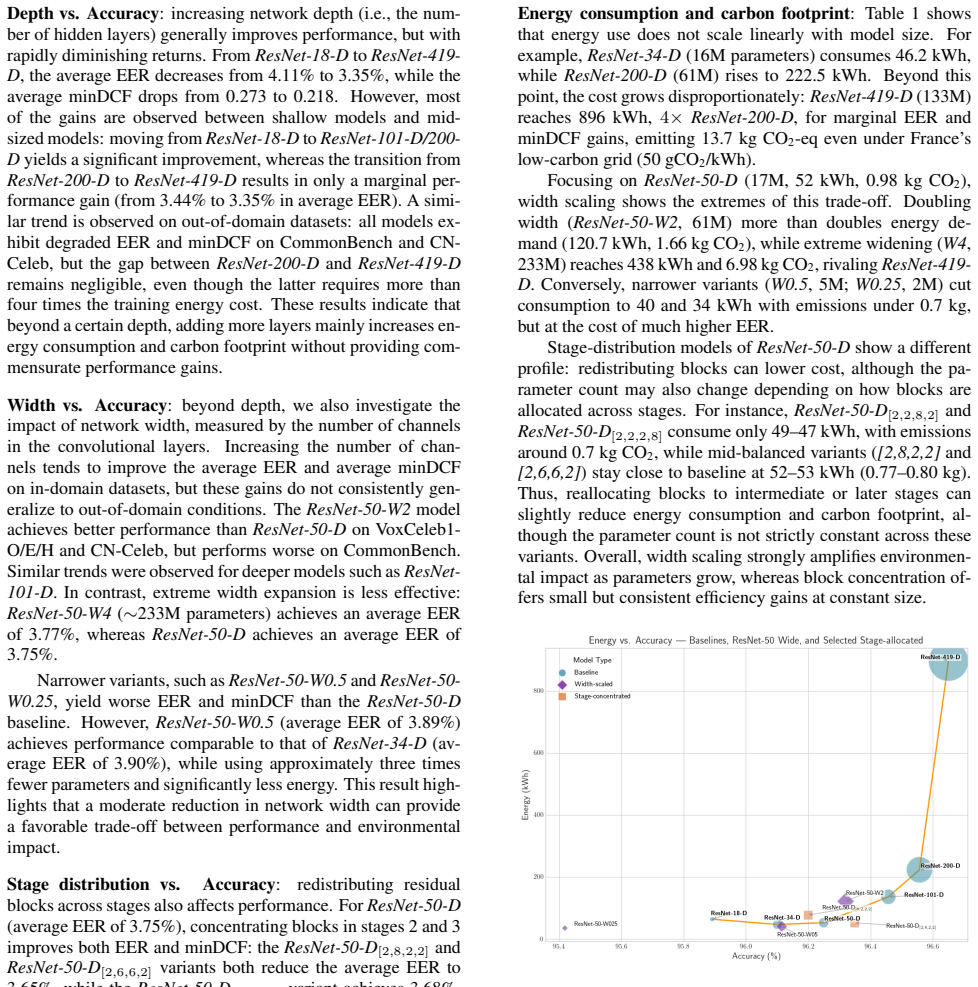
Introduction Speaker verification (SV) aims to verify a speaker’s identity based solely on their voice, with applications ranging from forensic analysis [1] to multimedia [2]. Modern speaker verification systems rely on Deep Neu- ral Networks (DNNs) to extract fixed-dimensional speaker em- beddings. These embeddings, extracted from hidden lay- ers, genera...
-
[2]
Related work Recent work on sustainable machine learning has emphasized that model evaluation should not rely on accuracy alone, but should also account for energy consumption and carbon foot- print. Early studies highlighted the financial cost and environ- mental impact of training large neural models and advocated for more transparent reporting of energ...
Pith/arXiv arXiv 2026
-
[3]
Environmental indicators In this study, two indicators of environmental impact are con- sidered: energy consumption and carbon footprint
Environmental Impact Indicators and Measurement Methodology 3.1. Environmental indicators In this study, two indicators of environmental impact are con- sidered: energy consumption and carbon footprint. Energy consumption: measured in kilowatt-hours (kWh), this indicator reflects the total electricity consumption of a process. In practice, it mainly comes...
-
[4]
ResNet is particularly well suited to SV because it combines strong representational ca- pacity with a flexible design that can be adapted to different computational budgets
Speaker Embedding Extraction with ResNet Many speaker verification (SV) systems are currently based on the ResNet architecture or its variants (e.g., Res2Net, ResNeXt, and ECAPA-style backbones). ResNet is particularly well suited to SV because it combines strong representational ca- pacity with a flexible design that can be adapted to different computati...
-
[5]
Experimental setup For these experiments, we use the Kiwano toolkit [20] 1 and train ResNet-based speaker embedding extractors on V ox- Celeb2 [21]
Experiments and results analysis 5.1. Experimental setup For these experiments, we use the Kiwano toolkit [20] 1 and train ResNet-based speaker embedding extractors on V ox- Celeb2 [21]. Training uses mini-batches of 512 and 3.5 s ran- dom crops. Standard data augmentation follows [22] with MU- SAN [23], RIRs [24] and SpecAugment [25]. Inputs are 80- dime...
-
[6]
Conclusions This paper analyzed the trade-offs between accuracy, energy consumption, and carbon footprint in ResNet-based speaker verification by varying depth, width, and stage distribution. Results show that although deeper models improve EER and minDCF, these gains diminish sharply beyondResNet-101- D/ResNet-200-D, while energy consumption and carbon f...
-
[7]
Acknowledgements This work was granted access to the HPC resources of IDRIS under the allocations AD011013257R4 and AD011016050R1 made by GENCI
-
[8]
Forensic speaker recognition,
Campbell, Joseph P. and Shen, Wade and Campbell, William M. and Schwartz, Reva and Bonastre, Jean-Francois and Matrouf, Driss, “Forensic speaker recognition,”IEEE Signal Processing Magazine, vol. 26, no. 2, pp. 95–103, 2009
2009
-
[9]
Acoustic pairing of original and dubbed voices in the context of video game localization,
A. Gresse, M. Rouvier, R. Dufour, V . Labatut, and J.-F. Bonastre, “Acoustic pairing of original and dubbed voices in the context of video game localization,” inInterspeech, 2017
2017
-
[10]
ABC System Description for NIST SRE 2024,
J. Alam, S. Barahona, D. Bobo ˇs, L. Burget, S. Cumani, M. Dah- mane, J. Han, M. Hlavacek, M. Kodovsky, F. Landiniet al., “ABC System Description for NIST SRE 2024,” 2024, nIST SRE 2024 system description
2024
-
[11]
Id r&d system description to voxceleb speaker recognition challenge 2022,
R. Makarov, N. Torgashov, A. Alenin, I. Yakovlev, and A. Okhot- nikov, “Id r&d system description to voxceleb speaker recognition challenge 2022,”ID R&D Inc.: New York, NY, USA, 2022
2022
-
[12]
Carbon Emissions and Large Neural Network Training,
D. Patterson, J. Gonzalez, Q. Le, C. Liang, L.-M. Munguia, D. Rothchild, D. So, M. Texier, and J. Dean, “Carbon Emissions and Large Neural Network Training,”arXiv preprint arXiv:2104.10350, 2021. [Online]. Available: https://arxiv.org/ abs/2104.10350
Pith/arXiv arXiv 2021
-
[13]
Benchmark dataset dynamics, bias and privacy challenges in voice biometrics research,
C. Rusti, A. Leschanowsky, C. Quinlan, M. Pnacek, L. Gorce, and W. Hutiri, “Benchmark dataset dynamics, bias and privacy challenges in voice biometrics research,” 2023. [Online]. Available: https://arxiv.org/abs/2304.03858
arXiv 2023
-
[14]
Energy and Policy Considerations for Deep Learning in NLP,
E. Strubell, A. Ganesh, and A. McCallum, “Energy and Policy Considerations for Deep Learning in NLP,” 2019. [Online]. Available: https://arxiv.org/abs/1906.02243
Pith/arXiv arXiv 2019
-
[15]
Carbontracker: Tracking and Predicting the Carbon Footprint of Training Deep Learning Models,
L. F. W. Anthony, B. Kanding, and R. Selvan, “Carbontracker: Tracking and Predicting the Carbon Footprint of Training Deep Learning Models,” 2020. [Online]. Available: https: //arxiv.org/abs/2007.03051
arXiv 2020
-
[17]
The Energy and Carbon Foot- print of Training End-to-End Speech Recognizers,
T. Parcollet and M. Ravanelli, “The Energy and Carbon Foot- print of Training End-to-End Speech Recognizers,” inInterspeech 2021, 2021, pp. 4583–4587
2021
-
[18]
Toward Low-Cost End-to-End Spoken Language Understanding,
M. Dinarelli, M. Naguib, and F. Portet, “Toward Low-Cost End-to-End Spoken Language Understanding,” 2022. [Online]. Available: https://arxiv.org/abs/2207.00352
arXiv 2022
-
[19]
T. Parcollet, H. Nguyen, S. Evain, M. Z. Boito, A. Pupier, S. Mdhaffar, H. Le, S. Alisamir, N. Tomashenko, M. Dinarelli, S. Zhang, A. Allauzen, M. Coavoux, Y . Esteve, M. Rouvier, J. Goulian, B. Lecouteux, F. Portet, S. Rossato, F. Ringeval, D. Schwab, and L. Besacier, “LeBenchmark 2.0: a Standard- ized, Replicable and Enhanced Framework for Self-supervis...
arXiv 2024
-
[20]
A. Kulkarni, A. Kulkarni, M. Couceiro, and I. Trancoso, “Unveiling Biases while Embracing Sustainability: Assessing the Dual Challenges of Automatic Speech Recognition Systems,” in Interspeech 2024. ISCA, Sep. 2024, p. 4628–4632. [Online]. Available: http://dx.doi.org/10.21437/Interspeech.2024-2494
-
[21]
Energy concerns with hpc systems and applications,
R. Nana, C. Tadonki, P. Dokladal, and Y . Mesri, “Energy concerns with hpc systems and applications,” 2023. [Online]. Available: https://arxiv.org/abs/2309.08615
arXiv 2023
-
[22]
Analyzing GPU Energy Consumption in Data Movement and Storage,
P. Delestrac, J. Miquel, D. Bhattacharjee, D. Moolchandani, F. Catthoor, L. Torres, and D. Novo, “Analyzing GPU Energy Consumption in Data Movement and Storage,” inASAP 2024 - IEEE 35th International Conference on Application-specific Systems, Architectures and Processors. Hong Kong, Hong Kong SAR China: IEEE, Jul. 2024, pp. 143–151. [Online]. Available: ...
2024
-
[23]
Measuring the carbon intensity of ai in cloud instances,
J. Dodge, T. Prewitt, R. T. D. Combes, E. Odmark, R. Schwartz, E. Strubell, A. S. Luccioni, N. A. Smith, N. DeCario, and W. Buchanan, “Measuring the carbon intensity of ai in cloud instances,” 2022. [Online]. Available: https://arxiv.org/abs/2206.05229
arXiv 2022
-
[24]
Ceems: A resource manager agnostic en- ergy and emissions monitoring stack,
M. Paipuri, “Ceems: A resource manager agnostic en- ergy and emissions monitoring stack,” inSC24-W: Work- shops of the International Conference for High Per- formance Computing, Networking, Storage and Analy- sis. IEEE, Nov. 2024, p. 1862–1866. [Online]. Available: http://dx.doi.org/10.1109/SCW63240.2024.00233
-
[25]
eco2mix: Real- time electricity data in france,
R ´eseau de Transport d’ ´Electricit´e (RTE), “eco2mix: Real- time electricity data in france,” https://www.rte-france.com/en/ eco2mix, 2025, accessed May 17, 2025
2025
-
[26]
Electricity maps: Real-time carbon intensity data,
Electricity Maps, “Electricity maps: Real-time carbon intensity data,” https://www.electricitymaps.com/, 2025, accessed May 17, 2025
2025
-
[27]
Kiwano: A Cutting-Edge Open- Source Toolkit for Speaker Verification,
M. Rouvier and P.-M. Bousquet, “Kiwano: A Cutting-Edge Open- Source Toolkit for Speaker Verification,” inOdyssey 2026, 2026
2026
-
[28]
V oxceleb2: Deep speaker recognition,
J. S. Chung, A. Nagrani, and A. Zisserman, “V oxceleb2: Deep speaker recognition,” inInterspeech, 2018, arXiv:1806.05622
arXiv 2018
-
[29]
X-vectors: Robust dnn embeddings for speaker recognition,
D. Snyder, D. Garcia-Romero, G. Sell, D. Povey, and S. Khudan- pur, “X-vectors: Robust dnn embeddings for speaker recognition,” inInternational Conference on Acoustics, Speech and Signal Pro- cessing (ICASSP). IEEE, 2018
2018
-
[30]
Musan: A music, speech, and noise corpus,
D. Snyder, G. Chen, and D. Povey, “Musan: A music, speech, and noise corpus,” 2015. [Online]. Available: https: //arxiv.org/abs/1510.08484
Pith/arXiv arXiv 2015
-
[31]
A study on data augmentation of reverberant speech for robust speech recognition,
T. Ko, V . Peddinti, D. Povey, M. L. Seltzer, and S. Khudanpur, “A study on data augmentation of reverberant speech for robust speech recognition,” inInternational Conference on Acoustics, Speech and Signal Processing (ICASSP), 2017, pp. 5220–5224
2017
-
[32]
Specaugment: A simple data augmentation method for automatic speech recognition,
D. S. Park, W. Chan, Y . Zhang, C.-C. Chiu, B. Zoph, E. D. Cubuk, and Q. V . Le, “Specaugment: A simple data augmentation method for automatic speech recognition,”Interspeech, 2019
2019
-
[33]
Studying squeeze-and- excitation used in cnn for speaker verification,
M. Rouvier and P.-M. Bousquet, “Studying squeeze-and- excitation used in cnn for speaker verification,” 2021. [Online]. Available: https://arxiv.org/abs/2109.05977
arXiv 2021
-
[34]
V oxceleb: a large- scale speaker identification dataset,
A. Nagrani, J. S. Chung, and A. Zisserman, “V oxceleb: a large- scale speaker identification dataset,” inInterspeech, 2017
2017
-
[35]
Commonbench: A larger scale speaker verification benchmark,
J. Hintz and I. Siegert, “Commonbench: A larger scale speaker verification benchmark,” in4th Symposium on Security and Pri- vacy in Speech Communication, 2024, pp. 17–20
2024
-
[36]
Cn-celeb: A challenging chinese speaker recognition dataset,
Y . Fan, L. Chen, S. Kang, and et al., “Cn-celeb: A challenging chinese speaker recognition dataset,” inProc. Interspeech, 2019
2019
discussion (0)
Sign in with ORCID, Apple, or X to comment. Anyone can read and Pith papers without signing in.