Radar Guided Camera Verification for Automatic Emergency Braking Rethinking Object Detection in Radar Camera Fusion
Pith reviewed 2026-06-29 01:42 UTC · model grok-4.3
The pith
Radar-guided edge density verification confirms obstacles for automatic emergency braking without object detectors or training.
A machine-rendered reading of the paper's core claim, the machinery that carries it, and where it could break.
Core claim
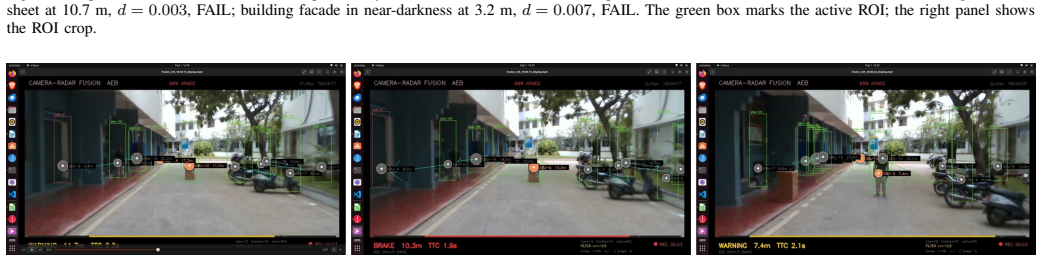
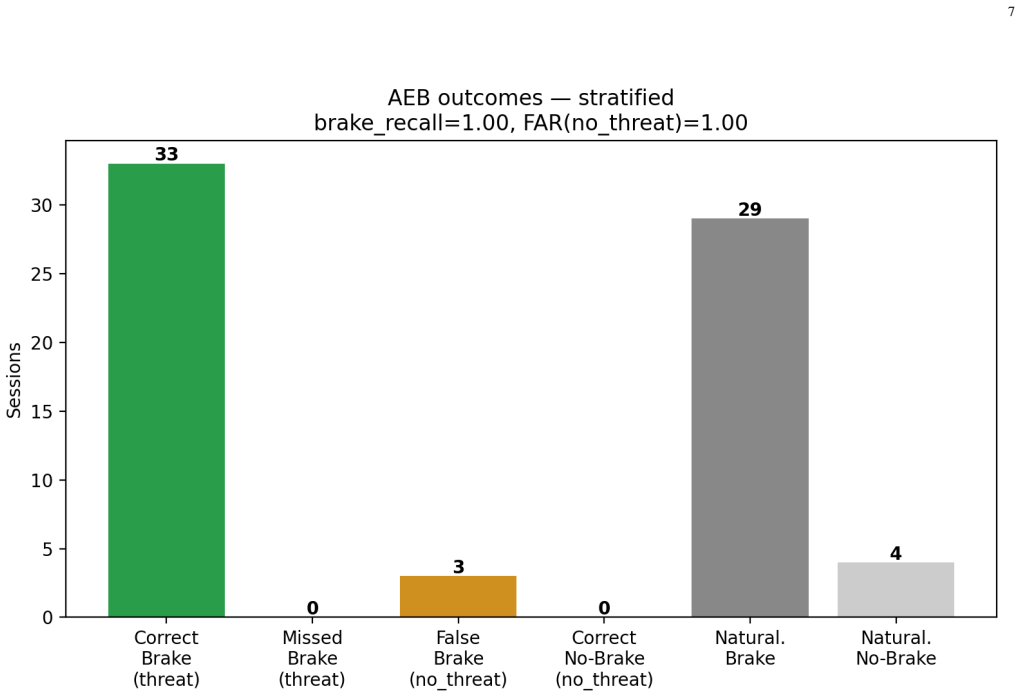
Obstacle verification for radar-camera AEB can be performed by computing edge density inside radar-localized regions of interest; this radar-scoped edge density gate requires no training data, model weights, or GPU acceleration, integrates directly into a brake-by-wire system, and on real-vehicle data achieves up to 98.7 percent reduction in camera search space, 0.121 ms mean latency per ROI, AUC of 0.898, recall of 0.994, and zero missed brake events in 33 staged threat scenarios.
What carries the argument
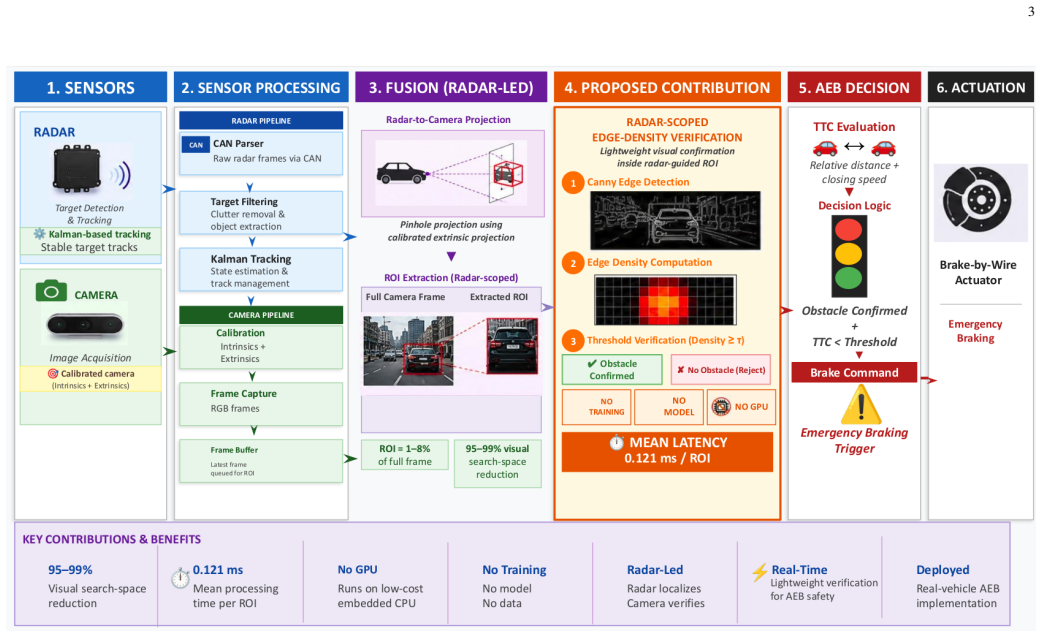
The radar scoped edge density gate, which measures edge density within radar-guided image regions of interest to verify obstacle presence.
If this is right
- Camera processing is limited to small radar-defined regions, cutting search space by up to 98.7 percent.
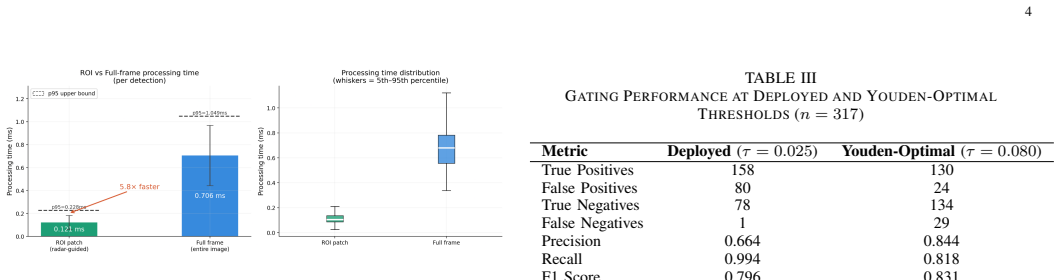
- Mean latency drops to 0.121 ms per ROI without GPU or learned models.
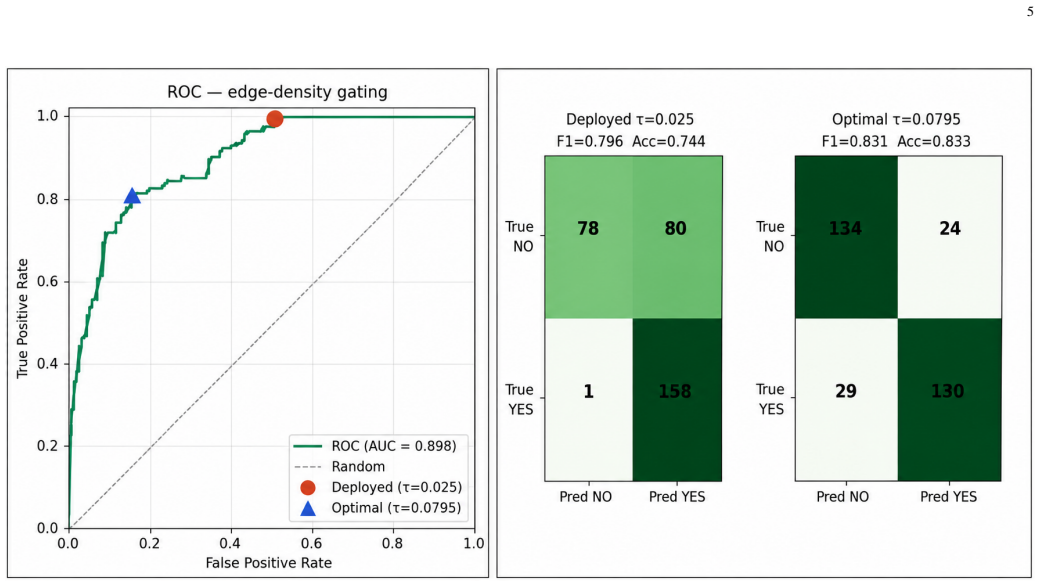
- Recall reaches 0.994 with AUC 0.898 on the collected real-vehicle data.
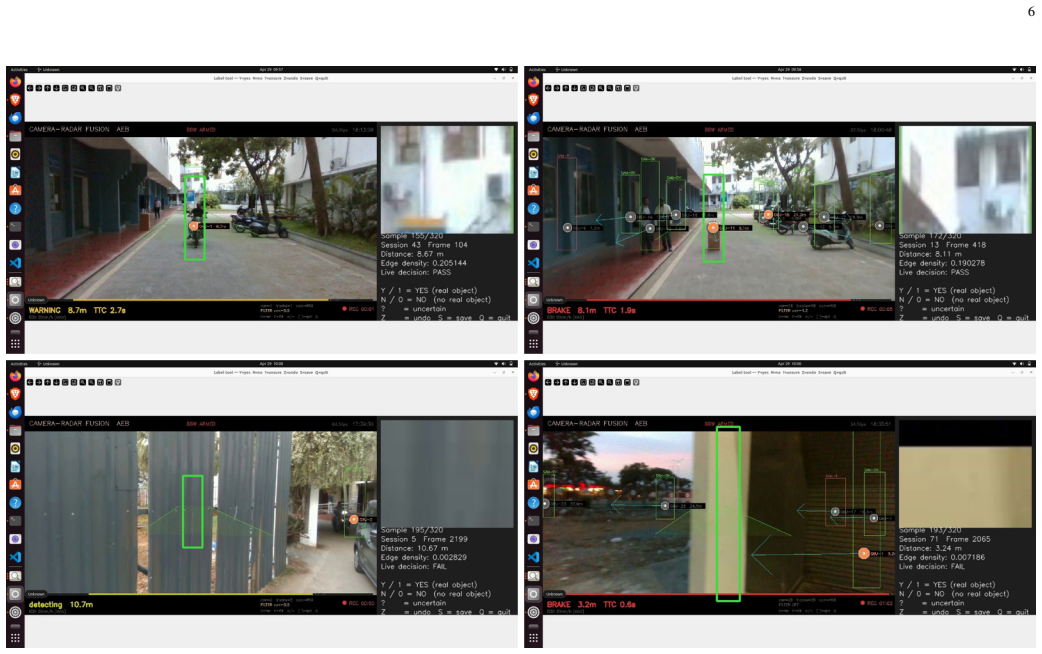
- The full AEB system with brake-by-wire records zero missed brake events across 33 staged threat scenarios.
- The method operates on standard camera frames using only radar range and velocity to scope the check.
Where Pith is reading between the lines
- The same radar-scoped check could be tried for other ADAS alerts such as forward collision warning where full detection is not required.
- Performance may degrade if radar range or velocity estimates are inaccurate, narrowing the image region away from the actual obstacle.
- Combining the edge-density gate with a second lightweight cue such as brightness change could raise precision while preserving the zero-missed-brake property.
- The approach suggests that many radar-camera fusion tasks may be solved by verification rather than detection when one sensor already supplies location.
Load-bearing premise
Measuring edge density inside radar-localized image regions is enough to confirm obstacle presence reliably without missing real threats under varied conditions.
What would settle it
A recorded driving sequence in which an obstacle enters the radar ROI yet produces edge density below the decision threshold, resulting in a missed brake command on the instrumented vehicle.
Figures


read the original abstract
Radar camera fusion is widely used in Automatic Emergency Braking AEB systems because radar provides reliable range and velocity measurements while cameras provide a proper visual confirmation of the objects . Most of the deployed systems perform this confirmation using computationally intensive object detectors. However, if the radar has already localized a target, the camera may only need to verify the obstacles presence rather than solving a full problem by identifying the object. Our work proposes a radar scoped edge density gate that performs obstacle verification within radar guided image regions of interest. This method requires no training data, model weights, or GPU acceleration and was integrated into a complete radar camera fusion AEB system with brake by wire actuation. Evaluated on a real instrumented vehicle across 72 driving sessions and 131,603 camera frames, the proposed approach reduced the camera search space by up to 98.7 percentage, achieved a mean processing latency of 0.121 ms per ROI, an AUC of 0.898, and a recall of 0.994. Across 33 staged threat scenarios, the complete AEB system recorded zero missed brake events.
Editorial analysis
A structured set of objections, weighed in public.
Referee Report
Summary. The manuscript proposes a radar-scoped edge density gate for obstacle verification within radar-localized ROIs in camera images, as an alternative to full object detection for Automatic Emergency Braking (AEB) systems. The method is claimed to be training-free and GPU-free. On real-vehicle data from 72 sessions and 131,603 frames, it reports up to 98.7% reduction in camera search space, 0.121 ms mean latency per ROI, AUC 0.898, recall 0.994, and zero missed brake events across 33 staged threat scenarios in a complete brake-by-wire AEB system.
Significance. If the edge density verification proves robust, the work demonstrates a lightweight, parameter-free approach to radar-camera fusion that could substantially lower computational demands in embedded AEB systems while maintaining high recall. The real-vehicle integration and staged-scenario results provide a practical starting point, though the absence of detailed method specification and condition-specific analysis limits immediate impact.
major comments (4)
- [Abstract] Abstract: The edge density gate is introduced only at a conceptual level with no pseudocode, equations, threshold definition, or edge-detection operator specified. Without this, the reported AUC of 0.898, recall of 0.994, and claim of being parameter-free cannot be reproduced or verified against post-hoc tuning.
- [Evaluation] Evaluation section (implied by results on 131,603 frames and 33 scenarios): No stratified performance breakdown by lighting, weather, fog, glare, or radar-camera calibration error is provided. This leaves the core assumption—that obstacles always produce detectable edges inside radar ROIs—untested in the low-contrast or misaligned conditions highlighted as potential failure modes.
- [Results] Results: The complete AEB system reports zero missed brake events, yet no failure-case analysis, radar error magnitude statistics, or integration details between the edge-density gate and brake actuation are given, making it impossible to assess whether the high-recall outcome generalizes beyond the staged scenarios.
- [Method] Method description: No baseline comparisons to alternative verification methods (e.g., intensity thresholding, simple blob detection, or lightweight CNNs) are included, so the claimed 98.7% search-space reduction and 0.121 ms latency cannot be placed in context against existing approaches.
minor comments (2)
- [Abstract] Abstract: '98.7 percentage' should read '98.7 percent'.
- [Abstract] Abstract: The phrasing 'proper visual confirmation of the objects' is imprecise; 'precise visual confirmation' would be clearer.
Simulated Author's Rebuttal
We thank the referee for the constructive feedback. We address each major comment below and will revise the manuscript accordingly.
read point-by-point responses
-
Referee: [Abstract] Abstract: The edge density gate is introduced only at a conceptual level with no pseudocode, equations, threshold definition, or edge-detection operator specified. Without this, the reported AUC of 0.898, recall of 0.994, and claim of being parameter-free cannot be reproduced or verified against post-hoc tuning.
Authors: We agree the abstract is high-level. In revision we will add a brief method description to the abstract, include pseudocode and the specific edge operator (Canny) plus threshold definition in the Method section, and clarify that 'parameter-free' means no learned weights while fixed thresholds are empirically set. revision: yes
-
Referee: [Evaluation] Evaluation section: No stratified performance breakdown by lighting, weather, fog, glare, or radar-camera calibration error is provided. This leaves the core assumption untsted in low-contrast or misaligned conditions.
Authors: The current evaluation prioritizes aggregate metrics and staged safety tests. We will add a limitations discussion on the edge-density assumption and report any available per-condition observations from the 72 sessions; full stratification is not feasible without additional labeling. revision: partial
-
Referee: [Results] Results: The complete AEB system reports zero missed brake events, yet no failure-case analysis, radar error magnitude statistics, or integration details between the edge-density gate and brake actuation are given.
Authors: We will add a dedicated subsection with failure-case discussion, radar error statistics from the collected data, and explicit integration details with the brake-by-wire system to support the zero-miss outcome. revision: yes
-
Referee: [Method] Method description: No baseline comparisons to alternative verification methods (e.g., intensity thresholding, simple blob detection, or lightweight CNNs) are included.
Authors: We will include comparisons against intensity thresholding and blob detection on the same 131k-frame dataset to place the search-space reduction and latency in context. revision: yes
Circularity Check
No circularity: method defined independently of reported metrics
full rationale
The paper proposes a radar-scoped edge density gate for obstacle verification inside radar-guided ROIs. This is presented as a direct, parameter-free algorithmic choice requiring no training data or model weights. No equations, derivations, fitted parameters, or self-citations appear in the provided text that would reduce the verification step to its own inputs by construction. Performance numbers (AUC 0.898, recall 0.994, latency 0.121 ms) are reported from separate empirical evaluation on 131,603 frames and 33 staged scenarios, not derived from the method definition itself. The derivation chain is therefore self-contained and does not match any of the enumerated circularity patterns.
Axiom & Free-Parameter Ledger
Reference graph
Works this paper leans on
-
[1]
Global status report on road safety 2018,
World Health Organization, “Global status report on road safety 2018,” World Health Organization, Geneva, Switzerland, Tech. Rep., 2018
2018
-
[2]
Centerfusion: Center-based radar and camera fusion for 3d object detection,
R. Nabati and H. Qi, “Centerfusion: Center-based radar and camera fusion for 3d object detection,” inProceedings of the IEEE/CVF Winter Conference on Applications of Computer Vision (WACV), 2021, pp. 1527–1536. 8
2021
-
[3]
Bridging the view disparity between radar and camera features for multi-modal fusion 3d object detection,
T. Zhou, Y . Shi, J. Chen, K. Jiang, M. Yang, and D. Yang, “Bridging the view disparity between radar and camera features for multi-modal fusion 3d object detection,”IEEE Transactions on Intelligent Vehicles, vol. 8, no. 6, pp. 3523–3533, 2023
2023
-
[4]
L. Wang, X. Zhang, J. Sun, and Y . Wang, “Radar-camera fusion for object detection and semantic segmentation in autonomous driving: A comprehensive review,”arXiv preprint arXiv:2304.10410, 2023
-
[5]
Deep learning derived object detection and tracking based on sensor fusion of mmwave radar and video on embedded systems,
C.-J. Linet al., “Deep learning derived object detection and tracking based on sensor fusion of mmwave radar and video on embedded systems,”Sensors, vol. 23, no. 4, p. 2542, 2023
2023
-
[6]
Real-time hybrid multi-sensor fusion framework for perception in autonomous vehicles,
B. S. Jahromiet al., “Real-time hybrid multi-sensor fusion framework for perception in autonomous vehicles,”Sensors, vol. 19, no. 20, p. 4357, 2019
2019
-
[7]
Cr3dt: Camera-radar fusion for 3d detection and tracking,
N. Baumannet al., “Cr3dt: Camera-radar fusion for 3d detection and tracking,”arXiv preprint arXiv:2403.15313, 2024
-
[8]
Multi-sensor fusion in automated driving: A survey,
Z. Wanget al., “Multi-sensor fusion in automated driving: A survey,” IEEE Access, vol. 8, pp. 2847–2868, 2020
2020
-
[9]
Radar and camera fusion for object detection and tracking: A comprehensive survey,
K. Shi, S. He, Z. Shi, A. Chen, Z. Xiong, J. Chen, and J. Luo, “Radar and camera fusion for object detection and tracking: A comprehensive survey,”arXiv preprint arXiv:2410.19872, 2024
-
[10]
D. Wu, F. Yang, B. Xu, P. Liao, and B. Liu, “A survey of deep learning based radar and vision fusion for 3d object detection in autonomous driving,”arXiv preprint arXiv:2406.00714, 2024
-
[11]
Mmwave radar and vision fusion for object detection in autonomous driving: A review,
Z. Wei, F. Zhang, S. Chang, Y . Liu, H. Wu, and Z. Feng, “Mmwave radar and vision fusion for object detection in autonomous driving: A review,”Sensors, vol. 22, no. 7, p. 2542, 2022
2022
-
[12]
A comprehensive review on deep learning-based motion planning and end-to-end learning for self-driving vehicle,
M. Ganesan, S. Kandhasamy, B. Chokkalingam, and L. Mihet-Popa, “A comprehensive review on deep learning-based motion planning and end-to-end learning for self-driving vehicle,”IEEE Access, vol. 12, pp. 66 031–66 067, 2024
2024
-
[13]
A new approach to linear filtering and prediction problems,
R. E. Kalman, “A new approach to linear filtering and prediction problems,”Transactions of the ASME, Journal of Basic Engineering, vol. 82, no. 1, pp. 35–45, 1960
1960
-
[14]
A computational approach to edge detection,
J. Canny, “A computational approach to edge detection,”IEEE Trans- actions on Pattern Analysis and Machine Intelligence, vol. 8, no. 6, pp. 679–698, 1986
1986
-
[15]
Continental Engineering Services,ARS408-21 Premium Automotive Radar Sensor: Datasheet, Continental Engineering Services, 2021
2021
-
[16]
Intel Corporation,Intel RealSense Depth Camera D435: Product Datasheet, Intel Corporation, 2020
2020
-
[17]
Aeb car-to-car test protocol version 4.2,
Euro NCAP, “Aeb car-to-car test protocol version 4.2,” Euro NCAP Test Protocol, 2022. RAM CHARAN AKULAis currently pursuing the B.Tech. degree in Mechatronics Engineering (Robotics) at SRM Institute of Science and Tech- nology, Chennai, India. He is an intern at Euler Motors, New Delhi, India. As a core member of Electruisers, he has worked on autonomous ...
2022
discussion (0)
Sign in with ORCID, Apple, or X to comment. Anyone can read and Pith papers without signing in.