Testing masking effectiveness using multi-line image cubes based on COSMOS2020 for [CII] line intensity mapping at z_([CII]) > 3.5
Pith reviewed 2026-06-27 02:39 UTC · model grok-4.3
The pith
Masking can recover the [CII] intensity mapping signal above 300 GHz under ideal conditions but realistic noise keeps the signal-to-noise ratio below 5 until late in the 2000-hour survey.
A machine-rendered reading of the paper's core claim, the machinery that carries it, and where it could break.
Core claim
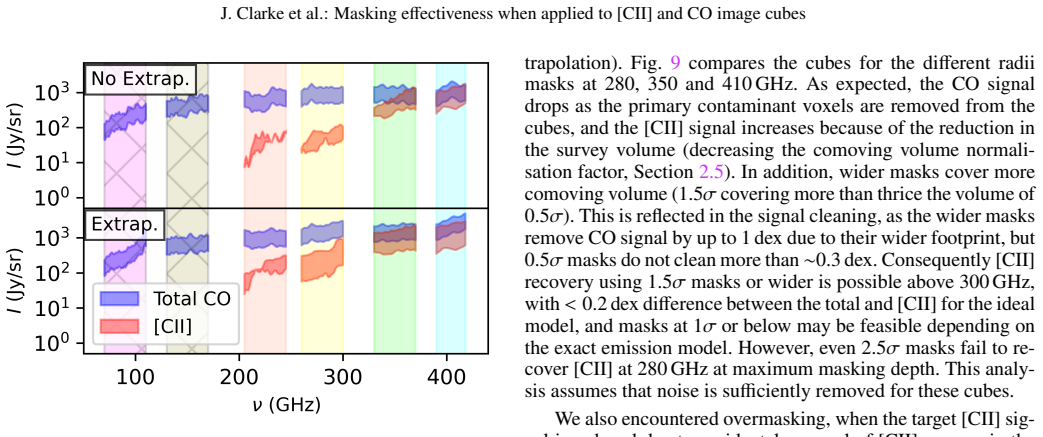
Line luminosity models applied to the COSMOS2020 catalogue generate conservative lower-limit intensity cubes whose CO predictions match existing ALMA, VLA and NOEMA measurements. When targeted masking with a complete bright-source catalogue or blind masking across additional lower-frequency bands is applied, the [CII] power spectrum above 300 GHz is recovered in the zero-noise case. Addition of realistic instrument noise keeps the [CII] signal-to-noise ratio below 5 above 300 GHz until near the end of the 2000-hour observing period, while CO remains recoverable below 300 GHz.
What carries the argument
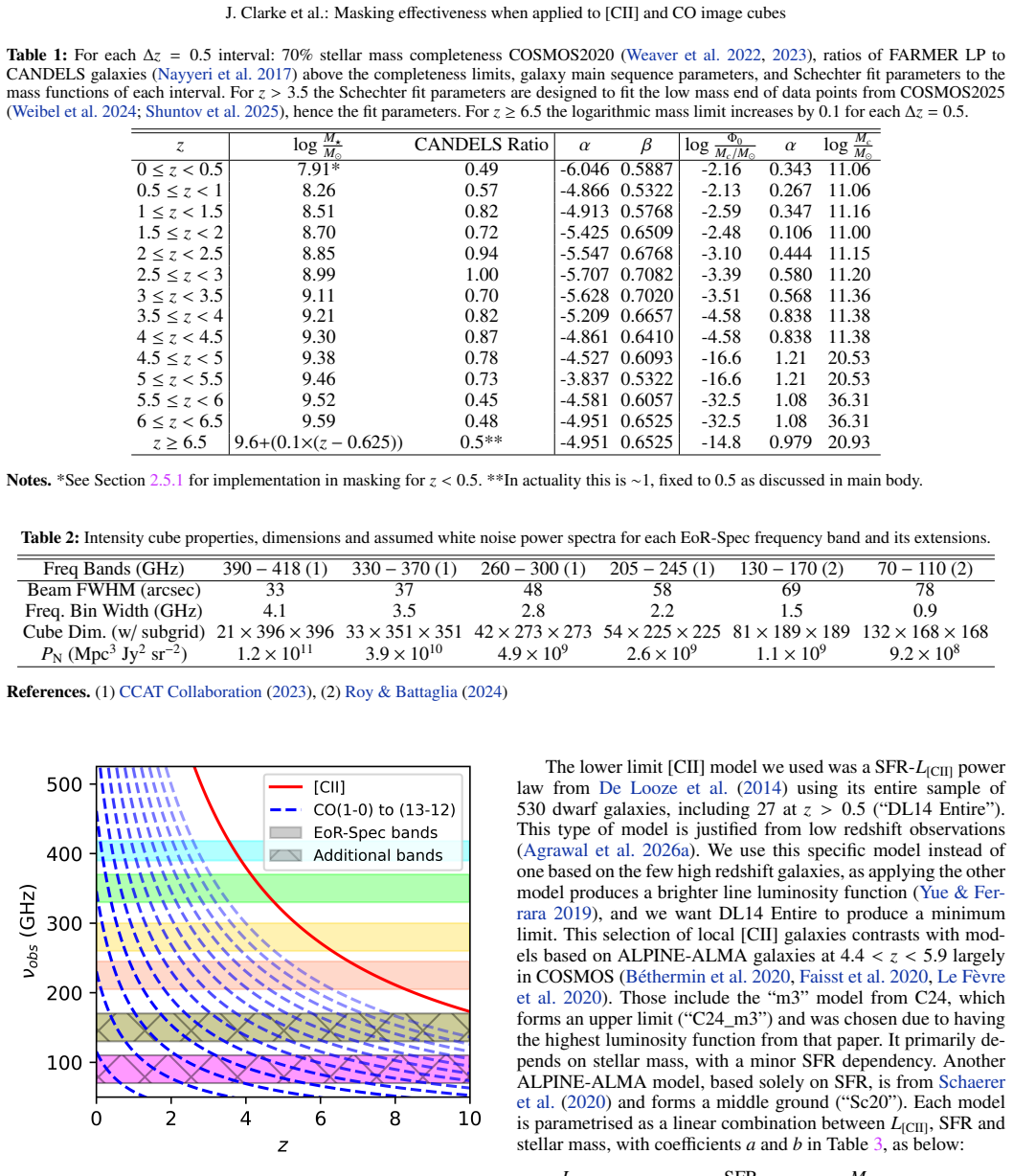
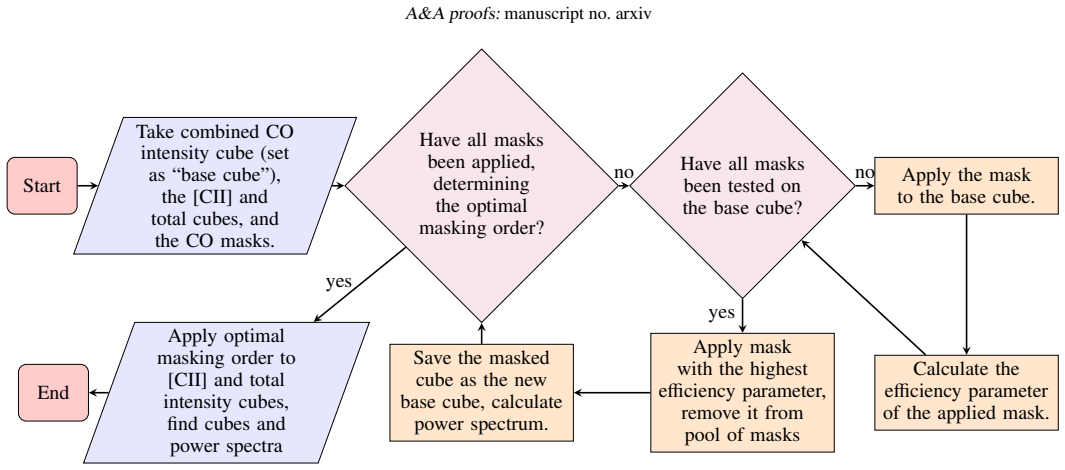
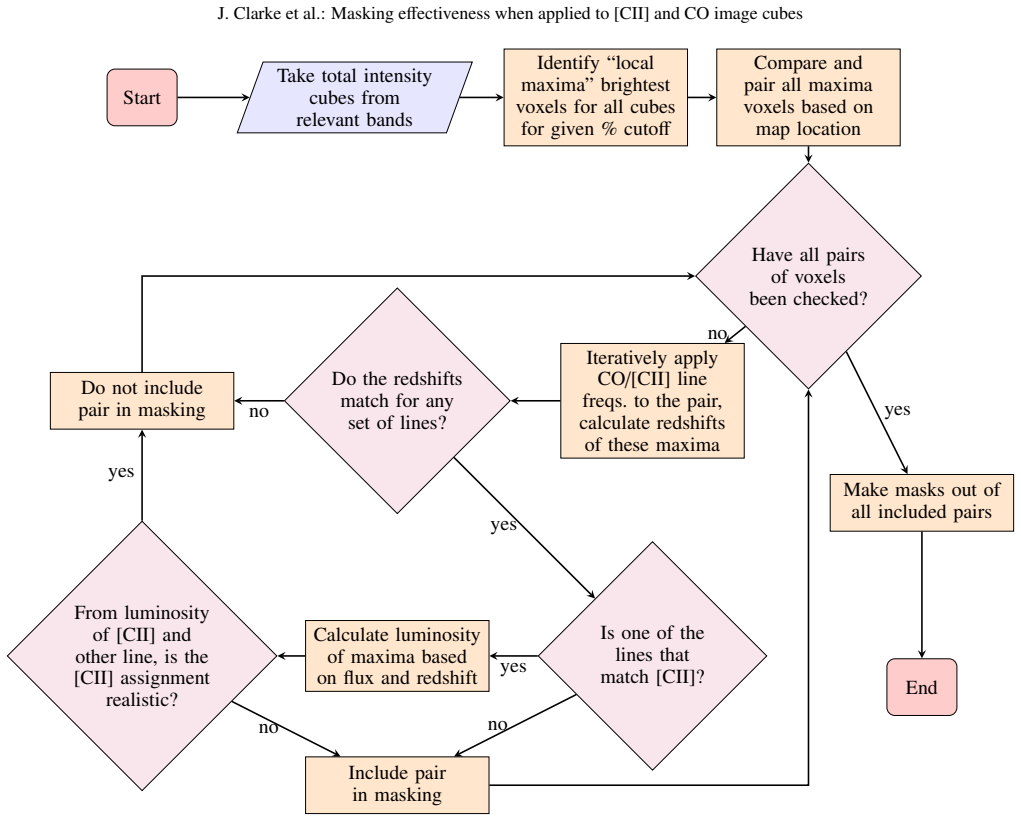
Multi-line image cubes constructed from COSMOS2020 galaxies with line luminosity models and Spectral Line Energy Distribution templates, combined with targeted and blind masking applied to 40 GHz bands in the 205-420 GHz range.
If this is right
- Targeted masking recovers [CII] only when a complete foreground catalogue of bright CO sources is available.
- Blind masking requires additional lower-frequency bands to remove CO contaminants effectively.
- Noise levels delay usable [CII] recovery above 300 GHz until the end of the planned 2000-hour period.
- CO emission can be recovered below 300 GHz with either masking method even in the presence of noise.
- [CII] mapping above 300 GHz will require cross-correlation techniques unless extra observing time is allocated.
Where Pith is reading between the lines
- Survey designs may need to allocate early time to lower-frequency bands or invest in deeper foreground catalogues to enable earlier [CII] detections.
- Because the catalogue is incomplete, the true [CII] signal could be stronger than simulated, potentially allowing recovery with less total integration time.
- The same cube-construction and masking framework could be applied to other intensity-mapping lines or instruments to test general contaminant-removal strategies.
- Cross-correlation between [CII] and other tracers may become the default route for early high-redshift detections rather than auto-power spectrum measurements.
Load-bearing premise
The line luminosity models applied to the COSMOS2020 catalogue produce realistic emission estimates and the added white-plus-correlated noise accurately represents Prime-Cam performance.
What would settle it
Direct measurement of the [CII] power spectrum signal-to-noise ratio in actual Prime-Cam observations after 2000 hours, checking whether it reaches or stays below 5 above 300 GHz.
Figures



read the original abstract
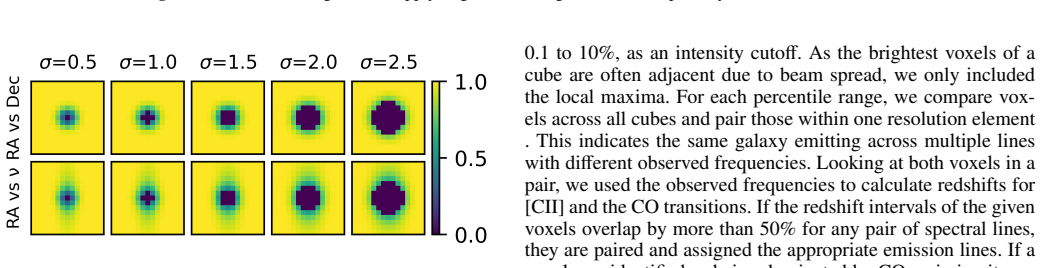
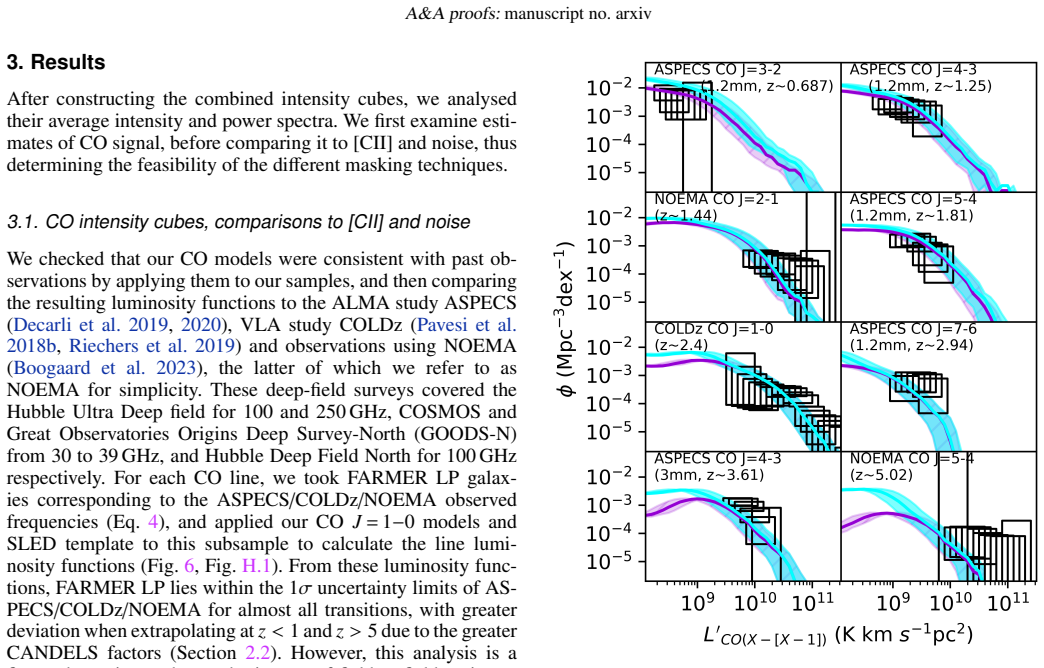
We created line intensity mapping intensity cubes for CO and [CII] emission lines using the COSMOS2020 galaxy catalogue, forming predictions based on empirical data, for observations from Prime-Cam mounted on the Fred Young Submm Telescope. We also included simulated noise including white and correlated components, and tested masking techniques to recover [CII] signal at $3.5<z<8.2$. We applied line luminosity models to the COSMOS2020 galaxy catalogue, spanning 1.44deg$^2$, to estimate the [CII] and CO J=1-0 emission, with other CO transitions derived using Spectral Line Energy Distribution templates. From these we made cubes for four 40 GHz bands in the EoR-Spec frequency range (205-420GHz), as well as a potential future upgrade to EoR-Spec including bands at 150 and 90GHz. Given the incompleteness of the empirical catalogue, these predictions are conservative lower limits, which we subsequently extrapolated from. We applied masks to recover the [CII] power spectra, using bright galaxies of COSMOS2020 as a foreground catalogue to target CO at low z (targeted masking), and matching bright voxels across frequency bands to eliminate those associated with CO emission (blind masking). Our CO intensity cube predictions are consistent with ALMA, VLA and NOEMA observations, indicating that this method gives realistic CO estimates for E-COSMOS. In ideal conditions, masking can recover [CII] above 300GHz, with targeted masking requiring a complete foreground catalogue of bright CO sources to prevent them from contributing to contaminant emission, and blind masking needing additional lower frequency ranges to be effective. However, noise will hinder [CII] recovery above 300 GHz until near the end of the currently planned 2000 hour observing period, as $S/N<5$ without extra observing time. Whilst CO can be recovered below 300GHz, [CII] will be unavailable without cross correlation techniques.
Editorial analysis
A structured set of objections, weighed in public.
Referee Report
Summary. The paper constructs simulated line intensity mapping cubes for multiple CO transitions and the [CII] line at 3.5 < z < 8.2 by applying empirical line luminosity models to the COSMOS2020 catalog over 1.44 deg², derives other CO lines via SLED templates, adds white-plus-correlated noise matching Prime-Cam on the Fred Young Submm Telescope, and tests targeted masking (using bright COSMOS2020 galaxies as a foreground catalog) and blind masking (cross-band voxel matching) to recover the [CII] auto-power spectrum in four 40 GHz bands (205–420 GHz) plus potential lower-frequency extensions. It reports that the CO cubes are consistent with existing ALMA/VLA/NOEMA observations and concludes that masking can recover [CII] above 300 GHz under ideal (noiseless) conditions, but that noise prevents S/N > 5 recovery until near the end of the planned 2000-hour integration, while CO is recoverable below 300 GHz.
Significance. If the simulation fidelity holds, the work supplies concrete, observationally anchored forecasts for masking strategies in [CII] LIM with Prime-Cam, quantifies the catalog-completeness and frequency-coverage requirements for targeted versus blind approaches, and highlights the S/N limitations imposed by realistic noise; the explicit consistency check against ALMA/VLA/NOEMA CO data is a positive reproducibility anchor.
major comments (3)
- [Abstract; line-luminosity modeling section] Abstract and the section on line-luminosity modeling: the central claim that masking recovers the [CII] power spectrum above 300 GHz rests on the fidelity of the [CII] luminosity model applied to COSMOS2020, yet the manuscript provides no equivalent validation (error bars, residual statistics, or comparison to independent [CII] data) to the CO consistency check against ALMA/VLA/NOEMA; this is load-bearing because any systematic offset in the [CII] model directly scales the recovered power spectrum and the voxels selected by both masking schemes.
- [Catalog incompleteness and extrapolation paragraph] The paragraph on catalog incompleteness and extrapolation: the cubes are stated to be conservative lower limits that are subsequently extrapolated, but the impact of this extrapolation on the [CII] auto-power spectrum amplitude or on the fraction of voxels masked in the targeted/blind schemes is not quantified; because the masking performance metrics are derived from these extrapolated cubes, the absence of an uncertainty envelope undermines the quantitative statements about recovery above 300 GHz.
- [Noise-model description] Noise-model description: the white-plus-correlated noise is asserted to represent Prime-Cam performance, but no validation metrics (e.g., power-spectrum residuals against on-sky data or simulated beam-convolved maps) are reported; this assumption directly controls the S/N < 5 conclusion for the 2000-hour survey and therefore the practical recommendation on when [CII] recovery becomes feasible.
minor comments (2)
- [Figure captions] Figure captions and axis labels should explicitly state whether the plotted power spectra include the extrapolated component or are limited to the catalog volume.
- [Band definition paragraph] The frequency ranges of the four 40 GHz bands and the potential 150/90 GHz extensions should be tabulated with the corresponding redshift intervals for both CO and [CII] to improve readability.
Simulated Author's Rebuttal
We thank the referee for their constructive and detailed comments, which have helped us identify areas where the manuscript can be strengthened. We provide point-by-point responses to the major comments below.
read point-by-point responses
-
Referee: [Abstract; line-luminosity modeling section] Abstract and the section on line-luminosity modeling: the central claim that masking recovers the [CII] power spectrum above 300 GHz rests on the fidelity of the [CII] luminosity model applied to COSMOS2020, yet the manuscript provides no equivalent validation (error bars, residual statistics, or comparison to independent [CII] data) to the CO consistency check against ALMA/VLA/NOEMA; this is load-bearing because any systematic offset in the [CII] model directly scales the recovered power spectrum and the voxels selected by both masking schemes.
Authors: We agree that the [CII] model lacks the direct observational validation shown for CO lines. This stems from the limited availability of resolved [CII] observations at z > 3.5 suitable for such comparisons. In revision we will expand the line-luminosity modeling section to explicitly discuss the empirical basis and reported uncertainties of the [CII] relations used, and we will qualify the recovery claims with these model caveats. We cannot add new data comparisons that do not exist in the literature. revision: partial
-
Referee: [Catalog incompleteness and extrapolation paragraph] The paragraph on catalog incompleteness and extrapolation: the cubes are stated to be conservative lower limits that are subsequently extrapolated, but the impact of this extrapolation on the [CII] auto-power spectrum amplitude or on the fraction of voxels masked in the targeted/blind schemes is not quantified; because the masking performance metrics are derived from these extrapolated cubes, the absence of an uncertainty envelope undermines the quantitative statements about recovery above 300 GHz.
Authors: We acknowledge that the quantitative impact of the extrapolation was not assessed. In the revised manuscript we will add a short analysis (e.g., by comparing power spectra and masked-voxel fractions before and after extrapolation) to provide an uncertainty range on the reported recovery metrics. revision: yes
-
Referee: [Noise-model description] Noise-model description: the white-plus-correlated noise is asserted to represent Prime-Cam performance, but no validation metrics (e.g., power-spectrum residuals against on-sky data or simulated beam-convolved maps) are reported; this assumption directly controls the S/N < 5 conclusion for the 2000-hour survey and therefore the practical recommendation on when [CII] recovery becomes feasible.
Authors: The noise model follows the published Prime-Cam specifications and instrument-team simulations. Because the instrument has not yet taken on-sky data, direct residuals against observations cannot be provided. We will add explicit references to the noise-model derivations and any available end-to-end simulations from the instrument papers to better justify the S/N estimates. revision: partial
Circularity Check
No circularity: forward simulation from external catalog with independent validation for CO.
full rationale
The paper applies published line luminosity models to the external COSMOS2020 catalog to generate simulated CO and [CII] cubes, adds modeled noise, and evaluates masking recovery on those cubes. The target [CII] power spectrum recovery is not reduced to any fitted parameter or self-citation within the paper; CO cubes are checked for consistency against independent ALMA/VLA/NOEMA data. No self-definitional steps, fitted-input predictions, or load-bearing self-citations appear in the derivation chain. The result is a self-contained forward test whose central claim does not collapse to its own inputs by construction.
Axiom & Free-Parameter Ledger
free parameters (1)
- line luminosity model parameters
axioms (1)
- domain assumption COSMOS2020 provides a representative lower-limit sample for E-COSMOS emission after extrapolation for incompleteness
Reference graph
Works this paper leans on
-
[1]
Planck 2018 results. VI. Cosmological parameters. , keywords =. doi:10.1051/0004-6361/201833910 , archivePrefix =. 1807.06209 , primaryClass =
work page internal anchor Pith review Pith/arXiv arXiv doi:10.1051/0004-6361/201833910 2018
-
[2]
[CII] line intensity mapping the epoch of reionization with the Prime-Cam on FYST. I. Line intensity mapping predictions using the Illustris TNG hydrodynamical simulation. , keywords =. doi:10.1051/0004-6361/202141293 , archivePrefix =. 2111.12847 , primaryClass =
-
[3]
The ALMA Spectroscopic Survey in the HUDF: CO Luminosity Functions and the Molecular Gas Content of Galaxies through Cosmic History. , keywords =. doi:10.3847/1538-4357/ab30fe , archivePrefix =. 1903.09164 , primaryClass =
-
[4]
[CII] luminosity models and large-scale image cubes based on COSMOS 2020 and ALPINE-ALMA [CII] data back to the epoch of reionisation. , keywords =. doi:10.1051/0004-6361/202450300 , archivePrefix =. 2404.05352 , primaryClass =
-
[5]
COSMOS2020: A Panchromatic View of the Universe to z 10 from Two Complementary Catalogs. , keywords =. doi:10.3847/1538-4365/ac3078 , archivePrefix =. 2110.13923 , primaryClass =
-
[6]
Cross-correlation Techniques to Mitigate the Interloper Contamination for Line Intensity Mapping Experiments. , keywords =. doi:10.3847/1538-4357/ad4a29 , archivePrefix =. 2312.08471 , primaryClass =
-
[7]
COSMOS-Web: An Overview of the JWST Cosmic Origins Survey. , keywords =. doi:10.3847/1538-4357/acc2bc , archivePrefix =. 2211.07865 , primaryClass =
-
[8]
ALMA as a Redshift Machine: Using [C II] to Efficiently Confirm Galaxies in the Epoch of Reionization. , keywords =. doi:10.3847/1538-4357/ace10c , archivePrefix =. 2202.04080 , primaryClass =
-
[9]
LIMpy: A Semianalytic Approach to Simulating Multiline Intensity Maps at Millimeter Wavelengths. , keywords =. doi:10.3847/1538-4357/acf92f , archivePrefix =. 2304.06748 , primaryClass =
-
[10]
The assembly and star formation cessation of galaxies at 0.2< z 7.5
COSMOS2020: The galaxy stellar mass function. The assembly and star formation cessation of galaxies at 0.2< z 7.5. , keywords =. doi:10.1051/0004-6361/202245581 , archivePrefix =. 2212.02512 , primaryClass =
-
[11]
CO foreground masking based on an external catalog
[CII] line intensity mapping the epoch of reionization with the Prime-Cam on FYST: II. CO foreground masking based on an external catalog. , keywords =. doi:10.1051/0004-6361/202450304 , archivePrefix =. 2410.17330 , primaryClass =
-
[12]
CONCERTO: Extracting the power spectrum of the [C _ II ] emission line. , keywords =. doi:10.1051/0004-6361/202346270 , archivePrefix =. 2306.01568 , primaryClass =
-
[13]
Galaxy build-up in the first 1.5 Gyr of cosmic history: insights from the stellar mass function at z 4-9 from JWST NIRCam observations. , keywords =. doi:10.1093/mnras/stae1891 , archivePrefix =. 2403.08872 , primaryClass =
-
[14]
CANDELS Multi-wavelength Catalogs: Source Identification and Photometry in the CANDELS COSMOS Survey Field. , keywords =. doi:10.3847/1538-4365/228/1/7 , archivePrefix =. 1612.07364 , primaryClass =
work page internal anchor Pith review Pith/arXiv arXiv doi:10.3847/1538-4365/228/1/7
-
[15]
Secondary standard stars for absolute spectrophotometry. , keywords =. doi:10.1086/160817 , adsurl =
-
[16]
Regularity Underlying Complexity: A Redshift-independent Description of the Continuous Variation of Galaxy-scale Molecular Gas Properties in the Mass-star Formation Rate Plane. , keywords =. doi:10.1088/0004-637X/793/1/19 , archivePrefix =. 1303.4392 , primaryClass =
work page internal anchor Pith review Pith/arXiv arXiv doi:10.1088/0004-637x/793/1/19
-
[17]
, year = 1976, month = jan, volume =
An analytic expression for the luminosity function for galaxies. , year = 1976, month = jan, volume =. doi:10.1086/154079 , adsurl =
-
[18]
CCAT-prime Collaboration: Science Goals and Forecasts with Prime-Cam on the Fred Young Submillimeter Telescope. , keywords =. doi:10.3847/1538-4365/ac9838 , archivePrefix =. 2107.10364 , primaryClass =
-
[19]
Connecting CO Intensity Mapping to Molecular Gas and Star Formation in the Epoch of Galaxy Assembly
Connecting CO Intensity Mapping to Molecular Gas and Star Formation in the Epoch of Galaxy Assembly. , keywords =. doi:10.3847/0004-637X/817/2/169 , archivePrefix =. 1503.08833 , primaryClass =
work page internal anchor Pith review Pith/arXiv arXiv doi:10.3847/0004-637x/817/2/169
-
[20]
The applicability of far-infrared fine-structure lines as star formation rate tracers over wide ranges of metallicities and galaxy types. , keywords =. doi:10.1051/0004-6361/201322489 , archivePrefix =. 1402.4075 , primaryClass =
work page internal anchor Pith review Pith/arXiv arXiv doi:10.1051/0004-6361/201322489
-
[21]
Little to no evolution in the [C II]-SFR relation over the last 13 Gyr
The ALPINE-ALMA [C II] survey. Little to no evolution in the [C II]-SFR relation over the last 13 Gyr. , keywords =. doi:10.1051/0004-6361/202037617 , archivePrefix =. 2002.00979 , primaryClass =
-
[22]
COSMOS2025: The COSMOS-Web galaxy catalog of photometry, morphology, redshifts, and physical parameters from JWST, HST, and ground-based imaging. , keywords =. doi:10.1051/0004-6361/202555799 , archivePrefix =. 2506.03243 , primaryClass =
-
[23]
CONCERTO: Simulating the CO, [CII], and [CI] line emission of galaxies in a 117 deg ^ 2 field and the impact of field-to-field variance. , keywords =. doi:10.1051/0004-6361/202245151 , archivePrefix =. 2212.02235 , primaryClass =
-
[24]
On the [CII]-SFR relation in high redshift galaxies
On the [CII]-SFR Relation in High Redshift Galaxies. , keywords =. doi:10.1088/0004-637X/813/1/36 , archivePrefix =. 1507.00340 , primaryClass =
work page internal anchor Pith review Pith/arXiv arXiv doi:10.1088/0004-637x/813/1/36
-
[25]
The [CII] 158 micron line emission in high-redshift galaxies
The [CII] 158 m line emission in high-redshift galaxies. , keywords =. doi:10.1051/0004-6361/201732019 , archivePrefix =. 1711.00798 , primaryClass =
work page internal anchor Pith review Pith/arXiv arXiv doi:10.1051/0004-6361/201732019
-
[26]
The Cosmic Evolution Survey (COSMOS) -- Overview
The Cosmic Evolution Survey (COSMOS): Overview. , keywords =. doi:10.1086/516585 , archivePrefix =. astro-ph/0612305 , primaryClass =
work page internal anchor Pith review Pith/arXiv arXiv doi:10.1086/516585
-
[27]
Euclid preparation. I. The Euclid Wide Survey. , keywords =. doi:10.1051/0004-6361/202141938 , archivePrefix =. 2108.01201 , primaryClass =
-
[28]
Forecasting [C II] Line-intensity Mapping Measurements between the End of Reionization and the Epoch of Galaxy Assembly. , keywords =. doi:10.3847/1538-4357/ab798f , archivePrefix =. 1812.08135 , primaryClass =
-
[29]
COMAP Early Science. I. Overview. , keywords =. doi:10.3847/1538-4357/ac63cc , archivePrefix =. 2111.05927 , primaryClass =
-
[30]
Joint Power Spectrum and Voxel Intensity Distribution Forecast on the CO Luminosity Function with COMAP. , keywords =. doi:10.3847/1538-4357/aaf4bc , archivePrefix =. 1808.07487 , primaryClass =
work page internal anchor Pith review Pith/arXiv arXiv doi:10.3847/1538-4357/aaf4bc
-
[31]
The stellar populations of high-redshift dwarf galaxies. , keywords =. doi:10.1093/mnras/staa2410 , archivePrefix =. 2009.03912 , primaryClass =
-
[32]
Journal of Low Temperature Physics , keywords =
Sensitivity of the Prime-Cam Instrument on the CCAT-Prime Telescope. Journal of Low Temperature Physics , keywords =. doi:10.1007/s10909-020-02428-z , archivePrefix =. 1908.10451 , primaryClass =
-
[33]
Euclid Quick Data Release (Q1) -- Data release overview. arXiv e-prints , keywords =. doi:10.48550/arXiv.2503.15302 , archivePrefix =. 2503.15302 , primaryClass =
-
[34]
Three-dimensional stacking as a line intensity mapping statistic. , keywords =. doi:10.1051/0004-6361/202554780 , archivePrefix =. 2503.21743 , primaryClass =
-
[35]
A NOEMA Molecular Line Scan of the Hubble Deep Field North: Improved Constraints on the CO Luminosity Functions and Cosmic Density of Molecular Gas. , keywords =. doi:10.3847/1538-4357/acb4f0 , archivePrefix =. 2301.05705 , primaryClass =
-
[36]
The ALMA Spectroscopic Survey in the Hubble Ultra Deep Field: Multiband Constraints on Line-luminosity Functions and the Cosmic Density of Molecular Gas. , keywords =. doi:10.3847/1538-4357/abaa3b , archivePrefix =. 2009.10744 , primaryClass =
-
[37]
Phase-space Spectral Line Deconfusion in Intensity Mapping. , keywords =. doi:10.3847/1538-4357/abb023 , archivePrefix =. 2005.05341 , primaryClass =
-
[38]
2014, title Cosmic Star-Formation History , , 52, 415, 10.1146/annurev-astro-081811-125615
Cosmic Star-Formation History. , keywords =. doi:10.1146/annurev-astro-081811-125615 , archivePrefix =. 1403.0007 , primaryClass =
work page internal anchor Pith review Pith/arXiv arXiv doi:10.1146/annurev-astro-081811-125615
-
[39]
CONCERTO: High-fidelity simulation of millimeter line emissions of galaxies and [CII] intensity mapping. , keywords =. doi:10.1051/0004-6361/202243888 , archivePrefix =. 2204.12827 , primaryClass =
-
[40]
User's guide to extracting cosmological information from line-intensity maps. , keywords =. doi:10.1103/PhysRevD.100.123522 , archivePrefix =. 1907.10067 , primaryClass =
-
[41]
Line-intensity mapping: theory review with a focus on star-formation lines. , keywords =. doi:10.1007/s00159-022-00143-0 , archivePrefix =. 2206.15377 , primaryClass =
-
[42]
2019b, Computational Astrophysics and Cosmology, 6, 2, doi: 10.1186/s40668-019-0028-x
The IllustrisTNG simulations: public data release. Computational Astrophysics and Cosmology , keywords =. doi:10.1186/s40668-019-0028-x , archivePrefix =. 1812.05609 , primaryClass =
-
[43]
The EAGLE simulations of galaxy formation: Public release of particle data
The EAGLE simulations of galaxy formation: Public release of particle data. arXiv e-prints , keywords =. doi:10.48550/arXiv.1706.09899 , archivePrefix =. 1706.09899 , primaryClass =
work page internal anchor Pith review Pith/arXiv arXiv doi:10.48550/arxiv.1706.09899
-
[44]
The ALPINE-ALMA [CII] survey: The population of [CII]-undetected galaxies and their role in the L _ [CII] -SFR relation. , keywords =. doi:10.1051/0004-6361/202142265 , archivePrefix =. 2202.02334 , primaryClass =
-
[45]
Prospects for detecting CII emission during the Epoch of Reionization
Prospects for Detecting C II Emission during the Epoch of Reionization. , keywords =. doi:10.1088/0004-637X/806/2/209 , archivePrefix =. 1410.4808 , primaryClass =
work page internal anchor Pith review Pith/arXiv arXiv doi:10.1088/0004-637x/806/2/209
-
[46]
Astrophysics Source Code Library , title = "
-
[47]
Measuring the redshift evolution of clustering: the Hubble Deep Field South. , keywords =. doi:10.1046/j.1365-8711.2002.04988.x , archivePrefix =. astro-ph/0109453 , primaryClass =
-
[48]
EAZY: A Fast, Public Photometric Redshift Code
EAZY: A Fast, Public Photometric Redshift Code. , keywords =. doi:10.1086/591786 , archivePrefix =. 0807.1533 , primaryClass =
work page internal anchor Pith review Pith/arXiv arXiv doi:10.1086/591786
-
[49]
High-J CO SLEDs in nearby infrared bright galaxies observed by Herschel-PACS
High-J CO Sleds in Nearby Infrared Bright Galaxies Observed By Herschel/PACS. , keywords =. doi:10.1088/0004-637X/802/2/81 , archivePrefix =. 1410.0006 , primaryClass =
work page internal anchor Pith review Pith/arXiv arXiv doi:10.1088/0004-637x/802/2/81
-
[50]
Cool Gas in High Redshift Galaxies
Cool Gas in High-Redshift Galaxies. , keywords =. doi:10.1146/annurev-astro-082812-140953 , archivePrefix =. 1301.0371 , primaryClass =
work page internal anchor Pith review Pith/arXiv arXiv doi:10.1146/annurev-astro-082812-140953
-
[51]
Stacked Average Far-infrared Spectrum of Dusty Star-forming Galaxies from the Herschel/SPIRE Fourier Transform Spectrometer. , keywords =. doi:10.3847/1538-4357/aa8cc7 , archivePrefix =. 1705.00734 , primaryClass =
work page internal anchor Pith review Pith/arXiv arXiv doi:10.3847/1538-4357/aa8cc7
-
[52]
Line-Intensity Mapping: 2017 Status Report
Line-Intensity Mapping: 2017 Status Report. arXiv e-prints , keywords =. doi:10.48550/arXiv.1709.09066 , archivePrefix =. 1709.09066 , primaryClass =
work page internal anchor Pith review Pith/arXiv arXiv doi:10.48550/arxiv.1709.09066 2017
-
[53]
Predictions and sensitivity forecasts for reionization-era [C II] line intensity mapping
Predictions and sensitivity forecasts for reionization-era [C II] line intensity mapping. , keywords =. doi:10.1093/mnras/stz617 , archivePrefix =. 1802.04804 , primaryClass =
work page internal anchor Pith review Pith/arXiv arXiv doi:10.1093/mnras/stz617
-
[54]
A statistical framework for recovering intensity mapping autocorrelations from cross-correlations. , keywords =. doi:10.1093/mnras/stae1700 , archivePrefix =. 2308.00749 , primaryClass =
-
[55]
Measuring the EoR Power Spectrum Without Measuring the EoR Power Spectrum
Measuring the EoR Power Spectrum without Measuring the EoR Power Spectrum. , keywords =. doi:10.3847/1538-4357/ab0a08 , archivePrefix =. 1811.10609 , primaryClass =
work page internal anchor Pith review Pith/arXiv arXiv doi:10.3847/1538-4357/ab0a08
-
[56]
Exploring the dusty star-formation in the early Universe using intensity mapping
Exploring the dusty star-formation in the early Universe using intensity mapping. Cambridge University Press , keywords =. doi:10.1017/S1743921318000558 , archivePrefix =. 1801.08054 , primaryClass =
work page internal anchor Pith review Pith/arXiv arXiv doi:10.1017/s1743921318000558
-
[57]
A wide field-of-view low-resolution spectrometer at APEX: Instrument design and scientific forecast. , keywords =. doi:10.1051/0004-6361/202038456 , archivePrefix =. 2007.14246 , primaryClass =
-
[58]
The Terahertz Intensity Mapper (TIM): a Next-Generation Experiment for Galaxy Evolution Studies. arXiv e-prints , keywords =. doi:10.48550/arXiv.2009.14340 , archivePrefix =. 2009.14340 , primaryClass =
-
[59]
Journal of Low Temperature Physics , keywords =
The Tomographic Ionized-Carbon Mapping Experiment (TIME) CII Imaging Spectrometer. Journal of Low Temperature Physics , keywords =. doi:10.1007/s10909-014-1126-4 , adsurl =
-
[60]
COSMOS Spectroscopic Redshift Compilation (First Data Release): 488,000 Redshifts Encompassing Two Decades of Spectroscopy. , keywords =. doi:10.3847/1538-4365/ae1cb9 , archivePrefix =. 2503.00120 , primaryClass =
-
[61]
Submillimeter Atmospheric Transparency at Maunakea, at the South Pole, and at Chajnantor
Submillimeter Atmospheric Transparency at Maunakea, at the South Pole, and at Chajnantor. , keywords =. doi:10.1088/1538-3873/128/965/075001 , archivePrefix =. 1602.08795 , primaryClass =
work page internal anchor Pith review Pith/arXiv arXiv doi:10.1088/1538-3873/128/965/075001
-
[62]
Twenty years of precipitable water vapor measurements in the Chajnantor area. , keywords =. doi:10.1051/0004-6361/202037784 , archivePrefix =. 2007.04262 , primaryClass =
-
[63]
Modeling atmospheric emission for CMB ground-based observations
Modeling Atmospheric Emission for CMB Ground-based Observations. , keywords =. doi:10.1088/0004-637X/809/1/63 , archivePrefix =. 1501.07911 , primaryClass =
work page internal anchor Pith review Pith/arXiv arXiv doi:10.1088/0004-637x/809/1/63
-
[64]
Effective model for line intensity mapping: Auto- and cross-power spectra in the cosmic dawn and reionization. , keywords =. doi:10.1103/xq1r-zh51 , archivePrefix =. 2507.15922 , primaryClass =
-
[65]
The Epoch of Reionization. The First Galaxies , year = 2013, editor =. doi:10.1007/978-3-642-32362-1_2 , archivePrefix =. 1206.0267 , primaryClass =
work page internal anchor Pith review Pith/arXiv arXiv doi:10.1007/978-3-642-32362-1_2 2013
-
[66]
Reviews of Modern Physics , keywords =
Photodissociation regions in the interstellar medium of galaxies. Reviews of Modern Physics , keywords =. doi:10.1103/RevModPhys.71.173 , adsurl =
-
[67]
The ALPINE-ALMA [CII] survey: Data processing, catalogs, and statistical source properties. , keywords =. doi:10.1051/0004-6361/202037649 , archivePrefix =. 2002.00962 , primaryClass =
-
[68]
Measurements of the Cross-spectra of the Cosmic Infrared and Microwave Backgrounds from 95 to 1200 GHz. , keywords =. doi:10.3847/1538-4357/ab2da0 , archivePrefix =. 1810.10643 , primaryClass =
-
[69]
An Overview of CHIME, the Canadian Hydrogen Intensity Mapping Experiment. , keywords =. doi:10.3847/1538-4365/ac6fd9 , archivePrefix =. 2201.07869 , primaryClass =
-
[70]
Detection of Cosmological 21 cm Emission with the Canadian Hydrogen Intensity Mapping Experiment. , keywords =. doi:10.3847/1538-4357/acb13f , archivePrefix =. 2202.01242 , primaryClass =
-
[71]
Hidden in Plain Sight: A Massive, Dusty Starburst in a Galaxy Protocluster at z = 5.7 in the COSMOS Field. , keywords =. doi:10.3847/1538-4357/aac6b6 , archivePrefix =. 1803.08048 , primaryClass =
work page internal anchor Pith review Pith/arXiv arXiv doi:10.3847/1538-4357/aac6b6
-
[72]
A Massive Molecular Gas Reservoir in the z=5.3 Submillimeter Galaxy AzTEC-3
A Massive Molecular Gas Reservoir in the z = 5.3 Submillimeter Galaxy AzTEC-3. , keywords =. doi:10.1088/2041-8205/720/2/L131 , archivePrefix =. 1008.0389 , primaryClass =
work page internal anchor Pith review Pith/arXiv arXiv doi:10.1088/2041-8205/720/2/l131 2041
-
[73]
A 3D Drizzle Algorithm for JWST and Practical Application to the MIRI Medium Resolution Spectrometer. , keywords =. doi:10.3847/1538-3881/acdddc , archivePrefix =. 2306.05520 , primaryClass =
-
[74]
A Survey of Atomic Carbon [C I] in High-redshift Main-Sequence Galaxies
A Survey of Atomic Carbon [C I] in High-redshift Main-sequence Galaxies. , keywords =. doi:10.3847/1538-4357/aaeb88 , archivePrefix =. 1810.11029 , primaryClass =
work page internal anchor Pith review Pith/arXiv arXiv doi:10.3847/1538-4357/aaeb88
-
[75]
Improved data selection and processing
COMAP Pathfinder Season 2 results: I. Improved data selection and processing. , keywords =. doi:10.1051/0004-6361/202451121 , archivePrefix =. 2406.07510 , primaryClass =
-
[76]
COMAP Early Science. II. Pathfinder Instrument. , keywords =. doi:10.3847/1538-4357/ac63c6 , archivePrefix =. 2111.05928 , primaryClass =
-
[77]
Journal of Instrumentation , keywords =
CONCERTO: Digital processing for finding and tuning LEKIDs. Journal of Instrumentation , keywords =. doi:10.1088/1748-0221/17/08/P08037 , archivePrefix =. 2206.11554 , primaryClass =
-
[78]
CONCERTO at APEX On-sky performance in continuum. , keywords =. doi:10.1051/0004-6361/202449260 , archivePrefix =. 2406.15572 , primaryClass =
-
[79]
Machine Learning Classification of COSMOS2020 Galaxies: Quiescent versus Star-forming. , keywords =. doi:10.3847/1538-4357/ae0a2c , archivePrefix =. 2509.03039 , primaryClass =
-
[80]
Towards THz IFUs: from DESHIMA to TIFUUN and AtLAST. The Atacama Large Aperture Submillimeter Telescope (AtLAST) design study: results, science, and next steps , year = 2024, month = jun, eid =. doi:10.5281/zenodo.12202439 , adsurl =
discussion (0)
Sign in with ORCID, Apple, or X to comment. Anyone can read and Pith papers without signing in.