Revisiting Disk Winds in Active Galactic Nuclei as an Origin of Cosmic Gamma-ray and Neutrino Backgrounds
Pith reviewed 2026-06-27 00:00 UTC · model grok-4.3
The pith
AGN disk winds contribute at most 5% of the cosmic gamma-ray background above 10 GeV and 10% of the neutrino background near 100 TeV.
A machine-rendered reading of the paper's core claim, the machinery that carries it, and where it could break.
Core claim
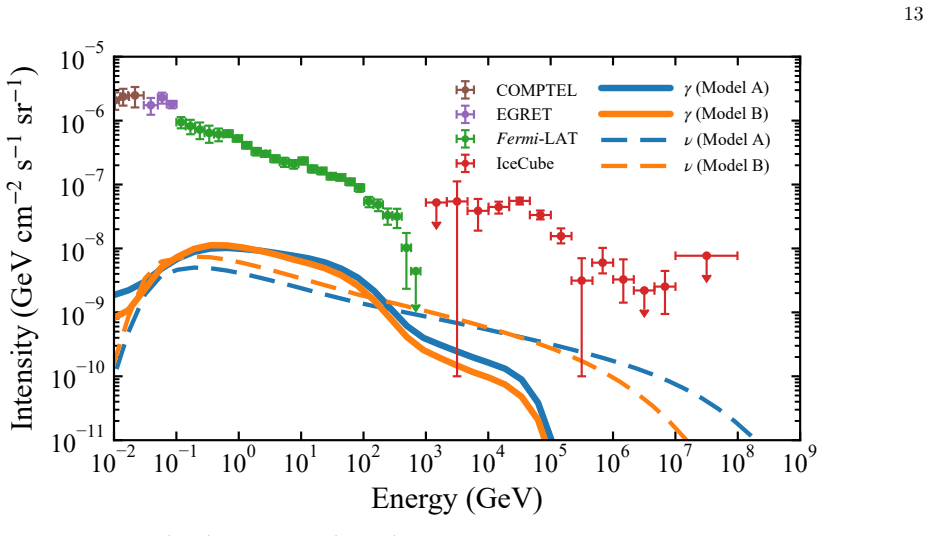
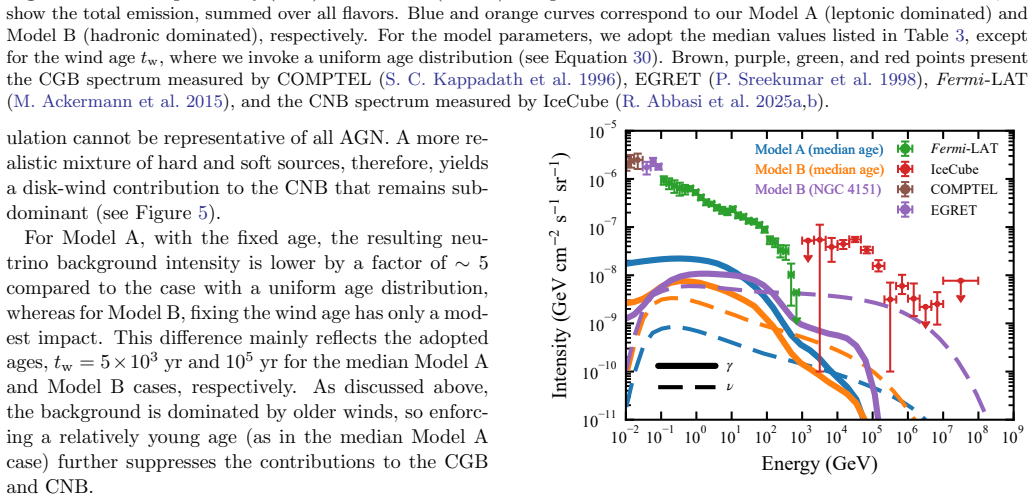
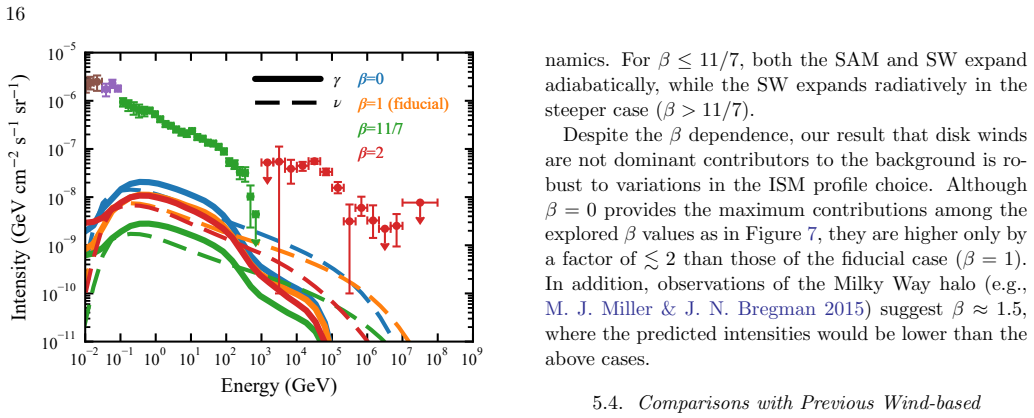
Lepto-hadronic models of AGN disk winds, with cosmic rays accelerated at wind-driven shocks and emission components calibrated to nearby Seyfert observations plus XRISM constraints, when applied to a full AGN population synthesis, yield at most ≲5% of the CGB above 10 GeV and ≲10% of the CNB around 100 TeV.
What carries the argument
Lepto-hadronic wind model in which cosmic rays at forward and reverse shocks produce synchrotron, external-Compton, and hadronic emission, calibrated to radio and GeV data of nearby Seyferts.
If this is right
- Disk winds are unlikely to dominate either the cosmic gamma-ray or neutrino backgrounds.
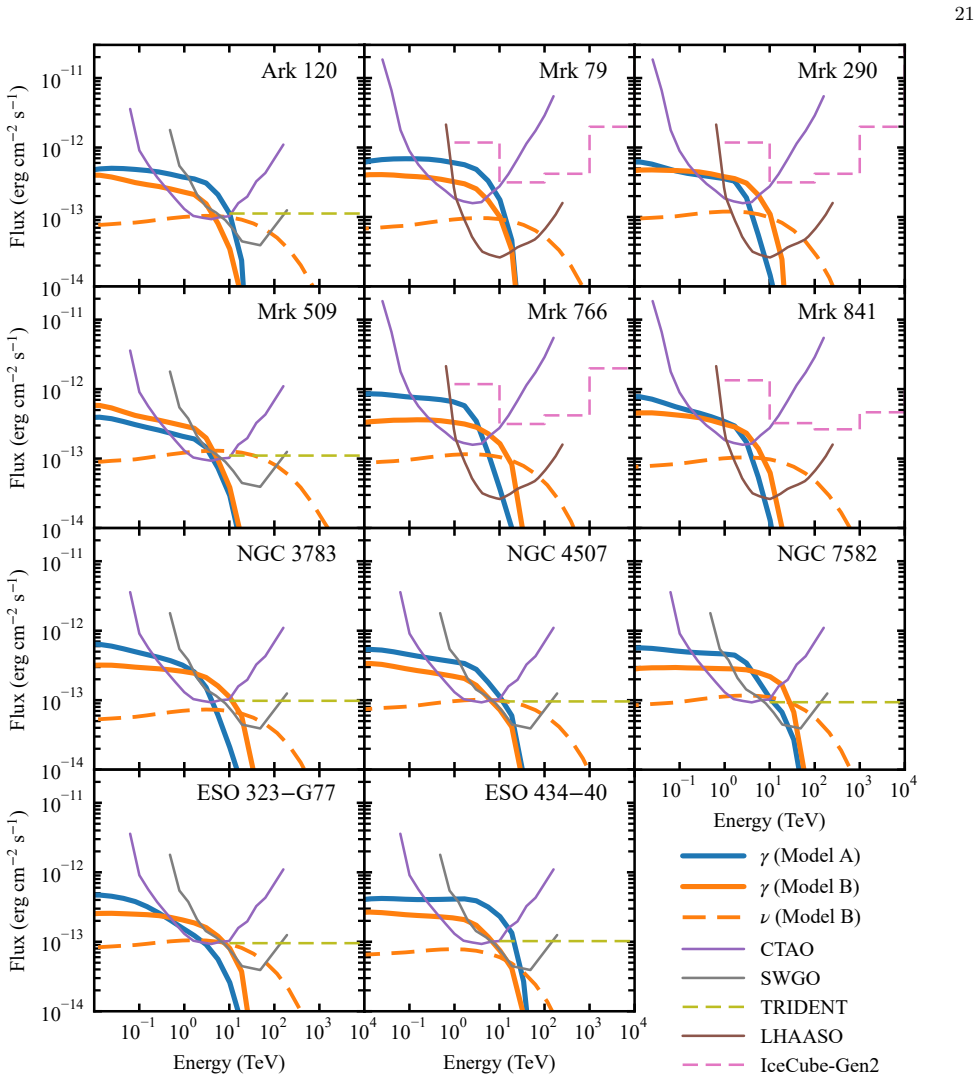
- Nearby Seyfert galaxies with ultrafast outflows become priority targets for TeV gamma-ray and TeV-PeV neutrino telescopes.
- The small predicted fluxes imply that multi-messenger searches for AGN winds must reach deeper sensitivities to test the scenario.
- The conclusion holds within the range of parameters allowed by current radio, GeV, and XRISM constraints.
Where Pith is reading between the lines
- If the calibrated model is accurate, the dominant contributors to both backgrounds must lie outside the disk-wind channel, such as other AGN structures or entirely different source populations.
- Future population studies could test the result by varying the redshift evolution of wind parameters independently of the local calibration sample.
- Non-detections at TeV energies from the proposed nearby targets would strengthen the case that winds remain sub-dominant even in the most favorable objects.
Load-bearing premise
Wind energetics, ambient densities, and the assumption that parameters fitted to a handful of nearby Seyferts apply uniformly to the entire AGN population at all redshifts.
What would settle it
A measured contribution from disk winds exceeding 5% of the CGB above 10 GeV or 10% of the CNB near 100 TeV in population-level data, or TeV gamma-ray detections from nearby ultrafast-outflow Seyferts well above the model's predicted flux, would falsify the low-contribution result.
Figures


read the original abstract
The origin of the cosmic neutrino background (CNB) and the cosmic gamma-ray background (CGB) remains uncertain. Accretion disk winds driven by active galactic nuclei (AGNs) have been proposed as possible contributors, but their predicted background levels depend sensitively on poorly constrained wind energetics and ambient densities. We revisit the AGN disk-wind scenario by constructing a lepto-hadronic wind model calibrated with radio and GeV gamma-ray data of nearby Fermi-LAT-detected Seyfert galaxies. In our framework, cosmic rays accelerated both at wind-driven forward and reverse shocks produce synchrotron, external-Compton, and hadronic emission. We also incorporate recent XRISM constraints on wind parameters. Applying our calibrated lepto-hadronic models to an AGN population synthesis model, we find that disk winds contribute at most $\lesssim 5\%$ of the CGB above 10 GeV and $\lesssim 10\%$ of the CNB around 100 TeV, suggesting that they are unlikely to dominate both backgrounds. Finally, we identify nearby Seyfert galaxies hosting ultrafast outflows as promising targets for future TeV gamma-ray and TeV$-$PeV neutrino observations, which would offer firm tests of the disk-wind scenario.
Editorial analysis
A structured set of objections, weighed in public.
Referee Report
Summary. The manuscript constructs a lepto-hadronic model for AGN accretion disk winds, calibrated using radio and GeV gamma-ray observations of nearby Fermi-LAT detected Seyfert galaxies along with XRISM constraints on wind parameters. The model includes cosmic ray acceleration at forward and reverse shocks producing synchrotron, external-Compton, and hadronic emission. This calibrated model is then applied to an AGN population synthesis to compute contributions to the cosmic gamma-ray background (CGB) and cosmic neutrino background (CNB), yielding upper limits of ≲5% for the CGB above 10 GeV and ≲10% for the CNB around 100 TeV. The authors conclude that disk winds are unlikely to dominate these backgrounds and suggest nearby Seyferts with ultrafast outflows as targets for future observations.
Significance. If the central upper limits hold under the model's assumptions, the result is significant as it constrains the role of AGN disk winds in the diffuse backgrounds, indicating that other source classes must dominate. The calibration to multi-wavelength data from nearby objects and the use of population synthesis provide a concrete framework for such estimates. The identification of specific targets for TeV and neutrino observations adds value for future tests. The strength depends on the validity of extrapolating local calibrations to the full population.
major comments (2)
- [§3] §3: The assumption that wind kinetic power, ambient density, and acceleration efficiency calibrated on a small sample of nearby Fermi-LAT Seyferts apply uniformly to the full AGN population synthesis at all redshifts is load-bearing for the quoted ≲5% CGB and ≲10% CNB limits. No sensitivity analysis is presented for plausible variations with bolometric luminosity, Eddington ratio, or redshift (as hinted by XRISM surveys), which could raise the integrated backgrounds without violating the local fit.
- [Abstract and §3] Abstract and §3: The abstract states that wind energetics and densities are 'poorly constrained' prior to the fit; after calibration the upper limits are reported without propagating the small calibration sample size into uncertainties on the population-integrated fractions, weakening the claim that winds are 'unlikely to dominate'.
minor comments (1)
- The lepto-hadronic emission components (synchrotron, external-Compton, hadronic) would benefit from a short dedicated subsection clarifying the target photon fields and shock properties for readers outside the immediate subfield.
Simulated Author's Rebuttal
We thank the referee for the detailed and constructive report. We address the two major comments point by point below, indicating planned revisions where appropriate.
read point-by-point responses
-
Referee: [§3] The assumption that wind kinetic power, ambient density, and acceleration efficiency calibrated on a small sample of nearby Fermi-LAT Seyferts apply uniformly to the full AGN population synthesis at all redshifts is load-bearing for the quoted ≲5% CGB and ≲10% CNB limits. No sensitivity analysis is presented for plausible variations with bolometric luminosity, Eddington ratio, or redshift (as hinted by XRISM surveys), which could raise the integrated backgrounds without violating the local fit.
Authors: We agree that uniform extrapolation of the locally calibrated parameters is a central assumption. The calibration draws on the best-constrained nearby Seyferts with radio and GeV data, and we have already folded in XRISM wind-parameter constraints. While redshift or Eddington-ratio dependence cannot be ruled out, the model is constructed to yield conservative upper limits. We will add a dedicated sensitivity analysis in §3 that varies wind kinetic power, ambient density, and acceleration efficiency over ranges allowed by XRISM and other surveys, while preserving the local fits, and will report the resulting range of background contributions. revision: yes
-
Referee: [Abstract and §3] The abstract states that wind energetics and densities are 'poorly constrained' prior to the fit; after calibration the upper limits are reported without propagating the small calibration sample size into uncertainties on the population-integrated fractions, weakening the claim that winds are 'unlikely to dominate'.
Authors: The calibration sample is small by necessity (Fermi-LAT-detected Seyferts with radio coverage), and we acknowledge that formal propagation of sample-size uncertainty would strengthen the error budget. The reported ≲5% and ≲10% figures are already framed as upper limits from the best-fit model rather than central values. We will revise the abstract and the relevant paragraph in §3 to explicitly note the limited sample size and the conservative nature of the limits, while retaining the conclusion that even these upper bounds indicate disk winds are unlikely to dominate. revision: partial
Circularity Check
No significant circularity; calibration to independent local data then extrapolated
full rationale
The paper calibrates lepto-hadronic parameters (wind power, density, efficiency) to radio/GeV observations of nearby Fermi-LAT Seyferts plus XRISM constraints, then integrates the fixed model over an external AGN population synthesis to obtain background fractions. This is an application of fitted parameters to a separate dataset, not a fit to the target CGB/CNB or a self-referential definition. No self-citation chains, ansatz smuggling, or uniqueness theorems from the same authors appear in the derivation. The central upper-limit claim therefore retains independent content from the population synthesis step.
Axiom & Free-Parameter Ledger
free parameters (1)
- wind kinetic power and ambient density
axioms (1)
- domain assumption Lepto-hadronic emission processes (synchrotron, external-Compton, hadronic) dominate the wind output
Reference graph
Works this paper leans on
-
[1]
G., Abraham, K., Ackermann, M., et al
Aartsen, M. G., Abraham, K., Ackermann, M., et al. 2015, ApJ, 809, 98, doi: 10.1088/0004-637X/809/1/98
-
[2]
G., Abraham, K., Ackermann, M., et al
Aartsen, M. G., Abraham, K., Ackermann, M., et al. 2017, ApJ, 835, 45, doi: 10.3847/1538-4357/835/1/45
-
[3]
G., Abbasi, R., Ackermann, M., et al
Aartsen, M. G., Abbasi, R., Ackermann, M., et al. 2021, Journal of Physics G Nuclear Physics, 48, 060501, doi: 10.1088/1361-6471/abbd48
-
[4]
2025a, arXiv e-prints, arXiv:2507.22233, doi: 10.48550/arXiv.2507.22233
Abbasi, R., Ackermann, M., Adams, J., et al. 2025a, arXiv e-prints, arXiv:2507.22233, doi: 10.48550/arXiv.2507.22233
-
[5]
Abbasi, R., Ackermann, M., Adams, J., et al. 2025b, arXiv e-prints, arXiv:2507.22234, doi: 10.48550/arXiv.2507.22234
work page internal anchor Pith review Pith/arXiv arXiv doi:10.48550/arxiv.2507.22234
-
[6]
2025c, PhRvL, 135, 031001, doi: 10.1103/PhysRevLett.135.031001
Abbasi, R., Ackermann, M., Adams, J., et al. 2025c, PhRvL, 135, 031001, doi: 10.1103/PhysRevLett.135.031001
-
[7]
2025d, ApJ, 981, 131, doi: 10.3847/1538-4357/ada94b
Abbasi, R., Ackermann, M., Adams, J., et al. 2025d, ApJ, 981, 131, doi: 10.3847/1538-4357/ada94b
-
[8]
2025e, ApJ, 988, 141, doi: 10.3847/1538-4357/addd05
Abbasi, R., Ackermann, M., Adams, J., et al. 2025e, ApJ, 988, 141, doi: 10.3847/1538-4357/addd05
-
[9]
2025f, arXiv e-prints, arXiv:2510.13403, doi: 10.48550/arXiv.2510.13403
Abbasi, R., Ackermann, M., Adams, J., et al. 2025f, arXiv e-prints, arXiv:2510.13403, doi: 10.48550/arXiv.2510.13403
-
[10]
2025, arXiv e-prints, arXiv:2507.16527, doi: 10.48550/arXiv.2507.16527
Abe, K., Abe, S., Abhir, J., et al. 2025, arXiv e-prints, arXiv:2507.16527, doi: 10.48550/arXiv.2507.16527
-
[11]
Acciari, V. A., Ansoldi, S., Antonelli, L. A., et al. 2019, ApJ, 883, 135, doi: 10.3847/1538-4357/ab3a51
-
[12]
2012, ApJ, 755, 164, doi: 10.1088/0004-637X/755/2/164
Ackermann, M., Ajello, M., Allafort, A., et al. 2012, ApJ, 755, 164, doi: 10.1088/0004-637X/755/2/164
-
[13]
2013, Science, 339, 807, doi: 10.1126/science.1231160
Ackermann, M., Ajello, M., Allafort, A., et al. 2013, Science, 339, 807, doi: 10.1126/science.1231160
-
[14]
Ackermann, M., Ajello, M., Albert, A., et al. 2015, ApJ, 799, 86, doi: 10.1088/0004-637X/799/1/86 Adri´ an-Mart´ ınez, S., Ageron, M., Aharonian, F., et al. 2016, Journal of Physics G Nuclear Physics, 43, 084001, doi: 10.1088/0954-3899/43/8/084001
-
[15]
2020, Nature Astronomy, 4, 913, doi: 10.1038/s41550-020-1182-4
Agostini, M., B¨ ohmer, M., Bosma, J., et al. 2020, Nature Astronomy, 4, 913, doi: 10.1038/s41550-020-1182-4
-
[16]
C., Galvan-Gamez, A., & de Diego, J
Aguilar-Ruiz, E., Fraija, N., Joshi, J. C., Galvan-Gamez, A., & de Diego, J. A. 2021, PhRvD, 104, 083013, doi: 10.1103/PhysRevD.104.083013
-
[17]
2023, ApJL, 954, L49, doi: 10.3847/2041-8213/acf296
Ajello, M., Murase, K., & McDaniel, A. 2023, ApJL, 954, L49, doi: 10.3847/2041-8213/acf296
-
[18]
2021, ApJ, 921, 144, doi: 10.3847/1538-4357/ac1bb2 Astropy Collaboration, Robitaille, T
Ajello, M., Baldini, L., Ballet, J., et al. 2021, ApJ, 921, 144, doi: 10.3847/1538-4357/ac1bb2 Astropy Collaboration, Robitaille, T. P., Tollerud, E. J., et al. 2013, A&A, 558, A33, doi: 10.1051/0004-6361/201322068 Astropy Collaboration, Price-Whelan, A. M., Sip˝ ocz, B. M., et al. 2018, AJ, 156, 123, doi: 10.3847/1538-3881/aabc4f Astropy Collaboration, P...
-
[19]
Atoyan, A., & Dermer, C. D. 2001, PhRvL, 87, 221102, doi: 10.1103/PhysRevLett.87.221102 23
-
[20]
Fermi Large Area Telescope Fourth Source Catalog Data Release 4 (4FGL-DR4)
Ballet, J., Bruel, P., Burnett, T. H., Lott, B., & The Fermi-LAT collaboration. 2023, arXiv e-prints, arXiv:2307.12546, doi: 10.48550/arXiv.2307.12546
work page internal anchor Pith review Pith/arXiv arXiv doi:10.48550/arxiv.2307.12546 2023
-
[21]
Ballet, J., Burnett, T. H., Digel, S. W., & Lott, B. 2020, arXiv e-prints, arXiv:2005.11208, doi: 10.48550/arXiv.2005.11208
-
[22]
2017, ApJ, 836, 47, doi: 10.3847/1538-4357/836/1/47
Vandenbroucke, J. 2017, ApJ, 836, 47, doi: 10.3847/1538-4357/836/1/47
-
[23]
2015, A&A Rv, 24, 4, doi: 10.1007/s00159-015-0084-4
Beck, R. 2015, A&A Rv, 24, 4, doi: 10.1007/s00159-015-0084-4
-
[24]
Bell, A. R. 1978a, MNRAS, 182, 147, doi: 10.1093/mnras/182.2.147
-
[25]
Bell, A. R. 1978b, MNRAS, 182, 443, doi: 10.1093/mnras/182.3.443
-
[26]
Bell, A. R., Schure, K. M., Reville, B., & Giacinti, G. 2013, MNRAS, 431, 415, doi: 10.1093/mnras/stt179
-
[27]
Blandford, R. D., & Ostriker, J. P. 1978, ApJL, 221, L29, doi: 10.1086/182658
-
[28]
Blumenthal, G. R., & Gould, R. J. 1970, Reviews of Modern Physics, 42, 237, doi: 10.1103/RevModPhys.42.237
-
[29]
Carulli, A. M., & Reynoso, M. M. 2024, MNRAS, 529, 4137, doi: 10.1093/mnras/stae562
-
[30]
2016, A&A, 589, A119, doi: 10.1051/0004-6361/201527163
Chakravorty, S., Petrucci, P.-O., Ferreira, J., et al. 2016, A&A, 589, A119, doi: 10.1051/0004-6361/201527163
-
[31]
2021, ApJ, 920, 24, doi: 10.3847/1538-4357/ac0ef2 Cherenkov Telescope Array Consortium, Acharya, B
Chartas, G., Cappi, M., Vignali, C., et al. 2021, ApJ, 920, 24, doi: 10.3847/1538-4357/ac0ef2 Cherenkov Telescope Array Consortium, Acharya, B. S.,
-
[32]
2019, Science with the Cherenkov Telescope Array, doi: 10.1142/10986
Agudo, I., et al. 2019, Science with the Cherenkov Telescope Array, doi: 10.1142/10986
-
[33]
Das, A., Zhang, B. T., & Murase, K. 2024, ApJ, 972, 44, doi: 10.3847/1538-4357/ad5a04
-
[34]
D., & Menon, G
Dermer, C. D., & Menon, G. 2009, High Energy Radiation from Black Holes: Gamma Rays, Cosmic Rays, and Neutrinos
2009
-
[35]
IEEE Proceedings , year = 2009, month = aug, volume =
Dewdney, P. E., Hall, P. J., Schilizzi, R. T., & Lazio, T. J. L. W. 2009, IEEE Proceedings, 97, 1482, doi: 10.1109/JPROC.2009.2021005
-
[36]
Drury, L. O. 1983, Reports on Progress in Physics, 46, 973, doi: 10.1088/0034-4885/46/8/002
-
[37]
2016, ApJ, 821, 87, doi: 10.3847/0004-637X/821/2/87
Eichmann, B., & Becker Tjus, J. 2016, ApJ, 821, 87, doi: 10.3847/0004-637X/821/2/87
-
[38]
Eichmann, B., Oikonomou, F., Salvatore, S., Dettmar, R.-J., & Tjus, J. B. 2022, ApJ, 939, 43, doi: 10.3847/1538-4357/ac9588
-
[39]
Elmouttie, M., Haynes, R. F., Jones, K. L., Sadler, E. M., & Ehle, M. 1998, MNRAS, 297, 1202, doi: 10.1046/j.1365-8711.1998.01592.x Faucher-Gigu` ere, C.-A., & Quataert, E. 2012, MNRAS, 425, 605, doi: 10.1111/j.1365-2966.2012.21512.x
-
[40]
D., Ajello, M., Dom´ ınguez, A., et al
Finke, J. D., Ajello, M., Dom´ ınguez, A., et al. 2022, ApJ, 941, 33, doi: 10.3847/1538-4357/ac9843
-
[41]
Fiorillo, D. F. G., Comisso, L., Peretti, E., Petropoulou, M., & Sironi, L. 2025, ApJ, 989, 215, doi: 10.3847/1538-4357/adec9c
-
[42]
Ginzburg, V. L., & Syrovatski˘i, S. I. 1966, Soviet Physics Uspekhi, 9, 223, doi: 10.1070/PU1966v009n02ABEH002871
-
[43]
Gofford, J., Reeves, J. N., McLaughlin, D. E., et al. 2015, MNRAS, 451, 4169, doi: 10.1093/mnras/stv1207 GRAVITY Collaboration, Pfuhl, O., Davies, R., et al. 2020, A&A, 634, A1, doi: 10.1051/0004-6361/201936255
-
[44]
Greenhill, L. J., Booth, R. S., Ellingsen, S. P., et al. 2003, ApJ, 590, 162, doi: 10.1086/374862
-
[45]
2019, ApJ, 885, 117, doi: 10.3847/1538-4357/ab44ba
Guo, X.-L., Xin, Y.-L., Liao, N.-H., & Fan, Y.-Z. 2019, ApJ, 885, 117, doi: 10.3847/1538-4357/ab44ba
-
[46]
Hayashida, M., Stawarz, L., Cheung, C. C., et al. 2013, ApJ, 779, 131, doi: 10.1088/0004-637X/779/2/131
-
[47]
2013, PhRvD, 87, 063011, doi: 10.1103/PhysRevD.87.063011
He, H.-N., Wang, T., Fan, Y.-Z., Liu, S.-M., & Wei, D.-M. 2013, PhRvD, 87, 063011, doi: 10.1103/PhysRevD.87.063011
-
[48]
2018, A&A, 615, A155, doi: 10.1051/0004-6361/201732174
Henkel, C., M¨ uhle, S., Bendo, G., et al. 2018, A&A, 615, A155, doi: 10.1051/0004-6361/201732174
-
[49]
Hopkins, P. F., Richards, G. T., & Hernquist, L. 2007, ApJ, 654, 731, doi: 10.1086/509629
-
[50]
Huentemeyer, P., BenZvi, S., Dingus, B., et al. 2019, in Bulletin of the American Astronomical Society, Vol. 51, 109, doi: 10.48550/arXiv.1907.07737 IceCube Collaboration, Abbasi, R., Ackermann, M., et al. 2022, Science, 378, 538, doi: 10.1126/science.abg3395
work page internal anchor Pith review Pith/arXiv arXiv doi:10.48550/arxiv.1907.07737 2019
-
[51]
2017, ApJ, 835, 74, doi: 10.3847/1538-4357/835/1/74
Ichikawa, K., Ricci, C., Ueda, Y., et al. 2017, ApJ, 835, 74, doi: 10.3847/1538-4357/835/1/74
-
[52]
Impellizzeri, C. M. V., Gallimore, J. F., Baum, S. A., et al. 2019, ApJL, 884, L28, doi: 10.3847/2041-8213/ab3c64
-
[53]
2022, arXiv e-prints, arXiv:2207.02097, doi: 10.48550/arXiv.2207.02097
Inoue, S., Cerruti, M., Murase, K., & Liu, R.-Y. 2022, arXiv e-prints, arXiv:2207.02097, doi: 10.48550/arXiv.2207.02097
-
[54]
2023, PASJ, 75, L33, doi: 10.1093/pasj/psad072
Inoue, Y., & Khangulyan, D. 2023, PASJ, 75, L33, doi: 10.1093/pasj/psad072
-
[55]
2020, ApJL, 891, L33, doi: 10.3847/2041-8213/ab7661
Inoue, Y., Khangulyan, D., & Doi, A. 2020, ApJL, 891, L33, doi: 10.3847/2041-8213/ab7661
-
[56]
2019, ApJ, 880, 40, doi: 10.3847/1538-4357/ab2715
Inoue, Y., Khangulyan, D., Inoue, S., & Doi, A. 2019, ApJ, 880, 40, doi: 10.3847/1538-4357/ab2715
-
[57]
2024, PASJ, 76, 996, doi: 10.1093/pasj/psae065
Inoue, Y., Takasao, S., & Khangulyan, D. 2024, PASJ, 76, 996, doi: 10.1093/pasj/psae065
-
[58]
2018, ApJ, 867, 48, doi: 10.3847/1538-4357/aae20b 24
Kohno, K. 2018, ApJ, 867, 48, doi: 10.3847/1538-4357/aae20b 24
-
[59]
Jacobsen, I. B., Wu, K., On, A. Y. L., & Saxton, C. J. 2015, MNRAS, 451, 3649, doi: 10.1093/mnras/stv1196
-
[60]
Kalashev, O., Semikoz, D., & Tkachev, I. 2015, Soviet Journal of Experimental and Theoretical Physics, 120, 541, doi: 10.1134/S106377611503022X
-
[61]
C., Ryan, J., Bennett, K., et al
Kappadath, S. C., Ryan, J., Bennett, K., et al. 1996, A&AS, 120, 619
1996
-
[62]
2008, Black-Hole Accretion Disks — Towards a New Paradigm —
Kato, S., Fukue, J., & Mineshige, S. 2008, Black-Hole Accretion Disks — Towards a New Paradigm —
2008
-
[63]
Kelner, S. R., & Aharonian, F. A. 2008, PhRvD, 78, 034013, doi: 10.1103/PhysRevD.78.034013
-
[64]
Kelner, S. R., Aharonian, F. A., & Bugayov, V. V. 2006, PhRvD, 74, 034018, doi: 10.1103/PhysRevD.74.034018
-
[65]
Khangulyan, D., Aharonian, F. A., & Kelner, S. R. 2014, ApJ, 783, 100, doi: 10.1088/0004-637X/783/2/100
-
[66]
King, A., & Pounds, K. 2015, ARA&A, 53, 115, doi: 10.1146/annurev-astro-082214-122316 KM3NeT Collaboration, Aiello, S., Albert, A., et al. 2025, Nature, 638, 376, doi: 10.1038/s41586-024-08543-1
work page internal anchor Pith review doi:10.1146/annurev-astro-082214-122316 2015
-
[67]
Koo, B.-C., & McKee, C. F. 1992, ApJ, 388, 103, doi: 10.1086/171133
-
[68]
1999, PASP, 111, 1, doi: 10.1086/316294
Koratkar, A., & Blaes, O. 1999, PASP, 111, 1, doi: 10.1086/316294
-
[69]
Kraemer, S. B., Turner, T. J., Couto, J. D., et al. 2020, MNRAS, 493, 3893, doi: 10.1093/mnras/staa428
-
[70]
2017, A&A, 607, A18, doi: 10.1051/0004-6361/201731452
Lamastra, A., Menci, N., Fiore, F., et al. 2017, A&A, 607, A18, doi: 10.1051/0004-6361/201731452
-
[71]
2016, A&A, 596, A68, doi: 10.1051/0004-6361/201628667
Lamastra, A., Fiore, F., Guetta, D., et al. 2016, A&A, 596, A68, doi: 10.1051/0004-6361/201628667
-
[72]
2025, A&A, 697, A124, doi: 10.1051/0004-6361/202453296
Lemoine, M., & Rieger, F. 2025, A&A, 697, A124, doi: 10.1051/0004-6361/202453296
-
[73]
P., Ricci, C., T¨ urler, M., Dorner, D., & Walter, R
Lenain, J. P., Ricci, C., T¨ urler, M., Dorner, D., & Walter, R. 2010, A&A, 524, A72, doi: 10.1051/0004-6361/201015644
-
[74]
2018, ApJ, 858, 9, doi: 10.3847/1538-4357/aaba74
Liu, R.-Y., Murase, K., Inoue, S., Ge, C., & Wang, X.-Y. 2018, ApJ, 858, 9, doi: 10.3847/1538-4357/aaba74
-
[75]
Mannheim, K., Stanev, T., & Biermann, P. L. 1992, A&A, 260, L1
1992
-
[76]
The Elusive Active Nucleus of NGC 4945
Marconi, A., Oliva, E., van der Werf, P. P., et al. 2000, A&A, 357, 24, doi: 10.48550/arXiv.astro-ph/0002244
work page internal anchor Pith review Pith/arXiv arXiv doi:10.48550/arxiv.astro-ph/0002244 2000
-
[77]
Marconi, A., Risaliti, G., Gilli, R., et al. 2004, MNRAS, 351, 169, doi: 10.1111/j.1365-2966.2004.07765.x
-
[78]
2017, MNRAS, 470, 4039, doi: 10.1093/mnras/stx1551
Marinucci, A., Bianchi, S., Fabbiano, G., et al. 2017, MNRAS, 470, 4039, doi: 10.1093/mnras/stx1551
-
[79]
The hard X-ray source GRS 1734-292: a Seyfert 1 galaxy behind the Galactic Center
Marti, J., Mirabel, I. F., Chaty, S., & Rodriguez, L. F. 1998, A&A, 330, 72, doi: 10.48550/arXiv.astro-ph/9710136
work page internal anchor Pith review Pith/arXiv arXiv doi:10.48550/arxiv.astro-ph/9710136 1998
-
[80]
2014, A&A, 569, A37, doi: 10.1051/0004-6361/201424217
Menci, N., Gatti, M., Fiore, F., & Lamastra, A. 2014, A&A, 569, A37, doi: 10.1051/0004-6361/201424217
discussion (0)
Sign in with ORCID, Apple, or X to comment. Anyone can read and Pith papers without signing in.