Multi-Agent Reinforcement Learning from Delayed Marketplace Feedback for Objective-Weight Adaptation in Three-Sided Dispatch
Reviewed by Pith2026-06-27 06:45 UTCgrok-4.3pith:VTE45LMTopen to challenge →
The pith
An offline-trained policy adapts dispatch weights in a live three-sided marketplace to increase batching while holding delivery quality steady.
A machine-rendered reading of the paper's core claim, the machinery that carries it, and where it could break.
Core claim
A store-level policy trained offline on logged marketplace data selects discrete multipliers for the dispatch optimizer's tradeoff between delivery quality and batching efficiency. Using centralized training of a shared value function with Double Q-learning targets and a conservative regularizer, the policy increases batching rates and reduces courier-side time costs in a production switchback experiment while leaving customer-facing delivery quality unchanged.
What carries the argument
A store-level policy that outputs discrete multipliers for the existing combinatorial assignment optimizer, trained via centralized offline value learning with Double Q-learning and a conservative regularizer to bound out-of-distribution overestimation.
Load-bearing premise
Logged marketplace data plus the conservative regularizer produces value estimates that stay reliable under live deployment without large distribution shift or violation of production constraints.
What would settle it
A new switchback period in which the policy either fails to increase batching, increases courier time costs, or degrades measured delivery quality relative to the baseline would falsify the claim that the learned policy improves the intended metrics.
Figures


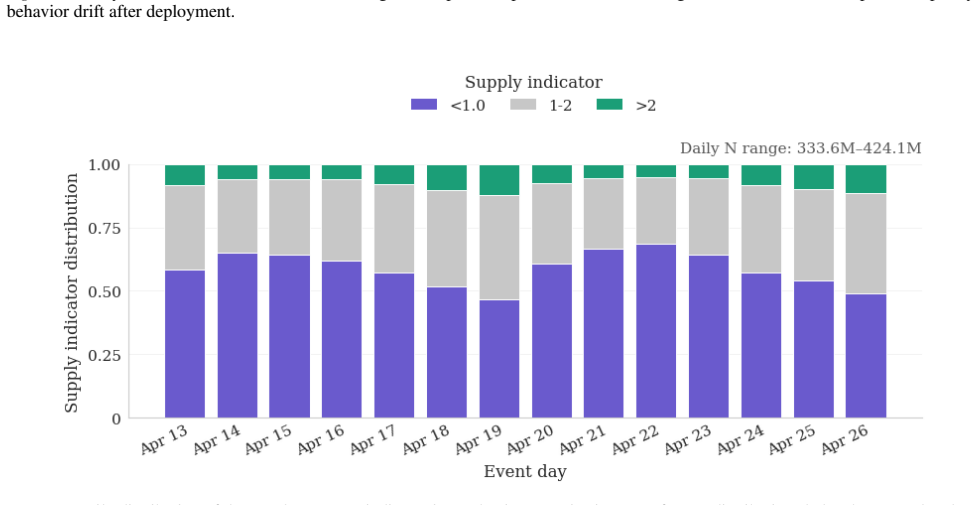
read the original abstract
Dispatch in three-sided marketplaces provides a natural setting for reinforcement learning from world feedback: decisions are evaluated by delayed operational outcomes such as delivery speed, courier utilization, and merchant congestion. We present a deployed reinforcement learning system at DoorDash that adapts dispatch objective weights in a large-scale food-delivery marketplace using delayed signals. Rather than replacing the combinatorial assignment optimizer, a store-level policy learned from logged marketplace data selects a discrete multiplier that shifts the dispatch optimizer's tradeoff between delivery quality and batching efficiency. This interface enables offline policy learning under noisy, delayed, and coupled feedback while preserving production feasibility constraints and operational safeguards. We train a shared value function using centralized offline data and decentralized store-level execution, with Double Q-learning targets and a conservative regularizer to reduce out-of-distribution value overestimation. In a production switchback experiment, the offline-trained policy increases batching and reduces courier-side time costs without degrading customer-facing delivery quality. Results illustrate how world feedback from a live economic and logistics system can be used to safely adapt decision policies online.
Editorial analysis
A structured set of objections, weighed in public.
Referee Report
Summary. The manuscript presents a deployed multi-agent RL system at DoorDash for adapting dispatch objective weights in a three-sided food-delivery marketplace. A store-level policy is trained offline on centralized logged data using Double Q-learning with a conservative regularizer; the policy selects discrete multipliers for an existing combinatorial dispatch optimizer. The approach preserves production feasibility constraints. Validation occurs via a production switchback experiment in which the learned policy increases batching, reduces courier-side time costs, and does not degrade customer-facing delivery quality.
Significance. If the central experimental result holds after addressing the noted gaps, the work supplies a concrete, production-validated template for offline RL under delayed, noisy, and coupled marketplace feedback. The centralized-training/decentralized-execution interface together with the conservative regularizer offers a practical route to objective-weight adaptation while respecting operational safeguards; this is a rare documented case of live economic-system feedback being used to adapt a deployed decision policy.
major comments (1)
- [Training and Experiment sections (abstract paragraph on training and experiment)] The production switchback experiment is presented as the primary validation that value estimates remain reliable under live deployment. However, the manuscript provides no explicit quantification of distribution shift (e.g., divergence in state-action occupancy between logged and policy-induced trajectories) nor additional off-policy evaluation on shifted subsets. Without such analysis, it is unclear whether the conservative regularizer alone suffices to bound overestimation when batching patterns, timing, or merchant/courier behavior change after deployment.
minor comments (1)
- [Abstract] The abstract states results qualitatively; reporting the magnitude of batching increase, courier time-cost reduction, and any statistical significance or confidence intervals from the switchback would strengthen the claim.
Simulated Author's Rebuttal
We thank the referee for the constructive feedback on the distribution-shift analysis. We address the single major comment below and will revise the manuscript accordingly.
read point-by-point responses
-
Referee: [Training and Experiment sections (abstract paragraph on training and experiment)] The production switchback experiment is presented as the primary validation that value estimates remain reliable under live deployment. However, the manuscript provides no explicit quantification of distribution shift (e.g., divergence in state-action occupancy between logged and policy-induced trajectories) nor additional off-policy evaluation on shifted subsets. Without such analysis, it is unclear whether the conservative regularizer alone suffices to bound overestimation when batching patterns, timing, or merchant/courier behavior change after deployment.
Authors: We agree that the current manuscript lacks explicit quantification of distribution shift between the offline logged data and the policy-induced trajectories observed after deployment. The conservative regularizer was introduced specifically to mitigate overestimation under such shifts, and the production switchback experiment provides empirical evidence that the learned policy improved batching without degrading customer metrics. To strengthen the presentation, the revised manuscript will add (i) a quantitative comparison of state-action occupancy measures (e.g., via KL divergence or total variation on discretized state features) between the training logs and the post-deployment trajectories collected during the switchback, and (ii) off-policy value estimates on temporally or geographically shifted subsets of the logged data. These additions will clarify the degree of shift encountered and the extent to which the regularizer bounds overestimation in practice. revision: yes
Circularity Check
No circularity: offline RL training on logged data evaluated via independent live experiment
full rationale
The paper trains a policy via Double Q-learning plus conservative regularizer on centralized logged marketplace data, then deploys it for decentralized execution and validates via a separate production switchback experiment. No step equates a claimed prediction or result to its own fitted inputs by construction, no self-citation is load-bearing for the central claim, and the live experiment supplies external validation outside the training distribution. The derivation chain is therefore self-contained against the reported benchmarks.
Axiom & Free-Parameter Ledger
Reference graph
Works this paper leans on
-
[1]
Transportation Science , volume=
The Restaurant Meal Delivery Problem: Dynamic Pickup and Delivery with Deadlines and Random Ready Times , author=. Transportation Science , volume=. 2021 , doi=
2021
-
[2]
Transportation Research Part C: Emerging Technologies , volume=
Crowdsourced on-demand food delivery: An order batching and assignment algorithm , author=. Transportation Research Part C: Emerging Technologies , volume=. 2023 , doi=
2023
-
[3]
Tsinghua Science and Technology , volume=
A Matching Algorithm with Reinforcement Learning and Decoupling Strategy for Order Dispatching in On-Demand Food Delivery , author=. Tsinghua Science and Technology , volume=. 2024 , doi=
2024
-
[4]
Knowledge-Based Systems , volume=
A Deep Reinforcement Learning Approach for the Meal Delivery Problem , author=. Knowledge-Based Systems , volume=. 2022 , doi=
2022
-
[5]
Applied Intelligence , year=
Online Food Ordering Delivery Strategies Based on Deep Reinforcement Learning , author=. Applied Intelligence , year=
-
[6]
2018 , howpublished =
Richard Hwang , title =. 2018 , howpublished =
2018
-
[7]
2025 , howpublished =
Mehrdad Bakhtiari and Soheil Sadeghi and Prateek Jain , title =. 2025 , howpublished =
2025
-
[8]
2018 , howpublished =
Yuyan Wang and Uber Eats Engineering , title =. 2018 , howpublished =
2018
-
[9]
2023 , howpublished =
David Vengerov and Vinesh Gudla and Tejaswi Tenneti and Haixun Wang and Kourosh Hakhamaneshi , title =. 2023 , howpublished =
2023
-
[10]
Computers & Industrial Engineering , volume =
Ayca Bozanta and Ilker Kucukyilmaz and Esra Yildiz and Okan Aras , title =. Computers & Industrial Engineering , volume =. 2022 , doi =
2022
-
[11]
Proceedings of the IEEE Real-Time Systems Symposium (RTSS) , year =
Baoshen Guo and Shuai Wang and Yi Ding and Guang Wang and Suining He and Desheng Zhang and Tian He , title =. Proceedings of the IEEE Real-Time Systems Symposium (RTSS) , year =
-
[12]
International Journal of Transportation Science and Technology , volume =
Miaojia Lu and Xinyu Yan and Shadi Sharif Azadeh and Pengling Wang , title =. International Journal of Transportation Science and Technology , volume =. 2024 , doi =
2024
-
[13]
2025 , eprint =
Jingyi Cheng and Shadi Sharif Azadeh , title =. 2025 , eprint =
2025
-
[14]
Rusu and Joel Veness and Marc G
Volodymyr Mnih and Koray Kavukcuoglu and David Silver and Andrei A. Rusu and Joel Veness and Marc G. Bellemare and Alex Graves and Martin Riedmiller and Andreas K. Fidjeland and Georg Ostrovski and Stig Petersen and Charles Beattie and Amir Sadik and Ioannis Antonoglou and Helen King and Dharshan Kumaran and Daan Wierstra and Shane Legg and Demis Hassabis...
2015
-
[15]
Proceedings of the AAAI Conference on Artificial Intelligence , volume =
Hado van Hasselt and Arthur Guez and David Silver , title =. Proceedings of the AAAI Conference on Artificial Intelligence , volume =
-
[16]
Advances in Neural Information Processing Systems , volume =
Aviral Kumar and Aurick Zhou and George Tucker and Sergey Levine , title =. Advances in Neural Information Processing Systems , volume =
-
[17]
2024 , eprint =
Christopher Amato , title =. 2024 , eprint =
2024
-
[18]
Management Science , volume=
Design and Analysis of Switchback Experiments , author=. Management Science , volume=. 2023 , doi=
2023
discussion (0)
Sign in with ORCID, Apple, or X to comment. Anyone can read and Pith papers without signing in.