Escape from Callback Hell! A New Programming Paradigm for Network Simulation
Pith reviewed 2026-05-19 19:22 UTC · model grok-4.3
The pith
Coroutine-based discrete event simulation lets developers write network protocols as simple sequential code instead of callback tangles.
A machine-rendered reading of the paper's core claim, the machinery that carries it, and where it could break.
Core claim
The central claim is that coroutine mechanisms can be fused with discrete event simulation to produce CoDES, a paradigm that naturally simulates network events through sequential workflows rather than callbacks. This directly tackles stack ripping and maintainability problems in simulators such as NS-3. Concrete implementations for Message Passing Interface, High Precision Congestion Control, and Routing Information Protocol demonstrate the reductions in code volume and complexity while simulation accuracy, execution time, and runtime memory stay unchanged.
What carries the argument
The CoDES framework, which replaces callback-driven event handling in discrete event simulators with coroutines to support sequential program structure for network protocols.
If this is right
- Network simulation code can be written and read as ordinary sequential programs rather than scattered callback functions.
- Development workload for protocols such as MPI, HPCC, and RIP drops measurably while code readability improves.
- Existing simulators retain full accuracy, timing behavior, and memory footprint after the coroutine integration.
- Rapid evaluation and iterative evolution of network functions become more practical because of reduced cognitive load.
Where Pith is reading between the lines
- The same coroutine replacement pattern could be ported to other discrete event simulators beyond NS-3.
- Sequential simulation code might integrate more easily with contemporary debuggers and static analysis tools.
- Lower code complexity could shorten the time needed for researchers to prototype and validate new congestion-control or routing ideas.
Load-bearing premise
Coroutines can be integrated into existing discrete event simulators while fully preserving event ordering, timing semantics, and protocol correctness without hidden overheads or compatibility breaks.
What would settle it
Run an identical network protocol simulation under both the original NS-3 callback version and the CoDES version and observe any divergence in packet delivery order, timing, or final state.
Figures





read the original abstract
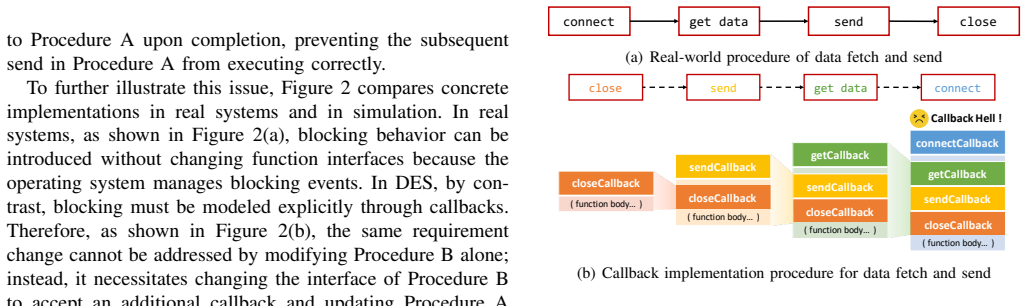
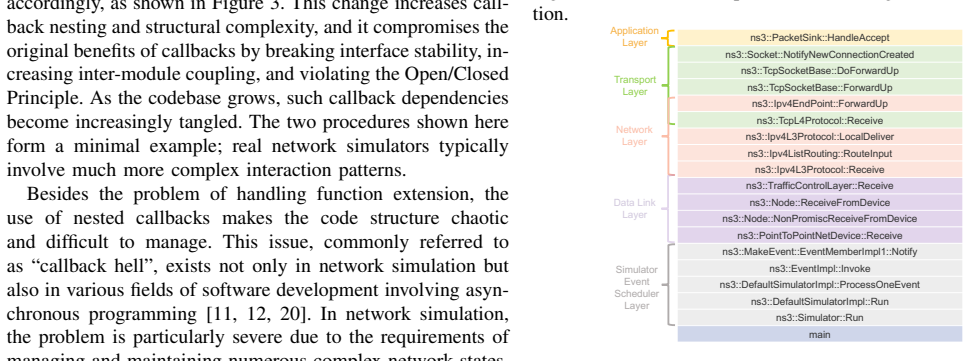
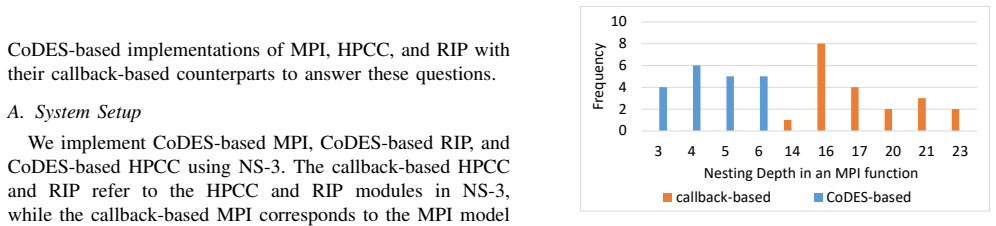
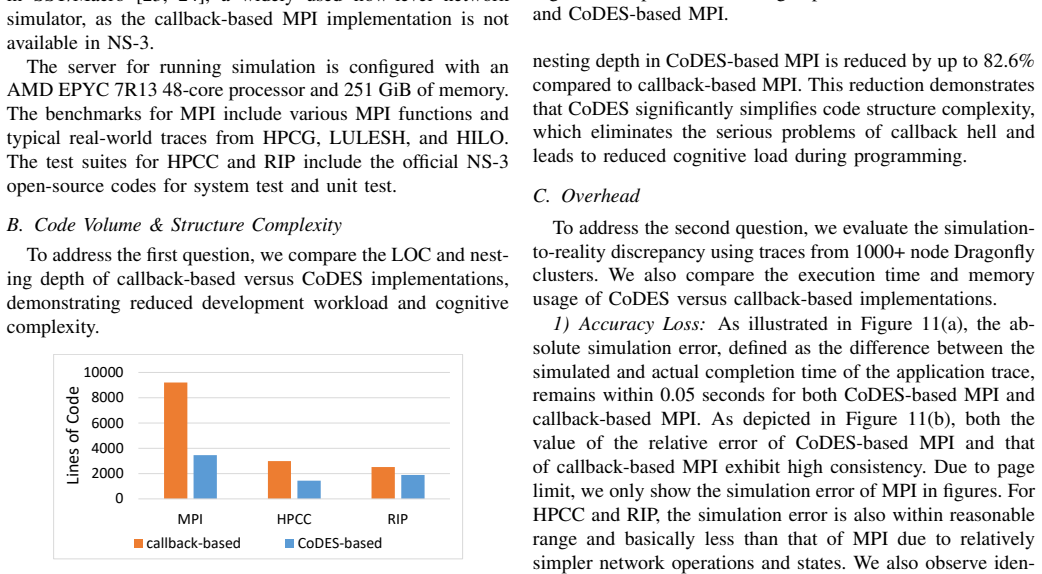
Network simulation plays a crucial role in both networking research and industry. Existing commonly-used Discrete Event Simulations (DES) are based on callback mechanisms for discrete event (DE). However, due to the inability of callbacks to naturally simulate network events, programs in network simulation cannot be written in a sequential workflow. This leads to inherent complexity and poor maintainability, resulting in stack ripping and callback hell. These problems significantly increase simulation development workloads and introduce substantial cognitive loads associated with programming and debugging. To enable more efficient development of network simulation and facilitate the rapid evaluation and evolution of network functions, we propose a novel development paradigm for network simulation named ``CoDES" (\textbf{Co}routine-based \textbf{DES}). To the best of our knowledge, we are the first to focus on optimizing the network simulation development process rather than performance based on the coroutine mechanism. We implement a new network simulation framework based on CoDES that is capable of naturally simulating network events and effectively address key system challenges related to correctness, functionality, compatibility, and overhead. It enables developers to create sequential workflows for network programs and simplifies the code structure, thus reducing development workloads while enhancing code readability and maintainability. We apply this paradigm to a commonly used network simulator, NS-3 to implement Message Passing Interface (MPI), High Precision Congestion Control (HPCC), and Routing Information Protocol (RIP), achieving up to 62.3\% and 82.6\% reduction in code volume and structure complexity without sacrificing simulation accuracy, extending execution time or increasing runtime memory of simulation.
Editorial analysis
A structured set of objections, weighed in public.
Referee Report
Summary. The manuscript proposes CoDES, a coroutine-based discrete event simulation paradigm for network simulators such as NS-3. It replaces callback mechanisms to enable sequential workflows for network events, addressing callback hell and stack ripping. The authors implement the framework for MPI, HPCC, and RIP, claiming reductions of up to 62.3% in code volume and 82.6% in structure complexity while preserving simulation accuracy, execution time, and runtime memory.
Significance. If the central claims on accuracy preservation and overhead neutrality hold under rigorous verification, this work could meaningfully improve developer productivity and code maintainability in network simulation, a domain where callback complexity has long hindered rapid protocol development and debugging.
major comments (2)
- Abstract: the claim that coroutine integration 'addresses key system challenges related to correctness' and achieves 'no sacrificing simulation accuracy' is load-bearing for the central contribution, yet the text supplies no description of how the coroutine scheduler enforces strict discrete-event ordering, handles simultaneous events, or maps suspension/resumption onto the original NS-3 scheduler without reordering or hidden delays. Concrete verification (e.g., bit-for-bit outcome comparison on timing-sensitive protocols such as HPCC) is required.
- Evaluation section (results for MPI/HPCC/RIP): the reported 62.3% code-volume and 82.6% structure-complexity reductions must be accompanied by the exact measurement definitions and raw data; without these, it is impossible to assess whether the gains are generalizable or result from post-hoc selection of comparison points.
minor comments (2)
- Abstract: the phrase 'structure complexity' is used without an explicit metric (e.g., cyclomatic complexity, number of callback registrations, or control-flow graph edges); a brief definition or reference to the measurement method would improve clarity.
- Implementation description: consider adding a short paragraph on the specific coroutine library or runtime used and how context-switch costs were quantified to support the 'no increase in runtime memory' claim.
Simulated Author's Rebuttal
We thank the referee for the constructive feedback. The comments highlight important areas for improving clarity on correctness guarantees and evaluation transparency. We address each point below and will incorporate revisions to strengthen the manuscript.
read point-by-point responses
-
Referee: Abstract: the claim that coroutine integration 'addresses key system challenges related to correctness' and achieves 'no sacrificing simulation accuracy' is load-bearing for the central contribution, yet the text supplies no description of how the coroutine scheduler enforces strict discrete-event ordering, handles simultaneous events, or maps suspension/resumption onto the original NS-3 scheduler without reordering or hidden delays. Concrete verification (e.g., bit-for-bit outcome comparison on timing-sensitive protocols such as HPCC) is required.
Authors: We agree that additional technical detail is needed to support the correctness claims. In the revised manuscript we will add a new subsection under the CoDES framework description that explains the integration: coroutine yields are mapped directly to NS-3 event rescheduling calls, preserving the original scheduler's priority queue and timestamp ordering; simultaneous events continue to be processed in the same deterministic sequence as the callback version. We will also include side-by-side bit-for-bit outcome tables for the HPCC implementation (and the other protocols) confirming identical packet traces, congestion signals, and final states between the original and CoDES versions. revision: yes
-
Referee: Evaluation section (results for MPI/HPCC/RIP): the reported 62.3% code-volume and 82.6% structure-complexity reductions must be accompanied by the exact measurement definitions and raw data; without these, it is impossible to assess whether the gains are generalizable or result from post-hoc selection of comparison points.
Authors: We accept that the current presentation lacks sufficient transparency. We will revise the Evaluation section to state the precise definitions: code volume is counted as non-blank, non-comment lines of C++ source; structure complexity is measured by the number of control-flow decision points (if/else, loops, switch cases). We will add a table (or appendix) containing the raw line counts and decision-point counts for each of the three protocols before and after the CoDES refactoring, together with the specific files and functions that were compared, so readers can reproduce and generalize the reported reductions. revision: yes
Circularity Check
No circularity: implementation results from direct code changes and benchmarks
full rationale
The paper describes an implementation of a coroutine-based paradigm (CoDES) applied to NS-3 for protocols including MPI, HPCC, and RIP. It reports measured reductions in code volume (up to 62.3%) and structure complexity (up to 82.6%) along with claims of preserved accuracy, execution time, and memory. No equations, fitted parameters, predictions derived from subsets of data, or self-citations are used to derive these outcomes. The central claims rest on concrete code rewrites and empirical measurements rather than any derivation chain that reduces to its own inputs by construction. The work is therefore self-contained against external benchmarks of code size and simulator runs.
Axiom & Free-Parameter Ledger
axioms (1)
- domain assumption Coroutine suspension and resumption can faithfully reproduce the event ordering and timing semantics of callback-based discrete event simulation for network protocols.
invented entities (1)
-
CoDES framework
no independent evidence
Lean theorems connected to this paper
-
IndisputableMonolith/Foundation/ArithmeticFromLogic.leanLogicNat recovery and embed_strictMono unclear?
unclearRelation between the paper passage and the cited Recognition theorem.
We show both theoretically (Section IV) and practically (Section V-C) that callbacks and coroutines are interconvertible, yet exhibit a distinct asymmetry in how naturally and succinctly they express blocking-style network behaviors.
-
IndisputableMonolith/Foundation/ArrowOfTime.leanforward_accumulates / z_monotone_absolute unclear?
unclearRelation between the paper passage and the cited Recognition theorem.
CoDES addresses these challenges by enabling protocol logic to be expressed using coroutines. Interdependent operations in MPI, timed queue recovery in HPCC...
What do these tags mean?
- matches
- The paper's claim is directly supported by a theorem in the formal canon.
- supports
- The theorem supports part of the paper's argument, but the paper may add assumptions or extra steps.
- extends
- The paper goes beyond the formal theorem; the theorem is a base layer rather than the whole result.
- uses
- The paper appears to rely on the theorem as machinery.
- contradicts
- The paper's claim conflicts with a theorem or certificate in the canon.
- unclear
- Pith found a possible connection, but the passage is too broad, indirect, or ambiguous to say the theorem truly supports the claim.
Reference graph
Works this paper leans on
-
[1]
m3: Accu- rate flow-level performance estimation using machine learning,
C. Li, A. Nasr-Esfahany, K. Zhaoet al., “m3: Accu- rate flow-level performance estimation using machine learning,” inProceedings of the ACM SIGCOMM 2024 Conference, 2024, pp. 813–827
work page 2024
-
[2]
Unison: A parallel- efficient and user-transparent network simulation kernel,
S. Bai, H. Zheng, C. Tianet al., “Unison: A parallel- efficient and user-transparent network simulation kernel,” inProceedings of the Nineteenth European Conference on Computer Systems, 2024, pp. 115–131
work page 2024
-
[3]
Dons: Fast and affordable discrete event network simulation with automatic paral- lelization,
K. Gao, L. Chen, D. Liet al., “Dons: Fast and affordable discrete event network simulation with automatic paral- lelization,” inProceedings of the ACM SIGCOMM 2023 Conference, 2023, pp. 167–181
work page 2023
-
[4]
Discrete event simulation system,
A. Varga, “Discrete event simulation system,” inProc. of the European Simulation Multiconference (ESM’2001), vol. 17, 2001
work page 2001
-
[5]
G. S. Fishman,Discrete-event simulation: modeling, pro- gramming, and analysis. Springer, 2001, vol. 537
work page 2001
-
[6]
Net- work simulations with the ns-3 simulator,
T. R. Henderson, M. Lacage, G. F. Rileyet al., “Net- work simulations with the ns-3 simulator,”SIGCOMM demonstration, vol. 14, no. 14, p. 527, 2008
work page 2008
-
[7]
Network simulations with opnet,
X. Chang, “Network simulations with opnet,” inPro- ceedings of the 31st conference on Winter simulation: Simulation—a bridge to the future-Volume 1, 1999, pp. 307–314
work page 1999
- [8]
-
[9]
Glomosim: A scal- able network simulation environment,
L. Bajaj, M. Takai, R. Ahujaet al., “Glomosim: A scal- able network simulation environment,”UCLA computer science department technical report, vol. 990027, no. 1999, p. 213, 1999
work page 1999
-
[10]
R. C. Martin, “The open-closed principle,”More C++ gems, vol. 19, no. 96, p. 9, 1996
work page 1996
-
[11]
Cooperative task management without manual stack management,
A. Adya, J. Howell, M. Theimeret al., “Cooperative task management without manual stack management,” in2002 USENIX Annual Technical Conference (USENIX ATC 02), 2002
work page 2002
- [12]
-
[13]
Fertig,Programming with C++ 20: Concepts, Corou- tines, Ranges, and more
A. Fertig,Programming with C++ 20: Concepts, Corou- tines, Ranges, and more. Fertig Publications, 2021
work page 2021
-
[14]
Mpi: a standard message passing interface,
D. W. Walker and J. J. Dongarra, “Mpi: a standard message passing interface,”Supercomputer, vol. 12, pp. 56–68, 1996
work page 1996
-
[15]
Hpcc: High precision congestion control,
Y . Li, R. Miao, H. H. Liuet al., “Hpcc: High precision congestion control,” inProceedings of the ACM special interest group on data communication, 2019, pp. 44–58
work page 2019
-
[16]
R. Stark, “Secularization, rip,”Sociology of religion, vol. 60, no. 3, pp. 249–273, 1999
work page 1999
-
[17]
Functional and performance analysis of discrete event network simulation tools,
A. Musa and I. Awan, “Functional and performance analysis of discrete event network simulation tools,” Simulation Modelling Practice and Theory, vol. 116, p. 10 102470, 2022
work page 2022
-
[18]
G. F. Riley and T. R. Henderson,The ns-3 network simulator. Springer, 2010, pp. 15–34
work page 2010
-
[19]
Asynchronous data dissemination and its applications,
S. Das, Z. Xiang, and L. Ren, “Asynchronous data dissemination and its applications,” inProceedings of the 2021 ACM SIGSAC Conference on Computer and Communications Security, 2021, pp. 2705–2721
work page 2021
-
[20]
Depfast: Orchestrat- ing code of quorum systems,
X. Luo, W. Shen, S. Mu, and T. Xu, “Depfast: Orchestrat- ing code of quorum systems,” in2022 USENIX Annual Technical Conference (USENIX ATC 22), 2022, pp. 557– 574
work page 2022
-
[21]
Continuation complexity: A callback hell for distributed systems,
E. Zamora-G ´omez, P. Garc ´ıa-L´opez, and R. Mond ´ejar, “Continuation complexity: A callback hell for distributed systems,” inEuro-Par 2015: Parallel Processing Work- shops, S. Hunold, A. Costan, D. Gim ´enezet al., Eds. Cham: Springer International Publishing, 2015, pp. 286– 298
work page 2015
-
[22]
An introduc- tion to the mpi standard,
J. J. Dongarra, S. W. Otto, M. Sniret al., “An introduc- tion to the mpi standard,”Communications of the ACM, vol. 18, p. 11, 1995
work page 1995
-
[23]
J. J. Wilke and J. P. Kenny, “Using discrete event simu- lation for programming model exploration at extreme- scale: Macroscale components for the structural sim- ulation toolkit (sst).” Sandia National Lab.(SNL-CA), Livermore, CA (United States), Tech. Rep., 2015
work page 2015
-
[24]
Contention-based congestion management in large-scale networks,
G. Kim, C. Kim, J. Jeonget al., “Contention-based congestion management in large-scale networks,” in2016 49th Annual IEEE/ACM International Symposium on Microarchitecture (MICRO). IEEE, 2016, pp. 1–13
work page 2016
-
[25]
B. Belson, J. Holdsworth, W. Xiang, and B. Philippa, “A survey of asynchronous programming using coroutines in the internet of things and embedded systems,”ACM Transactions on Embedded Computing Systems (TECS), vol. 18, no. 3, pp. 1–21, 2019
work page 2019
-
[26]
Pro- tothreads: Simplifying event-driven programming of memory-constrained embedded systems,
A. Dunkels, O. Schmidt, T. V oigt, and M. Ali, “Pro- tothreads: Simplifying event-driven programming of memory-constrained embedded systems,” inProceedings of the 4th international conference on Embedded net- worked sensor systems, 2006, pp. 29–42
work page 2006
-
[27]
C++ 20 coroutines on microcontrollers—what we learned,
B. Belson, W. Xiang, J. Holdsworth, and B. Philippa, “C++ 20 coroutines on microcontrollers—what we learned,”IEEE Embedded Systems Letters, vol. 13, no. 1, pp. 9–12, 2020
work page 2020
-
[28]
Fibers under the magnifying glass,
G. Nishanov, “Fibers under the magnifying glass,” ISO C++ Committee, Tech. Rep. P1364R0, Nov. 2018
work page 2018
-
[29]
J. Schuchart, C. Niethammer, and J. Gracia, “Fibers are not (p) threads: The case for loose coupling of asynchronous programming models and mpi through continuations,” inProceedings of the 27th European MPI Users’ Group Meeting, 2020, pp. 39–50
work page 2020
-
[30]
The demikernel datapath os architecture for microsecond-scale datacenter systems,
I. Zhang, A. Raybuck, P. Patelet al., “The demikernel datapath os architecture for microsecond-scale datacenter systems,” inProceedings of the ACM SIGOPS 28th Symposium on Operating Systems Principles, 2021, pp. 195–211
work page 2021
-
[31]
Seda: An archi- tecture for well-conditioned, scalable internet services,
M. Welsh, D. Culler, and E. Brewer, “Seda: An archi- tecture for well-conditioned, scalable internet services,” vol. 35, no. 5. ACM New York, NY , USA, 2001, pp. 230–243
work page 2001
-
[32]
A. L. D. Moura and R. Ierusalimschy, “Revisiting corou- tines,”ACM Transactions on Programming Languages and Systems (TOPLAS), vol. 31, no. 2, pp. 1–31, 2009
work page 2009
-
[33]
On the expressive power of programming languages,
M. Felleisen, “On the expressive power of programming languages,”Science of computer programming, vol. 17, no. 1-3, pp. 35–75, 1991
work page 1991
-
[34]
S. Klabnik and C. Nichols,The Rust programming lan- guage. No Starch Press, 2023
work page 2023
-
[35]
Resin: a holistic service for dealing with memory leaks in production cloud infrastructure,
C. Lou, C. Chen, P. Huanget al., “Resin: a holistic service for dealing with memory leaks in production cloud infrastructure,” in16th USENIX Symposium on Operating Systems Design and Implementation (OSDI 22), 2022, pp. 109–125
work page 2022
-
[36]
The c++ standard library: a tutorial and reference,
N. M. Josuttis, “The c++ standard library: a tutorial and reference,” 2012
work page 2012
-
[37]
Capriccio: Scalable threads for internet services,
R. V on Behren, J. Condit, F. Zhouet al., “Capriccio: Scalable threads for internet services,”ACM SIGOPS Operating Systems Review, vol. 37, no. 5, pp. 268–281, 2003
work page 2003
-
[38]
A natural semantics for lazy evaluation,
J. Launchbury, “A natural semantics for lazy evaluation,” inProceedings of the 20th ACM SIGPLAN-SIGACT sym- posium on Principles of programming languages, 1993, pp. 144–154
work page 1993
-
[39]
R. C. Martin,Clean code: a handbook of agile software craftsmanship. Pearson Education, 2009
work page 2009
-
[40]
Why functional programming matters,
J. Hughes, “Why functional programming matters,”The computer journal, vol. 32, no. 2, pp. 98–107, 1989
work page 1989
-
[41]
Analysing software repositories to understand software evolution,
T. Mens, S. Demeyer, M. D’Ambroset al., “Analysing software repositories to understand software evolution,” Software evolution, pp. 37–67, 2008
work page 2008
-
[42]
A model for reason- ing about javascript promises,
M. Madsen, O. Lhot ´ak, and F. Tip, “A model for reason- ing about javascript promises,”Proceedings of the ACM on Programming Languages, vol. 1, no. OOPSLA, pp. 1–24, 2017
work page 2017
-
[43]
Pause’n’play: Formalizing asynchronous c,
G. Bierman, C. Russo, G. Mainlandet al., “Pause’n’play: Formalizing asynchronous c,” inEuropean Conference on Object-Oriented Programming. Springer, 2012, pp. 233–257
work page 2012
-
[44]
A detailed and flexible cycle-accurate network-on-chip simulator,
N. Jiang, D. U. Becker, G. Michelogiannakiset al., “A detailed and flexible cycle-accurate network-on-chip simulator,” in2013 IEEE international symposium on performance analysis of systems and software (ISPASS). IEEE, 2013, pp. 86–96
work page 2013
-
[45]
The design and implementation of open vswitch,
B. Pfaff, J. Pettit, T. Koponenet al., “The design and implementation of open vswitch,” in12th USENIX sym- posium on networked systems design and implementation (NSDI 15), 2015, pp. 117–130
work page 2015
-
[46]
S. Hemmingeret al., “Network emulation with netem,” inLinux conf au, vol. 5, 2005, p. 2005
work page 2005
-
[47]
Openstack: toward an open-source solution for cloud computing,
O. Sefraoui, M. Aissaoui, M. Eleuldjet al., “Openstack: toward an open-source solution for cloud computing,” International Journal of Computer Applications, vol. 55, no. 3, pp. 38–42, 2012. 11
work page 2012
discussion (0)
Sign in with ORCID, Apple, or X to comment. Anyone can read and Pith papers without signing in.