Transition asymptotics for the real solutions of the sinh-Gordon Painlev\'e III equation
Pith reviewed 2026-06-30 00:39 UTC · model grok-4.3
The pith
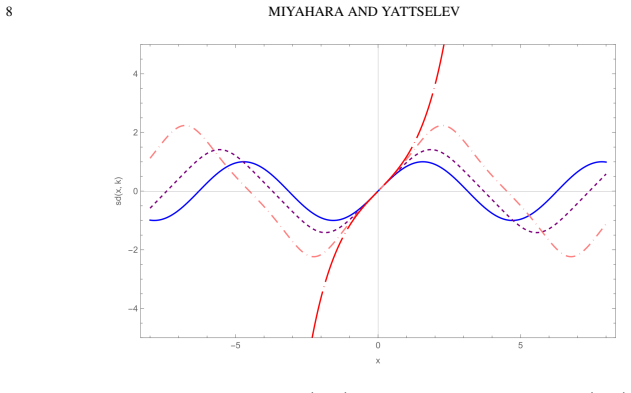
The asymptotics of real solutions to the sinh-Gordon Painlevé III equation transition between exponential, elliptic, and trigonometric regimes depending on the scaling parameter ϰ.
A machine-rendered reading of the paper's core claim, the machinery that carries it, and where it could break.
Core claim
If we parametrize |p|^2 = 1 + e^{2ϰ x}, then the smooth exponential asymptotics of the solutions extends to the region ϰ>1, with a change of the leading order term at ϰ=2; at ϰ=1 the exponential behavior transitions into an elliptic asymptotics, which holds for all 0<ϰ<1; as ϰ decays to zero, elliptic asymptotics degenerates into trigonometric one, which holds for all p fixed.
What carries the argument
The scaling relation |p|^2 = 1 + e^{2ϰ x} combined with the condition 2 Im(p) = -s^R that interpolates between finite and infinite p while maintaining reality of the solution.
If this is right
- Exponential asymptotics persist for ϰ greater than 1, but the leading term changes when ϰ exceeds 2.
- Elliptic asymptotics govern the behavior throughout the interval 0 < ϰ < 1.
- Trigonometric asymptotics emerge in the limit of small ϰ and remain valid for any fixed p.
- The transition point ϰ equals 1 marks the boundary between exponential and elliptic regimes.
Where Pith is reading between the lines
- The same scaling might be used to derive higher-order corrections that are uniform across the transition.
- These transition results could inform the study of other Painlevé equations that admit similar monodromy parametrizations.
- Numerical integration of the differential equation for intermediate ϰ values could confirm the predicted elliptic behavior.
Load-bearing premise
The specific scaling |p|^2 = 1 + e^{2ϰ x} together with the relation 2 Im(p) = -s^R correctly captures the continuous transition between the singular solutions (|p| finite) and the smooth solutions (p = ∞) while preserving the reality condition on (0, ∞).
What would settle it
Numerical computation of a solution for ϰ slightly larger than 1 and slightly smaller than 1, checking whether the large-x behavior switches from exponential decay or growth to oscillatory elliptic type at exactly ϰ=1.
Figures







read the original abstract
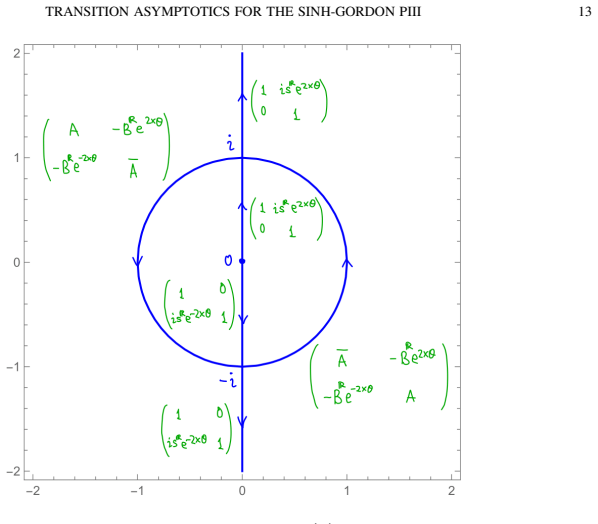
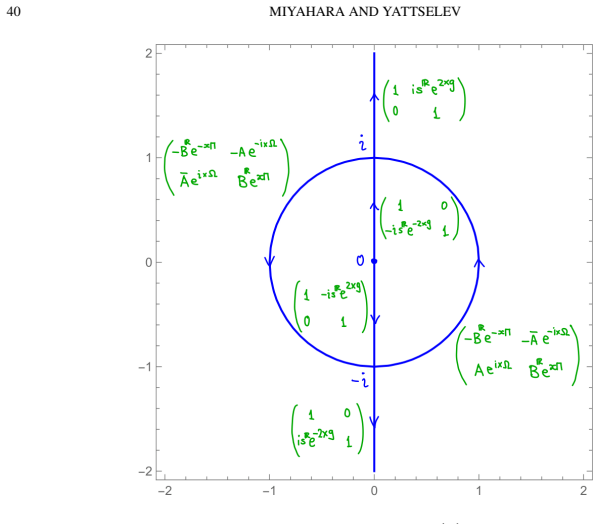
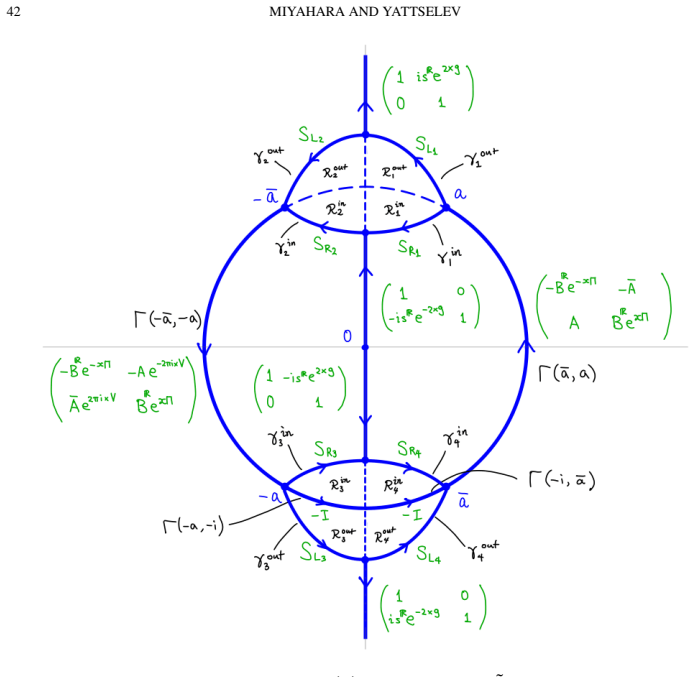
We consider solutions of the sinh-Gordon Painlev\'e III equation \[ u_{xx} + \frac{1}{x} u_x = \sinh u \] that are real on $(0,\infty)$. They are parametrized by the monodromy parameter $p\in\overline{\mathbb{C}}$, $|p|>1$, and an additional real parameter $s^{\mathbb{R}}$ when $p=\infty$. Our previous joint work with A. Its described the asymptotic behavior of these solutions as $x\to\infty$. Here, we describe the transition as $x, p\to \infty$, $2\Im(p)=-s^{\mathbb R}$, between singular solutions ($|p|<\infty$) and smooth solutions ($p=\infty$). In short, if we parametrize $|p|^2 = 1 + e^{2\varkappa x}$, then the smooth exponential asymptotics of the solutions extends to the region $\varkappa>1$, with a change of the leading order term at $\varkappa=2$; at $\varkappa=1$ the exponential behavior transitions into an elliptic asymptotics, which holds for all $0<\varkappa<1$; as $\varkappa$ decays to zero, elliptic asymptotics degenerates into trigonometric one, which holds for all $p$ fixed.
Editorial analysis
A structured set of objections, weighed in public.
Referee Report
Summary. The manuscript examines real solutions on (0,∞) of the sinh-Gordon Painlevé III equation u_xx + (1/x)u_x = sinh u, parametrized by the monodromy datum p ∈ ℂ̄ with |p|>1 together with an auxiliary real parameter s^ℝ when p=∞. Building on prior joint work with Its that treated the x→∞ asymptotics for fixed p, the paper analyzes the joint limit x,p→∞ subject to 2 Im(p)=-s^ℝ. Under the auxiliary scaling |p|^2=1+e^{2ϰ x} it asserts four regimes: smooth exponential asymptotics persist for ϰ>1 (with a change of leading coefficient at ϰ=2), an elliptic regime occupies 0<ϰ<1, and the elliptic description degenerates to a trigonometric one as ϰ→0 (recovering the fixed-p case).
Significance. If the claimed transition asymptotics are rigorously established, the work supplies a continuous interpolation between the singular (|p|<∞) and smooth (p=∞) families that was missing from the earlier fixed-p analysis. Such a parametrization-dependent unification is potentially useful for applications in integrable systems and random-matrix theory that require control across the full range of monodromy data.
major comments (2)
- [Abstract] Abstract: the central scaling |p|^2=1+e^{2ϰ x} together with the reality link 2 Im(p)=-s^ℝ is asserted to produce a continuous transition, yet no derivation or matching argument is supplied showing how this choice arises from the underlying Riemann-Hilbert or isomonodromic problem; without that step the claim that the scaling preserves the reality condition on (0,∞) remains unverified.
- [Abstract] Abstract: the transition points ϰ=2 and ϰ=1 are stated to mark changes in leading-order behavior, but no error estimates, uniformity statements, or matching conditions between the exponential, elliptic, and trigonometric regimes are indicated; these are load-bearing for the asserted continuity of the transition.
Simulated Author's Rebuttal
We thank the referee for the careful review and constructive suggestions. The comments correctly identify areas where the abstract could better motivate the scaling and clarify the technical underpinnings of the transitions. We respond point-by-point below and will incorporate clarifications in a revised manuscript.
read point-by-point responses
-
Referee: [Abstract] Abstract: the central scaling |p|^2=1+e^{2ϰ x} together with the reality link 2 Im(p)=-s^ℝ is asserted to produce a continuous transition, yet no derivation or matching argument is supplied showing how this choice arises from the underlying Riemann-Hilbert or isomonodromic problem; without that step the claim that the scaling preserves the reality condition on (0,∞) remains unverified.
Authors: We agree that the abstract does not derive the scaling. The parametrization |p|^2 = 1 + e^{2ϰ x} is chosen so that the deviation from the unit circle grows exponentially in x, thereby interpolating between the fixed-p (singular) regime recovered as ϰ → 0 and the p = ∞ (smooth) regime recovered as ϰ → ∞. The auxiliary condition 2 Im(p) = -s^ℝ is imposed directly on the monodromy data to guarantee that the associated solution u remains real-valued on (0,∞). A short derivation showing how this scaling emerges from the underlying Riemann-Hilbert problem (via the isomonodromic deformation equations) will be added to the introduction of the revised manuscript. revision: yes
-
Referee: [Abstract] Abstract: the transition points ϰ=2 and ϰ=1 are stated to mark changes in leading-order behavior, but no error estimates, uniformity statements, or matching conditions between the exponential, elliptic, and trigonometric regimes are indicated; these are load-bearing for the asserted continuity of the transition.
Authors: The referee correctly observes that the abstract omits error estimates, uniformity statements, and explicit matching conditions. The body of the manuscript derives the leading-order asymptotics separately in each regime via steepest-descent analysis of the Riemann-Hilbert problem. To substantiate the claimed continuity, we will add a dedicated paragraph (or short subsection) that outlines the matching procedure across the critical values ϰ = 2 and ϰ = 1, together with the available error bounds and the regions of uniformity. This material will be placed immediately after the statement of the main results. revision: yes
Circularity Check
Minor self-citation to prior asymptotics; independent scaling parameter introduced
full rationale
The paper cites its prior joint work with A. Its solely for the base large-x asymptotics of real solutions. The transition analysis is performed by adopting the explicit parametrization |p|^2 = 1 + e^{2ϰ x} together with the reality link 2 Im(p) = -s^R; this scaling is presented as a choice that captures the continuous transition between singular and smooth regimes and is not derived from or fitted to the target asymptotic quantities. No load-bearing step reduces by construction to a self-citation, a fitted input renamed as prediction, or a self-definitional relation. The new regimes (ϰ > 1, ϰ = 1 transition, 0 < ϰ < 1 elliptic, ϰ → 0 trigonometric) therefore retain independent content.
Axiom & Free-Parameter Ledger
free parameters (1)
- ϰ
axioms (1)
- domain assumption Real solutions on (0, ∞) are parametrized by p ∈ ℂ-bar with |p| > 1 and, when p = ∞, by an additional real parameter s^R.
Reference graph
Works this paper leans on
-
[1]
Deift, Percy , title =
-
[2]
B\"ottcher, Albrecht and Karlovich, Yuri I. , TITLE =. 1997 , PAGES =. doi:10.1007/978-3-0348-8922-3 , URL =
-
[3]
Ince, E. L. , TITLE =. 1944 , PAGES =
1944
-
[4]
Fokas, Athanassios S. and Its, Alexander R. and Kapaev, Andrei A. and Novokshenov, Victor Yu. , TITLE =. 2006 , PAGES =. doi:10.1090/surv/128 , URL =
-
[5]
Olver, Frank W. J. , TITLE =. 1997 , PAGES =
1997
-
[6]
Its, Alexander R. , TITLE =. Random matrices, random processes and integrable systems , SERIES =. 2011 , MRCLASS =. doi:10.1007/978-1-4419-9514-8\_5 , URL =
-
[7]
and Gohberg, Israel , TITLE =
Clancey, Kevin F. and Gohberg, Israel , TITLE =. 1981 , PAGES =
1981
-
[8]
Guest, Martin A. and Its, Alexander R. and Lin, Chang-Shou , TITLE =. Int. Math. Res. Not. IMRN , FJOURNAL =. 2015 , NUMBER =. doi:10.1093/imrn/rnu250 , URL =
-
[9]
Guest, Martin A. and Its, Alexander R. and Lin, Chang-Shou , TITLE =. Comm. Math. Phys. , FJOURNAL =. 2015 , NUMBER =. doi:10.1007/s00220-014-2280-x , URL =
-
[10]
Guest, Martin A. and Its, Alexander R. and Lin, Chang-Shou , TITLE =. Comm. Math. Phys. , FJOURNAL =. 2020 , NUMBER =. doi:10.1007/s00220-019-03559-5 , URL =
-
[11]
Guest, Martin A. and Its, Alexander R. and Lin, Chang-Shou , TITLE =. Adv. Math. , FJOURNAL =. 2026 , PAGES =. doi:10.1016/j.aim.2025.110730 , URL =
-
[12]
2009 , PAGES =
Niles, David Gregory , TITLE =. 2009 , PAGES =
2009
-
[13]
1986 , PAGES =
Pressley, Andrew and Segal, Graeme , TITLE =. 1986 , PAGES =
1986
-
[14]
Asymptotic behavior as
Novoksh\". Asymptotic behavior as. Izv. Akad. Nauk SSSR Ser. Mat. , FJOURNAL =. 1984 , NUMBER =
1984
-
[15]
The method of isomonodromic deformation and the asymptotics of the third
Novoksh\". The method of isomonodromic deformation and the asymptotics of the third. Funktsional. Anal. i Prilozhen. , FJOURNAL =. 1984 , NUMBER =
1984
-
[16]
The asymptotic behavior of the general real solution of the third
Novoksh\". The asymptotic behavior of the general real solution of the third. Dokl. Akad. Nauk SSSR , FJOURNAL =. 1985 , NUMBER =
1985
-
[17]
Movable poles of solutions of the
Novoksh\". Movable poles of solutions of the. Funktsional. Anal. i Prilozhen. , FJOURNAL =. 1986 , NUMBER =
1986
-
[18]
Tracy, Craig A. and Widom, Harold , TITLE =. Comm. Math. Phys. , FJOURNAL =. 1998 , NUMBER =. doi:10.1007/s002200050257 , URL =
-
[19]
Alexander V. Mikhailov , abstract =. The reduction problem and the inverse scattering method , journal =. 1981 , issn =. doi:https://doi.org/10.1016/0167-2789(81)90120-2 , url =
-
[20]
Kitaev, Alexander V. , TITLE =. Zap. Nauchn. Sem. Leningrad. Otdel. Mat. Inst. Steklov. (LOMI) , FJOURNAL =. 1987 , NUMBER =. doi:10.1007/BF01096090 , URL =
-
[21]
Nonlinearity , FJOURNAL =
McIntosh, Ian , TITLE =. Nonlinearity , FJOURNAL =. 1994 , NUMBER =
1994
-
[22]
Cecotti, Sergio and Vafa, Cumrun , TITLE =. Nuclear Phys. B , FJOURNAL =. 1991 , NUMBER =. doi:10.1016/0550-3213(91)90021-O , URL =
-
[23]
Cecotti, S. and Vafa, Cumrun , TITLE =. Phys. Rev. Lett. , FJOURNAL =. 1992 , NUMBER =. doi:10.1103/PhysRevLett.68.903 , URL =
-
[24]
Cecotti, Sergio and Vafa, Cumrun , TITLE =. Comm. Math. Phys. , FJOURNAL =. 1993 , NUMBER =
1993
-
[25]
, TITLE =
Flaschka, Hermann and Newell, Alan C. , TITLE =. Comm. Math. Phys. , FJOURNAL =. 1980 , NUMBER =
1980
-
[26]
Jimbo, Michio and Miwa, Tetsuji and Ueno, Kimio , TITLE =. Phys. D , FJOURNAL =. 1981 , NUMBER =. doi:10.1016/0167-2789(81)90013-0 , URL =
-
[27]
Bobenko, Alexander and Its, Alexander , TITLE =. Manuscripta Math. , FJOURNAL =. 1995 , NUMBER =. doi:10.1007/BF02570481 , URL =
-
[28]
Kitaev, A. V. , TITLE =. Mat. Sb. (N.S.) , FJOURNAL =. 1987 , NUMBER =. doi:10.1070/SM1989v062n02ABEH003247 , URL =
-
[29]
Kitaev, A. V. and Vartanian, A. H. , TITLE =. Inverse Problems , FJOURNAL =. 2004 , NUMBER =. doi:10.1088/0266-5611/20/4/010 , URL =
-
[30]
Kitaev, A. V. and Vartanian, A. , TITLE =. Inverse Problems , FJOURNAL =. 2010 , NUMBER =. doi:10.1088/0266-5611/26/10/105010 , URL =
-
[31]
Novokshenov, V. Yu. and Shagalov, A. G. , TITLE =. Phys. D , FJOURNAL =. 1997 , NUMBER =. doi:10.1016/S0167-2789(97)89486-9 , URL =
-
[32]
Barouch, Eytan and McCoy, Barry M. and Wu, Tai Tsun , journal =. Zero-Field Susceptibility of the Two-Dimensional Ising Model near. 1973 , month =. doi:10.1103/PhysRevLett.31.1409 , url =
-
[33]
McCoy, Barry M. and Tracy, Craig A. and Wu, Tai Tsun , TITLE =. J. Mathematical Phys. , FJOURNAL =. 1977 , NUMBER =. doi:10.1063/1.523367 , URL =
-
[34]
Guest, Martin A. and Lin, Chang-Shou , TITLE =. Commun. Number Theory Phys. , FJOURNAL =. 2012 , NUMBER =. doi:10.4310/CNTP.2012.v6.n4.a3 , URL =
-
[35]
Guest, Martin A. and Lin, Chang-Shou , TITLE =. J. Reine Angew. Math. , FJOURNAL =. 2014 , PAGES =. doi:10.1515/crelle-2012-0057 , URL =
-
[36]
Guest and Alexander R
Martin A. Guest and Alexander R. Its and Maksim Kosmakov and Kenta Miyahara and Ryosuke Odoi , year=. Connection formulae for the radial
-
[37]
Bothner, Thomas and Its, Alexander , TITLE =. Phys. D , FJOURNAL =. 2012 , NUMBER =. doi:10.1016/j.physd.2012.02.014 , URL =
-
[38]
Fokas, A. S. and Its, A. R. and Sung, L.-Y. , TITLE =. Nonlinearity , FJOURNAL =. 2005 , NUMBER =. doi:10.1088/0951-7715/18/4/019 , URL =
-
[39]
Abdullaev, A. S. , TITLE =. Dokl. Akad. Nauk SSSR , FJOURNAL =. 1985 , NUMBER =
1985
-
[40]
Its, Alexander and Prokhorov, Andrei , TITLE =. Int. Math. Res. Not. IMRN , FJOURNAL =. 2016 , NUMBER =. doi:10.1093/imrn/rnv375 , URL =
-
[41]
Novokshenov, V. Yu. , TITLE =. Integrable systems and random matrices , SERIES =. 2008 , ISBN =. doi:10.1090/conm/458/08929 , URL =
-
[42]
Deift, P. and Zhou, X. , TITLE =. Ann. of Math. (2) , FJOURNAL =. 1993 , NUMBER =. doi:10.2307/2946540 , URL =
-
[43]
Guest, Martin A. and Hertling, Claus , TITLE =. 2017 , PAGES =. doi:10.1007/978-3-319-66526-9 , URL =
-
[44]
Novokshenov, V. Yu. , TITLE =. Difference equations, special functions and orthogonal polynomials , PAGES =. 2007 , ISBN =. doi:10.1142/9789812770752\_0037 , URL =
-
[45]
Its, Alexander and Niles, David , TITLE =. Lett. Math. Phys. , FJOURNAL =. 2011 , NUMBER =. doi:10.1007/s11005-010-0449-6 , URL =
-
[46]
Integrable systems and random matrices , SERIES =
Widom, Harold , TITLE =. Integrable systems and random matrices , SERIES =. 2008 , ISBN =. doi:10.1090/conm/458/08928 , URL =
-
[47]
SIGMA Symmetry Integrability Geom
Li, Yuqi , TITLE =. SIGMA Symmetry Integrability Geom. Methods Appl. , FJOURNAL =. 2024 , PAGES =. doi:10.3842/SIGMA.2024.057 , URL =
-
[48]
NIST Digital Library of Mathematical Functions
-
[49]
and Miyahara, Kenta and Yattselev, Maxim L
Its, Alexander R. and Miyahara, Kenta and Yattselev, Maxim L. , TITLE =. Lett. Math. Phys. , FJOURNAL =. 2025 , NUMBER =. doi:10.1007/s11005-024-01892-y , URL =
-
[50]
Bothner, Thomas , TITLE =. Duke Math. J. , FJOURNAL =. 2017 , NUMBER =. doi:10.1215/00127094-3714650 , URL =
-
[51]
Barhoumi, Ahmad and Bleher, Pavel and Dea\ no, Alfredo and Yattselev, Maxim , TITLE =. J. Math. Phys. , FJOURNAL =. 2022 , NUMBER =. doi:10.1063/5.0086911 , URL =
-
[52]
Babusci, D. and Dattoli, G. and Quattromini, M. , TITLE =. Appl. Math. Lett. , FJOURNAL =. 2012 , NUMBER =. doi:10.1016/j.aml.2012.02.043 , URL =
-
[53]
Whittaker, E. T. and Watson, G. N. , TITLE =. 2021 , PAGES =
2021
-
[54]
1981 , PAGES =
Forster, Otto , TITLE =. 1981 , PAGES =
1981
-
[55]
Pommerenke , date-modified =
Ch. Pommerenke , date-modified =. Boundary Behavior of Conformal Maps , volume =
-
[56]
and Knuth, Donald E
Graham, Ronald L. and Knuth, Donald E. and Patashnik, Oren , TITLE =. 1994 , PAGES =
1994
-
[57]
Takebe, Takashi , Title =. 2023 , Publisher =. doi:10.1007/978-3-031-30265-7 , Keywords =
-
[58]
Deift, P. and Kriecherbauer, T. and McLaughlin, K. T.-R. and Venakides, S. and Zhou, X. , TITLE =. Comm. Pure Appl. Math. , FJOURNAL =. 1999 , NUMBER =. doi:10.1002/(SICI)1097-0312(199911)52:11<1335::AID-CPA1>3.0.CO;2-1 , URL =
-
[59]
Deift, P. and Kriecherbauer, T. and McLaughlin, K. T-R and Venakides, S. and Zhou, X. , TITLE =. Comm. Pure Appl. Math. , FJOURNAL =. 1999 , NUMBER =. doi:10.1002/(SICI)1097-0312(199912)52:12<1491::AID-CPA2>3.3.CO;2-R , URL =
-
[60]
McKean, Henry and Moll, Victor , TITLE =. 1997 , PAGES =. doi:10.1017/CBO9781139174879 , URL =
-
[61]
McIntosh, Ian , TITLE =. Differential Geom. Appl. , FJOURNAL =. 2025 , PAGES =. doi:10.1016/j.difgeo.2025.102249 , URL =
-
[62]
Bothner, Thomas and Deift, Percy and Its, Alexander and Krasovsky, Igor , TITLE =. Comm. Math. Phys. , FJOURNAL =. 2015 , NUMBER =. doi:10.1007/s00220-015-2357-1 , URL =
-
[63]
Large truncated
Bothner, Thomas and Deift, Percy and Its, Alexander and Krasovsky, Igor , TITLE =. Large truncated. 2017 , ISBN =
2017
-
[64]
Bothner, Thomas and Deift, Percy and Its, Alexander and Krasovsky, Igor , TITLE =. J. Math. Phys. , FJOURNAL =. 2018 , NUMBER =. doi:10.1063/1.5050394 , URL =
-
[65]
In preparation , YEAR =
Bothner, Thomas and Deift, Percy and Its, Alexander and Krasovsky, Igor , TITLE =. In preparation , YEAR =
-
[66]
Kapaev, Andrei , TITLE =. Phys. Lett. A , FJOURNAL =. 1992 , NUMBER =. doi:10.1016/0375-9601(92)90271-M , URL =
-
[67]
Bothner, Thomas , TITLE =. J. Phys. A , FJOURNAL =. 2016 , NUMBER =. doi:10.1088/1751-8113/49/7/075204 , URL =
-
[68]
Bothner, Thomas and Buckingham, Robert , TITLE =. Comm. Math. Phys. , FJOURNAL =. 2018 , NUMBER =. doi:10.1007/s00220-017-3006-7 , URL =
-
[69]
Hastings, S. P. and McLeod, J. B. , TITLE =. Arch. Rational Mech. Anal. , FJOURNAL =. 1980 , NUMBER =. doi:10.1007/BF00283254 , URL =
-
[70]
Ablowitz, M. J. and Segur, H. , TITLE =. Studies in Appl. Math. , FJOURNAL =. 1976/77 , NUMBER =. doi:10.1002/sapm197757113 , URL =
-
[71]
Physica D: Nonlinear Phenomena , volume =
Asymptotic solutions of nonlinear evolution equations and a. Physica D: Nonlinear Phenomena , volume =. 1981 , issn =. doi:https://doi.org/10.1016/0167-2789(81)90124-X , AUTHOR =
discussion (0)
Sign in with ORCID, Apple, or X to comment. Anyone can read and Pith papers without signing in.