A practical probabilistic framework for deformable image registration uncertainty in radiotherapy dose propagation
Pith reviewed 2026-06-27 17:12 UTC · model grok-4.3
The pith
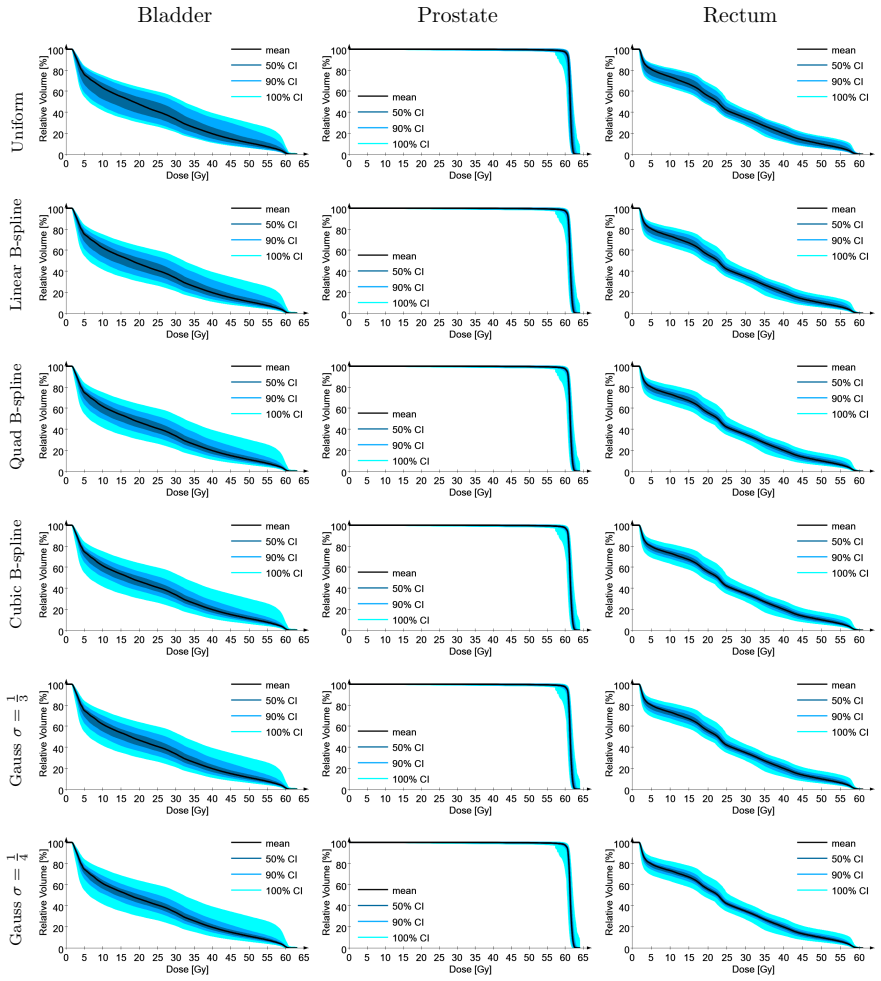
Modeling voxel mappings in DIR as random variables via local certainty maps produces dose probabilities, expected values, and DVH envelopes for radiotherapy.
A machine-rendered reading of the paper's core claim, the machinery that carries it, and where it could break.
Core claim
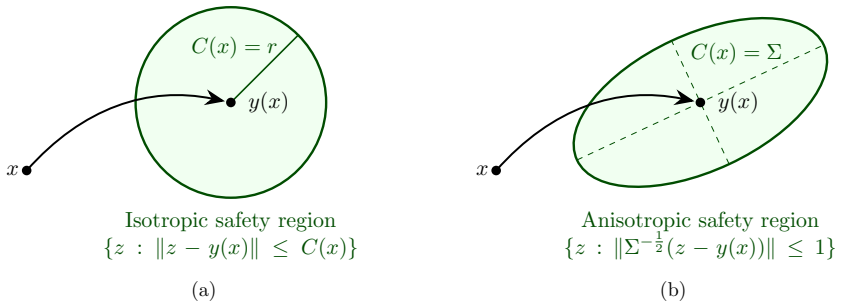
By representing the correspondence of each voxel under deformation as a random variable controlled by a transparent local certainty map, the framework computes interpretable probabilistic dose statistics and induced DVH envelopes while remaining computationally light and avoiding complex uncertainty models.
What carries the argument
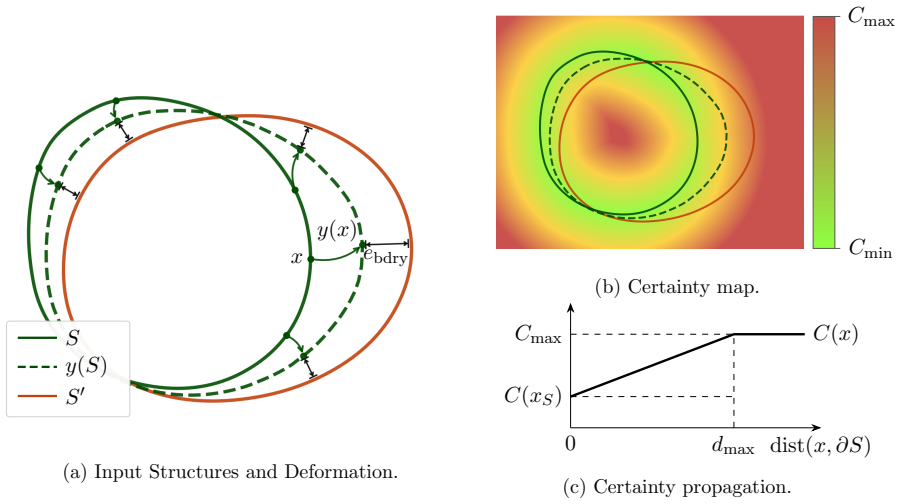
The local certainty map that defines the distribution of the random variable for mapped correspondence at each voxel.
If this is right
- Voxel-wise dose probabilities and expected doses become directly available from the registration output.
- Confidence bounds on delivered dose can be reported for each voxel.
- DVH envelopes quantify uncertainty ranges for volume receiving given dose levels.
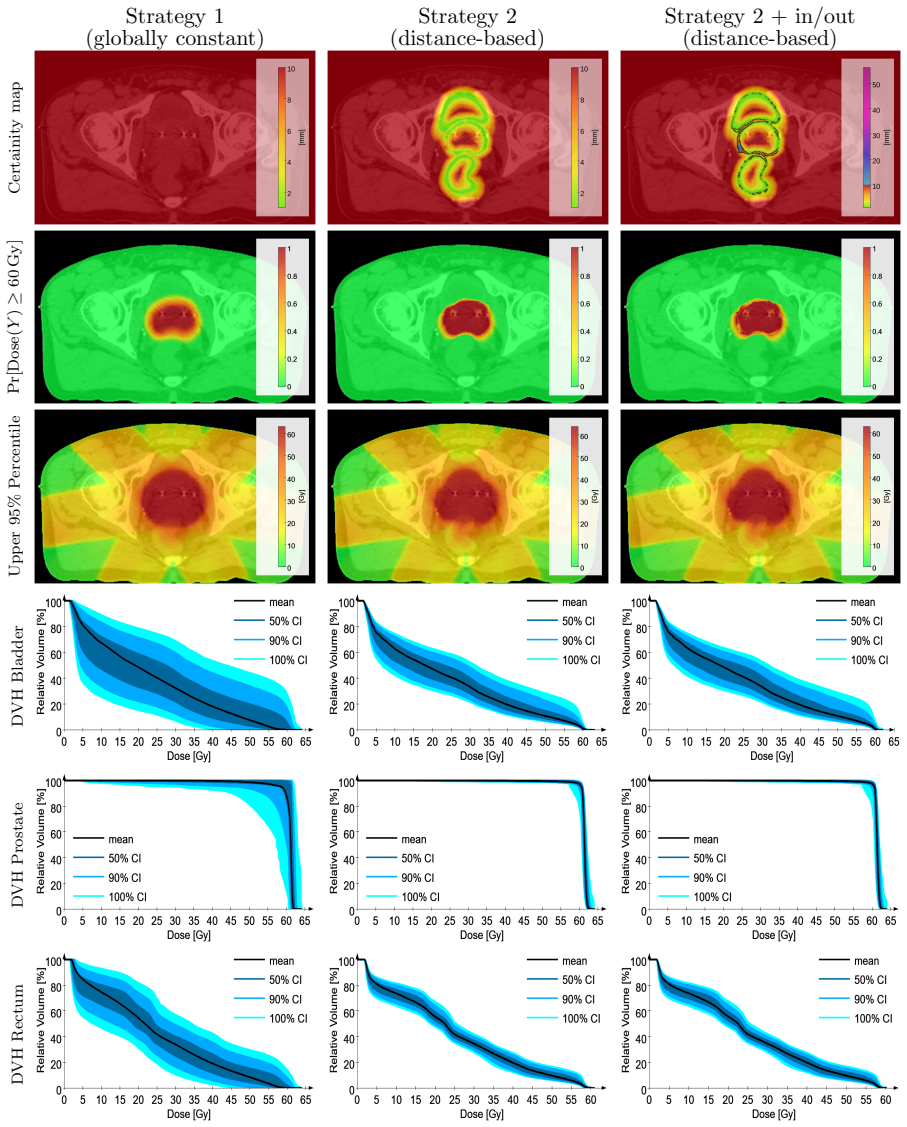
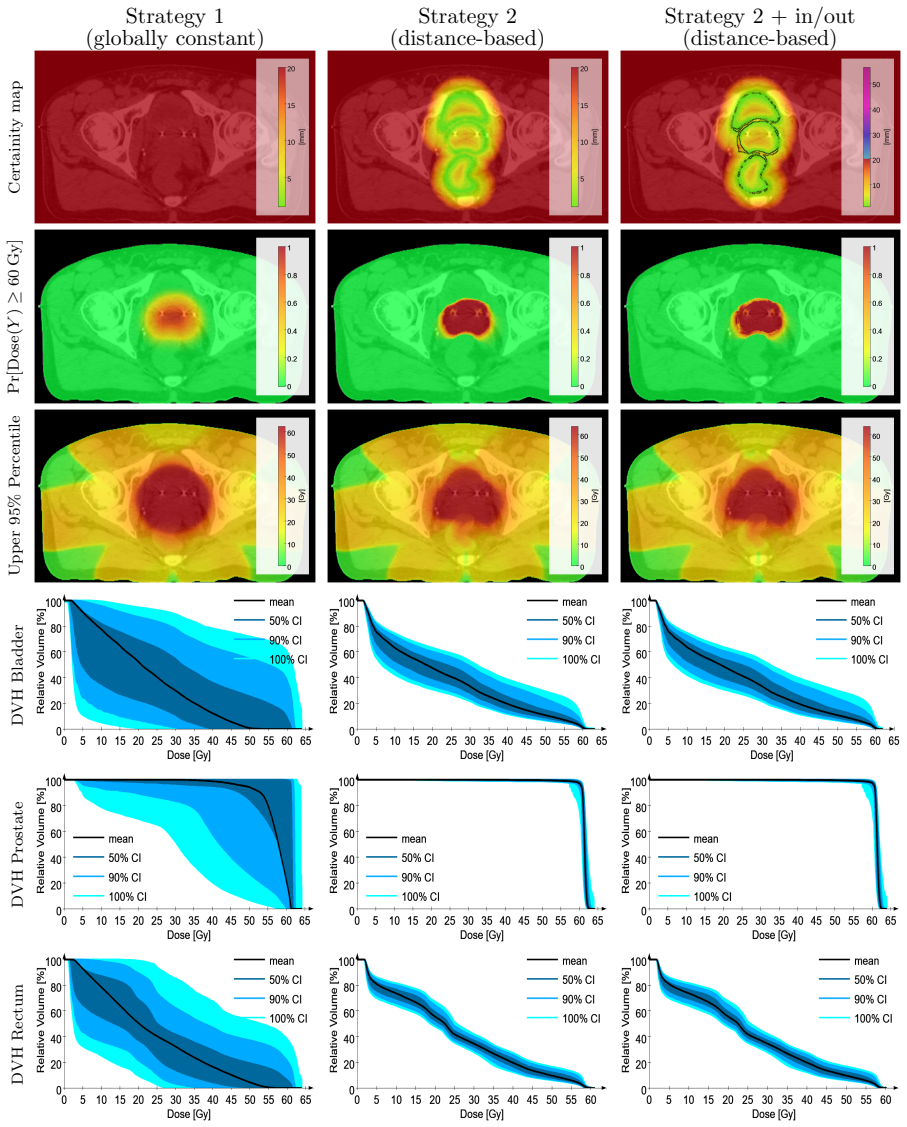
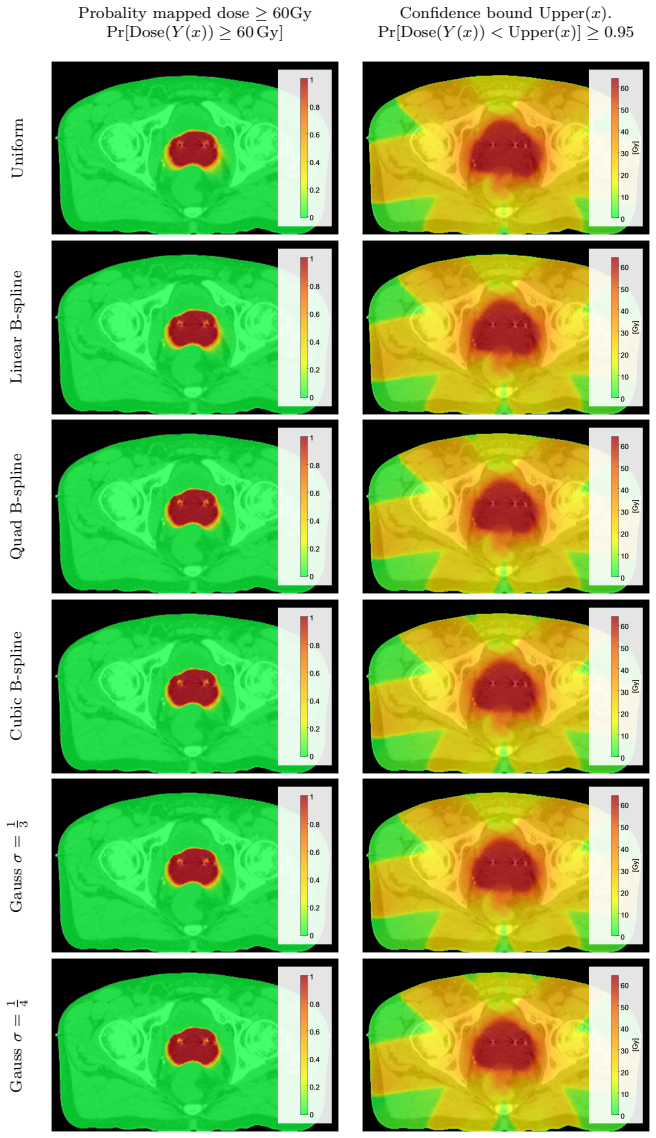
- Different certainty-map constructions can be compared for their effect on final dose uncertainty.
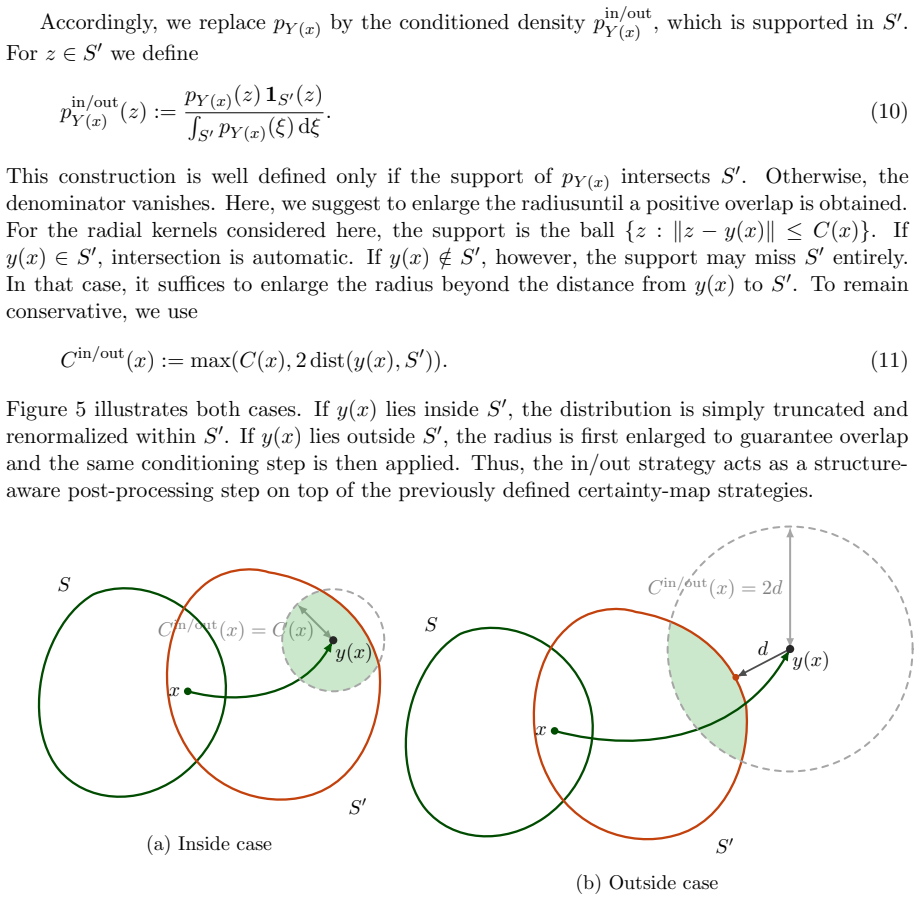
- The optional in/out strategy can restrict probability mass to anatomically plausible regions when desired.
Where Pith is reading between the lines
- Clinicians could use the resulting DVH envelopes to adjust planning margins on a per-structure basis.
- The same certainty-map idea might extend to other image-analysis tasks where correspondence uncertainty matters, such as longitudinal change detection.
- Integration into treatment-planning software would allow routine reporting of dose uncertainty alongside standard metrics.
- Case-by-case validation of the in/out strategy on additional anatomies would clarify when the modest benefit observed here becomes larger.
Load-bearing premise
A local certainty map built from simple safety margins, boundary mismatches, or conservative structure values is sufficient to control the random mapping at each voxel.
What would settle it
Compare the computed dose confidence bounds against the actual spread of doses obtained from multiple independent registrations or ground-truth deformations on the same patient data; large systematic mismatch would falsify the model.
Figures

read the original abstract
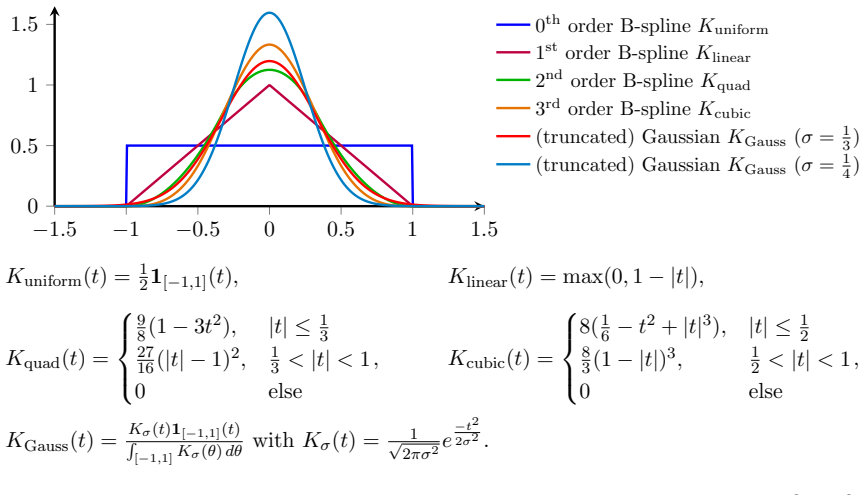
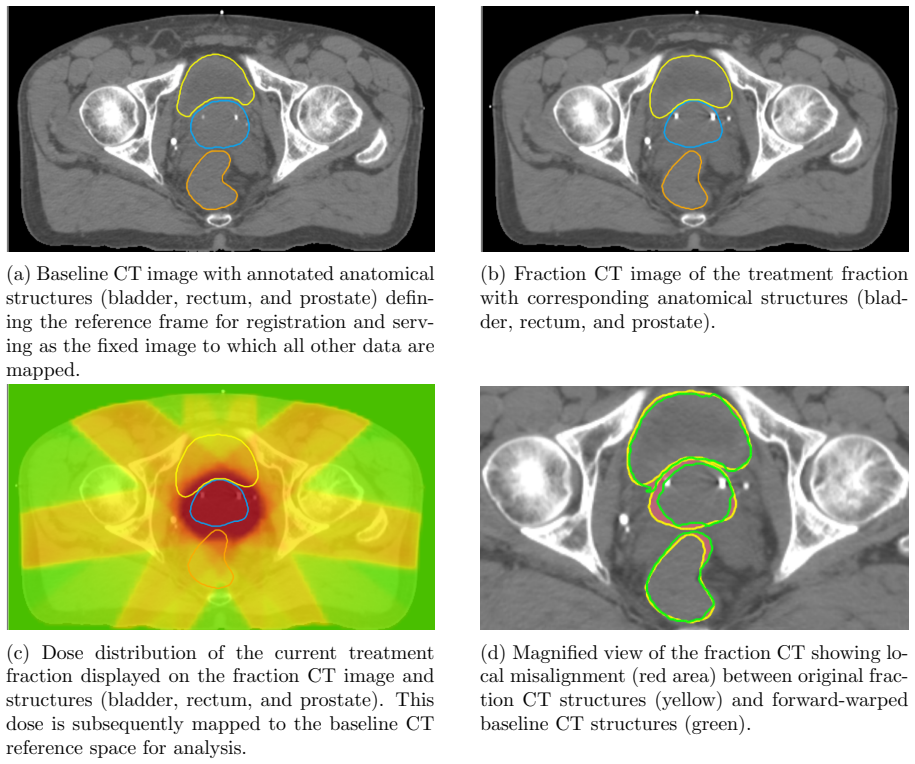
Deformable image registration (DIR) is widely used in radiotherapy for dose propagation and accumulation, but uncertainty in the underlying deformation can substantially affect clinically relevant dose estimates. We present a practical probabilistic framework for propagating DIR uncertainty to voxel-wise dose statistics and dose-volume histograms (DVHs). The method models the mapped correspondence at each voxel as a random variable governed by a transparent local certainty map that can be defined by simple safety margins, structure-boundary mismatch, or structure-wise conservative uncertainty values. This yields interpretable quantities such as dose probabilities, expected dose, confidence bounds, and induced DVH envelopes. The framework is designed to remain lightweight and interpretable: it avoids complex biomechanical or ensemble-based uncertainty models and instead emphasizes simple parameterization, computational feasibility, and transparent dose metrics. We further introduce a structure-guided in/out strategy as an optional refinement that restricts mapping probabilities to anatomically plausible target regions. The approach is demonstrated on a prostate radiotherapy case study and used to compare different certainty-map strategies and probability kernels. The experiments show that the certainty-map design has a stronger effect on resulting dose and DVH uncertainty bounds than the specific kernel choice, while the additional benefit of the in/out strategy is case-dependent and modest in the present example. Overall, the proposed framework provides a transparent way to incorporate DIR uncertainty into radiotherapy dose assessment and to study how modelling choices affect propagated dose metrics.
Editorial analysis
A structured set of objections, weighed in public.
Referee Report
Summary. The paper presents a practical probabilistic framework for propagating uncertainty from deformable image registration (DIR) to dose statistics and DVHs in radiotherapy. It models the mapped correspondence at each voxel as a random variable controlled by a user-defined local certainty map (via safety margins, boundary mismatch, or conservative values), optionally refined by a structure-guided in/out strategy. This produces dose probabilities, expected doses, confidence bounds, and DVH envelopes. The approach is demonstrated on a single prostate radiotherapy case study comparing different certainty-map strategies and probability kernels, finding that map design has stronger effect than kernel choice and in/out benefit is modest and case-dependent.
Significance. If the framework's outputs can be shown to accurately reflect actual registration uncertainty, it would provide a lightweight, interpretable, and computationally feasible method for incorporating DIR uncertainty into clinical dose assessment without requiring complex biomechanical models or large ensembles. The emphasis on transparent parameterization and the structure-guided refinement are positive features that could facilitate adoption in radiotherapy planning.
major comments (2)
- [Abstract] Abstract: the central claim that the framework yields interpretable quantities such as dose probabilities, expected dose, confidence bounds, and induced DVH envelopes by modeling the mapped correspondence at each voxel as a random variable governed by a transparent local certainty map is not supported by evidence that these maps produce calibrated outputs; the prostate case study only compares map designs and kernels and reports 'modest case-dependent gains' for the in/out strategy, with no quantitative calibration, overlap metrics with ensemble DIR variability, or biomechanical reference.
- [Case study demonstration] Case study demonstration (described in abstract): no error bars, coverage probabilities, mean absolute deviations, or statistical comparisons against independent uncertainty estimates are provided, so the reported effects of certainty-map design versus kernel choice cannot be assessed for robustness or clinical relevance.
minor comments (1)
- [Abstract] The abstract states the framework 'avoids complex biomechanical or ensemble-based uncertainty models' but does not specify how the probability kernels are normalized or whether they guarantee valid probability distributions over the mapping random variable.
Simulated Author's Rebuttal
We thank the referee for the constructive feedback. The manuscript introduces a lightweight modeling framework for propagating user-specified DIR uncertainty rather than a calibrated predictive model. The case study is illustrative. We address the comments below and will revise the abstract, discussion, and limitations sections accordingly.
read point-by-point responses
-
Referee: [Abstract] Abstract: the central claim that the framework yields interpretable quantities such as dose probabilities, expected dose, confidence bounds, and induced DVH envelopes by modeling the mapped correspondence at each voxel as a random variable governed by a transparent local certainty map is not supported by evidence that these maps produce calibrated outputs; the prostate case study only compares map designs and kernels and reports 'modest case-dependent gains' for the in/out strategy, with no quantitative calibration, overlap metrics with ensemble DIR variability, or biomechanical reference.
Authors: The central claim concerns the mathematical production of these quantities from the random-variable model and user-provided certainty map, which holds by construction. The paper does not claim or demonstrate calibration of the maps to true registration errors; the maps are explicit, user-defined inputs. The prostate example illustrates sensitivity to modeling choices. We will revise the abstract to state that outputs are conditional on the input maps and that quantitative calibration against ensemble or biomechanical references is outside the current scope and left for future work. A new limitations paragraph will be added. revision: yes
-
Referee: [Case study demonstration] Case study demonstration (described in abstract): no error bars, coverage probabilities, mean absolute deviations, or statistical comparisons against independent uncertainty estimates are provided, so the reported effects of certainty-map design versus kernel choice cannot be assessed for robustness or clinical relevance.
Authors: The demonstration uses a single clinical case to compare outputs under different map and kernel choices; it is not a statistical validation study. Consequently, error bars, coverage probabilities, or formal statistical tests against independent estimates are not feasible or reported. The observations on map design versus kernel are qualitative. We will revise the abstract and methods to emphasize the illustrative purpose and add explicit discussion of this limitation, including the need for multi-case studies with reference uncertainty estimates. revision: partial
Circularity Check
No circularity: framework derives dose metrics forward from explicit user-specified certainty maps
full rationale
The paper defines a probabilistic model in which the mapped correspondence at each voxel is treated as a random variable whose distribution is directly parameterized by a user-provided local certainty map (via safety margins, boundary mismatch, or conservative values). All derived quantities (dose probabilities, expected dose, confidence bounds, DVH envelopes) are computed from this input map and the chosen kernel; no equation or claim reduces those outputs back to the inputs by construction, nor does any load-bearing step rely on self-citation, fitted parameters renamed as predictions, or an ansatz smuggled via prior work. The structure-guided in/out strategy is likewise an optional, explicitly stated refinement. The derivation chain is therefore self-contained and non-circular.
Axiom & Free-Parameter Ledger
free parameters (1)
- structure-wise conservative uncertainty values
axioms (1)
- standard math Probability theory: a local certainty map defines a valid probability distribution over possible mappings at each voxel.
Reference graph
Works this paper leans on
-
[1]
On the Liapunov limit error in the theory of probability , volume =
Carl Gustav Esseen , journal =. On the Liapunov limit error in the theory of probability , volume =
-
[2]
Rogozin, B. A. , journal =. A Remark on Esseen's Paper ``A Moment Inequality with an Application to the Central Limit Theorem'' , volume =
-
[3]
A moment inequality with an application to the central limit theorem , volume =
Carl Gustav Esseen , journal =. A moment inequality with an application to the central limit theorem , volume =
-
[4]
The accuracy of the Gaussian approximation to the sum of independent variates , volume =
Andrew Campbell Berry , journal =. The accuracy of the Gaussian approximation to the sum of independent variates , volume =
-
[5]
Berry–Esseen theorem
Wikipedia. Berry–Esseen theorem. 2025
2025
-
[6]
Lyapunov central limit theorem
Wikipedia. Lyapunov central limit theorem. 2025
2025
-
[7]
International Journal of Radiation Oncology*Biology*Physics , title =
Sebastian Meyer and Yu-Chi Hu and Andreas Rimner and James Mechalakos and Laura Cervi. International Journal of Radiation Oncology*Biology*Physics , title =
-
[8]
Review and recommendations on deformable image registration uncertainties for radiotherapy applications , volume =
Nenoff, Lena and Amstutz, Florian and Murr, Martina and Archibald-Heeren, Ben and Fusella, Marco and Hussein, Mohammad and Lechner, Wolfgang and Zhang, Ye and Sharp, Greg and Vasquez Osorio, Eliana , journal =. Review and recommendations on deformable image registration uncertainties for radiotherapy applications , volume =
-
[9]
Deep learning based uncertainty prediction of deformable image registration for contour propagation and dose accumulation in online adaptive radiotherapy , volume =
Smolders, A and Lomax, A and Weber, D C and Albertini, F , journal =. Deep learning based uncertainty prediction of deformable image registration for contour propagation and dose accumulation in online adaptive radiotherapy , volume =
-
[10]
Chetty and Mihaela Rosu-Bubulac , journal =
Indrin J. Chetty and Mihaela Rosu-Bubulac , journal =. Deformable Registration for Dose Accumulation , volume =
-
[11]
Deformable image registration for radiation therapy: principle, methods, applications and evaluation , volume =
Bastien Rigaud and Antoine Simon and Jo. Deformable image registration for radiation therapy: principle, methods, applications and evaluation , volume =. Acta Oncologica , number =
-
[12]
Large deformation three-dimensional image registration in image-guided radiation therapy , volume =
Mark Foskey and Brad Davis and Lav Goyal and Sha Chang and Ed Chaney and Nathalie Strehl and Sandrine Tomei and Julian Rosenman and Sarang Joshi , journal =. Large deformation three-dimensional image registration in image-guided radiation therapy , volume =
-
[13]
Applicability and usage of dose mapping/accumulation in radiotherapy , volume =
Murr, Martina and Brock, Kristy K and Fusella, Marco and Hardcastle, Nicholas and Hussein, Mohammad and Jameson, Michael G and Wahlstedt, Isak and Yuen, Johnson and McClelland, Jamie R and Vasquez Osorio, Eliana , journal =. Applicability and usage of dose mapping/accumulation in radiotherapy , volume =
-
[14]
RAdiotherapy Dose Accumulation Routine (RADAR)-A Novel Dose Accumulation Script With Built-In Uncertainty , volume =
Mechalakos, James G and Hu, Yu-Chi and Kuo, Licheng and Zhang, Lei and Shah, Niral and Ballangrud, Ase and Cervino, Laura and Yorke, Ellen and Liu, Yilin and Zhang, Pengpeng , journal =. RAdiotherapy Dose Accumulation Routine (RADAR)-A Novel Dose Accumulation Script With Built-In Uncertainty , volume =
-
[15]
Probabilistic optimization of dose coverage in radiotherapy , volume =
Tilly, David and Holm,. Probabilistic optimization of dose coverage in radiotherapy , volume =. Physics and Imaging in Radiation Oncology , month =
-
[16]
Fast dose algorithm for generation of dose coverage probability for robustness analysis of fractionated radiotherapy , volume =
Tilly, David and Ahnesj. Fast dose algorithm for generation of dose coverage probability for robustness analysis of fractionated radiotherapy , volume =. Physics in Medicine
-
[17]
Uncertainty Quantification for LDDMM Using a Low-Rank Hessian Approximation , year =
Yang, Xiao and Niethammer, Marc , booktitle =. Uncertainty Quantification for LDDMM Using a Low-Rank Hessian Approximation , year =
-
[18]
Probabilistic Diffeomorphic Registration: Representing Uncertainty , volume =
Demian Wassermann and Matthew Toews and Marc Niethammer and WilliamM Wells III , booktitle =. Probabilistic Diffeomorphic Registration: Representing Uncertainty , volume =
-
[19]
Registration uncertainty quantification via low-dimensional characterization of geometric deformations , volume =
Wang, Jian and Wells, 3rd, William M and Golland, Polina and Zhang, Miaomiao , journal =. Registration uncertainty quantification via low-dimensional characterization of geometric deformations , volume =
-
[20]
Efficient Laplace Approximation for Bayesian Registration Uncertainty Quantification , volume =
Wang, Jian and Wells, 3rd, William M and Golland, Polina and Zhang, Miaomiao , journal =. Efficient Laplace Approximation for Bayesian Registration Uncertainty Quantification , volume =
-
[21]
Le Folgoc and H
L. Le Folgoc and H. Delingette and A. Criminisi and N. Ayache , journal =. Quantifying Registration Uncertainty With Sparse Bayesian Modelling , volume =
-
[22]
Gaussian Process Interpolation for Uncertainty Estimation in Image Registration , volume =
Christian Wachinger and Polina Golland and Martin Reuter and WilliamM Wells III , journal =. Gaussian Process Interpolation for Uncertainty Estimation in Image Registration , volume =
-
[23]
Bayesian characterization of uncertainty in intra-subject non-rigid registration , volume =
Risholm, Petter and Janoos, Firdaus and Norton, Isaiah and Golby, Alex J and Wells, 3rd, William M , journal =. Bayesian characterization of uncertainty in intra-subject non-rigid registration , volume =
-
[24]
Thomas , booktitle =
Zhang, Miaomiao and Singh, Nikhil and Fletcher, P. Thomas , booktitle =. Bayesian Estimation of Regularization and Atlas Building in Diffeomorphic Image Registration , year =
-
[25]
A Bayesian Nonrigid Registration Method to Enhance Intraoperative Target Definition in Image-guided Prostate Procedures through Uncertainty Characterization , volume =
Jennifer Pursley and Petter Risholm and Andriy Fedorov and Kemal Tuncali and FionaM Fennessy and WilliamM Wells III and ClareM Tempany and RobertA Cormack , journal =. A Bayesian Nonrigid Registration Method to Enhance Intraoperative Target Definition in Image-guided Prostate Procedures through Uncertainty Characterization , volume =
-
[26]
Measure and integration theory , volume =
Bauer, Heinz , publisher =. Measure and integration theory , volume =
-
[27]
Hoffmann-J
J. Hoffmann-J. Probability with a View towards Statistics Volume I , volume =
-
[28]
Automated tracking of morphologic changes in weekly magnetic resonance imaging during head and neck radiotherapy , volume =
Aliotta, Eric and Hu, Yu-Chi and Zhang, Peng and Lichtenwalner, Phillip and Caringi, Amanda and Allgood, Natasha and Tsai, C Jillian and Zakeri, Kaveh and Lee, Nancy and Zhang, Pengpeng and Cervi. Automated tracking of morphologic changes in weekly magnetic resonance imaging during head and neck radiotherapy , volume =. J Appl Clin Med Phys , month =
-
[29]
Chayan Banerjee and Kien Nguyen and Olivier Salvado and Truyen Tran and Clinton Fookes , title =
-
[30]
Deep learning-based lung image registration: A review , volume =
Hanguang Xiao and Xufeng Xue and Mi Zhu and Xin Jiang and Qingling Xia and Kai Chen and Huanqi Li and Li Long and Ke Peng , journal =. Deep learning-based lung image registration: A review , volume =
-
[31]
and Paragios, N
Sotiras, A and Davatzikos, C. and Paragios, N. , journal =. Deformable Medical Image Registration: A Survey , volume =
-
[32]
Thompson , doi =
Aasheesh Kanwar and Brandon Merz and Cheryl Claunch and Shushan Rana and Arthur Hung and Reid F. Thompson , doi =. Stress-testing pelvic autosegmentation algorithms using anatomical edge cases , url =. Physics and Imaging in Radiation Oncology , keywords =
-
[33]
Thompson, R. F. and Kanwar, A. and Merz, B. and Cohen, E. and Fisher, H. and Rana, S. and Claunch, C. and Hung, A. , doi =. Stress-Testing Pelvic Autosegmentation Algorithms Using Anatomical Edge Cases (Prostate Anatomical Edge Cases) (Version 1) [Data set] , url =
-
[34]
Bosma and Mohammad Hussein and Michael G
Lando S. Bosma and Mohammad Hussein and Michael G. Jameson and Soban Asghar and Kristy K. Brock and Jamie R. McClelland and Sara Poeta and Johnson Yuen and Cornel Zachiu and Adam U. Yeo , journal =. Tools and recommendations for commissioning and quality assurance of deformable image registration in radiotherapy , volume =
-
[35]
, journal =
Kipritidis, John and Quinn, Alexandra and Morgas, Tomasz and Kuckertz, Sven and Papenberg, Nils and Heldmann, Stefan and Givehchi, Nasim and Coradi, Thomas and Booth, Jeremy T. , journal =. Method for end-user validation of deformable dose accumulation uncertainty modelling tools , volume =
discussion (0)
Sign in with ORCID, Apple, or X to comment. Anyone can read and Pith papers without signing in.