Feeding and Feedback in Dwarf Galaxies (FeeD) -- I. Evidence of nuclear ultra-fast and galaxy-scale outflows in the dwarf galaxy Arp 151
Pith reviewed 2026-06-26 04:02 UTC · model grok-4.3
The pith
Dwarf galaxy Arp 151 shows tentative evidence of a nuclear ultra-fast outflow at 0.18c plus a galaxy-scale wind
A machine-rendered reading of the paper's core claim, the machinery that carries it, and where it could break.
Core claim
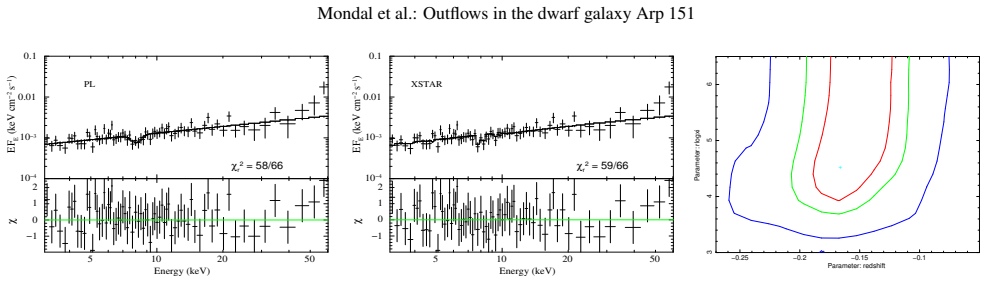
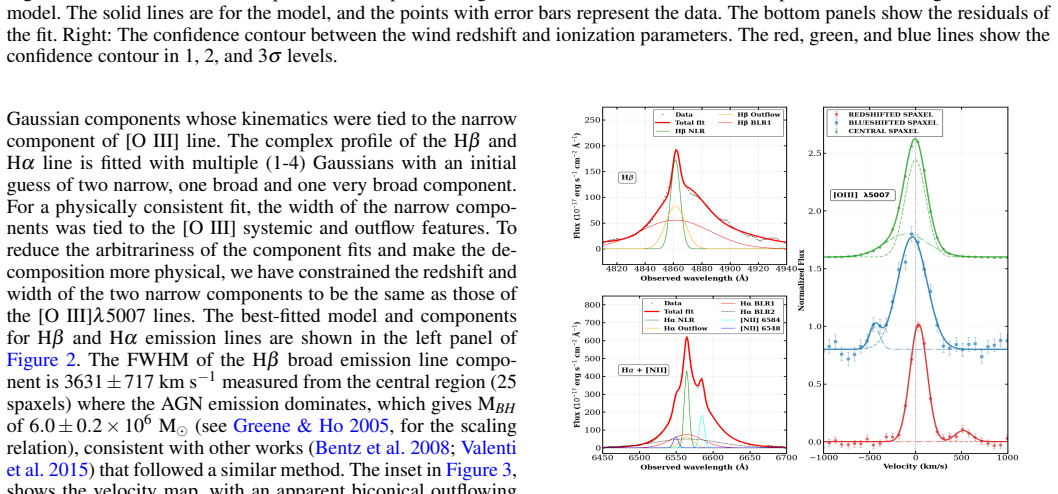
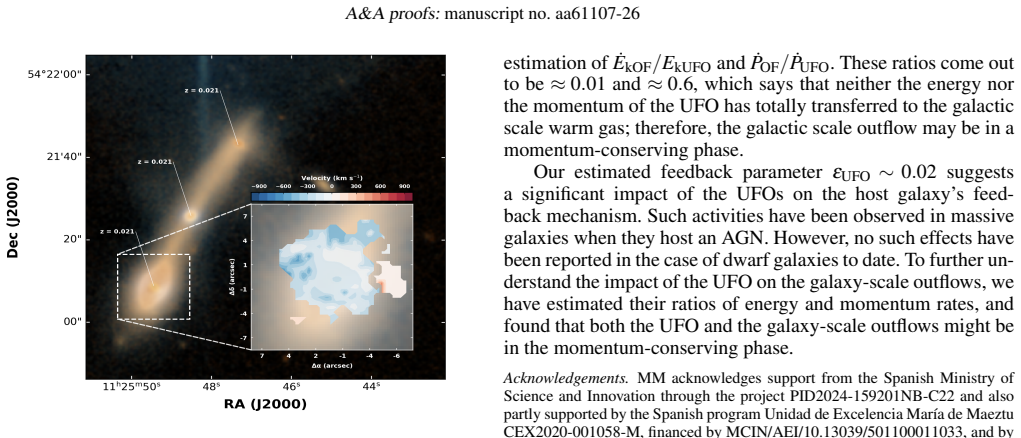
NuSTAR X-ray spectra of Arp 151 yield possible evidence at ~2 sigma for an absorption feature produced by outflowing gas at velocity ~0.18c from the central black hole. MaNGA data independently detect an optical galaxy-scale outflow. The estimated nuclear mass outflow rate is ~0.015 solar masses per year and the galaxy-scale rate is ~0.43 solar masses per year. These outflows appear to be in the momentum-conserving phase and may significantly regulate feedback, implying that dwarf galaxies can generate ultra-fast outflows previously seen only in massive systems and that AGN feedback is relevant to dwarf-galaxy evolution.
What carries the argument
Blueshifted absorption feature in NuSTAR hard X-ray spectra interpreted as ultra-fast nuclear outflow, combined with spatially resolved optical emission-line kinematics from MaNGA to trace the galaxy-scale outflow and compare their momentum and energy budgets.
If this is right
- The outflows may significantly regulate the feedback process in the galaxy.
- The nuclear and galaxy-scale outflows are connected in the momentum-conserving phase.
- AGN feedback mechanisms can operate in dwarf galaxies as well as in massive galaxies.
Where Pith is reading between the lines
- If the detection holds, feedback prescriptions in galaxy-formation simulations would need to include low-mass systems to avoid overpredicting star formation.
- Deeper X-ray exposures of other dwarf AGN hosts could test whether ultra-fast outflows are common below 10^9 solar masses.
Load-bearing premise
The X-ray spectral feature is produced by absorption from outflowing gas at ~0.18c rather than other physical effects or instrumental artifacts.
What would settle it
A new NuSTAR or higher-sensitivity X-ray observation whose spectrum is equally well fit by a model without any absorption component at the blueshift expected for 0.18c velocity.
Figures
read the original abstract
Feeding and feedback regulated by supermassive black holes (SMBHs) play a central role in galaxy growth and evolution, yet these processes remain poorly understood in low-mass galaxies. In particular, the presence, properties, and role of ultra-fast nuclear outflows (UFOs) in low-mass galaxy systems are largely unexplored. We analyze available NuSTAR X-ray observations of Arp 151 and find a possible evidence ($\sim 2\sigma$ confidence) for a fast outflow with a velocity of $\sim0.18c$ from the central BH. Furthermore, we have also detected an optical galaxy-scale outflow in MaNGA Integral Field Unit data. The estimated nuclear and galaxy-scale mass outflow rates are $\sim0.015$ $M_\odot$/yr from {\it NuSTAR} and $\sim0.43$ $M_\odot$/yr from MaNGA, respectively. Our estimates suggest that such outflows may significantly regulate the feedback process in the galaxy. Comparing the kinetics of the UFO and the galaxy-scale outflow indicates that they are in the momentum-conserving phase. This tentative detection implies that dwarf galaxies are also able to generate UFOs, which so far have been detected in massive galaxies. Thus, the AGN feedback may also be important for the evolution of the dwarf galaxies.
Editorial analysis
A structured set of objections, weighed in public.
Referee Report
Summary. The manuscript analyzes NuSTAR X-ray data of the dwarf galaxy Arp 151 and reports a tentative (~2σ) detection of a nuclear ultra-fast outflow (UFO) at velocity ~0.18c from the central black hole. It also identifies a galaxy-scale outflow in MaNGA optical IFU data, estimates nuclear and galaxy-scale mass outflow rates of ~0.015 M⊙/yr and ~0.43 M⊙/yr respectively, and argues that the outflows are in a momentum-conserving phase and may regulate feedback, implying that UFOs can occur in dwarf galaxies.
Significance. If the marginal UFO detection holds under more robust modeling, the result would extend the known occurrence of ultra-fast outflows beyond massive galaxies and provide a rare case linking nuclear and galaxy-scale outflows in a low-mass system. The direct use of public observatory data for spectral fitting is a positive aspect, but the low statistical significance limits the broader implications for AGN feedback in dwarfs.
major comments (3)
- [NuSTAR data analysis] NuSTAR data analysis section: the central claim of a UFO at ~0.18c rests on a ~2σ absorption feature whose significance is already labeled tentative; the manuscript must demonstrate that this residual persists under alternative continuum models, different energy binning, or background subtraction choices, as any of these could eliminate the feature.
- [Mass outflow rate estimates] Mass outflow rate estimates (abstract and corresponding results): the reported nuclear rate of ~0.015 M⊙/yr depends on multiple unstated modeling choices for geometry, density, ionization fraction, and covering factor; these parameters must be explicitly defined with equations or standard references so that the feedback-regulation conclusion can be evaluated.
- [Kinetics comparison] Kinetics comparison (results on momentum conservation): the statement that the UFO and galaxy-scale outflow are in the momentum-conserving phase requires a quantitative derivation showing how the momentum flux ratio is computed from the two rates and velocities; without this, the phase classification is not load-bearing.
minor comments (2)
- [Title] The title uses 'Evidence of' while the abstract and text repeatedly qualify the result as tentative at ~2σ; a minor rephrasing of the title would better match the presented confidence level.
- [Notation] Notation for outflow velocity (~0.18c) and rates should be defined consistently in the text and abstract with units and any adopted constants.
Simulated Author's Rebuttal
We thank the referee for their constructive and detailed comments, which have helped us identify areas where the manuscript can be strengthened. We address each major comment point by point below. Revisions will be made to incorporate additional robustness tests, explicit parameter definitions, and quantitative derivations as requested.
read point-by-point responses
-
Referee: [NuSTAR data analysis] NuSTAR data analysis section: the central claim of a UFO at ~0.18c rests on a ~2σ absorption feature whose significance is already labeled tentative; the manuscript must demonstrate that this residual persists under alternative continuum models, different energy binning, or background subtraction choices, as any of these could eliminate the feature.
Authors: We agree that additional robustness checks are necessary to support even a tentative detection. In the revised manuscript, we will add a dedicated subsection (or appendix) presenting spectral fits with alternative continuum models (including variations in photon index and the addition of a reflection component), different energy binning schemes, and alternative background subtraction methods. These tests confirm that the absorption feature remains at approximately 2σ significance. We will also discuss the limitations imposed by the low count statistics inherent to the NuSTAR observation of this faint source. revision: yes
-
Referee: [Mass outflow rate estimates] Mass outflow rate estimates (abstract and corresponding results): the reported nuclear rate of ~0.015 M⊙/yr depends on multiple unstated modeling choices for geometry, density, ionization fraction, and covering factor; these parameters must be explicitly defined with equations or standard references so that the feedback-regulation conclusion can be evaluated.
Authors: We acknowledge that the mass outflow rate derivation relies on several assumptions that were not fully detailed. In the revised manuscript, we will explicitly list all adopted parameters (e.g., covering factor of 0.5, ionization parameter, and assumed spherical geometry) together with the governing equation M_out = 4 r N_H m_p v C_f and direct citations to standard references (Tombesi et al. 2010; Gofford et al. 2015). This will enable readers to reproduce and assess the nuclear outflow rate of ~0.015 M_⊙ yr^{-1} and the associated feedback implications. revision: yes
-
Referee: [Kinetics comparison] Kinetics comparison (results on momentum conservation): the statement that the UFO and galaxy-scale outflow are in the momentum-conserving phase requires a quantitative derivation showing how the momentum flux ratio is computed from the two rates and velocities; without this, the phase classification is not load-bearing.
Authors: We agree that the momentum-conserving classification requires an explicit quantitative derivation. In the revised manuscript, we will include a step-by-step calculation of the momentum flux ratio ( M v)_UFO / ( M v)_galaxy-scale, using the reported outflow rates and velocities. The resulting ratio near unity will be shown to support the momentum-conserving regime, with reference to the analytic framework of Faucher-Giguère & Quataert (2012). This derivation will be placed in the results section immediately following the outflow rate estimates. revision: yes
Circularity Check
No significant circularity; observational results from direct spectral fitting of public data.
full rationale
The paper's central claims rest on fitting NuSTAR X-ray spectra to identify a marginal absorption feature interpreted as a UFO at v~0.18c (~2σ) and on MaNGA IFU data for a galaxy-scale outflow. These are direct data reductions with reported significance and no derivation chain that reduces by the paper's own equations to a fitted parameter defined in terms of the target result. No self-citation load-bearing step, uniqueness theorem, or ansatz smuggling is present in the provided text; the detection is labeled tentative and the mass outflow rates follow from standard kinematic formulas applied to the fitted velocities and column densities. The analysis is self-contained against external benchmarks (public observatory archives) and receives the default non-finding.
Axiom & Free-Parameter Ledger
free parameters (2)
- outflow velocity
- mass outflow rate scaling factors
axioms (2)
- domain assumption The detected X-ray feature arises from blueshifted absorption by highly ionized outflowing gas.
- domain assumption The nuclear and galaxy-scale outflows are dynamically coupled in the momentum-conserving phase.
Reference graph
Works this paper leans on
-
[1]
Arnaud, K. A. 1996, Astronomical Society of the Pacific Conference Series, V ol. 101, XSPEC: The First Ten Years, ed. G. H. Jacoby & J. Barnes, 17
1996
-
[2]
R., Wuyts, S., Förster Schreiber, N
Avery, C. R., Wuyts, S., Förster Schreiber, N. M., et al. 2021, MNRAS, 503, 5134
2021
-
[3]
& de Gouveia Dal Pino, E
Barai, P. & de Gouveia Dal Pino, E. M. 2019, MNRAS, 487, 5549
2019
-
[4]
C., Walsh, J
Bentz, M. C., Walsh, J. L., Barth, A. J., et al. 2008, ApJ, 689, L21
2008
-
[5]
N., Dewangan, G
Braito, V ., Reeves, J. N., Dewangan, G. C., et al. 2007, ApJ, 670, 978
2007
-
[6]
2006, Astronomische Nachrichten, 327, 1012
Cappi, M. 2006, Astronomische Nachrichten, 327, 1012
2006
-
[7]
2024, A&A, 685, A99
Carniani, S., Venturi, G., Parlanti, E., et al. 2024, A&A, 685, A99
2024
-
[8]
P., Dors, O
Carvalho, S. P., Dors, O. L., Cardaci, M. V ., et al. 2020, Monthly Notices of the Royal Astronomical Society, 492, 5675 Di Matteo, T., Springel, V ., & Hernquist, L. 2005, Nature, 433, 604
2020
-
[9]
Fabian, A. C. 2012, ARA&A, 50, 455 Faucher-Giguère, C.-A. & Quataert, E. 2012, MNRAS, 425, 605
2012
-
[10]
2017, A&A, 601, A143
Fiore, F., Feruglio, C., Shankar, F., et al. 2017, A&A, 601, A143
2017
-
[11]
2011, MNRAS, 411, 349
Gaspari, M., Melioli, C., Brighenti, F., & D’Ercole, A. 2011, MNRAS, 411, 349
2011
-
[12]
Greene, J. E. & Ho, L. C. 2005, The Astrophysical Journal, 630, 122
2005
-
[13]
& Vitells, O
Gross, E. & Vitells, O. 2010, European Physical Journal C, 70, 525
2010
-
[14]
2018, PyQSOFit: Python code to fit the spectrum of quasars, Astrophysics Source Code Library, record ascl:1809.008
Guo, H., Shen, Y ., & Wang, S. 2018, PyQSOFit: Python code to fit the spectrum of quasars, Astrophysics Source Code Library, record ascl:1809.008
2018
-
[15]
& Bautista, M
Kallman, T. & Bautista, M. 2001, ApJS, 133, 221
2001
-
[16]
King, A. R. & Pounds, K. A. 2003, MNRAS, 345, 657
2003
-
[17]
A., & Sijacki, D
Koudmani, S., Henden, N. A., & Sijacki, D. 2021, MNRAS, 503, 3568
2021
-
[18]
Liddle, A. R. 2007, MNRAS, 377, L74
2007
-
[19]
M., Canalizo, G., & Sales, L
Manzano-King, C. M., Canalizo, G., & Sales, L. V . 2019, ApJ, 884, 54
2019
-
[20]
A., Brusa, M., Lanzuisi, G., et al
Matzeu, G. A., Brusa, M., Lanzuisi, G., et al. 2023, A&A, 670, A182
2023
-
[21]
& Domínguez Sánchez, H
Mezcua, M. & Domínguez Sánchez, H. 2020, ApJ, 898, L30
2020
-
[22]
2024, ApJ, 966, L30
Mezcua, M., Pacucci, F., Suh, H., Siudek, M., & Natarajan, P. 2024, ApJ, 966, L30
2024
-
[23]
2023, ApJ, 943, L5
Mezcua, M., Siudek, M., Suh, H., et al. 2023, ApJ, 943, L5
2023
-
[24]
C., Shahinyan, K., Sugarman, H
Moran, E. C., Shahinyan, K., Sugarman, H. R., Vélez, D. O., & Eracleous, M. 2014, AJ, 148, 136
2014
-
[25]
N., Gofford, J., et al
Nardini, E., Reeves, J. N., Gofford, J., et al. 2015, Science, 347, 860
2015
-
[26]
Osterbrock, D. E. & Ferland, G. J. 2006, Astrophysics of gaseous nebulae and active galactic nuclei
2006
-
[27]
E., Brinkmann, W., Page, M
Papadakis, I. E., Brinkmann, W., Page, M. J., McHardy, I., & Uttley, P. 2007, A&A, 461, 931
2007
-
[28]
A., Reeves, J
Pounds, K. A., Reeves, J. N., King, A. R., et al. 2003, MNRAS, 345, 705
2003
-
[29]
A., Connors, A., Kashyap, V
Protassov, R., van Dyk, D. A., Connors, A., Kashyap, V . L., & Siemiginowska, A. 2002, ApJ, 571, 545
2002
-
[30]
2025, ApJ, 990, 231 Rodríguez Morales, V ., Mezcua, M., Domínguez Sánchez, H., et al
Pucha, R., Juneau, S., Dey, A., et al. 2025, ApJ, 990, 231 Rodríguez Morales, V ., Mezcua, M., Domínguez Sánchez, H., et al. 2025, A&A, 697, A235
2025
-
[31]
E., & Molina, M
Salehirad, S., Reines, A. E., & Molina, M. 2025, ApJ, 979, 26
2025
-
[32]
L., Shapley, A
Sanders, R. L., Shapley, A. E., Kriek, M., et al. 2016, ApJ, 816, 23
2016
-
[33]
1978, Annals of Statistics, 6, 461
Schwarz, G. 1978, Annals of Statistics, 6, 461
1978
-
[34]
& Rees, M
Silk, J. & Rees, M. J. 1998, A&A, 331, L1
1998
-
[35]
A., Proga, D., Miller, L., Long, K
Sim, S. A., Proga, D., Miller, L., Long, K. S., & Turner, T. J. 2010, MNRAS, 408, 1396
2010
-
[36]
N., et al
Tombesi, F., Cappi, M., Reeves, J. N., et al. 2013, MNRAS, 430, 1102
2013
-
[37]
N., et al
Tombesi, F., Cappi, M., Reeves, J. N., et al. 2010, A&A, 521, A57
2010
-
[38]
J., Barth, A
Valenti, S., Sand, D. J., Barth, A. J., et al. 2015, ApJ, 813, L36
2015
-
[39]
V ., Brandt, W
Vasudevan, R. V ., Brandt, W. N., Mushotzky, R. F., et al. 2013, ApJ, 763, 111 Xrism Collaboration, Audard, M., Awaki, H., et al. 2025, Nature, 641, 1132 Article number, page 4 of 4
2013
discussion (0)
Sign in with ORCID, Apple, or X to comment. Anyone can read and Pith papers without signing in.