Towards Adversarially Robust Object Detection
Pith reviewed 2026-05-24 17:01 UTC · model grok-4.3
The pith
An adversarial training approach leveraging multiple attack sources improves object detector robustness by exploiting asymmetric task losses.
A machine-rendered reading of the paper's core claim, the machinery that carries it, and where it could break.
Core claim
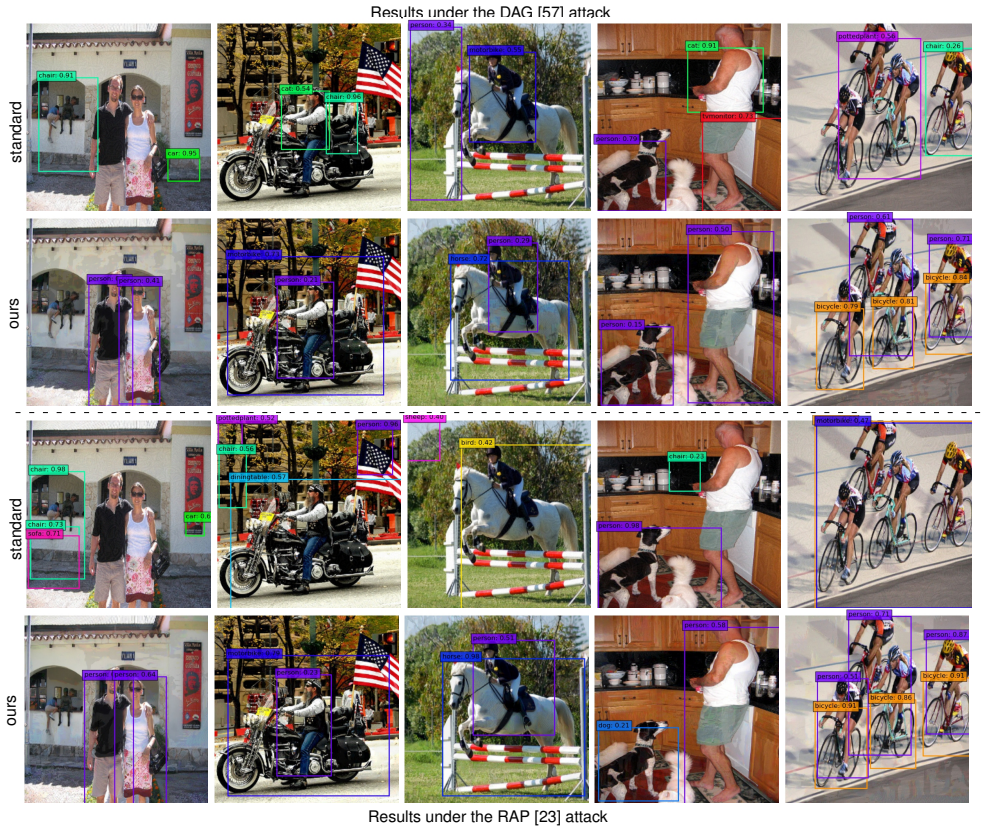
By presenting a multi-task learning perspective of object detection and identifying the asymmetric role of task losses, the authors develop an adversarial training approach which can leverage the multiple sources of attacks for improving the robustness of detection models, with effectiveness verified through extensive experiments on PASCAL-VOC and MS-COCO.
What carries the argument
Multi-task learning perspective of object detection identifying the asymmetric role of task losses, which guides the design of a multi-source adversarial training method.
If this is right
- The adversarial training method can improve robustness of detection models against attacks.
- Multiple sources of attacks can be leveraged during training instead of relying on one.
- The approach applies to existing detection models as demonstrated on PASCAL-VOC and MS-COCO.
- Robustness becomes a more achievable performance factor for practical vision systems.
Where Pith is reading between the lines
- The loss asymmetry insight could apply to designing defenses in other multi-task vision models.
- Attack generation strategies might need to account for how different losses respond asymmetrically.
- Combining this training method with architectural changes could further enhance robustness.
Load-bearing premise
The identified asymmetric role of task losses in the multi-task learning perspective provides a valid basis for designing an effective adversarial training method.
What would settle it
If the proposed adversarial training using multiple attack sources shows no improvement in robustness metrics over standard single-source adversarial training on PASCAL-VOC or MS-COCO, the central claim would be falsified.
Figures




read the original abstract
Object detection is an important vision task and has emerged as an indispensable component in many vision system, rendering its robustness as an increasingly important performance factor for practical applications. While object detection models have been demonstrated to be vulnerable against adversarial attacks by many recent works, very few efforts have been devoted to improving their robustness. In this work, we take an initial attempt towards this direction. We first revisit and systematically analyze object detectors and many recently developed attacks from the perspective of model robustness. We then present a multi-task learning perspective of object detection and identify an asymmetric role of task losses. We further develop an adversarial training approach which can leverage the multiple sources of attacks for improving the robustness of detection models. Extensive experiments on PASCAL-VOC and MS-COCO verified the effectiveness of the proposed approach.
Editorial analysis
A structured set of objections, weighed in public.
Referee Report
Summary. The manuscript analyzes object detectors and adversarial attacks from a robustness perspective, introduces a multi-task learning view of object detection that identifies an asymmetric role of task losses (classification vs. localization), develops an adversarial training method that leverages multiple attack sources based on this asymmetry, and reports that experiments on PASCAL-VOC and MS-COCO verify the effectiveness of the approach.
Significance. If the experiments demonstrate robustness gains specifically attributable to exploiting the identified asymmetry (rather than generic multi-attack training), the work would address an important gap in making object detectors robust for practical applications. The use of standard benchmark datasets supports reproducibility.
major comments (2)
- [§3] §3: The multi-task perspective is used to identify the asymmetric role of task losses, but no equation or explicit formulation is given showing how this asymmetry determines attack selection, weighting, or generation in the adversarial training objective; without this, it is unclear whether the perspective is load-bearing for the method.
- [Experiments section] Experiments section: The claim that the approach improves robustness by leveraging the asymmetry is not supported by an ablation that compares the proposed method against standard multi-attack adversarial training (without the asymmetry); this omission prevents verification that the identified perspective drives the reported gains.
minor comments (1)
- [Abstract] Abstract: The statement that 'extensive experiments verified the effectiveness' would benefit from a brief mention of key quantitative improvements or baselines to give readers an immediate sense of the results.
Simulated Author's Rebuttal
We thank the referee for the constructive feedback on our manuscript. We address the major comments point by point below, indicating where revisions will be made to strengthen the presentation and empirical support.
read point-by-point responses
-
Referee: [§3] §3: The multi-task perspective is used to identify the asymmetric role of task losses, but no equation or explicit formulation is given showing how this asymmetry determines attack selection, weighting, or generation in the adversarial training objective; without this, it is unclear whether the perspective is load-bearing for the method.
Authors: We agree that an explicit formulation would better demonstrate how the identified asymmetry guides the method. Section 3 qualitatively describes the multi-task view of object detection and the asymmetric importance of classification versus localization losses, which motivates selecting and combining attacks from multiple sources. To address this, we will add a mathematical formulation in the revised Section 3 that explicitly connects the asymmetry to attack generation, selection, and weighting within the adversarial training objective. revision: yes
-
Referee: [Experiments section] Experiments section: The claim that the approach improves robustness by leveraging the asymmetry is not supported by an ablation that compares the proposed method against standard multi-attack adversarial training (without the asymmetry); this omission prevents verification that the identified perspective drives the reported gains.
Authors: This comment is valid. The current experiments on PASCAL-VOC and MS-COCO demonstrate the overall effectiveness of the approach, but do not include a direct ablation isolating the asymmetry from generic multi-attack training. We will add this ablation study in the revised manuscript to provide evidence that the reported robustness gains are attributable to the multi-task asymmetry perspective. revision: yes
Circularity Check
No circularity; derivation is self-contained with independent experimental support
full rationale
The abstract describes a sequence of analysis of detectors and attacks, followed by a multi-task perspective that identifies an asymmetric role of task losses, leading to an adversarial training method whose effectiveness is verified on PASCAL-VOC and MS-COCO. No equations, fitted parameters renamed as predictions, self-definitional constructs, or load-bearing self-citations appear in the provided text. The central claim rests on the perspective informing the method and on external experimental validation rather than reducing to its own inputs by construction.
Axiom & Free-Parameter Ledger
Reference graph
Works this paper leans on
-
[1]
A. Athalye, N. Carlini, and D. Wagner. Obfuscated gradients give a false sense of security: Circumventing defenses to ad- versarial examples. In International Conference on Machine learning, 2018
work page 2018
-
[2]
B. Biggio and F. Roli. Wild patterns: Ten years after the rise of adversarial machine learning. In ACM Conference on Computer and Communications Security, 2018
work page 2018
- [3]
-
[4]
N. Carlini and D. Wagner. Towards evaluating the robustness of neural networks. In IEEE Symposium on Security and Privacy, 2017
work page 2017
-
[5]
R. Caruana. Multitask learning. Machine Learning , 28(1):41–75, 1997
work page 1997
-
[6]
S. Chen, C. Cornelius, J. Martin, and D. H. Chau. ShapeShifter: Robust physical adversarial attack on Faster R-CNN object detector. CoRR, abs/1804.05810, 2018
work page internal anchor Pith review Pith/arXiv arXiv 2018
- [7]
-
[8]
N. Dalal and B. Triggs. Histograms of oriented gradients for human detection. In IEEE Conference on Computer Vision and Pattern Recognition, 2005
work page 2005
- [9]
-
[10]
M. Everingham, S. M. Eslami, L. Gool, C. K. Williams, J. Winn, and A. Zisserman. The pascal visual object classes challenge: A retrospective. Int. J. Comput. Vision , 111(1):98–136, 2015
work page 2015
-
[11]
Physical Adversarial Examples for Object Detectors
K. Eykholt, I. Evtimov, E. Fernandes, B. Li, A. Rahmati, F. Tram `er, A. Prakash, T. Kohno, and D. Song. Phys- ical adversarial examples for object detectors. CoRR, abs/1807.07769, 2018
work page internal anchor Pith review Pith/arXiv arXiv 2018
-
[12]
P. F. Felzenszwalb, R. B. Girshick, D. McAllester, and D. Ra- manan. Object detection with discriminatively trained part- based models. IEEE Trans. Pattern Anal. Mach. Intell. , 32(9):1627–1645, 2010
work page 2010
-
[13]
C.-Y . Fu, W. Liu, A. Ranga, A. Tyagi, and A. C. Berg. DSSD: Deconvolutional single shot detector. CoRR, abs/1701.06659, 2017
work page internal anchor Pith review Pith/arXiv arXiv 2017
- [14]
-
[15]
R. Girshick, J. Donahue, T. Darrell, and J. Malik. Rich fea- ture hierarchies for accurate object detection and semantic segmentation. In IEEE Conference on Computer Vision and Pattern Recognition, 2014
work page 2014
-
[16]
I. Goodfellow, J. Shlens, and C. Szegedy. Explaining and harnessing adversarial examples. In International Confer- ence on Learning Representations, 2015
work page 2015
-
[17]
C. Guo, M. Rana, M. Ciss ´e, and L. van der Maaten. Coun- tering adversarial images using input transformations. In In- ternational Conference on Learning Representations, 2018
work page 2018
-
[18]
K. He, R. B. Girshick, and P. Doll ´ar. Rethinking ImageNet pre-training. CoRR, abs/1811.08883, 2018
work page internal anchor Pith review Pith/arXiv arXiv 2018
-
[19]
K. He, X. Zhang, S. Ren, and J. Sun. Deep residual learning for image recognition. In IEEE Conference on Computer Vision and Pattern Recognition, 2016
work page 2016
-
[20]
A. Kendall, Y . Gal, and R. Cipolla. Multi-task learning using uncertainty to weigh losses for scene geometry and seman- tics. In IEEE Conference on Computer Vision and Pattern Recognition, 2018
work page 2018
-
[21]
A. Kurakin, I. Goodfellow, and S. Bengio. Adversarial machine learning at scale. In International Conference on Learning Representations, 2017
work page 2017
-
[22]
Y . Li, X. Bian, and S. Lyu. Attacking object detectors via im- perceptible patches on background. CoRR, abs/1809.05966, 2018
work page internal anchor Pith review Pith/arXiv arXiv 2018
-
[23]
Y . Li, D. Tian, M. Chang, X. Bian, and S. Lyu. Robust adver- sarial perturbation on deep proposal-based models. InBritish Machine Vision Conference, 2018
work page 2018
- [24]
-
[25]
F. Liao, M. Liang, Y . Dong, and T. Pang. Defense against ad- versarial attacks using high-level representation guided de- noiser. In IEEE Conference on Computer Vision and Pattern Recognition, 2018
work page 2018
-
[26]
T.-Y . Lin, P. Goyal, R. B. Girshick, K. He, and P. Doll ´ar. Focal loss for dense object detection. In International Con- ference on Computer Vision, 2017
work page 2017
-
[27]
T.-Y . Lin, M. Maire, S. J. Belongie, L. D. Bourdev, R. B. Gir- shick, J. Hays, P. Perona, D. Ramanan, P. Doll ´ar, and C. L. Zitnick. Microsoft COCO: Common objects in context. In European Conference on Computer Vision, 2014
work page 2014
-
[28]
S. Liu, D. Huang, and a. Wang. Receptive field block net for accurate and fast object detection. In European Conference on Computer Vision, 2018
work page 2018
-
[29]
W. Liu, D. Anguelov, D. Erhan, C. Szegedy, S. Reed, C.-Y . Fu, and A. C. Berg. SSD: Single shot multibox detector. In European Conference on Computer Vision, 2016
work page 2016
-
[30]
X. Liu, M. Cheng, H. Zhang, and C.-J. Hsieh. Towards ro- bust neural networks via random self-ensemble. InEuropean Conference on Computer Vision, 2018
work page 2018
-
[31]
X. Liu, H. Yang, L. Song, H. Li, and Y . Chen. DPatch: Attacking object detectors with adversarial patches. CoRR, abs/1806.02299, 2018
work page internal anchor Pith review Pith/arXiv arXiv 2018
-
[32]
J. Lu, H. Sibai, and E. Fabry. Adversarial examples that fool detectors. CoRR, abs/1712.02494, 2017
work page internal anchor Pith review Pith/arXiv arXiv 2017
- [33]
-
[34]
D. Meng and H. Chen. MagNet: a two-pronged defense against adversarial examples. In ACM SIGSAC Conference on Computer and Communications Security, 2017
work page 2017
-
[35]
J. H. Metzen, T. Genewein, V . Fischer, and B. Bischoff. On detecting adversarial perturbations. In International Confer- ence on Learning Representations, 2017
work page 2017
-
[36]
S.-M. Moosavi-Dezfooli, A. Fawzi, and P. Frossard. Deep- Fool: a simple and accurate method to fool deep neural net- works. In IEEE Conference on Computer Vision and Pattern Recognition, 2016
work page 2016
- [37]
-
[38]
A. Prakash, N. Moran, S. Garber, A. DiLillo, and J. Storer. Deflecting adversarial attacks with pixel deflection. In IEEE Conference on Computer Vision and Pattern Recognition , 2018
work page 2018
-
[39]
J. Redmon. Darknet: Open source neural networks in C. http://pjreddie.com/darknet/, 2013–2016
work page 2013
- [40]
-
[41]
YOLOv3: An Incremental Improvement
J. Redmon and A. Farhadi. YOLOv3: An incremental im- provement. CoRR, abs/1804.02767, 2018
work page internal anchor Pith review Pith/arXiv arXiv 2018
-
[42]
S. Ren, K. He, R. B. Girshick, and J. Sun. Faster R-CNN: Towards real-time object detection with region proposal net- works. In Advances in Neural Information Processing Sys- tems, 2015
work page 2015
-
[43]
A. Rosenfeld and M. Thurston. Edge and curve detection for visual scene analysis. IEEE Trans. Comput., 20(5):562–569, 1971
work page 1971
-
[44]
P. Samangouei, M. Kabkab, and R. Chellappa. Defense- GAN: Protecting classifiers against adversarial attacks using generative models. In International Conference on Learning Representations, 2018
work page 2018
-
[45]
K. Simonyan and A. Zisserman. Very deep convolutional networks for large-scale image recognition. In International Conference on Learning Representations, 2015
work page 2015
-
[46]
Y . Song, T. Kim, S. Nowozin, S. Ermon, and N. Kushman. Pixeldefend: Leveraging generative models to understand and defend against adversarial examples. In International Conference on Learning Representations, 2018
work page 2018
-
[47]
C. Szegedy, W. Liu, Y . Jia, P. Sermanet, S. Reed, D. Anguelov, D. Erhan, V . Vanhoucke, and A. Rabinovich. Going deeper with convolutions. In IEEE Conference on Computer Vision and Pattern Recognition, 2015
work page 2015
-
[48]
Scalable, High-Quality Object Detection
C. Szegedy, S. E. Reed, D. Erhan, and D. Anguelov. Scal- able, high-quality object detection. CoRR, abs/1412.1441, 2014
work page internal anchor Pith review Pith/arXiv arXiv 2014
-
[49]
C. Szegedy, W. Zaremba, I. Sutskever, J. Bruna, D. Erhan, I. Goodfellow, and R. Fergus. Intriguing properties of neural networks. In International Conference on Learning Repre- sentations, 2014
work page 2014
-
[50]
F. Tram `er, A. Kurakin, N. Papernot, D. Boneh, and P. Mc- Daniel. Ensemble adversarial training: Attacks and defenses. In International Conference on Learning Representations , 2018
work page 2018
-
[51]
D. Tsipras, S. Santurkar, L. Engstrom, A. Turner, and A. Madry. Robustness may be at odds with accuracy. In In- ternational Conference on Learning Representations, 2019
work page 2019
-
[52]
G. Tsoumakas and I. Katakis. Multi label classification: An overview. 3(3):1–13, 2007
work page 2007
-
[53]
J. Uijlings, K. van de Sande, T. Gevers, and A. Smeulders. Selective search for object recognition. International Jour- nal of Computer Vision, 104(2):154–171, 2013
work page 2013
-
[54]
P. Viola and M. J. Jones. Robust real-time face detection.Int. J. Comput. Vision, 57(2):137–154, 2004
work page 2004
-
[55]
X. Wei, S. Liang, X. Cao, and J. Zhu. Transferable adver- sarial attacks for image and video object detection. CoRR, abs/1811.12641, 2018
work page internal anchor Pith review Pith/arXiv arXiv 2018
-
[56]
C. Xie, J. Wang, Z. Zhang, Z. Ren, and A. Yuille. Mitigating adversarial effects through randomization. In International Conference on Learning Representations, 2018
work page 2018
-
[57]
C. Xie, J. Wang, Z. Zhang, Y . Zhou, L. Xie, and A. Yuille. Adversarial examples for semantic segmentation and object detection. In International Conference on Computer Vision, 2017
work page 2017
-
[58]
C. Xie, Y . Wu, L. van der Maaten, A. Yuille, and K. He. Feature denoising for improving adversarial robustness. In IEEE Conference on Computer Vision and Pattern Recogni- tion, 2019
work page 2019
-
[59]
X. Zhao, H. Li, X. Shen, X. Liang, and Y . Wu. A modulation module for multi-task learning with applications in image re- trieval. In European Conference on Computer Vision, 2018
work page 2018
discussion (0)
Sign in with ORCID, Apple, or X to comment. Anyone can read and Pith papers without signing in.