Energy-Efficient CNN Acceleration with MSDF Digit-Serial Arithmetic on FPGA
Reviewed by Pith T0 review T1 audit T2 compute T3 formal T4 kernel 2026-06-25 19:37 UTCgrok-4.3pith:WTEFCRP6record.jsonopen to challenge →
The pith
Fusing multiply and add into one MSDF pipeline shortens per-iteration latency and yields up to 15.14 GOPS/W on FPGA for U-Net.
A machine-rendered reading of the paper's core claim, the machinery that carries it, and where it could break.
Core claim
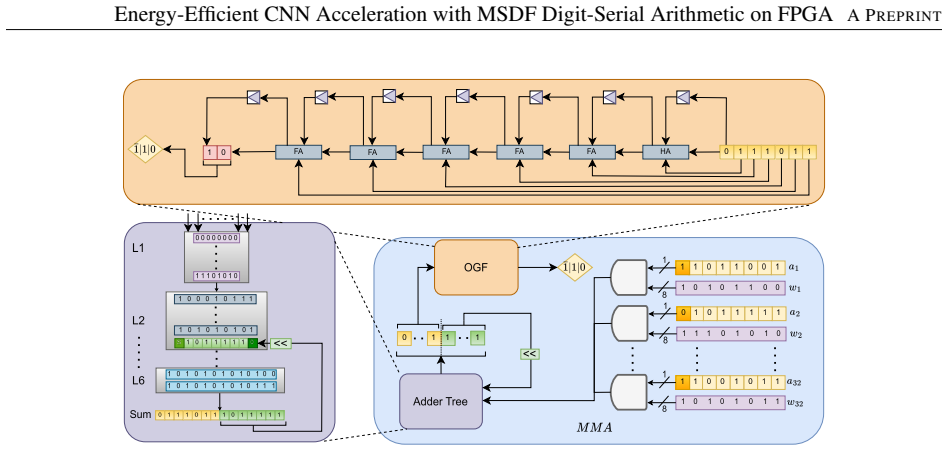
The central claim is that a merged multiply-add architecture fuses MSDF multiplication and addition into one unified pipeline whose per-iteration latency is shorter than the sum of the two separate units; when these MMA units process spatial input depths in parallel the resulting FPGA accelerator for U-Net convolutional layers reaches 15.14 GOPS/W and nine-fold lower energy than earlier MSDF FPGA implementations while still operating below CPU frequency.
What carries the argument
The merged multiply-add (MMA) unit that combines MSDF multiply and add operations into a single pipeline with one startup latency.
If this is right
- MMA units deliver shorter per-iteration latency than cascaded separate MSDF multiply-then-add units.
- Parallel handling of spatial input depths raises performance above both standalone MSDF and conventional FPGA designs.
- The accelerator reaches 15.14 GOPS/W for U-Net inference, an order of magnitude above the 1.93 GOPS/W CPU baseline.
- Energy consumption drops by a factor of approximately nine relative to prior MSDF-based FPGA implementations.
- The design suits latency-sensitive, power-constrained edge medical-imaging tasks.
Where Pith is reading between the lines
- The same MMA fusion could be applied to other CNN topologies that repeatedly multiply and accumulate feature maps.
- Lower operating frequency on FPGA may enable additional voltage scaling for further power reduction in battery devices.
- Extending the single-latency property across deeper cascaded layers could compound throughput gains in full networks.
- Repeating the experiment on a different FPGA family would test whether routing overheads limit the reported savings.
Load-bearing premise
Fusing multiply and add into one MMA unit actually produces shorter per-iteration latency than the sum of separate MSDF units and that this latency saving directly produces the measured energy gains without hidden routing or resource costs on the target FPGA.
What would settle it
Direct measurement on the same FPGA of the cycle count from input arrival to first valid output digit for an MMA unit versus a separate MSDF multiplier followed by a separate MSDF adder.
Figures

read the original abstract
This paper presents an energy-efficient hardware acceleration of the convolutional layers in the U-Net architecture for image segmentation, implemented on FPGA. While digit-serial arithmetic, particularly most-significant-digit-first (MSDF) techniques, offers a compact hardware footprint, it suffers from initial latency before producing the first output digit. This delay accumulates in cascaded operations like multiplication followed by addition, where each unit introduces its own startup overhead. To overcome this, we propose a merged multiply-add (MMA) architecture that fuses these operations into a unified pipeline. Instead of incurring separate delays, the MMA introduces a single streamlined latency per iteration, shorter than the combined latency of conventional cascaded units, resulting in enhanced throughput and efficiency. The MMA units are designed to process spatial input depths in parallel, achieving significantly higher performance than both standalone MSDF-based and conventional designs. We evaluate the proposed design using U-Net as a target application. Despite operating at a lower frequency than a CPU, the FPGA-based accelerator achieves up to an order of magnitude higher energy efficiency, delivering up to $15.14$ GOPS/W compared to $1.93$ GOPS/W for CPU-based inference. The design also shows approximately $9\times$ reduction in energy consumption compared to MSDF-based FPGA implementations. These results highlight the efficacy of the merged arithmetic approach for resource-constrained, latency-sensitive edge applications in medical imaging and computer vision.
Editorial analysis
A structured set of objections, weighed in public.
Referee Report
Summary. The paper proposes a merged multiply-add (MMA) architecture based on most-significant-digit-first (MSDF) digit-serial arithmetic to accelerate convolutional layers of U-Net on FPGA. By fusing multiply and add into a single unit with a single streamlined startup latency (instead of cumulative delays from cascaded units) and processing spatial input depths in parallel, the design claims significantly higher throughput and energy efficiency than standalone MSDF or conventional approaches. On the target FPGA, it reports up to 15.14 GOPS/W (vs. 1.93 GOPS/W on CPU) and approximately 9× energy reduction versus prior MSDF FPGA implementations.
Significance. If the reported efficiency numbers hold after verification, the MMA fusion technique would represent a practical contribution to resource-constrained, latency-sensitive CNN acceleration on FPGAs for edge medical imaging and computer vision. The work directly addresses a known drawback of digit-serial MSDF (startup latency accumulation) with an engineering solution that could be relevant for similar arithmetic optimizations.
major comments (2)
- [Abstract] Abstract: the headline claims of 15.14 GOPS/W and 9× energy reduction versus other MSDF FPGA designs are presented without any supporting implementation details, resource utilization tables, post-place-and-route power numbers, latency breakdowns, or measurement methodology; these data are required to attribute the gains to the MMA construction rather than unaccounted overheads.
- [Evaluation] Evaluation section (U-Net results): the central assumption that the fused MMA datapath eliminates cumulative digit-serial startup overhead without new pipeline stalls, wider digit paths, or increased routing capacitance on the target FPGA is load-bearing for the efficiency claims, yet no concrete latency-per-iteration comparisons or FPGA utilization data are supplied to confirm it.
minor comments (2)
- The manuscript would benefit from explicit comparison tables against both the standalone MSDF baseline and a conventional binary multiplier-add implementation on the same FPGA fabric.
- Notation for digit-serial parameters (e.g., digit width, iteration count) should be defined consistently in the first methods section.
Simulated Author's Rebuttal
We thank the referee for the constructive feedback highlighting the need for explicit supporting data. We will revise the manuscript to incorporate the requested details and comparisons.
read point-by-point responses
-
Referee: [Abstract] Abstract: the headline claims of 15.14 GOPS/W and 9× energy reduction versus other MSDF FPGA designs are presented without any supporting implementation details, resource utilization tables, post-place-and-route power numbers, latency breakdowns, or measurement methodology; these data are required to attribute the gains to the MMA construction rather than unaccounted overheads.
Authors: We agree that the abstract states the headline results without embedding the full supporting data. In the revised version we will add a concise measurement methodology paragraph and ensure the Evaluation section contains complete resource utilization tables, post-place-and-route power figures, latency breakdowns, and baseline comparisons so that the efficiency gains can be directly attributed to the MMA fusion. revision: yes
-
Referee: [Evaluation] Evaluation section (U-Net results): the central assumption that the fused MMA datapath eliminates cumulative digit-serial startup overhead without new pipeline stalls, wider digit paths, or increased routing capacitance on the target FPGA is load-bearing for the efficiency claims, yet no concrete latency-per-iteration comparisons or FPGA utilization data are supplied to confirm it.
Authors: The referee is correct that concrete latency-per-iteration data and utilization figures are required to validate the claim. We will insert explicit cycle-by-cycle latency comparisons between the MMA unit and conventional cascaded MSDF multiply-add units, together with post-implementation FPGA resource counts and timing reports, to demonstrate that the single streamlined latency is achieved without introducing stalls, wider paths, or measurable routing overhead. revision: yes
Circularity Check
No circularity: engineering design paper with no equations or fitted parameters
full rationale
The paper is a hardware architecture description for an FPGA accelerator using merged multiply-add (MMA) units in MSDF arithmetic. No mathematical derivation chain, equations, or fitted parameters exist that could reduce to self-referential inputs. Efficiency claims (15.14 GOPS/W, 9× reduction) rest on post-implementation measurements rather than any self-definitional or fitted-input prediction. No self-citations are load-bearing for a uniqueness theorem or ansatz. This matches the default expectation of no significant circularity for non-derivational engineering work.
Axiom & Free-Parameter Ledger
Reference graph
Works this paper leans on
-
[1]
Medical image segmentation review: The success of u-net,
R. Azad, E. K. Aghdam, A. Rauland, Y . Jia, A. H. Avval, A. Bozorgpour, S. Karimijafarbigloo, J. P. Cohen, E. Adeli, and D. Merhof, “Medical image segmentation review: The success of u-net,”IEEE Transactions on Pattern Analysis and Machine Intelligence, 2024. 5 Energy-Efficient CNN Acceleration with MSDF Digit-Serial Arithmetic on FPGAA PREPRINT
2024
-
[2]
Efficient hardware design of a deep u-net model for pixel-level ecg classification in healthcare device,
X. Cheng, D. Liu, J. Lu, L. Wei, A. Hu, J. Lei, Z. Zou, X. Zou, and Q. Jiang, “Efficient hardware design of a deep u-net model for pixel-level ecg classification in healthcare device,”Microelectronics Journal, vol. 126, p. 105492, 2022
2022
-
[3]
Review of neural network model acceleration techniques based on fpga platforms,
F. Liu, H. Li, W. Hu, and Y . He, “Review of neural network model acceleration techniques based on fpga platforms,”Neurocomputing, p. 128511, 2024
2024
-
[4]
Appq-cnn: An adaptive cnns inference accelerator for syn- ergistically exploiting pruning and quantization based on fpga,
X. Zhang, G. Xiao, M. Duan, Y . Chen, and K. Li, “Appq-cnn: An adaptive cnns inference accelerator for syn- ergistically exploiting pruning and quantization based on fpga,”IEEE Transactions on Sustainable Computing, 2024
2024
-
[5]
Bitmac: Bit-serial computation- based efficient multiply-accumulate unit for dnn accelerator,
H. Chhajed, G. Raut, N. Dhakad, S. Vishwakarma, and S. K. Vishvakarma, “Bitmac: Bit-serial computation- based efficient multiply-accumulate unit for dnn accelerator,”Circuits, Systems, and Signal Processing, pp. 1–16, 2022
2022
-
[6]
Bitcluster: Fine-grained weight quantization for load- balanced bit-serial neural network accelerators,
A. Li, H. Mo, W. Zhu, Q. Li, S. Yin, S. Wei, and L. Liu, “Bitcluster: Fine-grained weight quantization for load- balanced bit-serial neural network accelerators,”IEEE Transactions on Computer-Aided Design of Integrated Circuits and Systems, vol. 41, no. 11, pp. 4747–4757, 2022
2022
-
[7]
Usefuse: Uniform stride for enhanced performance in fused layer architecture of deep neural networks,
M. S. Ibrahim, M. Usman, and J.-A. Lee, “Usefuse: Uniform stride for enhanced performance in fused layer architecture of deep neural networks,”Journal of Systems Architecture, p. 103459, 2025
2025
-
[8]
Low-latency online multiplier with reduced activities and mini- mized interconnect for inner product arrays,
M. Usman, M. D. Ercegovac, and J.-A. Lee, “Low-latency online multiplier with reduced activities and mini- mized interconnect for inner product arrays,”Journal of Signal Processing Systems, vol. 95, no. 7, pp. 777–796, 2023
2023
-
[9]
On-cnn: Low latency and high throughput online arithmetic based convolutional neural network accelerator,
M. A. Shafique and J.-A. Lee, “On-cnn: Low latency and high throughput online arithmetic based convolutional neural network accelerator,”IEEE Access, 2024
2024
-
[10]
An efficient dot-product unit based on online arithmetic for variable precision applications,
S. Gorgin, M. H. Golamrezaei, J.-A. Lee, and M. D. Ercegovac, “An efficient dot-product unit based on online arithmetic for variable precision applications,” in2023 57th Asilomar Conference on Signals, Systems, and Computers. IEEE, 2023, pp. 950–954
2023
-
[11]
Echo: Energy-efficient computation harnessing online arithmetic—an msdf-based accelerator for dnn inference,
M. S. Ibrahim, M. Usman, and J.-A. Lee, “Echo: Energy-efficient computation harnessing online arithmetic—an msdf-based accelerator for dnn inference,”Electronics, vol. 13, no. 10, p. 1893, 2024
2024
-
[12]
Optimizing fpga-based accelerator design for deep convolutional neural networks,
C. Zhang, P. Li, G. Sun, Y . Guan, B. Xiao, and J. Cong, “Optimizing fpga-based accelerator design for deep convolutional neural networks,” inProceedings of the 2015 ACM/SIGDA international symposium on field- programmable gate arrays, 2015, pp. 161–170
2015
-
[13]
Unpu: An energy-efficient deep neural network accelerator with fully variable weight bit precision,
J. Lee, C. Kim, S. Kang, D. Shin, S. Kim, and H.-J. Yoo, “Unpu: An energy-efficient deep neural network accelerator with fully variable weight bit precision,”IEEE Journal of Solid-State Circuits, vol. 54, no. 1, pp. 173–185, 2018
2018
-
[14]
Constant-time addition with hybrid-redundant numbers: Theory and implementa- tions,
G. Jaberipur and B. Parhami, “Constant-time addition with hybrid-redundant numbers: Theory and implementa- tions,”Integration, vol. 41, no. 1, pp. 49–64, 2008
2008
-
[15]
Fbgemm: Enabling high- performance low-precision deep learning inference,
D. Khudia, J. Huang, P. Basu, S. Deng, H. Liu, J. Park, and M. Smelyanskiy, “Fbgemm: Enabling high- performance low-precision deep learning inference,”arXiv preprint arXiv:2101.05615, 2021. 6
discussion (0)
Sign in with ORCID, Apple, or X to comment. Anyone can read and Pith papers without signing in.