A phase-field model for microbiologically influenced corrosion
Pith reviewed 2026-06-26 09:25 UTC · model grok-4.3
The pith
A phase-field reaction-diffusion model couples microbial sulfate reduction to mechanical fields to predict MIC pitting kinetics.
A machine-rendered reading of the paper's core claim, the machinery that carries it, and where it could break.
Core claim
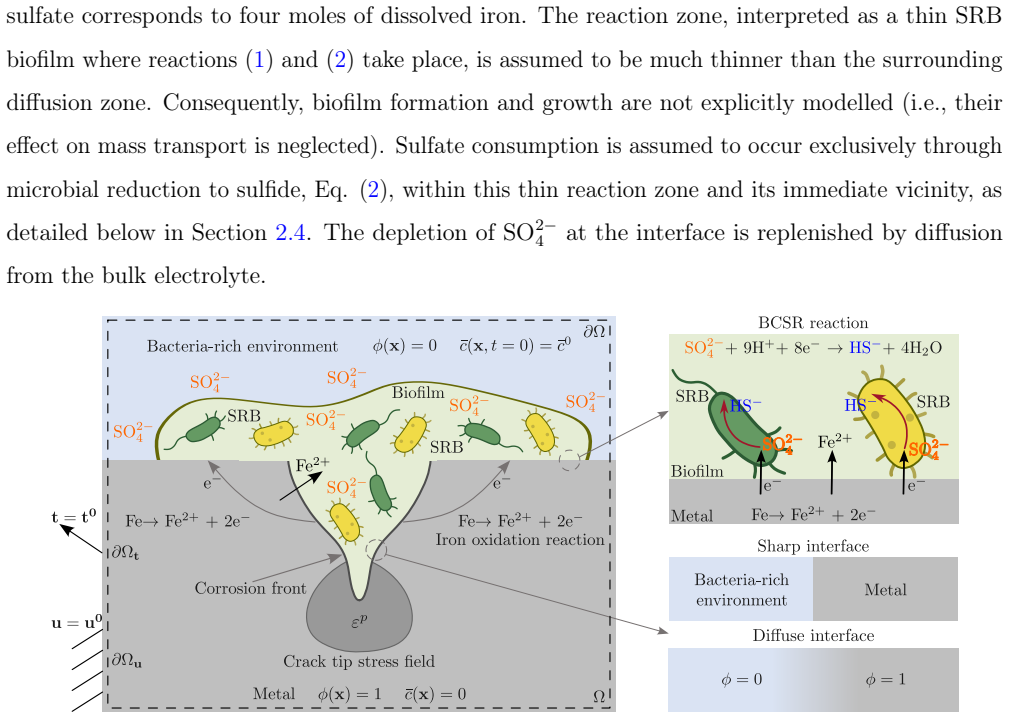
The central claim is that a phase-field-based reaction-diffusion corrosion model, incorporating a Monod expression for microbial sulfate reduction, sulfate transport, electrochemical kinetics, material dissolution, and mechano-chemical coupling through an enhanced mobility relation, reproduces experimental pitting kinetics under SRB activity and captures both MIC-induced pitting and stress-assisted corrosion across length scales from microstructure to engineering structures.
What carries the argument
phase-field reaction-diffusion model with Monod-type microbial kinetics and enhanced mobility for mechano-chemical coupling
If this is right
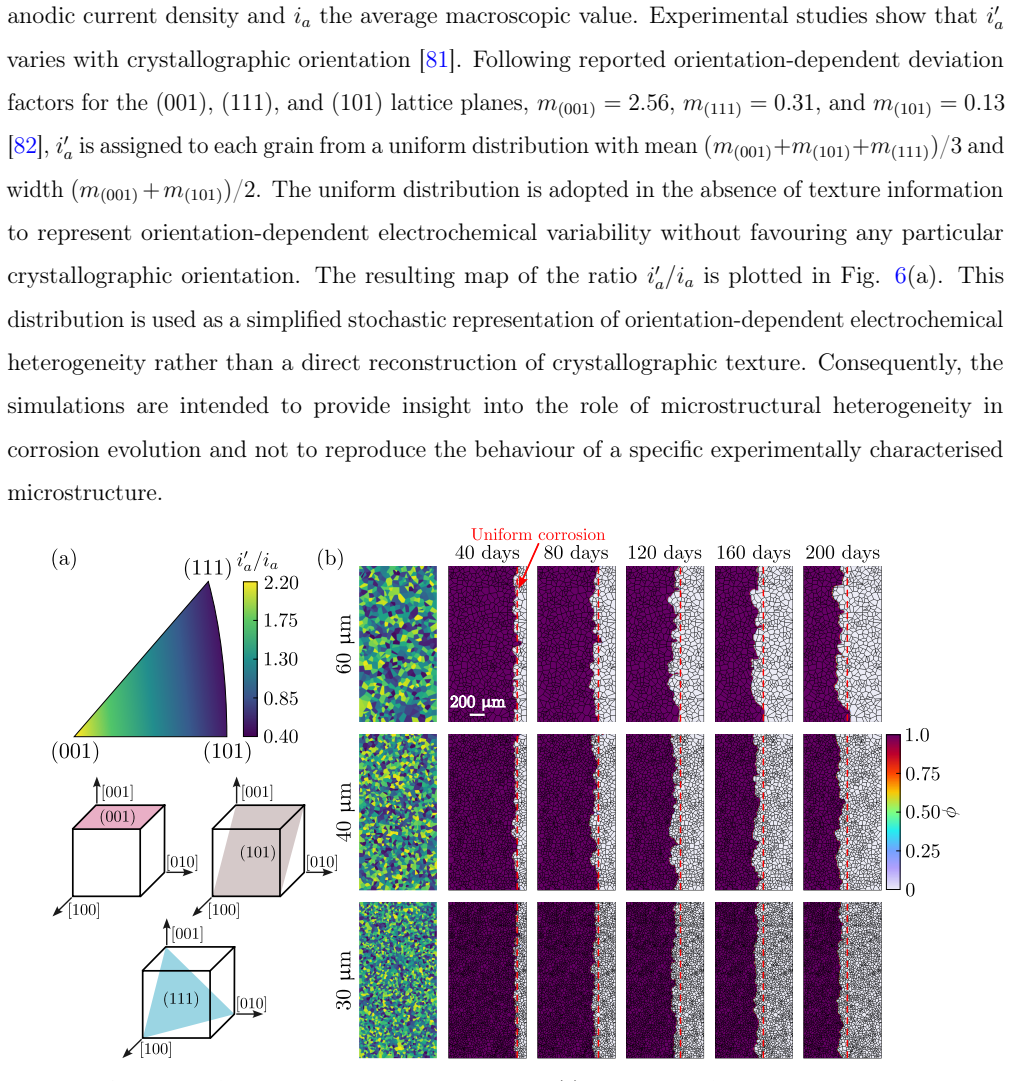
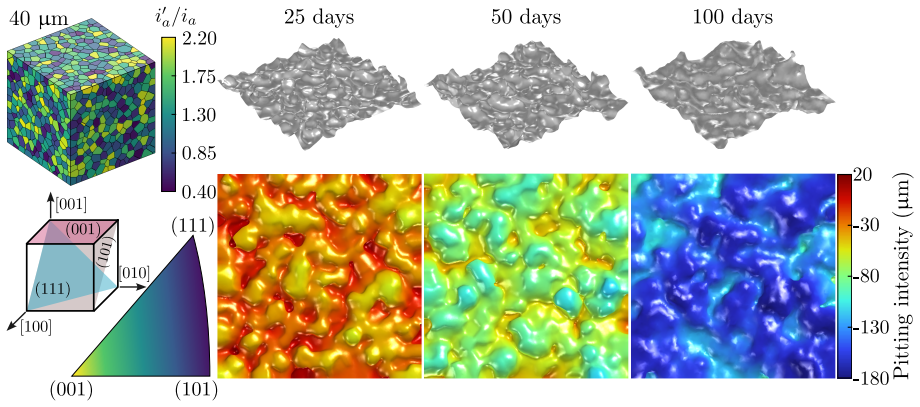
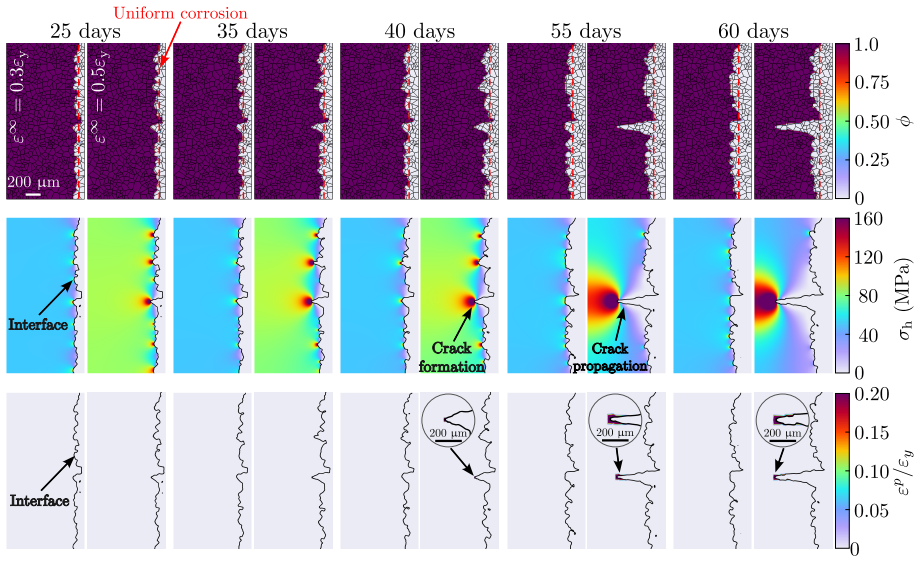
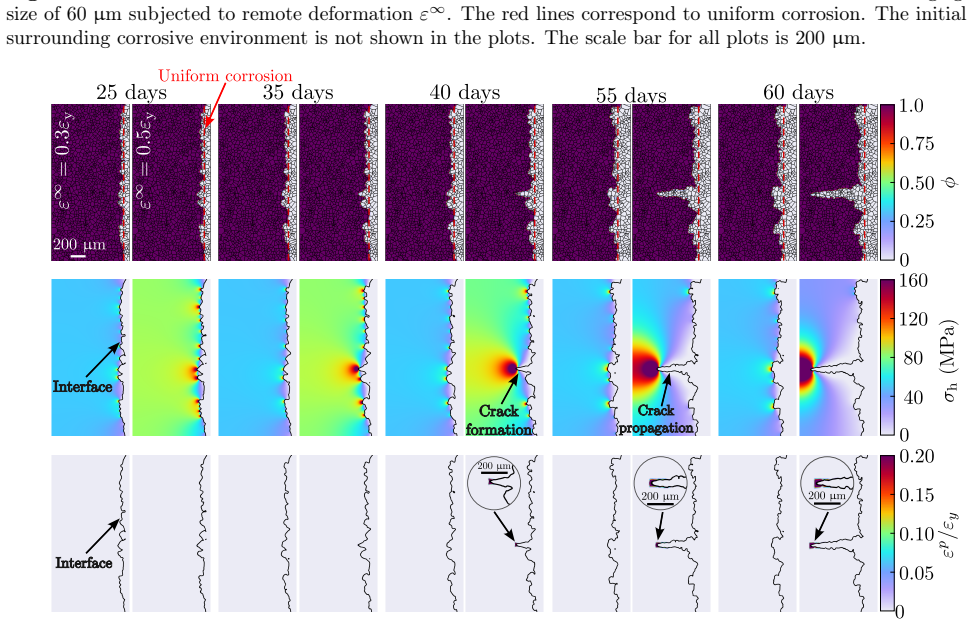
- Finer grain sizes reduce overall pitting severity while accelerating defect propagation under mechanical loading.
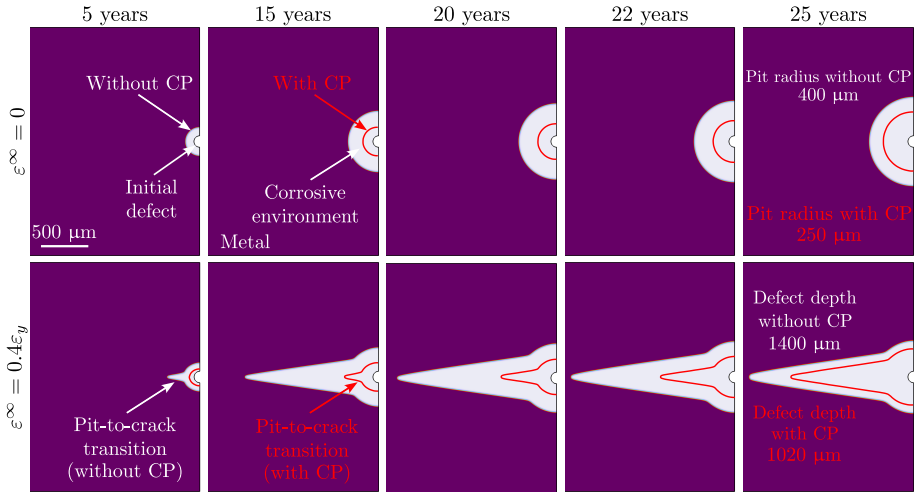
- Coupling to a cathodic protection model shows that CP delays pitting and suppresses cracking, with effectiveness declining as sacrificial anodes degrade.
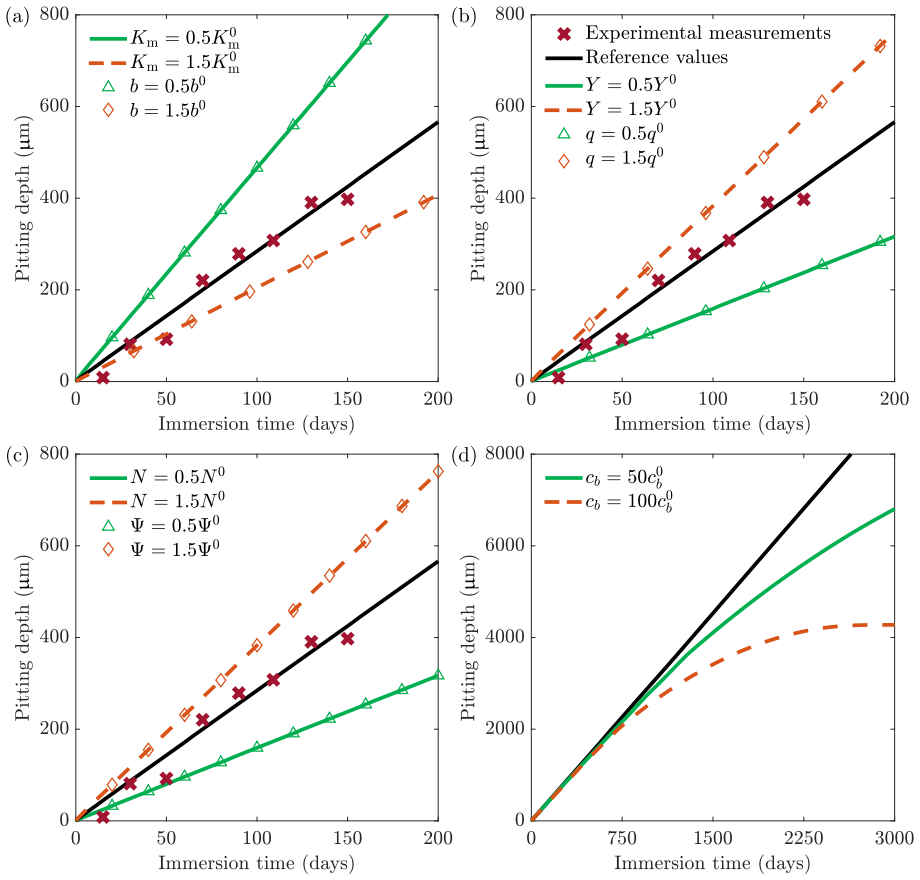
- Sensitivity analyses identify the relative influence of microbial kinetics, transport rates, and thermodynamic driving forces on corrosion behaviour.
- The model reproduces both MIC pitting and stress-assisted corrosion in microstructure-sensitive and structural-scale simulations.
Where Pith is reading between the lines
- The same framework could be used to explore trade-offs between grain refinement for corrosion resistance and the resulting increase in crack growth risk under load.
- Structural-scale predictions might inform inspection intervals or anode replacement schedules for assets such as offshore wind foundations exposed to SRB.
- Extension to time-dependent microbial community changes or varying environmental conditions would require only updates to the Monod parameters and transport fields.
Load-bearing premise
The chosen functional form and parameters of the enhanced mobility relation correctly convert mechanical fields into modified corrosion rates, and the calibration to the cited experiments extends to the microstructures and structural geometries examined.
What would settle it
New experimental measurements of pit depth evolution or crack growth rates under controlled SRB exposure and applied stress that deviate systematically from the model's calibrated predictions.
Figures




read the original abstract
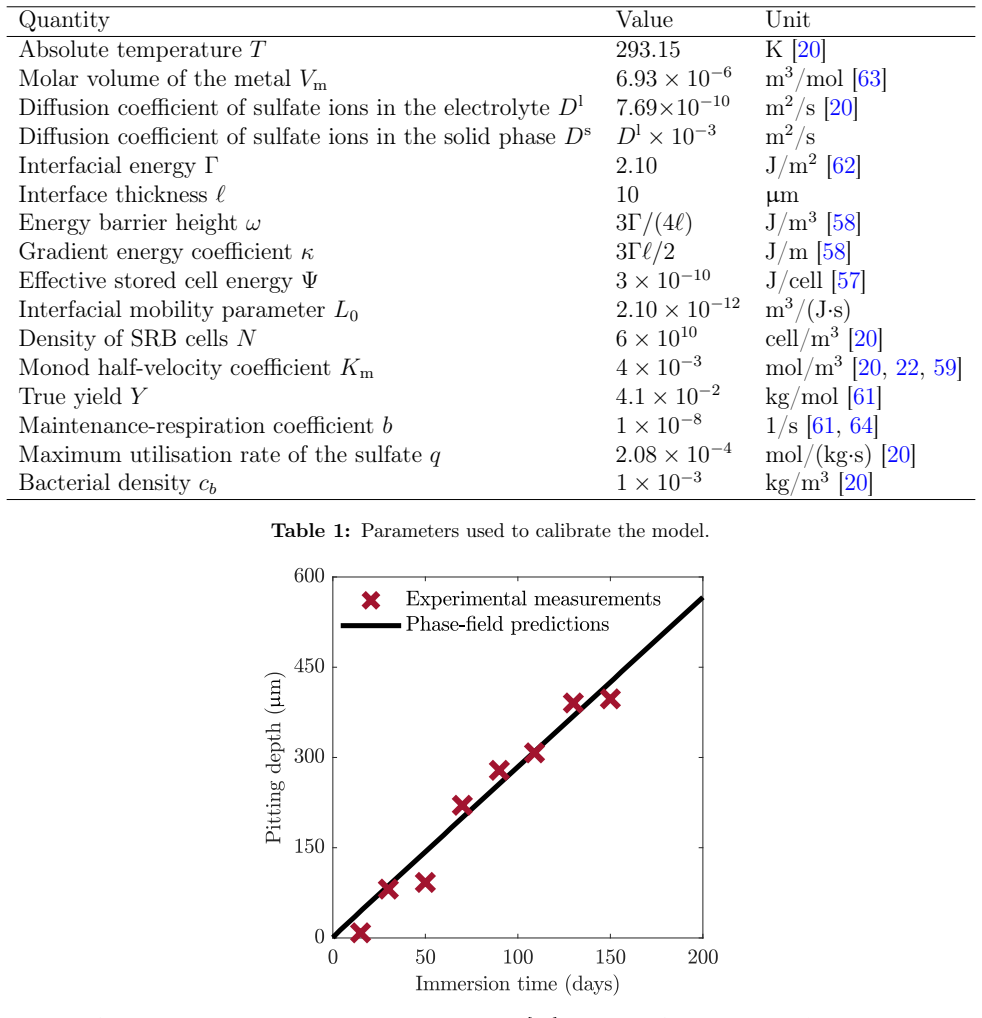
A phase-field-based reaction-diffusion corrosion model is developed to predict microbially influenced corrosion (MIC) in metal alloys, with a focus on anaerobic conditions and sulfate-reducing bacteria (SRB). The formulation couples microbial sulfate reduction, sulfate transport, electrochemical kinetics, material dissolution, and mechanical effects. Microbial activity is modelled using a Monod-type expression for sulfate consumption, whereas the mechano-chemical coupling is incorporated through an enhanced mobility relationship that captures the influence of mechanical fields on corrosion kinetics. The model is calibrated against experiments and shows strong agreement in predicting pitting kinetics under SRB activity. Sensitivity analyses quantify the competing roles of microbial kinetics, transport, and thermodynamic driving forces in governing corrosion behaviour. The capability of the formulation to capture both MIC-induced pitting and stress-assisted corrosion across multiple length scales is demonstrated through case studies that include microstructure-sensitive simulations and structural-scale coupling with a cathodic protection (CP) model. Results show that finer grain sizes reduce pitting severity but promote faster defect propagation under mechanical loading. At the structural scale, coupling with the CP model enables predictions of defect growth under varying electrochemical conditions and over engineering-relevant length scales, as exemplified with the analysis of an offshore wind turbine monopile. CP delays pitting and suppresses crack propagation, although its effectiveness diminishes as sacrificial anodes degrade. The framework provides a predictive and computationally efficient tool for assessing MIC-induced damage over extended times, with potential applications in the integrity and life assessment of metallic structures operating in aggressive microbial environments.
Editorial analysis
A structured set of objections, weighed in public.
Referee Report
Summary. The manuscript develops a phase-field reaction-diffusion model for microbiologically influenced corrosion (MIC) under anaerobic SRB conditions. It couples Monod-type microbial sulfate reduction, sulfate transport, electrochemical kinetics, material dissolution, and mechanical effects via an enhanced mobility relation. The model is calibrated to experiments with reported strong agreement on pitting kinetics, includes sensitivity analyses on microbial kinetics, transport, and driving forces, and demonstrates multi-scale case studies: microstructure-sensitive pitting (grain size effects on severity vs. propagation) and structural-scale coupling to a cathodic protection (CP) model for an offshore wind turbine monopile (CP delays pitting until anode degradation).
Significance. If the calibration generalizes, the work provides a multi-physics phase-field framework that integrates microbial activity with mechano-electrochemical corrosion across scales, which is valuable for integrity assessment of structures in aggressive environments. Explicit strengths include the sensitivity analyses quantifying competing mechanisms and the structural-scale CP demonstration; these go beyond single-scale pitting models.
major comments (2)
- [Calibration and case-study sections] The central claim of predictive capability at structural scale (monopile with CP) rests on transfer of calibrated Monod parameters and enhanced mobility relation from the pitting experiments. No independent validation set, hold-out data, or quantitative error metrics (e.g., RMSE on pit depth or growth rate) are reported for the CP-coupled or microstructure cases, so the generalization assumption is untested and load-bearing.
- [Model formulation] § on mechano-chemical coupling: the enhanced mobility functional form is introduced to encode stress effects on kinetics, but its parameters appear fitted to the same experiments used for overall calibration; this risks circularity when claiming the model captures both MIC-induced pitting and stress-assisted corrosion without additional verification.
minor comments (2)
- Notation for the Monod half-saturation constants and the mobility enhancement factor should be defined consistently in the text and equations to avoid ambiguity when comparing sensitivity results.
- Figure legends for the monopile CP simulations could explicitly state the anode degradation timeline and boundary conditions used, improving reproducibility of the structural-scale results.
Simulated Author's Rebuttal
We thank the referee for the constructive comments. We respond point-by-point to the major comments below, acknowledging limitations where they exist and indicating planned revisions to the manuscript.
read point-by-point responses
-
Referee: [Calibration and case-study sections] The central claim of predictive capability at structural scale (monopile with CP) rests on transfer of calibrated Monod parameters and enhanced mobility relation from the pitting experiments. No independent validation set, hold-out data, or quantitative error metrics (e.g., RMSE on pit depth or growth rate) are reported for the CP-coupled or microstructure cases, so the generalization assumption is untested and load-bearing.
Authors: We agree that the microstructure-sensitive and CP-coupled simulations transfer parameters calibrated solely from the SRB pitting experiments and do not include an independent validation dataset or quantitative error metrics (such as RMSE) for those cases. These simulations are presented as demonstrations of the model's multi-scale capabilities and coupling features rather than as validated predictions. We will revise the manuscript to explicitly qualify the scope of these case studies, add a limitations discussion on the need for future independent validation at structural scales, and ensure that calibration error metrics for the primary experiments are reported with greater prominence. revision: partial
-
Referee: [Model formulation] § on mechano-chemical coupling: the enhanced mobility functional form is introduced to encode stress effects on kinetics, but its parameters appear fitted to the same experiments used for overall calibration; this risks circularity when claiming the model captures both MIC-induced pitting and stress-assisted corrosion without additional verification.
Authors: The enhanced mobility relation is constructed from established mechano-chemical principles in the stress-corrosion literature, with its functional parameters adjusted to reproduce the observed pitting kinetics in the SRB experiments. The Monod microbial kinetics are calibrated independently of the mobility enhancement term. Nevertheless, we acknowledge the potential interdependence when the same dataset informs both components. We will revise the model formulation section to clarify the separation of terms, cite the literature basis for the mobility form more explicitly, and add a note on the calibration strategy to address concerns of circularity. revision: yes
Circularity Check
No significant circularity detected
full rationale
The paper formulates a phase-field reaction-diffusion model from standard electrochemical, microbial Monod kinetics, transport, and mechanical principles, then calibrates parameters to experimental pitting data before demonstrating application to microstructure and structural-scale cases. No quoted equations or steps in the provided text reduce the central claims (e.g., pitting kinetics predictions or CP coupling) to the calibration inputs by construction, nor do self-citations or ansatzes serve as load-bearing uniqueness theorems. The derivation chain remains independent of the fitted values, with calibration functioning as external validation rather than definitional equivalence.
Axiom & Free-Parameter Ledger
free parameters (2)
- Monod kinetic parameters
- enhanced mobility parameters
axioms (3)
- domain assumption Phase-field evolution equations can represent moving corrosion interfaces
- domain assumption Monod expression accurately captures SRB sulfate reduction rate
- ad hoc to paper Enhanced mobility relation correctly encodes mechano-chemical coupling
Reference graph
Works this paper leans on
-
[1]
D. Xu, T. Gu, D. Lovley, Microbially mediated metal corrosion, Nat. Rev. Microbiol. 21 (2023) 705–718
2023
-
[2]
T. Gu, R. Jia, T. Unsal, D. Xu, Toward a better understanding of microbiologically influenced corrosion caused by sulfate reducing bacteria, J. Mater. Sci. Technol. 35 (2019) 631–636
2019
-
[3]
Enning, J
D. Enning, J. Garrelfs, Corrosion of iron by sulfate-reducing bacteria: New views of an old problem, Appl. Environ. Microbiol. 80 (2014) 1226–1236
2014
-
[4]
D. Wang, E. Zhou, D. Xu, D. R. Lovley, Burning question: Are there sustainable strategies to prevent microbial metal corrosion?, Microb. Biotechnol. 16 (2023) 2026–2035. 41
2023
-
[5]
Venegas, F
V. Venegas, F. Caleyo, L. Vázquez, T. Baudin, J. Hallen, On the influence of crystallographic texture on pitting corrosion in pipeline steels, Int. J. Electrochem. Sci. 10 (2015) 3539–3552
2015
-
[6]
Y. Yu, J. Xu, B. Liu, T. Chai, C. Sun, Selective corrosion behavior of X80 steel heat affected zone by SRB in coastal saline soil, Int. J. Press. Vessel. Pip. 203 (2023) 104924
2023
-
[7]
T. Wu, M. Yan, D. Zeng, J. Xu, C. Sun, C. Yu, W. Ke, Stress corrosion cracking of X80 steel in the presence of sulfate-reducing bacteria, J. Mater. Sci. Technol. 31 (2015) 413–422
2015
-
[8]
M. Yan, B. Wei, J. Chen, J. Xu, C. Sun, U. Ramamurty, Micromechanisms of stress corrosion cracking induced by sulfate-reducing bacteria in a high-strength low-alloy steel, Acta Mater. 305 (2026) 121846
2026
-
[9]
T. Wu, J. Xu, C. Sun, M. Yan, C. Yu, W. Ke, Microbiological corrosion of pipeline steel under yield stress in soil environment, Corros. Sci. 88 (2014) 291–305
2014
-
[10]
T. Wu, J. Xu, M. Yan, C. Sun, C. Yu, W. Ke, Synergistic effect of sulfate-reducing bacteria and elastic stress on corrosion of X80 steel in soil solution, Corros. Sci. 83 (2014) 38–47
2014
-
[11]
Gutman, Mechanochemistry of Materials
E. Gutman, Mechanochemistry of Materials. Cambridge International Science Publishing, Cambridge, UK, 1988
1988
-
[12]
C. Cui, R. Ma, E. Martínez-Pañeda, A phase field formulation for dissolution-driven stress corrosion cracking, J. Mech. Phys. Solids 147 (2021) 104254
2021
-
[13]
Javaherdashti, R
R. Javaherdashti, R. Singh Raman, C. Panter, E. Pereloma, Microbiologically assisted stress corrosion cracking of carbon steel in mixed and pure cultures of sulfate reducing bacteria, Int. Biodeterior. Biodegrad. 58 (2006) 27–35
2006
-
[14]
H. Chen, O. Kimyon, H. Lamei Ramandi, P. Craig, C. Gunawan, S. Wu, M. Manefield, A. Crosky, S. Saydam, Microbiologically influenced stress corrosion cracking responsible for catastrophic failure of cable bolts, Eng. Fail. Anal. 131 (2022) 105884
2022
-
[15]
J. Li, E. Zhou, F. Xie, Z. Li, F. Wang, D. Xu, Accelerated stress corrosion cracking of X80 pipeline steel under the combined effects of sulfate-reducing bacteria and hydrostatic pressure, Corros. Sci. 243 (2025) 112593
2025
-
[16]
T. Wu, M. Yan, J. Xu, Y. Liu, C. Sun, W. Ke, Mechano-chemical effect of pipeline steel in microbio- logical corrosion, Corros. Sci. 108 (2016) 160–168
2016
-
[17]
T. Wu, M. Yan, L. Yu, H. Zhao, C. Sun, F. Yin, W. Ke, Stress corrosion of pipeline steel under disbonded coating in a SRB-containing environment, Corros. Sci. 157 (2019) 518–530
2019
-
[18]
X. Yang, J. Shao, Z. Liu, D. Zhang, L. Cui, C. Du, X. Li, Stress-assisted microbiologically influenced corrosion mechanism of 2205 duplex stainless steel caused by sulfate-reducing bacteria, Corros. Sci. 173 (2020) 108746
2020
-
[19]
Marciales, Y
A. Marciales, Y. Peralta, T. Haile, T. Crosby, J. Wolodko, Mechanistic microbiologically influenced corrosion modeling - A review, Corros. Sci. 146 (2019) 99–111
2019
-
[20]
Peng, S.-Y
C.-G. Peng, S.-Y. Suen, J. K. Park, Modeling of anaerobic corrosion influenced by sulfate-reducing bacteria, Water Environ. Res. 66 (1994) 707–715
1994
-
[21]
Javaherdashti, Modeling microbiologically influenced corrosion of N-80 carbon steel by fuzzy calculus, Metall
R. Javaherdashti, Modeling microbiologically influenced corrosion of N-80 carbon steel by fuzzy calculus, Metall. Mater. Trans. A 35A (2004) 2051–2056. 42
2004
-
[22]
M. M. Al-Darbi, K. Agha, M. R. Islam, Comprehensive modelling of the pitting biocorrosion of steel, Can. J. Chem. Eng. 83 (2005) 872–881
2005
-
[23]
Maxwell, Predicting Microbially Influenced Corrosion (MIC) in seawater injection systems, Vol
S. Maxwell, Predicting Microbially Influenced Corrosion (MIC) in seawater injection systems, Vol. SPE International Oilfield Corrosion Symposium, SPE-100519-MS, 2006
2006
-
[24]
R. E. Melchers, T. Wells, Models for the anaerobic phases of marine immersion corrosion, Corros. Sci. 48 (2006) 1791–1811
2006
-
[25]
T. Gu, K. Zhao, S. Nesic, A practical mechanistic model for MIC based on a Biocatalytic Cathodic Sulfate Reduction (BCSR) theory. Corrosion/2009 Paper No. 09390, NACE International, Houston, TX, USA. (2009)
2009
-
[26]
Larsen, K
J. Larsen, K. B. Sorense, S. Juhler, D. S. Pedersen, The application of molecular microbiological methods for early warning of MIC in pipelines. Corrosion/2013 Paper No. NACE-2013-2029, NACE International. (2013)
2013
-
[27]
Gu, Theoretical modeling of the possibility of acid producing bacteria causing fast pitting biocorro- sion, J
T. Gu, Theoretical modeling of the possibility of acid producing bacteria causing fast pitting biocorro- sion, J. Microb. Biochem. Technol. 6 (2014) 068–074
2014
-
[28]
Haile, P
T. Haile, P. Teevens, Z. Zhu, Sulphate-reducing bacteria growth kinetics’-based microbiologically influenced corrosion predictive model, J. Pipeline Eng. 14 (2015) 259–267
2015
-
[29]
D. Xu, Y. Li, T. Gu, Mechanistic modeling of biocorrosion caused by biofilms of sulfate reducing bacteria and acid producing bacteria, Bioelectrochemistry 110 (2016) 52–58
2016
-
[30]
Dawuda, M
A.-W. Dawuda, M. Taleb-berrouane, F. Khan, A probabilistic model to estimate microbiologically influenced corrosion rate, Process. Saf. Environ. Prot. 148 (2021) 908–926
2021
-
[31]
Anguita, G
J. Anguita, G. Pizarro, I. T. Vargas, Mathematical modelling of microbial corrosion in carbon steel due to early-biofilm formation of sulfate-reducing bacteria via extracellular electron transfer, Bioelectrochemistry 145 (2022) 108058
2022
-
[32]
Martínez-Pañeda, Phase-field simulations opening new horizons in corrosion research, MRS Bulletin (2024) 1–10
E. Martínez-Pañeda, Phase-field simulations opening new horizons in corrosion research, MRS Bulletin (2024) 1–10
2024
-
[33]
W. Mai, S. Soghrati, R. G. Buchheit, A phase field model for simulating the pitting corrosion, Corros. Sci. 110 (2016) 157–166
2016
-
[34]
Ansari, Z
T. Ansari, Z. Xiao, S. Hu, Y. Li, J. Luo, S. Shi, Phase-field model of pitting corrosion kinetics in metallic materials, npj Comput. Mater. 38 (2018) 382–390
2018
-
[35]
A. F. Chadwick, J. A. Stewart, R. A. Enrique, S. Du, K. Thornton, Numerical modeling of localized corrosion using phase-field and smoothed boundary methods, J. Electrochem. Soc. 165 (2018) C633– C646
2018
-
[36]
C. Lin, H. Ruan, Phase-field modeling of mechano–chemical-coupled stress-corrosion cracking, Elec- trochim. Acta 395 (2021) 139196
2021
-
[37]
P. T. Brewick, Simulating pitting corrosion in AM 316L microstructures through phase field methods and computational modeling, J. Electrochem. Soc. 169 (2022) 011503
2022
-
[38]
C. Cui, R. Ma, E. Martínez-Pañeda, Electro-chemo-mechanical phase field modeling of localized corrosion: theory and COMSOL implementation, Eng. Comput. 39 (2023) 3877–3894. 43
2023
-
[39]
Kovacevic, W
S. Kovacevic, W. Ali, E. Martínez-Pañeda, J. LLorca, Phase-field modeling of pitting and mechanically- assisted corrosion of Mg alloys for biomedical applications, Acta Biomater. 164 (2023) 641–658
2023
-
[40]
J. Song, C. Matthew, K. Sangoi, Y. Fu, A phase field model to simulate crack initiation from pitting site in isotropic and anisotropic elastoplastic material, Model. Simul. Mater. Sci. Eng. 31 (2023) 055002
2023
-
[41]
Makuch, S
M. Makuch, S. Kovacevic, M. R. Wenman, E. Martínez-Pañeda, A microstructure-sensitive electro- chemo-mechanical phase-field model of pitting and stress corrosion cracking, Corros. Sci. 232 (2024) 112031
2024
-
[42]
Q. Zeng, Y. Chen, Z. Yang, L. Zhang, Z. Wang, L. Wang, J. Li, J. Wang, Effect of grain size and grain boundary type on intergranular stress corrosion cracking of austenitic stainless steel: A phase-field study, Corros. Sci. 241 (2024) 112557
2024
-
[43]
Kandekar, A
C. Kandekar, A. Ravikumar, D. Höche, W. E. Weber, Mastering the complex time-scale interaction during stress corrosion cracking phenomena through an advanced coupling scheme, Comput. Methods Appl. Mech. Eng. 428 (2024) 117101
2024
-
[44]
Amador, J
J. Amador, J. Vega, E. García-Lecina, F. Varas, Quantitative phase-field model to simulate low carbon steel aqueous corrosion phenomena, Corros. Sci. 232 (2024) 112045
2024
-
[45]
Lhoest, S
A. Lhoest, S. Kovacevic, D. Nguyen-Manh, J. Lim, E. Martinez-Paneda, M. R. Wenman, A mesoscale phase-field model of intergranular liquid lithium corrosion of ferritic/martensitic steels, NPJ Mater. Degrad. 9 (2025) 68
2025
-
[46]
J. Chen, Y. Zhang, J. Pu, S. Li, J. Cao, Investigation of pitting-induced stress corrosion cracking using a phase-field model coupled with crystal plasticity, Eng. Fract. Mech. 339 (2026) 112102
2026
-
[47]
D. Wang, T. Ueki, P. Ma, D. Xu, D. R. Lovley, Elucidating microbial iron corrosion mechanisms with a hydrogenase-deficient strain ofDesulfovibrio vulgaris, mLife 3 (2024) 269–276
2024
-
[48]
Y. Dong, J. He, J. Sheng, L. Yang, H. Zhang, Y. Fan, F. Wang, T. Gu, D. Xu, Non-essential role of hydrogenases in microbiologically influenced corrosion byNitratidesulfovibrio vulgarisHildenborough: Challenging the cathodic depolarization theory, JMST 254 (2026) 135–144
2026
-
[49]
J. Li, D. E. Holmes, D. Xu, D. R. Lovley, Fe(III) oxide reduction bypassing outer-surface cytochromes in a marine respiratory anaerobe, Environ. Sci. Technol. 60 (2026) 14601–14609
2026
-
[50]
Muyzer, A
G. Muyzer, A. J. M. Stams, The ecology and biotechnology of sulfate-reducing bacteria, Nat. Rev. Microbiol. 6 (2008) 441–454
2008
-
[51]
S. G. Kim, W. T. Kim, T. Suzuki, Phase-field model for binary alloys, Phys. Rev. E 60 (1999) 7186–7197
1999
-
[52]
B. E. Rittmann, P. L. McCarty, Model of steady-state-biofilm kinetics, Biotechnol. Bioeng. 22 (1980) 2343–2357
1980
-
[53]
J. C. Simo, T. J. R. Hughes, Computational Inelasticity. Springer, 1998
1998
-
[54]
S. M. Allen, J. W. Cahn, A microscopic theory for antiphase boundary motion and its application to antiphase domain coarsening, Acta Metall. 27 (1979) 1085–1095
1979
-
[55]
C. Cui, R. Ma, E. Martínez-Pañeda, A generalised, multi-phase-field theory for dissolution-driven stress corrosion cracking and hydrogen embrittlement, J. Mech. Phys. Solids 166 (2022) 104951. 44
2022
-
[56]
Kovacevic, W
S. Kovacevic, W. Ali, T. K. Mandal, E. Martínez-Pañeda, J. LLorca, Impact of pH and chloride content on the biodegradation of magnesium alloys for medical implants: An in vitro and phase-field study, Acta Biomater. 198 (2025) 546–565
2025
-
[57]
H. Y. Wang, D.-G. Mou, J. R. Swartz, Thermodynamic evaluation of microbial growth, Biotechnol. Bioeng. 18 (1976) 1811–1814
1976
-
[58]
Kovacevic, R
S. Kovacevic, R. Pan, D. P. Sekulic, S.Dj. Mesarovic, Interfacial energy as the driving force for diffusion bonding of ceramics, Acta Mater. 186 (2020) 405–414
2020
-
[59]
Ingvorsen, B
K. Ingvorsen, B. B. Jørgensen, Kinetics of sulfate uptake by freshwater and marine species of Desulfovibrio, Arch. Microbiol. 139 (1984) 61–66
1984
-
[60]
M. B. Goldhaber, I. R. Kaplan, Controls and consequences of sulfate reduction rates in recent marine sediments, John Wiley & Sons, Ltd, 1982, Ch. 2, pp. 19–36
1982
-
[61]
C. J. Gantzer, H. G. Stefan, A model of microbial activity in lake sediments in response to periodic water-column mixing, Water Research 37 (2003) 2833–2846
2003
-
[62]
Kanhaiya, S
K. Kanhaiya, S. Kim, W. Im, H. Heinz, Accurate simulation of surfaces and interfaces of ten FCC metals and steel using Lennard-Jones potentials, NPJ Comput. Mater. 7 (2021) 17
2021
-
[63]
British Standard BS EN 10088-1:2005, The European Organisation for Standardisation, Sandvik AB, SANDVIKEN, SE-811 81, Sweden, 2005
2005
-
[64]
Y. H. Lin, K. K. Lee, Verification of anaerobic biofilm model for phenol degradation with sulfate reduction, J. Environ. Eng. 127 (2001) 119–125
2001
-
[65]
Sorensen, U
K. Sorensen, U. Thomsen, S. Juhler, J. Larsen, Cost Efficient MIC management system based on molecular microbiological methods. Corrosion/2012 Paper No. NACE-2012-1111, NACE International. (2012)
2012
-
[66]
Y. Dong, J. Wang, Z. Gao, J. Di, D. Wang, X. Guo, Z. Hu, X. Gao, Y. Wang, Study on growth influencing factors and desulfurization performance of sulfate reducing bacteria based on the response surface methodology, ACS Omega 8 (2023) 4046–4059
2023
-
[67]
Saxena, D
P. Saxena, D. Samanta, P. Thakur, K. M. Goh, M. Subramaniam, B. M. Peyton, M. Fields, R. K. Sani, pH-dependent genotypic and phenotypic variability inOleidesulfovibrio alaskensisG20, Appl. Environ. Microbiol. 91 (2025) e02565–24
2025
-
[68]
J. W. Costerton, Z. Lewandowski, D. E. Caldwell, D. R. Korber, H. M. Lappin-Scott, Microbial biofilms, Annu. Rev. Microbiol. 49 (1995) 711–745
1995
-
[69]
Y. Fan, C. Chen, Y. Zhang, H. Liu, H. Liu, H. Liu, Early corrosion behavior of X80 pipeline steel in a simulated soil solution containing Desulfovibrio desulfuricans, Bioelectrochem. 141 (2021) 107880
2021
-
[70]
Y. Wang, H. Huang, Y. Tang, S. Wen, X. Hou, Influence of initial cell counts on the microbiologically influenced corrosion of L245N steel in shale gas environments, Bioelectrochemistry 168 (2026) 109157
2026
-
[71]
P. Liu, H. Zhang, Y. Fan, D. Xu, Microbially influenced corrosion of steel in marine environments: A review from mechanisms to prevention, Microorganisms 11 (2023) 2299
2023
-
[72]
Erdogan, G
C. Erdogan, G. Swain, Conceptual sacrificial anode cathodic protection design for offshore wind monopiles, Ocean Eng. 235 (2021) 109339. 45
2021
-
[73]
DNV AS, Cathodic protection design, Recommended Practice DNV-RP-B401, DNV, Høvik, Norway (2021)
2021
-
[74]
Jamieson, B
J. Jamieson, B. Wing, J. Farquhar, M. Hannington, Neoarchaean seawater sulphate concentrations from sulphur isotopes in massive sulphide ore, Nat. Geosci. 6 (2013) 61–64
2013
-
[75]
Ingvorsen, A
K. Ingvorsen, A. J. B. Zehnder, B. B. Jørgensen, Kinetics of sulfate and acetate uptake by Desulfobacter postgatei, Appl. Environ. Microbiol. 47 (1984) 403–408
1984
-
[76]
Overmann, C
J. Overmann, C. Lepleux, Marine bacteria and archaea: Diversity, adaptations, and culturability, Springer, 2016, pp. 21–55
2016
-
[77]
Yuan-Hui, S
L. Yuan-Hui, S. Gregory, Diffusion of ions in sea water and in deep-sea sediments, Geochim. Cosmochim. Acta 38 (1974) 703–714
1974
-
[78]
S. A. Elahi, F. Mehri Sofiani, S. Chaudhuri, J. A. Balbín, N. O. Larrosa, W. De Waele, A numerical study on fatigue strength degradation due to pitting corrosion of S355 structural steel in a marine environment, Eng. Fail. Anal. 177 (2025) 109669
2025
-
[79]
Lehto, H
P. Lehto, H. Remes, EBSD characterisation of grain size distribution and grain sub-structures for ferritic steel weld metals, Weld. World 66 (2022) 363–377
2022
-
[80]
Lehto, J
P. Lehto, J. Romanoff, H. Remes, T. Sarikka, Characterisation of local grain size variation of welded structural steel, Weld. World 60 (2016) 673–688
2016
discussion (0)
Sign in with ORCID, Apple, or X to comment. Anyone can read and Pith papers without signing in.