Dual-Prior Guided Null-Space Learning with Mixture-of-Splines for Arbitrary Medical Slice Super-Resolution
Pith reviewed 2026-06-29 05:23 UTC · model grok-4.3
The pith
Dual-prior null-space learning confines medical slice super-resolution details to the measurement null space while enforcing exact reproduction of acquired slices.
A machine-rendered reading of the paper's core claim, the machinery that carries it, and where it could break.
Core claim
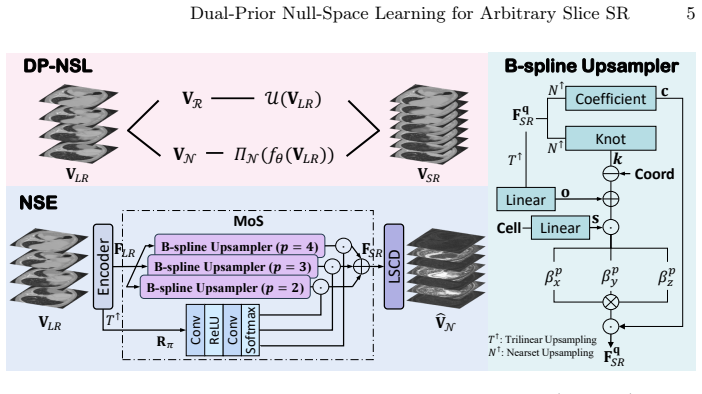
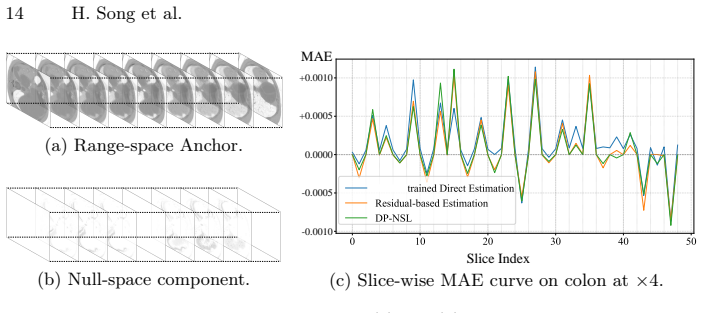
DP-NSL reformulates arbitrary slice super-resolution as a constrained recovery process guided by a Deterministic Observation Prior via MCP orthogonal projection that reproduces every acquired slice with zero error and a Geometric Continuity Prior via MoS dynamic mixing of B-spline experts, with experiments showing outperformance on CT/MRI benchmarks while strictly preserving measurement consistency.
What carries the argument
Dual-Prior Null-space Learning framework that uses Measurement-Consistent Projection to confine learning to the null space of the measurement operator and Mixture-of-Splines to impose adaptive geometric continuity.
Load-bearing premise
That confining all learned content to the null space of the measurement operator, combined with the Mixture-of-Splines continuity model, is sufficient to prevent generation of anatomically implausible structures across all regions and modalities.
What would settle it
A reconstructed volume that either fails to reproduce an acquired slice with zero error or contains anatomically implausible structures in a held-out CT or MRI test case would falsify the central claim.
Figures



read the original abstract
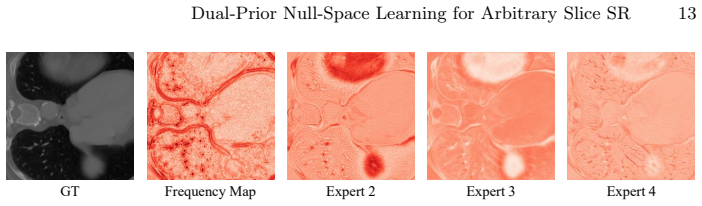
Arbitrary slice super-resolution reconstructs isotropic volumes from anisotropic clinical acquisitions by synthesizing intermediate slices at arbitrary scales. However, treating this ill-posed inverse problem as unconstrained residual-based regression risks hallucinating anatomically implausible structures or altering the originally observed data. To address both concerns, this paper presents the Dual-Prior Null-space Learning (DP-NSL) framework, which reformulates the task as a constrained recovery process guided by two complementary priors. A Measurement-Consistent Projection (MCP) enforces a Deterministic Observation Prior: the reconstruction undergoes an exact orthogonal projection that reproduces every acquired slice with zero error, confining all learned details to the unobservable null space. Within this null space, a Mixture-of-Splines (MoS) module imposes a Geometric Continuity Prior by dynamically mixing B-spline experts of different analytic orders, allowing each anatomical region to be modeled with a content-aware level of continuity. To promote spatial coherence, a Local Spatial Consistency Decoder (LSCD) further injects local inductive bias. Experiments on three CT and one MRI benchmark show that DP-NSL outperforms existing approaches while strictly preserving measurement consistency. Code is available at https://github.com/DeepMed-Lab-ECNU/Medical-Image-Reconstruction.
Editorial analysis
A structured set of objections, weighed in public.
Referee Report
Summary. The paper presents the Dual-Prior Null-space Learning (DP-NSL) framework for arbitrary medical slice super-resolution. It reformulates the task as constrained recovery guided by a Measurement-Consistent Projection (MCP) that enforces a Deterministic Observation Prior via orthogonal projection reproducing every acquired slice with zero error (confining learned content to the null space) and a Mixture-of-Splines (MoS) module that imposes a Geometric Continuity Prior through dynamic mixing of B-spline experts of varying orders. A Local Spatial Consistency Decoder (LSCD) adds local inductive bias. Experiments on three CT and one MRI benchmark demonstrate outperformance over existing methods while strictly preserving measurement consistency. Code is released at the provided GitHub link.
Significance. If the central claims hold, the work supplies a principled null-space formulation that directly addresses hallucination and consistency violations in ill-posed medical super-resolution, which is a recurring practical concern. The explicit separation of the deterministic observation prior from the learned geometric continuity prior, together with the public code release, strengthens reproducibility and allows direct verification of the zero-error projection property.
minor comments (1)
- [Abstract / §3] The abstract and framework description would benefit from an explicit statement of the spline orders used in the MoS module and the precise form of the orthogonal projection operator (e.g., in matrix notation) to allow immediate reproduction of the consistency guarantee.
Simulated Author's Rebuttal
We thank the referee for their positive assessment of our work, accurate summary of the DP-NSL framework, and recommendation to accept the manuscript. We appreciate the recognition of the principled separation of the deterministic observation prior and geometric continuity prior, as well as the emphasis on reproducibility through code release.
Circularity Check
No significant circularity detected
full rationale
The paper's core construction defines MCP as an orthogonal projection that, by definition of the null-space operator, reproduces acquired slices with zero error and confines learning to the null space; MoS is introduced as an explicit dynamic mixture of B-spline experts for content-adaptive continuity. These are methodological design choices, not derivations in which a claimed prediction reduces by construction to a fitted quantity or self-citation chain. No load-bearing self-citations, uniqueness theorems imported from prior author work, or ansatzes smuggled via citation appear in the abstract or framework description. Experimental outperformance claims rest on external CT/MRI benchmarks and are falsifiable independently of the internal definitions.
Axiom & Free-Parameter Ledger
axioms (1)
- standard math An orthogonal projection onto the range of the measurement operator reproduces every acquired slice with zero error
invented entities (2)
-
Mixture-of-Splines (MoS) module
no independent evidence
-
Local Spatial Consistency Decoder (LSCD)
no independent evidence
Reference graph
Works this paper leans on
-
[1]
Ixi dataset.https://brain-development.org/ixi-dataset/
-
[2]
Nature Communications13(1), 4128 (2022)
Antonelli, M., Reinke, A., Bakas, S., Farahani, K., Kopp-Schneider, A., Landman, B.A., Litjens, G., Menze, B., Ronneberger, O., Summers, R.M., et al.: The medical segmentation decathlon. Nature Communications13(1), 4128 (2022)
2022
-
[3]
CRC Press (2014)
Birkfellner, W.: Applied Medical Image Processing: A Basic Course. CRC Press (2014)
2014
-
[4]
In: CVPR (2023) 16 H
Cao, J., Wang, Q., Xian, Y., Van Gool, L., Timofte, R.: Ciaosr: Continuous im- plicit attention-in-attention network for arbitrary-scale image super-resolution. In: CVPR (2023) 16 H. Song et al
2023
-
[5]
In: CVPR (2021)
Chen, Y., Liu, S., Wang, X.: Learning continuous image representation with local implicit image function. In: CVPR (2021)
2021
-
[6]
IEEE TIP (2025)
Chen, Y., Wang, Y., Zhang, H.: Unsupervised range-nullspace learning prior for multispectral images reconstruction. IEEE TIP (2025)
2025
-
[7]
In: CVPR (2024)
Fang, W., Tang, Y., Xu, M., Pan, J., Cai, J.: Cycleinr: Cycle implicit neural repre- sentation for arbitrary-scale volumetric super-resolution of medical data. In: CVPR (2024)
2024
-
[8]
IEEE Trans
Gerig, G., Kubler, O., Kikinis, R., Jolesz, F.A.: Nonlinear anisotropic filtering of mri data. IEEE Trans. Med. Imaging11(2), 221–232 (1992)
1992
-
[9]
In: CVPR (2024)
He, Z., Jin, Z.: Latent modulated function for computational optimal continuous image representation. In: CVPR (2024)
2024
-
[10]
arXiv preprint arXiv:1904.00445 (2019)
Heller, N., Sathianathen, N., Kalapara, A., Walczak, E., Moore, K., Kaluzniak, H., Rosenberg, J., Blake, P., Rengel, Z., Oestreich, M., et al.: The kits19 challenge data: 300 kidney tumor cases with clinical context, ct semantic segmentations, and surgical outcomes. arXiv preprint arXiv:1904.00445 (2019)
-
[11]
In: CVPR (2019)
Hu, X., Mu, H., Zhang, X., Wang, Z., Tan, T., Sun, J.: Meta-sr: A magnification- arbitrary network for super-resolution. In: CVPR (2019)
2019
-
[12]
In: NeurIPS (2025)
Jacome, R., Gualdron-Hurtado, R., Arguello, H.: Npn: Non-linear projections of the null-space for imaging inverse problems. In: NeurIPS (2025)
2025
-
[13]
In: CVPR (2025)
Jiang, Y., Kwan, H.M., Zhang, F., Bull, D.: Hiif: Hierarchical encoding based implicit image function for continuous super-resolution. In: CVPR (2025)
2025
-
[14]
In: CVPR (2025)
Kim, E., Kim, H., Yoo, J.: Bf-stvsr: B-splines and fourier – best friends for high fidelity spatial-temporal video super-resolution. In: CVPR (2025)
2025
-
[15]
Adam: A Method for Stochastic Optimization
Kingma, D.P., Ba, J.: Adam: A method for stochastic optimization. arXiv preprint arXiv:1412.6980 (2014)
work page internal anchor Pith review Pith/arXiv arXiv 2014
-
[16]
In: CVPR (2022)
Lee, J., Jin, K.H.: Local texture estimator for implicit representation function. In: CVPR (2022)
2022
-
[17]
In: CVPRW (2017)
Lim, B., Son, S., Kim, H., Nah, S., Mu Lee, K.: Enhanced deep residual networks for single image super-resolution. In: CVPRW (2017)
2017
-
[18]
In: CVPR
Liu, X., Tang, H.: Difffno: Diffusion fourier neural operator. In: CVPR. pp. 150–160 (2025)
2025
-
[19]
In: ICML (2024)
Luo, X., Qian, X., Yoon, B.J.: Hierarchical neural operator transformer with learnable frequency-aware loss prior for arbitrary-scale super-resolution. In: ICML (2024)
2024
-
[20]
In: CVPR (2023)
Pak, B., Lee, J., Jin, K.H.: B-spline texture coefficients estimator for screen content image super-resolution. In: CVPR (2023)
2023
-
[21]
In: CVPR (2020)
Peng, C., Lin, W.A., Liao, H., Chellappa, R., Zhou, S.K.: Saint: spatially aware interpolation network for medical slice synthesis. In: CVPR (2020)
2020
-
[22]
IEEE TMI (2024)
Song, H., Mao, X., Wang, Y., Shen, W., Li, Q.: I3net: Inter-intra-slice interpolation network for medical slice synthesis. IEEE TMI (2024)
2024
-
[23]
In: CVPR (2015)
Szegedy, C., Liu, W., Jia, Y., Sermanet, P., Reed, S., Anguelov, D., Erhan, D., Vanhoucke, V., Rabinovich, A.: Going deeper with convolutions. In: CVPR (2015)
2015
-
[24]
In: CVPR (2016)
Szegedy, C., Vanhoucke, V., Ioffe, S., Shlens, J., Wojna, Z.: Rethinking the incep- tion architecture for computer vision. In: CVPR (2016)
2016
-
[25]
IEEE Trans
Uhm, K.H., Cho, H., Hong, S.H., Jung, S.W.: An anisotropic cross-view texture transfer with multi-reference non-local attention for ct slice interpolation. IEEE Trans. Med. Imaging (2025)
2025
-
[26]
Unser, M., Aldroubi, A., Eden, M.: B-spline signal processing. i. theory. IEEE transactions on signal processing41(2), 821–833 (2002)
2002
-
[27]
Unser, M., Aldroubi, A., Eden, M.: B-spline signal processing. ii. efficiency design and applications. IEEE transactions on signal processing41(2), 834–848 (2002) Dual-Prior Null-Space Learning for Arbitrary Slice SR 17
2002
-
[28]
In: IJCAI (2021)
Wang, P.S., Liu, Y., Yang, Y.Q., Tong, X.: Spline positional encoding for learning 3d implicit signed distance fields. In: IJCAI (2021)
2021
-
[29]
Medical Image Analysis94, 103158 (2024)
Wang, X., Wang, S., Xiong, H., Xuan, K., Zhuang, Z., Liu, M., Shen, Z., Zhao, X., Zhang, L., Wang, Q.: Spatial attention-based implicit neural representation for arbitrary reduction of mri slice spacing. Medical Image Analysis94, 103158 (2024)
2024
-
[30]
In: ICLR (2023)
Wang, Y., Yu, J., Zhang, J.: Zero-shot image restoration using denoising diffusion null-space model. In: ICLR (2023)
2023
-
[31]
In: CVPR
Wei, M., Zhang, X.: Super-resolution neural operator. In: CVPR. pp. 18247–18256 (2023)
2023
-
[32]
IEEE JBHI27(2), 1004–1015 (2022)
Wu, Q., Li, Y., Sun, Y., Zhou, Y., Wei, H., Yu, J., Zhang, Y.: An arbitrary scale super-resolution approach for 3d mr images via implicit neural representation. IEEE JBHI27(2), 1004–1015 (2022)
2022
-
[33]
Yu, P., Zhang, H., Kang, H., Tang, W., Arnold, C.W., Zhang, R.: Rplhr-ct dataset andtransformerbaselineforvolumetricsuper-resolutionfromctscans.In:MICCAI (2022)
2022
-
[34]
wCoord” and “w/oCoord
Zeng, C., Zhang, Z., Huang, W., Zhang, L.: Dc2-sr: A dual-consistency guided curriculum learning method for thick-slice fetal mri super-resolution. In: ACM MM (2025) 18 H. Song et al. Supplementary Material for Dual-Prior Guided Null-Space Learning with Mixture-of-Splines for Arbitrary Medical Slice Super-Resolution This supplementary material provides ad...
2025
discussion (0)
Sign in with ORCID, Apple, or X to comment. Anyone can read and Pith papers without signing in.