Wonderboom -- Efficient, and Censorship-Resilient Signature Aggregation for Million Scale Consensus
Pith reviewed 2026-05-21 14:22 UTC · model grok-4.3
The pith
Wonderboom aggregates signatures from a million Ethereum validators 32 times faster than current methods while resisting adversarial attacks.
A machine-rendered reading of the paper's core claim, the machinery that carries it, and where it could break.
Core claim
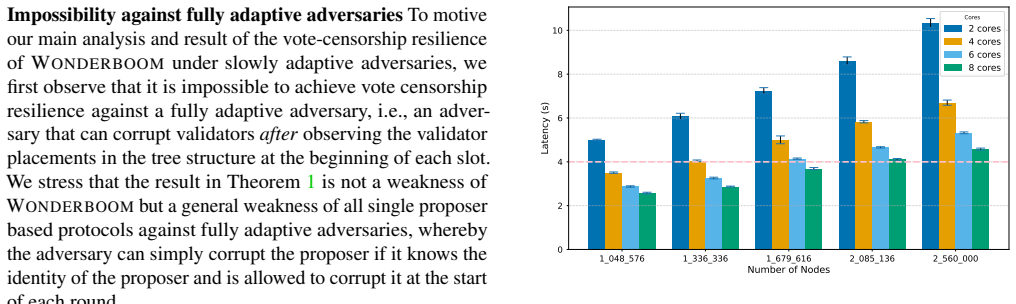
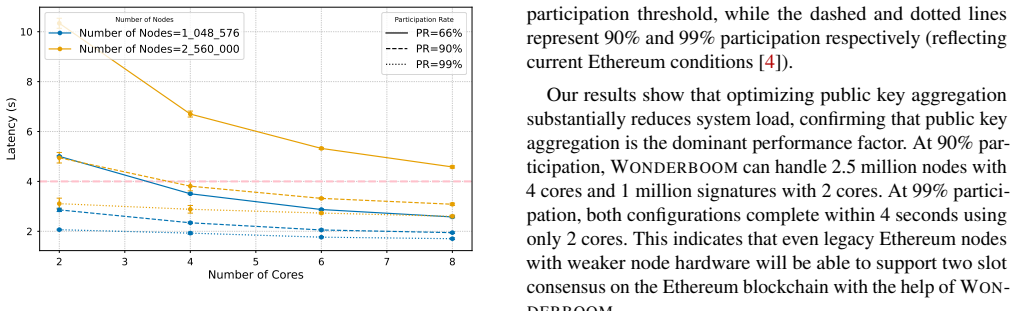
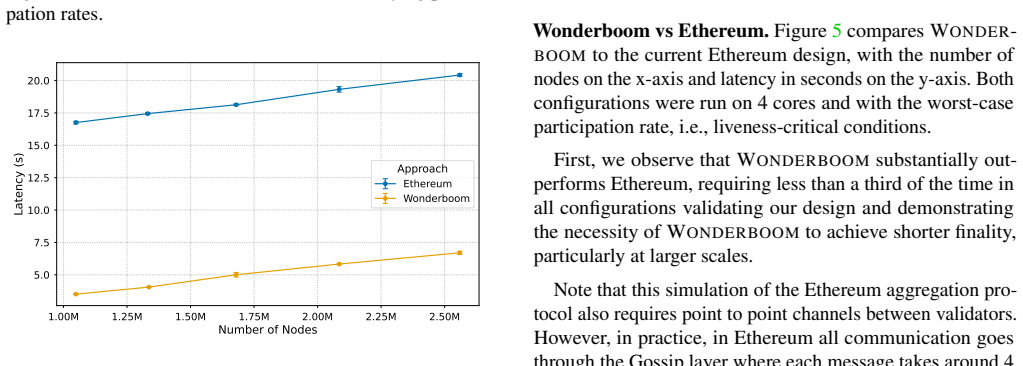
Wonderboom is the first protocol that can efficiently aggregate the signatures of millions of validators in a single Ethereum slot while offering higher security guarantees than the state of the art protocol used in Ethereum. It achieves this 32 times faster and the authors provide a simulation showing it handles more than 2 million signatures in worst case conditions.
What carries the argument
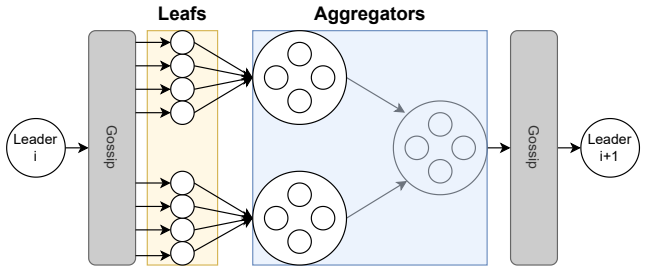
Wonderboom aggregation protocol that combines efficient signature collection with censorship resilience to operate at million-validator scale.
If this is right
- Blocks on Ethereum can finalize much quicker, around one slot instead of 15 minutes.
- Adversaries cannot easily shift stake proportions from honest to adversarial nodes.
- The system supports aggregation of over 2 million signatures per slot.
- Real-world applications requiring fast finality become feasible on Ethereum.
Where Pith is reading between the lines
- If implemented, this could increase Ethereum's overall throughput and adoption for time-sensitive uses.
- Similar methods might improve consensus in other decentralized systems with large participant sets.
- Further optimizations could reduce the slot time even more or handle even larger validator sets.
Load-bearing premise
The custom simulation tool must accurately model real-world network delays, dissemination costs, and adversarial behaviors at million-validator scale without introducing biases that favor Wonderboom.
What would settle it
Deploying Wonderboom in a large-scale test environment with one million simulated or real validators and verifying whether signature aggregation completes reliably within a 12-second slot under adversarial network conditions.
Figures

read the original abstract
Over the last years, Ethereum has evolved into a public platform that safeguards the savings of hundreds of millions of people and secures more than $650 billion in assets, placing it among the top 25 stock exchanges worldwide in market capitalization, ahead of Singapore, Mexico, and Thailand. As such, the performance and security of the Ethereum blockchain are not only of theoretical interest, but also carry significant global economic implications. At the time of writing, the Ethereum platform is collectively secured by almost one million validators highlighting its decentralized nature and underlining its economic security guarantees. However, due to this large validator set, the protocol takes around 15 minutes to finalize a block which is prohibitively slow for many real world applications. This delay is largely driven by the cost of aggregating and disseminating signatures across a validator set of this scale. Furthermore, as we show in this paper, the existing protocol that is used to aggregate and disseminate the signatures has several shortcomings that can be exploited by adversaries to shift stake proportion from honest to adversarial nodes. In this paper, we introduce Wonderboom, the first million scale aggregation protocol that can efficiently aggregate the signatures of millions of validators in a single Ethereum slot (x32 faster) while offering higher security guarantees than the state of the art protocol used in Ethereum. Furthermore, to evaluate Wonderboom, we implement the first simulation tool that can simulate such a protocol on the million scale and show that even in the worst case Wonderboom can aggregate and verify more than 2 million signatures within a single Ethereum slot.
Editorial analysis
A structured set of objections, weighed in public.
Referee Report
Summary. The manuscript introduces Wonderboom, a signature aggregation protocol for million-scale validator sets in systems like Ethereum. It claims to aggregate and verify signatures from more than 2 million validators within a single 12-second Ethereum slot (32x faster than the current protocol), while providing stronger security guarantees against adversarial stake shifting. Evaluation relies on a newly developed custom simulation tool that models the protocol at this scale and demonstrates compliance with timing requirements even under worst-case conditions.
Significance. If the simulation accurately captures real network conditions, dissemination costs, and adversarial behaviors, the work would represent a meaningful advance in scalable consensus, enabling substantially faster finality times and improved censorship resistance for large proof-of-stake networks securing hundreds of billions in value.
major comments (1)
- [Simulation Results section] Simulation Results section: the headline claims of 32x speedup and successful aggregation of >2M signatures in one slot rest entirely on outputs from an unvalidated custom simulator. The manuscript supplies no description of how the tool models per-validator bandwidth/latency distributions, gossip-sub message costs under partial synchrony, or adaptive adversarial dropping/equivocation, nor any cross-check against smaller-scale runs of deployed Ethereum clients. This modeling gap is load-bearing for both the performance and security conclusions.
minor comments (1)
- [Abstract and Introduction] The abstract and introduction repeatedly reference 'as we show in this paper' without explicit section pointers to the protocol construction, security argument, or simulation methodology; adding such cross-references would improve traceability.
Simulated Author's Rebuttal
We thank the referee for their careful and constructive review of the manuscript. We address the major comment below and outline the revisions we will make to strengthen the presentation of the simulation results.
read point-by-point responses
-
Referee: [Simulation Results section] Simulation Results section: the headline claims of 32x speedup and successful aggregation of >2M signatures in one slot rest entirely on outputs from an unvalidated custom simulator. The manuscript supplies no description of how the tool models per-validator bandwidth/latency distributions, gossip-sub message costs under partial synchrony, or adaptive adversarial dropping/equivocation, nor any cross-check against smaller-scale runs of deployed Ethereum clients. This modeling gap is load-bearing for both the performance and security conclusions.
Authors: We agree that the current manuscript provides only a high-level overview of the custom simulation tool and does not supply sufficient detail on its modeling assumptions or validation steps. This is a substantive gap that affects the strength of the performance and security claims. In the revised version we will expand the Simulation Results section (and add a dedicated subsection on the simulator) to describe: the concrete distributions and parameter ranges used for per-validator bandwidth and latency (derived from publicly available Ethereum network measurements); the accounting for gossip-sub message sizes and propagation delays under partial synchrony; the implementation of adaptive adversarial actions including selective dropping and equivocation; and the results of cross-validation experiments performed on smaller validator sets against actual Ethereum client code. These additions will make the modeling choices explicit and allow independent assessment of the simulator's fidelity. revision: yes
Circularity Check
No circularity: protocol design and simulation results are independent of target claims
full rationale
The paper presents Wonderboom as a newly designed aggregation protocol whose performance (x32 faster aggregation of >2M signatures in one slot) and security advantages are obtained by direct evaluation in a custom million-scale simulator. No equations, parameters, or uniqueness theorems are shown to reduce to self-definitions, fitted inputs renamed as predictions, or self-citation chains. The central claims rest on the protocol construction plus simulation outputs rather than any step that is equivalent to its own inputs by construction; the simulation framework is external to the claimed results even if its fidelity remains unvalidated.
Axiom & Free-Parameter Ledger
axioms (1)
- domain assumption The underlying network model permits reliable dissemination of aggregated signatures within a single slot even under adversarial conditions.
Reference graph
Works this paper leans on
-
[1]
https://github.com/randao/randao
Randao. https://github.com/randao/randao . Accessed on 26.08.2025
work page 2025
-
[2]
Aptos. Run a validator and vfn. https://aptos.dev/ network/nodes/validator-node , 2025. Accessed on 11.08.2025
work page 2025
-
[3]
A fast confirmation rule for the ethereum consensus protocol.arXiv preprint arXiv:2405.00549, 2024
Aditya Asgaonkar, Francesco D’Amato, Roberto Saltini, Luca Zanolini, and Chenyi Zhang. A fast confirmation rule for the ethereum consensus protocol.arXiv preprint arXiv:2405.00549, 2024
-
[4]
CoBRA: A Universal Strategyproof Confirmation Protocol for Quorum-based Proof-of-Stake Blockchains
Zeta Avarikioti, Eleftherios Kokoris Kogias, Ray Nei- heiser, and Christos Stefo. Cobra: A universal strate- gyproof confirmation protocol for quorum-based proof- of-stake blockchains, 2025. URL: https://arxiv.or g/abs/2503.16783,arXiv:2503.16783
work page internal anchor Pith review Pith/arXiv arXiv 2025
-
[5]
History of daily active validators
Beaconcha.in. History of daily active validators. ht tps://beaconcha.in/charts/validators , 2025. Accessed on 11.08.2025
work page 2025
-
[6]
Ethereum staking ecosystem overview
Beaconcha.in. Ethereum staking ecosystem overview. https://beaconcha.in/entities, 2026. Accessed on 11.08.2025
work page 2026
-
[7]
Com- pact multi-signatures for smaller blockchains
Dan Boneh, Manu Drijvers, and Gregory Neven. Com- pact multi-signatures for smaller blockchains. In Thomas Peyrin and Steven Galbraith, editors,Advances in Cryptology – ASIACRYPT 2018, pages 435–464, Cham, 2018. Springer International Publishing
work page 2018
-
[8]
Short signatures from the weil pairing.Journal of cryptology, 17(4):297–319, 2004
Dan Boneh, Ben Lynn, and Hovav Shacham. Short signatures from the weil pairing.Journal of cryptology, 17(4):297–319, 2004
work page 2004
-
[9]
The economic limits of permissionless consensus
Eric Budish, Andrew Lewis-Pye, and Tim Roughgarden. The economic limits of permissionless consensus. In Proceedings of the 25th ACM Conference on Economics and Computation, EC ’24, page 704–731, New York, NY , USA, 2024. Association for Computing Machinery. doi:10.1145/3670865.3673548
-
[10]
Paths toward single-slot finality.https: //notes.ethereum.org/@vbuterin/single_slot _finality, 2022
Vitalik Buterin. Paths toward single-slot finality.https: //notes.ethereum.org/@vbuterin/single_slot _finality, 2022. Accessed on 11.08.2025
work page 2022
-
[11]
Practical byzantine fault tolerance
Miguel Castro, Barbara Liskov, et al. Practical byzantine fault tolerance. InOsDI, volume 99, pages 173–186, 1999
work page 1999
-
[12]
Jing Chen and Silvio Micali. Algorand: A secure and efficient distributed ledger.Theoretical Computer Sci- ence, 777:155–183, 2019. In memory of Maurice Nivat, a founding father of Theoretical Computer Science - Part I. URL: https://www.sciencedirect.co 14 m/science/article/pii/S030439751930091X , doi:10.1016/j.tcs.2019.02.001
- [13]
-
[14]
URL: https://docs.chia.net/green-paper -abstract
-
[15]
A simple single slot finality protocol for ethereum
Francesco D’Amato and Luca Zanolini. A simple single slot finality protocol for ethereum. InEuropean Sympo- sium on Research in Computer Security, pages 376–393. Springer, 2023
work page 2023
-
[16]
Upgrading ethereum, bls signatures
Ben Edgington. Upgrading ethereum, bls signatures. ht tps://eth2book.info/latest/part2/building_ blocks/signatures/, 2025. Accessed on 30.07.2025
work page 2025
-
[17]
Upgrading ethereum, committees
Ben Edgington. Upgrading ethereum, committees. ht tps://eth2book.info/latest/part2/building_ blocks/committees/, 2025. Accessed on 30.07.2025
work page 2025
-
[18]
Ethereum. Sync committee penalties. https://eth2bo ok.info/latest/part2/incentives/penalties/ ,
-
[19]
Accessed on 21.08.2025
work page 2025
-
[20]
William Feller.An Introduction to Probability Theory and Its Applications, volume 1. Wiley, January 1968. URL: http://www.amazon.ca/exec/obidos/redi rect?tag=citeulike04-20{&}path=ASIN/04712 57087
work page 1968
-
[21]
Deanonymizing ethereum validators: The p2p network has a privacy issue,
Lioba Heimbach, Yann V onlanthen, Juan Villacis, Lu- cianna Kiffer, Roger Wattenhofer, et al. Deanonymizing ethereum validators: The p2p network has a privacy issue.arXiv preprint arXiv:2409.04366, 2024
-
[22]
Idit Keidar, Eleftherios Kokoris-Kogias, Oded Naor, and Alexander Spiegelman. All you need is DAG. InPODC, pages 165–175. ACM, 2021
work page 2021
-
[23]
Enhancing bitcoin security and performance with strong consistency via collective signing
Eleftherios Kokoris Kogias, Philipp Jovanovic, Nicolas Gailly, Ismail Khoffi, Linus Gasser, and Bryan Ford. Enhancing bitcoin security and performance with strong consistency via collective signing. In25th USENIX Security Symposium (USENIX Security 16), pages 279– 296, Austin, TX, August 2016. USENIX Association
work page 2016
-
[24]
Om- niledger: A secure, scale-out, decentralized ledger via sharding
Eleftherios Kokoris-Kogias, Philipp Jovanovic, Linus Gasser, Nicolas Gailly, Ewa Syta, and Bryan Ford. Om- niledger: A secure, scale-out, decentralized ledger via sharding. In2018 IEEE Symposium on Security and Privacy (SP), pages 583–598, San Francisco, CA, USA,
-
[25]
Daniel Lemire, Gregory Ssi-Yan-Kai, and Owen Kaser. Consistently faster and smaller compressed bitmaps with roaring.Software: Practice and Experience, 46(11):1547–1569, 2016
work page 2016
-
[26]
Low-resource eclipse attacks on ethereum’s peer-to-peer network.IACR ePrint Cryptology Report, 2020
Yuval Marcus, Ethan Heilman, and Sharon Goldberg. Low-resource eclipse attacks on ethereum’s peer-to-peer network.IACR ePrint Cryptology Report, 2020
work page 2020
-
[27]
Bitcoin: A peer-to-peer electronic cash system
Satoshi Nakamoto. Bitcoin: A peer-to-peer electronic cash system. 2008
work page 2008
-
[28]
Kauri: Scalable bft consensus with pipelined tree-based dissemination and aggregation
Ray Neiheiser, Miguel Matos, and Luís Rodrigues. Kauri: Scalable bft consensus with pipelined tree-based dissemination and aggregation. InProceedings of the ACM SIGOPS 28th Symposium on Operating Sys- tems Principles, SOSP ’21, page 35–48, New York, NY , USA, 2021. Association for Computing Machinery. doi:10.1145/3477132.3483584
-
[29]
Market statistics - february 2026
World Federation of Exchanges. Market statistics - february 2026. https://focus.world-exchanges .org/issue/february-2026/market-statistics ,
work page 2026
-
[30]
Accessed on 26.01.2026
work page 2026
-
[31]
Byzantine attacks exploiting penal- ties in ethereum pos
Ulysse Pavloff, Yackolley Amoussou-Guenou, and Sara Tucci-Piergiovanni. Byzantine attacks exploiting penal- ties in ethereum pos. In2024 54th Annual IEEE/IFIP International Conference on Dependable Systems and Networks (DSN), pages 53–65, 2024. doi:10.1109/DS N58291.2024.00020
work page doi:10.1109/ds 2024
-
[32]
Gossipsub message propagation latency
Yiannis Psaras. Gossipsub message propagation latency. https://ethresear.ch/t/gossipsub-message-p ropagation-latency, 2024. Accessed on 11.08.2025
work page 2024
-
[33]
Scalable and proba- bilistic leaderless bft consensus through metastability,
Team Rocket, Maofan Yin, Kevin Sekniqi, Robbert van Renesse, and Emin Gün Sirer. Scalable and proba- bilistic leaderless bft consensus through metastability,
- [34]
-
[35]
HEMMINGER S. Network emulation with netem. https://cir.nii.ac.jp/crid/1572543024894323456, 2005. Accessed on 18.04.2022
-
[36]
Navigating rewards, risks, and attesta- tion efficiency
Reza Sabernia. Navigating rewards, risks, and attesta- tion efficiency. https://figment.io/insights/st rategies-for-ethereum-validators-navigatin g-rewards-risks-and-attestation-efficiency ,
-
[37]
Accessed on 30.07.2025
work page 2025
-
[38]
Impact of geo-distribution and mining pools on blockchains: A study of ethereum
Paulo Silva, David Vavricka, João Barreto, and Miguel Matos. Impact of geo-distribution and mining pools on blockchains: A study of ethereum. In2020 50th Annual IEEE/IFIP International Conference on Dependable Systems and Networks (DSN), pages 245–252, 2020. doi:10.1109/DSN48063.2020.00041
-
[39]
Corwin Smith, Nicolas Consigny, Julio, nixo, Tim Beiko, Sam Calder-Mason, Mario Havel, and wackerow. Pectra. https://ethereum.org/roadmap/pectra/ , 2025. Accessed on 17.09.2025. 15
work page 2025
-
[40]
Share of cryptocurrency owners in 53 countries and territories worldwide as of january 2025, 2025
Statista. Share of cryptocurrency owners in 53 countries and territories worldwide as of january 2025, 2025. Ac- cessed on 08.10.2025. URL: https://www.statista .com/forecasts/1452605/share-of-cryptocur rency-owners-in-selected-countries-worldwi de
-
[41]
Supranational. blst. https://github.com/suprana tional/blst, 2025. Accessed on 11.08.2025
work page 2025
-
[42]
tokenterminal. Ecosystem total value locked. https: //tokenterminal.com/explorer/projects/ethe reum/ecosystem/ecosystem-tvl , 2026. Accessed on 26.01.2026
work page 2026
-
[43]
Gavin Wood. Ethereum: A secure decentralised gen- eralised transaction ledger.Ethereum project yellow paper, 151:1–32, 2014. Accessed on 18.04.2022. URL: https://files.gitter.im/ethereum/yellowpap er/VIyt/Paper.pdf
work page 2014
-
[44]
Guangquan Xu, Bingjiang Guo, Chunhua Su, Xi Zheng, Kaitai Liang, Duncan S. Wong, and Hao Wang. Am i eclipsed? a smart detector of eclipse attacks for ethereum.Computers & Security, 88:101604, 2020. URL: https://www.sciencedirect.com/scie nce/article/pii/S0167404818313798 , doi: 10.1016/j.cose.2019.101604
-
[45]
Peiyun Zhang, Fuya Xu, Tianlin Huang, Haibin Zhu, and Qinglin Zhao. Ctt: A three-layer tree consensus mech- anism for consortium blockchains with enhanced secu- rity and reduced communication cost.IEEE Transac- tions on Industrial Informatics, 21(6):4355–4366, 2025. doi:10.1109/TII.2025.3534426. C Omitted Proofs and Analysis C.1 Proof of Lemma 2 Lemma 2.F...
-
[46]
Now we compute the probability that the proposer is cor- rect
Thus, at depth d−2 from the first internal aggregator to the proposer, the probability to con- sistently pick a correct aggregate by random over all d−2 depths is at least 2 3 d−2 · 16− 16 3 15 . Now we compute the probability that the proposer is cor- rect. As there is only a single proposer, there is only a 2 3 chance for the proposer to be correct. As ...
discussion (0)
Sign in with ORCID, Apple, or X to comment. Anyone can read and Pith papers without signing in.