Fine-Tuning and Serving Gemma 4 31B on Google Cloud TPU: A Technical Comparison with GPU Baselines
Pith reviewed 2026-06-29 20:37 UTC · model grok-4.3
The pith
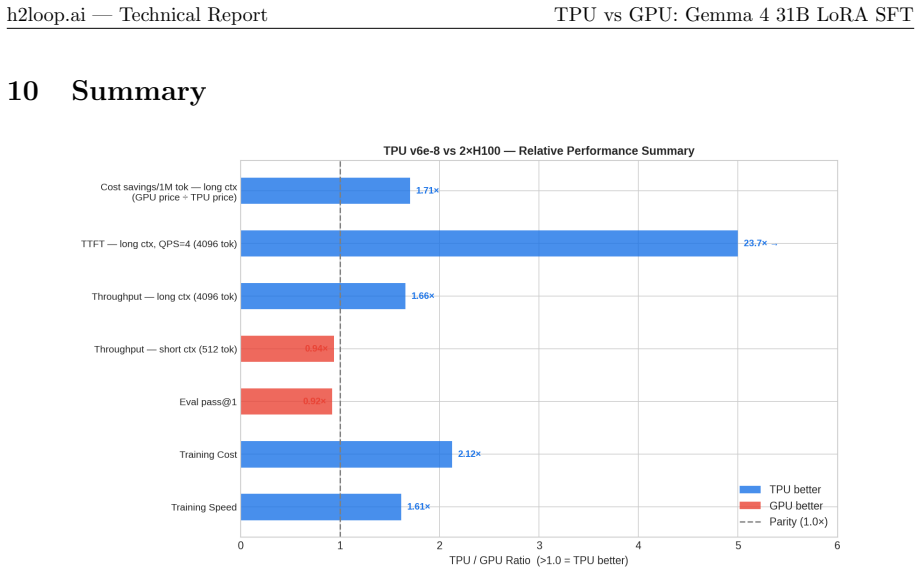
TPU hardware completes fine-tuning of the 31B model 1.61 times faster and at 2.12 times lower cost than a matched GPU baseline.
A machine-rendered reading of the paper's core claim, the machinery that carries it, and where it could break.
Core claim
By carrying out the full set of required changes to mesh layout, LoRA naming, sharding annotations, gradient checkpointing, data pipelines, and checkpoint merging, the TPU v5p-8 run finishes training 1.61 times faster at 2.12 times lower cost than the 2xH100 GPU baseline. For inference the TPU v6e-8 platform matches GPU results at short contexts and produces 66 percent higher throughput together with 23.6 times faster time-to-first-token at 4096-token inputs.
What carries the argument
The sequence of code-level adaptations that translate a PyTorch FSDP plus Hugging Face recipe into the JAX plus Tunix/Qwix stack while preserving identical hyperparameters and model behavior.
If this is right
- Training time and monetary cost both drop when the adapted recipe runs on TPU rather than the GPU baseline.
- Inference throughput rises 66 percent on TPU once input lengths reach 4096 tokens.
- Time-to-first-token latency falls by more than an order of magnitude on TPU at the same long-context operating point.
- The documented vLLM-TPU Docker configuration and checkpoint procedure make the model immediately servable on the target hardware.
Where Pith is reading between the lines
- Hardware choice for inference workloads may shift toward TPU when average context length exceeds a few thousand tokens.
- The porting steps could be reused as a template for other dense models of similar scale once the same JAX stack is targeted.
- Direct energy or power measurements on both platforms would allow a fuller cost comparison that includes electricity rather than only billed dollars.
Load-bearing premise
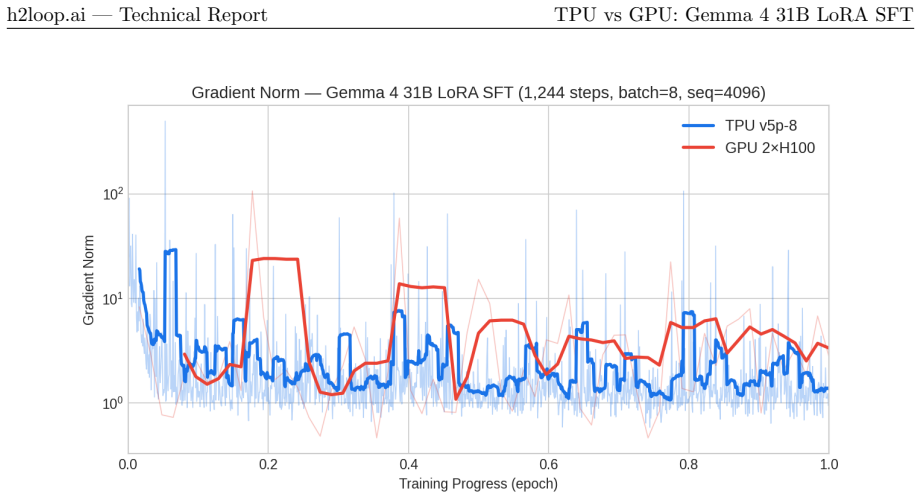
The GPU baseline and TPU runs truly share identical hyperparameters, effective batch sizes, and model outputs after all described adaptations.
What would settle it
A controlled side-by-side execution in which loss curves or generated token distributions diverge between the two platforms despite the claimed identical settings.
Figures



read the original abstract
We present the first end-to-end demonstration of fine-tuning and serving Google's Gemma 4 31B model on TPU hardware, providing an empirical comparison of TPU and GPU platforms for large language model adaptation. Using LoRA on a Google TPU v5p-8 for training and TPU v6e-8 (Trillium) for inference, we document the full set of code-level adaptations required to port a GPU-native training recipe - built on PyTorch, HuggingFace TRL, and FSDP - to the JAX + Tunix/Qwix stack. These adaptations span mesh configuration, LoRA module naming conventions, sharding annotation corrections, gradient checkpoint, data pipeline restructuring, and a custom Orbax-to-safetensor checkpoint merging procedure. For inference, we detail the vLLM-TPU Docker setup necessary to serve Gemma 4 on v6e-8 and characterize the resulting latency and throughput profile. Compared with a similar-costing 2xH100 GPU baseline under identical hyperparameters, TPU training completes 1.61x faster at 2.12x lower cost. For inference, we cover the vLLM-TPU Docker setup required to serve Gemma 4 on v6e-8 and explain the observed latency and throughput characteristics across a QPS sweep spanning 512 to 16k input tokens. Across both workloads we compare performance and cost against a 2xH100 GPU baseline running identical hyperparameters. The TPU completes training 1.61x faster at 2.12x lower cost. For inference, TPU v6e-8 matches GPU at short context (<=2048 tokens) and decisively outperforms at long context: 66% higher throughput and 23.6x faster TTFT at 4096-token inputs (61 ms vs 1,443 ms at QPS=4). Our work removes a critical gap in the open tooling ecosystem and provides practitioners with a recipe for Gemma 4 Dense 31B deployment on the TPU infrastructure.
Editorial analysis
A structured set of objections, weighed in public.
Referee Report
Summary. The manuscript presents the first end-to-end demonstration of fine-tuning Gemma 4 31B (LoRA) on TPU v5p-8 using JAX/Tunix/Qwix and serving on TPU v6e-8 with vLLM-TPU, detailing porting adaptations from a PyTorch/FSDP/HuggingFace TRL baseline. It reports that, under identical hyperparameters, TPU training completes 1.61× faster at 2.12× lower cost than a comparable 2×H100 GPU baseline; for inference, TPU v6e-8 matches GPU at short contexts and outperforms at long contexts (66% higher throughput, 23.6× faster TTFT at 4096-token inputs and QPS=4).
Significance. If the JAX and PyTorch implementations are shown to be numerically and dynamically equivalent and the measurements are reproducible with statistical controls, the work would supply practitioners with concrete, open recipes for 31B-scale model deployment on TPU hardware and close a documented tooling gap. The focus on real hardware cost/performance trade-offs and full porting details has practical utility in distributed systems and cloud ML.
major comments (2)
- [Abstract] Abstract: the headline training ratios (1.61× speed, 2.12× cost) and inference metrics (throughput, TTFT) are computed under the explicit premise of 'identical hyperparameters' after porting, yet no verification is supplied that effective batch size, tokens per update, gradient accumulation, loss curves, or final model quality match between the PyTorch and JAX stacks; the listed adaptations (mesh config, LoRA naming, sharding, checkpointing, Orbax merging) can alter these quantities.
- [Abstract] Abstract: none of the reported performance numbers include error bars, number of runs, run-to-run variance, data-exclusion rules, or statistical tests, so the reliability and generalizability of the direct ratio claims cannot be assessed from the given text.
minor comments (1)
- [Abstract] Abstract contains duplicated phrasing in the inference-setup sentence.
Simulated Author's Rebuttal
We thank the referee for the careful reading and constructive feedback on the equivalence of the two implementations and the statistical robustness of the reported metrics. We address each major comment below and will revise the manuscript to improve clarity on these points.
read point-by-point responses
-
Referee: [Abstract] Abstract: the headline training ratios (1.61× speed, 2.12× cost) and inference metrics (throughput, TTFT) are computed under the explicit premise of 'identical hyperparameters' after porting, yet no verification is supplied that effective batch size, tokens per update, gradient accumulation, loss curves, or final model quality match between the PyTorch and JAX stacks; the listed adaptations (mesh config, LoRA naming, sharding, checkpointing, Orbax merging) can alter these quantities.
Authors: We agree that the manuscript should explicitly demonstrate that the port preserves the intended training dynamics. The adaptations were chosen to maintain identical per-device batch size, gradient accumulation steps, and optimizer state; however, we did not include a direct side-by-side comparison of effective batch size, tokens-per-update, or loss curves in the original submission. In the revision we will add a dedicated subsection (Section 3.3) that (1) tabulates the hyperparameter mapping between the two stacks, (2) confirms that the effective global batch size and tokens per update are identical, and (3) presents training loss curves from both implementations on the same data subset to show comparable convergence behavior and final loss values. We will also note that model quality was not re-evaluated on downstream benchmarks because the focus was on systems-level porting cost, but the loss curves provide the requested dynamic equivalence check. revision: yes
-
Referee: [Abstract] Abstract: none of the reported performance numbers include error bars, number of runs, run-to-run variance, data-exclusion rules, or statistical tests, so the reliability and generalizability of the direct ratio claims cannot be assessed from the given text.
Authors: The reported ratios derive from single training and inference runs; repeating 31 B-scale experiments multiple times was not feasible within the available cloud budget. We will revise the abstract and add a short “Limitations” paragraph that states the single-run nature of the measurements, the fixed random seeds used where applicable, and the absence of run-to-run variance statistics. No data-exclusion rules were applied beyond standard checkpointing. While we cannot retroactively supply error bars without new experiments, the revised text will make the statistical limitations explicit so readers can interpret the ratios accordingly. revision: partial
Circularity Check
No circularity: empirical hardware measurements only
full rationale
The paper contains no derivations, equations, fitted parameters, or self-citations that could reduce claims to inputs by construction. All reported ratios (1.61x training speedup, 2.12x cost reduction, inference throughput/TTFT numbers) are presented as direct empirical measurements from separate TPU and GPU runs. The central premise of 'identical hyperparameters' after porting is an unverified empirical assumption, not a mathematical reduction or self-referential fit. No patterns from the enumerated list (self-definitional, fitted-input-called-prediction, self-citation load-bearing, etc.) are present. This is a standard benchmark report whose claims rest on external hardware execution rather than internal definitional closure.
Axiom & Free-Parameter Ledger
Reference graph
Works this paper leans on
-
[1]
Y. Zhu et al., “CodeV: Empowering LLMs for Verilog Generation through Multi-Level Summarization,”arXiv:2407.10424, 2024
-
[2]
VerilogEval: Evaluating LLMs for Verilog Code Generation,
M. Liu et al., “VerilogEval: Evaluating LLMs for Verilog Code Generation,”ICCAD, 2023
2023
-
[3]
Gemma 4 Technical Report,
Google DeepMind, “Gemma 4 Technical Report,” 2025
2025
-
[4]
LoRA: Low-Rank Adaptation of Large Language Models,
E. Hu et al., “LoRA: Low-Rank Adaptation of Large Language Models,”ICLR, 2022
2022
-
[5]
Efficient Memory Management for Large Language Model Serving with PagedAttention,
W. Kwon et al., “Efficient Memory Management for Large Language Model Serving with PagedAttention,”SOSP, 2023. 16
2023
discussion (0)
Sign in with ORCID, Apple, or X to comment. Anyone can read and Pith papers without signing in.