Before the Shutter: Aesthetic and Actionable Portrait Photography Planning in 3D Scenes
Pith reviewed 2026-06-28 23:40 UTC · model grok-4.3
The pith
A Photographic Scene Graph enables planning of human pose, camera position, lighting, and exposure in 3D scenes to produce aesthetically preferred and physically feasible portraits before capture.
A machine-rendered reading of the paper's core claim, the machinery that carries it, and where it could break.
Core claim
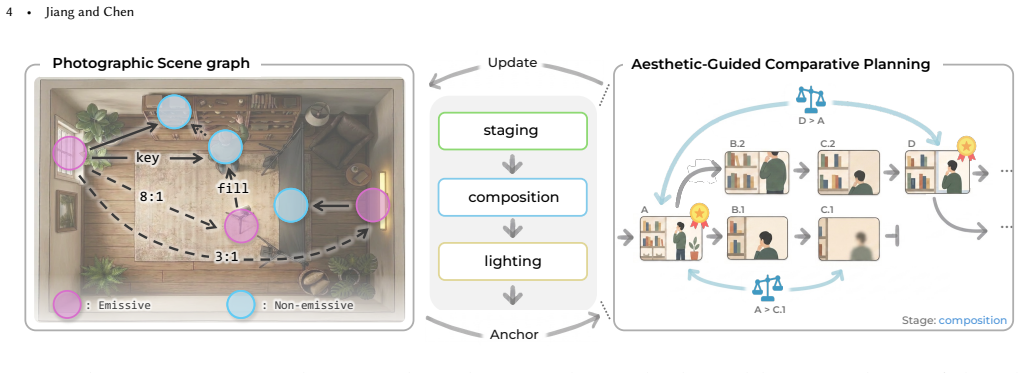
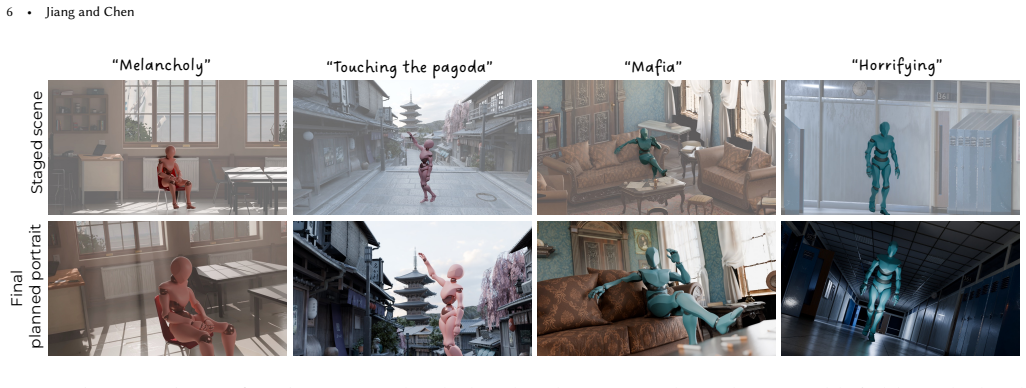
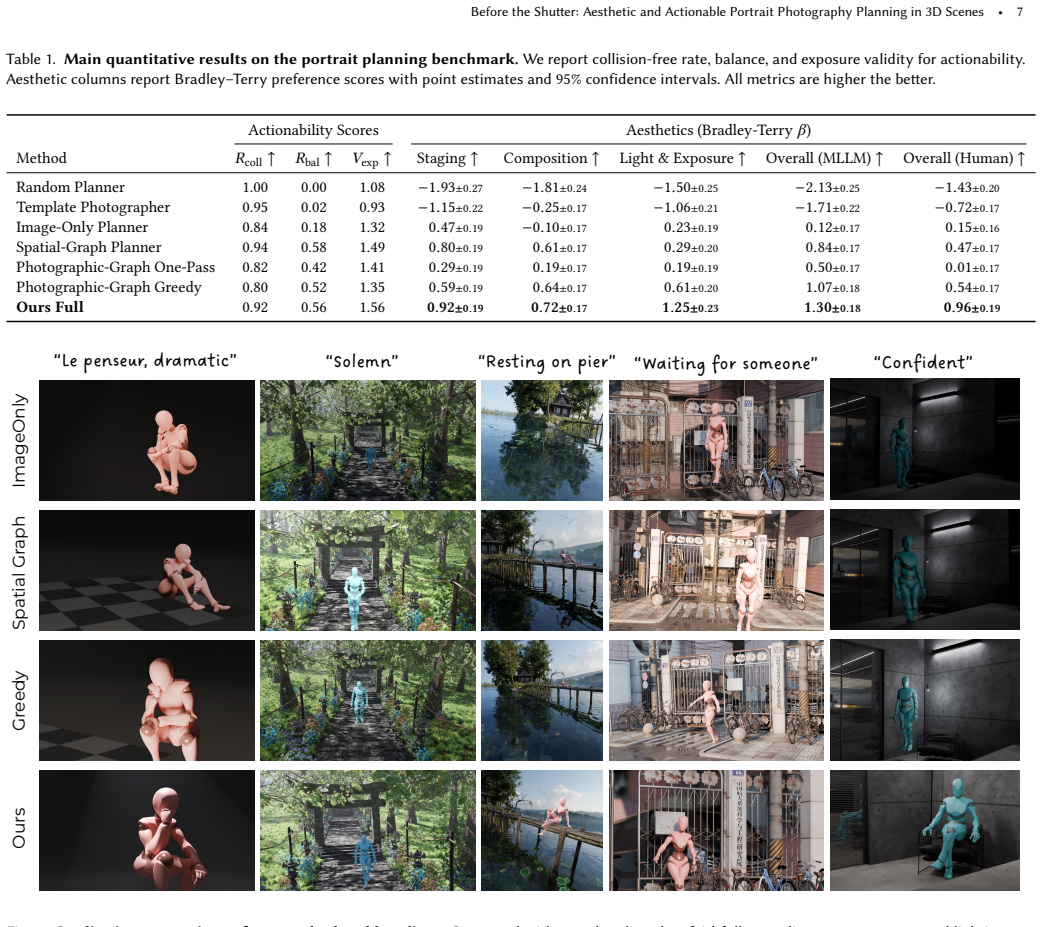
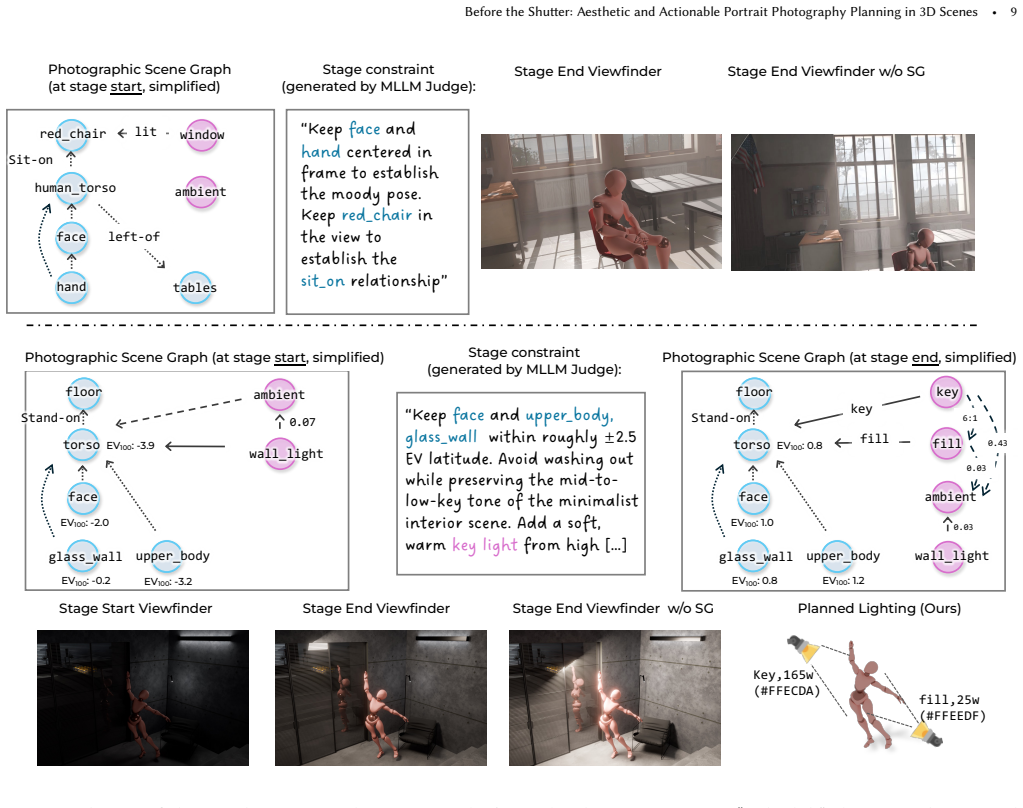
We introduce 3D aesthetic portrait planning, the task of generating human pose, camera, lighting, and exposure plans that produce visually compelling portraits while satisfying geometric and photometric feasibility in a 3D scene. Our approach builds a Photographic Scene Graph that represents scene affordances, subject-scene relations, and portrait-relevant lighting structure. Built on this representation, we perform aesthetic-guided comparative planning over previous attempts and current viewfinder observations. Experiments across diverse indoor and outdoor scenes show that our method produces portraits preferred by human raters and MLLM evaluators over competitive baselines, while maintaini
What carries the argument
The Photographic Scene Graph, a representation that encodes scene affordances, subject-scene relations, and portrait-relevant lighting structure to support aesthetic-guided comparative planning of pose, camera, lighting, and exposure.
If this is right
- Photography workflows can move from post-production editing to pre-capture planning that respects 3D scene constraints.
- Generated portraits achieve higher preference scores from both human raters and multimodal evaluators while remaining physically plausible.
- The same scene graph and comparative planning loop can be reused across multiple indoor and outdoor environments without retraining.
- Computational tools gain the ability to suggest actionable adjustments to pose, viewpoint, and illumination before any image is recorded.
Where Pith is reading between the lines
- The approach could be extended to plan sequences for short video clips or live-action capture by adding temporal consistency constraints to the scene graph.
- Integration with wearable AR displays might allow real-time on-site suggestions for amateur photographers without requiring full 3D reconstruction.
- Similar graph-based planning could apply to other capture tasks such as product photography or architectural documentation where lighting and viewpoint matter.
- A controlled user study comparing the system's plans against those produced by professional photographers on identical scenes would quantify practical value.
Load-bearing premise
The Photographic Scene Graph accurately represents scene affordances, subject-scene relations, and portrait-relevant lighting structure to support effective aesthetic-guided comparative planning.
What would settle it
Run the method on a new set of 3D scenes; if human raters or MLLM evaluators consistently prefer baseline outputs or if the generated plans frequently produce collisions or invalid lighting, the central claim does not hold.
Figures


read the original abstract
Portrait photography is largely decided before the shutter opens: the subject's pose, the camera configuration, and the lighting devices must be coordinated within the surrounding 3D scene. In contrast, most existing computational methods focus on post-production in 2D image space, such as retouching, relighting, or editing images that already exist; pre-capture photographic planning remains largely unexplored. We introduce 3D aesthetic portrait planning, the task of generating human pose, camera, lighting, and exposure plans that produce visually compelling portraits while satisfying geometric and photometric feasibility in a 3D scene. Our approach builds a Photographic Scene Graph that represents scene affordances, subject-scene relations, and portrait-relevant lighting structure. Built on this representation, we perform aesthetic-guided comparative planning over previous attempts and current viewfinder observations. Experiments across diverse indoor and outdoor scenes show that our method produces portraits preferred by human raters and MLLM evaluators over competitive baselines, while maintaining high physical plausibility. Together, our results suggest a path from post-capture correction toward pre-capture computational portrait planning. Project repository: https://github.com/songrise/Before-the-Shutter
Editorial analysis
A structured set of objections, weighed in public.
Referee Report
Summary. The paper introduces the task of 3D aesthetic portrait planning, which generates coordinated human pose, camera, lighting, and exposure configurations in a 3D scene to produce visually compelling portraits that satisfy geometric and photometric constraints. The core technical contribution is the Photographic Scene Graph, a structured representation of scene affordances, subject-scene relations, and portrait-relevant lighting, upon which an aesthetic-guided comparative planning procedure is performed. Experiments across indoor and outdoor scenes are reported to show that the resulting portraits are preferred by human raters and MLLM evaluators over competitive baselines while preserving high physical plausibility.
Significance. If the experimental claims are substantiated, the work opens a new direction in computational photography by moving from post-capture 2D editing to pre-capture 3D planning. The Photographic Scene Graph provides a reusable intermediate representation that could support downstream applications in virtual production, robotics, and AR. The emphasis on both aesthetic preference and physical feasibility is a constructive framing for the new task.
major comments (2)
- [§5] §5 (Experiments): The reported human and MLLM preference results are presented without sufficient protocol details—number of raters, rating scale and instructions, number of scenes and trials per condition, exact baseline implementations, or statistical tests—making it impossible to assess whether the preference claims are robust or whether confounds (e.g., scene selection bias) are controlled.
- [§3.1] §3.1 (Photographic Scene Graph construction): The claim that the graph accurately encodes portrait-relevant lighting structure and subject-scene affordances is central to the planning procedure, yet the extraction process is described at a high level without explicit algorithms, parameter choices, or validation against ground-truth lighting or affordance annotations; this leaves the weakest assumption untested.
minor comments (2)
- [Abstract] The abstract states that the method 'maintains high physical plausibility' but does not define the metric or threshold used; a brief operational definition would improve clarity.
- Figure captions and the project repository link are helpful, but the manuscript would benefit from an explicit limitations paragraph discussing failure modes of the scene graph (e.g., dynamic lighting or complex occlusions).
Simulated Author's Rebuttal
We thank the referee for the constructive feedback on our work. We address each major comment below and will incorporate the requested clarifications and additions in the revised manuscript.
read point-by-point responses
-
Referee: [§5] §5 (Experiments): The reported human and MLLM preference results are presented without sufficient protocol details—number of raters, rating scale and instructions, number of scenes and trials per condition, exact baseline implementations, or statistical tests—making it impossible to assess whether the preference claims are robust or whether confounds (e.g., scene selection bias) are controlled.
Authors: We agree that the experimental protocol details were insufficient. In the revised manuscript we will expand §5 with the exact number of human raters (20), the 5-point Likert scale together with the full instructions provided to participants, the total number of scenes (15 indoor + 15 outdoor), the number of trials per condition, precise descriptions or code references for all baseline implementations, and the results of statistical tests (paired Wilcoxon signed-rank tests with p-values). We will also document the randomized scene-selection procedure to address potential selection bias. revision: yes
-
Referee: [§3.1] §3.1 (Photographic Scene Graph construction): The claim that the graph accurately encodes portrait-relevant lighting structure and subject-scene affordances is central to the planning procedure, yet the extraction process is described at a high level without explicit algorithms, parameter choices, or validation against ground-truth lighting or affordance annotations; this leaves the weakest assumption untested.
Authors: We agree that §3.1 requires greater specificity. We will revise the section to present the full extraction algorithms, including concrete parameter choices (intensity thresholds, clustering radii, and affordance heuristics). We will also add a dedicated validation subsection that compares the automatically extracted graphs against manually annotated ground-truth lighting and affordance labels on a held-out set of scenes, reporting precision, recall, and F1 scores for both lighting sources and subject-scene relations. revision: yes
Circularity Check
No significant circularity; empirical planning method with no derivations or self-referential quantities
full rationale
The paper describes an empirical task of 3D aesthetic portrait planning via a Photographic Scene Graph representation followed by comparative planning, with claims resting on human/MLLM preference experiments and physical plausibility checks. No equations, fitted parameters, self-citations, or uniqueness theorems appear in the provided abstract or description. The derivation chain is absent; the method is presented as a procedural pipeline evaluated externally, satisfying the condition for a self-contained result with no reduction to inputs by construction.
Axiom & Free-Parameter Ledger
invented entities (1)
-
Photographic Scene Graph
no independent evidence
Reference graph
Works this paper leans on
-
[1]
In: IEEE/CVF Conference on Computer Vision and Pattern Recognition (CVPR)
Learning Physics-Guided Face Relighting Under Directional Light. InPro- ceedings of the IEEE/CVF Conference on Computer Vision and Pattern Recognition. 5124–5133. doi:10.1109/CVPR42600.2020.00517 Rohit Pandey, Sergio Orts-Escolano, Chloe LeGendre, Christian Häne, Sofien Bouaziz, Christoph Rhemann, Paul Debevec, and Sean Fanello. 2021. Total Relighting: Le...
-
[2]
doi:10.1145/2897824.2925867 Christoph Schuhmann
PiGraphs: Learning Interaction Snapshots from Observations.ACM Transac- tions on Graphics35, 4, Article 139 (2016), 12 pages. doi:10.1145/2897824.2925867 Christoph Schuhmann. 2022. LAION-Aesthetics. https://laion.ai/blog/laion-aesthetics/ Accessed: 2026-05-06. Wanchao Su, Can Wang, Chen Liu, Fangzhou Han, Hongbo Fu, and Jing Liao. 2025. StyleRetoucher: Ge...
-
[3]
Siwei Zhang, Yan Zhang, Qianli Ma, Michael J
GenDoP: Auto-regressive Camera Trajectory Generation as a Director of Photography.arXiv preprint arXiv:2504.07083(2025). Siwei Zhang, Yan Zhang, Qianli Ma, Michael J. Black, and Siyu Tang. 2020. PLACE: Proximity Learning of Articulation and Contact in 3D Environments. InInternational Conference on 3D Vision. 642–651. Kaifeng Zhao, Shaofei Wang, Yan Zhang,...
-
[4]
Aesthetic-Guided Outward Image Cropping.ACM Transactions on Graphics 40, 6, Article 211 (2021), 13 pages. doi:10.1145/3478513.3480566
discussion (0)
Sign in with ORCID, Apple, or X to comment. Anyone can read and Pith papers without signing in.