REVIEW 4 major objections 5 minor 4 cited by
A single merging black hole binary leaves a unique, deterministic correlation fingerprint across a pulsar timing array, not just a universal Hellings-Downs curve.
Reviewed by Pith at T0; open to challenge. T0 means a machine referee read the full paper against a public rubric. the ladder, T0–T4 →
T0 review · deepseek-v4-flash
2026-08-02 18:41 UTC pith:XNWRF2BY
load-bearing objection A genuinely useful closed-form ORF for single SMBHBs, with a clean derivation but an application section that is not yet convincing because the simulations do not test the pulsar-term assumption they rely on. the 4 major comments →
Fingerprints of Individual Supermassive Black Hole Binaries in Pulsar Timing Arrays
The pith
A machine-rendered reading of the paper's core claim, the machinery that carries it, and where it could break.
Core claim
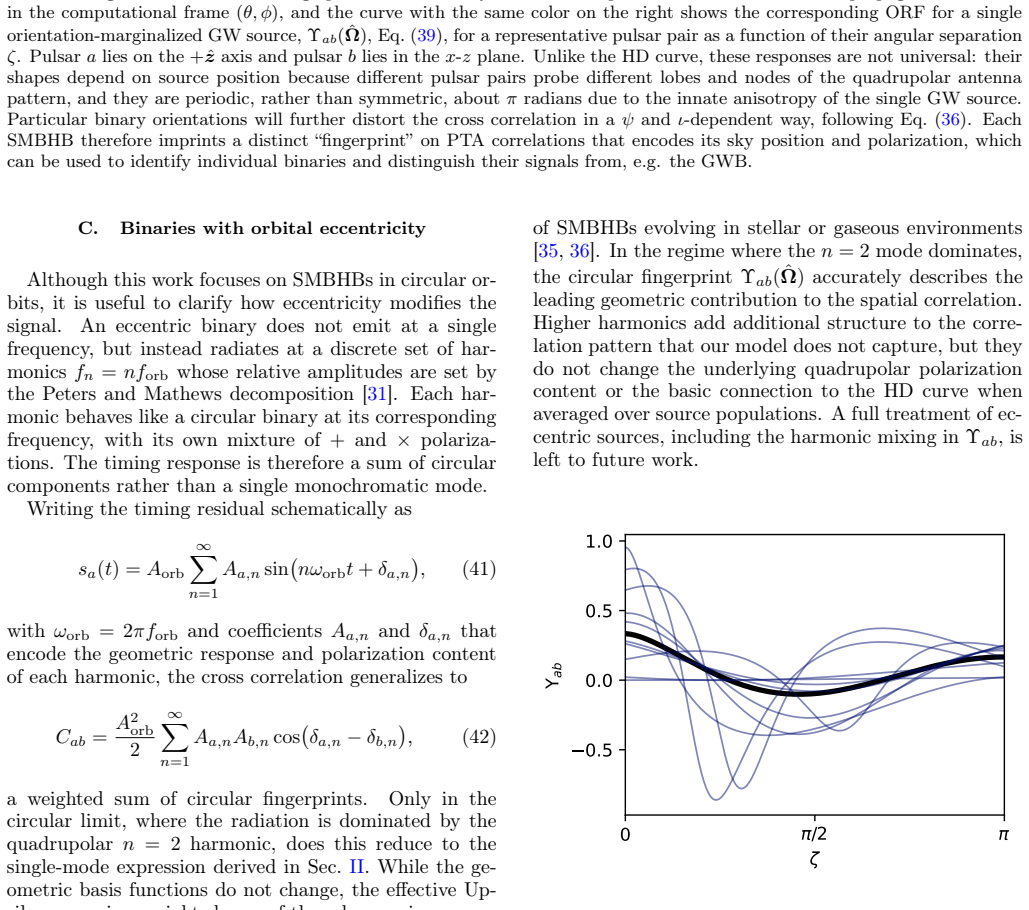
Each circular supermassive black hole binary produces a closed-form, direction-dependent correlation pattern Υ_ab(θ, φ, ζ, ι, ψ) across a pulsar timing array. This single-source overlap reduction function is the deterministic limit of the stochastic Hellings-Downs correlation: summing many such fingerprints over an isotropic sky reproduces the HD curve. The paper derives analytic expressions (Eqs. 36 and 39) in a computational frame where the pulsar pair geometry is fixed, showing that the pattern is not universal like HD but carries the source's sky position and orientation. Including these cross-correlations in simulated data strongly favors the continuous-wave model over an HD-correlated
What carries the argument
The single-source overlap reduction function Υ_ab(θ, φ, ζ, ι, ψ), defined as the cycle-averaged cross-correlation of timing residuals from two pulsars, factorized into a pulsar-independent amplitude and a purely geometric antenna-pattern product. It is derived in a computational frame where one pulsar lies on the z-axis and the other in the x-z plane, allowing closed-form trigonometric expressions for the correlation as a function of the pulsar separation angle ζ and source sky location (θ, φ). This function serves as the deterministic analogue of the Hellings-Downs curve and is the object that carries the fingerprint information in cross-correlation searches.
Load-bearing premise
The derived fingerprint relies on the Earth-term response alone, assuming that after marginalizing over poorly known pulsar distances, the pulsar term contributes only extra variance and does not alter the angular correlation pattern; if pulsar distances were precisely known or the pulsar term added coherent angular structure, the predicted Υ_ab would be incomplete.
What would settle it
Compute the full Earth-plus-pulsar correlation for a single circular binary with realistic, moderately well-measured pulsar distances and compare it to the Earth-term-only Υ_ab; if the difference produces angular structure comparable to the fingerprint over a wide range of realistic distance uncertainties, the paper's neglect of the pulsar term shape would be falsified.
If this is right
- A single bright binary can now be searched for using spatial correlations alone, complementing coherent matched-filter approaches that require phase coherence across pulsars.
- The fingerprint breaks the degeneracy between a continuous wave and a stochastic background: the paper reports Bayes factors of 1611 favoring the continuous-wave model over a Hellings-Downs-correlated background and 159 over an uncorrelated red-noise model in simulated data.
- Cross-correlations improve sky localization by roughly a factor of 11 over autocorrelation-only searches, as shown by the posterior widths in the simulations.
- The derivation shows that deviations from the Hellings-Downs curve in real data can be interpreted as incomplete averaging over individual single-source fingerprints, uniting several previously separate analysis frameworks.
- Because the fingerprint encodes source geometry, it can be extended to test alternative gravitational-wave polarizations or eccentric binaries, which would modify the angular structure.
Where Pith is reading between the lines
- If the Earth-term-only fingerprint holds in real data, then pulsar timing arrays may be able to identify individual supermassive black hole binaries well before their pulsar terms can be modeled, making cross-correlations the workhorse for the first resolved nHz sources.
- The geometric fingerprint also implies that an unresolvable population of binaries will leave a residual anisotropy pattern that is not simply HD-like; characterizing this residual could provide a new probe of the binary population's spatial distribution.
- A direct extension would be to apply the derived Υ_ab to existing and future PTA datasets and check whether the residuals after subtracting the HD background show structure localized in (θ, φ), as predicted here; such a search would provide an independent test of the paper's central claim.
- The factorization suggests a natural way to separate 'shape' from 'amplitude' in CW searches, potentially simplifying multi-source analyses where several binaries contribute overlapping fingerprints; whether the pattern remains robust when multiple sources coexist is an open question the paper does not fully address.
Editorial analysis
A structured set of objections, weighed in public.
Referee Report
Summary. The paper derives a closed-form, direction-dependent overlap reduction function for a single circular SMBHB in a PTA, denoted Υ_ab(θ,φ,ζ,ι,ψ) (Eqs. 36 and 39), and presents it as the deterministic analogue of the Hellings–Downs curve. It shows that sky-averaging this single-source ORF recovers the HD curve (Eq. 43), and it reports idealized PTA simulations in which a covariance model built from this ORF is favored over HD-correlated and diagonal models, with claimed Bayes factors of 1611 and 159, plus an 11× improvement in sky localization. The analytic derivation from Eq. (1) through Eq. (36) is internally consistent, and the recovery of the HD curve by averaging is a useful consistency check. The main weakness is that the quantitative validation is performed in a regime that does not match the Earth-term-only assumption on which the fingerprint is based, and the headline separation claim is not tested against data containing an actual stochastic background or red noise.
Significance. If the validation is brought in line with the stated assumptions, the analytic fingerprint would be a useful compact complement to numerical point-source ORFs used in PTA anisotropy and CW studies. It provides a clean geometric interpretation of hotspots and HD scatter reported in prior simulations, and it gives a concrete model for cross-correlation-based CW searches. The derivation itself is a strength: the algebra is checkable, the special cases are identified, and the connection to the stochastic HD limit is explicit. However, the paper's central quantitative claims — breaking the degeneracy with a stochastic background and the reported Bayes factors — are currently supported only by idealized, CW-only simulations, so the significance of the result is not yet established at the level claimed in the abstract.
major comments (4)
- [Sec. IV, Table I, Eq. (53)] The validation does not exercise the regime in which the Earth-term-only fingerprint is derived. Table I states that the injected CW includes pulsar terms with distances fixed to 1 kpc, while the recovery model Eq. (53) uses the Earth-term ORF and contains no pulsar-term variance term. Appendix C argues that distance marginalization reduces the pulsar term to variance only, but the simulation does not marginalize over distances. Consequently the reported B_BHB/HD = 1611 and B_BHB/Diag = 159 are not demonstrated for the assumption under which Υ_ab is derived. The authors should either simulate with broad distance priors and marginalize over them, or include a pulsar-term variance term in the noise model and show that the Earth-term fingerprint still recovers the injected parameters and separates the models.
- [Abstract vs. Sec. IV] The paper contains two inconsistent sets of headline Bayes factors. The abstract reports 144 (BHB vs stochastic background) and ∼80 (BHB vs uncorrelated red noise), while Sec. IV and Fig. 6 report B_BHB/HD = 1611.37 ± 0.02 and B_BHB/Diag = 159.13 ± 0.02, and Sec. V repeats the 1611/160 values. This is not a presentation nuance; it is the paper's central quantitative result. The manuscript must be reconciled to a single set of values before the claims can be evaluated.
- [Sec. IV and Sec. V] The claim that the fingerprint 'breaks the degeneracy between an individual binary and a stochastic background' is tested only on CW-only injections with no GWB and no red noise. Comparing BHB against an HD-correlated model on the same CW dataset is a model-selection test between two ORF templates for a single signal, not a test of whether a CW can be separated from a stochastic background when both are present. The paper's own text acknowledges the simulation is a proof of concept with no red noise or GWB. The headline should either be tempered to 'distinguishable in controlled CW-only data' or supported by an injection containing a GWB and red noise.
- [Sec. IV, sky-localization claim] The factor of '∼11× improvement in sky localization' is asserted without a defined metric. The text says the cross-correlated models yield 'less error on ϕ_gw and cos θ_gw,' but no credible-area calculation, posterior volume, or angular separation statistic is reported. Since this is a quantitative performance claim, the authors should define the localization measure and report the actual numbers for each model.
minor comments (5)
- [Sec. IV] The text calls the simulation 'noiseless' while Table I includes a white-noise realization with σ_TOA = 0.1 μs. Please clarify whether 'noiseless' means 'no red noise or GWB' rather than no noise at all.
- [Fig. 4 caption] There is a duplicated word: 'We note note the oscillatory ψ modulations...' Please correct.
- [Fig. 6 caption] The caption says the spike-pixel model is 'for a face-on binary,' but the injected binary is edge-on (ι=π/2) and the spike-pixel ORF is polarization-marginalized. This wording is confusing and should be fixed.
- [Eq. (25) and Sec. IV] The derivation of the cycle-averaged correlation assumes the boundary term is negligible, but the simulated dataset contains only N_cyc ≈ 3 GW cycles, for which the correction is at the ∼5% level. Please state explicitly whether any finite-window correction was applied in the likelihood or why it is negligible for the reported Bayes factors.
- [Appendix C] The statement that the pulsar term 'is always present' and 'manifests as a rapidly oscillating function of the pulsar distance' is in tension with the main-text assertion that it 'does not change the angular shape.' This tension is central enough that it should be reconciled in the main text rather than only in the appendix.
Circularity Check
No significant circularity: the single-source ORF is derived from the standard GR timing response, not from fitted inputs or self-referential constraints.
full rationale
The derivation chain is self-contained. Starting from the standard timing response Eq. (1) and antenna patterns Eqs. (4)-(6), the paper builds the monochromatic CW residual (Eqs. 14-17), computes the cycle-averaged cross-correlation (Eqs. 20-26), and defines Υ_ab from that product (Eqs. 27-31). The computational-frame expressions Eqs. (36) and (39) are obtained by substituting the explicit antenna patterns given in Appendix A; they are not reverse-engineered from the HD curve or from any fitted parameter. The HD curve is recovered as a sky average (Eq. 43) and is therefore a consistency check, not an input. Section IV's injection/recovery is a simulation using the same GR response for injection and the same ORF family for recovery; it is a pipeline demonstration rather than a fitted parameter renamed as a prediction. The acknowledged equivalence to the spike-pixel ORF [22] and to Cornish-Sesana [20] shows that the paper is not concealing a known result; it explicitly says Eq. (14) matches [20,22] and Eq. (39) matches [22,26]. The pulsar-term assumption in Appendix C is a physical approximation supported by arguments and a mix of self- and external citations; even if it were incorrect, it would be a modeling limitation, not a circular step. The inconsistent Bayes factors between the abstract (144/~80) and Sec. IV (1611/159) are an internal consistency issue, not evidence that a result was defined into existence.
Axiom & Free-Parameter Ledger
axioms (6)
- domain assumption General relativity tensor polarizations only: the GW perturbation is a sum of + and × polarization tensors, with no scalar or vector modes.
- domain assumption Circular, non-evolving binary with negligible frequency evolution over the observation span (monochromatic approximation).
- domain assumption Earth-term-only response: the pulsar term can be neglected when distances are poorly known because marginalizing over distance uncertainty adds variance but does not change the angular shape of the correlation.
- domain assumption The Monte Carlo datasets are representative of the claimed application: 100 pulsars, uniform sky, white noise only, no injected GWB or red noise.
- standard math Finite-time boundary terms in the cross-correlation are negligible for N_cyc ≳ 3 (≤ few percent).
- standard math Sky-averaging Υ_ab over source directions, inclination, and polarization yields the Hellings-Downs curve (Eqs. 43-44).
read the original abstract
With evidence for a nanoHertz gravitational-wave background now established by Pulsar Timing Arrays, the search focuses on identifying individual supermassive black hole binaries. We show that these binaries produce a distinct spatial correlation pattern across the array, acting as a deterministic analogue to the stochastic Hellings \& Downs curve. We derive a closed analytic expression for this single-source overlap reduction function, $\Upsilon_{ab}$, factorizing the signal into a source-dependent amplitude and a purely geometric fingerprint. Using simulated datasets, we demonstrate that this fingerprint breaks the degeneracy between an individual binary and a stochastic background. Including these cross-correlations yields Bayes factors of $1611$ favoring the continuous-wave model over a Hellings \& Downs correlated background model and $159$ favoring the continuous-wave model over an uncorrelated red-noise model. Furthermore, these new cross-correlations improve sky localization by a factor of $11\times$ over an uncorrelated search. Finally, while coherent matched filtering offers higher theoretical sensitivity, we argue that a cross-correlation-based search for individual binaries provides a robust alternative that hedges against the possibility of overfitting to noise fluctuations by focusing on the evidence for the correlations. Indeed, the geometric fingerprints we present here show that spatial correlations can also be used to identify the first nanoHertz gravitational-wave sources.
Figures




Forward citations
Cited by 4 Pith papers
-
Testing General Relativity with Individual Supermassive Black Hole Binaries
A framework is developed to test beyond-GR effects in nanohertz continuous waves from individual SMBHBs, deriving modified inter-pulsar correlations, antenna responses, and phase delays for three deviation classes, va...
-
Testing General Relativity with Individual Supermassive Black Hole Binaries
Beyond-GR polarization modes in a single supermassive black hole binary show up linearly (not quadratically) in pulsar-timing cross-correlations, massive-graviton dispersion shifts antenna patterns and pulsar-term pha...
-
The Heavy Tailed Non-Gaussianity of the Supermassive Black Hole Gravitational Wave Background
The gravitational wave background from supermassive black hole binaries has a universal heavy-tailed amplitude distribution with power-law index -4, causing divergent higher moments and dominance of the strongest sign...
-
The NANOGrav 15 yr Data Set: Impacts of Customized Chromatic Noise Models on Gravitational Wave Analyses
Customized chromatic noise models applied to NANOGrav 15 yr data raise the Bayes factor for Hellings-Downs GWB correlations by a factor of ~8, lower the amplitude to 2.1e-15, and increase the spectral index to 3.5.
Reference graph
Works this paper leans on
-
[1]
(B1) vanishes identically, and the sin4ιcos 4ψcontribution in the first term is eliminated, yielding ⟨Υab⟩ψ = 1 2 1 + cos4ι+ 6 cos2ι F + a F + b .(B3)
A veraging overψ Averaging uniformly over the polarization angleψ∈ [0,2π), we use ⟨cos 4ψ⟩ψ =⟨sin 4ψ⟩ ψ = 0.(B2) The second term in Eq. (B1) vanishes identically, and the sin4ιcos 4ψcontribution in the first term is eliminated, yielding ⟨Υab⟩ψ = 1 2 1 + cos4ι+ 6 cos2ι F + a F + b .(B3)
-
[2]
Definingx= cosι, the required moments are ⟨x2⟩= 1 2 Z 1 −1 x2 dx= 1 3 ,⟨x 4⟩= 1 2 Z 1 −1 x4 dx= 1 5
A veraging overι We average over the inclination assuming a uniform distribution incosι, i.e.cosι∼ U(−1,1). Definingx= cosι, the required moments are ⟨x2⟩= 1 2 Z 1 −1 x2 dx= 1 3 ,⟨x 4⟩= 1 2 Z 1 −1 x4 dx= 1 5 . (B4) 15 Substituting into Eq. (B3), 1 + cos4ι+ 6 cos2ι ι = 1 + 1 5 + 6× 1 3 = 16 5 ,(B5) and thus ⟨Υab⟩ι,ψ = 8 5 F + a F + b . (B6) Appendix C: Pul...
-
[3]
D. J. Reardon and et al, The Astrophysical Journal951, L6 (2023)
2023
-
[4]
G. Agazie, A. Anumarlapudi, A. M. Archibald, Z. Ar- zoumanian, P. T. Baker, B. Bécsy, L. Blecha, A. Brazier, P. R. Brook, S. Burke-Spolaor, R. Burnette, R. Case, M. Charisi, S. Chatterjee, K. Chatziioannou, B. D. Cheeseboro, S. Chen, T. Cohen, J. M. Cordes, N. J. Cornish, F. Crawford, H. T. Cromartie, K. Crowter, C. J. Cutler, M. E. Decesar, D. Degan, P. ...
Pith/arXiv arXiv 2023
-
[5]
EPTA Collaboration, InPTA Collaboration, J. An- toniadis, P. Arumugam, S. Arumugam, S. Babak, M. Bagchi, A.-S. Bak Nielsen, C. G. Bassa, A. Bathula, A. Berthereau, M. Bonetti, E. Bortolas, P. R. Brook, M. Burgay, R. N. Caballero, A. Chalumeau, D. J. Cham- pion, S. Chanlaridis, S. Chen, I. Cognard, S. Danda- pat, D. Deb, S. Desai, G. Desvignes, N. Dhanda-B...
Pith/arXiv arXiv 2023
-
[6]
R. W. Hellings and G. S. Downs, Astrophys. J. Lett.265, L39 (1983)
1983
-
[7]
H. Xu, S. Chen, Y. Guo, J. Jiang, B. Wang, J. Xu, Z. Xue, R. N. Caballero, J. Yuan, Y. Xu, J. Wang, L. Hao, J. Luo, K. Lee, J. Han, P. Jiang, Z. Shen, M. Wang, N. Wang, R. Xu, X. Wu, R. Manchester, L. Qian, X. Guan, M. Huang, C. Sun, and Y. Zhu, Re- searchinAstronomyandAstrophysics23,075024(2023), arXiv:2306.16216 [astro-ph.HE]
Pith/arXiv arXiv 2023
-
[8]
M. T. Miles, R. M. Shannon, D. J. Reardon, M. Bailes, D. J. Champion, M. Geyer, P. Gitika, K. Grunthal, M. J. Keith, M. Kramer, A. D. Kulkarni, R. S. Nathan, A. Parthasarathy, J. Singha, G. Theureau, E. Thrane, F. Abbate, S. Buchner, A. D. Cameron, F. Camilo, B. E. Moreschi, G. Shaifullah, M. Shamohammadi, A. Pos- senti, and V. V. Krishnan, Mon. Not. R. A...
Pith/arXiv arXiv 2025
-
[9]
C. M. F. Mingarelli, Nature Astronomy3, 8 (2019), arXiv:1901.06785 [gr-qc]
Pith/arXiv arXiv 2019
-
[10]
B. Allen, Phys. Rev. D107, 043018 (2023), arXiv:2205.05637 [gr-qc]
Pith/arXiv arXiv 2023
-
[11]
S. Burke-Spolaor, S. R. Taylor, M. Charisi, T. Dolch, J. S. Hazboun, A. M. Holgado, L. Z. Kelley, T. J. W. Lazio, D. R. Madison, N. McMann, C. M. F. Mingarelli, A. Rasskazov, X. Siemens, J. J. Simon, and T. L. Smith, Astron. Astrophys. Rev.27, 5 (2019), arXiv:1811.08826 [astro-ph.HE]
Pith/arXiv arXiv 2019
-
[12]
G. Agazie, A. Anumarlapudi, A. M. Archibald, Z. Arzou- manian, J. G. Baier, P. T. Baker, B. Bécsy, L. Blecha, A. Brazier, P. R. Brook, L. Brown, S. Burke-Spolaor, J. A. Casey-Clyde, M. Charisi, S. Chatterjee, T. Cohen, J. M. Cordes, N. J. Cornish, F. Crawford, H. T. Cromar- tie, K.Crowter, M.E.DeCesar, P.B.Demorest, H.Deng, T. Dolch, E. C. Ferrara, W. Fio...
Pith/arXiv arXiv 2025
-
[13]
C. M. F. Mingarelli, L. Blecha, T. Bogdanović, M. Charisi, S. Chen, A. Escala, B. Goncharov, M. J. Graham, S. Komossa, S. T. McWilliams, D. A. Schwartz, and J. Zrake, Nature Astronomy9, 183 (2025), arXiv:2501.08956 [astro-ph.HE]
Pith/arXiv arXiv 2025
-
[14]
S. R. Taylor, Astrophys. Space Sci.370, 124 (2025), arXiv:2511.08966 [astro-ph.HE]
arXiv 2025
-
[15]
J. A. Ellis, X. Siemens, and J. D. E. Creighton, The As- trophysical Journal756, 175 (2012)
2012
-
[16]
G. Agazie, A. Anumarlapudi, A. M. Archibald, Z. Ar- zoumanian, P. T. Baker, B. Bécsy, L. Blecha, A. Brazier, P. R. Brook, S. Burke-Spolaor, R. Case, J. A. Casey- Clyde, M.Charisi, S.Chatterjee, T.Cohen, J.M.Cordes, N. J. Cornish, F. Crawford, H. T. Cromartie, K. Crowter, M. E. Decesar, P. B. Demorest, M. C. Digman, T. Dolch, B. Drachler, E. C. Ferrara, W....
Pith/arXiv arXiv 2023
-
[17]
N. Agarwal, G. Agazie, A. Anumarlapudi, A. M. Archibald, Z. Arzoumanian, J. G. Baier, P. T. Baker, B. Becsy, L. Blecha, A. Brazier, P. R. Brook, S. Burke- Spolaor, R. Burnette, R. Case, J. A. Casey-Clyde, Y.-T. Chang, M. Charisi, S. Chatterjee, T. Cohen, P. Coppi, J. M. Cordes, N. J. Cornish, F. Crawford, H. T. Cromar- tie, K.Crowter, M.E.DeCesar, P.B.Dem...
Pith/arXiv arXiv 2025
-
[18]
Y. Ali-Haïmoud, T. L. Smith, and C. M. F. Mingarelli, Phys. Rev. D102, 122005 (2020), arXiv:2006.14570 [gr- qc]
Pith/arXiv arXiv 2020
-
[19]
Babak, A
S. Babak, A. Petiteau, A. Sesana,et al., MNRAS455 (2016)
2016
-
[20]
C.M.F.Mingarelli, T.Sidery, I.Mandel,andA.Vecchio, Phys. Rev. D88, 062005 (2013), arXiv:1306.5394 [astro- ph.HE]
Pith/arXiv arXiv 2013
-
[21]
J.Gair, J.D.Romano, S.Taylor,andC.M.F.Mingarelli, Phys. Rev. D90, 082001 (2014), arXiv:1406.4664 [gr-qc]
Pith/arXiv arXiv 2014
-
[22]
Y. Ali-Haïmoud, T. L. Smith, and C. M. F. Mingarelli, Phys. Rev. D103, 042009 (2021), arXiv:2010.13958 [gr- qc]
Pith/arXiv arXiv 2021
-
[23]
N. J. Cornish and A. Sesana, Classical and Quantum Gravity30, 224005 (2013), arXiv:1305.0326 [gr-qc]
Pith/arXiv arXiv 2013
-
[24]
W. Qin, K. K. Boddy, M. Kamionkowski, and L. Dai, Phys. Rev. D99, 063002 (2019), arXiv:1810.02369 [astro- ph.CO]
Pith/arXiv arXiv 2019
-
[25]
L. Schult, P. Petrov, S. R. Taylor, N. Pol, N. Laal, M. Charisi, and C.-P. Ma, arXiv e-prints , arXiv:2510.01317 (2025), arXiv:2510.01317 [astro- ph.IM]
Pith/arXiv arXiv 2025
-
[26]
W. Qin, K. K. Boddy, and M. Kamionkowski, Phys. Rev. D103, 024045 (2021), arXiv:2007.11009 [gr-qc]
Pith/arXiv arXiv 2021
-
[27]
N. Anil Kumar and M. Kamionkowski, Phys. Rev. Lett. 133, 151401 (2024), arXiv:2311.14159 [astro-ph.CO]
Pith/arXiv arXiv 2024
-
[28]
C. M. F. Mingarelli and T. Sidery, Phys. Rev. D90, 062011 (2014), arXiv:1408.6840 [astro-ph.HE]
Pith/arXiv arXiv 2014
-
[29]
M. Anholm, S. Ballmer, J. D. E. Creighton, L. R. Price, and X. Siemens, Phys. Rev. D79, 084030 (2009), arXiv:0809.0701 [gr-qc]
Pith/arXiv arXiv 2009
-
[30]
B. Allen, Phys. Rev. D110, 043043 (2024), arXiv:2404.05677 [gr-qc]
Pith/arXiv arXiv 2024
-
[31]
J. Nay, K. K. Boddy, T. L. Smith, and C. M. F. Mingarelli, Phys. Rev. D110, 044062 (2024), arXiv:2306.06168 [gr-qc]
Pith/arXiv arXiv 2024
-
[32]
G. Agazie, A. Anumarlapudi, A. M. Archibald, Z. Arzou- manian, J. G. Baier, P. T. Baker, B. Bécsy, L. Blecha, K. K. Boddy, A. Brazier, P. R. Brook, S. Burke-Spolaor, R. Burnette, J. A. Casey-Clyde, M. Charisi, S. Chatter- jee, T. Cohen, J. M. Cordes, N. J. Cornish, F. Craw- ford, H. T. Cromartie, K. Crowter, M. E. Decesar, P. B. Demorest, H. Deng, L. Dey,...
Pith/arXiv arXiv 2025
-
[33]
Sesana, The Astrophysical Journal719, 851 (2010)
A. Sesana, The Astrophysical Journal719, 851 (2010)
2010
-
[34]
P. C. Peters and J. Mathews, Phys. Rev.131, 435 (1963)
1963
-
[35]
Barack and C
L. Barack and C. Cutler, Physical Review D70, 122002 (2004)
2004
-
[36]
L. Z. Kelley, L. Blecha, and L. Hernquist, Mon. Not. R. Astron. Soc.464, 3131 (2017), arXiv:1606.01900 [astro- ph.HE]
Pith/arXiv arXiv 2017
-
[37]
S. R. Taylor, E. A. Huerta, J. R. Gair, and S. T. McWilliams, Astrophys. J.817, 70 (2016), arXiv:1505.06208 [gr-qc]
Pith/arXiv arXiv 2016
-
[38]
R. M. O’Leary, B. Kocsis, and A. Loeb, Monthly Notices of the Royal Astronomical Society395, 2127 (2009)
2009
-
[39]
N.J.CornishandJ.D.Romano,Phys.Rev.D92,042001 (2015), arXiv:1505.08084 [gr-qc]
Pith/arXiv arXiv 2015
-
[40]
I. Ferranti, G. Shaifullah, A. Chalumeau, and A. Sesana, Astron. Astrophys.694, A194 (2025), arXiv:2407.21105 [astro-ph.HE]
Pith/arXiv arXiv 2025
-
[41]
B. Bécsy, N. J. Cornish, and L. Z. Kelley, Astrophys. J. 941, 119 (2022), arXiv:2207.01607 [astro-ph.HE]
Pith/arXiv arXiv 2022
-
[42]
S. C. Sardesai, S. J. Vigeland, K. A. Gersbach, and S. R. Taylor, Phys. Rev. D108, 124081 (2023), arXiv:2303.09615 [astro-ph.IM]
Pith/arXiv arXiv 2023
-
[43]
P. Petrov, L. Schult, S. R. Taylor, N. Pol, N. Laal, M. Charisi, and C.-P. Ma, arXiv e-prints , arXiv:2510.01316 (2025), arXiv:2510.01316 [astro- ph.IM]
Pith/arXiv arXiv 2025
-
[44]
K. A. Gersbach, S. R. Taylor, P. M. Meyers, and J. D. Romano, Phys. Rev. D111, 023027 (2025), arXiv:2406.11954 [astro-ph.IM]
Pith/arXiv arXiv 2025
-
[45]
B. Bécsy, N. J. Cornish, and M. C. Digman, Phys. Rev. D105, 122003 (2022), arXiv:2204.07160 [gr-qc]
Pith/arXiv arXiv 2022
-
[46]
K. A. Gersbach, S. R. Taylor, B. Bécsy, A.-M. Lemke, A. Mitridate, and N. Pol, arXiv e-prints , arXiv:2509.07090 (2025), arXiv:2509.07090 [astro- ph.IM]
Pith/arXiv arXiv 2025
-
[47]
A. Gundersen and N. J. Cornish, Phys. Rev. D112, 083035 (2025), arXiv:2412.13379 [gr-qc]
arXiv 2025
-
[48]
A. D. Johnson, P. M. Meyers, P. T. Baker, N. J. Cor- nish, J. S. Hazboun, T. B. Littenberg, J. D. Romano, S. R. Taylor, M. Vallisneri, S. J. Vigeland, K. D. Olum, 20 X. Siemens, J. A. Ellis, R. van Haasteren, S. Hourihane, G. Agazie, A. Anumarlapudi, A. M. Archibald, Z. Arzou- manian, L. Blecha, A. Brazier, P. R. Brook, S. Burke- Spolaor, B. Bécsy, J. A. ...
Pith/arXiv arXiv 2024
-
[49]
E. C. Gardiner, B. Bécsy, L. Z. Kelley, and N. J. Cornish, Astrophys. J.988, 222 (2025), arXiv:2502.16016 [astro- ph.CO]
Pith/arXiv arXiv 2025
-
[50]
B. Bécsy, N. J. Cornish, P. Petrov, X. Siemens, S. R. Taylor, S. J. Vigeland, and C. A. Witt, Classical and Quantum Gravity42, 175016 (2025), arXiv:2502.18114 [gr-qc]
Pith/arXiv arXiv 2025
-
[51]
A. Sesana and A. Vecchio, Phys. Rev. D81, 104008 (2010), arXiv:1003.0677 [astro-ph.CO]
Pith/arXiv arXiv 2010
-
[52]
N. J. Cornish and L. Sampson, Phys. Rev. D93, 104047 (2016), arXiv:1512.06829 [gr-qc]
Pith/arXiv arXiv 2016
-
[53]
J. U. Lange, Mon. Not. R. Astron. Soc.525, 3181 (2023), arXiv:2306.16923 [astro-ph.IM]
Pith/arXiv arXiv 2023
-
[54]
Enoki and M
M. Enoki and M. Nagashima, Progress of Theoretical Physics117, 241 (2007)
2007
-
[55]
Aggarwal, Z
K. Aggarwal, Z. Arzoumanian, P. T. Baker, A. Bra- zier, M. R. Brinson, P. R. Brook, S. Burke-Spolaor, S. Chatterjee, J. M. Cordes, N. J. Cornish, F. Craw- ford, K. Crowter, H. T. Cromartie, M. DeCesar, P. B. Demorest, T. Dolch, J. A. Ellis, R. D. Ferdman, E. Fer- rara, E. Fonseca, N. Garver-Daniels, P. Gentile, J. S. Hazboun, A. M. Holgado, E. A. Huerta, ...
2019
-
[56]
C. M. F. Falxa, M. andMingarelli, J. A. Casey-Clyde, and with the IPTA Collaboration, Monthly Notices of the Royal Astronomical Society521, 5077 (2023)
2023
-
[57]
S. J. Chamberlin and X. Siemens, Physical Review D85, 082001 (2012)
2012
-
[58]
D. M. Eardley, D. L. Lee, and A. P. Lightman, Physical Review D8, 3308 (1973)
1973
-
[59]
K.-F. Lee, W. F. Jenet, and R. H. Price, The Astrophys- ical Journal685, 1304 (2008)
2008
-
[60]
C. M. F. Mingarelli, K. Grover, T. Sidery, R. J. E. Smith, and A. Vecchio, Phys. Rev. Lett.109, 081104 (2012), arXiv:1207.5645 [astro-ph.HE]
Pith/arXiv arXiv 2012
-
[61]
G. Agazie, A. Anumarlapudi, A. M. Archibald, Z. Ar- zoumanian, J. Baier, P. T. Baker, B. Bécsy, L. Blecha, A. Brazier, P. R. Brook, S. Burke-Spolaor, R. Burnette, R. Case, J. A. Casey-Clyde, M. Charisi, S. Chatterjee, T. Cohen, J. M. Cordes, N. J. Cornish, F. Crawford, H. T. Cromartie, K. Crowter, M. E. Decesar, D. De- gan, P. B. Demorest, T. Dolch, B. Dr...
Pith/arXiv arXiv 2024
-
[62]
V. Corbin and N. J. Cornish, arXiv e-prints , arXiv:1008.1782 (2010), arXiv:1008.1782 [astro-ph.HE]
Pith/arXiv arXiv 2010
-
[63]
F. Semenzato, J. A. Casey-Clyde, C. M. F. Min- garelli, A. Raccanelli, N. Bellomo, N. Bartolo, and D. Bertacca, arXiv e-prints , arXiv:2411.00532 (2024), arXiv:2411.00532 [astro-ph.CO]
Pith/arXiv arXiv 2024
-
[64]
M. Kerr, F. Camilo, T. J. Johnson, E. C. Ferrara, L. Guillemot, A. K. Harding, J. Hessels, S. Johnston, M. Keith, M. Kramer, S. M. Ransom, P. S. Ray, J. E. Reynolds, J. Sarkissian, and K. S. Wood, Astrophys. J. Lett.748, L2 (2012), arXiv:1201.5160 [astro-ph.HE]
Pith/arXiv arXiv 2012
-
[65]
FERMI-LAT Collaboration, M. Ajello, W. B. Atwood, L. Baldini, J. Ballet, G. Barbiellini, D. Bastieri, R. Bel- lazzini, A. Berretta, B. Bhattacharyya, E. Bissaldi, R. D. Blandford, E. Bloom, R. Bonino, P. Bruel, R. Buehler, E. Burns, S. Buson, R. A. Cameron, P. A. Caraveo, E. Cavazzuti, N. Cibrario, S. Ciprini, C. J. Clark, I. Cognard, J. Coronado-Blázquez...
Pith/arXiv arXiv 2022
-
[66]
In a future PTA with precise pulsar distances for a sig- nificant fraction of the array, the balance will shift
in the low evolution, low distance precision regime. In a future PTA with precise pulsar distances for a sig- nificant fraction of the array, the balance will shift. At that point it will become attractive to generalize Earth termfingerprintanalyseslikeΥ ab toincludecoherentpul- sar term structure for those pulsars withδL a ≪λ gw. This hybrid strategy wou...
-
[67]
K. J. Lee, N. Wex, M. Kramer, B. W. Stappers, C. G. Bassa, G. H. Janssen, R. Karuppusamy, and R. Smits, Mon. Not. R. Astron. Soc.414, 3251 (2011), arXiv:1103.0115 [astro-ph.HE]
Pith/arXiv arXiv 2011
-
[68]
C. M. F. Mingarelli and A. B. Mingarelli, Jour- nal of Physics Communications2, 105002 (2018), arXiv:1806.06979 [astro-ph.IM]
Pith/arXiv arXiv 2018
-
[69]
M. Charisi, S. R. Taylor, C. A. Witt, and J. Runnoe, Phys. Rev. Lett.132, 061401 (2024), arXiv:2304.03786 [gr-qc]
Pith/arXiv arXiv 2024
discussion (0)
Sign in with ORCID, Apple, or X to comment. Anyone can read and Pith papers without signing in.