Creativity in the BioFoundry: Supporting scientific creativity in the age of automation
Pith reviewed 2026-06-27 14:39 UTC · model grok-4.3
The pith
Biofoundries should be understood as Creativity Support Tools whose design shapes how researchers notice breakdowns, exercise judgment, learn from failure, and progress through success.
A machine-rendered reading of the paper's core claim, the machinery that carries it, and where it could break.
Core claim
Biofoundries displace sensory cues, redistribute responsibility between humans and machines, and transform troubleshooting from an embodied, local practice into a predictive, social, and interpretive one. Rather than framing biofoundries as automation factories, they should be understood as Creativity Support Tools, whose design directly shapes how researchers notice breakdowns, exercise judgment, learn from failure, and progress through success.
What carries the argument
Biofoundries framed as Creativity Support Tools, systems whose design choices influence how scientists notice breakdowns, exercise judgment, learn from failure, and progress through success in automated biological experimentation.
Load-bearing premise
That findings from in-depth interviews with nine experts are enough to describe how scientific creativity works under automation across biofoundries in general.
What would settle it
Observations or interviews in additional biofoundries showing no change in sensory engagement, responsibility distribution, or troubleshooting style when automation is introduced would challenge the central claim.
Figures

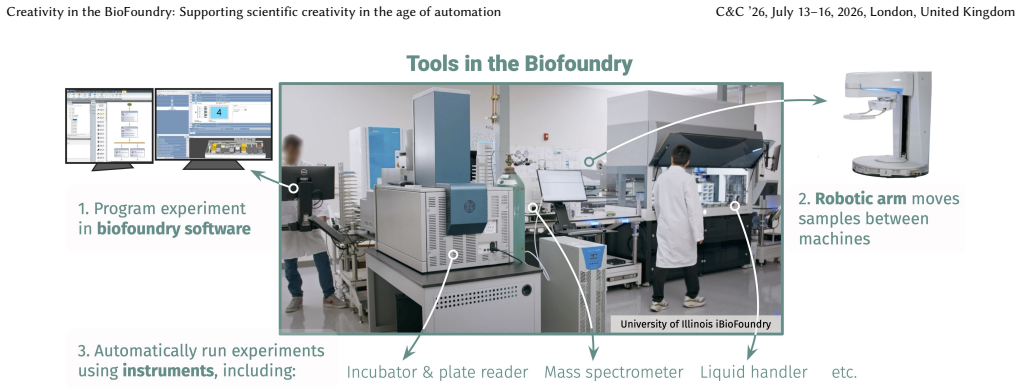
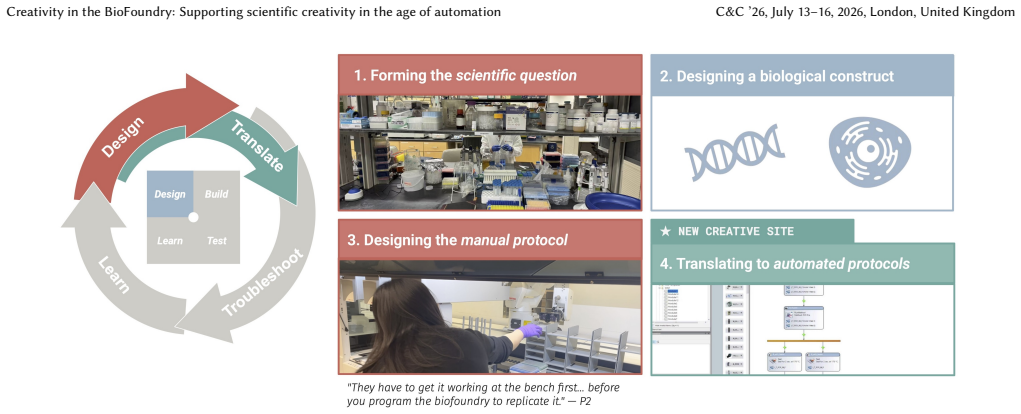


read the original abstract
Biofoundries automate biological experimentation at unprecedented scale, promising speed, reproducibility, and access. Yet automation also reshapes how scientists experience experimentation and creativity. Through in-depth interviews with nine scientists and experts across academia and industry (including biofoundry developers, automation engineers, and end-users), we examine how scientific creativity is enacted under automation. Biofoundries displace sensory cues, redistribute responsibility between humans and machines, and transform troubleshooting from an embodied, local practice into a predictive, social, and interpretive one. Rather than framing biofoundries as automation factories, we argue that they should be understood as Creativity Support Tools, whose design directly shapes how researchers notice breakdowns, exercise judgment, learn from failure, and progress through success. By connecting biofoundry practice with prior HCI work on automation, debugging, and distributed creativity, this paper demonstrates biofoundries as a distinctive and timely site for creativity research in science.
Editorial analysis
A structured set of objections, weighed in public.
Referee Report
Summary. The paper reports on in-depth interviews with nine scientists, biofoundry developers, automation engineers, and end-users across academia and industry. It describes how automation in biofoundries displaces sensory cues, redistributes responsibility between humans and machines, and transforms troubleshooting into a predictive, social, and interpretive practice. The central claim is that biofoundries should be reframed as Creativity Support Tools (CSTs) whose design shapes researchers' noticing of breakdowns, exercise of judgment, learning from failure, and progression through success, rather than as automation factories. The work connects these observations to prior HCI literature on automation, debugging, and distributed creativity.
Significance. If the interview themes prove robust, the reframing offers a constructive bridge between HCI and synthetic biology, highlighting design opportunities for automation that preserve and enhance scientific creativity. The explicit linkage to established HCI concepts on distributed creativity and failure learning is a clear strength, positioning biofoundries as a timely empirical site for creativity research.
major comments (2)
- [Methods] The central claim—that biofoundries should be understood as CSTs whose design directly shapes noticing breakdowns, judgment, failure learning, and success—rests on themes from nine interviews. The Methods section provides no details on recruitment strategy, interview protocol, thematic analysis procedure, saturation assessment, or any form of validation (e.g., member checking or triangulation with logs). Without these, the leap from the sampled accounts to a general design implication for the field cannot be evaluated.
- [Discussion] The abstract and discussion assert that the findings characterize how scientific creativity is enacted under automation in biofoundries in general. However, the participant sample is described only at a high level (academia/industry, roles); no information is given on institutional contexts, automation maturity levels, or purposive sampling criteria that would support transferability of the four creativity-related themes.
minor comments (1)
- [Abstract] The abstract states the sample size and high-level roles but omits any reference to analysis method; adding one sentence on the qualitative approach would improve transparency for HCI readers.
Simulated Author's Rebuttal
We thank the referee for their constructive comments, which identify key areas where additional methodological transparency and clarification of scope will strengthen the paper. We address each major comment below and will revise the manuscript accordingly.
read point-by-point responses
-
Referee: [Methods] The central claim—that biofoundries should be understood as CSTs whose design directly shapes noticing breakdowns, judgment, failure learning, and success—rests on themes from nine interviews. The Methods section provides no details on recruitment strategy, interview protocol, thematic analysis procedure, saturation assessment, or any form of validation (e.g., member checking or triangulation with logs). Without these, the leap from the sampled accounts to a general design implication for the field cannot be evaluated.
Authors: We agree that the Methods section is currently too brief and omits important procedural details. In the revised manuscript we will expand this section to describe the recruitment approach (purposive sampling via professional networks in synthetic biology and biofoundry communities), the semi-structured interview protocol, the inductive thematic analysis process, our judgment that thematic saturation had been reached, and the steps taken for analytic rigor (including author discussion and peer debriefing). We will also explicitly note the absence of member checking or log triangulation as a limitation. These additions will allow readers to assess the basis for the design implications. revision: yes
-
Referee: [Discussion] The abstract and discussion assert that the findings characterize how scientific creativity is enacted under automation in biofoundries in general. However, the participant sample is described only at a high level (academia/industry, roles); no information is given on institutional contexts, automation maturity levels, or purposive sampling criteria that would support transferability of the four creativity-related themes.
Authors: We accept that the current high-level sample description limits evaluation of transferability and that the abstract and discussion language could be read as overly general. The study was conceived as an exploratory qualitative inquiry with purposive sampling for role and sector diversity rather than statistical representativeness. In revision we will add available contextual information on institutional settings and automation maturity levels (while preserving participant anonymity), state the purposive sampling criteria explicitly, and revise the abstract and discussion to frame the four themes as insights from this sample that generate design considerations rather than general characterizations of the field. revision: yes
Circularity Check
No significant circularity; qualitative argument self-contained
full rationale
The paper derives its central claim—that biofoundries should be reframed as Creativity Support Tools—from thematic analysis of nine in-depth interviews. No equations, fitted parameters, predictions, or self-definitional loops appear. The argument connects interview themes to prior HCI literature on automation and creativity without reducing any step to a self-citation chain or renaming of inputs. The derivation is therefore self-contained against external benchmarks of qualitative HCI research.
Axiom & Free-Parameter Ledger
axioms (1)
- domain assumption In-depth interviews with domain experts can reveal how automation reshapes the lived experience of scientific creativity
Reference graph
Works this paper leans on
-
[1]
Saleema Amershi, Dan Weld, Mihaela Vorvoreanu, Adam Fourney, Besmira Nushi, Penny Collisson, Jina Suh, Shamsi Iqbal, Paul N. Bennett, Kori Inkpen, Creativity in the BioFoundry: Supporting scientific creativity in the age of automation C&C ’26, July 13–16, 2026, London, United Kingdom Jaime Teevan, Ruth Kikin-Gil, and Eric Horvitz. 2019. Guidelines for Hum...
-
[2]
Carrie Arnold. 2022. Cloud labs: Where robots do the research.Nature606, 7914 (Jun 2022), 612–613. doi:10.1038/d41586-022-01618-x
-
[3]
Lisanne Bainbridge. 1983. Ironies of automation.Automatica19, 6 (Nov 1983), 775–779. doi:10.1016/0005-1098(83)90046-8
-
[4]
Alan F. Blackwell. 2006. The reification of metaphor as a design tool.ACM Trans. Comput.-Hum. Interact.13, 4 (Dec. 2006), 490–530. doi:10.1145/1188816.1188820
-
[5]
Susanne Bødker. 2015. Third-wave HCI, 10 years later—participation and sharing. Interactions22, 5 (Aug. 2015), 24–31. doi:10.1145/2804405
-
[6]
Virginia Braun and Victoria Clarke. 2019. Reflecting on Reflexive Thematic Analysis. 11, 4 (2019), 589–597. doi:10.1080/2159676X.2019.1628806
-
[7]
V. Braun and V. Clarke. 2006. Using Thematic Analysis in Psychology. 3, 2 (2006), 77–101. doi:10.1191/1478088706qp063oa
-
[8]
Leah Buechley and Benjamin Mako Hill. 2010. LilyPad in the wild: how hardware’s long tail is supporting new engineering and design communities. InProceedings of the 8th ACM Conference on Designing Interactive Systems(Aarhus, Denmark) (DIS ’10). Association for Computing Machinery, New York, NY, USA, 199–207. doi:10.1145/1858171.1858206
-
[9]
Ran Chao, Shekhar Mishra, Tong Si, and Huimin Zhao. 2017. Engineering biolog- ical systems using automated biofoundries.Metabolic Engineering42 (Jul 2017), 98–108. doi:10.1016/j.ymben.2017.06.003
-
[10]
Yuning Chen, Elise Cachat, and Larissa Pschetz. 2025. Labour Provenance as a Lens to Reveal More-Than-Human Ecologies in Biological Design and HCI. In Proceedings of the 2025 CHI Conference on Human Factors in Computing Systems (CHI ’25). Association for Computing Machinery, New York, NY, USA, Article 743, 22 pages. doi:10.1145/3706598.3713272
-
[11]
Quentin M Dudley, Yao-Min Cai, Kalyani Kallam, Hubert Debreyne, Jose A Carrasco Lopez, and Nicola J Patron. 2021. Biofoundry-assisted expression and characterization of plant proteins.Synthetic Biology6, 1 (Sep 2021). doi:10.1093/ synbio/ysab029
2021
-
[12]
Feger, Sünje Dallmeier-Tiessen, Paweł W
Sebastian S. Feger, Sünje Dallmeier-Tiessen, Paweł W. Woźniak, and Albrecht Schmidt. 2019. The role of HCI in reproducible science. InExtended Abstracts of the 2019 CHI Conference on Human Factors in Computing Systems. 1–6. doi:10. 1145/3290607.3312905
arXiv 2019
-
[13]
Jonas Frich, Lindsay MacDonald Vermeulen, Christian Remy, Michael Mose Biskjaer, and Peter Dalsgaard. 2019. Mapping the Landscape of Creativity Support Tools in HCI. InProceedings of the 2019 CHI Conference on Human Factors in Computing Systems(Glasgow, Scotland Uk)(CHI ’19). Association for Computing Machinery, New York, NY, USA, 1–18. doi:10.1145/329060...
-
[14]
2014.Distributed creativity: Thinking outside the box of the creative individual
Vlad Petre Glăveanu. 2014.Distributed creativity: Thinking outside the box of the creative individual. Springer
2014
-
[15]
Foad Hamidi, Lydia Stamato, Lisa Scheifele, Rian Ciela Visscher Hammond, and S. Nisa Asgarali-Hoffman. 2021. “Turning the Invisible Visible”: Transdisciplinary Bioart Explorations in Human-DNA Interaction. InProceedings of the 2021 CHI Conference on Human Factors in Computing Systems(Yokohama, Japan)(CHI ’21). Association for Computing Machinery, New York...
-
[16]
Annie Hammang. 2023. Troubleshooting: The automation of synthetic biology and the Labor of Technological Futures.Science, Technology, & Human Values50, 1 (Jan 2023), 120–143. doi:10.1177/01622439221149524
-
[17]
Jeffrey Heer. 2019. Agency plus automation: Designing Artificial Intelligence into interactive systems. InProceedings of the National Academy of Sciences, Vol. 116. 1844–1850. doi:10.1073/pnas.1807184115
-
[18]
Hillson, Mark Caddick, Yizhi Cai, Jose A
Nathan J. Hillson, Mark Caddick, Yizhi Cai, Jose A. Carrasco, Matthew Wook Chang, Natalie C. Curach, David J. Bell, Rosalind Le Feuvre, Douglas C. Friedman, Xiongfei Fu, and et al. 2019. Building a global alliance of biofoundries.Nature Communications10, 2040 (May 2019). doi:10.1038/s41467-019-10079-2
-
[19]
Mare Hirsch, Gabrielle Benabdallah, Jennifer Jacobs, and Nadya Peek. 2023. Nothing Like Compilation: How Professional Digital Fabrication Workflows Go Beyond Extruding, Milling, and Machines.ACM Trans. Comput.-Hum. Interact. 31, 1, Article 13 (Nov. 2023), 45 pages. doi:10.1145/3609328
-
[20]
1996.Cognition in the Wild
Edwin Hutchins. 1996.Cognition in the Wild. MIT Press
1996
-
[21]
Mary Beth Kery, Amber Horvath, and Brad Myers. 2017. Variolite: Supporting Exploratory Programming by Data Scientists. InProceedings of the 2017 CHI Conference on Human Factors in Computing Systems(Denver, Colorado, USA) (CHI ’17). Association for Computing Machinery, New York, NY, USA, 1265–1276. doi:10.1145/3025453.3025626
-
[22]
Haseong Kim, Nathan J. Hillson, Byung-Kwan Cho, Bong Hyun Sung, Dae-Hee Lee, Dong-Myung Kim, Min-Kyu Oh, Matthew Wook Chang, Yong-Su Jin, Susan J. Rosser, and et al. 2025. Abstraction hierarchy to define biofoundry workflows and operations for interoperable synthetic biology research and applications. Nature Communications16, 6056 (Jul 2025). doi:10.1038/...
-
[23]
Aniket Kittur, Lixiu Yu, Tom Hope, Joel Chan, Hila Lifshitz-Assaf, Karni Gilon, Felicia Ng, Robert E. Kraut, and Dafna Shahaf. 2019. Scaling up analogical inno- vation with crowds and AI.Proceedings of the National Academy of Sciences116, 6 (2019), 1870–1877. arXiv:https://www.pnas.org/doi/pdf/10.1073/pnas.1807185116 doi:10.1073/pnas.1807185116
-
[24]
Klemmer, Björn Hartmann, and Leila Takayama
Scott R. Klemmer, Björn Hartmann, and Leila Takayama. 2006. How bodies matter: five themes for interaction design. InProceedings of the 6th Conference on Designing Interactive Systems(University Park, PA, USA)(DIS ’06). Association for Computing Machinery, New York, NY, USA, 140–149. doi:10.1145/1142405. 1142429
-
[25]
Amy J. Ko, Thomas D. LaToza, and Margaret M. Burnett. 2015. A practical guide to controlled experiments of software engineering tools with human participants. Empirical Softw. Engg.20, 1 (Feb. 2015), 110–141. doi:10.1007/s10664-013-9279-3
-
[26]
Stacey Kuznetsov, Carrie Doonan, Nathan Wilson, Swarna Mohan, Scott E. Hud- son, and Eric Paulos. 2015. DIYbio Things: Open Source Biology Tools as Plat- forms for Hybrid Knowledge Production and Scientific Participation. InProceed- ings of the 33rd Annual ACM Conference on Human Factors in Computing Systems (Seoul, Republic of Korea)(CHI ’15). Associatio...
-
[27]
Sophie Landwehr Sydow, Martin Jonsson, and Jakob Tholander. 2022. Modding the Pliable Machine: Unpacking the Creative and Social Practice of Upkeep at the Makerspace. InProceedings of the 14th Conference on Creativity and Cognition (Venice, Italy)(C&C ’22). Association for Computing Machinery, New York, NY, USA, 220–233. doi:10.1145/3527927.3532804
-
[28]
1979.Laboratory Life: The Construction of Scientific Facts
Bruno Latour and Steve Woolgar. 1979.Laboratory Life: The Construction of Scientific Facts. Sage Publications
1979
-
[29]
Nancy J. Nersessian. 2006. The cognitive-cultural systems of the research labora- tory.Organization Studies27, 1 (Jan 2006), 125–145. doi:10.1177/0170840606061842
-
[30]
Donald A. Norman. 2013.The design of everyday things. Basic Books
2013
-
[31]
Christopher J Petzold and Aindrila Mukhopadhyay. 2025. From bench to bio- factory: High-throughput technologies and automated workflows to accelerate biomanufacturing.Current Opinion in Biotechnology94 (Aug 2025), 103320. doi:10.1016/j.copbio.2025.103320
-
[32]
1995.The Mangle of Practice: Time, Agency, and Science
Andrew Pickering. 1995.The Mangle of Practice: Time, Agency, and Science. University of Chicago Press
1995
-
[33]
2018.Lifelong kindergarten: Cultivating creativity through projects, passion, peers, and play
Mitchel Resnick and Ken Robinson. 2018.Lifelong kindergarten: Cultivating creativity through projects, passion, peers, and play. The MIT Press
2018
-
[34]
Tobias Michael Rosch, Julia Tenhaef, Tim Stoltmann, Till Redeker, Dominic Kösters, Niels Hollmann, Karin Krumbach, Wolfgang Wiechert, Michael Bott, Susana Matamouros, and et al. 2024. Autobiotech - a versatile Biofoundry for automated strain engineering.ACS Synthetic Biology13, 7 (Jul 2024), 2227–2237. doi:10.1021/acssynbio.4c00298
-
[35]
Keith Sawyer and Stacy Dezutter. 2009. Distributed Creativity: How Collective Creations Emerge From Collaboration.Psychology of Aesthetics, Creativity, and the Arts3 (05 2009), 81–92. doi:10.1037/a0013282
-
[36]
Keith Sawyer and Danah Henriksen
R. Keith Sawyer and Danah Henriksen. 2024.Explaining creativity: The science of human innovation. Oxford University Press
2024
-
[37]
Donald A. Schön. 1983.The reflective practitioner: How professionals think in action. Basic Books
1983
-
[38]
Ben Shneiderman. 2007. Creativity support tools: accelerating discovery and innovation.Commun. ACM50, 12 (Dec. 2007), 20–32. doi:10.1145/1323688. 1323689
-
[39]
Ben Shneiderman, Catherine Plaisant, M. Cohen, and S. Jacobs. 2009. Designing the user interface: strategies for effective human-computer interaction.Informa- tion Design Journal17 (01 2009), 157–158. doi:10.1075/idj.17.2.14mar
-
[40]
Blair Subbaraman, Nathaneal Bursch, and Nadya Peek. 2025. It’s Not the Shape, It’s the Settings: Tools for Exploring, Documenting, and Sharing Physical Fabri- cation Parameters in 3D Printing. InProceedings of the 2025 CHI Conference on Human Factors in Computing Systems (CHI ’25). Association for Computing Ma- chinery, New York, NY, USA, Article 449, 19 ...
-
[41]
1987.Plans and situated actions: The problem of human- machine communication
Lucille Alice Suchman. 1987.Plans and situated actions: The problem of human- machine communication. Cambridge University Press
1987
-
[42]
Hannah Twigg-Smith and Nadya Peek. 2023. Dynamic Toolchains: Software Infrastructure for Digital Fabrication Workflows. InProceedings of the 36th Annual ACM Symposium on User Interface Software and Technology(San Francisco, CA, USA)(UIST ’23). Association for Computing Machinery, New York, NY, USA, Article 23, 20 pages. doi:10.1145/3586183.3606802
-
[43]
Anna Vallgårda and Johan Redström. 2007. Computational composites. InPro- ceedings of the SIGCHI Conference on Human Factors in Computing Systems(San Jose, California, USA)(CHI ’07). Association for Computing Machinery, New York, NY, USA, 513–522. doi:10.1145/1240624.1240706
discussion (0)
Sign in with ORCID, Apple, or X to comment. Anyone can read and Pith papers without signing in.