Instance-Level Post Hoc Uncertainty Quantification in Object Detection
Pith reviewed 2026-06-28 06:30 UTC · model grok-4.3
The pith
Monte-Carlo generalized linearized model enables instance-level post-hoc uncertainty quantification in object detection.
A machine-rendered reading of the paper's core claim, the machinery that carries it, and where it could break.
Core claim
The authors claim that the Monte-Carlo generalized linearized model (MC-GLM) provides instance-level and approximately post hoc uncertainty quantification. The number of samples required in the Monte Carlo step is constant and independent of the number of output instances, so it can be parallelized. Experiments on the nuScenes dataset with the CenterPoint detector validate the effectiveness of the method, and the resulting uncertainties exhibit good quality.
What carries the argument
Monte-Carlo generalized linearized model (MC-GLM), which augments the Laplace approximation with fixed-cost Monte Carlo sampling to obtain per-instance uncertainty estimates.
If this is right
- Instance-level uncertainties become available without multiple back-propagations through the detector.
- The procedure stays approximately post hoc and requires no retraining.
- Computational cost remains fixed regardless of how many objects are present in an image.
- The fixed sample count permits straightforward parallelization of the Monte Carlo step.
- The approach produces usable uncertainties when applied to CenterPoint on nuScenes.
Where Pith is reading between the lines
- The constant-sample property could allow the same method to scale to dense scenes without added latency per object.
- If the calibration holds, downstream systems could use the per-instance scores directly for risk-aware planning.
- The technique might extend to other post-hoc approximations in detection or segmentation tasks.
- Verification on detectors other than CenterPoint would test whether the fixed-cost property generalizes.
Load-bearing premise
The Laplace approximation plus the proposed Monte Carlo sampling produces calibrated instance-level uncertainty without requiring multiple back-propagations or violating the post-hoc constraint.
What would settle it
A measurement showing that the reported per-instance uncertainties do not correlate with actual prediction errors on held-out data, or that runtime grows with the number of detected instances.
Figures
read the original abstract
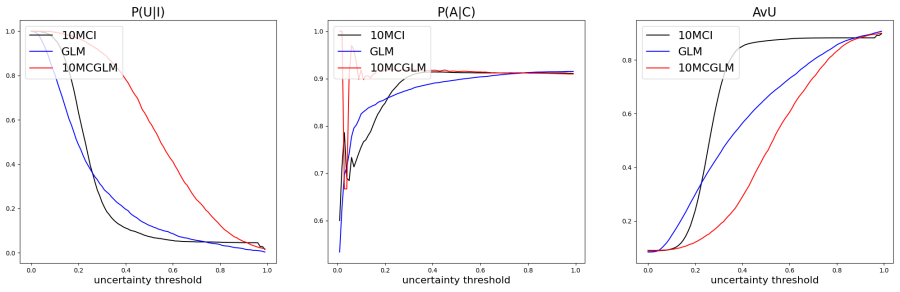
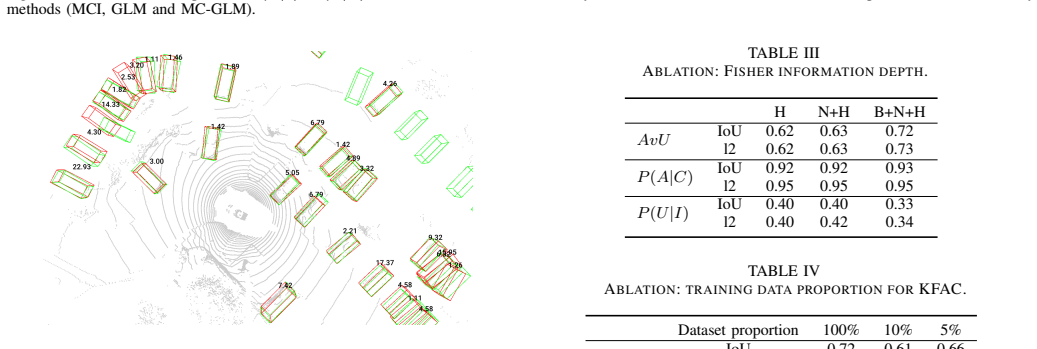
Object detection is a safety-critical component of autonomous driving. It is essential to quantify the uncertainty in bounding-box predictions for safety assurance. Post hoc uncertainty quantification without retraining aligns with real-world deployment requirements; therefore, we employ the Laplace approximation. Because instance-level uncertainty is needed, linearized inference methods that require multiple backpropagations are not time-efficient, and sampling-based methods are not fully post hoc. We propose Monte-Carlo generalized linearized model (MC-GLM), which provides instance-level and approximately post hoc uncertainty quantification. The number of samples required in the Monte Carlo step is constant and independent of the number of output instances, so it can be parallelized. Experiments on the nuScenes dataset with the CenterPoint detector validate the effectiveness of our method, and the resulting uncertainties exhibit good quality.
Editorial analysis
A structured set of objections, weighed in public.
Referee Report
Summary. The paper proposes Monte-Carlo generalized linearized model (MC-GLM) that combines the Laplace approximation with a fixed-budget Monte Carlo sampling step to deliver instance-level, approximately post-hoc uncertainty quantification for object detectors. The key property asserted is that the Monte Carlo sample count remains constant and independent of the (variable) number of output instances, enabling parallelization. Effectiveness is claimed to be validated on the nuScenes dataset with the CenterPoint detector, with resulting uncertainties described as exhibiting good quality.
Significance. If the MC-GLM construction can be shown to produce reliably calibrated per-instance uncertainties while satisfying the approximately post-hoc constraint and avoiding multiple back-propagations, the approach would address a practical need in safety-critical detection pipelines. The constant-sample MC design is a potentially useful engineering contribution for scalability when instance counts vary.
major comments (2)
- [Abstract] Abstract: the central claim that Laplace + MC-GLM yields calibrated instance-level uncertainty while remaining approximately post-hoc is stated without any analytic error bound on the linearization, derivation of the sampling procedure, or argument that the fixed-budget MC step preserves the post-hoc property when the detector emits a variable number of boxes; this modeling assumption is load-bearing for the entire contribution.
- [Experiments] Experiments section: no quantitative calibration metrics, error bars, or baseline comparisons are reported to substantiate the assertion that uncertainties exhibit 'good quality' on nuScenes with CenterPoint; the validation therefore cannot be checked against the paper's own evidence.
Simulated Author's Rebuttal
We thank the referee for the constructive comments. We address each major comment below.
read point-by-point responses
-
Referee: [Abstract] Abstract: the central claim that Laplace + MC-GLM yields calibrated instance-level uncertainty while remaining approximately post-hoc is stated without any analytic error bound on the linearization, derivation of the sampling procedure, or argument that the fixed-budget MC step preserves the post-hoc property when the detector emits a variable number of boxes; this modeling assumption is load-bearing for the entire contribution.
Authors: The manuscript derives MC-GLM by first applying the Laplace approximation to the trained detector parameters (post-hoc) and then performing a fixed-budget Monte Carlo sampling step whose sample count is chosen independently of the (variable) number of output instances per image. This design ensures the sampling cost remains constant and can be parallelized, preserving the approximately post-hoc property. We agree that an explicit analytic error bound on the linearization is absent; deriving tight bounds for the non-linear, multi-instance detection setting is non-trivial. We will add a dedicated discussion of the approximation assumptions and limitations in the revised manuscript. revision: partial
-
Referee: [Experiments] Experiments section: no quantitative calibration metrics, error bars, or baseline comparisons are reported to substantiate the assertion that uncertainties exhibit 'good quality' on nuScenes with CenterPoint; the validation therefore cannot be checked against the paper's own evidence.
Authors: We acknowledge that the experiments rely on qualitative description of uncertainty quality. In revision we will add quantitative calibration metrics (adapted expected calibration error for detection tasks), report results with error bars over multiple seeds, and include direct comparisons to baselines such as standard Laplace approximation without the MC step. revision: yes
Circularity Check
No circularity: proposal is a novel construction with external validation.
full rationale
The paper introduces MC-GLM as a new combination of Laplace approximation and constant-budget Monte Carlo sampling for instance-level post-hoc uncertainty in object detection. No equations, parameters, or claims in the abstract or description reduce by construction to prior fits, self-definitions, or self-citation chains. The method is presented as a construction and validated on the external nuScenes dataset with CenterPoint; no load-bearing step equates the output uncertainty to an input by definition or renaming. This is the common case of a self-contained methodological proposal.
Axiom & Free-Parameter Ledger
Reference graph
Works this paper leans on
-
[1]
Can we trust you? on calibration of a probabilistic object detector for autonomous driving,
D. Feng, L. Rosenbaum, C. Glaeser, F. Timm, and K. Dietmayer, “Can we trust you? on calibration of a probabilistic object detector for autonomous driving,”arXiv preprint arXiv:1909.12358, 2019
arXiv 1909
-
[2]
Adaptive bounding box uncertainties via two-step conformal prediction,
A. Timans, C.-N. Straehle, K. Sakmann, and E. Nalisnick, “Adaptive bounding box uncertainties via two-step conformal prediction,”arXiv preprint arXiv:2403.07263, 2024
arXiv 2024
-
[3]
Estimating and evaluating regression predictive uncertainty in deep object detectors,
A. Harakeh and S. L. Waslander, “Estimating and evaluating regression predictive uncertainty in deep object detectors,” inInternational Conference on Learning Representations, 2021. [Online]. Available: https://openreview.net/forum?id=YLewtnvKgR7
2021
-
[4]
Laplace approximation based epistemic uncertainty estimation in 3d object detection,
P. Yun and M. Liu, “Laplace approximation based epistemic uncertainty estimation in 3d object detection,” inConference on Robot Learning. PMLR, 2023, pp. 1125–1135
2023
-
[5]
Improving predictions of bayesian neural nets via local linearization,
B. Immer, Korzepa, “Improving predictions of bayesian neural nets via local linearization,”roceedings of the 24th International Conference on Artificial Intelligence and Statistics (AISTATS) 2021, San Diego, California, USA. PMLR: Volume 130., 2021
2021
-
[6]
A survey of uncertainty in deep neural networks,
J. Gawlikowski, C. R. N. Tassi, M. Ali, J. Lee, M. Humt, J. Feng, A. Kruspe, R. Triebel, P. Jung, R. Roscheret al., “A survey of uncertainty in deep neural networks,”Artificial Intelligence Review, vol. 56, no. Suppl 1, pp. 1513–1589, 2023
2023
-
[7]
Bayesian convolutional neural net- works with bernoulli approximate variational inference,
Y . Gal and Z. Ghahramani, “Bayesian convolutional neural net- works with bernoulli approximate variational inference,”arXiv preprint arXiv:1506.02158, 2015
Pith/arXiv arXiv 2015
-
[8]
Dropout as a bayesian approximation: Representing model uncertainty in deep learning,
Y . Gal and Z. Ghahramani, “Dropout as a bayesian approximation: Representing model uncertainty in deep learning,” ininternational conference on machine learning. PMLR, 2016, pp. 1050–1059
2016
-
[9]
Practical variational inference for neural networks,
A. Graves, “Practical variational inference for neural networks,”Advances in neural information processing systems, vol. 24, 2011
2011
-
[10]
Structured and efficient variational deep learning with matrix gaussian posteriors,
C. Louizos and M. Welling, “Structured and efficient variational deep learning with matrix gaussian posteriors,” inInternational conference on machine learning. PMLR, 2016, pp. 1708–1716
2016
-
[11]
Learning structured weight uncertainty in bayesian neural networks,
S. Sun, C. Chen, and L. Carin, “Learning structured weight uncertainty in bayesian neural networks,” inArtificial Intelligence and Statistics. PMLR, 2017, pp. 1283–1292
2017
-
[12]
Eigenvalue corrected noisy natural gradient,
J. Bae, G. Zhang, and R. Grosse, “Eigenvalue corrected noisy natural gradient,”arXiv preprint arXiv:1811.12565, 2018
Pith/arXiv arXiv 2018
-
[13]
Practical deep learning with bayesian principles,
K. Osawa, S. Swaroop, M. E. E. Khan, A. Jain, R. Eschenhagen, R. E. Turner, and R. Yokota, “Practical deep learning with bayesian principles,” Advances in neural information processing systems, vol. 32, 2019
2019
-
[14]
Bayesian model comparison and backprop nets,
Mackay, “Bayesian model comparison and backprop nets,”Advances in neural in- formation processing systems, 1992
1992
-
[15]
Optimizing neural networks with kronecker-factored ap- proximate curvature,
G. Martens, “Optimizing neural networks with kronecker-factored ap- proximate curvature,”Proceedings of the 32nd International Conference on Machine Learning, 2015
2015
-
[16]
Fast approximate natural gradient descent in a kronecker factored eigenbasis,
T. George, C. Laurent, X. Bouthillier, N. Ballas, and P. Vincent, “Fast approximate natural gradient descent in a kronecker factored eigenbasis,” Advances in Neural Information Processing Systems, vol. 31, 2018
2018
-
[17]
Estimating model uncertainty of neural networks in sparse information form,
J. Lee, M. Humt, J. Feng, and R. Triebel, “Estimating model uncertainty of neural networks in sparse information form,” inInternational Conference on Machine Learning. PMLR, 2020, pp. 5702–5713
2020
-
[18]
Simple and scalable predictive uncertainty estimation using deep ensembles,
B. Lakshminarayanan, A. Pritzel, and C. Blundell, “Simple and scalable predictive uncertainty estimation using deep ensembles,”Advances in neural information processing systems, vol. 30, 2017
2017
-
[19]
Hyperparameter ensembles for robustness and uncertainty quantification,
F. Wenzel, J. Snoek, D. Tran, and R. Jenatton, “Hyperparameter ensembles for robustness and uncertainty quantification,”Advances in Neural Information Processing Systems, vol. 33, pp. 6514–6527, 2020
2020
-
[20]
Autoregressive uncertainty modeling for 3d bounding box prediction,
Y . Liu, N. Mishra, M. Sieb, Y . Shentu, P. Abbeel, and X. Chen, “Autoregressive uncertainty modeling for 3d bounding box prediction,” in European Conference on Computer Vision. Springer, 2022, pp. 673–694
2022
-
[21]
Bayesod: A bayesian approach for uncertainty estimation in deep object detectors,
A. Harakeh, M. Smart, and S. L. Waslander, “Bayesod: A bayesian approach for uncertainty estimation in deep object detectors,” in2020 IEEE International Conference on Robotics and Automation (ICRA). IEEE, 2020, pp. 87–93
2020
-
[22]
Monte carlo dropblock for modelling uncertainty in object detection,
K. Deepshikha, S. H. Yelleni, P. Srijith, and C. K. Mohan, “Monte carlo dropblock for modelling uncertainty in object detection,”arXiv preprint arXiv:2108.03614, 2021
arXiv 2021
-
[23]
Probabilistic object detection via deep ensembles,
Z. Lyu, N. Gutierrez, A. Rajguru, and W. J. Beksi, “Probabilistic object detection via deep ensembles,” inEuropean Conference on Computer Vision. Springer, 2020, pp. 67–75
2020
-
[24]
Laplace approximation for real-time uncertainty estimation in object detection,
M. Gui, T. Qiu, F. Bauer, and H. Shen, “Laplace approximation for real-time uncertainty estimation in object detection,” in2022 IEEE 25th International Conference on Intelligent Transportation Systems (ITSC). IEEE, 2022, pp. 409–415
2022
-
[25]
Deep evidential regression,
A. Amini, W. Schwarting, A. Soleimany, and D. Rus, “Deep evidential regression,”Advances in neural information processing systems, vol. 33, pp. 14 927–14 937, 2020
2020
-
[26]
Evaluating bayesian deep learning methods for semantic segmentation,
J. Mukhoti and Y . Gal, “Evaluating bayesian deep learning methods for semantic segmentation,”arXiv preprint arXiv:1811.12709, 2018
Pith/arXiv arXiv 2018
-
[27]
Center-based 3d object detection and tracking,
T. Yin, X. Zhou, and P. Krahenbuhl, “Center-based 3d object detection and tracking,” inProceedings of the IEEE/CVF conference on computer vision and pattern recognition, 2021, pp. 11 784–11 793
2021
-
[28]
nuscenes: A multimodal dataset for autonomous driving,
H. Caesar, V . Bankiti, A. H. Lang, S. V ora, V . E. Liong, Q. Xu, A. Krishnan, Y . Pan, G. Baldan, and O. Beijbom, “nuscenes: A multimodal dataset for autonomous driving,” inProceedings of the IEEE/CVF conference on computer vision and pattern recognition, 2020, pp. 11 621–11 631
2020
discussion (0)
Sign in with ORCID, Apple, or X to comment. Anyone can read and Pith papers without signing in.