Collective Radiative Enhancement of Rare-Earth Ions in Lithium Niobate via Engineered LargeArea Nanohole Arrays
Pith reviewed 2026-06-29 10:13 UTC · model grok-4.3
The pith
Periodic gold nanohole arrays on thulium-implanted lithium niobate produce collective radiative enhancement of the ions.
A machine-rendered reading of the paper's core claim, the machinery that carries it, and where it could break.
Core claim
The hybrid nanohole-ion structure simultaneously supports localized and lattice plasmon resonances from the metallic array and collective atomic resonances from the ion ensemble. Using time-resolved photoluminescence and temperature-dependent measurements, enhanced radiative emission is observed and attributed to collective atomic effects mediated by the nanohole lattice, distinct from single-emitter Purcell enhancement.
What carries the argument
The semi-two-dimensional array of thulium ions embedded in the nanohole lattice on lithium niobate, which mediates collective atomic resonances.
If this is right
- Geometry engineering of emitters provides a complementary route to photonic density of states engineering for controlling collective radiative properties.
- The approach enables broadband and scalable quantum optical interfaces in solid-state platforms.
- Collective effects can be realized in high-index crystalline thin films with rare-earth ions.
- The distinction via time-resolved and temperature-dependent measurements confirms the collective nature.
Where Pith is reading between the lines
- Similar lattice designs might enhance coherence times or enable entanglement in quantum emitter arrays.
- The method could extend to other rare-earth ion and host combinations for different operating wavelengths.
- Integration with existing lithium niobate photonic circuits could produce on-chip collective quantum light sources.
Load-bearing premise
The observed emission enhancement stems specifically from collective atomic resonances enabled by the nanohole lattice rather than from fabrication artifacts, local density of states variations, or non-collective mechanisms.
What would settle it
A measurement showing that the enhancement disappears when the lattice periodicity is altered while keeping ion density constant, or that it correlates with local defects instead of the periodic structure.
Figures


read the original abstract
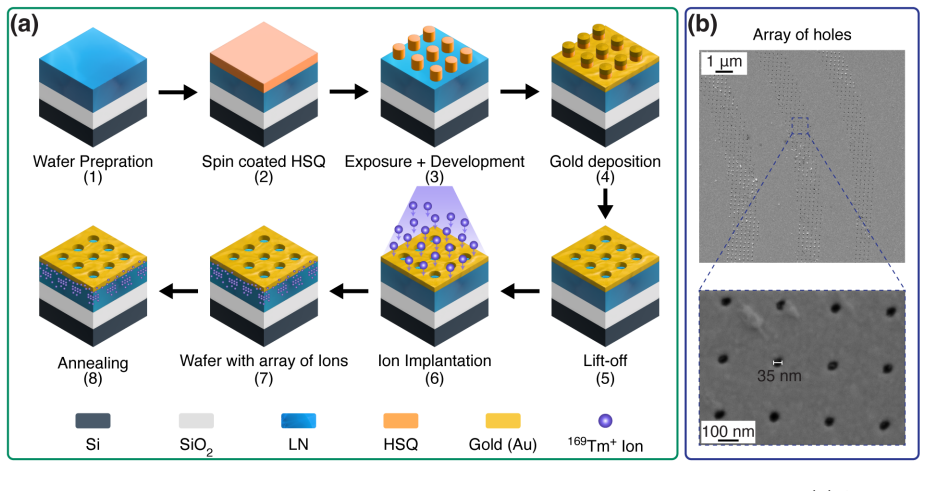
Conventional approaches to light-matter interactions rely on engineering photonic density of states. More recently, tailoring the spatial geometry of atoms or emitters themselves has emerged as a powerful and complementary route to control collective radiative properties. Here we experimentally realize a geometry-engineered ensemble of rare-earth ions by fabricating a periodic array of subwavelength gold nanoholes on lithium niobate implanted with thulium ions, forming a semi-two-dimensional array of quantum emitters embedded in a high-index crystalline thin film. The hybrid structure can simultaneously support localized and lattice plasmon resonances from the metallic array and collective atomic resonances from the ion ensemble. Using time-resolved photoluminescence and temperature-dependent measurements, we observe enhanced radiative emission attributed to collective atomic effects mediated by the nanohole lattice, distinct from single-emitter Purcell enhancement. Our results demonstrate a new regime of light-matter interaction opening a pathway toward broadband and scalable, geometry-controlled quantum optical interfaces in solid-state platforms.
Editorial analysis
A structured set of objections, weighed in public.
Referee Report
Summary. The manuscript reports fabrication of a periodic array of subwavelength gold nanoholes on thulium-ion-implanted lithium niobate, forming a semi-2D ensemble of rare-earth emitters. Time-resolved photoluminescence and temperature-dependent measurements are used to claim observation of enhanced radiative emission specifically due to collective atomic resonances mediated by the nanohole lattice geometry, distinct from single-emitter Purcell enhancement or other mechanisms.
Significance. If the attribution to collective atomic effects is rigorously established, the result would provide a geometry-based route to collective light-matter interactions that complements photonic density-of-states engineering, with potential for scalable quantum optical interfaces in crystalline platforms. The hybrid support of lattice plasmons and collective atomic resonances is a notable experimental direction.
major comments (2)
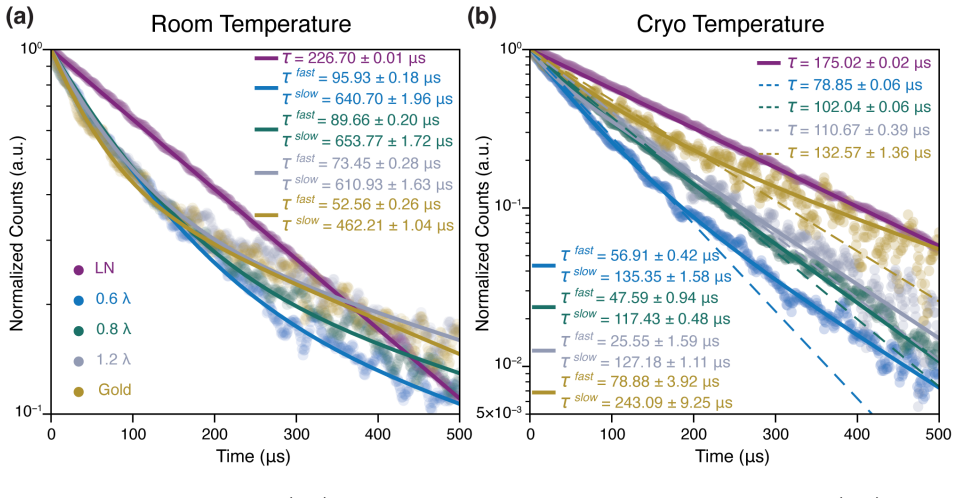
- [Abstract and §3] Abstract and §3 (Results): the central attribution of the observed radiative enhancement to collective atomic resonances (rather than LDOS modifications from the gold array, fabrication-induced ion density variations, or single-emitter effects) rests on time-resolved PL and temperature-dependent data, yet no quantitative signatures, decay-rate values, control-sample comparisons, or fitting procedures are supplied to demonstrate the distinguishing power of these measurements.
- [§4] §4 (Discussion): the claim that the enhancement is 'distinct from single-emitter Purcell enhancement' requires explicit comparison of the measured lifetime shortening against the expected Purcell factor calculated from the local density of states of the nanohole array; without this calculation or reference to a control structure lacking the periodic lattice, the separation from conventional mechanisms remains unverified.
minor comments (2)
- [Figure 2] Figure 2 caption and axis labels: the temperature-dependent PL spectra lack error bars and the temperature range is not stated; this obscures assessment of the thermal stability of the claimed collective effect.
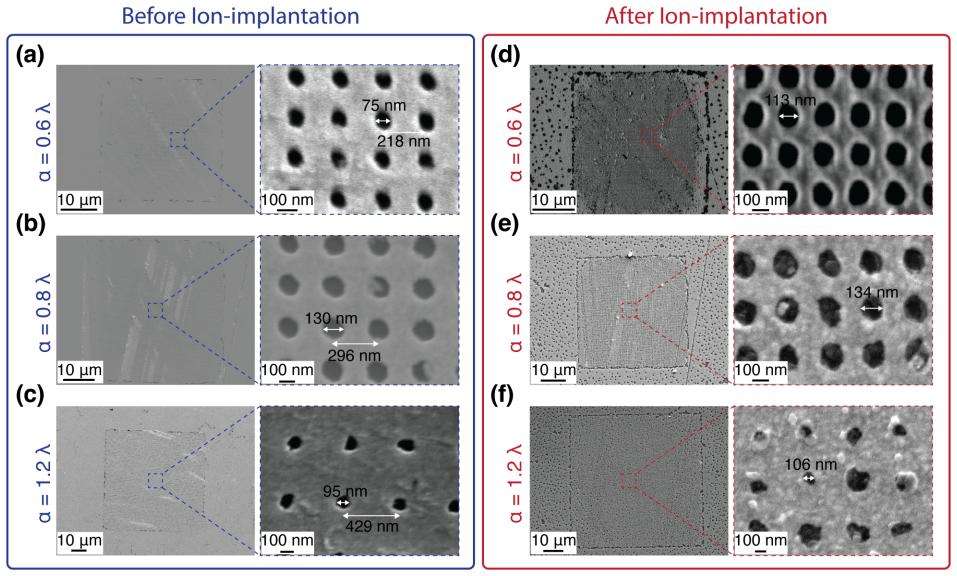
- [Methods] Methods section: the ion implantation dose, annealing conditions, and gold nanohole fabrication parameters (period, diameter, thickness) should be tabulated for reproducibility.
Simulated Author's Rebuttal
We thank the referee for the detailed and constructive report. The comments highlight important points regarding the quantitative support for our attribution of the observed enhancement to collective atomic resonances. We address each major comment below and will revise the manuscript to strengthen these aspects.
read point-by-point responses
-
Referee: [Abstract and §3] Abstract and §3 (Results): the central attribution of the observed radiative enhancement to collective atomic resonances (rather than LDOS modifications from the gold array, fabrication-induced ion density variations, or single-emitter effects) rests on time-resolved PL and temperature-dependent data, yet no quantitative signatures, decay-rate values, control-sample comparisons, or fitting procedures are supplied to demonstrate the distinguishing power of these measurements.
Authors: We agree that additional quantitative details would improve the clarity and rigor of the attribution. The time-resolved PL data in §3 show lifetime shortening, and the temperature dependence is used to distinguish from non-radiative processes, but explicit values and procedures were not tabulated. In the revised manuscript we will add: (i) extracted decay rates with uncertainties, (ii) description of the fitting model (including any multi-exponential components), and (iii) direct comparison to control samples (unpatterned implanted LN and non-periodic gold structures) that were measured but not fully presented. revision: yes
-
Referee: [§4] §4 (Discussion): the claim that the enhancement is 'distinct from single-emitter Purcell enhancement' requires explicit comparison of the measured lifetime shortening against the expected Purcell factor calculated from the local density of states of the nanohole array; without this calculation or reference to a control structure lacking the periodic lattice, the separation from conventional mechanisms remains unverified.
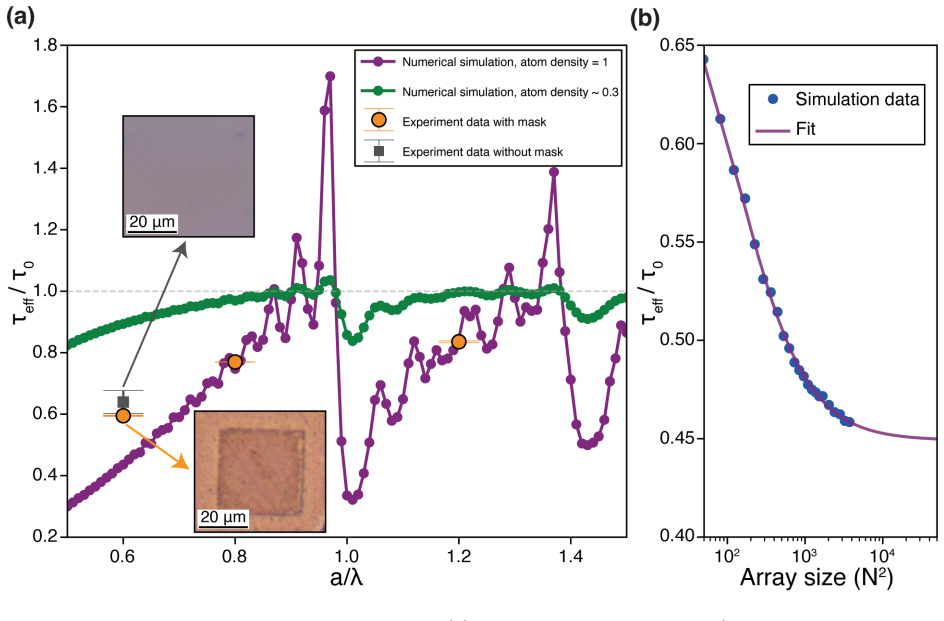
Authors: This is a valid concern; the current discussion relies on qualitative arguments from geometry and temperature dependence rather than a direct LDOS calculation. We will add in the revised §4 an FDTD-computed LDOS map for the nanohole array at the Tm emission wavelength, the resulting position-averaged Purcell factor, and a side-by-side comparison with the experimentally observed lifetime reduction. We will also explicitly reference the non-periodic control data mentioned above to further separate lattice-mediated collective effects from local plasmonic LDOS changes. revision: yes
Circularity Check
No circularity: experimental observation with no derivation or self-referential fitting
full rationale
The paper presents an experimental result on enhanced radiative emission in a fabricated nanohole array structure, supported by time-resolved photoluminescence and temperature-dependent measurements. No equations, fitted parameters renamed as predictions, ansatzes, uniqueness theorems, or derivation chains appear in the abstract or described claims. The attribution to collective effects is framed as an interpretation of data rather than a mathematical reduction to inputs. This is a standard experimental report with no load-bearing self-citation or definitional circularity.
Axiom & Free-Parameter Ledger
Reference graph
Works this paper leans on
-
[1]
D.; Zakomirnyi, V
(25) Utyushev, A. D.; Zakomirnyi, V. I.; Rasskazov, I. L. Collective lattice resonances: Plasmonics and beyond.Reviews in Physics2021,6, 100051. (26) Yang, X.; Xiao, G.; Lu, Y.; Li, G. Narrow plasmonic surface lattice resonances with preference to asymmetric dielectric environment.Optics express2019,27, 25384–25394. 10 (27) Prodan, E.; Radloff, C.; Halas,...
2008
-
[2]
(37) Duan, H.; Hu, H.; Kumar, K.; Shen, Z.; Yang, J. K. Direct and reliable patterning of plasmonic nanostructures with sub-10-nm gaps.ACS nano2011,5, 7593–7600. (38) Ren, L.; Chen, B. InProceedings. 7th International Conference on Solid-State and Integrated Circuits Technology, 2004.2004; Vol. 1, pp 579–582. (39) Lei, M.; Fukumori, R.; Rochman, J.; Zhu, ...
discussion (0)
Sign in with ORCID, Apple, or X to comment. Anyone can read and Pith papers without signing in.