Efficient Image Registration for Ultrasound Localization Microscopy by Obtaining Gradients via Integration Across Iterations
Pith reviewed 2026-06-26 19:22 UTC · model grok-4.3
The pith
Extremum seeking control supplies effective descent directions for image registration by integrating perturbed similarity metrics across iterations instead of computing explicit gradients.
A machine-rendered reading of the paper's core claim, the machinery that carries it, and where it could break.
Core claim
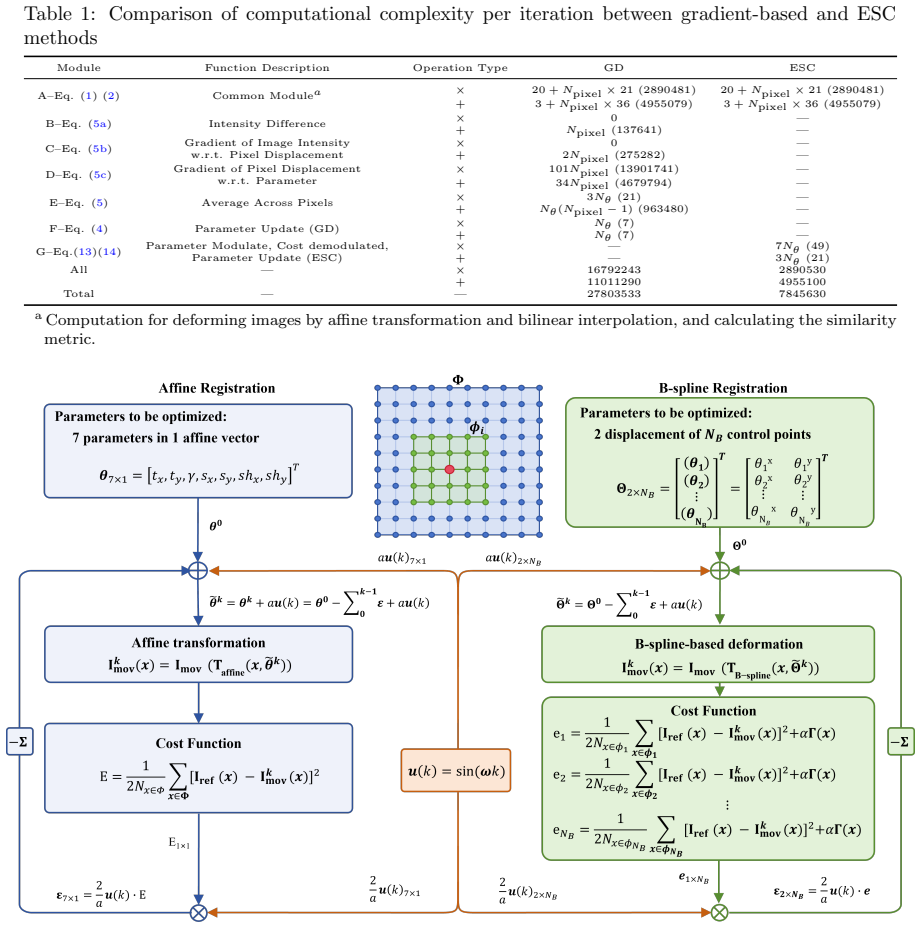
By using extremum seeking control, which approximates gradient descent through integration of perturbed and demodulated image similarity metrics over iterations, the method performs affine and B-spline registration without explicit differentiation, reducing computational cost by 3.5 times while maintaining accuracy, and enabling 219 μm resolution in ex vivo heart ULM.
What carries the argument
Extremum seeking control that obtains descent information via integration of perturbed and demodulated image similarity metrics across iterations.
If this is right
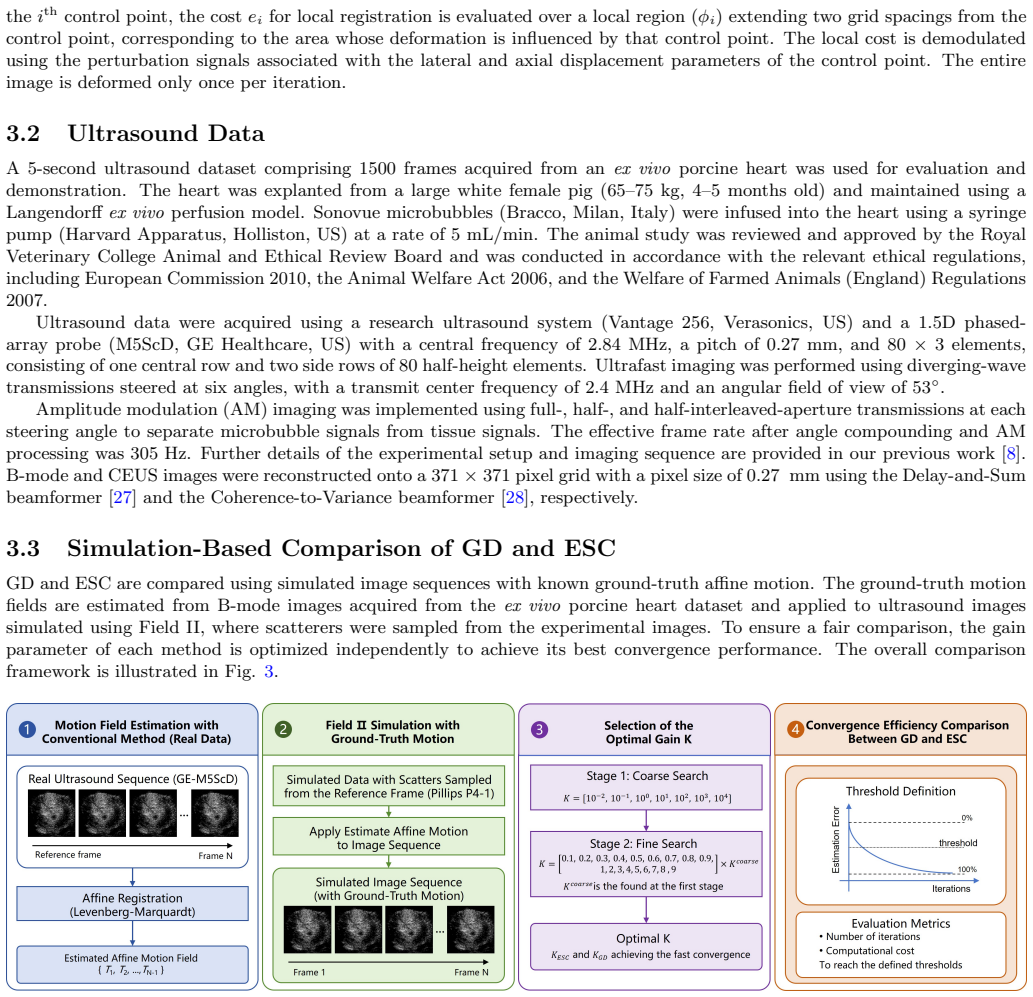
- ESC matches GD accuracy and convergence behavior for affine registration using simulated ground-truth motions from the ex vivo porcine heart dataset.
- Per-iteration computational cost is reduced by a factor of approximately 3.5 compared with explicit gradient evaluation.
- A two-stage pipeline of affine followed by B-spline registration corrects both global tissue motion and residual local deformation.
- The corrected images support ULM reconstruction at 219 micrometers spatial resolution, below the 321 micrometer half-wavelength diffraction limit for 2.4 MHz diverging-wave imaging.
Where Pith is reading between the lines
- The integration-based descent mechanism may extend to other parametric registration tasks where repeated differentiation of complex similarity metrics is the dominant cost.
- Lower per-iteration expense could enable registration at higher temporal sampling rates or on larger volumetric datasets without proportional increases in compute.
- Because the approach separates the perturbation and demodulation steps from the underlying image metric, it could be paired with alternative similarity measures or added regularization without altering the core optimization loop.
Load-bearing premise
Integrating perturbed and demodulated image similarity metrics across iterations reliably supplies descent directions equivalent to explicit gradients for both affine and B-spline parametric registration on the tested datasets.
What would settle it
A case on the porcine heart dataset in which extremum seeking control and explicit gradient descent produce final motion parameters that differ by more than the reported registration error, or yield a final image similarity score markedly lower for the extremum seeking approach.
Figures



read the original abstract
Tissue motion correction through image registration is essential for ultrasound localization microscopy (ULM). Parametric image registration is commonly formulated as an optimization problem where motion parameters are iteratively updated to maximize image similarity, and used optimization algorithms typically rely on gradient information, the explicit evaluation of which can become computationally demanding. This work investigates Extremum Seeking Control (ESC) as an alternative to explicit derivative evaluation in image registration. By obtaining descent information via integrating perturbed and demodulated image similarity metric across iterations, ESC avoids differentiation of the image similarity metric with respect to motion parameters in each iteration. The classical ESC, whose optimization behavior approximates that of classical gradient descent (GD), is first compared with GD for affine image registration using simulated ground-truth motions derived from a beating ex vivo porcine heart dataset. The results show that ESC achieves registration accuracy and convergence behavior comparable to GD while reducing per-iteration computational cost by approximately 3.5-fold. ESC is subsequently employed in a two-stage motion correction pipeline, where affine registration compensates for global tissue motion and B-spline registration corrects residual local deformation. The proposed method is applied to ULM imaging of a beating ex vivo porcine heart and achieves a spatial resolution of 219 um, substantially below the half-wavelength diffraction limit of 321 um associated with 2.4 MHz diverging-wave imaging. These results demonstrate that ESC provides an effective alternative to explicit derivative evaluation in ULM image registration, enabling accurate motion correction and high-quality super-resolution imaging.
Editorial analysis
A structured set of objections, weighed in public.
Referee Report
Summary. The manuscript proposes Extremum Seeking Control (ESC) as an alternative to explicit gradient evaluation in parametric image registration for ultrasound localization microscopy (ULM). It first compares classical ESC to gradient descent (GD) for affine registration on simulated ground-truth motions derived from an ex vivo porcine heart dataset, claiming comparable accuracy and convergence with ~3.5-fold per-iteration cost reduction. It then deploys ESC in a two-stage pipeline (affine global correction followed by B-spline local correction) and reports a spatial resolution of 219 μm in ULM imaging of a beating ex vivo heart, below the 321 μm half-wavelength diffraction limit at 2.4 MHz.
Significance. If the ESC-to-GD equivalence extends reliably to the B-spline stage on real data, the approach would offer a practical route to lower the per-iteration cost of non-rigid registration in dynamic ULM without explicit differentiation of similarity metrics. The reported sub-diffraction resolution on a beating-heart dataset would strengthen the case for ESC in motion-corrected super-resolution ultrasound. The use of externally derived ground-truth simulated motions for the affine validation is a positive element of the experimental design.
major comments (3)
- [Abstract; two-stage pipeline description] Abstract and results on two-stage pipeline: the headline claim that ESC supplies descent directions whose accuracy and convergence match explicit GD is demonstrated only for affine registration on simulated motions; the B-spline stage on real beating-heart data has no direct GD baseline or perturbation-sensitivity analysis, leaving the full-pipeline performance claim without the same level of support.
- [ESC description and parameter selection] Methods on ESC formulation: no derivation or ablation is provided for how perturbation frequency/amplitude and demodulation window interact with the non-convex NCC or MI metrics, nor whether residual local deformations after affine correction remain inside the linearization regime assumed by classical ESC.
- [Results and abstract] Experimental results: the abstract states comparable accuracy and 3.5-fold cost reduction, yet reports no error bars, statistical tests, or implementation details (e.g., exact perturbation parameters, similarity-metric implementation) that would allow independent verification of the central performance numbers.
minor comments (1)
- [Methods] The manuscript would benefit from an explicit statement of the exact similarity metric (NCC or MI) used in each stage and the precise definition of the demodulation operation.
Simulated Author's Rebuttal
We thank the referee for the constructive comments and positive assessment of the experimental design. We address each major comment below with proposed revisions to improve clarity and support for the claims.
read point-by-point responses
-
Referee: [Abstract; two-stage pipeline description] Abstract and results on two-stage pipeline: the headline claim that ESC supplies descent directions whose accuracy and convergence match explicit GD is demonstrated only for affine registration on simulated motions; the B-spline stage on real beating-heart data has no direct GD baseline or perturbation-sensitivity analysis, leaving the full-pipeline performance claim without the same level of support.
Authors: We agree that the direct equivalence demonstration between ESC and GD (accuracy and convergence) is limited to the affine stage on simulated ground-truth motions. The B-spline stage applies ESC to real data without a parallel GD baseline, primarily because explicit gradient computation for the large number of B-spline parameters is computationally prohibitive. The two-stage pipeline result (219 μm resolution) is presented as an application outcome rather than a matched GD comparison. We will revise the abstract and results to explicitly delineate the scope of the GD validation and note that the B-spline stage uses ESC without direct benchmarking. This clarifies the evidential basis without overstating equivalence for the full pipeline. revision: yes
-
Referee: [ESC description and parameter selection] Methods on ESC formulation: no derivation or ablation is provided for how perturbation frequency/amplitude and demodulation window interact with the non-convex NCC or MI metrics, nor whether residual local deformations after affine correction remain inside the linearization regime assumed by classical ESC.
Authors: The manuscript employs the classical ESC formulation as an approximation to gradient descent, with parameters chosen via empirical tuning for the NCC metric on the dataset. No full derivation or ablation study of the perturbation parameters with respect to metric non-convexity or the linearization assumption is included. In revision we will add the exact perturbation frequency, amplitude, and demodulation window values used, along with a concise discussion of the post-affine residual deformation scale and why it is expected to remain compatible with the small-signal linearization of classical ESC. A brief reference to supporting ESC theory will also be included. revision: yes
-
Referee: [Results and abstract] Experimental results: the abstract states comparable accuracy and 3.5-fold cost reduction, yet reports no error bars, statistical tests, or implementation details (e.g., exact perturbation parameters, similarity-metric implementation) that would allow independent verification of the central performance numbers.
Authors: We acknowledge the absence of error bars, statistical tests, and full implementation details in the current version. The reported 3.5-fold per-iteration cost reduction derives from the number of similarity-metric evaluations (ESC requires two evaluations per parameter versus the higher cost of finite-difference or analytic gradients). We will expand the methods section with the precise perturbation parameters, NCC implementation details, and add error bars or standard deviations computed across the multiple simulated motion trials. Where appropriate, simple statistical comparisons will be added to support the accuracy claims. revision: yes
Circularity Check
No circularity: empirical method comparison and application remain independent of inputs.
full rationale
The paper introduces ESC as a known classical technique whose behavior approximates GD, then performs direct experimental comparison of ESC vs. GD on affine registration using externally simulated ground-truth motions from an ex vivo dataset. The subsequent two-stage pipeline applies ESC to B-spline registration on real data without any derivation that reduces the claimed accuracy or resolution improvement to a fitted parameter or self-citation chain. No equations redefine outputs as inputs, no predictions are statistically forced by construction, and the central claims rest on reported empirical metrics rather than tautological equivalence. This is the standard case of a self-contained empirical study.
Axiom & Free-Parameter Ledger
axioms (1)
- domain assumption The image similarity metric admits a demodulable perturbation response that approximates gradient information for the registration optimization.
Reference graph
Works this paper leans on
-
[1]
Ultrafast ultrasound localization microscopy for deep super-resolution vascular imaging,
C. Errico, J. Pierre, S. Pezet, Y. Desailly, Z. Lenkei, O. Couture, and M. Tanter, “Ultrafast ultrasound localization microscopy for deep super-resolution vascular imaging,”Nature, vol. 527, no. 7579, pp. 499–502, 2015
2015
-
[2]
In vivo acoustic super-resolution and super-resolved velocity mapping using microbubbles,
K. Christensen-Jeffries, R. J. Browning, M.-X. Tang, C. Dunsby, and R. J. Eckersley, “In vivo acoustic super-resolution and super-resolved velocity mapping using microbubbles,”IEEE Transactions on Medical Imaging, vol. 34, no. 2, pp. 433–440, 2014
2014
-
[3]
Super-resolution ultrasound imaging,
K. Christensen-Jeffries, O. Couture, P. A. Dayton, Y. C. Eldar, K. Hynynen, F. Kiessling, M. O’Reilly, G. F. Pinton, G. Schmitz, M.-X. Tanget al., “Super-resolution ultrasound imaging,”Ultrasound in medicine & biology, vol. 46, no. 4, pp. 865–891, 2020
2020
-
[4]
Super-resolution ultrasound microvascular imaging: Is it ready for clinical use?
P. Song, J. M. Rubin, and M. R. Lowerison, “Super-resolution ultrasound microvascular imaging: Is it ready for clinical use?”Zeitschrift f¨ ur Medizinische Physik, vol. 33, no. 3, pp. 309–323, 2023
2023
-
[5]
Quantitative image markers of super-resolution ultrasound,
C. A. Smith, H. Wilson, J. Yan, and M.-X. Tang, “Quantitative image markers of super-resolution ultrasound,” EBioMedicine, vol. 124, 2026. 10 Figure 7: Computation efficiency analysis. a) Box plot of iterations required to reach 25%, 50%, and 75% thresholds. b) Box plot of computational cost required to reach 25%, 50%, and 75% thresholds
2026
-
[6]
Dynamic myocardial ultrasound localization angiography,
P. Cormier, J. Por´ ee, C. Bourquin, and J. Provost, “Dynamic myocardial ultrasound localization angiography,”IEEE Transactions on Medical Imaging, vol. 40, no. 12, pp. 3379–3388, 2021
2021
-
[7]
Coronary flow assessment using 3-dimensional ultrafast ultrasound localization microscopy,
O. Demeulenaere, Z. Sandoval, P. Mateo, A. Dizeux, O. Villemain, R. Gallet, B. Ghaleh, T. Deffieux, C. Dem´ en´ e, M. Tan- teret al., “Coronary flow assessment using 3-dimensional ultrafast ultrasound localization microscopy,”Cardiovascular Imaging, vol. 15, no. 7, pp. 1193–1208, 2022
2022
-
[8]
Transthoracic ultrasound localization microscopy of myocardial vasculature in patients,
J. Yan, B. Huang, J. Tonko, M. Toulemonde, J. Hansen-Shearer, Q. Tan, K. Riemer, K. Ntagiantas, R. A. Chowdhury, P. D. Lambiaseet al., “Transthoracic ultrasound localization microscopy of myocardial vasculature in patients,”Nature Biomedical Engineering, vol. 8, pp. 689–700, 2024
2024
-
[9]
In vivo motion correction in super-resolution imaging of rat kidneys,
I. Taghavi, S. B. Andersen, C. A. V. Hoyos, M. B. Nielsen, C. M. Sørensen, and J. A. Jensen, “In vivo motion correction in super-resolution imaging of rat kidneys,”IEEE Transactions on Ultrasonics, Ferroelectrics, and Frequency Control, vol. 68, no. 10, pp. 3082–3093, 2021
2021
-
[10]
Transcranial ultrafast ultrasound localization microscopy of brain vasculature in patients,
C. Demen´ e, J. Robin, A. Dizeux, B. Heiles, M. Pernot, M. Tanter, and F. Perren, “Transcranial ultrafast ultrasound localization microscopy of brain vasculature in patients,”Nature Biomedical Engineering, vol. 5, no. 3, pp. 219–228, 2021
2021
-
[11]
Super-resolution ultrasound: from data acquisition and motion correction to localization, tracking, and evaluation,
S. Dencks, M. Lowerison, J. Hansen-Shearer, Y. Shin, G. Schmitz, P. Song, and M.-X. Tang, “Super-resolution ultrasound: from data acquisition and motion correction to localization, tracking, and evaluation,”IEEE Transactions on Ultrasonics, Ferroelectrics, and Frequency Control, 2025
2025
-
[12]
Subwavelength motion-correction for ultrafast ultrasound localization microscopy,
V. Hingot, C. Errico, M. Tanter, and O. Couture, “Subwavelength motion-correction for ultrafast ultrasound localization microscopy,”Ultrasonics, vol. 77, pp. 17–21, 2017
2017
-
[13]
A pyramidal optical flow method based on dense sift feature maps for motion correction in ultrafast power doppler imaging,
X. Wei, L. Huang, H. Lan, and J. Luo, “A pyramidal optical flow method based on dense sift feature maps for motion correction in ultrafast power doppler imaging,” in2024 IEEE International Symposium on Biomedical Imaging (ISBI). IEEE, 2024, pp. 1–4
2024
-
[14]
Deformable medical image registration: A survey,
A. Sotiras, C. Davatzikos, and N. Paragios, “Deformable medical image registration: A survey,”IEEE transactions on medical imaging, vol. 32, no. 7, pp. 1153–1190, 2013
2013
-
[15]
Two-stage motion correction for super-resolution ultrasound imaging in human lower limb,
S. Harput, K. Christensen-Jeffries, J. Brown, Y. Li, K. J. Williams, A. H. Davies, R. J. Eckersley, C. Dunsby, and M.-X. Tang, “Two-stage motion correction for super-resolution ultrasound imaging in human lower limb,”IEEE Transactions on Ultrasonics, Ferroelectrics, and Frequency control, vol. 65, no. 5, pp. 803–814, 2018
2018
-
[16]
Nonrigid registration using free-form deformations: application to breast mr images,
D. Rueckert, L. I. Sonoda, C. Hayes, D. L. Hill, M. O. Leach, and D. J. Hawkes, “Nonrigid registration using free-form deformations: application to breast mr images,”IEEE transactions on medical imaging, vol. 18, no. 8, pp. 712–721, 2002
2002
-
[17]
A survey on deep learning in medical image registration: New technologies, uncertainty, evaluation metrics, and beyond,
J. Chen, Y. Liu, S. Wei, Z. Bian, S. Subramanian, A. Carass, J. L. Prince, and Y. Du, “A survey on deep learning in medical image registration: New technologies, uncertainty, evaluation metrics, and beyond,”Medical Image Analysis, vol. 100, p. 103385, 2025. 11 Figure 8: ULM density maps reconstructed from acquired 5-seconds CEUS sequence without and with ...
2025
-
[18]
Stability of extremum seeking feedback for general nonlinear dynamic systems,
M. Krsti´ c and H.-H. Wang, “Stability of extremum seeking feedback for general nonlinear dynamic systems,”Automatica, vol. 36, no. 4, pp. 595–601, 2000
2000
-
[19]
K. B. Ariyur and M. Krstic,Real-time optimization by extremum-seeking control. John Wiley & Sons, 2003
2003
-
[20]
On non-local stability properties of extremum seeking control,
Y. Tan, D. Neˇ si´ c, and I. Mareels, “On non-local stability properties of extremum seeking control,”Automatica, vol. 42, no. 6, pp. 889 – 903, 2006
2006
-
[21]
100 years of extremum seeking: A survey,
A. Scheinker, “100 years of extremum seeking: A survey,”Automatica, vol. 161, p. 111481, 2024
2024
-
[22]
Engineering and algorithm design for an image processing api: a technical report on itk-the insight toolkit,
T. Yoo, V. Chalana, and W. Schroeder, “Engineering and algorithm design for an image processing api: a technical report on itk-the insight toolkit,”Studies in health technology and informatics, 2002
2002
-
[23]
Improved optimization for the robust and accurate linear registration and motion correction of brain images,
M. Jenkinson, P. Bannister, M. Brady, and S. Smith, “Improved optimization for the robust and accurate linear registration and motion correction of brain images,”Neuroimage, vol. 17, no. 2, pp. 825–841, 2002
2002
-
[24]
Solving smooth and nonsmooth multivariable extremum seeking problems by the methods of nonlinear programming,
A. R. Teel and D. Popovic, “Solving smooth and nonsmooth multivariable extremum seeking problems by the methods of nonlinear programming,” inProceedings of the 2001 American Control Conference, vol. 3, 2001, pp. 2394–2399
2001
-
[25]
H. K. Khalil,Nonlinear systems. Third edition Prentice Hall, Upper Saddle River, New Jersey, 2002
2002
-
[26]
Evaluation of optimization methods for nonrigid medical image registration using mutual information and b-splines,
S. Klein, M. Staring, and J. P. Pluim, “Evaluation of optimization methods for nonrigid medical image registration using mutual information and b-splines,”IEEE transactions on image processing, vol. 16, no. 12, pp. 2879–2890, 2007
2007
-
[27]
So you think you can das? a viewpoint on delay-and-sum beamforming,
V. Perrot, M. Polichetti, F. Varray, and D. Garcia, “So you think you can das? a viewpoint on delay-and-sum beamforming,” Ultrasonics, vol. 111, p. 106309, 2021. 12
2021
-
[28]
Fast 3d super-resolution ultrasound with adaptive weight-based beamforming,
J. Yan, B. Wang, K. Riemer, J. Hansen-Shearer, M. Lerendegui, M. Toulemonde, C. J. Rowlands, P. D. Weinberg, and M.-X. Tang, “Fast 3d super-resolution ultrasound with adaptive weight-based beamforming,”IEEE Transactions on Biomedical Engineering, vol. 70, no. 9, pp. 2752–2761, 2023
2023
-
[29]
Super-resolution ultrasound through sparsity-based deconvolution and multi-feature tracking,
J. Yan, T. Zhang, J. Broughton-Venner, P. Huang, and M.-X. Tang, “Super-resolution ultrasound through sparsity-based deconvolution and multi-feature tracking,”IEEE Transactions on Medical Imaging, vol. 41, no. 8, pp. 1938–1947, 2022
1938
-
[30]
Measuring image resolution in ultrasound localization microscopy,
V. Hingot, A. Chavignon, B. Heiles, and O. Couture, “Measuring image resolution in ultrasound localization microscopy,” IEEE transactions on medical imaging, vol. 40, no. 12, pp. 3812–3819, 2021
2021
-
[31]
A unifying approach to extremum seeking: Adaptive schemes based on estimation of derivatives,
D. Neˇ si´ c, Y. Tan, W. H. Moase, and C. Manzie, “A unifying approach to extremum seeking: Adaptive schemes based on estimation of derivatives,” inProceedings of the 49th IEEE Conference on Decision and Control (CDC), Atlanta, GA, USA, 2010, pp. 4625–4630
2010
-
[32]
Nonsmooth extremum seeking control with user-prescribed fixed-time convergence,
J. I. Poveda and M. Krsti´ c, “Nonsmooth extremum seeking control with user-prescribed fixed-time convergence,”IEEE Transactions on Automatic Control, vol. 66, no. 12, pp. 6156–6163, 2021
2021
-
[33]
Fast extremum seeking control for a class of generalized hammerstein systems with the knowledge of relative degree
H. Liu, Y. Tan, T. Bacek, D. Kulic, D. Oetomo, and C. Manzie, “Fast extremum seeking control for a class of generalized hammerstein systems with the knowledge of relative degree.” inACC, 2023, pp. 2405–2410
2023
-
[34]
Online 4d ultrasound- guided robotic tracking enables 3d ultrasound localisation microscopy with large tissue displacements,
J. Yan, Q. Tan, S. Kawara, J. Zhu, B. Wang, M. Toulemonde, H. Liu, Y. Tan, and M.-X. Tang, “Online 4d ultrasound- guided robotic tracking enables 3d ultrasound localisation microscopy with large tissue displacements,”IEEE transactions on medical imaging, 2025
2025
-
[35]
Real-time super-resolution ultrasound imaging using the erythrocytes,
S. K. Præsius, L. T. Jørgensen, and J. A. Jensen, “Real-time super-resolution ultrasound imaging using the erythrocytes,” IEEE Transactions on Ultrasonics, 2026. 13
2026
discussion (0)
Sign in with ORCID, Apple, or X to comment. Anyone can read and Pith papers without signing in.