PrivacyMotiv: Vulnerability-Centered Persona Journeys for Empathic Privacy Reviews in UX Design
Pith reviewed 2026-05-22 13:25 UTC · model grok-4.3
The pith
PrivacyMotiv uses LLM-generated persona journeys to increase empathy and help UX designers identify 59 percent more privacy issues.
A machine-rendered reading of the paper's core claim, the machinery that carries it, and where it could break.
Core claim
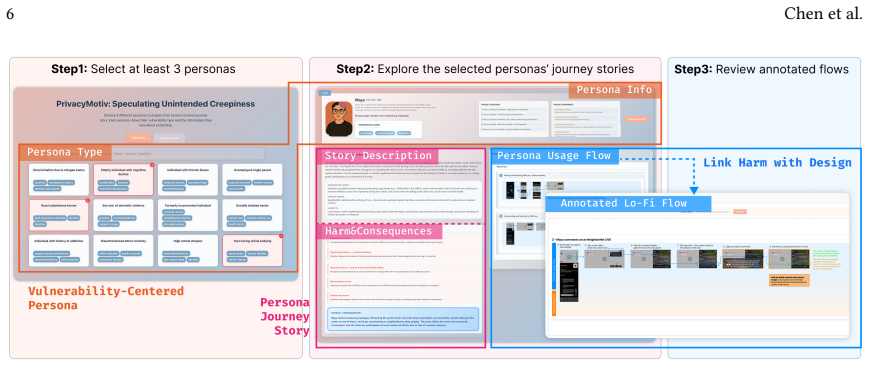
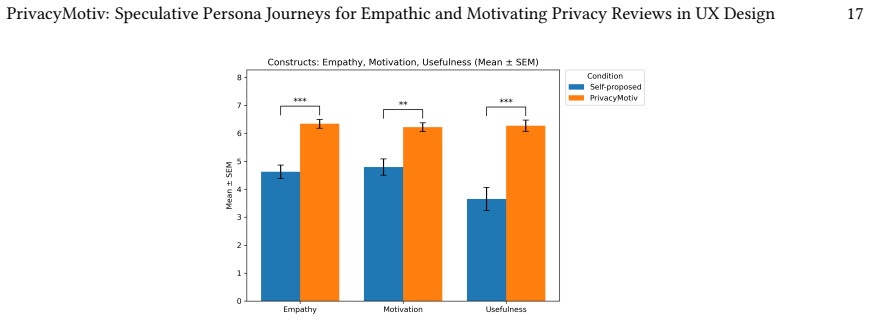
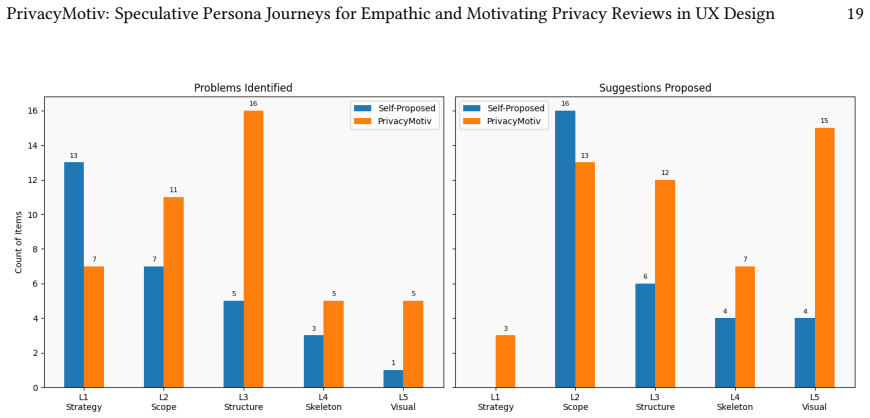
PrivacyMotiv is an LLM-powered system that generates vulnerability-centered personas, persona journey stories, and traceable design diagnoses grounded in lo-fi user flows to support privacy-oriented UX design review. In a within-subjects study with professional UX practitioners (N=16), PrivacyMotiv significantly improved empathy, intrinsic motivation, and perceived usefulness, with participants identifying 59% more privacy issues and proposing 70% more redesign solutions compared to self-proposed methods. This work contributes empirical insight into motivational barriers in privacy-aware UX and a structured, narrative-driven approach for integrating privacy review into early-stage UX.
What carries the argument
PrivacyMotiv, an LLM-powered generator of vulnerability-centered personas and persona journey stories grounded in lo-fi user flows, which supplies narrative structure to build empathy and motivation for privacy reviews.
Load-bearing premise
The measured gains in issue detection and motivation come specifically from the generated personas and journeys rather than from any structured review process or the general use of an AI tool.
What would settle it
A follow-up within-subjects study that replaces the persona journeys with generic structured prompts and checks whether the 59 percent and 70 percent gains in issues and solutions disappear.
Figures





read the original abstract
UX professionals routinely conduct design reviews, yet privacy concerns are often overlooked, not only due to limited tools, but more fundamentally from low intrinsic motivation, driven by limited privacy knowledge, weak empathy for unexpectedly affected users, and low autonomy in identifying harms. We present PrivacyMotiv, an LLM-powered system that generates vulnerability-centered personas, persona journey stories, and traceable design diagnoses grounded in lo-fi user flows to support privacy-oriented UX design review. In a within-subjects study with professional UX practitioners (N=16), PrivacyMotiv significantly improved empathy, intrinsic motivation, and perceived usefulness, with participants identifying 59% more privacy issues and proposing 70% more redesign solutions compared to self-proposed methods. This work contributes empirical insight into motivational barriers in privacy-aware UX and a structured, narrative-driven approach for integrating privacy review into early-stage UX practice.
Editorial analysis
A structured set of objections, weighed in public.
Referee Report
Summary. The paper introduces PrivacyMotiv, an LLM-powered tool that generates vulnerability-centered personas, persona journey stories, and traceable design diagnoses from lo-fi user flows to help UX practitioners conduct privacy-oriented design reviews. It reports results from a within-subjects study (N=16 professional UX practitioners) claiming statistically significant gains in empathy, intrinsic motivation, and perceived usefulness, plus 59% more privacy issues identified and 70% more redesign solutions proposed relative to participants' self-proposed methods.
Significance. If the empirical claims hold after addressing controls, the work would offer a concrete, narrative-driven method for lowering motivational barriers to privacy review in early UX practice. The contribution lies in the empirical demonstration with practitioners and the structured use of speculative personas rather than generic checklists; reproducible study materials or code would strengthen this.
major comments (1)
- [§5] §5 (User Study / Evaluation): The within-subjects protocol pits PrivacyMotiv against an unstructured 'self-proposed methods' baseline. This design does not isolate the effect of the LLM-generated vulnerability-centered personas and traceable journeys from the general presence of any structured scaffold or the novelty of an interactive AI interface. Consequently, the reported 59% and 70% lifts cannot be unambiguously attributed to the specific mechanism claimed in the abstract and strongest_claim; a matched control arm (e.g., static privacy checklist or non-narrative prompt) is required to support the causal interpretation.
minor comments (2)
- [Abstract] Abstract and §5: The claims of 'significantly improved' outcomes and the exact percentage lifts are presented without mention of statistical tests, effect sizes, order-effect controls, or inter-rater reliability for issue coding; these details must be added to allow readers to assess the quantitative results.
- [§4] §4 (System Description): The precise prompting strategy and grounding mechanism for generating 'traceable design diagnoses' from lo-fi flows should be illustrated with a concrete example to clarify how the output remains faithful to the input artifacts.
Simulated Author's Rebuttal
We thank the referee for the constructive feedback and the recommendation for major revision. We address the single major comment on the user study design below, acknowledging its validity while explaining our rationale and planned revisions.
read point-by-point responses
-
Referee: [§5] §5 (User Study / Evaluation): The within-subjects protocol pits PrivacyMotiv against an unstructured 'self-proposed methods' baseline. This design does not isolate the effect of the LLM-generated vulnerability-centered personas and traceable journeys from the general presence of any structured scaffold or the novelty of an interactive AI interface. Consequently, the reported 59% and 70% lifts cannot be unambiguously attributed to the specific mechanism claimed in the abstract and strongest_claim; a matched control arm (e.g., static privacy checklist or non-narrative prompt) is required to support the causal interpretation.
Authors: We thank the referee for this observation. The within-subjects baseline of self-proposed methods was deliberately chosen to reflect authentic UX practice, where privacy reviews are typically performed without dedicated tools or external structure. This comparison demonstrates the practical gains PrivacyMotiv can deliver in real workflows. We agree, however, that the design does not isolate the contribution of the vulnerability-centered personas and traceable journeys from the effects of introducing any scaffold or an interactive AI interface. In the revised manuscript we will expand the Limitations section with an explicit discussion of this potential confound and will recommend future controlled experiments that add arms such as a static privacy checklist or a non-narrative prompt. We cannot conduct a new study for this revision but believe the added discussion will allow readers to interpret the reported improvements with appropriate caution. revision: partial
Circularity Check
No circularity: empirical user study with independent measures
full rationale
The paper introduces an LLM-powered system for generating vulnerability-centered personas and journey stories to support privacy reviews in UX design, then reports results from a within-subjects empirical study (N=16 UX practitioners) measuring empathy, intrinsic motivation, issue identification, and redesign proposals. No mathematical derivations, equations, predictions, or first-principles results exist that could reduce to inputs by construction. Outcome measures and study protocol are defined separately from any cited prior work. No self-citation chains, uniqueness theorems, or ansatz smuggling support the central claims; the work remains self-contained against the reported empirical benchmarks.
Axiom & Free-Parameter Ledger
axioms (1)
- domain assumption Large language models can generate useful, vulnerability-centered personas and journey stories from lo-fi user flows without introducing systematic biases that would invalidate designer empathy gains.
Lean theorems connected to this paper
-
IndisputableMonolith/Foundation/RealityFromDistinction.leanreality_from_one_distinction unclear?
unclearRelation between the paper passage and the cited Recognition theorem.
PrivacyMotiv, an LLM-powered system that generates vulnerability-centered personas, persona journey stories, and traceable design diagnoses grounded in lo-fi user flows
-
IndisputableMonolith/Cost/FunctionalEquation.leanwashburn_uniqueness_aczel unclear?
unclearRelation between the paper passage and the cited Recognition theorem.
within-subjects study with professional UX practitioners (N=16) ... 59% more privacy issues and 70% more redesign solutions
What do these tags mean?
- matches
- The paper's claim is directly supported by a theorem in the formal canon.
- supports
- The theorem supports part of the paper's argument, but the paper may add assumptions or extra steps.
- extends
- The paper goes beyond the formal theorem; the theorem is a base layer rather than the whole result.
- uses
- The paper appears to rely on the theorem as machinery.
- contradicts
- The paper's claim conflicts with a theorem or certificate in the canon.
- unclear
- Pith found a possible connection, but the passage is too broad, indirect, or ambiguous to say the theorem truly supports the claim.
discussion (0)
Sign in with ORCID, Apple, or X to comment. Anyone can read and Pith papers without signing in.