Probing Physical Conditions in Classical and Symbiotic Novae with the Square Kilometre Array Observatory
Pith reviewed 2026-06-25 20:31 UTC · model grok-4.3
The pith
The Square Kilometre Array Observatory will enable regular radio monitoring of Galactic novae to track evolving physical conditions in both ionised gas and relativistic particles.
A machine-rendered reading of the paper's core claim, the machinery that carries it, and where it could break.
Core claim
The SKAO, particularly its SKA-Mid component, will enable regular monitoring of Galactic novae, multiple times per year for classical novae and every few years for symbiotic systems, providing powerful probes of evolving physical conditions from both ionised and relativistic particle populations through multi-frequency, multi-epoch, and multi-scale interferometric observations.
What carries the argument
Multi-frequency, multi-epoch, and multi-scale interferometric radio observations with SKAO sensitivity and VLBI resolution, which separate thermal emission from ionised material and non-thermal emission from relativistic particles.
If this is right
- Multiple observations per year will map the time evolution of mass ejection and jet formation in classical novae.
- Less frequent sampling will still constrain conditions in symbiotic systems with red-giant companions.
- VLBI imaging will isolate compact shocked regions while sensitive imaging characterises quiescent binary emission.
- The data will span wide ranges of white-dwarf mass, accretion rate, and circumstellar environment.
Where Pith is reading between the lines
- Coordinated radio campaigns could be scheduled around known gamma-ray detections to link particle acceleration sites.
- Long-term quiescent monitoring may reveal accretion-rate variations that precede the next outburst cycle.
- The same cadence could test whether non-thermal emission persists or decays differently once the ejected shell becomes optically thin.
Load-bearing premise
Radio emission in classical and symbiotic novae arises from both thermal and non-thermal processes that can be separated and tracked with the planned SKAO sensitivity and cadence.
What would settle it
Repeated SKA observations of a sample of novae that fail to detect the predicted changes in flux or spectral index between ionised and relativistic components at the stated monitoring intervals.
Figures
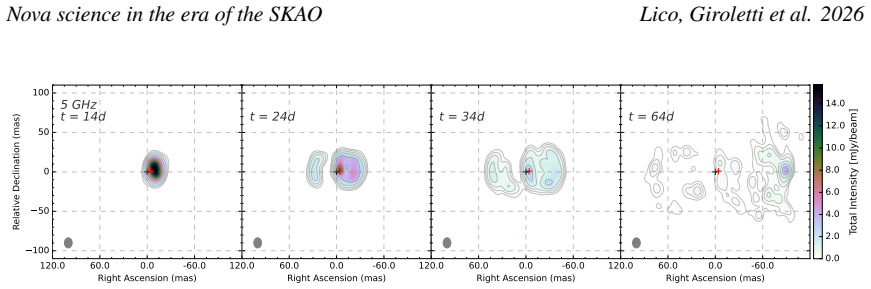
read the original abstract
Cataclysmic variables and symbiotic stars are interacting binary systems in which a hot white dwarf (WD) orbits a companion main-sequence or red giant star, respectively. Accumulation of hydrogen-rich material on the WD surface may trigger re-ignition of thermonuclear reactions that, under degenerate conditions, lead to an explosive ejection of the accreted layer mixed with WD material. These explosions, known as classical novae, provide opportunities to study key astrophysical processes such as binary evolution, accretion, ionisation of circumstellar material, mass ejection, jet formation, and thermonuclear burning. Radio emission in these systems arises from both thermal and non-thermal processes, which manifest differently in classical and symbiotic novae. $\gamma$-ray emission has also been detected in several cases, and recent progress, driven by coordinated radio and multiwavelength observations, has greatly advanced our understanding of both types of novae. Multi-frequency, multi-epoch, and multi-scale interferometric observations are powerful probes of the evolving physical conditions following thermonuclear explosions, revealing information from both ionised and relativistic particle populations. The SKAO, particularly its SKA-Mid component, will enable regular monitoring of Galactic novae, multiple times per year for classical novae and every few years for symbiotic systems. It will explore a wide range of conditions, including companion types, WD masses, accretion regimes, and surrounding environments. The VLBI capabilities of the SKAO will target compact shocked regions, while its exceptional sensitivity will also allow characterisation of emission during quiescent phases of the binaries.
Editorial analysis
A structured set of objections, weighed in public.
Referee Report
Summary. The manuscript presents a science case for using the Square Kilometre Array Observatory (SKAO), especially its SKA-Mid component and VLBI capabilities, to conduct regular multi-frequency, multi-epoch radio monitoring of Galactic classical and symbiotic novae. It argues that such observations will probe evolving physical conditions from thermal and non-thermal processes in ionised and relativistic particle populations, building on recent coordinated multiwavelength (including gamma-ray) observations of these systems.
Significance. If implemented, the proposed monitoring strategies could meaningfully advance studies of nova physics by providing systematic radio data across a range of companion types, WD masses, and environments. The paper does not deliver new empirical results, derivations, or falsifiable predictions but serves as a forward-looking overview that could help prioritize SKAO time allocation for novae.
Simulated Author's Rebuttal
We thank the referee for their positive assessment of the manuscript and the recommendation to accept. The summary accurately reflects the forward-looking science case for SKAO monitoring of classical and symbiotic novae.
Circularity Check
No significant circularity; purely descriptive science case
full rationale
The paper is a review and forward-looking proposal for SKAO monitoring of novae. It contains no equations, derivations, fitted parameters, or predictions that reduce to inputs by construction. Claims rest on established astrophysical descriptions of thermal/non-thermal emission and instrument capabilities, with no self-citation chains or ansatzes invoked as load-bearing steps. The central assertion (SKAO enabling regular monitoring) is a statement of future observational potential, not a derived result.
Axiom & Free-Parameter Ledger
Reference graph
Works this paper leans on
-
[1]
doi:10.1038/258501a0 , journal =
-
[2]
, keywords =. doi:10.1086/522201 , eprint =
-
[3]
doi:10.1088/0004-6256/140/1/34 , eprint =
, keywords =. doi:10.1088/0004-6256/140/1/34 , eprint =
-
[4]
doi:10.1126/science.1192537 , eprint =
Science , keywords =. doi:10.1126/science.1192537 , eprint =
-
[5]
doi:10.1088/1538-3873/128/963/051001 , eprint =
, keywords =. doi:10.1088/1538-3873/128/963/051001 , eprint =
-
[6]
The Galactic Nova Rate Revisited
doi:10.3847/1538-4357/834/2/196 , eid =. arXiv , author =:1606.02358 , journal =
work page internal anchor Pith review Pith/arXiv arXiv doi:10.3847/1538-4357/834/2/196
-
[7]
doi:10.1093/mnrasl/sly121 , eprint =
, keywords =. doi:10.1093/mnrasl/sly121 , eprint =
-
[8]
arXiv , author =:1910.12786 , journal =
doi:10.3847/2041-8213/ab5310 , eid =. arXiv , author =:1910.12786 , journal =
-
[9]
The Astronomer's Telegram , keywords =
-
[10]
arXiv , author =:2004.06540 , journal =
doi:10.1007/s00159-020-0124-6 , eid =. arXiv , author =:2004.06540 , journal =
-
[11]
doi:10.1016/j.asr.2019.10.022 , eprint =
Advances in Space Research , keywords =. doi:10.1016/j.asr.2019.10.022 , eprint =
-
[12]
arXiv , author =:1910.00575 , journal =
doi:10.3847/1538-4357/ab8d23 , eid =. arXiv , author =:1910.00575 , journal =
-
[13]
arXiv , author =:2101.12239 , journal =
doi:10.3847/1538-4357/abe53d , eid =. arXiv , author =:2101.12239 , journal =
-
[14]
arXiv , author =:2101.04045 , journal =
doi:10.3847/1538-4357/abeb75 , eid =. arXiv , author =:2101.04045 , journal =
-
[15]
arXiv , author =:2107.06251 , journal =
doi:10.3847/1538-4365/ac24ab , eid =. arXiv , author =:2107.06251 , journal =
-
[16]
, keywords =. doi:10.1146/annurev-astro-112420-114502 , eprint =
-
[17]
arXiv , author =:2207.05689 , journal =
doi:10.3847/1538-4357/ac87ad , eid =. arXiv , author =:2207.05689 , journal =
-
[18]
arXiv , author =:2206.14132 , journal =
doi:10.3847/1538-4357/ac8d5e , eid =. arXiv , author =:2206.14132 , journal =
-
[19]
arXiv , author =:2108.07868 , journal =
doi:10.3847/1538-4357/ac913b , eid =. arXiv , author =:2108.07868 , journal =
-
[20]
Nature Astronomy , keywords =. doi:10.1038/s41550-022-01640-z , eprint =
-
[21]
Science , keywords =. doi:10.1126/science.abn0567 , eprint =
-
[22]
doi:10.1093/mnras/stad887 , eprint =
, keywords =. doi:10.1093/mnras/stad887 , eprint =
-
[23]
, keywords =. doi:10.1093/mnras/stad1418 , eprint =
-
[24]
doi:10.1093/mnras/stad1625 , eprint =
, keywords =. doi:10.1093/mnras/stad1625 , eprint =
-
[25]
arXiv , author =:2303.17759 , journal =
doi:10.1017/pasa.2023.21 , eid =. arXiv , author =:2303.17759 , journal =
-
[26]
arXiv , author =:2407.16610 , journal =
doi:10.1051/0004-6361/202348726 , eid =. arXiv , author =:2407.16610 , journal =
-
[27]
doi:10.1051/0004-6361/202452447 , eid =. arXiv , author =:2503.13283 , journal =
-
[28]
doi:10.3847/1538-4357/adc0f6 , eid =. arXiv , author =:2503.14994 , journal =
-
[29]
doi:10.1093/mnras/stad3647 , eprint =
, keywords =. doi:10.1093/mnras/stad3647 , eprint =
-
[30]
Nature Astronomy , keywords =. doi:10.1038/s41550-020-1070-y , eprint =
-
[31]
Multi-wavelength spectroscopic study of shock-driven phenomena in explosive outbursts in symbiotic-like recurrent novae with an emphasis on RS Ophiuchi , volume =
Azzollini, Alessandra and Shore, Steven N and Kuin, Paul and Page, Kim L , journal =. Multi-wavelength spectroscopic study of shock-driven phenomena in explosive outbursts in symbiotic-like recurrent novae with an emphasis on RS Ophiuchi , volume =
-
[32]
arXiv , author =:1912.12699 , primaryclass =
Anticipated Performance of the Square Kilometre Array -- Phase 1 (SKA1) , url =. arXiv , author =:1912.12699 , primaryclass =
arXiv 1912
-
[33]
Fermi LAT gamma-ray detection of the recurrent nova RS ophiuchi during its 2021 outburst , volume =
Cheung, CC and Johnson, TJ and Jean, P and Kerr, M and Page, KL and Osborne, JP and Beardmore, AP and Sokolovsky, KV and Teyssier, F and Ciprini, S and others , journal =. Fermi LAT gamma-ray detection of the recurrent nova RS ophiuchi during its 2021 outburst , volume =
2021
-
[34]
2025, Galaxies, 13, 49, doi: 10.3390/galaxies13030049
Symbiotic Stars in the Era of Modern Ground- and Space-Based Surveys. Galaxies , keywords =. doi:10.3390/galaxies13030049 , archivePrefix =. 2504.16825 , primaryClass =
-
[35]
Recurrent novae as progenitors of Type Ia supernovae
Recurrent novae as progenitors of Type Ia supernovae. Bulletin of the Astronomical Society of India , keywords =. doi:10.48550/arXiv.1212.2295 , archivePrefix =. 1212.2295 , primaryClass =
work page internal anchor Pith review Pith/arXiv arXiv doi:10.48550/arxiv.1212.2295
-
[36]
Low-frequency radio observations of recurrent nova RS Ophiuchi with MeerKAT and LOFAR , volume =
de Ruiter, Iris and Nyamai, Miriam M and Rowlinson, Antonia and Wijers, Ralph AMJ and O'Brien, Tim J and Williams, David RA and Woudt, Patrick , journal =. Low-frequency radio observations of recurrent nova RS Ophiuchi with MeerKAT and LOFAR , volume =
-
[37]
Eyres, SPS and O'Brien, TJ and Beswick, R and Muxlow, TWB and Anupama, GC and Kantharia, NG and Bode, MF and Gawro. Double radio peak and non-thermal collimated ejecta in RS Ophiuchi following the 2006 outburst , volume =. doi:10.1111/j.1365-2966.2009.14633.x , journal =
-
[38]
arXiv , author =:2005.06473 , journal =
doi:10.1051/0004-6361/202038142 , eid =. arXiv , author =:2005.06473 , journal =
-
[39]
doi:10.1093/mnras/staf556 , eprint =
, keywords =. doi:10.1093/mnras/staf556 , eprint =
-
[40]
A nova outburst powered by shocks , volume =
Li, Kwan-Lok and Metzger, Brian D and Chomiuk, Laura and Vurm, Indrek and Strader, Jay and Finzell, Thomas and Beloborodov, Andrei M and Nelson, Thomas and Shappee, Benjamin J and Kochanek, Christopher S and others , journal =. A nova outburst powered by shocks , volume =
-
[41]
doi:10.1051/0004-6361/202451364 , eid =. arXiv , author =:2407.05794 , journal =
-
[42]
arXiv , author =:2103.04669 , journal =
doi:10.1051/0004-6361/202040050 , eid =. arXiv , author =:2103.04669 , journal =
-
[43]
doi:10.1051/0004-6361/202244821 , eid =. arXiv , author =:2209.12794 , journal =
-
[44]
Contributions of the Astronomical Observatory Skalnate Pleso , keywords =
Contributions of the Astronomical Observatory Skalnate Pleso , keywords =. doi:10.31577/caosp.2025.55.3.47 , eprint =
-
[45]
2025, A&A, 701, A176, doi: 10.1051/0004-6361/202555917 M´ erand, A., Astro-mh, & Gomes, T
doi:10.1051/0004-6361/202555917 , eid =. arXiv , author =:2507.23323 , journal =
-
[46]
doi:10.1038/nature04949 , eprint =
, keywords =. doi:10.1038/nature04949 , eprint =
-
[47]
arXiv , author =:1502.04927 , keywords =
Advancing Astrophysics with the Square Kilometre Array (AASKA14) , doi =. arXiv , author =:1502.04927 , keywords =
-
[48]
, keywords =. doi:10.1086/525555 , eprint =
-
[49]
A ``combination nova'' outburst in Z Andromedae: nuclear shell burning triggered by a disk instability , volume =
Sokoloski, Jennifer L and Kenyon, SJ and Espey, BR and Keyes, Charles D and McCandliss, SR and Kong, AKH and Aufdenberg, JP and Filippenko, AV and Li, W and Brocksopp, C and others , journal =. A ``combination nova'' outburst in Z Andromedae: nuclear shell burning triggered by a disk instability , volume =
-
[50]
Uncovering the nature of nova jets: a radio image of highly collimated outflows from RS Ophiuchi , volume =
Sokoloski, JL and Rupen, MP and Mioduszewski, AJ , doi =. Uncovering the nature of nova jets: a radio image of highly collimated outflows from RS Ophiuchi , volume =. , number =
-
[51]
doi:10.1093/mnras/staa2104 , eprint =
, keywords =. doi:10.1093/mnras/staa2104 , eprint =
-
[52]
Anderson and others , title =
Gemma E. Anderson and others , title =. 2026 , publisher =
2026
-
[53]
2026 , publisher =
Emmanuel Bempong-Manful and others , title =. 2026 , publisher =
2026
-
[54]
2026 , publisher =
Gianluca Castignani and others , title =. 2026 , publisher =
2026
discussion (0)
Sign in with ORCID, Apple, or X to comment. Anyone can read and Pith papers without signing in.