REVIEW 4 major objections 4 minor 26 references
Predicting Pulmonary Hypertension in Newborns: A Multi-view VAE Approach
T0 review · 4 major / 4 minor · reviewed 2026-08-06 · deepseek-v4-flash
Pith's one-line read A multi-view variational autoencoder with a data-dependent mixture-of-experts prior improves pulmonary hypertension severity classification in newborns and transfers to a held-out cohort more consistently than a supervised baseline.
desk verdict The generalization claim doesn't hold up in the paper's own held-out Table 3; still a legitimate application paper worth refereeing if claims are narrowed. read the letter →
The pith
A machine-rendered reading of the paper's core claim, the machinery that carries it, and where it could break.
The reading
What carries the argument
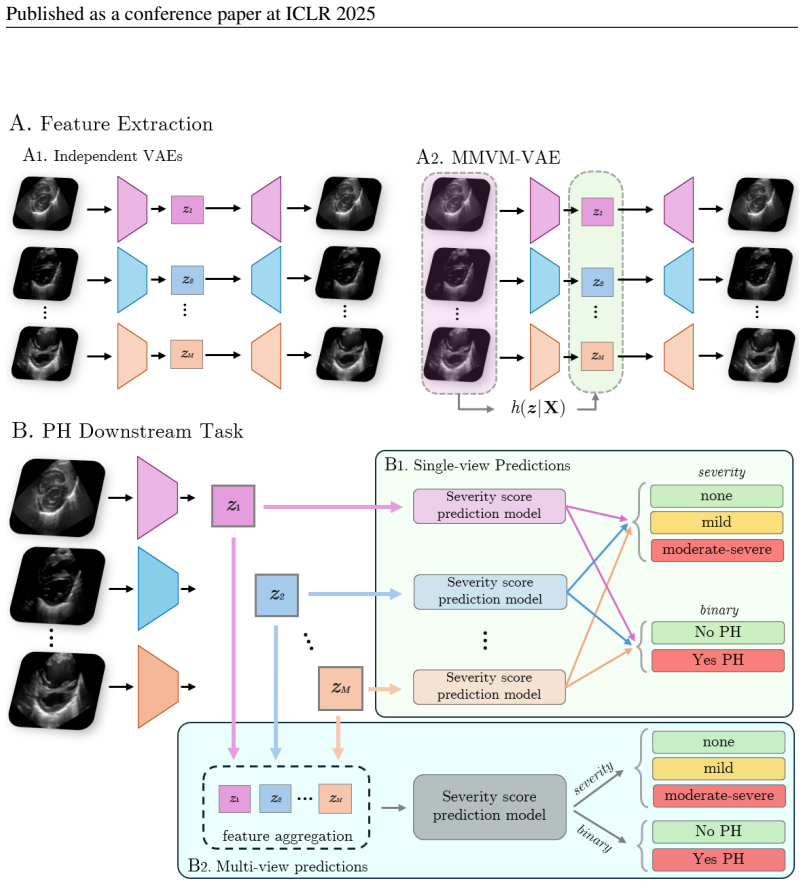
The central object is the MMVM-VAE, a multi-view variational autoencoder with a variational mixture-of-experts prior. The prior is defined as $h(z \mid X) = \prod_{m=1}^{M} h(z_m \mid X)$ with $h(z_m \mid X) = \frac{1}{M} \sum_{\tilde{m}=1}^{M} q_\phi(z_m \mid x_{\tilde{m}})$, so each view's latent density is a mixture of all views' encodings. This soft-sharing aligns view-specific representations, captures both shared and view-specific features, and is what carries the generalization improvement on the held-out cohort.
What would settle it
Remove the PSAX-P view from the multi-view input set and retrain the MMVM-VAE pipeline; if the severity balanced accuracy falls to the independent-VAE level on the held-out test set, the reported multi-view gain is explained by the model reading the label-defining view rather than by cross-view sharing.
Extended reading notes
Core claim
The central discovery is that forcing views to share a latent code through a variational mixture-of-experts prior improves the transferability of the learned features. In MMVM-VAE, the prior for each view is a mixture of the posterior encodings of all views, so the latent representation of any one view is influenced by the others. Pretraining this model on echocardiographic videos, including unlabeled clips, and then training a small classifier on the latents yields more robust detection and grading of PH on a held-out test cohort than training a supervised video classifier end-to-end. The paper reports stable results especially for the three-class severity task, where MMVM-VAE achieves higher balanced accuracy and a strong AUROC relative to alternatives (Table 1).
Load-bearing premise
The ground-truth PH severity labels come from one senior cardiologist's visual grading of septal flattening or bowing in the PSAX-P echo view, and the model also receives that view as an input, so the whole claim assumes that this visual surrogate is a valid severity measure and that using the label-defining view does not inflate apparent performance.
Editorial extensions
If this is right
- PH severity can be graded automatically with higher balanced accuracy than an end-to-end supervised video classifier, so the screening step may require less of a cardiologist's time.
- Because the VAE is pretrained on both labeled and unlabeled videos, routinely collected echocardiograms without labels can contribute to the model, easing the burden of building large annotated datasets.
- The learned representation transfers more consistently to a held-out test cohort than the supervised baseline, suggesting the approach is better suited to deployment on data collected later or under slightly different conditions.
- Multi-view inputs outperform single-view inputs across methods, confirming that the five standard echocardiographic views carry complementary information useful for PH assessment.
Reading between the lines
- If the label-defining PSAX-P view is also a model input, a reader should suspect that at least part of the severity signal comes from that view; replacing or masking PSAX-P in an ablation would clarify whether the shared prior adds independent information.
- The method assumes the standard views are acquired close enough in time to be meaningfully shared, but the videos are not synchronized, so cross-view sharing could underestimate the benefit of truly aligned multi-view data.
- Should multi-center data become available, the same pretraining strategy can be tested on demographic shifts; a failure there would limit the generalization claim to within-center shifts.
- The two-stage representation-learning pipeline may transfer to other neonatal echocardiographic tasks, such as predicting therapy response or adverse outcomes, which the paper names as future work.
Editorial analysis
A structured set of objections, weighed in public.
Referee Report
Summary. The paper proposes a two-stage pipeline for predicting pulmonary hypertension (PH) in newborns from echocardiographic videos. In the first stage, a multi-view variational autoencoder (MMVM-VAE) with a mixture-of-experts prior is trained to reconstruct clips from five standard views; in the second stage, the learned latent representations are used to train a lightweight classifier for binary PH detection and three-class severity grading. The authors compare this approach against a supervised baseline (Ragnarsdottir et al., 2024) and against independently trained per-view VAEs with feature aggregation, reporting results on an in-house dataset that includes a held-out test cohort. The central claim is that the multi-view VAE representation improves generalization and severity classification accuracy relative to supervised learning.
Significance. The clinical problem is important and the dataset (936 videos from 192 newborns for training/validation, 375 videos from 78 newborns for held-out testing) is relatively large for neonatal echocardiography. The two-stage self-supervised approach is a plausible way to exploit unlabeled data, and the inclusion of a held-out test cohort is a genuine strength. The architecture is described clearly and the paper evaluates several baselines and multiple metrics. However, the evidence as reported does not support the headline claims: the held-out test table (Table 3) shows the proposed model tied with or worse than the baselines on key metrics, and the severity label is derived from an input view (PSAX-P), raising a circularity concern that is not addressed. These issues are load-bearing for the paper's central empirical claim.
major comments (4)
- [§4.5, Table 3] The central claim that MMVM-VAE improves PH severity classification and generalization is not supported by the held-out test set. On severity prediction, MMVM-VAE achieves balanced accuracy 0.46±0.06, identical to Ind-VAE-FA (0.46±0.04) and only slightly above the supervised baseline (0.42±0.03), while its AUROC (0.64±0.04) is below both Ind-VAE-FA (0.65±0.02) and supervised (0.72±0.05). On binary detection, the supervised baseline is strictly better (AUROC 0.86 vs 0.78; balanced accuracy 0.77 vs 0.75). No significance tests are reported, so the small differences shown in Table 1 may reflect seed noise. The conclusion in §5 that the framework achieved 'more robust detection and grading' and 'less decreasing in performance' is therefore overstated.
- [§4.1, §4.5] The PH severity label is defined entirely from the PSAX-P view: 'PH grading was determined based on the PSAX-P view' with severity criteria based on septal flattening or bowing. Since PSAX-P is also one of the model inputs, a model can 'predict' the label by mimicking the cardiologist's qualitative reading of that same view. The paper does not discuss this circularity, and it does not validate the echocardiographic surrogate against right heart catheterization hemodynamics or an independent grading basis. As a result, the reported severity results cannot be interpreted as evidence that the model learns clinically meaningful PH severity beyond reproducing the PSAX-P-derived annotation.
- [§4.4, Tables 2–3] The evaluation unit appears to be individual videos, but the data contain multiple videos per newborn (roughly 5 videos per patient in both cohorts). No patient-level clustering or aggregation is reported, and the 5-fold cross-validation described in Table 2 does not state whether splits are patient-disjoint. Metrics computed on videos from the same patient are not independent, so the reported standard deviations (across three seeds) underestimate variability and significance testing is missing. Please report patient-level metrics (e.g., per-patient majority voting) and patient-disjoint cross-validation details.
- [§4.5, Tables 1–3] The relationship between Tables 1, 2, and 3 is unclear and appears internally inconsistent. Table 1 reports MMVM-VAE multi-view severity balanced accuracy of 0.56±0.04 and AUROC 0.74±0.01, whereas Table 3 (held-out test) reports 0.46±0.06 and 0.64±0.04, and Table 2 (validation) reports 0.56±0.17 and 0.69±0.10. Similarly, the multi-view supervised numbers in Table 1 (0.86/0.80/0.77 for binary) match Table 3 but not Table 2. The text says the validation-to-test drop 'can't directly be observed in Table 1', yet Table 1 appears to duplicate Table 3 for some rows. Please specify which data split Table 1 reports and how it relates to Tables 2 and 3.
minor comments (4)
- [Table 1 caption] The caption contains a typo: 'Ind-VAE-FA and and MMVM-VAE' should read 'Ind-VAE-FA and MMVM-VAE'.
- [§4.3] Several key hyperparameters are not reported, including latent dimension, optimizer, learning rate, batch size, number of training epochs, and the augmentation schedule used during VAE pretraining. These details are needed for reproducibility.
- [Table 2] Some table entries appear to be malformed or misprinted, e.g., '0.68 ±0.5' for PSAX-P MMVM-VAE balanced accuracy and several '±0.5' values that are inconsistent with the ranges elsewhere. Please proofread all tables carefully.
- [§2] The terms 'multi-view' and 'multi-modal' are used interchangeably (e.g., 'multi-view learning conceptually align with multi-modal learning'); the distinction and the intended mapping should be clarified.
Circularity Check
No circularity: the PH prediction claim is an empirical benchmark, not a derivation reducible to its inputs.
full rationale
The paper's central claim is empirical: MMVM-VAE pretraining improves classification accuracy and generalization for newborn PH prediction. This is established by held-out test comparisons in Tables 1 and 3 against a supervised baseline and independent VAEs, not by an equation-level derivation. The MMVM-VAE objective is cited from Sutter et al. (2024), which shares authors, and the dataset and supervised baseline come from Ragnarsdottir et al. (2024), also with overlapping authorship; however, these self-citations supply the model definition and the comparison setup, not the evidence for the performance claim. The performance claim is tested against external held-out data with multiple seeds, so it is not statistically forced by construction. One validity concern is that the PH severity label is defined by a senior cardiologist's visual grading of the PSAX-P view, and PSAX-P is also a model input; this could inflate apparent performance if the model simply mimics the grading view. But this is a label-validity and possible information-leakage issue, not circularity in the derivation sense: the model does not compute the label from the view by a fixed formula, and it could fail on this task. No fitted parameter is renamed as a prediction, no uniqueness theorem is imported to forbid alternatives, and no ansatz is smuggled in as external fact. The paper is therefore self-contained as an empirical comparison, and the central claim does not reduce to its own inputs.
Assumptions & free parameters
free parameters (1)
- Unreported VAE hyperparameters (latent dimension, optimizer, learning rate, epochs, augmentation schedule)
assumptions (3)
- standard math ELBO-based VAE training and the MMVM-VAE mixture-of-experts prior from Sutter et al. 2024 are valid for this domain.
- domain assumption Expert visual grading of septal flattening on the PSAX-P view is a valid ground truth for PH severity.
- domain assumption Videos from the same newborn are treated as independent samples in the evaluation.
Cite this review
Pith. "Pith review of Predicting Pulmonary Hypertension in Newborns: A Multi-view VAE Approach." pith.science (2026). https://pith.science/paper/YAMINKIQ
@misc{pith2026250711561,
  author       = {Pith},
  title        = {Pith review of: Predicting Pulmonary Hypertension in Newborns: A Multi-view VAE Approach},
  year         = {2026},
  howpublished = {\url{https://pith.science/paper/YAMINKIQ}},
  note         = {Machine review of arXiv:2507.11561}
}
read the original abstract
Pulmonary hypertension (PH) in newborns is a critical condition characterized by elevated pressure in the pulmonary arteries, leading to right ventricular strain and heart failure. While right heart catheterization (RHC) is the diagnostic gold standard, echocardiography is preferred due to its non-invasive nature, safety, and accessibility. However, its accuracy highly depends on the operator, making PH assessment subjective. While automated detection methods have been explored, most models focus on adults and rely on single-view echocardiographic frames, limiting their performance in diagnosing PH in newborns. While multi-view echocardiography has shown promise in improving PH assessment, existing models struggle with generalizability. In this work, we employ a multi-view variational autoencoder (VAE) for PH prediction using echocardiographic videos. By leveraging the VAE framework, our model captures complex latent representations, improving feature extraction and robustness. We compare its performance against single-view and supervised learning approaches. Our results show improved generalization and classification accuracy, highlighting the effectiveness of multi-view learning for robust PH assessment in newborns.
Figures

Reference graph
Works this paper leans on
-
[1]
write newline
" write newline "" before.all 'output.state := FUNCTION n.dashify 't := "" t empty not t #1 #1 substring "-" = t #1 #2 substring "--" = not "--" * t #2 global.max substring 't := t #1 #1 substring "-" = "-" * t #2 global.max substring 't := while if t #1 #1 substring * t #2 global.max substring 't := if while FUNCTION format.date year duplicate empty "emp...
-
[2]
Daniel X. Augustine, Lindsay D. Coates-Bradshaw, James Willis, Allan Harkness, Liam Ring, Julia Grapsa, Gerry Coghlan, Nikki Kaye, David Oxborough, Shaun Robinson, Julie Sandoval, Bushra S. Rana, Anjana Siva, Petros Nihoyannopoulos, Luke S. Howard, Kevin Fox, Sanjeev Bhattacharyya, Vishal Sharma, Richard P. Steeds, and Thomas Mathew. Echocardiographic ass...
work page 2018
-
[3]
Ghalib A. Bello, Timothy J. W. Dawes, Jinming Duan, Carlo Biffi, Antonio de Marvao, Luke S. G. E. Howard, J. Simon R. Gibbs, Martin R. Wilkins, Stuart A. Cook, Daniel Rueckert, and Declan P. O'Regan. Deep-learning cardiac motion analysis for human survival prediction. Nature Machine Intelligence, 1 0 (2): 0 95--104, February 2019
work page 2019
-
[4]
A systematic study of the class imbalance problem in convolutional neural networks
Mateusz Buda, Atsuto Maki, and Maciej A Mazurowski. A systematic study of the class imbalance problem in convolutional neural networks. Neural networks, 106: 0 249--259, 2018
work page 2018
-
[5]
Timothy J. W. Dawes, Antonio de Marvao, Wenzhe Shi, Tristan Fletcher, Geoffrey M. J. Watson, John Wharton, Christopher J. Rhodes, Luke S. G. E. Howard, J. Simon R. Gibbs, Daniel Rueckert, Stuart A. Cook, Martin R. Wilkins, and Declan P. O'Regan. Machine learning of three-dimensional right ventricular motion enables outcome prediction in pulmonary hyperten...
work page 2017
-
[6]
Neonatal echocardiography teaching manual, 01 2014
Afif EL-Khuffash. Neonatal echocardiography teaching manual, 01 2014
work page 2014
-
[7]
Pulmonary hypertension in infants, children, and young adults
Georg Hansmann. Pulmonary hypertension in infants, children, and young adults. Journal of the American College of Cardiology, 69 0 (20): 0 2551–2569, May 2017. ISSN 0735-1097
work page 2017
-
[8]
u nig, Paul M Hassoun, Merel Hellemons, Tiny Jaarsma, Barbro Kjellstr\
Marc Humbert, Gabor Kovacs, Marius M Hoeper, Roberto Badagliacca, Rolf M F Berger, Margarita Brida, Jørn Carlsen, Andrew J S Coats, Pilar Escribano-Subias, Pisana Ferrari, Diogenes S Ferreira, Hossein Ardeschir Ghofrani, George Giannakoulas, David G Kiely, Eckhard Mayer, Gergely Meszaros, Blin Nagavci, Karen M Olsson, Joanna Pepke-Zaba, Jennifer K Quint, ...
work page 2022
Show all 26 references
-
[9]
Zemp, and Ian Adatia
Tarek Kaddoura, Karunakar Vadlamudi, Shine Kumar, Prashant Bobhate, Long Guo, Shreepal Jain, Mohamed Elgendi, James Y Coe, Daniel Kim, Dylan Taylor, Wayne Tymchak, Dale Schuurmans, Roger J. Zemp, and Ian Adatia. Acoustic diagnosis of pulmonary hypertension: automated speech- r...
2016
-
[10]
Auto- Encoding Variational Bayes
Diederik P Kingma and Max Welling. Auto- Encoding Variational Bayes . In International Conference on Learning Representations , 2014
2014
-
[11]
Deep learning to predict elevated pulmonary artery pressure in patients with suspected pulmonary hypertension using standard chest X -ray
Kenya Kusunose, Yukina Hirata, Takumasa Tsuji, Jun'ichi Kotoku, and Masataka Sata. Deep learning to predict elevated pulmonary artery pressure in patients with suspected pulmonary hypertension using standard chest X -ray. Scientific Reports, 10 0 (1), November 2020
2020
-
[12]
Artificial intelligence for early prediction of pulmonary hypertension using electrocardiography
Joon-Myoung Kwon, Kyung-Hee Kim, Jose Medina-Inojosa, Ki-Hyun Jeon, Jinsik Park, and Byung-Hee Oh. Artificial intelligence for early prediction of pulmonary hypertension using electrocardiography. The Journal of Heart and Lung Transplantation, 39 0 (8): 0 805--814, August 2020
2020
-
[13]
Diagnosing atrial septal defect from electrocardiogram with deep learning
Hiroki Mori, Kei Inai, Hisashi Sugiyama, and Yoshihiro Muragaki. Diagnosing atrial septal defect from electrocardiogram with deep learning. Pediatric Cardiology, 42 0 (6): 0 1379--1387, April 2021
2021
-
[14]
Hanna Ragnarsdottir, Ece Ozkan, Holger Michel, Kieran Chin-Cheong, Laura Manduchi, Sven Wellmann, and Julia E. Vogt. Deep learning based prediction of pulmonary hypertension in newborns using echocardiograms. International Journal of Computer Vision, 132 0 (7): 0 2567–2584, Fe...
2024
-
[15]
Stephan Rosenkranz and Ioana R. Preston. Right heart catheterisation: best practice and pitfalls in pulmonary hypertension. European Respiratory Review, 24 0 (138): 0 642--652, November 2015
2015
-
[16]
Lang, Gerald Maurer, Thomas Binder, and Georg Goliasch
Matthias Schneider, Anna Maria Pistritto, Christian Gerges, Mario Gerges, Christina Binder, Irene M. Lang, Gerald Maurer, Thomas Binder, and Georg Goliasch. Multi-view approach for the diagnosis of pulmonary hypertension using transthoracic echocardiography. The International ...
2017
-
[17]
Siddharth, Brooks Paige, and Philip Torr
Yuge Shi, N. Siddharth, Brooks Paige, and Philip Torr. Variational Mixture -of- Experts Autoencoders for Multi - Modal Deep Generative Models . In Advances in Neural Information Processing Systems , pp.\ 15692--15703, 2019
2019
-
[18]
Steinhorn
Robin H. Steinhorn. Neonatal pulmonary hypertension. Pediatric Critical Care Medicine, 11: 0 S79–S84, March 2010. ISSN 1529-7535
2010
-
[19]
Sutter, Imant Daunhawer, and Julia E
Thomas M. Sutter, Imant Daunhawer, and Julia E. Vogt. Generalized Multimodal ELBO . International Conference on Learning Representations, 2021. URL https://openreview.net/forum?id=5Y21V0RDBV
2021
-
[21]
Performance of a 3d convolutional neural network in the detection of hypoperfusion at CT pulmonary angiography in patients with chronic pulmonary embolism: a feasibility study
Tuomas Vainio, Teemu M\" a kel\" a , Sauli Savolainen, and Marko Kangasniemi. Performance of a 3d convolutional neural network in the detection of hypoperfusion at CT pulmonary angiography in patients with chronic pulmonary embolism: a feasibility study. European Radiology Exp...
2021
-
[22]
Multimodal Generative Models for Scalable Weakly - Supervised Learning
Mike Wu and Noah Goodman. Multimodal Generative Models for Scalable Weakly - Supervised Learning . In Advances in Neural Information Processing Systems 31: Annual Conference on Neural Information Processing Systems 2018, NeurIPS 2018, 3-8 December 2018, Montreal , Canada , pp....
2018 arXiv
-
[23]
Tison, Laura A
Jeffrey Zhang, Sravani Gajjala, Pulkit Agrawal, Geoffrey H. Tison, Laura A. Hallock, Lauren Beussink-Nelson, Mats H. Lassen, Eugene Fan, Mandar A. Aras, ChaRandle Jordan, Kirsten E. Fleischmann, Michelle Melisko, Atif Qasim, Sanjiv J. Shah, Ruzena Bajcsy, and Rahul C. Deo. Ful...
2018
-
[24]
A promising approach for screening pulmonary hypertension based on frontal chest radiographs using deep learning: A retrospective study
Xiao-Ling Zou, Yong Ren, Ding-Yun Feng, Xu-Qi He, Yue-Fei Guo, Hai-Ling Yang, Xian Li, Jia Fang, Quan Li, Jun-Jie Ye, Lan-Qing Han, and Tian-Tuo Zhang. A promising approach for screening pulmonary hypertension based on frontal chest radiographs using deep learning: A retrospec...
2020
-
[25]
@esa (Ref
\@ifxundefined[1] #1\@undefined \@firstoftwo \@secondoftwo \@ifnum[1] #1 \@firstoftwo \@secondoftwo \@ifx[1] #1 \@firstoftwo \@secondoftwo [2] @ #1 \@temptokena #2 #1 @ \@temptokena \@ifclassloaded agu2001 natbib The agu2001 class already includes natbib coding, so you should ...
-
[26]
\@lbibitem[] @bibitem@first@sw\@secondoftwo \@lbibitem[#1]#2 \@extra@b@citeb \@ifundefined br@#2\@extra@b@citeb \@namedef br@#2 \@nameuse br@#2\@extra@b@citeb \@ifundefined b@#2\@extra@b@citeb @num @parse #2 @tmp #1 NAT@b@open@#2 NAT@b@shut@#2 \@ifnum @merge>\@ne @bibitem@firs...
-
[27]
u nig, Ekkehard and Hassoun, Paul M and Hellemons, Merel and Jaarsma, Tiny and Kjellstr\
@open @close @open @close and [1] URL: #1 \@ifundefined chapter * \@mkboth \@ifxundefined @sectionbib * \@mkboth * \@mkboth\@gobbletwo \@ifclassloaded amsart * \@ifclassloaded amsbook * \@ifxundefined @heading @heading NAT@ctr thebibliography [1] @ \@biblabel @NAT@ctr \@bibset...
2014 arXiv
Reviewed August 6, 2026 · model on record in the stance chip above.
Discussion (0). Continue with ORCID to comment.