Chemical enrichment of the Perseus cluster core seen by XRISM/Resolve
Pith reviewed 2026-06-27 03:24 UTC · model grok-4.3
The pith
XRISM spectra rule out a strong central iron drop in the Perseus cluster and show uniform metal ratios.
A machine-rendered reading of the paper's core claim, the machinery that carries it, and where it could break.
Core claim
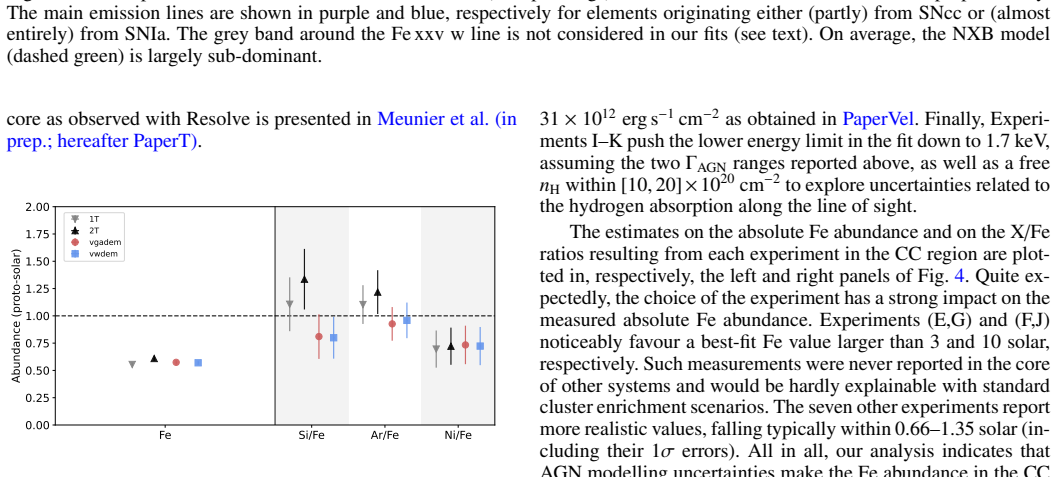
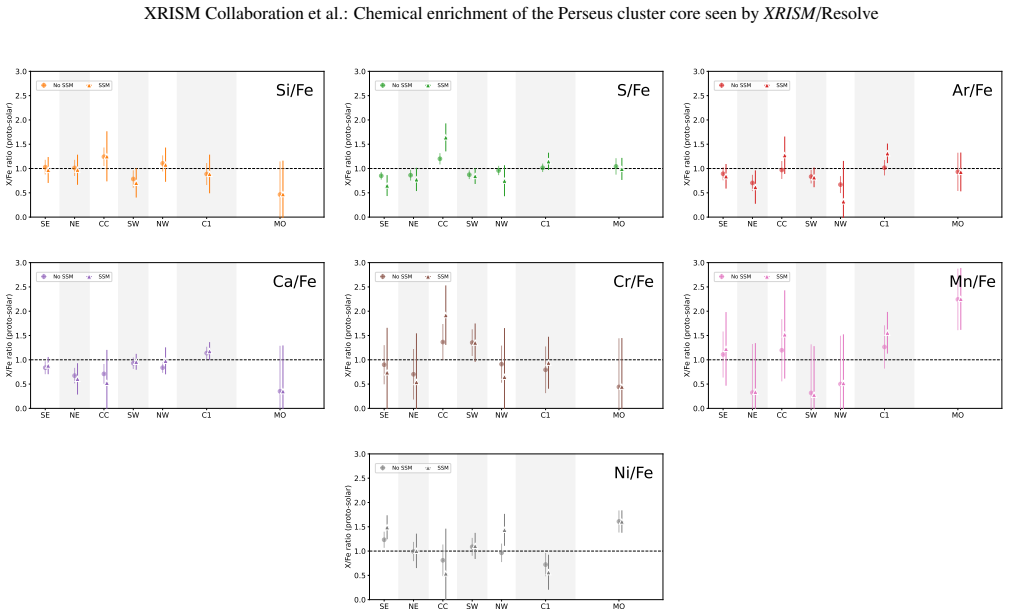
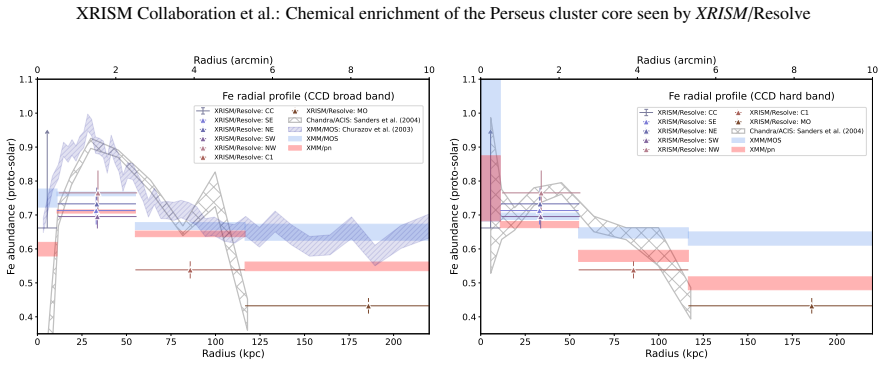
Baseline spectral analysis of four XRISM pointings out to 0.2 r_500 rules out a strong central Fe abundance drop at greater than 2 sigma , in contrast to prior CCD results. The X/Fe ratios exhibit remarkable spatial uniformity, consistent with negligible late SNIa enrichment from NGC 1275. The overall ICM composition is reproduced by standard SNcc and SNIa nucleosynthesis yields without requiring two distinct SNIa enrichment channels.
What carries the argument
The ~5 eV spectral resolution of the Resolve microcalorimeter, which permits separation of ICM line emission from the central AGN continuum for abundance ratio measurements.
If this is right
- The central Fe peak in relaxed clusters arises from processes that predate the current activity of the brightest cluster galaxy.
- Metal ratios measured in the core can be treated as representative of the entire cluster volume for enrichment studies.
- Standard single-channel SNIa yield sets are sufficient to explain observed ICM abundance patterns.
- Earlier reports of central abundance drops likely reflect instrumental resolution limits rather than true astrophysical features.
Where Pith is reading between the lines
- Repeating the same Resolve-style mapping in additional relaxed clusters would test whether uniform ratios are a general property.
- The observed uniformity implies efficient large-scale mixing of supernova products on timescales shorter than cluster assembly.
- Absolute abundance values remain harder to pin down than ratios while the AGN is bright; future instruments with better angular resolution could tighten those numbers.
Load-bearing premise
Spectral modeling can adequately separate the bright central AGN contribution from the ICM emission to permit reliable abundance measurements in the core.
What would settle it
A higher-signal observation or alternative AGN-subtraction model that recovers a statistically significant central Fe drop at less than 2 sigma exclusion would falsify the no-drop result.
Figures




read the original abstract
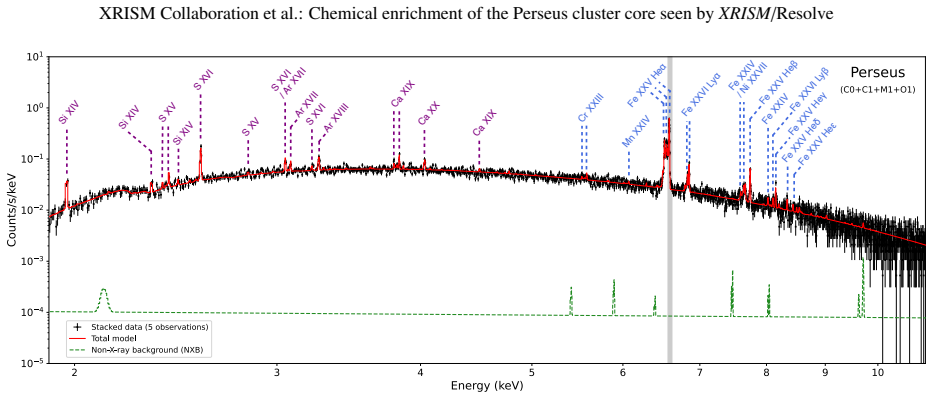
The intracluster medium (ICM) is rich in chemical elements, produced by core-collapse (SNcc) and Type Ia supernovae (SNIa) over the last $\sim$12 Gyr. Whereas cluster outskirts are uniformly enriched with Fe at $\sim$0.3 solar - strongly suggesting that the gas had been pre-enriched during or before the assembly of galaxies into clusters, the Fe abundance is known to centrally increase in the core of relaxed clusters. The origin of these central Fe peaks however, as well as the apparent presence of mysterious drops previously reported in the very centre of a number of systems, remain to be clarified. In this paper, we address these two questions by measuring the spatial distribution of Fe and its relative Si/Fe, S/Fe, Ar/Fe, Ca/Fe, Cr/Fe, Mn/Fe, and Ni/Fe ratios in the X-ray bright, nearby Perseus cluster. We take advantage of the unprecedented spectral resolution ($\sim$5 eV) offered by the Resolve microcalorimeter on board XRISM, which observed four distinct pointings of Perseus out to $\sim$250 kpc ($\sim$0.2$r_{500}$) during its Performance Verification phase. Although the presence of an X-ray bright AGN challenges a precise quantification of absolute abundances in the very core, our baseline analysis rules out a strong drop with $>$2$\sigma$ confidence, at variance with previous CCD measurements. In addition, we find a remarkable spatial uniformity of X/Fe ratios, supporting the idea of negligible late SNIa enrichment from the brightest cluster galaxy NGC 1275. We also compare the overall chemical composition of the Perseus ICM with SNcc and SNIa nucleosynthesis yield models, finding that the co-existence of two separate SNIa enrichment channels is not needed to reproduce the ICM ratios satisfactorily.
Editorial analysis
A structured set of objections, weighed in public.
Referee Report
Summary. The paper reports XRISM/Resolve microcalorimeter spectra from four pointings in the Perseus cluster out to ~0.2 r_500. It measures the Fe abundance profile and X/Fe ratios (Si, S, Ar, Ca, Cr, Mn, Ni), claims a >2σ exclusion of a strong central Fe drop (contrary to prior CCD results), reports spatial uniformity of the ratios, and shows that standard SNcc + SNIa yield models reproduce the observed composition without requiring two distinct SNIa channels.
Significance. If the central AGN-ICM decomposition holds, the result supplies high-resolution constraints on ICM enrichment, challenges earlier reports of central abundance drops, and simplifies the required supernova yield parameter space. The uniformity finding directly supports early pre-enrichment scenarios.
major comments (2)
- [Abstract / core pointing analysis] Abstract and core spectral analysis: the >2σ exclusion of a strong central Fe drop is load-bearing for the headline result, yet the text only states that the AGN 'challenges a precise quantification of absolute abundances' without showing how systematic uncertainties in the AGN power-law index, cutoff, or spatial extent are propagated into the Fe K equivalent-width measurement or the final abundance error budget.
- [Core spectral modeling] Core region spectral fitting: multi-temperature ICM components are potentially degenerate with the AGN continuum; the manuscript must demonstrate (via explicit model comparison or Monte Carlo runs) that any residual AGN line or reflection features do not systematically shift the recovered central Fe abundance enough to weaken the >2σ claim.
minor comments (3)
- [Abstract] The abstract states 'remarkable spatial uniformity' but does not quote the quantitative criterion (e.g., reduced χ² or maximum allowed gradient) used to reach that conclusion.
- [Figures / results section] Figure captions and text should explicitly list the energy band and line complexes used for each abundance ratio to allow direct comparison with prior CCD work.
- [SN yield comparison] The SN yield comparison section would benefit from a table of best-fit parameters and reduced χ² for the single-channel versus dual-channel SNIa models.
Simulated Author's Rebuttal
We thank the referee for their careful reading of the manuscript and for highlighting the need for a more explicit treatment of AGN-related systematics in the core analysis. We address each major comment below and will revise the manuscript to incorporate the requested demonstrations.
read point-by-point responses
-
Referee: [Abstract / core pointing analysis] Abstract and core spectral analysis: the >2σ exclusion of a strong central Fe drop is load-bearing for the headline result, yet the text only states that the AGN 'challenges a precise quantification of absolute abundances' without showing how systematic uncertainties in the AGN power-law index, cutoff, or spatial extent are propagated into the Fe K equivalent-width measurement or the final abundance error budget.
Authors: We agree that the manuscript would benefit from an explicit propagation of AGN parameter uncertainties into the Fe abundance. In the revised version we will add an appendix containing Monte Carlo runs in which the AGN power-law index, cutoff energy, and spatial extent are varied within their 1σ uncertainties (drawn from the joint fit). The resulting distribution of central Fe abundances will be shown, confirming that the >2σ exclusion of a strong drop remains robust and is folded into the final error budget. revision: yes
-
Referee: [Core spectral modeling] Core region spectral fitting: multi-temperature ICM components are potentially degenerate with the AGN continuum; the manuscript must demonstrate (via explicit model comparison or Monte Carlo runs) that any residual AGN line or reflection features do not systematically shift the recovered central Fe abundance enough to weaken the >2σ claim.
Authors: We acknowledge the potential degeneracy. The revised manuscript will include (i) explicit model-comparison statistics (ΔC-stat) between the baseline multi-temperature ICM + AGN model and variants that add a reflection component or allow residual AGN line features, and (ii) Monte Carlo simulations of the core spectrum in which AGN continuum parameters are randomized. These tests will quantify any systematic shift in the recovered central Fe abundance and demonstrate that it does not reduce the exclusion significance below 2σ. revision: yes
Circularity Check
No significant circularity: direct observational measurements compared to external models
full rationale
The paper reports spectral fitting results from XRISM/Resolve observations to derive Fe abundance profiles and X/Fe ratios in the Perseus cluster. Central claims (ruling out strong central Fe drop at >2σ, spatial uniformity of ratios, consistency with single SNIa channel) rest on these measurements and direct comparison to independent SNcc/SNIa nucleosynthesis yield models from the literature. No equations or steps reduce by construction to fitted parameters renamed as predictions, no self-definitional loops, and no load-bearing self-citations or ansatzes. The analysis is self-contained against external benchmarks with the noted modeling uncertainty being a standard systematic rather than circularity.
Axiom & Free-Parameter Ledger
free parameters (1)
- elemental abundances
axioms (2)
- domain assumption Intracluster medium plasma is in collisional ionization equilibrium
- domain assumption Nucleosynthesis yield models from literature accurately represent SNcc and SNIa contributions
Reference graph
Works this paper leans on
-
[1]
2017, MNRAS, 468, 531
Biffi, V ., Planelles, S., Borgani, S., et al. 2017, MNRAS, 468, 531
2017
-
[2]
M., Burbidge, G
Burbidge, E. M., Burbidge, G. R., Fowler, W. A., & Hoyle, F. 1957, Reviews of Modern Physics, 29, 547
1957
-
[3]
1999, A&A, 351, 459
Cappellaro, E., Evans, R., & Turatto, M. 1999, A&A, 351, 459
1999
-
[4]
2003, ApJ, 590, 225
Churazov, E., Forman, W., Jones, C., & Böhringer, H. 2003, ApJ, 590, 225
2003
-
[5]
1991, ApJ, 376, 380
Ciotti, L., D’Ercole, A., Pellegrini, S., & Renzini, A. 1991, ApJ, 376, 380
1991
-
[6]
Claeys, J. S. W., Pols, O. R., Izzard, R. G., Vink, J., & Verbunt, F. W. M. 2014, A&A, 563, A83
2014
-
[7]
J., & van Dokkum, P
Conroy, C., Graves, G. J., & van Dokkum, P. G. 2014, ApJ, 780, 33
2014
-
[8]
2018, A&A, 620, A173 De Grandi, S., Ettori, S., Longhetti, M., & Molendi, S
Cucchetti, E., Pointecouteau, E., Peille, P., et al. 2018, A&A, 620, A173 De Grandi, S., Ettori, S., Longhetti, M., & Molendi, S. 2004, A&A, 419, 7 de Plaa, J., Werner, N., Bleeker, J. A. M., et al. 2007, A&A, 465, 345
2018
-
[9]
& Fabian, A
Ettori, S. & Fabian, A. C. 2006, MNRAS, 369, L42
2006
-
[10]
2017, ApJ, 836, 110
Ezer, C., Bulbul, E., Nihal Ercan, E., et al. 2017, ApJ, 836, 110
2017
-
[11]
C., Sanders, J
Fabian, A. C., Sanders, J. S., Allen, S. W., et al. 2011, MNRAS, 418, 2154
2011
-
[12]
M., Mantz, A
Flores, A. M., Mantz, A. B., Allen, S. W., et al. 2021, MNRAS, 507, 5195
2021
-
[13]
2008, PASJ, 60, S343
Fujita, Y ., Tawa, N., Hayashida, K., et al. 2008, PASJ, 60, S343
2008
-
[14]
B., & Matsushita, K
Fukushima, K., Kobayashi, S. B., & Matsushita, K. 2022, MNRAS, 514, 4222
2022
-
[15]
2021, Universe, 7, 208
Gastaldello, F., Simionescu, A., Mernier, F., et al. 2021, Universe, 7, 208
2021
-
[16]
J., et al
Gendron-Marsolais, M., Hlavacek-Larrondo, J., van Weeren, R. J., et al. 2020, MNRAS, 499, 5791
2020
-
[17]
2014, A&A, 570, A117
Ghizzardi, S., De Grandi, S., & Molendi, S. 2014, A&A, 570, A117
2014
-
[18]
2021, A&A, 646, A92 Hitomi Collaboration, Aharonian, F., Akamatsu, H., et al
Ghizzardi, S., Molendi, S., van der Burg, R., et al. 2021, A&A, 646, A92 Hitomi Collaboration, Aharonian, F., Akamatsu, H., et al. 2016, Nature, 535, 117 Hitomi Collaboration, Aharonian, F., Akamatsu, H., et al. 2018a, PASJ, 70, 9 Hitomi Collaboration, Aharonian, F., Akamatsu, H., et al. 2018b, PASJ, 70, 11 Hitomi Collaboration, Aharonian, F., Akamatsu, H...
2021
-
[19]
Kaastra, J. S. 2017, A&A, 605, A51
2017
-
[20]
2024, MNRAS, 528, 1500
Kara, S., Plšek, T., Protušová, K., et al. 2024, MNRAS, 528, 1500
2024
-
[21]
2019, A&A, 623, A17
Lakhchaura, K., Mernier, F., & Werner, N. 2019, A&A, 623, A17
2019
-
[22]
M., Mushotzky, R., & Holt, S
Lea, S. M., Mushotzky, R., & Holt, S. S. 1982, ApJ, 262, 24
1982
-
[23]
2025, ApJ, 990, 207
Leung, S.-C., Nomoto, K., & Simionescu, A. 2025, ApJ, 990, 207
2025
-
[24]
A., Brown, G
Leutenegger, M. A., Brown, G. V ., Chiao, M. P., et al. 2025, Journal of Astro- nomical Telescopes, Instruments, and Systems, 11, 042024
2025
-
[25]
2018, MNRAS, 481, 361
Liu, A., Tozzi, P., Yu, H., De Grandi, S., & Ettori, S. 2018, MNRAS, 481, 361
2018
-
[26]
2019, MNRAS, 485, 1651
Liu, A., Zhai, M., & Tozzi, P. 2019, MNRAS, 485, 1651
2019
-
[27]
Lodders, K., Palme, H., & Gail, H. P. 2009, Landolt Börnstein, 4B, 712
2009
-
[28]
B., Allen, S
Mantz, A. B., Allen, S. W., Morris, R. G., et al. 2017, MNRAS, 472, 2877
2017
-
[29]
2026, arXiv e-prints, arXiv:2605.18989
Martin, J., Simionescu, A., Mernier, F., et al. 2026, arXiv e-prints, arXiv:2605.18989
Pith/arXiv arXiv 2026
-
[30]
2016, ApJ, 826, 124
McDonald, M., Bulbul, E., de Haan, T., et al. 2016, ApJ, 826, 124
2016
-
[31]
R., & Tremblay, G
McDonald, M., Gaspari, M., McNamara, B. R., & Tremblay, G. R. 2018, ApJ, 858, 45
2018
-
[32]
S., et al
Mernier, F., de Plaa, J., Kaastra, J. S., et al. 2017, A&A, 603, A80
2017
-
[33]
2026, A&A, 706, A86
Mernier, F., Fukushima, K., Simionescu, A., et al. 2026, A&A, 706, A86
2026
-
[34]
2022, MNRAS, 511, 3159
Mernier, F., Werner, N., Su, Y ., et al. 2022, MNRAS, 511, 3159
2022
-
[35]
T., Werner, N., Simionescu, A., & Allen, S
Million, E. T., Werner, N., Simionescu, A., & Allen, S. W. 2011, MNRAS, 418, 2744
2011
-
[36]
J., Culhane, J
Mitchell, R. J., Culhane, J. L., Davison, P. J. N., & Ives, J. C. 1976, MNRAS, 175, 29P
1976
-
[37]
A., et al
Mushotzky, R., Loewenstein, M., Arnaud, K. A., et al. 1996, ApJ, 466, 686
1996
-
[38]
2013, ARA&A, 51, 457
Nomoto, K., Kobayashi, C., & Tominaga, N. 2013, ARA&A, 51, 457
2013
-
[39]
K., Sanders, J
Panagoulia, E. K., Sanders, J. S., & Fabian, A. C. 2015, MNRAS, 447, 417 Planck Collaboration, Aghanim, N., Akrami, Y ., et al. 2020, A&A, 641, A6
2015
-
[40]
M., Mushotzky, R
Rani, B., Madejski, G. M., Mushotzky, R. F., Reynolds, C., & Hodgson, J. A. 2018, ApJ, 866, L13
2018
-
[41]
S., Smith, R
Reynolds, C. S., Smith, R. N., Fabian, A. C., et al. 2021, MNRAS, 507, 5613
2021
-
[42]
Sanders, J. S. & Fabian, A. C. 2006, MNRAS, 370, 63
2006
-
[43]
Sanders, J. S. & Fabian, A. C. 2007, MNRAS, 381, 1381
2007
-
[44]
S., Fabian, A
Sanders, J. S., Fabian, A. C., Allen, S. W., & Schmidt, R. W. 2004, MNRAS, 349, 952 Article number, page 14 XRISM Collaboration et al.: Chemical enrichment of the Perseus cluster core seen byXRISM/Resolve
2004
-
[45]
S., Fabian, A
Sanders, J. S., Fabian, A. C., Taylor, G. B., et al. 2016, MNRAS, 457, 82
2016
-
[46]
D., McNamara, B., et al
Sarkar, A., Miller, E. D., McNamara, B., et al. 2025, ApJ, 995, L26
2025
-
[47]
2022, MNRAS, 516, 3068
Sarkar, A., Su, Y ., Truong, N., et al. 2022, MNRAS, 516, 3068
2022
-
[48]
H., Lovisari, L., Nevalainen, J., & David, L
Schellenberger, G., Reiprich, T. H., Lovisari, L., Nevalainen, J., & David, L. 2015, A&A, 575, A30
2015
-
[49]
W., Fabian, A
Schmidt, R. W., Fabian, A. C., & Sanders, J. S. 2002, MNRAS, 337, 71
2002
-
[50]
J., Smith, B
Serlemitsos, P. J., Smith, B. W., Boldt, E. A., Holt, S. S., & Swank, J. H. 1977, ApJ, 211, L63
1977
-
[51]
2019, MNRAS, 483, 1701
Simionescu, A., Nakashima, S., Yamaguchi, H., et al. 2019, MNRAS, 483, 1701
2019
-
[52]
2009, A&A, 493, 409
Simionescu, A., Werner, N., Böhringer, H., et al. 2009, A&A, 493, 409
2009
-
[53]
2015, ApJ, 811, L25
Simionescu, A., Werner, N., Urban, O., et al. 2015, ApJ, 811, L25
2015
-
[54]
W., Simionescu, A., & Mantz, A
Urban, O., Werner, N., Allen, S. W., Simionescu, A., & Mantz, A. 2017, MN- RAS, 470, 4583
2017
-
[55]
A., Sanders, J
Walker, S. A., Sanders, J. S., & Fabian, A. C. 2018, MNRAS, 481, 1718
2018
-
[56]
S., et al
Werner, N., de Plaa, J., Kaastra, J. S., et al. 2006, A&A, 449, 475
2006
-
[57]
Werner, N., Durret, F., Ohashi, T., Schindler, S., & Wiersma, R. P. C. 2008, Space Sci. Rev., 134, 337
2008
-
[58]
Werner, N., Urban, O., Simionescu, A., & Allen, S. W. 2013, Nature, 502, 656
2013
-
[59]
Willingale, R., Starling, R. L. C., Beardmore, A. P., Tanvir, N. R., & O’Brien, P. T. 2013, MNRAS, 431, 394 XRISM Collaboration, Audard, M., Awaki, H., et al. 2026, Nature, 650, 309
2013
-
[60]
D., et al
Yaqoob, T., Angelini, L., Miller, E. D., et al. 2018, Journal of Astronomical
2018
discussion (0)
Sign in with ORCID, Apple, or X to comment. Anyone can read and Pith papers without signing in.