REVIEW 3 major objections 6 minor 1 cited by
The First JWST View of a 30-Myr-old Protoplanetary Disk Reveals a Late-stage Carbon-rich Phase
T0 review · 3 major / 6 minor · reviewed 2026-08-11 · deepseek-v4-flash
Pith's one-line read JWST spectroscopy shows a 34-million-year-old low-mass star still surrounded by a carbon-rich planet-forming gas disk.
desk verdict First JWST spectrum of a ~30 Myr disk is a real observational step forward; the carbon-rich conclusion is credible but the C/O>2 number is softer than the abstract implies. read the letter →
The pith
A machine-rendered reading of the paper's core claim, the machinery that carries it, and where it could break.
The reading
What carries the argument
The central object is the MIRI/MRS spectrum itself: continuum-subtracted mid-infrared data over 4.9–28.6 $\mu$m, fitted with LTE plane-parallel slab models that include optical-depth and line-overlap effects, producing column density, temperature, and emitting area for each molecule. Two derived ratios carry the chemical argument: the C$_2$H$_2$/CO$_2$ column-density ratio, converted to gas-phase $\mathrm{C/O}$ through thermo-chemical model grids, and the H$_2$ S(1)/S(3) line ratio, which yields the warm gas temperature. The time-evolution claim is carried by a 1D $\alpha$-disk model that tracks the inward drift and sublimation of icy pebbles and the accretion of outer carbon-rich gas, showing that a high inner $\mathrm{C/O}$ can be sustained for tens of Myr at $\alpha \lesssim 10^{-4}$.
What would settle it
A decisive check would be to resolve the H$_2$ and [Ne II] emission spatially or spectrally at higher angular and spectral resolution: if the lines are extended or systematically blueshifted, they trace a disk wind rather than a primordial disk. Independently, a lithium detection or a revised moving-group membership that puts J0446B at an age under $\sim$10 Myr would remove the '30-Myr-old disk' framing, and a direct measurement of the gas-phase $\mathrm{C/O}$ from another tracer (for example, ALMA observations of HCN or C$_2$H) that gives $\mathrm{C/O} < 1$ would undercut the carbon-rich claim.
Extended reading notes
Core claim
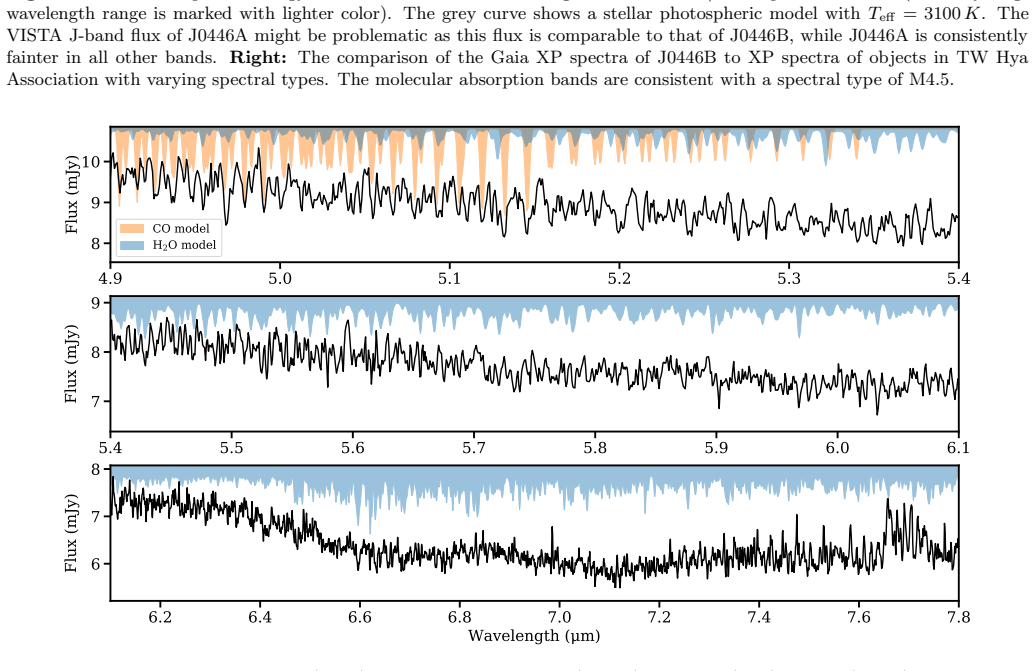
The paper's central claim is that J0446B is the first confirmed example of a primordial protoplanetary disk with gas surviving past $\sim$30 Myr, and that its inner disk has entered a late, hydrocarbon-dominated, carbon-rich phase. The evidence is a MIRI/MRS spectrum from 4.9 to 28.6 $\mu$m showing 14 molecular species, including nine hydrocarbons with a very optically thick C$_2$H$_2$ component, a marginal water detection, five pure-rotational H$_2$ lines, and spatially unresolved [Ne II] and [Ar II] lines. Slab-model column densities, mapped through thermo-chemical model grids, imply a gas-phase $\mathrm{C/O} \gtrsim 2$. The authors place J0446B at the oldest end of the JWST M-star disk sample, with hydrocarbon excitation conditions (T $\sim$ 250–300 K, emitting radii 0.05–0.1 AU) similar to younger carbon-rich disks, and use a 1D viscous disk model with pebble drift and volatile transport to argue that such a carbon-rich state can persist for tens of Myr only if the disk viscosity is low, $\alpha \lesssim 10^{-4}$.
Load-bearing premise
The argument assumes both that J0446B is truly $\sim$34 Myr old (with membership and lithium age taken from the literature rather than measured independently for this star) and that the unresolved H$_2$ and neon lines trace disk gas rather than a small-scale disk wind.
Editorial extensions
If this is right
- If J0446B is truly a 34-Myr-old primordial disk, disk gas can survive roughly ten times longer than the canonical few-Myr disk lifetime, at least around very low-mass stars.
- Planets forming in such a disk would accrete gas with $\mathrm{C/O} \gtrsim 2$, producing carbon-rich atmospheres with different chemistry and haze formation than solar-composition planets.
- The millimeter-faint, carbon-rich disks around late M stars are expected to be the norm at ages beyond $\sim$10 Myr, while water-rich disks like Sz 114 are the exception, tied to bright millimeter emission and dust substructures that trap icy pebbles.
- Maintaining the carbon-rich phase for tens of Myr requires a slowly evolving disk with $\alpha \lesssim 10^{-4}$, linking the observed chemistry to the disk's viscosity and lifetime.
- The comparable fluxes of [Ne II] and [Ar II] imply soft X-ray/EUV ionization dominates, so stellar high-energy radiation alone may not disperse such disks.
Reading between the lines
- The paper does not forecast how common long-lived carbon-rich disks are; a natural next step is a JWST survey of the known accreting M-dwarf disks at 20–50 Myr, measuring the fraction that are hydrocarbon-dominated. The pebble-drift picture predicts that fraction rises with age and anticorrelates with millimeter flux.
- The carbon-rich inner disk implies carbon is being transferred from solids to gas; if this is general, terrestrial planets assembled late in such systems could be carbon-poor even while the gas they accrete is carbon-rich, a bias worth folding into interpretations of exoplanet atmospheric C/O for M-dwarf systems like TRAPPIST-1.
- A testable extension of the low-viscosity requirement: high-spectral-resolution observations of CO or H$_2$ line profiles in J0446B could measure turbulence and constrain $\alpha$ directly, providing an independent check on the $\alpha \lesssim 10^{-4}$ limit inferred from chemistry.
- The unresolved [Ne II] and [Ar II] lines could be used as a diagnostic in other old disks to tell whether stellar high-energy radiation or an unseen wind controls the final disk dispersal.
Editorial analysis
A structured set of objections, weighed in public.
Referee Report
Summary. The paper presents JWST MIRI/MRS 4.9–28.6 μm spectroscopy of J0446B, an M4.5 star in the ~34 Myr-old χ1 For association with weak accretion signatures. It reports the detection of 14 molecular species, dominated by hydrocarbons (CH4, C2H2, C2H4, C2H6, C6H6, etc.), plus H2 pure-rotational lines, [Ne II], and [Ar II], with only a marginal H2O detection. Slab-model fits yield a very high column density optically thick C2H2 component and a high N(C2H2)/N(CO2) ratio. Using the Najita et al. (2011) chemical grid, the authors infer a gas-phase C/O ≳2. They argue that the spatially unresolved H2 and [Ne II] emission indicates a long-lived primordial disk, and chemcomp models suggest that maintaining a carbon-rich inner disk for tens of Myr requires α-viscosity ≲1e-4. The paper interprets J0446B as the first detailed characterization of disk gas at ~30 Myr and as evidence for a late-stage carbon-rich phase in disk evolution.
Significance. If the claims hold, this is a significant observational advance: it extends the well-characterized gas-disk phase from ~10 Myr to ~30 Myr, presents the richest hydrocarbon inventory yet seen in an old disk, and connects the observed chemistry to pebble-drift/volatile-transport disk evolution. The strengths of the paper include the use of a published reduction pipeline, public JWST data, careful line identification with HITRAN/iSLAT, and explicit acknowledgment of several caveats (e.g., line-width scaling, model-grid limitations, unresolved wind alternative). The qualitative result that J0446B is molecule-rich and hydrocarbon-dominated appears credible and is well documented. However, the headline quantitative claim (C/O ≳2) and the primordial-disk classification are not yet as secure as the line detections themselves: systematic uncertainties in the slab-model columns and in the chemical-grid mapping are not propagated into the reported C/O, and the H2/[Ne II] unresolved detections do not uniquely exclude a disk wind. These issues are addressable with additional analysis and do not undermine the value of the observations themselves.
major comments (3)
- [§3.2, Table 1] The central claim of gas-phase C/O ≳2 (abstract; §4.3.1) is derived from N(C2H2)/N(CO2), where the numerator is dominated by the optically thick C2H2 component with log N = 22.54 ± 0.26 cm^-2. The text in §3.2 states that for optically thick lines the column density scales roughly inversely with the assumed Gaussian width σ = 2 km/s, and the table caption notes that the quoted uncertainties are statistical and likely underestimated. No systematic uncertainty is propagated for σ, for the continuum/pseudo-continuum placement (including the excluded 7.1–8.5 and 12.0–16.5 μm regions), or for the plane-parallel slab geometry. Since the ratio in Figure 6 is what is mapped to C/O, an unquantified factor of a few in the thick C2H2 column can shift the inferred C/O from ≳2 toward ~1. The authors should refit with σ = 3 and 4 km/s, vary the continuum level, and report the resulting range in N(C2H2)/N(CO2) and in C/O. In addition, part of the 'thick' pseudo-continuum could in principle be produced by the many blended hydrocarbon lines detected here; this degeneracy should be explicitly discussed and, if possible, tested with the full molecular inventory included in the fit.
- [§3.3 and §4.1] The statement in §4.1 that 'the detection of spatially unresolved H2 and [Ne II] lines strongly suggests that J0446B hosts a long-lived primordial gas disk' goes beyond what §3.3 establishes. The same section concedes that 'the possibility of tracing a small-scale unresolved disk wind cannot be completely ruled out, given the moderate spatial resolution of MIRI/MRS (0.2–0.3).' Since [Ne II] is routinely identified as a disk-wind/jet tracer (as the paper itself notes), the unresolved detection does not uniquely require a quasi-static primordial disk. The authors should provide a quantitative discriminator — for example, line-centroid shifts, flux ratios among the H2 transitions, or an upper limit on the emitting radius from the point-spread function — or should temper the 'first confirmed case' claim to say that the emission is consistent with primordial disk gas but an unresolved wind is not excluded.
- [§4.3.1, Figure 6] The conversion from N(C2H2)/N(CO2) to C/O relies on the Najita et al. (2011) chemical grid, which the text itself notes was developed for warmer T Tauri disks and does not include pathways to the complex hydrocarbons (C2H4, C2H6, C6H6, etc.) that dominate the observed spectrum. These two effects may act in opposite directions on the derived C/O, but they are not quantified, so the resulting 'C/O ≳2' is a model-dependent inference without a stated systematic error. The authors should test the mapping with a network that includes these species at intermediate C/O values (e.g., a Kanwar et al. 2024b-type grid with C/O = 1–4 for J0446B-like parameters) or otherwise provide a quantitative uncertainty on C/O from the grid choice. Without this, the abstract's headline number is not yet robust, even if the qualitative carbon-rich conclusion survives.
minor comments (6)
- [Table 1] The note that the uncertainties are 'statistical and likely underestimated' is important for the C/O derivation and should be repeated in the main text where the column densities are used, not only in the table footnote.
- [§4.3.1] The statement that 'the resulting C/O ratio is also close to 2 based on the column density ratio of C2H2 and H2O' is based on an upper limit for H2O; it should be phrased as a lower limit on C/O from water, not as a measurement.
- [Figure 6] The observed values/ranges plotted in the left panel lack visible error bars; since the x-axis is a model-derived quantity, the figure should include propagated uncertainties or state explicitly that they are omitted.
- [§2.1] The text first quotes the M6 spectral type from Silverberg et al. (2020) and then derives M4.5; please state explicitly that the adopted spectral type is M4.5 (Teff ≈ 3100 K) throughout the remainder of the paper to avoid confusion.
- [§4.1 and Abstract] The phrase 'first confirmed case of disk gas surviving for more than 30 Myr' is stronger than the abstract's 'first detailed characterization of disk gas at ~30 Myr'; consider harmonizing the wording given the unresolved-wind degeneracy.
- [§4.3.2, Figure 8] The conclusion that maintaining C/O > 1 at ~30 Myr requires α ≲ 1e-4 depends on the assumed initial volatile partitioning (60% refractory carbon, 20% CO, 10% CO2, 10% CH4) and v_frag = 5 m/s; the paper should state how sensitive Figure 8 is to these choices.
Circularity Check
No circularity found: the C/O estimate is an external model-grid mapping of measured column ratios, and the evolutionary conclusions come from forward chemcomp runs, not from fitted parameters or self-citations.
full rationale
The paper's central claims are observationally anchored and not reduced to their inputs by construction. The detected species, line fluxes, and slab-model column densities are independent of the chemistry grids used for interpretation. The quantitative C/O ratio is obtained by mapping the measured N(C2H2)/N(CO2) column-density ratio onto the published thermo-chemical grid of Najita et al. (2011), which is an external model computed from stated assumptions (C/O from 0.2 to 4, solar 0.45) and not fitted to this spectrum; the paper explicitly notes caveats about the grid's T Tauri assumptions and cross-checks with the independent Kanwar et al. (2024b) models. The alpha-viscosity conclusion (alpha < 1e-4) is the output of forward chemcomp simulations matching stellar parameters, not a parameter fitted to the observed column ratios, so it is not a fitted input renamed as a prediction. The H2 and [Ne II] detections are direct spectroscopic measurements; interpreting them as evidence for primordial gas is an inference supported by external debris-disk non-detections, not a definitional equivalence. Self-citations exist (Najita et al. 2011; Mah et al. 2023), but they are not load-bearing in the prohibited sense: the cited models are external, parameter-free with stated assumptions, and the present paper runs its own evolutionary calculations rather than importing the conclusion. The acknowledged systematic sensitivity of the optically thick C2H2 column to the assumed 2 km/s line width is a model-dependence/correctness concern, not a circularity, because no equation in the paper defines the claimed C/O in terms of that assumption. No step reduces the central claim to its inputs by construction, so the appropriate finding is no significant circularity.
Assumptions & free parameters
free parameters (11)
- Slab-model column density N(C2H2), optically thick component =
log N = 22.54 +/- 0.26 cm^-2
- Slab-model column density N(C2H2), thin component =
log N = 18.36 +/- 0.05 cm^-2
- Slab-model column density N(CO2) =
log N = 18.46 +/- 0.17 cm^-2
- Slab-model excitation temperature and emitting radius for each molecule =
T = 170-309 K, Rslab = 0.02-1.1 AU (Table 1)
- Gaussian line width sigma =
2 km/s
- Wavelength-dependent continuum offset at >16.5 um =
small offset from Banzatti et al. (2024) line-free regions
- chemcomp alpha-viscosity =
explored 5e-4, 1e-4, 1e-5; conclusion requires <1e-4
- Initial disk mass in chemcomp models =
1%, 10%, and 25% of stellar mass
- Initial carbon volatile partitioning =
60% refractory C, 20% CO, 10% CO2, 10% CH4
- Dust fragmentation velocity v_frag =
5 m/s
- Initial characteristic disk radius R_c =
55 AU
assumptions (6)
- domain assumption J0446B is a member of the chi1 For association with age 33.7 Myr.
- domain assumption The observed unresolved H2 and [Ne II] emission originates in disk gas rather than an unresolved disk wind.
- domain assumption Plane-parallel LTE slab models with a single temperature, column, and area adequately represent the emitting gas.
- domain assumption The Najita et al. (2011) thermo-chemical model grid, developed for warmer T Tauri disks, maps observed C2H2/CO2 column ratios to gas-phase C/O.
- domain assumption The chemcomp model (Schneider & Bitsch 2021), with the stated initial volatile distribution, captures the long-term C/O evolution of the disk.
- domain assumption HITRAN line lists used for molecule identification and slab modeling are complete and accurate for the fitted bands.
Cite this review
Pith. "Pith review of The First JWST View of a 30-Myr-old Protoplanetary Disk Reveals a Late-stage Carbon-rich Phase." pith.science (2026). https://pith.science/paper/YLNLIBXU
@misc{pith2026241205535,
  author       = {Pith},
  title        = {Pith review of: The First JWST View of a 30-Myr-old Protoplanetary Disk Reveals a Late-stage Carbon-rich Phase},
  year         = {2026},
  howpublished = {\url{https://pith.science/paper/YLNLIBXU}},
  note         = {Machine review of arXiv:2412.05535}
}
abstract
We present a JWST MIRI/MRS spectrum of the inner disk of WISE J044634.16$-$262756.1B (hereafter J0446B), an old ($\sim$34 Myr) M4.5 star but with hints of ongoing accretion. The spectrum is molecule-rich and dominated by hydrocarbons. We detect 14 molecular species (H$_2$, CH$_3$, CH$_4$, C$_2$H$_2$, $^{13}$CCH$_2$, C$_2$H$_4$, C$_2$H$_6$, C$_3$H$_4$, C$_4$H$_2$, C$_6$H$_6$, HCN, HC$_3$N, CO$_2$ and $^{13}$CO$_2$) and 2 atomic lines ([Ne II] and [Ar II]), all observed for the first time in a disk at this age. The detection of spatially unresolved H$_2$ and Ne gas strongly supports that J0446B hosts a long-lived primordial disk, rather than a debris disk. The marginal H$_2$O detection and the high C$_2$H$_2$/CO$_2$ column density ratio indicate that the inner disk of J0446B has a very carbon-rich chemistry, with a gas-phase C/O ratio $\gtrsim$2, consistent with what have been found in most primordial disks around similarly low-mass stars. In the absence of significant outer disk dust substructures, inner disks are expected to first become water-rich due to the rapid inward drift of icy pebbles, and evolve into carbon-rich as outer disk gas flows inward on longer timescales. The faint millimeter emission in such low-mass star disks implies that they may have depleted their outer icy pebble reservoir early and already passed the water-rich phase. Models with pebble drift and volatile transport suggest that maintaining a carbon-rich chemistry for tens of Myr likely requires a slowly evolving disk with $\alpha-$viscosity $\lesssim10^{-4}$. This study represents the first detailed characterization of disk gas at $\sim$30 Myr, strongly motivating further studies into the final stages of disk evolution.
Figures


Figures from the paper (8 more)



Forward citations
Cited by 1 Pith paper
-
MINDS: The very low-mass star and brown dwarf sample. Detections and trends in the inner disk gas
All 10 very low-mass star and brown dwarf disks observed with JWST-MIRI show hydrocarbon-rich inner gas; detection rates anti-correlate between organic and inorganic molecules, with tentative evidence of carbon enrich...
Reference graph
Works this paper leans on
-
[1]
, " * write output.state after.block = add.period write newline
ENTRY address archivePrefix author booktitle chapter doi edition editor eprint howpublished institution journal key month number organization pages publisher school series title misctitle type volume year version url label extra.label sort.label short.list INTEGERS output.state before.all mid.sentence after.sentence after.block FUNCTION init.state.consts ...
-
[2]
write newline
" write newline "" before.all 'output.state := FUNCTION format.url url empty "" new.block "" url * "" * if FUNCTION format.eprint eprint empty "" archivePrefix empty "" archivePrefix "arXiv" = new.block " " eprint * " " * new.block " " eprint * " " * if if if FUNCTION format.doi doi empty "" " " doi * " " * if FUNCTION format.pid doi empty eprint empty ur...
-
[3]
-Ԫ]7Wߏ D Ul |/ԝE'?zNK|jv# n krF ? [ bT q Ј 3 I 4/m ,X Z, ,k솃BP4 eb <L5 / n&1 X wD;qIKןu |f_<+ K) *_#g
thebibliography [1] 20pt to REFERENCES 6pt =0pt -12pt 10pt plus 3pt =0pt =0pt =1pt plus 1pt =0pt =0pt -12pt =13pt plus 1pt =20pt =13pt plus 1pt \@M =10000 =-1.0em =0pt =0pt 0pt =0pt =1.0em @enumiv\@empty 10000 10000 `\.\@m \@noitemerr \@latex@warning Empty `thebibliography' environment \@ifnextchar \@reference \@latexerr Missing key on reference command E...
2021
-
[4]
Allard , F., Homeier , D., & Freytag , B. 2012, Philosophical Transactions of the Royal Society of London Series A, 370, 2765, 10.1098/rsta.2011.0269
arXiv 2012
-
[5]
Anderson , D. E., Blake , G. A., Cleeves , L. I., et al. 2021, , 909, 55, 10.3847/1538-4357/abd9c1
-
[6]
Ansdell , M., Williams , J. P., van der Marel , N., et al. 2016, , 828, 46, 10.3847/0004-637X/828/1/46
-
[7]
2005, Science, 310, 834, 10.1126/science.1118042
Apai , D., Pascucci , I., Bouwman , J., et al. 2005, Science, 310, 834, 10.1126/science.1118042
-
[8]
M., Kamp , I., Henning , T., et al
Arabhavi , A. M., Kamp , I., Henning , T., et al. 2024, Science, 384, 1086, 10.1126/science.adi8147
Show all 106 references
-
[9]
S., Pascucci , I., Gorti , U., et al
Bajaj , N. S., Pascucci , I., Gorti , U., et al. 2024, , 167, 127, 10.3847/1538-3881/ad22e1
2024 doi
-
[10]
D., et al
Banzatti , A., Pascucci , I., Bosman , A. D., et al. 2020, , 903, 124, 10.3847/1538-4357/abbc1a
2020 doi
-
[11]
M., Carr , J
Banzatti , A., Pontoppidan , K. M., Carr , J. S., et al. 2023, , 957, L22, 10.3847/2041-8213/acf5ec
2023 doi
- [12]
-
[13]
A., Carpenter , J
Barenfeld , S. A., Carpenter , J. M., Ricci , L., & Isella , A. 2016, , 827, 142, 10.3847/0004-637X/827/2/142
2016 doi
-
[14]
E., Le Gouellec , V
Barsony , M., Ressler , M. E., Le Gouellec , V. J. M., Tychoniec , ., & van Gelder , M. L. 2024, , 973, 42, 10.3847/1538-4357/ad5da1
2024 doi
-
[15]
A., Du , F., Cleeves , L
Bergin , E. A., Du , F., Cleeves , L. I., et al. 2016, , 831, 101, 10.3847/0004-637X/831/1/101
2016 doi
-
[16]
A., Kempton , E
Bergin , E. A., Kempton , E. M. R., Hirschmann , M., et al. 2023, , 949, L17, 10.3847/2041-8213/acd377
2023 doi
-
[17]
2012, , 539, A148, 10.1051/0004-6361/201118136
Birnstiel , T., Klahr , H., & Ercolano , B. 2012, , 539, A148, 10.1051/0004-6361/201118136
2012 doi
-
[18]
D., Bergin , E
Bosman , A. D., Bergin , E. A., Calahan , J. K., & Duval , S. E. 2022, , 933, L40, 10.3847/2041-8213/ac7d9f
2022 doi
-
[19]
2016, , 832, 50, 10.3847/0004-637X/832/1/50
Boucher , A., Lafreni \`e re , D., Gagn \'e , J., et al. 2016, , 832, 50, 10.3847/0004-637X/832/1/50
2016 doi
-
[20]
2022, Gaia DR3 documentation Chapter 5: Photometric data
Busso , G., Cacciari , C., Bellazzini , M., et al. 2022, Gaia DR3 documentation Chapter 5: Photometric data
2022
-
[21]
M., Mamajek , E
Carpenter , J. M., Mamajek , E. E., Hillenbrand , L. A., & Meyer , M. R. 2006, , 651, L49, 10.1086/509121
2006 doi
-
[22]
S., & Najita , J
Carr , J. S., & Najita , J. R. 2008, Science, 319, 1504, 10.1126/science.1153807
2008 doi
-
[23]
2011, , 733, 102, 10.1088/0004-637X/733/2/102
---. 2011, , 733, 102, 10.1088/0004-637X/733/2/102
2011 doi
-
[24]
Coleman , G. A. L., & Haworth , T. J. 2020, , 496, L111, 10.1093/mnrasl/slaa098
2020 doi
- [25]
-
[26]
F., Kennedy , G
Cronin-Coltsmann , P. F., Kennedy , G. M., Kral , Q., et al. 2023, , 526, 5401, 10.1093/mnras/stad3083
2023 doi
-
[27]
2010, , 45, 1461, 10.1111/j.1945-5100.2010.01122.x
Derenne , S., & Robert , F. 2010, , 45, 1461, 10.1111/j.1945-5100.2010.01122.x
2010
-
[28]
2014, in Protostars and Planets VI, ed
Espaillat , C., Muzerolle , J., Najita , J., et al. 2014, in Protostars and Planets VI, ed. H. Beuther , R. S. Klessen , C. P. Dullemond , & T. Henning , 497--520, 10.2458/azu_uapress_9780816531240-ch022
2014 doi
- [29]
-
[30]
M., Mamajek , E
Flaherty , K., Hughes , A. M., Mamajek , E. E., & Murphy , S. J. 2019, , 872, 92, 10.3847/1538-4357/aaf794
2019 doi
-
[31]
2024, , 687, A96, 10.1051/0004-6361/202348034
Franceschi , R., Henning , T., Tabone , B., et al. 2024, , 687, A96, 10.1051/0004-6361/202348034
2024 doi
-
[32]
L., Espaillat , C., et al
Furlan , E., Luhman , K. L., Espaillat , C., et al. 2011, , 195, 3, 10.1088/0067-0049/195/1/3
2011 doi
-
[33]
2022, VizieR Online Data Catalog, I/355
Gaia Collaboration . 2022, VizieR Online Data Catalog, I/355
2022
-
[34]
W., Rojas-Ayala , B., et al
Gaidos , E., Mann , A. W., Rojas-Ayala , B., et al. 2022, , 514, 1386, 10.1093/mnras/stac1433
2022 doi
-
[35]
2017, , 606, A16, 10.1051/0004-6361/201730480
Gail , H.-P., & Trieloff , M. 2017, , 606, A16, 10.1051/0004-6361/201730480
2017 doi
-
[36]
Gillon , M., Triaud , A. H. M. J., Demory , B.-O., et al. 2017, , 542, 456, 10.1038/nature21360
2017 doi
-
[37]
2006, , 454, 595, 10.1051/0004-6361:20054350
Gondoin , P. 2006, , 454, 595, 10.1051/0004-6361:20054350
2006 doi
-
[38]
E., Rothman , L
Gordon , I. E., Rothman , L. S., Hargreaves , R. J., et al. 2022, , 277, 107949, 10.1016/j.jqsrt.2021.107949
2022
-
[39]
L., van Dishoeck , E
Grant , S. L., van Dishoeck , E. F., Tabone , B., et al. 2023, , 947, L6, 10.3847/2041-8213/acc44b
2023 doi
-
[40]
2008, , 686, 1195, 10.1086/591224
Hern \'a ndez , J., Hartmann , L., Calvet , N., et al. 2008, , 686, 1195, 10.1086/591224
2008 doi
-
[41]
H \"o rst , S. M. 2017, Journal of Geophysical Research (Planets), 122, 432, 10.1002/2016JE005240
2017 doi
-
[42]
M., Dullemond , C
Huang , J., Andrews , S. M., Dullemond , C. P., et al. 2018, , 869, L42, 10.3847/2041-8213/aaf740
2018 doi
-
[43]
1994, , 292, 641
Jaeger , C., Mutschke , H., Begemann , B., Dorschner , J., & Henning , T. 1994, , 292, 641
1994
-
[44]
G., Banzatti , A., Johnson , M
Jellison , E. G., Banzatti , A., Johnson , M. B., & Bruderer , S. 2024, , 168, 99, 10.3847/1538-3881/ad6142
2024 doi
-
[45]
A., Tazzari , M., Clarke , C
Jennings , J., Booth , R. A., Tazzari , M., Clarke , C. J., & Rosotti , G. P. 2022, , 509, 2780, 10.1093/mnras/stab3185
2022 doi
-
[46]
2023, , 954, 66, 10.3847/1538-4357/ace535
Kalyaan , A., Pinilla , P., Krijt , S., et al. 2023, , 954, 66, 10.3847/1538-4357/ace535
2023 doi
-
[47]
2024 a , , 681, A22, 10.1051/0004-6361/202346262
Kanwar , J., Kamp , I., Woitke , P., et al. 2024 a , , 681, A22, 10.1051/0004-6361/202346262
2024 doi
-
[48]
2024 b , , 689, A231, 10.1051/0004-6361/202450078
Kanwar , J., Kamp , I., Jang , H., et al. 2024 b , , 689, A231, 10.1051/0004-6361/202450078
2024 doi
-
[49]
P., et al
Kessler-Silacci , J., Augereau , J.-C., Dullemond , C. P., et al. 2006, , 639, 275, 10.1086/499330
2006 doi
-
[50]
2003, , 399, 1101, 10.1051/0004-6361:20021831
Koike , C., Chihara , H., Tsuchiyama , A., et al. 2003, , 399, 1101, 10.1051/0004-6361:20021831
2003 doi
-
[51]
T., Pinilla , P., Long , F., et al
Kurtovic , N. T., Pinilla , P., Long , F., et al. 2021, , 645, A139, 10.1051/0004-6361/202038983
2021 doi
-
[52]
F., Blake , G
Lahuis , F., van Dishoeck , E. F., Blake , G. A., et al. 2007, , 665, 492, 10.1086/518931
2007 doi
-
[53]
P., Kuchner , M
Laos , S., Wisniewski , J. P., Kuchner , M. J., et al. 2022, , 935, 111, 10.3847/1538-4357/ac8156
2022 doi
-
[54]
A., Blake , G
Li , J., Bergin , E. A., Blake , G. A., Ciesla , F. J., & Hirschmann , M. M. 2021, Science Advances, 7, eabd3632, 10.1126/sciadv.abd3632
2021 doi
-
[55]
Luhman , K. L. 2023, , 165, 269, 10.3847/1538-3881/accf19
2023 doi
- [56]
-
[57]
Lynden-Bell , D., & Pringle , J. E. 1974, , 168, 603, 10.1093/mnras/168.3.603
1974 doi
-
[58]
2012, , 758, 36, 10.1088/0004-637X/758/1/36
Madhusudhan , N. 2012, , 758, 36, 10.1088/0004-637X/758/1/36
2012 doi
-
[59]
2023, , 677, L7, 10.1051/0004-6361/202347169
Mah , J., Bitsch , B., Pascucci , I., & Henning , T. 2023, , 677, L7, 10.1051/0004-6361/202347169
2023 doi
-
[60]
2024, , 686, L17, 10.1051/0004-6361/202450322
Mah , J., Savvidou , S., & Bitsch , B. 2024, , 686, L17, 10.1051/0004-6361/202450322
2024 doi
- [61]
-
[62]
2022, , 934, 74, 10.3847/1538-4357/ac6a56
Molli \`e re , P., Molyarova , T., Bitsch , B., et al. 2022, , 934, 74, 10.3847/1538-4357/ac6a56
2022 doi
-
[63]
2015, , 798, 9, 10.1088/0004-637X/798/1/9
Monga , N., & Desch , S. 2015, , 798, 9, 10.1088/0004-637X/798/1/9
2015 doi
-
[64]
I., Madhusudhan , N., Visscher , C., & Freedman , R
Moses , J. I., Madhusudhan , N., Visscher , C., & Freedman , R. S. 2013, , 763, 25, 10.1088/0004-637X/763/1/25
2013 doi
-
[65]
E., \"O berg , K
Mu \ n oz-Romero , C. E., \"O berg , K. I., Banzatti , A., et al. 2024, , 964, 36, 10.3847/1538-4357/ad20e9
2024 doi
-
[66]
D., Pascucci , I., Ciesla , F
Mulders , G. D., Pascucci , I., Ciesla , F. J., & Fernandes , R. B. 2021, , 920, 66, 10.3847/1538-4357/ac178e
2021 doi
-
[67]
E., Banzatti , A., & \"O berg , K
Munoz-Romero , C. E., Banzatti , A., & \"O berg , K. I. 2023, iris (InfraRed Isothermal Slabs) , Zenodo, 10.5281/zenodo.10369000
2023 doi
-
[68]
J., Mamajek , E
Murphy , S. J., Mamajek , E. E., & Bell , C. P. M. 2018, , 476, 3290, 10.1093/mnras/sty471
2018 doi
-
[69]
R., \'A d \'a mkovics , M., & Glassgold , A
Najita , J. R., \'A d \'a mkovics , M., & Glassgold , A. E. 2011, , 743, 147, 10.1088/0004-637X/743/2/147
2011 doi
-
[70]
I., Murray-Clay , R., & Bergin , E
\"O berg , K. I., Murray-Clay , R., & Bergin , E. A. 2011, , 743, L16, 10.1088/2041-8205/743/1/L16
2011 doi
-
[71]
2023, in Astronomical Society of the Pacific Conference Series, Vol
Paardekooper , S., Dong , R., Duffell , P., et al. 2023, in Astronomical Society of the Pacific Conference Series, Vol. 534, Protostars and Planets VII, ed. S. Inutsuka , Y. Aikawa , T. Muto , K. Tomida , & M. Tamura , 685, 10.48550/arXiv.2203.09595
-
[72]
2009, , 696, 143, 10.1088/0004-637X/696/1/143
Pascucci , I., Apai , D., Luhman , K., et al. 2009, , 696, 143, 10.1088/0004-637X/696/1/143
2009 doi
-
[73]
S., & Bruderer , S
Pascucci , I., Herczeg , G., Carr , J. S., & Bruderer , S. 2013, , 779, 178, 10.1088/0004-637X/779/2/178
2013 doi
-
[74]
2006, , 651, 1177, 10.1086/507761
Pascucci , I., Gorti , U., Hollenbach , D., et al. 2006, , 651, 1177, 10.1086/507761
2006 doi
-
[75]
J., et al
Pascucci , I., Testi , L., Herczeg , G. J., et al. 2016, , 831, 125, 10.3847/0004-637X/831/2/125
2016 doi
-
[76]
J., & Mamajek , E
Pecaut , M. J., & Mamajek , E. E. 2013, , 208, 9, 10.1088/0067-0049/208/1/9
2013 doi
-
[77]
I., Bergner , J
Pegues , J., \"O berg , K. I., Bergner , J. B., et al. 2021, , 911, 150, 10.3847/1538-4357/abe870
2021 doi
-
[78]
2013, , 554, A95, 10.1051/0004-6361/201220875
Pinilla , P., Birnstiel , T., Benisty , M., et al. 2013, , 554, A95, 10.1051/0004-6361/201220875
2013 doi
-
[79]
T., & Stammler , S
Pinilla , P., Lenz , C. T., & Stammler , S. M. 2021, , 645, A70, 10.1051/0004-6361/202038920
2021 doi
-
[80]
M., Salyk , C., Bergin , E
Pontoppidan , K. M., Salyk , C., Bergin , E. A., et al. 2014, in Protostars and Planets VI, ed. H. Beuther , R. S. Klessen , C. P. Dullemond , & T. Henning , 363--385, 10.2458/azu_uapress_9780816531240-ch016
2014 doi
-
[81]
M., Salyk , C., Blake , G
Pontoppidan , K. M., Salyk , C., Blake , G. A., et al. 2010, , 720, 887, 10.1088/0004-637X/720/1/887
2010 doi
-
[82]
M., Salyk , C., Banzatti , A., et al
Pontoppidan , K. M., Salyk , C., Banzatti , A., et al. 2024, , 963, 158, 10.3847/1538-4357/ad20f0
2024 doi
-
[83]
2015, , 576, A52, 10.1051/0004-6361/201424846
Ribas , \'A ., Bouy , H., & Mer \' n , B. 2015, , 576, A52, 10.1051/0004-6361/201424846
2015 doi
-
[84]
Ribas , \'A ., Mer \' n , B., Bouy , H., & Maud , L. T. 2014, , 561, A54, 10.1051/0004-6361/201322597
2014 doi
-
[85]
2014, , 791, 20, 10.1088/0004-637X/791/1/20
Ricci , L., Testi , L., Natta , A., et al. 2014, , 791, 20, 10.1088/0004-637X/791/1/20
2014 doi
-
[86]
H., Ressler , M
Rieke , G. H., Ressler , M. E., Morrison , J. E., et al. 2015, , 127, 665, 10.1086/682257
2015 doi
-
[87]
M., Blake , G
Salyk , C., Pontoppidan , K. M., Blake , G. A., Najita , J. R., & Carr , J. S. 2011, , 731, 130, 10.1088/0004-637X/731/2/130
2011 doi
-
[88]
D., & Bitsch , B
Schneider , A. D., & Bitsch , B. 2021, , 654, A71, 10.1051/0004-6361/202039640
2021 doi
-
[89]
R., Henning , T., Christiaens , V., et al
Schwarz , K. R., Henning , T., Christiaens , V., et al. 2024, , 962, 8, 10.3847/1538-4357/ad1393
2024 doi
-
[90]
I., & Sunyaev , R
Shakura , N. I., & Sunyaev , R. A. 1973, , 24, 337
1973
-
[91]
J., et al
Shi , Y., Long , F., Herczeg , G. J., et al. 2024, , 966, 59, 10.3847/1538-4357/ad2e94
2024 doi
-
[92]
M., Wisniewski , J
Silverberg , S. M., Wisniewski , J. P., Kuchner , M. J., et al. 2020, , 890, 106, 10.3847/1538-4357/ab68e6
2020 doi
-
[93]
Somers , G., Cao , L., & Pinsonneault , M. H. 2020, , 891, 29, 10.3847/1538-4357/ab722e
2020 doi
-
[94]
Speagle , J. S. 2020, , 493, 3132, 10.1093/mnras/staa278
2020 doi
-
[95]
2012, , 759, 47, 10.1088/0004-637X/759/1/47
Szul \'a gyi , J., Pascucci , I., \'A brah \'a m , P., et al. 2012, , 759, 47, 10.1088/0004-637X/759/1/47
2012 doi
-
[96]
F., et al
Tabone , B., Bettoni , G., van Dishoeck , E. F., et al. 2023, Nature Astronomy, 7, 805, 10.1038/s41550-023-01965-3
2023 doi
-
[97]
F., van Dishoeck , E
Thi , W. F., van Dishoeck , E. F., Blake , G. A., et al. 2001, , 561, 1074, 10.1086/323361
2001 doi
-
[98]
2009, , 497, 137, 10.1051/0004-6361/200811440
van Boekel , R., G \"u del , M., Henning , T., Lahuis , F., & Pantin , E. 2009, , 497, 137, 10.1051/0004-6361/200811440
2009 doi
-
[99]
2015, , 582, A88, 10.1051/0004-6361/201526751
Walsh , C., Nomura , H., & van Dishoeck , E. 2015, , 582, A88, 10.1051/0004-6361/201526751
2015 doi
-
[100]
W., Glasse , A., et al
Wells , M., Pel , J. W., Glasse , A., et al. 2015, , 127, 646, 10.1086/682281
2015 doi
-
[101]
Wilhelm , M. J. C., & Portegies Zwart , S. 2022, , 509, 44, 10.1093/mnras/stab2523
2022 doi
-
[102]
F., et al
Woitke , P., Min , M., Thi , W. F., et al. 2018, , 618, A57, 10.1051/0004-6361/201731460
2018 doi
-
[103]
H., Law , D
Worthen , K., Chen , C. H., Law , D. R., et al. 2024, , 964, 168, 10.3847/1538-4357/ad2354
2024 doi
- [104]
-
[105]
2023, , 959, L25, 10.3847/2041-8213/ad0ed9
Xie , C., Pascucci , I., Long , F., et al. 2023, , 959, L25, 10.3847/2041-8213/ad0ed9
2023 doi
-
[106]
Zawadzki , B., Carrera , D., & Ford , E. B. 2021, , 503, 1390, 10.1093/mnras/stab603
2021 doi
Reviewed August 11, 2026 · model on record in the stance chip above.
Discussion (0). Continue with ORCID to comment.