A study on Type-2 isomorphic circulant graphs. Part 7: Isomorphism series, digraph and graph of C_n(R)
Pith reviewed 2026-06-26 16:14 UTC · model grok-4.3
The pith
Circulant graphs admit isomorphism digraphs and graphs that organize their Type-2 isomorphisms and identify new classes.
A machine-rendered reading of the paper's core claim, the machinery that carries it, and where it could break.
Core claim
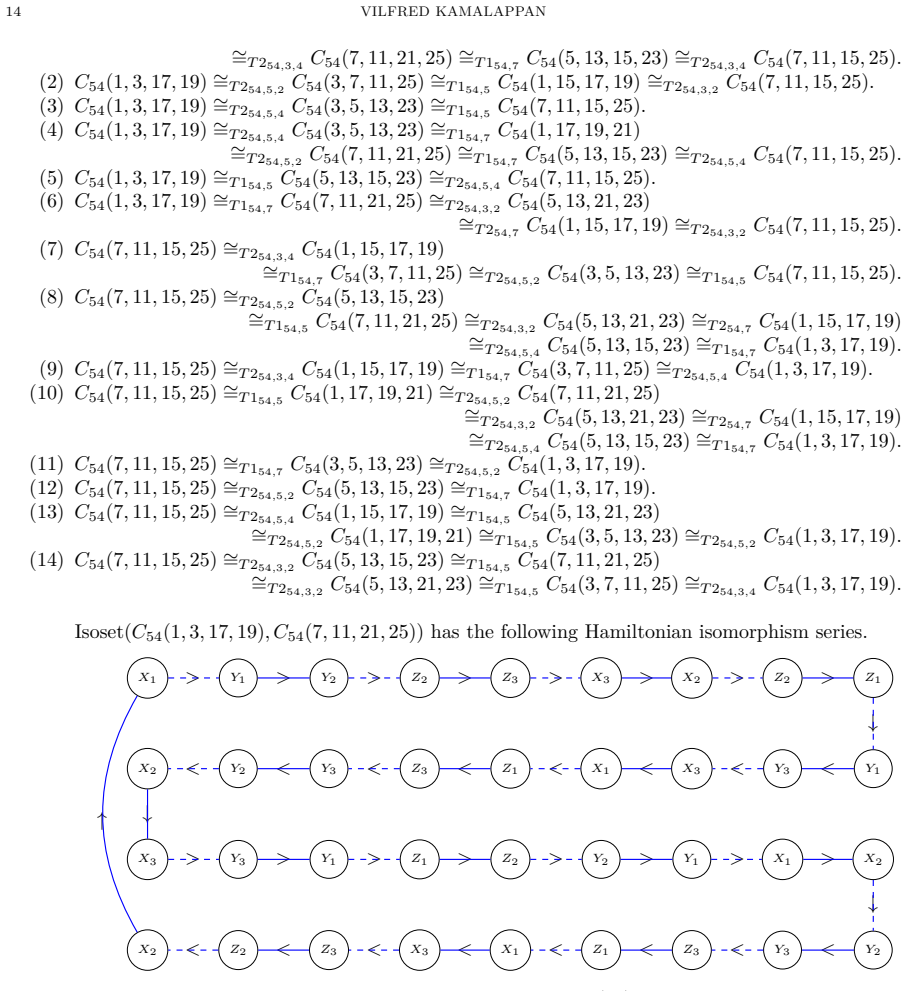
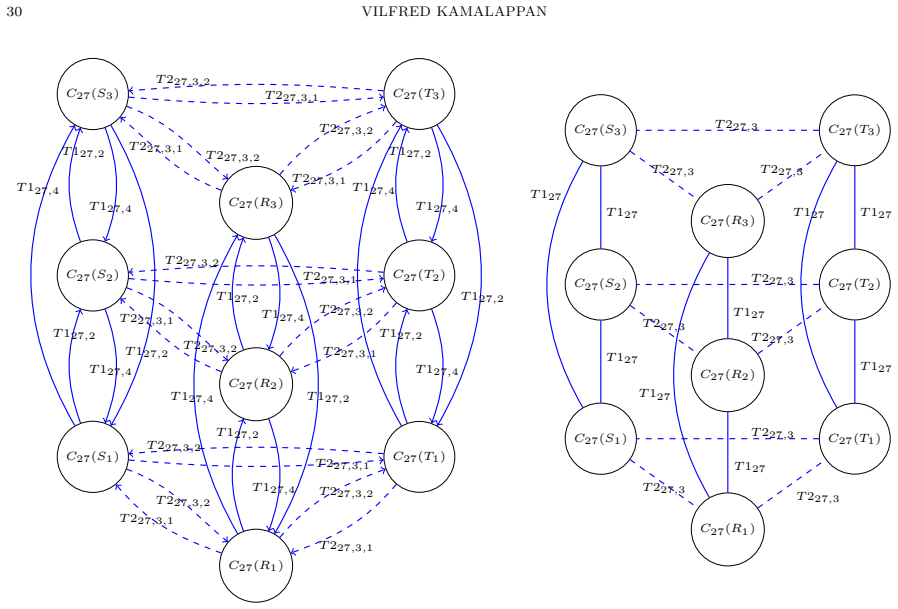
We define the isomorphic set of C_n(R) as the collection of all connection sets that give isomorphic circulant graphs, the isomorphism series as ordered sequences within these, the isomorphism digraph D as the directed graph with vertices as distinct graphs and arcs indicating isomorphism relations, and the isomorphism graph G as its undirected counterpart. For the listed examples these objects are determined, and pairs such as C_54(1,3,17,19) with C_54(5,13,21,23) are shown to be isomorphic yet outside the Type-1 and Type-2 categories for m=3. The diameter of the isomorphic set and isomorphic distances are also computed for some cases.
What carries the argument
The isomorphism digraph D and isomorphism graph G, which represent the relations among isomorphic circulant graphs with different connection sets R.
Load-bearing premise
The new isomorphism digraph and graph structures capture distinct and useful information about the isomorphisms that goes beyond merely determining whether two graphs are isomorphic or not.
What would settle it
A direct computation of all isomorphisms among the connection sets for C_54 would confirm or refute whether the identified pairs are isomorphic and whether any others exist that fit or do not fit the Type classifications.
Figures





read the original abstract
This study is the $7^{th}$ part of a detailed study on Type-2 isomorphic circulant graphs having ten parts \cite{v2-1}-\cite{v2-10}. In this study, we define {\em isomorphic set}, {\em isomorphism series}, {\em isomorphism digraph} $\mathcal{D}$ or {\em isomorphism diagram} and {\em isomorphism graph} $\mathcal{G}$ of circulant graphs and obtain these corresponding to $C_{16}(R)$, $C_{27}(S)$ and $C_{54}(1,3,17,19)$ and present the isomorphism digraph and the isomorphism graph of $C_{432}(16, 27, 48, 54, 128, 160, 189)$ which has isomorphic circulant graphs of Type-2 w.r.t. $m$ = 2 as well as $m$ = 3. We also show that each pair of circulant graphs $C_{54}(1,3,17,19)$, $C_{54}(5,13,21,23)$; $C_{54}(7, 11, 21, 25)$, $C_{54}(7, 11, 15, 25)$; and $C_{54}(1,3,17,19)$, $C_{54}(7,11,15,25)$ are isomorphic but they are neither of Type-1 nor of Type-2 w.r.t. $m$ = 3. More such circulant graphs are given in the conclusion. We also define {\em diameter of isomorphic set} of $C_n(R)$ and {\em isomorphic distance} of $C_n(S)$ and $C_n(T)$ and obtained these values for some circulant graphs.
Editorial analysis
A structured set of objections, weighed in public.
Referee Report
Summary. The paper, the seventh in a ten-part series on Type-2 isomorphic circulant graphs, defines the isomorphic set, isomorphism series, isomorphism digraph D (or diagram), and isomorphism graph G of circulant graphs C_n(R). It constructs explicit instances of these objects for C_16(R), C_27(S), and C_54(1,3,17,19), presents D and G for the larger example C_432(16,27,48,54,128,160,189) exhibiting Type-2 isomorphisms for both m=2 and m=3, identifies three pairs of C_54 graphs that are isomorphic yet neither Type-1 nor Type-2 with respect to m=3, and introduces the diameter of an isomorphic set together with the isomorphic distance between two such graphs, supplying numerical values for selected examples.
Significance. If the constructions are correct, the auxiliary structures supply diagrammatic and graph-theoretic representations that organize the isomorphism classes of circulant graphs in a manner extending the author's prior Type-1/Type-2 classification. The explicit identification of isomorphisms on 54 vertices lying outside that classification, together with the larger n=432 example, supplies concrete data that could be used to test the completeness of existing typologies. The work is incremental within the series and offers no comparison with standard isomorphism algorithms or external benchmarks.
major comments (1)
- [Abstract] Abstract: the assertion that the three listed pairs of C_54 graphs are isomorphic yet neither Type-1 nor Type-2 with respect to m=3 is stated without any derivation, computational procedure, or verification method; this claim is load-bearing for the paper's suggestion that the Type-1/Type-2 framework is incomplete.
minor comments (2)
- The manuscript does not restate the definitions of Type-1 and Type-2 isomorphisms from the cited prior parts, forcing readers to consult the series to evaluate the new claims.
- Notation for the connection sets (R, S, etc.) and the parameter m is used without an introductory example that would make the constructions self-contained.
Simulated Author's Rebuttal
We thank the referee for the review and for highlighting the need for clearer support of the key claim in the abstract. We address the comment below.
read point-by-point responses
-
Referee: [Abstract] Abstract: the assertion that the three listed pairs of C_54 graphs are isomorphic yet neither Type-1 nor Type-2 with respect to m=3 is stated without any derivation, computational procedure, or verification method; this claim is load-bearing for the paper's suggestion that the Type-1/Type-2 framework is incomplete.
Authors: The abstract is a concise summary; the explicit verification appears in the body via the newly defined isomorphism series, digraph D, and graph G. For the three C_54 pairs we construct the isomorphic sets, compute the directed edges of D and the edges of G, and confirm both the isomorphisms and that none of the connecting paths correspond to the Type-1 or Type-2 relations previously defined for m=3. These constructions are carried out directly from the connection sets and are therefore self-contained within the manuscript. If the presentation of the verification steps is judged insufficiently prominent, we are prepared to insert a short cross-reference to the relevant sections inside the abstract itself. revision: partial
Circularity Check
New definitions and explicit constructions are self-contained
full rationale
The manuscript introduces fresh auxiliary structures (isomorphic set, isomorphism series, digraph D, graph G, diameter, isomorphic distance) and applies them directly to concrete circulant graphs C_16(R), C_27(S), C_54(1,3,17,19) and C_432(...). These constructions are presented as outputs of the new definitions themselves. References to the author's prior parts supply only the baseline Type-1/Type-2 classification against which the new examples are contrasted; the paper does not derive any claimed isomorphism or diagram from those prior definitions by algebraic reduction or fitting. No equation or result inside the manuscript is shown to equal its input by construction, and the explicit pairs on n=54 are asserted to lie outside the prior classification without the classification itself being re-derived here. The work is therefore self-contained as a definitional and enumerative extension.
Axiom & Free-Parameter Ledger
axioms (2)
- standard math Standard definition and basic properties of circulant graphs C_n(R)
- domain assumption Validity and completeness of the Type-1 and Type-2 isomorphism classifications from parts 1-6
invented entities (4)
-
isomorphic set of C_n(R)
no independent evidence
-
isomorphism series of C_n(R)
no independent evidence
-
isomorphism digraph D
no independent evidence
-
isomorphism graph G
no independent evidence
Reference graph
Works this paper leans on
-
[1]
Adam,Research problem 2-10, J
A. Adam,Research problem 2-10, J. Combinatorial Theory,3(1967), 393
1967
-
[2]
J. A. Bondy and U. S. R. Murty,Graph Theory with Applications,5 th Edi., Elsevier Sci. Publ. Co., New York, 1982
1982
-
[3]
P. J. Davis,Circulant Matrices,Wiley, New York, 1979
1979
-
[4]
West,Introduction to Graph Theory,2 ed Edi., Pearson Education (Singapore) Pvt
Dauglas B. West,Introduction to Graph Theory,2 ed Edi., Pearson Education (Singapore) Pvt. Ltd., 2002
2002
-
[5]
Elspas and J
B. Elspas and J. Turner,Graphs with circulant adjacency matrices, J. Combinatorial Theory,9(1970), 297-307
1970
-
[6]
Kra and S
I. Kra and S. R. Simanca,On Circulant Matrices, AMS Notices,59(2012), 368–377
2012
-
[7]
Vilfred, ∑ -labelled Graphs and Circulant Graphs, Ph.D
V. Vilfred, ∑ -labelled Graphs and Circulant Graphs, Ph.D. Thesis, University of Kerala, Thiruvananthapuram, Kerala, India (1996)
1996
-
[8]
V. Vilfred Kamalappan,All Type-2 Isomorphic Circulant Graphs ofC 16(R)andC 24(S), arXiv: 2508.09384v1 [math.CO] (12 Aug 2025), 28 pages
work page internal anchor Pith review Pith/arXiv arXiv 2025
-
[9]
V. Vilfred,A study on Type-2 Isomorphic Circulant Graphs and related Abelian Groups, arXiv: 2012.11372v11 [math.CO] (26 Nov. 2024), 183 pages
-
[10]
Vilfred,A Theory of Cartesian Product and Factorization of Circulant Graphs, Hindawi Pub
V. Vilfred,A Theory of Cartesian Product and Factorization of Circulant Graphs, Hindawi Pub. Corp. - J. Discrete Math.,V ol. 2013, Article ID 163740, 10 pages
2013
-
[11]
V. Vilfred Kamalappan,New Families of Circulant Graphs Without Cayley Isomorphism Property withr i = 2, Int. Journal of Applied and Computational Mathematics, (2020) 6:90, 34 pages. https://doi.org/10.1007/s40819-020- 00835-0. Published online: 28.07.2020 by Springer
-
[12]
Vilfred Kamalappan,A study on Type-2 Isomorphic Circulant Graphs
V. Vilfred Kamalappan,A study on Type-2 Isomorphic Circulant Graphs. Part 1: Type-2 isomorphic circulant graphsC n(R)w.r.t.m= 2. Preprint. 31 pages
-
[13]
Vilfred Kamalappan,A study on Type-2 isomorphic circulant graphs
V. Vilfred Kamalappan,A study on Type-2 isomorphic circulant graphs. Part 2: Type-2 isomorphic circulant graphs of orders 16, 24, 27. Preprint. 32 pages
-
[14]
Vilfred Kamalappan,A study on Type-2 isomorphic circulant graphs
V. Vilfred Kamalappan,A study on Type-2 isomorphic circulant graphs. Part 3: 384 pairs of Type-2 isomorphic circulant graphsC 32(R). Preprint. 42 pages
-
[15]
Vilfred Kamalappan,A study on Type-2 isomorphic circulant graphs
V. Vilfred Kamalappan,A study on Type-2 isomorphic circulant graphs. Part 4: 960 triples of Type-2 isomorphic circulant graphsC 54(R). Preprint. 76 pages
-
[16]
Vilfred Kamalappan,A study on Type-2 isomorphic circulant graphs
V. Vilfred Kamalappan,A study on Type-2 isomorphic circulant graphs. Part 5: Type-2 isomorphic circulant graphs of orders 48, 81, 96. Preprint. 33 pages
-
[17]
Vilfred Kamalappan,A study on Type-2 Isomorphic Circulant Graphs
V. Vilfred Kamalappan,A study on Type-2 Isomorphic Circulant Graphs. Part 6: Abelian groups(T2 n,m(Cn(R)),◦)and(Vn,m(Cn(R)),◦). Preprint. 19 pages
-
[18]
Vilfred Kamalappan,A study on Type-2 Isomorphic Circulant Graphs
V. Vilfred Kamalappan,A study on Type-2 Isomorphic Circulant Graphs. Part 7: Isomorphism series, digraph and graph ofC n(R). Preprint. 54 pages
-
[19]
Vilfred Kamalappan,A Study on Type-2 Isomorphic Circulant Graphs: Part 8:C 432(R),C 6750(S)- each has 2 types of Type-2 isomorphic circulant graphs
V. Vilfred Kamalappan,A Study on Type-2 Isomorphic Circulant Graphs: Part 8:C 432(R),C 6750(S)- each has 2 types of Type-2 isomorphic circulant graphs. Preprint. 99 pages
-
[20]
Vilfred Kamalappan and P
V. Vilfred Kamalappan and P. Wilson,A study on Type-2 Isomorphic Circulant Graphs. Part 9: Computer program to show Type-1 and -2 isomorphic circulant graphs. Preprint. 21 pages
-
[21]
Vilfred Kamalappan and P
V. Vilfred Kamalappan and P. Wilson,A study on Type-2 Isomorphic Circulant Graphs. Part 10: Type-2 isomorphicC np3(R)w.r.t.m=pand related groups. Preprint. 20 pages Department of Mathematics, Central University of Kerala, Periye, Kasaragod, Kerala, India - 671 316. Email address:vilfredkamal@gmail.com A STUDY ON TYPE-2 CIRCULANT GRAPHS: PART 7: ISOMORPHIS...
discussion (0)
Sign in with ORCID, Apple, or X to comment. Anyone can read and Pith papers without signing in.