A magnetically-supported disk-corona model for Changing-Look AGN transitions
Pith reviewed 2026-06-25 20:08 UTC · model grok-4.3
The pith
Magnetically supported disk-corona models reproduce the Eddington ratios and durations of Changing-Look AGN transitions only for strongly magnetized inner disks.
A machine-rendered reading of the paper's core claim, the machinery that carries it, and where it could break.
Core claim
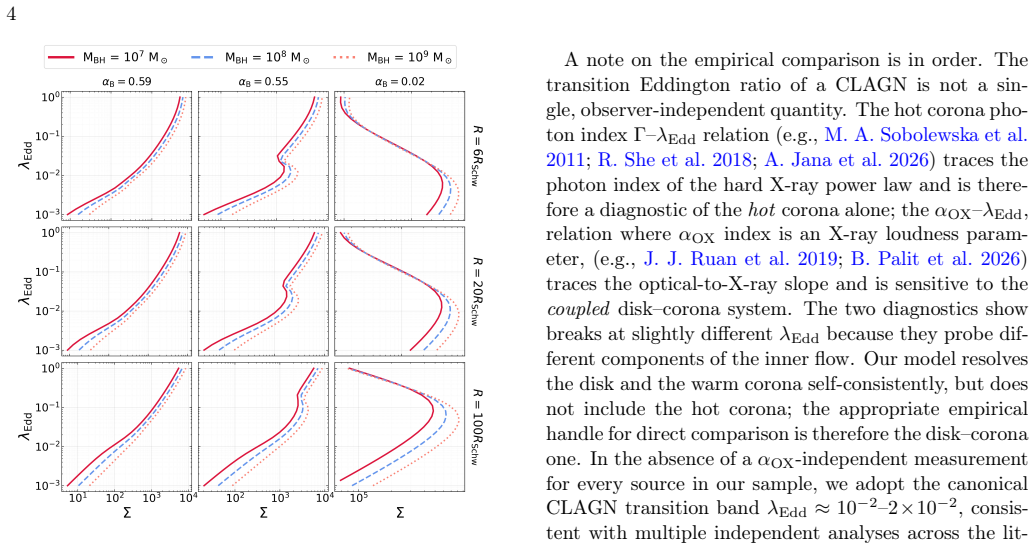
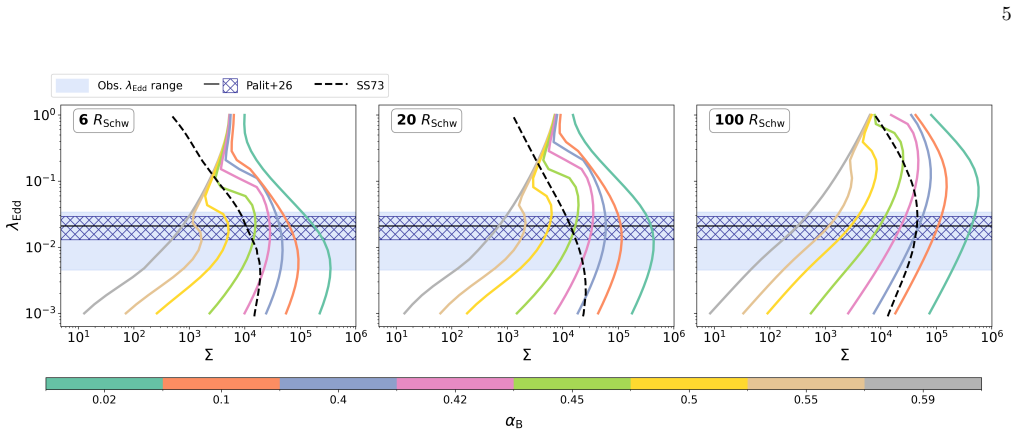
The diskvert code solutions for vertical disk structure with simultaneous gas, radiation, and magnetic pressure support, including a self-consistent warm corona, produce S-curves whose knee is pushed to Eddington ratios of approximately 0.01-0.03 and limit-cycle timescales that enter the months-to-years range for black hole masses of 10^7 to 10^9 solar masses, jointly matching the empirical transition rates and event durations of observed CLAGN only when the inner disk is strongly magnetized.
What carries the argument
Thermal-viscous S-curves from vertically solved disk-corona models under magnetic pressure support, which set the location of the instability knee and the integrated thermal plus front propagation timescales.
If this is right
- The S-curve knee moves down to Eddington ratios of 0.01-0.03 due to magnetic support.
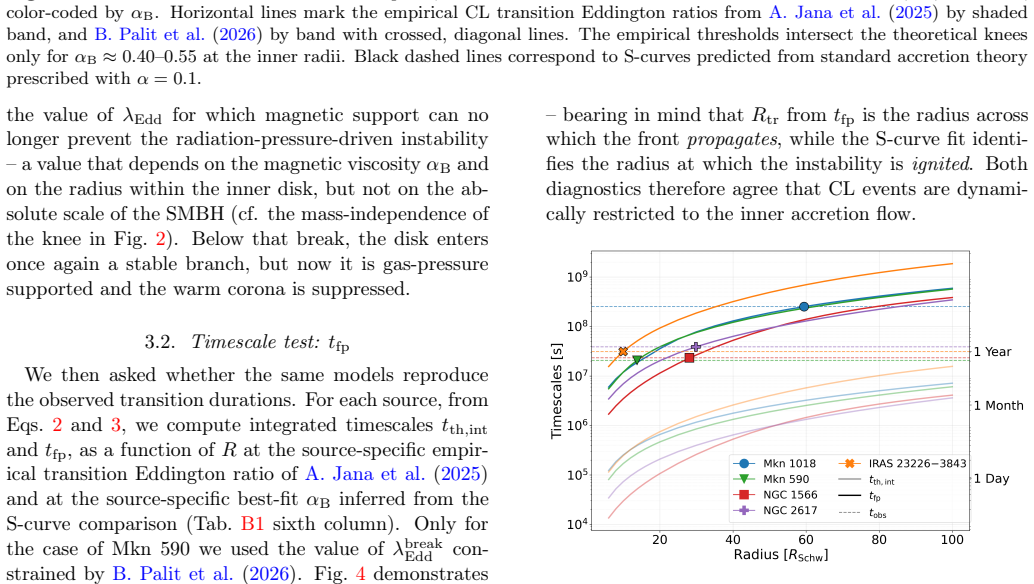
- Limit-cycle timescales reach months to years for black hole masses from 10^7 to 10^9 solar masses.
- A new stable branch of high luminosity solutions appears in magnetized models.
- The model matches data from sources including Mkn 590, NGC 1566, and others only with strong magnetization.
- Transition events are explained by the thermal-viscous limit cycle at small radii in the inner disk.
Where Pith is reading between the lines
- If correct, magnetic fields must dominate the vertical support and stability of inner AGN disks at low accretion rates.
- The same magnetic mechanism could govern variability timescales in other accreting compact objects where standard viscous times are too long.
- Observations of transition properties across a wider range of black hole masses could directly test the predicted scaling with magnetization strength.
- This approach implies that non-magnetized thin-disk models miss essential physics for explaining rapid state changes in AGN.
Load-bearing premise
The diskvert vertical structure solutions with magnetic support accurately capture the thermal-viscous instability behavior needed to match the observed transition properties.
What would settle it
A Changing-Look AGN transition observed at an Eddington ratio well below 0.01 or with a duration inconsistent with the calculated timescales for its measured black hole mass would falsify the requirement for strong inner-disk magnetization.
Figures



read the original abstract
Changing-Look Active Galactic Nuclei (CLAGN) undergo dramatic spectral and luminosity transitions on timescales of months to a few years -- orders of magnitude shorter than the viscous timescale of a standard $\alpha$-disk at the radii where the optical/UV continuum is generated, for typical supermassive black hole masses. We show that a magnetically supported disk-corona model reproduces \emph{both} the observed Eddington ratio at which changing event occurs and the observed transition duration. Using the \texttt{diskvert} code, which solves the steady vertical structure under simultaneous gas, radiation and magnetic pressure support with a self-consistent warm corona, we (i) construct thermal-viscous S-curves, and (ii) calculate the integrated thermal timescale together with the front propagation timescale. We compute a large grid of models of different black hole masses, Eddington ratios, magnetic viscosities, and disk radii, showing that magnetized disks push the S-curve knee down to an Eddington ratio of $ \approx 0.01-0.03$, and introduce a new stable branch of high luminosity solutions, while the limit-cycle timescale enters the months-to-years range for $M_\mathrm{BH} = 10^{7}-10^{9}\,\mathrm{M_\odot}$. Confronted with a sample of five CLAGN (Mkn 590, NGC 1566, IRAS 23226$-$3843, Mkn 1018, NGC 2617), the model jointly reproduces the empirical Eddington rates and the observed event durations only when the inner disk is strongly magnetized. The case of Mkn 590 is especially constraining: the recent tightly-determined transition Eddington ratio is matched by a highly magnetized disk-corona flow at small radii.
Editorial analysis
A structured set of objections, weighed in public.
Referee Report
Summary. The paper claims that a magnetically-supported disk-corona model implemented in the diskvert code, which solves the steady vertical structure under simultaneous gas, radiation and magnetic pressure support with a self-consistent warm corona, reproduces both the observed Eddington ratios (~0.01-0.03) at which Changing-Look AGN (CLAGN) transitions occur and the observed transition durations (months to years). A grid of models varying black hole mass, Eddington ratio, magnetic viscosity and disk radius shows that strong magnetization pushes the S-curve knee to the observed range, introduces a new high-luminosity stable branch, and brings the combined thermal plus front-propagation timescales into the observed window; direct comparison to five CLAGN (Mkn 590, NGC 1566, IRAS 23226-3843, Mkn 1018, NGC 2617) succeeds only for strongly magnetized inner disks, with Mkn 590 providing a particularly tight constraint.
Significance. If the central result holds, the work supplies a concrete physical mechanism linking magnetic support in the inner accretion flow to the rapid, low-Eddington-ratio transitions seen in CLAGN, while simultaneously constraining the magnetic-viscosity parameter from multi-object data. The introduction of a new stable high-luminosity branch and the joint reproduction of both rate and duration constitute a non-trivial advance over standard thin-disk models. The explicit grid and object-by-object comparison provide falsifiable predictions that can be tested with future monitoring campaigns.
major comments (2)
- [Abstract and S-curve construction] Abstract and the paragraph describing S-curve construction: the reported Eddington ratio at which the transition occurs is obtained only after selecting the magnetic viscosity that places the S-curve knee at the observed value; the paper should demonstrate that the same viscosity range is required by independent observables (e.g., coronal properties or variability) rather than being chosen post-hoc to match the CLAGN sample.
- [Timescale calculation] Section on timescale calculation and the skeptic note on diskvert: the integrated thermal timescale plus front-propagation timescale are derived from steady vertical solutions; for the high-magnetization branch where magnetic pressure dominates and a new stable branch appears, it remains to be shown that these equilibrium-derived timescales correctly locate the time-dependent limit-cycle threshold and duration, which is load-bearing for the joint match to observed event lengths.
minor comments (1)
- [Model grid] Table or figure presenting the grid: the range and sampling of magnetic viscosity values should be stated explicitly so that readers can assess how densely the high-magnetization regime is explored.
Simulated Author's Rebuttal
We thank the referee for their thorough review and for recognizing the potential significance of our results. We address each of the major comments below, providing clarifications and indicating where revisions will be made to the manuscript.
read point-by-point responses
-
Referee: [Abstract and S-curve construction] Abstract and the paragraph describing S-curve construction: the reported Eddington ratio at which the transition occurs is obtained only after selecting the magnetic viscosity that places the S-curve knee at the observed value; the paper should demonstrate that the same viscosity range is required by independent observables (e.g., coronal properties or variability) rather than being chosen post-hoc to match the CLAGN sample.
Authors: The magnetic viscosity is treated as a free parameter in our grid, and we demonstrate that only a narrow range corresponding to strong magnetization allows the model to simultaneously match both the transition Eddington ratios and the event durations for the five CLAGN in our sample. This is not a post-hoc fit to a single object but a joint requirement from multiple sources. While we agree that cross-checks with independent observables would be ideal, the current analysis is focused on CLAGN phenomenology, and the consistency across objects with different masses and radii provides some robustness. We will revise the text to emphasize that the viscosity range is constrained by the data and to briefly discuss potential links to coronal emission properties. revision: partial
-
Referee: [Timescale calculation] Section on timescale calculation and the skeptic note on diskvert: the integrated thermal timescale plus front-propagation timescale are derived from steady vertical solutions; for the high-magnetization branch where magnetic pressure dominates and a new stable branch appears, it remains to be shown that these equilibrium-derived timescales correctly locate the time-dependent limit-cycle threshold and duration, which is load-bearing for the joint match to observed event lengths.
Authors: We acknowledge this as a valid caveat. Our approach follows the standard methodology used in studies of disk instabilities, where thermal and viscous timescales derived from steady-state S-curves are used to estimate limit-cycle periods. For the new high-luminosity stable branch introduced by strong magnetization, the cycle involves transitions between the low and high branches, and our integrated timescales provide an estimate that falls within the observed months-to-years range. However, we recognize that dedicated time-dependent simulations would be necessary to fully confirm the dynamics on the high-magnetization branch. We will add a discussion paragraph noting this limitation and suggesting it as future work. revision: partial
Circularity Check
Magnetic viscosity selected to align S-curve knee with observed transition Eddington ratios
specific steps
-
fitted input called prediction
[Abstract]
"the model jointly reproduces the empirical Eddington rates and the observed event durations only when the inner disk is strongly magnetized. ... the recent tightly-determined transition Eddington ratio is matched by a highly magnetized disk-corona flow at small radii."
Magnetic viscosity is varied until the S-curve knee (constructed from diskvert steady vertical solutions) reaches the observed Eddington ratio range; the paper then states that the model reproduces the empirical Eddington rates for strongly magnetized disks. The reproduction of the transition Eddington ratio is therefore achieved by construction of the chosen viscosity value rather than an a-priori prediction.
full rationale
The paper varies magnetic viscosity across a grid and reports that the observed Eddington ratios (~0.01-0.03) and durations are jointly matched only for the strongly magnetized branch. This constitutes a fitted-input-called-prediction pattern because the viscosity parameter is adjusted until the steady-state S-curve instability threshold coincides with the data; the match is then presented as model reproduction. The duration calculation is performed after this selection. No other circular patterns (self-definition, self-citation chains, or ansatz smuggling) are present. The derivation remains partially independent because the grid exploration and timescale integration are explicit, but the central joint-reproduction claim reduces to the parameter choice for the Eddington-rate axis.
Axiom & Free-Parameter Ledger
free parameters (2)
- magnetic viscosity
- inner disk radius
axioms (1)
- domain assumption The steady vertical structure under simultaneous gas, radiation and magnetic pressure support with a self-consistent warm corona is an adequate description of the thermal-viscous instability.
Reference graph
Works this paper leans on
-
[1]
Changing-look Active Galactic Nuclei. I. Tracking the Transition on the Main Sequence of Quasars. , keywords =. doi:10.3847/1538-4365/ad344f , archivePrefix =. 2206.10056 , primaryClass =
-
[2]
The Astropy Project: Sustaining and Growing a Community-oriented Open-source Project and the Latest Major Release (v5.0) of the Core Package. , keywords =. doi:10.3847/1538-4357/ac7c74 , archivePrefix =. 2206.14220 , primaryClass =
work page internal anchor Pith review Pith/arXiv arXiv doi:10.3847/1538-4357/ac7c74
-
[3]
The Astropy Project: Building an inclusive, open-science project and status of the v2.0 core package
The Astropy Project: Building an Open-science Project and Status of the v2.0 Core Package. , keywords =. doi:10.3847/1538-3881/aabc4f , archivePrefix =. 1801.02634 , primaryClass =
work page internal anchor Pith review Pith/arXiv arXiv doi:10.3847/1538-3881/aabc4f
-
[4]
Astropy: A Community Python Package for Astronomy
Astropy: A community Python package for astronomy. , keywords =. 2013. doi:10.1051/0004-6361/201322068 , archivePrefix =. 1307.6212 , primaryClass =
work page internal anchor Pith review Pith/arXiv arXiv doi:10.1051/0004-6361/201322068 2013
-
[5]
Unified Schemes for Radio-Loud Active Galactic Nuclei
Unified Schemes for Radio-Loud Active Galactic Nuclei. , keywords =. doi:10.1086/133630 , archivePrefix =. astro-ph/9506063 , primaryClass =
work page internal anchor Pith review Pith/arXiv arXiv doi:10.1086/133630
-
[6]
SExtractor: Software for source extraction. , keywords =. 1996. doi:10.1051/aas:1996164 , adsurl =
-
[7]
Quantifying the Observational Effort Required for the Radial Velocity Characterization of TESS Planets. , keywords =. 2018. doi:10.3847/1538-3881/aacea9 , archivePrefix =. 1807.01263 , primaryClass =
work page internal anchor Pith review Pith/arXiv arXiv doi:10.3847/1538-3881/aacea9 2018
-
[8]
X-Ray Scattering Echoes and Ghost Halos from the Intergalactic Medium: Relation to the Nature of AGN Variability. , keywords =. 2015. doi:10.1088/0004-637X/805/1/23 , archivePrefix =. 1503.01475 , primaryClass =
work page internal anchor Pith review Pith/arXiv arXiv doi:10.1088/0004-637x/805/1/23 2015
-
[9]
, keywords =
The 2013 Release of Cloudy. , keywords =. 2013
2013
-
[10]
1989", month =
T _ E X and LAT _ E X Macro Definition Files for Astronomical Publications. , year = "1989", month = "Mar", pages =
1989
-
[11]
LaTeX: A Document Preparation System. 1994
1994
-
[12]
Quasi-periodic Fast Propagating Magnetoacoustic Waves during the Magnetic Reconnection Between Solar Coronal Loops. , keywords =. 2018. doi:10.3847/2041-8213/aaf167 , archivePrefix =. 1811.08553 , primaryClass =
work page internal anchor Pith review Pith/arXiv arXiv doi:10.3847/2041-8213/aaf167 2018
-
[13]
Nominal values for selected solar and planetary quantities: IAU 2015 Resolution B3
Nominal Values for Selected Solar and Planetary Quantities: IAU 2015 Resolution B3. , keywords =. 2016. doi:10.3847/0004-6256/152/2/41 , archivePrefix =. 1605.09788 , primaryClass =
work page internal anchor Pith review Pith/arXiv arXiv doi:10.3847/0004-6256/152/2/41 2015
-
[14]
Swift X-Ray Observations of Classical Novae. II. The Super Soft Source Sample. , keywords =. 2011. doi:10.1088/0067-0049/197/2/31 , archivePrefix =. 1110.6224 , primaryClass =
work page internal anchor Pith review Pith/arXiv arXiv doi:10.1088/0067-0049/197/2/31 2011
-
[15]
Galaxy emission line classification using 3D line ratio diagrams
Galaxy Emission Line Classification Using Three-dimensional Line Ratio Diagrams. , keywords =. 2014. doi:10.1088/0004-637X/793/2/127 , archivePrefix =. 1406.5186 , primaryClass =
work page internal anchor Pith review Pith/arXiv arXiv doi:10.1088/0004-637x/793/2/127 2014
-
[16]
Warm and thick corona for a magnetically supported disk in galactic black hole binaries. , keywords =. doi:10.1051/0004-6361/201935033 , archivePrefix =. 1903.03641 , primaryClass =
-
[17]
Thermal instability as a constraint for warm X-ray coronas in active galactic nuclei. , keywords =. doi:10.1051/0004-6361/202244410 , archivePrefix =. 2303.17384 , primaryClass =
-
[18]
The thermal-viscous disk instability model in the AGN context
The thermal-viscous disk instability model in the AGN context. , keywords =. doi:10.1051/0004-6361/200810928 , archivePrefix =. 0901.1229 , primaryClass =
work page internal anchor Pith review Pith/arXiv arXiv doi:10.1051/0004-6361/200810928
-
[19]
Investigating changing-look active galactic nuclei with long-term optical and X-ray observations. , keywords =. doi:10.1051/0004-6361/202451058 , archivePrefix =. 2411.08676 , primaryClass =
-
[20]
The spectral state transition of Mkn 590, a potential link between AGNs and X-ray binaries?
The spectral state transition of Mkn 590, a potential link between AGNs and X-ray binaries?. arXiv e-prints , keywords =. doi:10.48550/arXiv.2602.17572 , archivePrefix =. 2602.17572 , primaryClass =
work page internal anchor Pith review Pith/arXiv arXiv doi:10.48550/arxiv.2602.17572
-
[21]
the evolution of soft excess and X-ray continuum
Multi-wavelength properties of changing-state active galactic nuclei: I. the evolution of soft excess and X-ray continuum. arXiv e-prints , keywords =. doi:10.48550/arXiv.2601.07337 , archivePrefix =. 2601.07337 , primaryClass =
-
[22]
Central Masses and Broad-Line Region Sizes of Active Galactic Nuclei. II. A Homogeneous Analysis of a Large Reverberation-Mapping Database. , keywords =. doi:10.1086/423269 , archivePrefix =. astro-ph/0407299 , primaryClass =
work page internal anchor Pith review Pith/arXiv arXiv doi:10.1086/423269
-
[23]
The nuclear gas disk of NGC 1566 dissected by SINFONI and ALMA
The nuclear gas disk of NGC 1566 dissected by SINFONI and ALMA. , keywords =. doi:10.1051/0004-6361/201424850 , archivePrefix =. 1508.02664 , primaryClass =
work page internal anchor Pith review Pith/arXiv arXiv doi:10.1051/0004-6361/201424850
-
[24]
BASS. XXI. The Data Release 2 Overview. , keywords =. doi:10.3847/1538-4365/ac6c8f , archivePrefix =. 2207.12428 , primaryClass =
-
[25]
The Close AGN Reference Survey (CARS). Mrk 1018 returns to the shadows after 30 years as a Seyfert 1. , keywords =. doi:10.1051/0004-6361/201629102 , archivePrefix =. 1609.04423 , primaryClass =
work page internal anchor Pith review Pith/arXiv arXiv doi:10.1051/0004-6361/201629102
-
[26]
Velocity-resolved Reverberation Mapping of Changing-look AGN NGC 2617. , keywords =. doi:10.3847/1538-4357/abefe0 , archivePrefix =. 2103.03508 , primaryClass =
-
[27]
Evidence for rapid disc formation and reprocessing in the X-ray bright tidal disruption event candidate AT 2018fyk. , keywords =. doi:10.1093/mnras/stz1976 , archivePrefix =. 1903.12203 , primaryClass =
-
[28]
Accretion disk dynamo as the trigger for X-ray binary state transitions
Accretion Disk Dynamo as the Trigger for X-Ray Binary State Transitions. , keywords =. doi:10.1088/0004-637X/809/2/118 , archivePrefix =. 1507.03996 , primaryClass =
work page internal anchor Pith review Pith/arXiv arXiv doi:10.1088/0004-637x/809/2/118
-
[29]
Accretion disc dynamo activity in local simulations spanning weak-to-strong net vertical magnetic flux regimes. , keywords =. doi:10.1093/mnras/stw029 , archivePrefix =. 1511.06368 , primaryClass =
work page internal anchor Pith review Pith/arXiv arXiv doi:10.1093/mnras/stw029
-
[30]
Radiation Magneto-hydrodynamic Simulations of the Formation of Hot Accretion Disk Coronae
Radiation Magnetohydrodynamic Simulations of the Formation of Hot Accretion Disk Coronae. , keywords =. doi:10.1088/0004-637X/784/2/169 , archivePrefix =. 1402.2979 , primaryClass =
work page internal anchor Pith review Pith/arXiv arXiv doi:10.1088/0004-637x/784/2/169
-
[31]
The existence of warm and optically thick dissipative coronae above accretion disks
Warm and optically thick dissipative coronae above accretion disks. , keywords =. doi:10.1051/0004-6361/201526288 , archivePrefix =. 1504.03160 , primaryClass =
work page internal anchor Pith review Pith/arXiv arXiv doi:10.1051/0004-6361/201526288
-
[32]
Changing-look Quasar Candidates: First Results from Follow-up Spectroscopy of Highly Optically Variable Quasars. , keywords =. doi:10.3847/1538-4357/ab05e2 , archivePrefix =. 1810.00087 , primaryClass =
work page internal anchor Pith review Pith/arXiv arXiv doi:10.3847/1538-4357/ab05e2
-
[33]
Now You See It, Now You Don't: The Disappearing Central Engine of the Quasar J1011+5442
Now you see it, now you don't: the disappearing central engine of the quasar J1011+5442. , keywords =. doi:10.1093/mnras/stv2385 , archivePrefix =. 1509.03640 , primaryClass =
work page internal anchor Pith review Pith/arXiv arXiv doi:10.1093/mnras/stv2385
-
[34]
The Discovery of the First Changing Look Quasar: New Insights Into the Physics and Phenomenology of Active Galactic Nucleus. , keywords =. doi:10.1088/0004-637X/800/2/144 , archivePrefix =. 1412.2136 , primaryClass =
work page internal anchor Pith review Pith/arXiv arXiv doi:10.1088/0004-637x/800/2/144
-
[35]
1ES 1927+654: An AGN Caught Changing Look on a Timescale of Months. , keywords =. doi:10.3847/1538-4357/ab39e4 , archivePrefix =. 1903.11084 , primaryClass =
-
[36]
A Transient ``Changing-look'' Active Galactic Nucleus Resolved on Month Timescales from First-year Sloan Digital Sky Survey V Data. , keywords =. doi:10.3847/2041-8213/ac9a47 , archivePrefix =. 2210.07258 , primaryClass =
-
[37]
Changing-look active galactic nuclei. Nature Astronomy , keywords =. doi:10.1038/s41550-023-02108-4 , archivePrefix =. 2211.05132 , primaryClass =
-
[38]
Dormancy and Reawakening over Years: Eight New Recurrent Changing-look AGNs. , keywords =. doi:10.3847/1538-4357/adadf3 , archivePrefix =. 2410.15587 , primaryClass =
-
[39]
Explaining changing-look AGN with state transition triggered by rapid mass accretion rate drop
Explaining changing-look AGN with state transition triggered by rapid mass accretion rate drop. , keywords =. doi:10.1093/mnras/sty2032 , archivePrefix =. 1805.07873 , primaryClass =
work page internal anchor Pith review Pith/arXiv arXiv doi:10.1093/mnras/sty2032
-
[40]
Markarian 590: the AGN awakens. , keywords =. doi:10.1093/mnrasl/slaf027 , archivePrefix =. 2501.07225 , primaryClass =
-
[41]
Untangling the complex nature of AGN variability in Fairall 9. , keywords =. doi:10.1093/mnras/staf1751 , archivePrefix =. 2509.25324 , primaryClass =
-
[42]
Sleeping Giants Arise: Monitoring the Return of Three Changing-look Quasars to Their High States. , keywords =. doi:10.3847/1538-4357/adeb73 , archivePrefix =. 2504.06065 , primaryClass =
-
[43]
Black Holes (Les Astres Occlus) , year = 1973, editor =
Astrophysics of black holes. Black Holes (Les Astres Occlus) , year = 1973, editor =
1973
-
[44]
Observational appearance
Black holes in binary systems. Observational appearance. , year = 1973, month = jan, volume =
1973
-
[45]
Quasar viscosity crisis. Nature Astronomy , keywords =. doi:10.1038/s41550-017-0372-1 , archivePrefix =. 1802.00408 , primaryClass =
work page internal anchor Pith review Pith/arXiv arXiv doi:10.1038/s41550-017-0372-1
-
[46]
Possible mechanism for multiple changing-look phenomena in active galactic nuclei. , keywords =. doi:10.1051/0004-6361/202038575 , archivePrefix =. 2007.06441 , primaryClass =
-
[47]
The Effects of Large-scale Magnetic Fields on the Model for Repeating Changing-look AGNs. , keywords =. doi:10.3847/1538-4357/abe766 , archivePrefix =. 2103.00828 , primaryClass =
-
[48]
Magnetic flux inversion in a peculiar changing look AGN. , keywords =. doi:10.1093/mnrasl/slab002 , archivePrefix =. 2011.01954 , primaryClass =
-
[49]
A tidal disruption flare in a massive galaxy? Implications for the fuelling mechanisms of nuclear black holes. , keywords =. doi:10.1093/mnras/stv1095 , archivePrefix =. 1503.04870 , primaryClass =
work page internal anchor Pith review Pith/arXiv arXiv doi:10.1093/mnras/stv1095
-
[50]
Disk Tearing: Implications for Black Hole Accretion and AGN Variability. , keywords =. doi:10.3847/1538-4357/abdc25 , archivePrefix =. 2101.05825 , primaryClass =
-
[51]
, year = 1974, month = jan, volume =
Black Holes in Binary Systems: Instability of Disk Accretion. , year = 1974, month = jan, volume =. doi:10.1086/181377 , adsurl =
-
[52]
A theory of the instability of disk accretion on to black holes and the variability of binary X-ray sources, galactic nuclei and quasars. , keywords =. doi:10.1093/mnras/175.3.613 , adsurl =
-
[53]
Accretion discs with strong toroidal magnetic fields. , keywords =. doi:10.1111/j.1365-2966.2006.11372.x , archivePrefix =. astro-ph/0612300 , primaryClass =
-
[54]
Thin accretion disks are stabilized by a strong magnetic field
Thin accretion discs are stabilized by a strong magnetic field. , keywords =. doi:10.1093/mnras/stw913 , archivePrefix =. 1601.06785 , primaryClass =
work page internal anchor Pith review Pith/arXiv arXiv doi:10.1093/mnras/stw913
-
[55]
Extreme AGN variability: evidence of magnetically elevated accretion?
Extreme AGN variability: evidence of magnetically elevated accretion?. , keywords =. doi:10.1093/mnrasl/sly213 , archivePrefix =. 1807.03314 , primaryClass =
work page internal anchor Pith review Pith/arXiv arXiv doi:10.1093/mnrasl/sly213
-
[56]
Puffy Accretion Disks: Sub-Eddington, Optically Thick, and Stable. , keywords =. doi:10.3847/2041-8213/ab48f5 , archivePrefix =. 1908.08396 , primaryClass =
-
[57]
A simple model of globally magnetized accretion discs. , keywords =. doi:10.1093/mnras/stae2305 , archivePrefix =. 2402.15657 , primaryClass =
-
[58]
Testing warm Comptonization models for the origin of the soft X-ray excess in AGN
Testing warm Comptonization models for the origin of the soft X-ray excess in AGNs. , keywords =. doi:10.1051/0004-6361/201731580 , archivePrefix =. 1710.04940 , primaryClass =
work page internal anchor Pith review Pith/arXiv arXiv doi:10.1051/0004-6361/201731580
-
[59]
Radiation spectra of warm and optically thick coronae in AGNs. , keywords =. doi:10.1051/0004-6361/201937011 , archivePrefix =. 2001.02026 , primaryClass =
-
[60]
Black Hole Accretion Disks with Coronae. , keywords =. doi:10.1086/174934 , adsurl =
-
[61]
Simulated spectral states of active galactic nuclei and observational predictions. , keywords =. doi:10.1111/j.1365-2966.2011.18302.x , archivePrefix =. 1102.0798 , primaryClass =
-
[62]
Chandra Survey of Nearby Galaxies: Testing the Accretion Model for Low-luminosity AGNs
Chandra Survey of Nearby Galaxies: Testing the Accretion Model for Low-luminosity AGNs. , keywords =. doi:10.3847/1538-4357/aabfe7 , archivePrefix =. 1804.07482 , primaryClass =
work page internal anchor Pith review Pith/arXiv arXiv doi:10.3847/1538-4357/aabfe7
-
[63]
A Mid-IR Selected Changing-Look Quasar and Physical Scenarios for Abrupt AGN Fading
A Mid-IR Selected Changing-look Quasar and Physical Scenarios for Abrupt AGN Fading. , keywords =. doi:10.3847/1538-4357/aac726 , archivePrefix =. 1805.06920 , primaryClass =
work page internal anchor Pith review Pith/arXiv arXiv doi:10.3847/1538-4357/aac726
-
[64]
A new physical interpretation of optical and infrared variability in quasars
A new physical interpretation of optical and infrared variability in quasars. , keywords =. doi:10.1093/mnras/sty2002 , archivePrefix =. 1805.06921 , primaryClass =
work page internal anchor Pith review Pith/arXiv arXiv doi:10.1093/mnras/sty2002
-
[65]
The Analogous Structure of Accretion Flows in Supermassive and Stellar Mass Black Holes: New Insights from Faded Changing-look Quasars. , keywords =. doi:10.3847/1538-4357/ab3c1a , archivePrefix =. 1903.02553 , primaryClass =
-
[66]
Systematic collapse of the accretion disc across the supermassive black hole population. , keywords =. doi:10.1093/mnras/stae2272 , archivePrefix =. 2406.06674 , primaryClass =
-
[67]
Universal behaviour of $\alpha$-viscosity in black hole accretion discs
Universal behaviour of α -viscosity in black hole accretion discs. arXiv e-prints , keywords =. doi:10.48550/arXiv.2603.10997 , archivePrefix =. 2603.10997 , primaryClass =
work page internal anchor Pith review Pith/arXiv arXiv doi:10.48550/arxiv.2603.10997
-
[68]
Time-Averaged Structure of Accretion Disk
Disk-Accretion onto a Black Hole. Time-Averaged Structure of Accretion Disk. , year = 1974, month = jul, volume =. doi:10.1086/152990 , adsurl =
-
[69]
Unified models for active galactic nuclei and quasars. , keywords =. doi:10.1146/annurev.aa.31.090193.002353 , adsurl =
-
[70]
Properties of AGN coronae in the NuSTAR era
Properties of AGN coronae in the NuSTAR era. , keywords =. doi:10.1093/mnras/stv1218 , archivePrefix =. 1505.07603 , primaryClass =
work page internal anchor Pith review Pith/arXiv arXiv doi:10.1093/mnras/stv1218
-
[71]
Strongly magnetized accretion discs: structure and accretion from global magnetohydrodynamic simulations. , keywords =. doi:10.1093/mnras/stz3572 , archivePrefix =. 1907.08995 , primaryClass =
-
[72]
X-ray spectra reveal the reawakening of the repeat changing-look AGN NGC 1566
X-ray spectra reveal the reawakening of the repeat changing-look AGN NGC 1566. , keywords =. doi:10.1093/mnrasl/sly224 , archivePrefix =. 1811.10289 , primaryClass =
work page internal anchor Pith review Pith/arXiv arXiv doi:10.1093/mnrasl/sly224
-
[73]
Extreme line profile variations in the repeating changing-look active galactic nucleus IRAS 23226-3843. , keywords =. doi:10.1051/0004-6361/202558093 , archivePrefix =. 2601.15979 , primaryClass =
-
[74]
Odessa Astronomical Publications , keywords =
Multi-Wavelength Monitoring of the Changing-Look AGN NGC 2617 during State Changes. Odessa Astronomical Publications , keywords =. doi:10.18524/1810-4215.2017.30.114366 , archivePrefix =. 1711.02631 , primaryClass =
-
[75]
The Role of Strong Magnetic Fields in Stabilizing Highly Luminous Thin Disks. , keywords =. doi:10.3847/1538-4357/ac938b , archivePrefix =. 2209.03317 , primaryClass =
-
[76]
Radiation GRMHD Models of Accretion onto Stellar-Mass Black Holes: III. Near-Eddington Accretion
Radiation GRMHD Models of Accretion onto Stellar-Mass Black Holes: III. Near-Eddington Accretion. arXiv e-prints , keywords =. doi:10.48550/arXiv.2603.05588 , archivePrefix =. 2603.05588 , primaryClass =
work page internal anchor Pith review Pith/arXiv arXiv doi:10.48550/arxiv.2603.05588
-
[77]
Slim Accretion Disks. , keywords =. doi:10.1086/166683 , adsurl =
discussion (0)
Sign in with ORCID, Apple, or X to comment. Anyone can read and Pith papers without signing in.