Connecting Stellar Population Surveys to Stellar Evolution with Delay-time Distributions: Application to LMC Classical Cepheids
Pith reviewed 2026-06-26 01:25 UTC · model grok-4.3
The pith
Delay-time distributions from LMC star-formation maps recover Cepheid progenitor ages at 20-200 Myr and align with non-canonical models.
A machine-rendered reading of the paper's core claim, the machinery that carries it, and where it could break.
Core claim
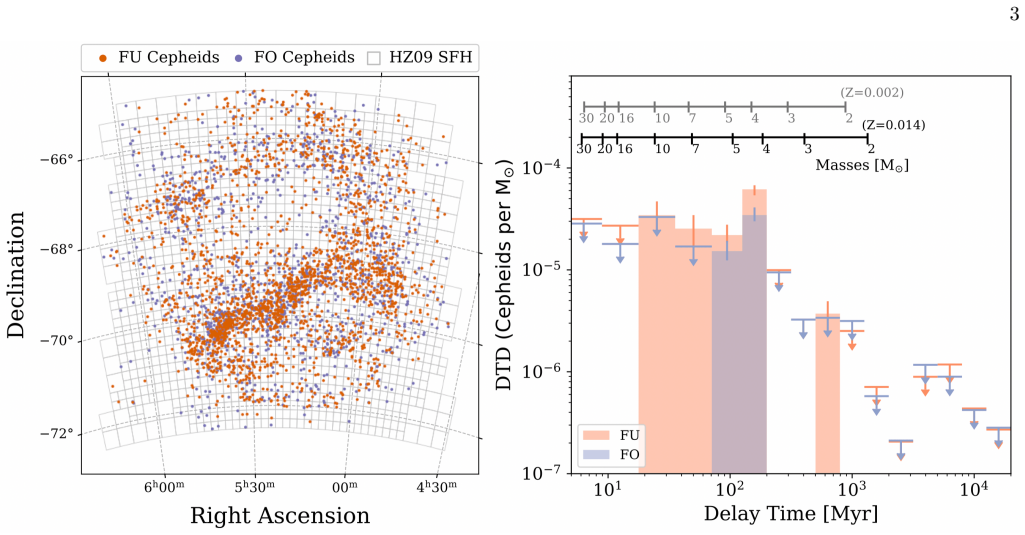
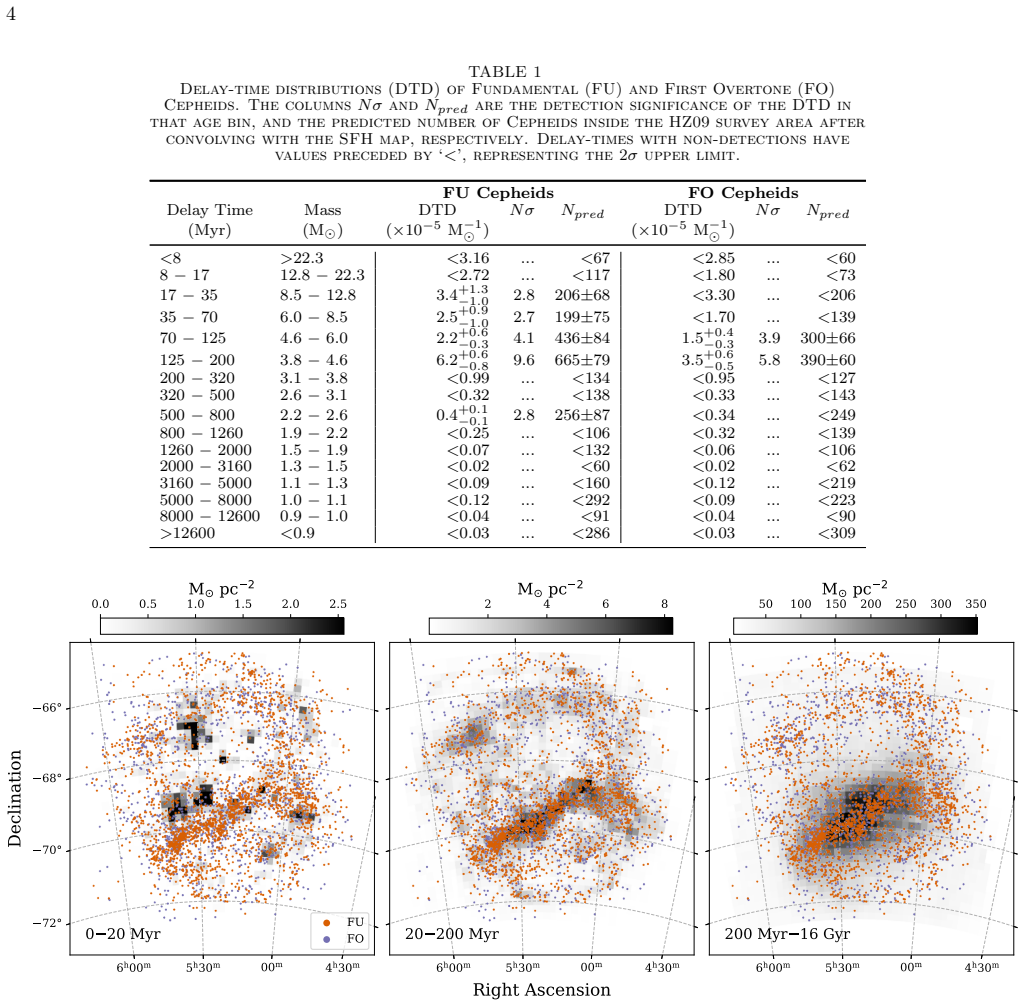
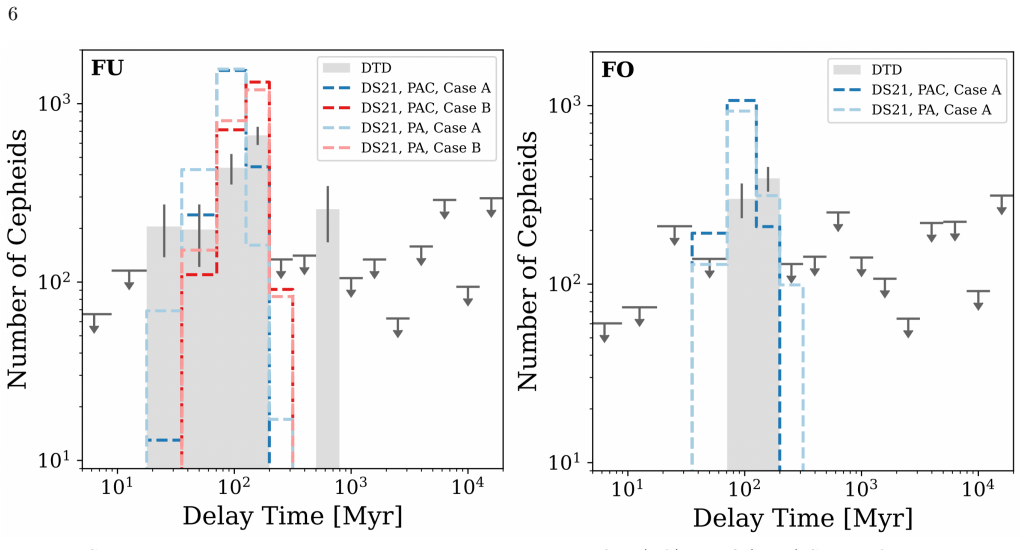
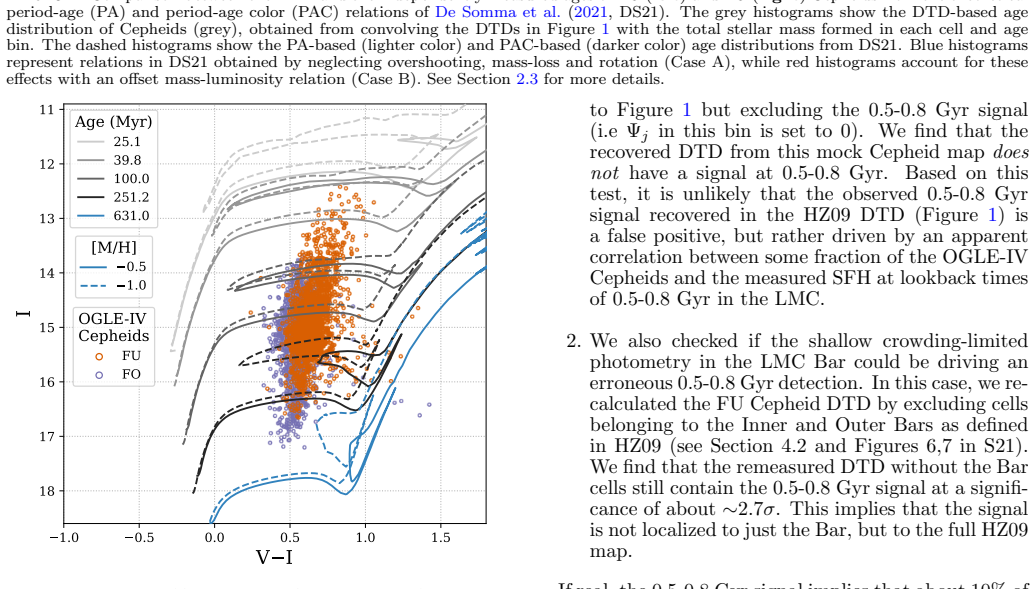
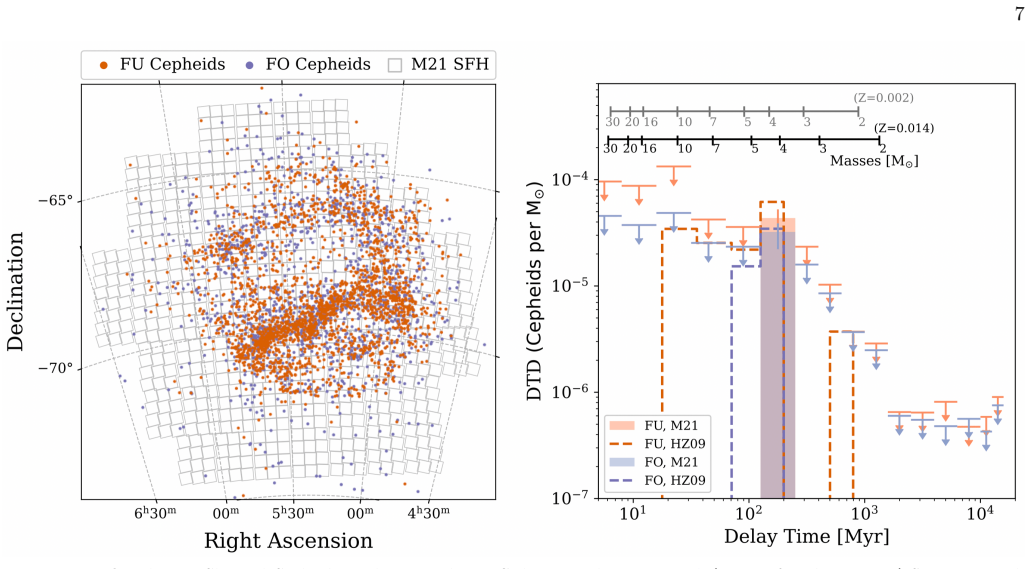
The measured DTDs from optical SFH maps show significant detections at ages of 20-200 Myr for FU Cepheids, and 125-200 Myr for FO Cepheids. These are consistent with independently measured ages from the period-age-color relations, with the DTD peak being more consistent with relations from non-canonical models that include effects of overshooting, rotational mixing etc. An outlier population of 0.5-0.8 Gyr of FU Cepheids is also detected in the DTD, though its veracity is debatable given the brightness and pulsation periods of FU Cepheids, and because the signal is not recovered with DTDs derived from near-infrared SFH.
What carries the argument
The delay-time distribution (DTD), which extracts the progenitor age distribution and production rates of a stellar phenomenon from galaxy star-formation history maps.
If this is right
- DTDs of stars with well-constrained progenitors such as Cepheids and RR Lyrae can provide independent verification of the derived SFHs in upcoming surveys.
- The technique offers a route to investigate progenitor scenarios for supernovae, evolved giants, planetary nebulae and AGB stars by confronting uncertainties in mass-loss, binary evolution, rotation, mixing and overshooting.
- An outlier 0.5-0.8 Gyr signal for FU Cepheids appears in optical DTDs but is absent in near-infrared versions and conflicts with expected brightness and periods.
Where Pith is reading between the lines
- If DTDs successfully recover known Cepheid ages, the same maps could be used to constrain binary channels for other transients whose progenitors lack direct age indicators.
- Extending the method to additional galaxies at different metallicities would test whether the preference for non-canonical models holds across environments.
- Cross-validation between DTD ages and period relations could flag systematic biases in SFH map construction for age ranges where Cepheids are abundant.
Load-bearing premise
The optical and near-infrared SFH maps accurately capture the LMC star-formation history in the relevant age bins without large systematic errors that would distort the recovered DTD.
What would settle it
If the DTD peaks derived from the same SFH maps fail to align with the independently measured ages from period-age-color relations in the same sample, the claimed consistency would not hold.
Figures
read the original abstract
The progenitors of many stellar-origin phenomena such as supernovae, evolved giants and supergiants, planetary nebulae, AGB stars and other post-main-sequence exotica remain poorly understood due to stellar evolution uncertainties such as mass-loss, binary evolution, rotation, mixing, and overshooting. A promising technique for investigating stellar progenitor scenarios with resolved stellar population surveys of galaxies is the delay-time distribution (DTD). Given a survey of stellar phenomena of interest, the DTD extracts the progenitor age distribution and production rates of the phenomena from star-formation history (SFH) maps of galaxies. Here we test the potential of DTDs as a stellar evolution diagnostic by applying to stars with known ages -- Classical Cepheids in the LMC. We use the high-completeness OGLE-IV survey of Cepheids, and LMC SFH maps from optical and near-infrared surveys. The measured DTDs from optical SFH maps show significant detections at ages of 20-200 Myr for FU Cepheids, and 125-200 Myr for FO Cepheids. These are consistent with independently measured ages from the period-age-color relations, with the DTD peak being more consistent with relations from non-canonical models that include effects of overshooting, rotational mixing etc. An outlier population of 0.5-0.8 Gyr of FU Cepheids is also detected in the DTD, though its veracity is debatable given the brightness and pulsation periods of FU Cepheids, and because the signal is not recovered with DTDs derived from near-infrared SFH. For upcoming surveys (e.g. with Roman), DTDs of stars with well-constrained progenitors such as Cepheids and RR Lyrae can provide independent verification of the derived SFHs.
Editorial analysis
A structured set of objections, weighed in public.
Referee Report
Summary. The paper applies the delay-time distribution (DTD) method to Classical Cepheids in the LMC, using the high-completeness OGLE-IV catalog together with optical and near-infrared SFH maps. It reports significant DTD signals for fundamental-mode Cepheids at 20-200 Myr and first-overtone Cepheids at 125-200 Myr, claims consistency between these DTD peaks and ages inferred from period-age-color relations, and states that the DTD peak aligns better with non-canonical stellar-evolution models that include overshooting and rotational mixing. An additional 0.5-0.8 Gyr feature appears only in the optical-derived DTD and is flagged as potentially spurious. The work positions DTDs of well-characterized tracers as an independent check on SFH maps for future surveys.
Significance. If the central result is robust, the manuscript demonstrates that DTD inversion on resolved populations can serve as an external consistency test for both SFH reconstructions and stellar-evolution prescriptions. This is a concrete, falsifiable link between population surveys and progenitor physics that could be applied to other tracers (RR Lyrae, planetary nebulae) once comparable completeness and age calibration are available. The approach is timely for Roman-era datasets.
major comments (3)
- [Abstract and §3] Abstract and §3 (results): the claim of consistency with period-age relations is presented without any quantitative metric (overlap integral, Kolmogorov-Smirnov statistic, or likelihood ratio) comparing the measured DTD to the canonical versus non-canonical model predictions; the statement that the DTD peak is “more consistent” with non-canonical models therefore cannot be evaluated from the supplied information.
- [Methods (SFH maps) and §4] Methods (SFH maps) and §4 (discussion): the DTD is obtained by matrix inversion of observed counts against the adopted SFH; the manuscript shows that the 0.5-0.8 Gyr feature disappears when NIR SFH maps are substituted, yet provides no propagated uncertainty budget or Monte-Carlo test of how plausible systematic shifts in the 20-200 Myr optical SFH bins (extinction, isochrone library, age resolution) would move the reported DTD peaks.
- [Abstract] Abstract: completeness corrections, photometric error budgets, and the precise handling of the 0.5-0.8 Gyr outlier are not quantified, leaving the statistical significance of the 20-200 Myr and 125-200 Myr detections unstated.
minor comments (2)
- The manuscript would benefit from an explicit table or figure panel showing the DTD values with 1σ uncertainties for each age bin so that readers can judge detection significance directly.
- Notation for the two SFH map sets (optical vs. NIR) should be standardized throughout the text and figures to avoid ambiguity when comparing results.
Simulated Author's Rebuttal
We thank the referee for their thoughtful and constructive report. The comments highlight areas where the manuscript can be strengthened with additional quantitative analysis and uncertainty quantification. We address each major comment below and indicate the revisions planned for the next version.
read point-by-point responses
-
Referee: [Abstract and §3] Abstract and §3 (results): the claim of consistency with period-age relations is presented without any quantitative metric (overlap integral, Kolmogorov-Smirnov statistic, or likelihood ratio) comparing the measured DTD to the canonical versus non-canonical model predictions; the statement that the DTD peak is “more consistent” with non-canonical models therefore cannot be evaluated from the supplied information.
Authors: We agree that the consistency claim would benefit from a quantitative metric. In the revised manuscript we will add a direct comparison (e.g., overlap integral or Kolmogorov-Smirnov statistic) between the measured DTD and the age distributions predicted by canonical versus non-canonical period-age relations, allowing readers to evaluate the degree of agreement. revision: yes
-
Referee: [Methods (SFH maps) and §4] Methods (SFH maps) and §4 (discussion): the DTD is obtained by matrix inversion of observed counts against the adopted SFH; the manuscript shows that the 0.5-0.8 Gyr feature disappears when NIR SFH maps are substituted, yet provides no propagated uncertainty budget or Monte-Carlo test of how plausible systematic shifts in the 20-200 Myr optical SFH bins (extinction, isochrone library, age resolution) would move the reported DTD peaks.
Authors: We acknowledge that a systematic uncertainty budget is needed. We will add Monte-Carlo realizations that perturb the optical SFH bins within ranges consistent with published uncertainties on extinction, isochrone libraries, and age binning, and will report the resulting spread on the DTD peak locations and amplitudes. revision: yes
-
Referee: [Abstract] Abstract: completeness corrections, photometric error budgets, and the precise handling of the 0.5-0.8 Gyr outlier are not quantified, leaving the statistical significance of the 20-200 Myr and 125-200 Myr detections unstated.
Authors: The manuscript references the high completeness of the OGLE-IV catalog but does not provide explicit error propagation or significance values. We will expand the abstract and methods to include (i) a quantitative statement of completeness and photometric error contributions, (ii) Poisson or bootstrap uncertainties on the DTD bins, and (iii) a clearer description of why the 0.5-0.8 Gyr feature is treated as potentially spurious. revision: yes
Circularity Check
No circularity: DTD recovered from independent SFH maps and Cepheid counts, then compared to external period-age relations
full rationale
The paper derives DTDs by inverting observed Cepheid counts against adopted optical/NIR SFH maps of the LMC, then reports age bins of significant detection (20-200 Myr for FU, 125-200 Myr for FO) and notes consistency with independently published period-age-color relations from stellar models. No step defines the DTD peak in terms of the same fitted quantities it claims to test, nor does any load-bearing premise reduce to a self-citation chain or ansatz smuggled from prior author work. The central comparison is to external model relations, and the method is self-contained against the provided SFH inputs and counts; map accuracy is an assumption but does not create definitional circularity.
Axiom & Free-Parameter Ledger
axioms (1)
- domain assumption Delay-time distributions can be reliably extracted from a combination of observed stellar counts and independently derived star-formation history maps.
Reference graph
Works this paper leans on
-
[1]
S., Badenes, C., Chomiuk, L., et al
Abelson, C. S., Badenes, C., Chomiuk, L., et al. 2025, ApJ, 984, 134, doi: 10.3847/1538-4357/adc68c
-
[2]
I., Saio, H., Ekstr¨ om, S., Georgy, C., & Meynet, G
Anderson, R. I., Saio, H., Ekstr¨ om, S., Georgy, C., & Meynet, G. 2016, A&A, 591, A8, doi: 10.1051/0004-6361/201528031
-
[3]
Antoniou, V., Zezas, A., Drake, J. J., et al. 2019, ApJ, 887, 20, doi: 10.3847/1538-4357/ab4a7a
-
[4]
2015, ApJ, 804, L25, doi: 10.1088/2041-8205/804/1/L25
Badenes, C., Maoz, D., & Ciardullo, R. 2015, ApJ, 804, L25, doi: 10.1088/2041-8205/804/1/L25
-
[5]
Badenes, C., Maoz, D., & Draine, B. T. 2010, MNRAS, 407, 1301, doi: 10.1111/j.1365-2966.2010.17023.x B¨ ohm-Vitense, E., Evans, N. R., Carpenter, K., et al. 1998, ApJ, 505, 903, doi: 10.1086/306177
-
[6]
Bono, G., Braga, V. F., & Pietrinferni, A. 2024, A&A Rev., 32, 4, doi: 10.1007/s00159-024-00153-0
-
[7]
2005, ApJ, 621, 966, doi: 10.1086/427744
Bono, G., Marconi, M., Cassisi, S., et al. 2005, ApJ, 621, 966, doi: 10.1086/427744
-
[8]
L., Clementini, G., Girardi, L., et al
Cioni, M.-R. L., Clementini, G., Girardi, L., et al. 2011, A&A, 527, A116, doi: 10.1051/0004-6361/201016137
-
[9]
Cohen, R. E., McQuinn, K. B. W., Murray, C. E., et al. 2024, ApJ, 975, 42, doi: 10.3847/1538-4357/ad6cd5
-
[10]
doi:10.1088/0004-637X/699/1/486 , eprint =
Conroy, C., Gunn, J. E., & White, M. 2009, ApJ, 699, 486, doi: 10.1088/0004-637X/699/1/486
work page internal anchor Pith review doi:10.1088/0004-637x/699/1/486 2009
-
[11]
2025, MNRAS, 541, 1434, doi: 10.1093/mnras/staf1095 De Somma, G., Marconi, M., Cassisi, S., et al
Cuevas-Otahola, B., Mateu, C., Cabrera-Ziri, I., et al. 2025, MNRAS, 541, 1434, doi: 10.1093/mnras/staf1095 De Somma, G., Marconi, M., Cassisi, S., et al. 2021, MNRAS, 508, 1473, doi: 10.1093/mnras/stab2611 De Somma, G., Marconi, M., Ripepi, V., et al. 2025, ApJ, 984, L60, doi: 10.3847/2041-8213/adcf92
-
[12]
Eldridge, J. J., & Stanway, E. R. 2022, ARA&A, 60, 455, doi: 10.1146/annurev-astro-052920-100646
-
[13]
Eldridge, J. J., Stanway, E. R., Xiao, L., et al. 2017, PASA, 34, e058, doi: 10.1017/pasa.2017.51
work page internal anchor Pith review doi:10.1017/pasa.2017.51 2017
-
[14]
Feast, M. W., & Walker, A. R. 1987, ARA&A, 25, 345, doi: 10.1146/annurev.aa.25.090187.002021
-
[15]
Freedman, W. L., Hughes, S. M., Madore, B. F., et al. 1994, ApJ, 427, 628, doi: 10.1086/174172
-
[16]
Freedman, W. L., Madore, B. F., Gibson, B. K., et al. 2001, ApJ, 553, 47, doi: 10.1086/320638
-
[17]
2021, MNRAS, 502, 5882, doi: 10.1093/mnras/stab493
Freundlich, J., & Maoz, D. 2021, MNRAS, 502, 5882, doi: 10.1093/mnras/stab493
-
[18]
2018, MNRAS, 479, 3563, doi: 10.1093/mnras/sty1664
Friedmann, M., & Maoz, D. 2018, MNRAS, 479, 3563, doi: 10.1093/mnras/sty1664
-
[19]
2005, ARA&A, 43, 387, doi: 10.1146/annurev.astro.43.072103.150608
Gallart, C., Zoccali, M., & Aparicio, A. 2005, ARA&A, 43, 387, doi: 10.1146/annurev.astro.43.072103.150608
-
[20]
2011, MNRAS, 415, 2020, doi: 10.1111/j.1365-2966.2011.18607.x
Graur, O., Poznanski, D., Maoz, D., et al. 2011, MNRAS, 417, 916, doi: 10.1111/j.1365-2966.2011.19287.x
-
[21]
Graur, O., Rodney, S. A., Maoz, D., et al. 2014, ApJ, 783, 28, doi: 10.1088/0004-637X/783/1/28
-
[22]
2004, AJ, 127, 1531, doi: 10.1086/381953 —
Harris, J., & Zaritsky, D. 2004, AJ, 127, 1531, doi: 10.1086/381953 —. 2009, AJ, 138, 1243, doi: 10.1088/0004-6256/138/5/1243
-
[23]
Hubble, E. P. 1929, ApJ, 69, 103, doi: 10.1086/143167
-
[24]
1993, PASP, 105, 1373, doi: 10.1086/133321
Iben, Jr., I., & Livio, M. 1993, PASP, 105, 1373, doi: 10.1086/133321
-
[25]
2021, MNRAS, 502, 5686, doi: 10.1093/mnras/stab005
Iorio, G., & Belokurov, V. 2021, MNRAS, 502, 5686, doi: 10.1093/mnras/stab005
-
[26]
Jacyszyn-Dobrzeniecka, A. M., Skowron, D. M., Mr´ oz, P., et al. 2016, Acta Astron., 66, 149, doi: 10.48550/arXiv.1602.09141
work page internal anchor Pith review Pith/arXiv arXiv doi:10.48550/arxiv.1602.09141 2016
-
[27]
2022, ApJ, 930, 65, doi: 10.3847/1538-4357/ac6354
Karczmarek, P., Smolec, R., Hajdu, G., et al. 2022, ApJ, 930, 65, doi: 10.3847/1538-4357/ac6354
-
[28]
Kervella, P., Gallenne, A., Evans, N. R., et al. 2019, A&A, 623, A117, doi: 10.1051/0004-6361/201834211
-
[29]
2012, ARA&A, 50, 107, doi: 10.1146/annurev-astro-081811-125534 9
Langer, N. 2012, ARA&A, 50, 107, doi: 10.1146/annurev-astro-081811-125534 9
-
[30]
Lazzarini, M., Williams, B. F., Durbin, M. J., et al. 2022, ApJ, 934, 76, doi: 10.3847/1538-4357/ac7568
-
[31]
Leavitt, H. S. 1907, Annals of Harvard College Observatory, 60, 87
1907
-
[32]
S., & Pickering, E
Leavitt, H. S., & Pickering, E. C. 1912, Harvard College Observatory Circular, 173, 1
1912
-
[33]
Lewis, A. R., Dolphin, A. E., Dalcanton, J. J., et al. 2015, ApJ, 805, 183, doi: 10.1088/0004-637X/805/2/183
-
[34]
Madore, B. F., & Freedman, W. L. 1991, PASP, 103, 933, doi: 10.1086/132911
-
[35]
2000, ARA&A, 38, 143, doi: 10.1146/annurev.astro.38.1.143
Maeder, A., & Meynet, G. 2000, ARA&A, 38, 143, doi: 10.1146/annurev.astro.38.1.143
-
[36]
Lewin, W. H. G. 1997, A&AS, 126, 401, doi: 10.1051/aas:1997394
-
[37]
Maoz, D., & Badenes, C. 2010, MNRAS, 407, 1314, doi: 10.1111/j.1365-2966.2010.16988.x
-
[38]
2012, PASA, 29, 447, doi: 10.1071/AS11052
Maoz, D., & Mannucci, F. 2012, PASA, 29, 447, doi: 10.1071/AS11052
-
[39]
Maoz, D., Mannucci, F., & Brandt, T. D. 2012, MNRAS, 426, 3282, doi: 10.1111/j.1365-2966.2012.21871.x
-
[40]
Maoz, D., Mannucci, F., Li, W., et al. 2011, MNRAS, 412, 1508, doi: 10.1111/j.1365-2966.2010.16808.x
-
[41]
2014, ARA&A, 52, 107, doi: 10.1146/annurev-astro-082812-141031
Maoz, D., Mannucci, F., & Nelemans, G. 2014, ARA&A, 52, 107, doi: 10.1146/annurev-astro-082812-141031
-
[42]
2010, ApJ, 722, 1879, doi: 10.1088/0004-637X/722/2/1879
Maoz, D., Sharon, K., & Gal-Yam, A. 2010, ApJ, 722, 1879, doi: 10.1088/0004-637X/722/2/1879
-
[43]
2024, ARA&A, 62, 21, doi: 10.1146/annurev-astro-052722-105936
Marchant, P., & Bodensteiner, J. 2024, ARA&A, 62, 21, doi: 10.1146/annurev-astro-052722-105936
-
[44]
2013, MNRAS, 428, 2185, doi: 10.1093/mnras/sts197
Marconi, M., Molinaro, R., Ripepi, V., Musella, I., & Brocato, E. 2013, MNRAS, 428, 2185, doi: 10.1093/mnras/sts197
-
[45]
Massana, P., Ruiz-Lara, T., No¨ el, N. E. D., et al. 2022, MNRAS, 513, L40, doi: 10.1093/mnrasl/slac030
-
[46]
First direct detection of an RR Lyrae star conclusively associated with an intermediate-age cluster
Mateu, C., Cuevas-Otahola, B., & Jos´ e Downes, J. 2025, arXiv e-prints, arXiv:2509.22336, doi: 10.48550/arXiv.2509.22336
work page internal anchor Pith review Pith/arXiv arXiv doi:10.48550/arxiv.2509.22336 2025
-
[47]
Mathieu, R. D., & Pols, O. R. 2025, ARA&A, 63, 467, doi: 10.1146/annurev-astro-071221-054402
-
[48]
2021, MNRAS, 508, 245, doi: 10.1093/mnras/stab2399
Mazzi, A., Girardi, L., Zaggia, S., et al. 2021, MNRAS, 508, 245, doi: 10.1093/mnras/stab2399
-
[49]
McQuinn, K. B. W., Newman, M. J. B., Skillman, E. D., et al. 2024, ApJ, 976, 60, doi: 10.3847/1538-4357/ad8158
-
[50]
Neilson, H. R., Schneider, F. R. N., Izzard, R. G., Evans, N. R., & Langer, N. 2015, A&A, 574, A2, doi: 10.1051/0004-6361/201424408 Pietrzy´ nski, G., Thompson, I. B., Gieren, W., et al. 2010, Nature, 468, 542, doi: 10.1038/nature09598
-
[51]
Pilecki, B., Thompson, I. B., Espinoza-Arancibia, F., et al. 2022, ApJ, 940, L48, doi: 10.3847/2041-8213/ac9fcc Prada Moroni, P. G., Gennaro, M., Bono, G., et al. 2012, ApJ, 749, 108, doi: 10.1088/0004-637X/749/2/108
-
[52]
2019, MNRAS, 490, 4975, doi: 10.1093/mnras/stz2881
Ragosta, F., Marconi, M., Molinaro, R., et al. 2019, MNRAS, 490, 4975, doi: 10.1093/mnras/stz2881
-
[53]
Riess, A. G., Casertano, S., Yuan, W., Macri, L. M., & Scolnic, D. 2019, ApJ, 876, 85, doi: 10.3847/1538-4357/ab1422
work page internal anchor Pith review doi:10.3847/1538-4357/ab1422 2019
-
[54]
Riess, A. G., Yuan, W., Macri, L. M., et al. 2022, ApJ, 934, L7, doi: 10.3847/2041-8213/ac5c5b
-
[55]
Ripepi, V., Cioni, M.-R. L., Moretti, M. I., et al. 2017, MNRAS, 472, 808, doi: 10.1093/mnras/stx2096
-
[56]
2018, MNRAS, 478, 5017, doi: 10.1093/mnras/sty1279
Rubele, S., Pastorelli, G., Girardi, L., et al. 2018, MNRAS, 478, 5017, doi: 10.1093/mnras/sty1279
-
[57]
2011, MNRAS, 415, 2020, doi: 10.1111/j.1365-2966.2011.18607.x
Ruiter, A. J., Belczynski, K., Sim, S. A., et al. 2011, MNRAS, 417, 408, doi: 10.1111/j.1365-2966.2011.19276.x
-
[58]
K., Heiger, M., Badenes, C., et al
Sarbadhicary, S. K., Heiger, M., Badenes, C., et al. 2021, ApJ, 912, 140, doi: 10.3847/1538-4357/abca86
-
[59]
Skowron, D. M., Skowron, J., Udalski, A., et al. 2021, ApJS, 252, 23, doi: 10.3847/1538-4365/abcb81
-
[60]
The OGLE Collection of Variable Stars. Classical Cepheids in the Magellanic System
Smith, N. 2014, ARA&A, 52, 487, doi: 10.1146/annurev-astro-081913-040025 Soszy´ nski, I., Udalski, A., Szyma´ nski, M. K., et al. 2015a, Acta Astron., 65, 297, doi: 10.48550/arXiv.1601.01318 —. 2015b, Acta Astron., 65, 329, doi: 10.48550/arXiv.1601.02020
work page internal anchor Pith review Pith/arXiv arXiv doi:10.1146/annurev-astro-081913-040025 2014
-
[61]
2020, ApJ, 890, 140, doi: 10.3847/1538-4357/ab6a97
Graur, O. 2020, ApJ, 890, 140, doi: 10.3847/1538-4357/ab6a97
-
[62]
Toonen, S., Nelemans, G., & Portegies Zwart, S. 2012, A&A, 546, A70, doi: 10.1051/0004-6361/201218966
-
[63]
OGLE-IV: Fourth Phase of the Optical Gravitational Lensing Experiment
Udalski, A., Szyma´ nski, M. K., & Szyma´ nski, G. 2015a, Acta Astron., 65, 1, doi: 10.48550/arXiv.1504.05966
work page internal anchor Pith review Pith/arXiv arXiv doi:10.48550/arxiv.1504.05966
-
[64]
Eclipsing Binaries with Classical Cepheid Component in the Magellanic System
Udalski, A., Soszy´ nski, I., Szyma´ nski, M. K., et al. 2015b, Acta Astron., 65, 341, doi: 10.48550/arXiv.1601.01683
work page internal anchor Pith review Pith/arXiv arXiv doi:10.48550/arxiv.1601.01683
-
[65]
Weisz, D. R., Dolphin, A. E., Skillman, E. D., et al. 2013, MNRAS, 431, 364, doi: 10.1093/mnras/stt165 —. 2014, ApJ, 789, 147, doi: 10.1088/0004-637X/789/2/147
-
[66]
Williams, B. F., Dolphin, A. E., Dalcanton, J. J., et al. 2017, ApJ, 846, 145, doi: 10.3847/1538-4357/aa862a
-
[67]
2021, MNRAS, 506, 3330, doi: 10.1093/mnras/stab1943
Wiseman, P., Sullivan, M., Smith, M., et al. 2021, MNRAS, 506, 3330, doi: 10.1093/mnras/stab1943
-
[68]
Zapartas, E., de Mink, S. E., Izzard, R. G., et al. 2017, A&A, 601, A29, doi: 10.1051/0004-6361/201629685
-
[69]
1997, AJ, 114, 1002, doi: 10.1086/118531
Zaritsky, D., Harris, J., & Thompson, I. 1997, AJ, 114, 1002, doi: 10.1086/118531
-
[70]
Zaritsky, D., Harris, J., Thompson, I. B., & Grebel, E. K. 2004, AJ, 128, 1606, doi: 10.1086/423910 This paper was built using the Open Journal of As- trophysics LATEX template. The OJA is a journal which provides fast and easy peer review for new papers in the astro-phsection of the arXiv, making the reviewing pro- cess simpler for authors and referees a...
discussion (0)
Sign in with ORCID, Apple, or X to comment. Anyone can read and Pith papers without signing in.