Branched Signature Kernel Solvers for ODEs with rough Single-Trajectory signals
Pith reviewed 2026-06-29 20:27 UTC · model grok-4.3
The pith
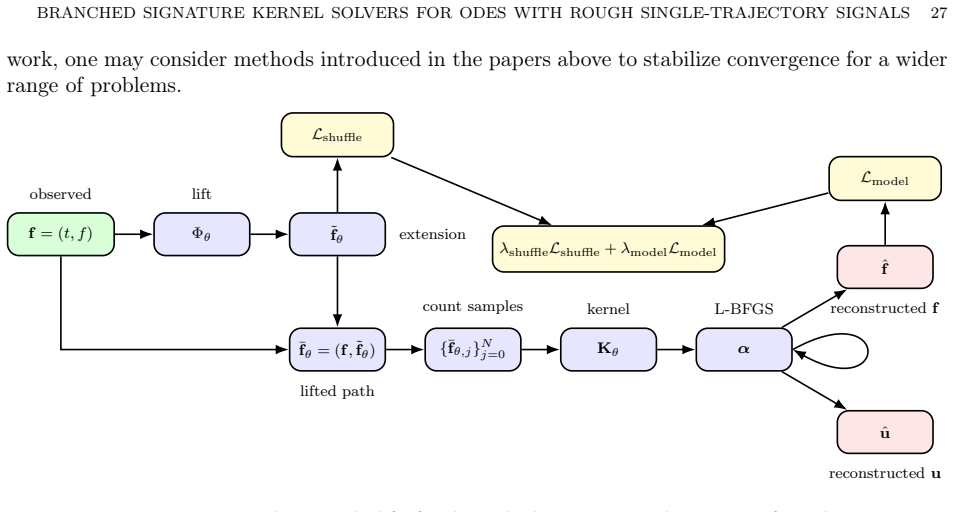
Count-sampling turns a single rough trajectory into nested paths that let branched signature kernels solve ODEs.
A machine-rendered reading of the paper's core claim, the machinery that carries it, and where it could break.
Core claim
The branched signature kernel solver for single-trajectory ODEs rests on the count-sampling construction that produces N+1 nested training paths from one observation, a collocation scheme that recovers lower derivatives by integration when needed, and a universal approximation result that reduces branched signature evaluations to geometric signatures of time-extended paths through the Hairer-Kelly morphism.
What carries the argument
the count-sampling construction, which converts one observed trajectory into a hierarchical family of N+1 nested training paths on which the branched signature kernel is evaluated
If this is right
- The solver applies to both linear and nonlinear ODEs with rough forcing.
- Numerical accuracy and stability are obtained on benchmarks including earthquake displacement, the Solow model, fractional Brownian motion driven equations, Duffing oscillators, and Kuramoto systems.
- The method extends from offline to streaming operation with closed-form updates in the linear case and scalar Newton steps in the nonlinear case.
- Kernel collocation can be performed either on the highest-order derivative with integration recovery or directly on the solution after m-fold integration of the ODE.
Where Pith is reading between the lines
- The same count-sampling idea might adapt to other kernel methods that currently require multiple realizations, such as in stochastic simulation.
- Testing the streaming protocol on real-time data streams with changing roughness could reveal practical limits not addressed in the offline benchmarks.
- The reduction via the Hairer-Kelly morphism suggests possible extensions to higher-order branched structures in rough path theory.
- Applications in structural health monitoring could use the online retraining step to update predictions as new forcing segments arrive.
Load-bearing premise
A single observed trajectory contains enough structure to be converted into a hierarchical family of nested paths that the branched signature kernel can use to approximate the ODE solution.
What would settle it
If the approximation error on the El-Centro earthquake displacement benchmark fails to decrease as the number of nested paths N is increased while keeping the kernel fixed, the claim that count-sampling enables accurate single-trajectory solutions would be refuted.
Figures





read the original abstract
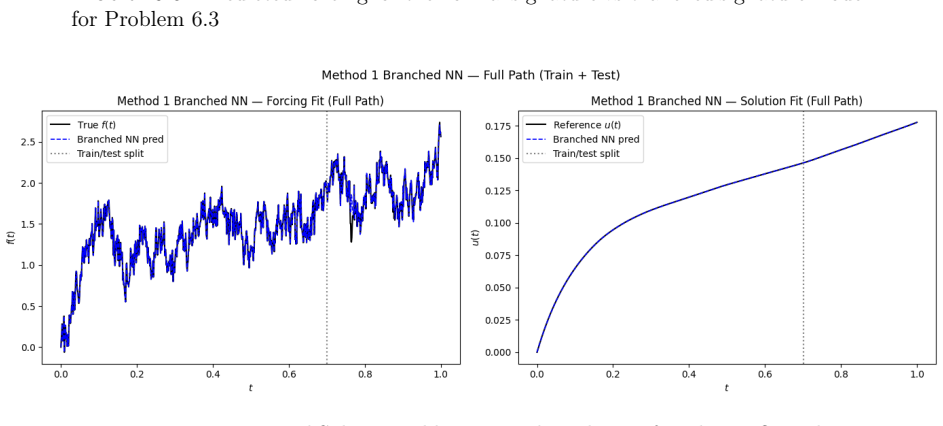
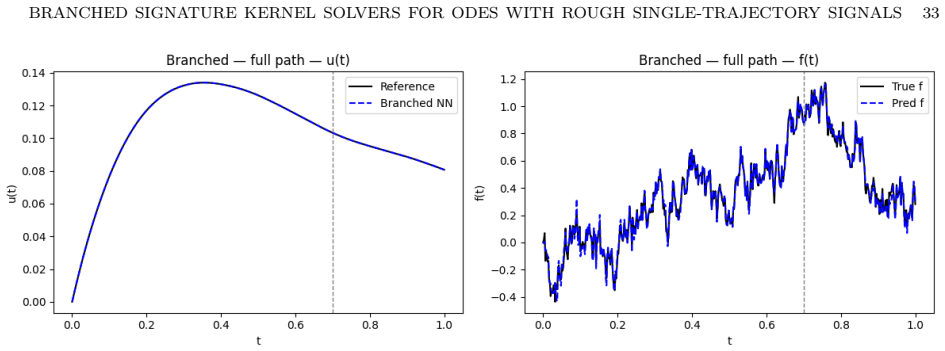
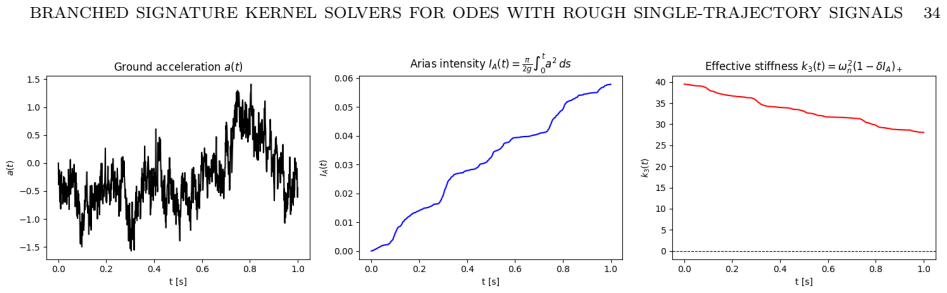
We develop a branched signature kernel solver for linear and nonlinear ordinary differential equations driven by a \emph{single observed trajectory} of a possibly rough forcing signal -- a setting that arises naturally in earthquake engineering, finance, biology, and structural health monitoring, where the forcing is observed exactly once and the solver must respect the underlying physical law without recourse to an ensemble of realizations. Two ingredients are new. First, a \emph{count-sampling} construction turns the single observation into a hierarchical family of $N+1$ nested training paths on which the branched signature kernel can be evaluated; this allows the signature kernel machinery, originally designed for multi-realization regression problems, to operate on a single-trajectory observation. Second, a kernel-collocation framework places the ansatz either on the highest-order derivative of the solution (with lower derivatives recovered by integrating the kernel) or on the solution itself (after $m$-fold integration of the ODE). We prove a universal approximation theorem for the branched signature kernel, leveraging the Hairer--Kelly morphism to express branched signature evaluations through geometric signatures of time-extended paths. The offline solver is extended to a streaming Test/Train/Retrain protocol with closed-form online updates in the linear case and scalar Newton steps in the nonlinear case. Numerical experiments on six benchmarks (El-Centro earthquake displacement, the Solow capital-stock model, an fBM-driven second-order ODE, a forced Duffing oscillator, a path-dependent Arias-intensity-degraded oscillator with variable coefficients, and a noisy Kuramoto phase-oscillator system) show that the branched signature-kernel solver delivers accurate, stable predictions across all regimes.
Editorial analysis
A structured set of objections, weighed in public.
Referee Report
Summary. The manuscript develops a branched signature kernel solver for linear and nonlinear ODEs driven by a single observed rough trajectory. It introduces a count-sampling construction to generate a hierarchical family of N+1 nested training paths from one observation, enabling signature kernel techniques originally for multi-realization settings. A kernel-collocation framework is proposed (ansatz on highest derivative or integrated solution), a universal approximation theorem is proved via the Hairer-Kelly morphism relating branched signatures to geometric signatures of time-extended paths, the solver is extended to a streaming Test/Train/Retrain protocol with closed-form updates, and accuracy is shown on six benchmarks including El-Centro earthquake data, Solow model, fBM-driven ODE, Duffing oscillator, Arias-intensity oscillator, and noisy Kuramoto system.
Significance. If the count-sampling step rigorously preserves the required rough-path structure, the work offers a new approach to single-trajectory rough ODE solvers in applications where ensembles are unavailable, extending signature kernels beyond their standard multi-realization regime. The Hairer-Kelly-based universal approximation theorem and the streaming protocol with closed-form updates constitute clear technical strengths.
major comments (3)
- [§3] §3 (count-sampling construction): the claim that the N+1 nested paths allow the branched signature kernel to operate on a single-trajectory observation requires explicit verification that the sampling rule preserves p-variation bounds and the algebraic relations needed for the Hairer-Kelly reduction to geometric signatures; without this, the kernel-collocation ansatz does not necessarily approximate the true solution operator.
- [§4] §4 (universal approximation theorem): while the Hairer-Kelly morphism is correctly invoked to express branched evaluations through geometric signatures, the theorem statement must specify the precise dependence of the approximation error on the count-sampling parameter N and on the single-trajectory regularity assumptions, as these are load-bearing for the solver's validity.
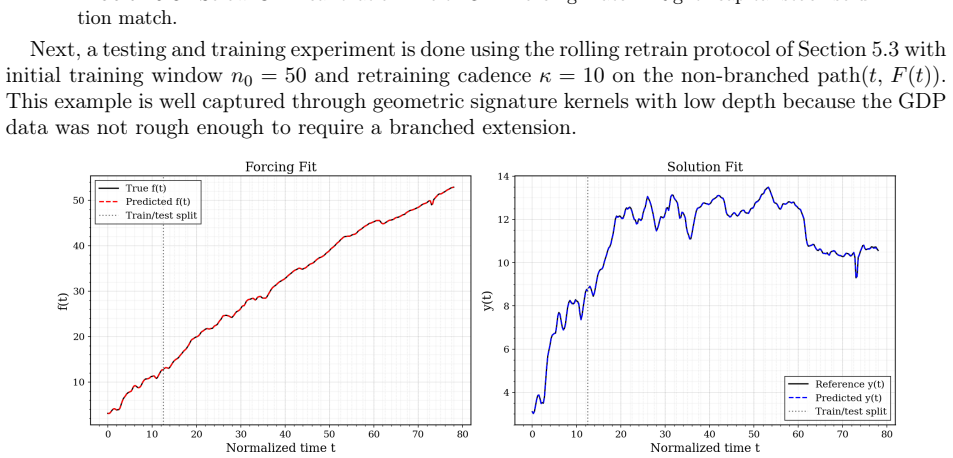
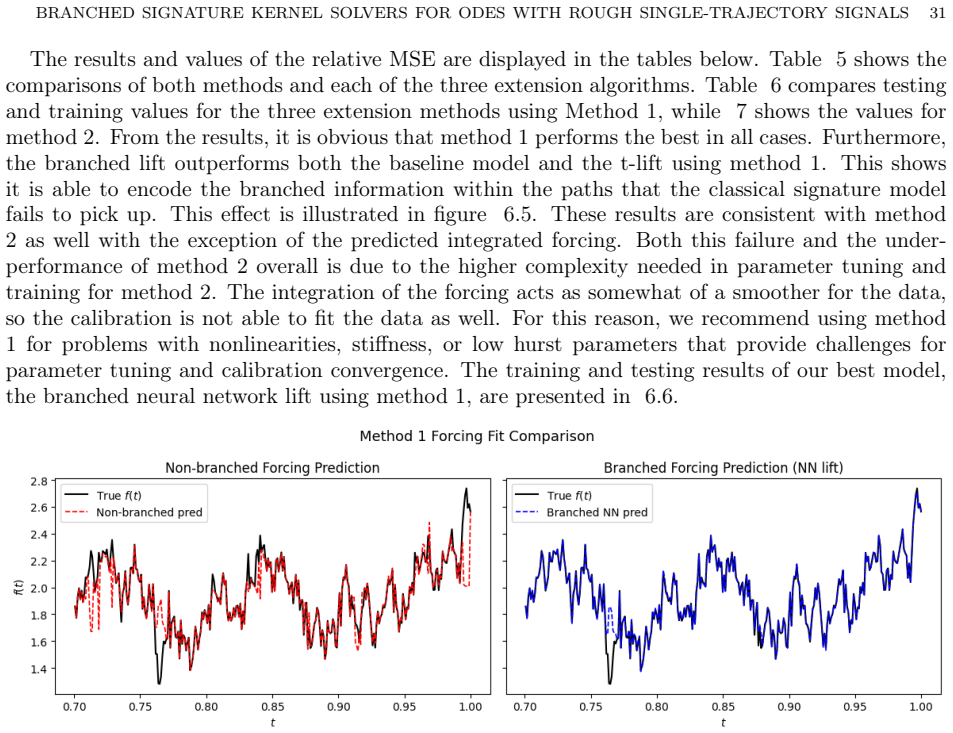
- [§6] Numerical experiments (§6): the six benchmarks report accurate predictions, but the absence of error bars, multiple realizations, or explicit exclusion criteria for the fBM-driven and noisy Kuramoto cases weakens the robustness claim across regimes; this is secondary to the theoretical gap but still affects the empirical support for the central solver.
minor comments (2)
- [§2] Notation for the branched signature kernel and the time-extension map should be introduced with a short self-contained definition in §2 before the count-sampling construction.
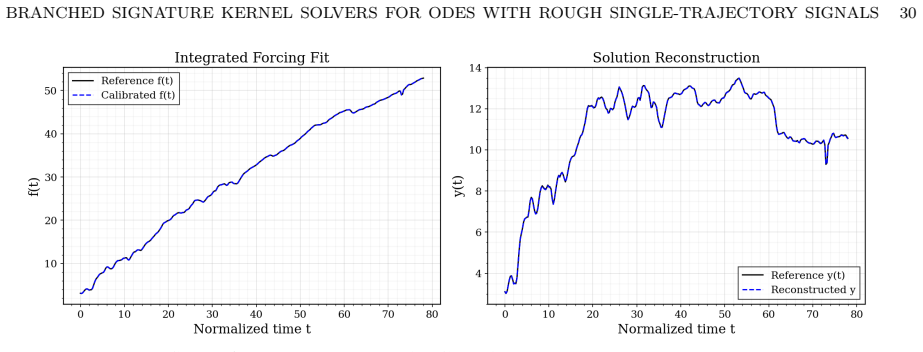
- [Figures] Figure captions for the benchmark plots should explicitly label the observed forcing trajectory alongside the predicted solution for direct visual comparison.
Simulated Author's Rebuttal
We thank the referee for their thorough review and constructive comments on our manuscript. We address each major comment point by point below, indicating the revisions we will implement.
read point-by-point responses
-
Referee: [§3] §3 (count-sampling construction): the claim that the N+1 nested paths allow the branched signature kernel to operate on a single-trajectory observation requires explicit verification that the sampling rule preserves p-variation bounds and the algebraic relations needed for the Hairer-Kelly reduction to geometric signatures; without this, the kernel-collocation ansatz does not necessarily approximate the true solution operator.
Authors: We agree that an explicit verification is required. In the revised manuscript we will add a new lemma in §3 proving that the count-sampling rule preserves the necessary p-variation bounds and the algebraic structure required for the Hairer-Kelly morphism to apply, thereby justifying the reduction to geometric signatures of time-extended paths. revision: yes
-
Referee: [§4] §4 (universal approximation theorem): while the Hairer-Kelly morphism is correctly invoked to express branched evaluations through geometric signatures, the theorem statement must specify the precise dependence of the approximation error on the count-sampling parameter N and on the single-trajectory regularity assumptions, as these are load-bearing for the solver's validity.
Authors: We accept that the current theorem statement lacks explicit error dependence. We will revise the universal approximation theorem in §4 to state quantitative bounds showing how the approximation error scales with the count-sampling parameter N and with the Hölder or p-variation regularity of the single observed trajectory, and we will update the proof to make these dependencies transparent. revision: yes
-
Referee: [§6] Numerical experiments (§6): the six benchmarks report accurate predictions, but the absence of error bars, multiple realizations, or explicit exclusion criteria for the fBM-driven and noisy Kuramoto cases weakens the robustness claim across regimes; this is secondary to the theoretical gap but still affects the empirical support for the central solver.
Authors: For real single-trajectory data such as the El-Centro record, multiple independent realizations are unavailable by nature of the problem. For the synthetic benchmarks we will add error bars computed over multiple simulated paths and include a short paragraph stating the explicit selection criteria used for all six examples. These additions will be made in the revised §6. revision: partial
Circularity Check
No significant circularity; central claims rest on external Hairer-Kelly morphism and explicit constructions
full rationale
The paper's universal approximation theorem is explicitly derived from the external Hairer-Kelly morphism applied to time-extended paths, with no reduction to self-citation or fitted inputs. The count-sampling construction is presented as a direct transformation of the single trajectory into N+1 nested paths, without any claim that it is 'predicted' from data or fitted parameters. No load-bearing steps reduce by definition or by self-referential fitting; the kernel-collocation ansatz and streaming updates are algorithmic extensions of the signature kernel framework. The derivation chain remains self-contained against external benchmarks.
Axiom & Free-Parameter Ledger
Reference graph
Works this paper leans on
-
[1]
Abbasbandy, S., Azarnavid, B., and Alhuthali, M. S. (2015). A shooting reproducing kernel hilbert space method for multiple solutions of nonlinear boundary value problems. Journal of Computational and Applied Mathematics , 279:293--305
2015
-
[2]
and Feng, Q
Ali, M. and Feng, Q. (2025). Branched signature model
2025
-
[3]
Alòs, E., Òscar Burés, de Santiago, R., and Vives, J. (2025). Volatility modeling with rough paths: A signature-based alternative to classical expansions
2025
-
[4]
Arias, A. (1970). A measure of earthquake intensity. Seismic Design for Nuclear Power Plants, R.J.\ Hansen (ed.), MIT Press , pages 438--483
1970
-
[5]
Bayer, C., Gogolashvili, D., and Pelizzari, L. (2025). Local regression on path spaces with signature metrics
2025
-
[6]
Bayraktar, E., Feng, Q., and Zhang, Z. (2024). Deep signature algorithm for multidimensional path-dependent options. SIAM Journal on Financial Mathematics , 15(1):194--214
2024
-
[7]
Boedihardjo, H., Geng, X., Lyons, T., and Yang, D. (2016). The signature of a rough path: Uniqueness. Advances in Mathematics , 293:720--737
2016
-
[8]
Caba \ n as, L., Benito, B., and Herr \'a iz, M. (1997). An approach to the measurement of the potential structural damage of earthquake ground motions. Earthquake Engineering & Structural Dynamics , 26(1):79--92
1997
-
[9]
Ceylan, M., Kwossek, A. P., and Pr \"o mel, D. J. (2026). Universal approximation with signatures of non-geometric rough paths. arXiv preprint arXiv:2602.05898
-
[10]
Chen, Y., Hosseini, B., Owhadi, H., and Stuart, A. M. (2021). Solving and learning nonlinear pdes with gaussian processes
2021
-
[11]
and Kormilitzin, A
Chevyrev, I. and Kormilitzin, A. (2025). A primer on the signature method in machine learning. In Signature Methods in Finance: An Introduction with Computational Applications , pages 3--64. Springer
2025
-
[12]
and Oberhauser, H
Chevyrev, I. and Oberhauser, H. (2022). Signature moments to characterize laws of stochastic processes
2022
-
[13]
N., Lui, S., Malpass, W., Mantoan, G., Nesheim, L., Áureo de Paula, Reeves, A., Scott, C., Small, E., and Yang, L
Cohen, S. N., Lui, S., Malpass, W., Mantoan, G., Nesheim, L., Áureo de Paula, Reeves, A., Scott, C., Small, E., and Yang, L. (2023). Nowcasting with signature methods
2023
-
[14]
and Kreimer, D
Connes, A. and Kreimer, D. (1999). Hopf algebras, renormalization and noncommutative geometry. In Quantum field theory: perspective and prospective , pages 59--109. Springer
1999
- [15]
-
[16]
Cuchiero, C., Gazzani, G., and Svaluto-Ferro, S. (2023). Signature-based models: theory and calibration. SIAM journal on financial mathematics , 14(3):910--957
2023
-
[17]
Cuchiero, C., Primavera, F., and Svaluto-Ferro, S. (2025). Universal approximation theorems for continuous functions of c \`a dl \`a g paths and l \'e vy-type signature models. Finance and Stochastics , 29(2):289--342
2025
-
[18]
Deng, X., Liu, H., and Long, T. (2012). A new complex duffing oscillator used in complex signal detection. Chinese Science Bulletin , 57
2012
-
[19]
Fang, B., Ni, H., and Wu, Y. (2023). A neural rde-based model for solving path-dependent pdes
2023
-
[20]
Louis (2024)
Federal Reserve Bank of St. Louis (2024). Real Gross Domestic Product . https://fred.stlouisfed.org/series/A191RL1Q225SBEA. FRED, Federal Reserve Bank of St. Louis. Accessed: 2026-05-19
2024
-
[21]
Feng, Q., Luo, M., and Zhang, Z. (2023). Deep signature fbsde algorithm
2023
-
[22]
and Flyer, N
Fornberg, B. and Flyer, N. (2015). Solving pdes with radial basis functions. Acta Numerica , 24:215–258
2015
-
[23]
Friz, P. K. and Victoir, N. B. (2010). Multidimensional Stochastic Processes as Rough Paths: Theory and Applications . Cambridge Studies in Advanced Mathematics. Cambridge University Press
2010
-
[24]
and Inzirillo, H
Genet, R. and Inzirillo, H. (2025). Keras sig: Efficient path signature computation on gpu in keras 3
2025
-
[25]
Green, P., Worden, K., Atallah, K., and Sims, N. (2012). The Benefits of Duffing-type Nonlinearities and Electrical Optimisation of a Randomly Excited Energy Harvester , volume 6, pages 657--667
2012
-
[26]
Gubinelli, M. (2010). Ramification of rough paths. Journal of Differential Equations , 248(4):693--721
2010
-
[27]
Extracting information from the signature of a financial data stream
Gyurk \'o , L. G., Lyons, T., Kontkowski, M., and Field, J. (2013). Extracting information from the signature of a financial data stream. arXiv preprint arXiv:1307.7244
work page internal anchor Pith review Pith/arXiv arXiv 2013
-
[28]
and Kelly, D
Hairer, M. and Kelly, D. (2015). Geometric versus non-geometric rough paths. In Annales de l'IHP Probabilit \'e s et statistiques , volume 51, pages 207--251
2015
-
[29]
and Lyons, T
Hambly, B. and Lyons, T. (2010). Uniqueness for the signature of a path of bounded variation and the reduced path group. Annals of Mathematics , pages 109--167
2010
-
[30]
Hao, B., Braga-Neto, U., Liu, C., Wang, L., and Zhong, M. (2025). Stability in training pinns for stiff pdes: Why initial conditions matter
2025
-
[31]
Horvath, B., Lemercier, M., Liu, C., Lyons, T., and Salvi, C. (2023). Optimal stopping via distribution regression: a higher rank signature approach
2023
-
[32]
Issa, Z., Horvath, B., Lemercier, M., and Salvi, C. (2023). Non-adversarial training of neural sdes with signature kernel scores
2023
-
[33]
Kansa, E. (1990a). Multiquadrics – a scattered data approximation scheme with applications to computational fluid-dynamics. ii: Solutions to parabolic, hyperbolic and elliptic partial differential equations. Computers & Mathematics with Applications , 19:147--161
-
[34]
Kansa, E. (1990b). Multiquadrics—a scattered data approximation scheme with applications to computational fluid-dynamics—i surface approximations and partial derivative estimates. Computers & Mathematics with Applications , 19(8):127--145
-
[35]
Kidger, P., Bonnier, P., Perez Arribas, I., Salvi, C., and Lyons, T. (2019). Deep signature transforms. In Advances in Neural Information Processing Systems , volume 32. Curran Associates, Inc
2019
-
[36]
and Lyons, T
Kidger, P. and Lyons, T. (2021). S ignatory: differentiable computations of the signature and logsignature transforms, on both CPU and GPU . In International Conference on Learning Representations . https://github.com/patrick-kidger/signatory
2021
-
[37]
Kir \'a ly, F. J. and Oberhauser, H. (2019). Kernels for sequentially ordered data. Journal of Machine Learning Research , 20(31):1--45
2019
-
[38]
Krishnapriyan, A., Gholami, A., Zhe, S., Kirby, R., and Mahoney, M. (2021). Characterizing possible failure modes in physics-informed neural networks. In Ranzato, M., Beygelzimer, A., Dauphin, Y., Liang, P., and Vaughan, J. W., editors, Advances in Neural Information Processing Systems , volume 34, pages 26548--26560. Curran Associates, Inc
2021
-
[39]
Kuramoto, Y. (1975). Self-entrainment of a population of coupled non-linear oscillators. In Araki, H., editor, International Symposium on Mathematical Problems in Theoretical Physics , pages 420--422, Berlin, Heidelberg. Springer Berlin Heidelberg
1975
-
[40]
and Leng, Y.-G
Lai, Z.-H. and Leng, Y.-G. (2015). Generalized parameter-adjusted stochastic resonance of duffing oscillator and its application to weak-signal detection. Sensors , 15(9):21327--21349
2015
-
[41]
V., and Lyons, T
Lemercier, M., Salvi, C., Damoulas, T., Bonilla, E. V., and Lyons, T. (2021). Distribution regression for sequential data
2021
-
[42]
Levin, D., Lyons, T., and Ni, H. (2016). Learning from the past, predicting the statistics for the future, learning an evolving system
2016
-
[43]
Li, Q. (2001). Free vibration of sdof systems with arbitrary time-varying coefficients. International Journal of Mechanical Sciences , 43(3):759--770
2001
-
[44]
Li, Q., Fang, J., and Liu, D. (2000). Exact solutions for free vibration of single-degree-of-freedom systems with nonperiodically varying parameters. Journal of Vibration and Control , 6:449--462
2000
-
[45]
Li, Q. S. (1999). A new exact approach for analyzing free vibration of sdof systems with nonperiodically time varying parameters. Journal of Vibration and Acoustics , 122(2):175--179
1999
-
[46]
Lobo, D., Ritto, T., Castello, D., and Cataldo, E. (2019). Dynamics of a duffing oscillator with the stiffness modeled as a stochastic process. International Journal of Non-Linear Mechanics , 116:273--280
2019
-
[47]
Lyons, T. (2014). Rough paths, signatures and the modelling of functions on streams
2014
-
[48]
and McLeod, A
Lyons, T. and McLeod, A. D. (2025). Signature methods in machine learning
2025
-
[49]
Lyons, T., Nejad, S., and Perez Arribas, I. (2020). Non-parametric pricing and hedging of exotic derivatives. Applied Mathematical Finance , 27(6):457--494
2020
-
[50]
J., Caruana, M., and L \'e vy, T
Lyons, T. J., Caruana, M., and L \'e vy, T. (2007). Differential equations driven by rough paths: Ecole d'Et \'e de Probabilit \'e s de Saint-Flour XXXIV-2004 . Springer
2007
-
[51]
and Sims, N
Mann, B. and Sims, N. (2009). Energy harvesting from the nonlinear oscillations of magnetic levitation. Journal of Sound and Vibration , 319:515--530
2009
-
[52]
Mohaddes, A., Iafrate, F., and Lederer, J. (2025). Regularized learning for fractional brownian motion via path signatures
2025
-
[53]
and Salvi, C
Pannier, A. and Salvi, C. (2024). A path-dependent pde solver based on signature kernels
2024
-
[54]
Ramtani, S. (2013). Basic concepts and models in continuum damage mechanics. Technical report, HAL Open Archive. hal-00776729, https://hal.science/hal-00776729/document
2013
-
[55]
and Graham, B
Reizenstein, J. and Graham, B. (2020). Algorithm 1004: The iisignature library: Efficient calculation of iterated-integral signatures and log signatures. ACM Transactions on Mathematical Software (TOMS)
2020
-
[56]
Reynolds, T., Harris, R., and Chang, W.-S. (2014). Nonlinear pre-yield modal properties of timber structures with large-diameter steel dowel connections. Engineering Structures , 76:235--244
2014
-
[57]
Sabate-Vidales, M., Šiška, D., and Szpruch, L. (2020). Solving path dependent pdes with lstm networks and path signatures
2020
-
[58]
Sakaguchi, H. (1988). Cooperative phenomena in coupled oscillator systems under external fields. Progress of theoretical physics , 79(1):39--46
1988
-
[59]
Salvi, C., Cass, T., Foster, J., Lyons, T., and Yang, W. (2021). The signature kernel is the solution of a goursat pde. SIAM Journal on Mathematics of Data Science , 3(3):873–899
2021
-
[60]
and Salvi, C
Shmelev, D. and Salvi, C. (2025). pysiglib -- fast signature-based computations on cpu and gpu
2025
-
[61]
Solow, R. M. (1956). A contribution to the theory of economic growth. The Quarterly Journal of Economics , 70(1):65--94
1956
- [62]
-
[63]
Toth, C., Oberhauser, H., and Szabo, Z. (2024). Random fourier signature features
2024
-
[64]
El centro earthquake
Vibrationdata . El centro earthquake
-
[65]
Wang, S., Sankaran, S., and Perdikaris, P. (2024). Respecting causality for training physics-informed neural networks. Computer Methods in Applied Mechanics and Engineering , 421:116813
2024
-
[66]
Wang, S., Teng, Y., and Perdikaris, P. (2021). Understanding and mitigating gradient flow pathologies in physics-informed neural networks. SIAM Journal on Scientific Computing , 43(5):A3055--A3081
2021
-
[67]
Xiang, J., Guo, J., and Li, X. (2024). A two-stage duffing equation-based oscillator and stochastic resonance for mechanical fault diagnosis. Chaos, Solitons & Fractals , 182:114755
2024
-
[68]
and Unal, G
Yilmaz, A. and Unal, G. (2019). Stochastic duffing equation in modelling of financial time series. International Journal of Dynamics and Control , 7:1--22
2019
-
[69]
and Jiang, S
Zeng, P. and Jiang, S. (2025). Semi-parametric functional classification via path signatures logistic regression
2025
discussion (0)
Sign in with ORCID, Apple, or X to comment. Anyone can read and Pith papers without signing in.