REVIEW 3 major objections 5 minor 40 references
Aug3D: Augmenting large scale outdoor datasets for Generalizable Novel View Synthesis
T0 review · 3 major / 5 minor · reviewed 2026-08-10 · deepseek-v4-flash
Pith's one-line read This paper claims that adding synthetic novel views rendered from a reconstruction of a large outdoor scene improves how well a feed-forward neural network predicts new views, with semantic sampling (21.80 PSNR) edging out grid sampling…
desk verdict Plausible augmentation idea undermined by an omitted baseline: the paper's own cluster-10 result beats the proposed method. read the letter →
The pith
A machine-rendered reading of the paper's core claim, the machinery that carries it, and where it could break.
The reading
What carries the argument
The central objects are the clustering metric and the two sampling strategies. The clustering metric is an SfM shared-point similarity matrix: cameras observing the same structures share many matched points, so top-K neighbors by this similarity form coherent clusters. The augmentation strategies are Multiscale Grid Sampling, which places virtual domes over dynamically sized grid cells, and Semantic Building Sampling, which fits a plane to the top percentile of points by height, renders a top-down mask, extracts bounding boxes, and merges nearby boxes to place domes preferentially over urban regions. These domes sample synthetic camera poses on the reconstructed mesh, and the rendered views are added to the real training set plus PixelNeRF, a feed-forward NeRF conditioned on pixel-aligned features.
What would settle it
Train PixelNeRF on the real Campus dataset with cluster size 10 (which the paper reports gives 22.94 PSNR) and compare it against the same model trained on real data plus Aug3D synthetic views under identical evaluation; if the augmented model does not exceed 22.94 PSNR on real held-out views, the augmentation's claimed benefit is falsified. Additionally, measuring real-image PSNR of a model trained only on synthetic views would directly quantify the domain gap implied by the 29.12 synthetic-only result.
Extended reading notes
Core claim
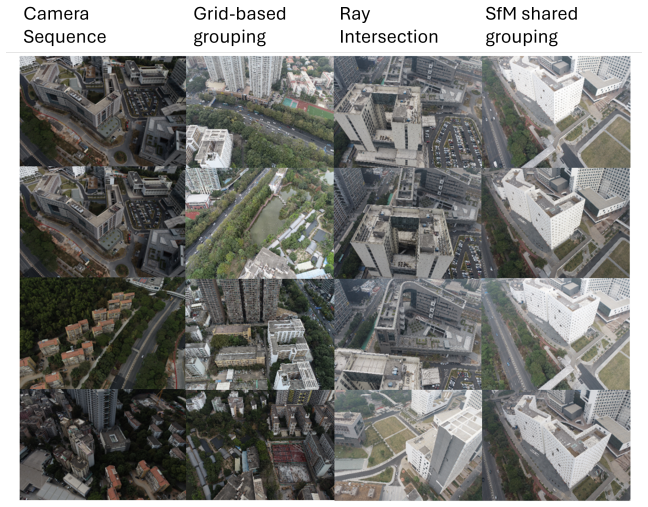
On the paper's own terms, the central discovery is that a data curation and augmentation pipeline can make feed-forward NeRF models viable on large outdoor scenes. The paper reports four clustering strategies tested on the UrbanScene3D Campus scene, finding that grouping images by shared SfM points yields the best PixelNeRF performance (best PSNR 20.03, average 14.6), far above sequence grouping (9.7), grid grouping (12.2), and ray-intersection grouping (13.6). It further reports that shrinking the cluster size from 20 to 10 images raises best PSNR to 22.94. The paper's proposed Aug3D augmentation renders synthetic views from a reconstructed mesh using either multiscale grid sampling or semantic plane-fitting sampling; synthetic-only training reaches 29.12 and 28.79 PSNR respectively, and mixing these synthetic views with the real dataset yields best PSNR of 21.80 (semantic) and 21.67 (grid), slightly surpassing the cluster-size-20 real baseline of 20.03.
Load-bearing premise
The load-bearing premise is that synthetic views rendered from an SfM/MVS reconstruction of the same scene are a valid proxy for real novel-view generalization, such that adding them to the real training set improves real-data performance; the presented evidence only compares against a weaker cluster-size-20 baseline, not the stronger cluster-size-10 real baseline.
Editorial extensions
If this is right
- Reducing cluster size from 20 to 10 images improves PSNR by roughly 10 percent, indicating that high view overlap within input clusters is a key factor for feed-forward NVS on outdoor scenes.
- Semantic sampling around urban regions outperforms uniform grid sampling when synthetic views are mixed with real data, suggesting that directing augmentation toward underrepresented scene content helps.
- The SfM shared-point grouping method can be applied to any feed-forward NVS model that expects DTU-like clustered inputs, not only PixelNeRF.
- The full pipeline trained successfully on the UrbanScene3D Campus scene, implying it could extend to other large outdoor datasets captured in similar drone grid patterns, such as Mill-19.
Reading between the lines
- The paper's claim that Aug3D 'enhances' GNVS performance would be stronger if benchmarked against the best real-data baseline: the cluster-size-10 baseline (22.94 PSNR) already exceeds the best augmented result (21.80 PSNR), so the marginal benefit of synthetic views on real data is not established by the presented comparison.
- The large gap between synthetic-only PSNR (29.12) and real-data PSNR (around 20 to 21) suggests a substantial domain gap; a natural test is whether synthetic pretraining followed by fine-tuning on real data narrows that gap.
- The semantic plane-fitting sampler could be extended to other semantic classes (roads, vegetation) or combined with more robust building detectors; the paper notes that SAM-based detection was shadow-sensitive, so better segmentation would likely improve view diversity.
- The key clustering insight—that shared SfM points define coherence—could be combined with the augmentation strategy for other feed-forward models and should be tested on held-out real captures from unseen drone trajectories.
Editorial analysis
A structured set of objections, weighed in public.
Referee Report
Summary. The paper addresses generalizable novel view synthesis (GNVS) on large-scale outdoor scenes by curating training clusters from the UrbanScene3D dataset and proposing Aug3D, a reconstruction-based augmentation method that generates synthetic views via multiscale grid or semantic plane-fitting sampling. The authors train PixelNeRF and compare four clustering strategies, finding SfM shared-point grouping to be the best. They report that reducing the cluster size from 20 to 10 images improves PSNR from 20.03 to 22.94. They then claim that augmenting the real dataset with synthetic views achieves a best PSNR of 21.80, surpassing the real-data baseline, and conclude that this validates Aug3D's effectiveness in enhancing GNVS performance.
Significance. If properly validated, a data curation and augmentation pipeline for outdoor GNVS would be valuable, as feed-forward NVS models are typically limited to small object-centric scenes. The systematic comparison of clustering methods and the idea of using reconstructed scenes to generate well-conditioned novel views are interesting and potentially useful. However, the current evidence does not support the central claim; the paper's own numbers contradict it, and the synthetic evaluation is circular.
major comments (3)
- [Section V, Table II] The claimed validation of Aug3D is unsupported because Table II compares Aug3D (best PSNR 21.80) only against the cluster-size-20 real baseline (20.03), while Section V itself reports that reducing the cluster size from 20 to 10 improves PSNR to 22.94. Under the paper's own numbers, the simple cluster-size reduction outperforms Aug3D Semantic by 1.14 dB. The statement 'These results validate the effectiveness of the Aug3D dataset in enhancing GNVS performance' therefore does not follow. The authors must compare against the best real-data configuration (cluster size 10) and, ideally, include an ablation in which Aug3D is added to that configuration.
- [Section V, Table II, Synthetic Dataset rows] The synthetic-only PSNR values (29.12 for Grid Sampling, 28.79 for Semantic Plane Fitting) are evaluated on renders from the same SfM/MVS reconstruction that was used to generate the synthetic training views. This evaluation is circular: the model is trained and tested on views derived from the same mesh, so the high PSNR reflects reconstruction consistency rather than generalization to real novel views. The approximately 8 dB gap between synthetic-only and real-data PSNR indicates a substantial domain gap. The authors should evaluate models trained on synthetic data against held-out real views or on a different scene to demonstrate generalization.
- [Section IV, Compute Setup and Table II] No error bars, standard deviations, or multiple-seed results are reported. The compute setup varies across experiments: the real-dataset experiments use two 32GB Tesla V100 GPUs, the Grid-based augmentation uses a single 24GB RTX 3090 Ti, and all other experiments use a 10GB RTX 3080. The difference between Aug3D Grid (21.67) and Aug3D Semantic (21.80) is only 0.13 dB, and without variance estimates or fixed hardware, training noise cannot be ruled out as an explanation. Report the mean and standard deviation over at least three independent runs on identical hardware.
minor comments (5)
- [Section III-B] The phrase 'scene sentric dome sampling' appears to contain a typo; it should read 'scene-centric dome sampling.'
- [Section IV, Dataset and Metric] The paper states that PixelNeRF is run with '256 hidden layers'; this is likely a typo for '256 hidden units' or 'hidden features,' since PixelNeRF's architecture uses fully connected layers with 256 hidden units.
- [Section V, Table I] The column labeled 'Low PSNR' in Table I is not defined; please clarify whether it refers to the minimum PSNR across test views, the worst cluster, or some other quantity.
- [Section IV and Appendix B] Section IV says 'we focus exclusively on the Campus scene from the UrbanScene3D dataset,' but Figure 7 in the Appendix reports qualitative results on a 'Residence scene.' Please clarify whether quantitative results also exist for that scene or remove the inconsistency.
- [Abstract and Section V] The abstract reports that reducing the cluster size from 20 to 10 'improves PSNR by 10%,' but the text gives values 20.03 and 22.94, which correspond to a relative improvement of about 14.5%. Please make the percentage calculation consistent.
Circularity Check
No load-bearing circularity; the real-data Aug3D comparison is independent in principle, though the synthetic-only PSNR scores are self-referential and the stronger cluster-size-10 baseline is omitted.
-
other
[Section V, 'Aug3D + Real vs Real dataset' paragraph and Table II; Section III-B augmentation description]
"The synthetic dataset, reconstructed using Grid Sampling and Semantic Plane Fitting, achieves PSNR values of 29.12 and 28.79, respectively, with 3 input images, a cluster size of 20."
The synthetic training views and the synthetic evaluation views are both renders of the same SfM/MVS reconstruction described in Section III-B ('First we reconstruct the scene using traditional structure from motion and multi-view stereo approaches, then sampling novel views'). The ground-truth images used to compute the 29.12/28.79 PSNR values are therefore produced by the same reconstruction that generated the training renders. The high PSNR chiefly measures how well the model reproduces that single reconstruction, not how well it generalizes to real novel views. The only independent evidence for the central claim is the real-data comparison in Table II, which is incomplete because the paper's own cluster-size-10 real baseline (22.94) is omitted from the table.
full rationale
The paper's central claim is that Aug3D augmentation improves real-data generalizable novel view synthesis. The direct evidence for this is the comparison in Table II between the Real Dataset baseline (20.03 PSNR) and Aug3D Semantic (21.80 PSNR), which is an independent, non-circular empirical comparison. However, the paper's own Section V reports that reducing the cluster size from 20 to 10 with SfM shared grouping improves PSNR to 22.94, and that number is not included in Table II. Under the paper's own numbers, the simple cluster-size reduction outperforms the proposed Aug3D Semantic result by 1.14 dB, so the statement that 'These results validate the effectiveness of the Aug3D dataset in enhancing GNVS performance' does not follow as written. This is a completeness and correctness problem, not a circularity of derivation. Separately, the synthetic-only PSNR values (29.12 and 28.79) are computed on renders from the same SfM/MVS reconstruction used to generate the synthetic training data, making those numbers self-referential as evidence of real-world generalization. That issue is real but minor relative to the central claim, because the real-data comparison is the load-bearing evidence and it is independent in principle. There is no self-citation chain, no fitted parameter renamed as a prediction, and no imported uniqueness theorem. The derivation of the augmentation pipeline itself is self-contained, so the overall circularity score is low.
Assumptions & free parameters
free parameters (6)
- cluster size K =
20 and 10
- number of input views =
3, 6, 9
- grid cell scales for multiscale sampling =
unspecified, dynamically adjusted
- Kth percentile for plane fitting =
unspecified
- M (number of nearest boxes merged) =
unspecified range 1 to M
- dome azimuth and elevation sampling ranges =
unspecified
assumptions (4)
- domain assumption SfM/MVS reconstruction (via Metashape) produces a mesh accurate enough that renders from it are useful training data for real scenes.
- domain assumption PixelNeRF with fixed encoder weights is a representative generalizable NVS model, and results on it transfer to other feed-forward models.
- domain assumption Evaluation on a single scene (UrbanScene3D Campus) supports conclusions about large outdoor scenes generally.
- domain assumption Best PSNR over the test set is a sufficient statistic for reconstruction fidelity.
Cite this review
Pith. "Pith review of Aug3D: Augmenting large scale outdoor datasets for Generalizable Novel View Synthesis." pith.science (2026). https://pith.science/paper/ZMIVG7VF
@misc{pith2026250106431,
  author       = {Pith},
  title        = {Pith review of: Aug3D: Augmenting large scale outdoor datasets for Generalizable Novel View Synthesis},
  year         = {2026},
  howpublished = {\url{https://pith.science/paper/ZMIVG7VF}},
  note         = {Machine review of arXiv:2501.06431}
}
read the original abstract
Recent photorealistic Novel View Synthesis (NVS) advances have increasingly gained attention. However, these approaches remain constrained to small indoor scenes. While optimization-based NVS models have attempted to address this, generalizable feed-forward methods, offering significant advantages, remain underexplored. In this work, we train PixelNeRF, a feed-forward NVS model, on the large-scale UrbanScene3D dataset. We propose four training strategies to cluster and train on this dataset, highlighting that performance is hindered by limited view overlap. To address this, we introduce Aug3D, an augmentation technique that leverages reconstructed scenes using traditional Structure-from-Motion (SfM). Aug3D generates well-conditioned novel views through grid and semantic sampling to enhance feed-forward NVS model learning. Our experiments reveal that reducing the number of views per cluster from 20 to 10 improves PSNR by 10%, but the performance remains suboptimal. Aug3D further addresses this by combining the newly generated novel views with the original dataset, demonstrating its effectiveness in improving the model's ability to predict novel views.
Figures


Figures from the paper (4 more)


Reference graph
Works this paper leans on
-
[1]
Aliev, K.A., Sevastopolsky, A., Kolos, M., Ulyanov, D., Lempitsky, V .: Neural point-based graphics. In: Computer Vision–ECCV 2020: 16th European Conference, Glasgow, UK, August 23–28, 2020, Pro- ceedings, Part XXII 16. pp. 696–712. Springer (2020)
work page 2020
-
[2]
2021 IEEE/CVF Conference on Computer Vision and Pattern Recognition (CVPR) pp
Bhattad, A., Dundar, A., Liu, G., Tao, A., Catanzaro, B.: View generalization for single image textured 3d models. 2021 IEEE/CVF Conference on Computer Vision and Pattern Recognition (CVPR) pp. 6077–6086 (2021), https://api.semanticscholar.org/ CorpusID:235417325
work page 2021
-
[3]
In: International Conference on Image Analysis and Processing
Bortolon, M., Del Bue, A., Poiesi, F.: Vm-nerf: tackling sparsity in nerf with view morphing. In: International Conference on Image Analysis and Processing. pp. 63–74. Springer (2023)
work page 2023
-
[4]
Chang, A.X., Funkhouser, T., Guibas, L., Hanrahan, P., Huang, Q., Li, Z., Savarese, S., Savva, M., Song, S., Su, H., Xiao, J., Yi, L., Yu, F.: ShapeNet: An Information-Rich 3D Model Repository
-
[5]
Charatan, D., Li, S., Tagliasacchi, A., Sitzmann, V .: pixelSplat: 3D Gaussian Splats from Image Pairs for Scalable Generalizable 3D Reconstruction (Dec 2023), http://arxiv.org/abs/2312. 12337, arXiv:2312.12337 [cs]
arXiv 2023
-
[6]
In: 2021 IEEE/CVF International Conference on Computer Vision (ICCV)
Chen, A., Xu, Z., Zhao, F., Zhang, X., Xiang, F., Yu, J., Su, H.: MVSNeRF: Fast Generalizable Radiance Field Reconstruction from Multi-View Stereo. In: 2021 IEEE/CVF International Conference on Computer Vision (ICCV). pp. 14104–14113. IEEE, Montreal, QC, Canada (Oct 2021). https://doi.org/10.1109/ICCV48922.2021.01386, https://ieeexplore.ieee.org/document/9711430/
arXiv 2021
-
[7]
In: Proceedings of the IEEE/CVF Conference on Computer Vision and Pattern Recognition
Chen, T., Wang, P., Fan, Z., Wang, Z.: Aug-nerf: Training stronger neural radiance fields with triple-level physically-grounded augmen- tations. In: Proceedings of the IEEE/CVF Conference on Computer Vision and Pattern Recognition. pp. 15191–15202 (2022)
work page 2022
-
[8]
arXiv preprint arXiv:2403.14627 (2024)
Chen, Y ., Xu, H., Zheng, C., Zhuang, B., Pollefeys, M., Geiger, A., Cham, T.J., Cai, J.: Mvsplat: Efficient 3d gaussian splatting from sparse multi-view images. arXiv preprint arXiv:2403.14627 (2024)
arXiv 2024
Show all 40 references
-
[9]
DeVries, T., Taylor, G.W.: Improved Regularization of Convolutional Neural Networks with Cutout (Nov 2017), http://arxiv.org/ abs/1708.04552, arXiv:1708.04552 [cs]
2017 arXiv
-
[10]
In: Proceed- ings of the IEEE/CVF Conference on Computer Vision and Pattern Recognition
Fridovich-Keil, S., Yu, A., Tancik, M., Chen, Q., Recht, B., Kanazawa, A.: Plenoxels: Radiance fields without neural networks. In: Proceed- ings of the IEEE/CVF Conference on Computer Vision and Pattern Recognition. pp. 5501–5510 (2022)
2022
-
[11]
In: 2014 IEEE Conference on Computer Vision and Pattern Recognition
Jensen, R., Dahl, A., V ogiatzis, G., Tola, E., Aanaes, H.: Large Scale Multi-view Stereopsis Evaluation. In: 2014 IEEE Conference on Computer Vision and Pattern Recognition. pp. 406–413. IEEE, Colum- bus, OH, USA (Jun 2014). https://doi.org/10.1109/CVPR.2014.59, https://ieeex...
2014
-
[12]
2021 IEEE/CVF Conference on Computer Vision and Pattern Recognition (CVPR) pp
Kellnhofer, P., Jebe, L., Jones, A., Spicer, R.P., Pulli, K., Wetzstein, G.: Neural lumigraph rendering. 2021 IEEE/CVF Conference on Computer Vision and Pattern Recognition (CVPR) pp. 4285–4295 (2021), https://api.semanticscholar.org/CorpusID: 232307471
2021
-
[13]
ACM Transactions on Graphics 42(4) (July 2023), https://repo-sam.inria.fr/ fungraph/3d-gaussian-splatting/
Kerbl, B., Kopanas, G., Leimk ¨uhler, T., Drettakis, G.: 3d gaussian splatting for real-time radiance field rendering. ACM Transactions on Graphics 42(4) (July 2023), https://repo-sam.inria.fr/ fungraph/3d-gaussian-splatting/
2023
-
[14]
In: 2019 IEEE/CVF Conference on Computer Vision and Pattern Recognition (CVPR)
Lan, Z., Yew, Z.J., Lee, G.H.: Robust Point Cloud Based Reconstruction of Large-Scale Outdoor Scenes. In: 2019 IEEE/CVF Conference on Computer Vision and Pattern Recognition (CVPR). pp. 9682–9690. IEEE, Long Beach, CA, USA (Jun 2019). https://doi.org/10.1109/CVPR.2019.00992, h...
2019
-
[15]
In: CVPR (2024)
Lin, J., Li, Z., Tang, X., Liu, J., Liu, S., Liu, J., Lu, Y ., Wu, X., Xu, S., Yan, Y ., Yang, W.: Vastgaussian: Vast 3d gaussians for large scene reconstruction. In: CVPR (2024)
2024
-
[16]
Lin, L., Liu, Y ., Hu, Y ., Yan, X., Xie, K., Huang, H.: Capturing, Re- constructing, and Simulating: the UrbanScene3D Dataset (Jul 2022), http://arxiv.org/abs/2107.04286, arXiv:2107.04286 [cs]
2022 arXiv
-
[17]
Mildenhall, B., Srinivasan, P.P., Tancik, M., Barron, J.T., Ramamoor- thi, R., Ng, R.: NeRF: Representing Scenes as Neural Radiance Fields for View Synthesis
-
[18]
In: 2021 International Conference on 3D Vision (3DV)
Nekrasov, A., Schult, J., Litany, O., Leibe, B., Engelmann, F.: Mix3D: Out-of-Context Data Augmentation for 3D Scenes. In: 2021 International Conference on 3D Vision (3DV). pp. 116–125. IEEE, London, United Kingdom (Dec 2021). https://doi.org/10.1109/3DV53792.2021.00022, https...
2021
-
[19]
2020 IEEE/CVF Conference on Computer Vision and Pattern Recognition (CVPR) pp
Niemeyer, M., Mescheder, L.M., Oechsle, M., Geiger, A.: Differen- tiable volumetric rendering: Learning implicit 3d representations with- out 3d supervision. 2020 IEEE/CVF Conference on Computer Vision and Pattern Recognition (CVPR) pp. 3501–3512 (2019), https: //api.semantics...
2019
-
[20]
Oleynikova, H., Millane, A., Taylor, Z., Galceran, E., Nieto, J., Siegwart, R.: Signed Distance Fields: A Natural Representation for Both Mapping and Planning p. 6 p. (2016). https://doi.org/10.3929/ETHZ-A-010820134, http: //hdl.handle.net/20.500.11850/128029, artwork Size: 6 ...
2016 doi
-
[22]
In: European Conference on Computer Vision (2020), https://api.semanticscholar
Riegler, G., Koltun, V .: Free view synthesis. In: European Conference on Computer Vision (2020), https://api.semanticscholar. org/CorpusID:221112229
2020
-
[23]
2019 IEEE/CVF Conference on Computer Vision and Pat- tern Recognition (CVPR) pp
Sitzmann, V ., Thies, J., Heide, F., Nießner, M., Wetzstein, G., Zollh¨ofer, M.: Deepvoxels: Learning persistent 3d feature embed- dings. 2019 IEEE/CVF Conference on Computer Vision and Pat- tern Recognition (CVPR) pp. 2432–2441 (2018), https://api. semanticscholar.org/CorpusI...
2018
-
[24]
org/abs/2312.13150, arXiv:2312.13150 [cs]
Szymanowicz, S., Rupprecht, C., Vedaldi, A.: Splatter Image: Ultra- Fast Single-View 3D Reconstruction (Dec 2023), http://arxiv. org/abs/2312.13150, arXiv:2312.13150 [cs]
2023 arXiv
-
[25]
Tancik, M., Casser, V ., Yan, X., Pradhan, S., Mildenhall, B., Srini- vasan, P.P., Barron, J.T., Kretzschmar, H.: Block-NeRF: Scalable Large Scene Neural View Synthesis (Feb 2022), http://arxiv.org/ abs/2202.05263, arXiv:2202.05263 [cs]
2022 arXiv
-
[26]
Computer Graph- ics Forum 41 (2021), https://api.semanticscholar.org/ CorpusID:236162433
Tewari, A., Fried, O., Thies, J., Sitzmann, V ., Lombardi, S., Xu, Z., Simon, T., Nießner, M., Tretschk, E., Liu, L., Mildenhall, B., Srinivasan, P., Pandey, R., Orts-Escolano, S., Fanello, S., Guo, M.G., Wetzstein, G., y Zhu, J., Theobalt, C., Agrawala, M., Goldman, D.B., Zol...
2021
-
[27]
In: 2017 IEEE/RSJ international con- ference on intelligent robots and systems (IROS)
Tobin, J., Fong, R., Ray, A., Schneider, J., Zaremba, W., Abbeel, P.: Domain randomization for transferring deep neural networks from simulation to the real world. In: 2017 IEEE/RSJ international con- ference on intelligent robots and systems (IROS). pp. 23–30. IEEE (2017)
2017
-
[28]
In: Proceedings of the IEEE conference on computer vision and pattern recognition workshops
Tremblay, J., Prakash, A., Acuna, D., Brophy, M., Jampani, V ., Anil, C., To, T., Cameracci, E., Boochoon, S., Birchfield, S.: Training deep networks with synthetic data: Bridging the reality gap by domain randomization. In: Proceedings of the IEEE conference on computer visio...
2018
-
[29]
ArXiv abs/2007.08504 (2020), https://api.semanticscholar.org/CorpusID: 220546413
Tulsiani, S., Kulkarni, N., Gupta, A.K.: Implicit mesh reconstruc- tion from unannotated image collections. ArXiv abs/2007.08504 (2020), https://api.semanticscholar.org/CorpusID: 220546413
2020 arXiv
-
[30]
In: 2022 IEEE/CVF Conference on Computer Vision and Pattern Recog- nition (CVPR)
Turki, H., Ramanan, D., Satyanarayanan, M.: Mega-NeRF: Scalable Construction of Large-Scale NeRFs for Virtual Fly- Throughs. In: 2022 IEEE/CVF Conference on Computer Vision and Pattern Recog- nition (CVPR). pp. 12912–12921. IEEE, New Orleans, LA, USA (Jun 2022). https://doi.or...
2022
-
[31]
In: 2013 IEEE Conference on Computer Vision and Pattern Recognition
Valentin, J.P., Sengupta, S., Warrell, J., Shahrokni, A., Torr, P.H.: Mesh Based Semantic Modelling for Indoor and Out- door Scenes. In: 2013 IEEE Conference on Computer Vision and Pattern Recognition. pp. 2067–2074. IEEE, Portland, OR, USA (Jun 2013). https://doi.org/10.1109/...
2013
-
[32]
In: Proceedings of the IEEE/CVF Conference on Computer Vision and Pattern Recognition
Wang, Q., Wang, Z., Genova, K., Srinivasan, P.P., Zhou, H., Barron, J.T., Martin-Brualla, R., Snavely, N., Funkhouser, T.: Ibrnet: Learning multi-view image-based rendering. In: Proceedings of the IEEE/CVF Conference on Computer Vision and Pattern Recognition. pp. 4690– 4699 (2021)
2021
-
[33]
2020 IEEE/CVF Conference on Computer Vision and Pattern Recognition (CVPR) pp
Wiles, O., Gkioxari, G., Szeliski, R., Johnson, J.: Synsin: End-to-end view synthesis from a single image. 2020 IEEE/CVF Conference on Computer Vision and Pattern Recognition (CVPR) pp. 7465–7475 (2019), https://api.semanticscholar.org/CorpusID: 209405397
2019
-
[34]
2021 IEEE/CVF Conference on Computer Vision and Pat- tern Recognition (CVPR) pp
Wizadwongsa, S., Phongthawee, P., Yenphraphai, J., Suwajanakorn, S.: Nex: Real-time view synthesis with neural basis expan- sion. 2021 IEEE/CVF Conference on Computer Vision and Pat- tern Recognition (CVPR) pp. 8530–8539 (2021), https://api. semanticscholar.org/CorpusID:232168851
2021
-
[35]
In: European conference on computer vision
Xiangli, Y ., Xu, L., Pan, X., Zhao, N., Rao, A., Theobalt, C., Dai, B., Lin, D.: Bungeenerf: Progressive neural radiance field for extreme multi-scale scene rendering. In: European conference on computer vision. pp. 106–122. Springer (2022)
2022
-
[36]
arXiv preprint arXiv:2312.04565 (2023)
Xu, H., Chen, A., Chen, Y ., Sakaridis, C., Zhang, Y ., Pollefeys, M., Geiger, A., Yu, F.: Murf: Multi-baseline radiance fields. arXiv preprint arXiv:2312.04565 (2023)
2023 arXiv
-
[37]
2021 IEEE/CVF International Conference on Computer Vision (ICCV) pp
Yu, A., Li, R., Tancik, M., Li, H., Ng, R., Kanazawa, A.: Plenoctrees for real-time rendering of neural radiance fields. 2021 IEEE/CVF International Conference on Computer Vision (ICCV) pp. 5732–5741 (2021), https://api.semanticscholar.org/CorpusID: 232352425
2021
-
[38]
In: CVPR (2021)
Yu, A., Ye, V ., Tancik, M., Kanazawa, A.: pixelNeRF: Neural radiance fields from one or few images. In: CVPR (2021)
2021
-
[39]
In: 2019 IEEE/CVF International Conference on Computer Vision (ICCV)
Yun, S., Han, D., Chun, S., Oh, S.J., Yoo, Y ., Choe, J.: Cut- Mix: Regularization Strategy to Train Strong Classifiers With Lo- calizable Features. In: 2019 IEEE/CVF International Conference on Computer Vision (ICCV). pp. 6022–6031. IEEE, Seoul, Ko- rea (South) (Oct 2019). ht...
2019
-
[40]
arXiv preprint arXiv:2402.04554 (2024)
Zhang, H., Xue, Y ., Liao, M., Lao, Y .: Birdnerf: Fast neural recon- struction of large-scale scenes from aerial imagery. arXiv preprint arXiv:2402.04554 (2024)
2024 arXiv
-
[41]
Advances in Neural Information Processing Systems 34, 29835–29847 (2021) Fig
Zhang, J., Yang, G., Tulsiani, S., Ramanan, D.: Ners: Neural re- flectance surfaces for sparse-view 3d reconstruction in the wild. Advances in Neural Information Processing Systems 34, 29835–29847 (2021) Fig. 6: Qualitative comparison of PixelNeRF trained exclusively on synthe...
2021
Reviewed August 10, 2026 · model on record in the stance chip above.
Discussion (0). Continue with ORCID to comment.