REVIEW 3 major objections 6 minor 31 references
Li-ViP3D++: Query-Gated Deformable Camera-LiDAR Fusion for End-to-End Perception and Trajectory Prediction
T0 review · 3 major / 6 minor · reviewed 2026-08-03 · deepseek-v4-flash
Pith's one-line read Query-gated camera–LiDAR fusion cuts false positives in end-to-end driving perception.
desk verdict A plausible fusion idea with an attribution gap: no ablations or error bars, so the headline numbers should be treated as unverified. read the letter →
The pith
A machine-rendered reading of the paper's core claim, the machinery that carries it, and where it could break.
The reading
What carries the argument
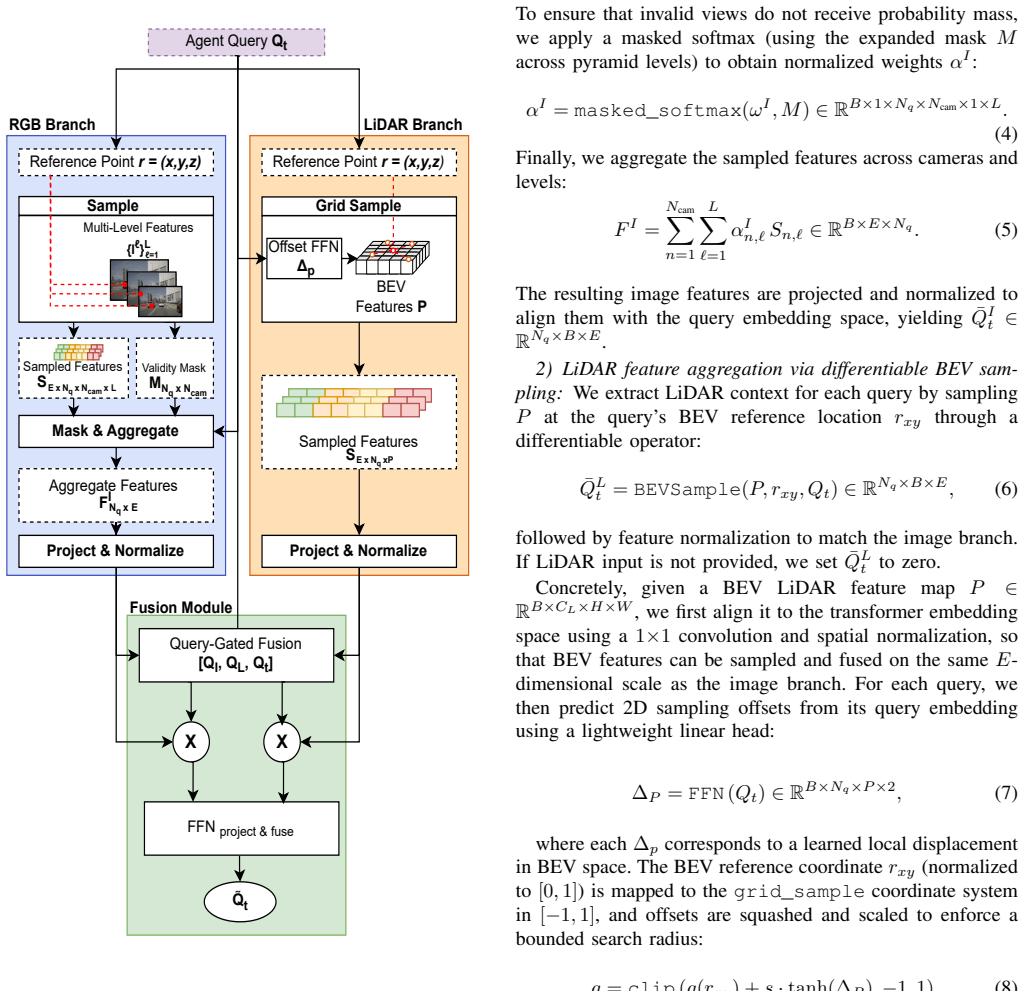
The central object is Query-Gated Deformable Fusion (QGDF), a module that updates each agent query using two branches and a gate. The image branch samples features at the query's projected 3D reference point across all cameras and pyramid levels, weighted by a masked softmax that excludes invalid views. The LiDAR branch predicts per-query 2D offsets in bird's-eye view and samples a BEV feature map at the displaced locations via differentiable grid sampling, replacing a hard top-k selection. The gate computes a softmax over concatenated modality features and the (detached) query, producing per-agent weights for the visual and geometric cues; a residual update with a positional encoding adds t
What would settle it
Retrain Li-ViP3D and Li-ViP3D++ under identical settings with only the fusion module swapped (or with one QGDF component disabled at a time) and compare EPA and FP ratio on the nuScenes validation split; if the gains vanish or reverse when QGDF is removed, the attribution is supported, whereas if they persist without QGDF, the claim fails.
Extended reading notes
Core claim
The central claim is that QGDF, a query-conditioned fusion module, enables a fully differentiable, query-space combination of RGB and LiDAR that improves detection reliability and end-to-end prediction accuracy without a latency penalty. Concretely, the method samples image evidence via masked attention across cameras and feature levels, samples LiDAR bird's-eye-view features with learned per-query offsets using grid sampling, and fuses the two using a per-query softmax gate. The paper reports that, relative to the previous Li-ViP3D baseline, this design raises EPA from 0.250 to 0.335, mAP from 0.472 to 0.502, and lowers the FP ratio from 0.221 to 0.147, with mean inference time 139.82 ms ve
Load-bearing premise
The improvements in EPA, mAP, and false-positive ratio are attributed to the QGDF design, but the paper does not ablate its components, so the gains could stem from other training or implementation changes rather than from the fusion mechanism itself.
Editorial extensions
If this is right
- If the reported gains hold, query-space fusion can be adopted as a drop-in replacement for heuristic camera–LiDAR fusion in other query-based end-to-end models, improving calibration without slowing inference.
- The reduction in FP ratio from 0.221 to 0.147 implies fewer hallucinated agents per scene, which in a planning stack translates to fewer spurious braking or avoidance maneuvers.
- The learned gating weights are interpretable: the model uses LiDAR more when point support is dense and more for smaller classes, providing a per-agent diagnostic signal.
- The maintained or slightly reduced latency (139.82 ms vs 145.91 ms) suggests the extra fusion steps do not undermine real-time operation on current GPUs.
- The paper's trade-off—slightly higher minADE/minFDE but better EPA—implies that detection calibration and trajectory fidelity are separable, and that end-to-end metrics like EPA capture a different quality axis than pure displacement error.
Reading between the lines
- A direct ablation isolating the three QGDF components (masked image attention, deformable BEV sampling, and query gating) would clarify which part drives the false-positive reduction; the paper does not provide one, so the attribution of the gains to the full module is an assumption.
- The reported monotonic increase in LiDAR gate weight with point count suggests an adaptive reliability estimate; one could test whether the gating behaves as a learned confidence on LiDAR evidence in degraded conditions, e.g., sensor dropout or heavy rain.
- Because the model replaces discrete top-k with soft sampling, it may generalize to settings where the number of informative LiDAR points varies widely, such as pedestrian-dense or partially occluded scenes; this could be evaluated on subsets stratified by object density.
- The efficiency analysis is limited to a single GPU without optimization; the authors note compute-aware fusion as future work, so latency comparisons on embedded platforms or with TensorRT would be a natural next test.
Editorial analysis
A structured set of objections, weighed in public.
Referee Report
Summary. The manuscript presents Li-ViP3D++, a query-based camera–LiDAR fusion architecture for end-to-end perception and trajectory prediction. The new component, QGDF, replaces discrete top-k feature selection with a fully differentiable pipeline: masked attention over multi-view camera features, deformable BEV sampling from LiDAR features, and query-conditioned softmax gating. On nuScenes, the authors report improvements over their previous Li-ViP3D in EPA (0.250→0.335), FP ratio (0.221→0.147), Precision (0.779→0.852), and mAP (0.472→0.502), with a small latency reduction (145.91→139.82 ms), while minADE/minFDE/MR worsen (1.45→1.57, 2.20→2.53, 0.236→0.264). The paper interprets this as a favorable precision/recall trade-off.
Significance. If the causal attribution to QGDF were established, the result would be valuable: it would show that query-space, fully differentiable fusion can reduce hallucinated agents and improve end-to-end PnP without a deployability penalty. The paper also contains a clearly specified fusion mechanism (Eqs. 1–15) and reports a broader metric set (EPA, FP ratio) than many PnP papers. However, the empirical evidence as presented does not isolate QGDF from training/implementation confounds, so the significance claim is currently conditional on additional controlled experiments.
major comments (3)
- [§IV, Table I; §III-B] The central claim that QGDF causes the observed improvements is not supported by a controlled comparison. Table I compares Li-ViP3D++ only with the original Li-ViP3D [9], which is not retrained under the Li-ViP3D++ training recipe; only ViP3D is said to be retrained. No ablation isolates the three QGDF sub-components (masked image attention, deformable BEV sampling, gating). The reported single-run differences (EPA 0.250→0.335, FP 0.221→0.147, mAP 0.472→0.502) could equally stem from training details, metric noise, or implementation changes. The paper should retrain Li-ViP3D under the new recipe, add ablations, and report variance.
- [§V-C, Table II] The latency comparison is confounded. QGDF adds an offset FFN, grid sampling, and a gate FFN (Eqs. 7–13), so the 6.09 ms speed-up over Li-ViP3D is not explained by the architecture. Table II reports only mean±std over an unspecified protocol (warmup, batch size, number of runs, software versions). Without profiling or a controlled implementation, the claim that QGDF reduces latency is not established. Please provide measurement conditions and an explanation or temper the claim.
- [§IV, Table I; §V] The paper frames the worsened minADE/minFDE/MR (1.57/2.53/0.264 vs 1.45/2.20/0.236) as a favorable trade-off because EPA and FP improve. This interpretation is load-bearing but rests on a single run with no confidence intervals. Since EPA and FP are the metrics that justify the design, the authors should report multiple seeds or per-scene bootstrap intervals, and ideally a significance test.
minor comments (6)
- [Throughout] Typographical issues: 'suitabilty' in the Introduction, 'all all' in Section IV, 'let's' in Section V-B, and 'lightning' should be 'lighting' in Section VI.
- [§III-B, Eq. (7)–(9)] The number of sampling points P is used in Eq. (7) but never defined; the scale s in Eq. (8) is not specified. Please clarify these hyperparameters and how they are set.
- [§III-B, Eq. (3)–(4)] The masked softmax reshapes ωI of shape B×Nq×(NcamL) into αI of shape B×1×Nq×Ncam×1×L. Spell out the reshape and how the validity mask is expanded across pyramid levels.
- [Fig. 4 caption] The caption says 'Li-ViP3D' but the figure presumably shows Li-ViP3D++ layers. Update the label.
- [§V-B] 'Mean usage of the LiDAR modality' should be defined precisely: is it the average of γ_{t,1} over queries, frames, and scenes? Does it include queries with no LiDAR support? State the exact aggregation.
- [§II-A / Table I] The 'modified vision-based PnPNet variant' is used as a baseline but the modification is not described. Specify what was changed and why.
Circularity Check
No circularity: QGDF is an architectural contribution evaluated against external benchmarks; no prediction reduces to a fit or to a self-citation chain.
full rationale
Li-ViP3D++ is an empirical systems paper. The derivation chain in Section III is constructive: Equations (1)-(15) define a forward architecture (image sampling, masked softmax attention, BEV grid sampling with learned offsets, query gating, and residual update) with no parameter fitted to the evaluation metrics. All trainable weights are learned on the nuScenes training split and evaluated on the validation split, so the reported EPA/mAP/FP improvements are external measurements, not quantities reconstructed from fitted inputs. Self-citations, especially the prior Li-ViP3D baseline [9], are used as comparison points or related context; the central claim does not rest on an unverified prior theorem or uniqueness argument. The main weakness—lack of a component ablation isolating QGDF and ambiguity about whether Li-ViP3D was retrained under exactly the same recipe—is an empirical attribution gap (a potential confounding-variable concern), not a circular definition, fitted prediction, or self-citation reduction. No equation in Section III reduces to a fitted parameter or assumes the target result. Therefore no circular step is identified.
Assumptions & free parameters
free parameters (3)
- Learned network weights (ResNet50, PointPillars, QGDF heads, prediction decoder) =
Not individually reported; trained on nuScenes train split
- Number of trajectory hypotheses K =
6
- Temporal context (LiDAR sweeps and query memory length) =
5 sweeps (0.5 s) and 4 time steps
assumptions (4)
- domain assumption nuScenes annotations, sensor calibration, and the standard train/validation split are accurate and appropriate
- domain assumption Query-based fully differentiable representations (DETR3D/ViP3D) are a valid interface for perception-and-prediction
- standard math Bilinear sampling and grid_sample are differentiable and propagate gradients as expected
- domain assumption The joint loss L = L_cls + L_coord + L_trajectory, with best-of-K selection, is sufficient to optimize the desired end-to-end behavior
Cite this review
Pith. "Pith review of Li-ViP3D++: Query-Gated Deformable Camera-LiDAR Fusion for End-to-End Perception and Trajectory Prediction." pith.science (2026). https://pith.science/paper/ZTGZP6RL
@misc{pith2026260120720,
  author       = {Pith},
  title        = {Pith review of: Li-ViP3D++: Query-Gated Deformable Camera-LiDAR Fusion for End-to-End Perception and Trajectory Prediction},
  year         = {2026},
  howpublished = {\url{https://pith.science/paper/ZTGZP6RL}},
  note         = {Machine review of arXiv:2601.20720}
}
read the original abstract
End-to-end perception and trajectory prediction from raw sensor data is one of the key capabilities for autonomous driving. Modular pipelines restrict information flow and can amplify upstream errors. Recent query-based, fully differentiable perception-and-prediction (PnP) models mitigate these issues, yet the complementarity of cameras and LiDAR in the query-space has not been sufficiently explored. Models often rely on fusion schemes that introduce heuristic alignment and discrete selection steps which prevent full utilization of available information and can introduce unwanted bias. We propose Li-ViP3D++, a query-based multimodal PnP framework that introduces Query-Gated Deformable Fusion (QGDF) to integrate multi-view RGB and LiDAR in query space. QGDF (i) aggregates image evidence via masked attention across cameras and feature levels, (ii) extracts LiDAR context through fully differentiable BEV sampling with learned per-query offsets, and (iii) applies query-conditioned gating to adaptively weight visual and geometric cues per agent. The resulting architecture jointly optimizes detection, tracking, and multi-hypothesis trajectory forecasting in a single end-to-end model. On nuScenes, Li-ViP3D++ improves end-to-end behavior and detection quality, achieving higher EPA (0.335) and mAP (0.502) while substantially reducing false positives (FP ratio 0.147), and it is faster than the prior Li-ViP3D variant (139.82 ms vs. 145.91 ms). These results indicate that query-space, fully differentiable camera-LiDAR fusion can increase robustness of end-to-end PnP without sacrificing deployability.
Figures


Figures from the paper (1 more)

Reference graph
Works this paper leans on
-
[9]
Li-vip3d: Enhancing end- to-end perception and prediction with camera-lidar fusion,
M. Halinkovic, A. Vinel, and W. Benesova, “Li-vip3d: Enhancing end- to-end perception and prediction with camera-lidar fusion,” in2025 IEEE International Automated Vehicle Validation Conference (IAVVC). IEEE, 2025, pp. 1–6
2025
-
[1]
Forecasting from lidar via future object detection,
N. Peri, J. Luiten, M. Li, A. O ˇsep, L. Leal-Taix ´e, and D. Ramanan, “Forecasting from lidar via future object detection,” inProceedings of the IEEE/CVF Conference on Computer Vision and Pattern Recognition, 2022, pp. 17 202–17 211
2022
-
[2]
Seeing through fog without seeing fog: Deep multi- modal sensor fusion in unseen adverse weather,
M. Bijelic, T. Gruber, F. Mannan, F. Kraus, W. Ritter, K. Dietmayer, and F. Heide, “Seeing through fog without seeing fog: Deep multi- modal sensor fusion in unseen adverse weather,” inProceedings of the IEEE/CVF Conference on Computer Vision and Pattern Recognition, 2020, pp. 11 682–11 692
2020
-
[3]
Are we ready for autonomous driving? the kitti vision benchmark suite,
A. Geiger, P. Lenz, and R. Urtasun, “Are we ready for autonomous driving? the kitti vision benchmark suite,” in2012 IEEE conference on computer vision and pattern recognition. IEEE, 2012, pp. 3354–3361
2012
-
[4]
End-to-end object detection with transformers,
N. Carion, F. Massa, G. Synnaeve, N. Usunier, A. Kirillov, and S. Zagoruyko, “End-to-end object detection with transformers,” in European conference on computer vision. Springer, 2020, pp. 213– 229
2020
-
[5]
Detr3d: 3d object detection from multi-view images via 3d-to-2d queries,
Y . Wang, V . C. Guizilini, T. Zhang, Y . Wang, H. Zhao, and J. Solomon, “Detr3d: 3d object detection from multi-view images via 3d-to-2d queries,” inConference on Robot Learning. PMLR, 2022, pp. 180–191
2022
-
[6]
Vip3d: End-to-end visual trajectory prediction via 3d agent queries,
J. Gu, C. Hu, T. Zhang, X. Chen, Y . Wang, Y . Wang, and H. Zhao, “Vip3d: End-to-end visual trajectory prediction via 3d agent queries,” inProceedings of the IEEE/CVF Conference on Computer Vision and Pattern Recognition, 2023, pp. 5496–5506
2023
-
[7]
Social robots for road safety: Pedestrian crossing assis- tance use-case,
A. L. F. Comeca, N. Masarykova, M. Halinkovic, M. Galinski, P. Laskov, and A. Vinel, “Social robots for road safety: Pedestrian crossing assis- tance use-case,” in2025 International Symposium ELMAR. IEEE, 2025, pp. 53–56
2025
Show all 31 references
-
[8]
Robots for safer pedestrian crossing on two-lane roads,
——, “Robots for safer pedestrian crossing on two-lane roads,” in2025 IEEE International Automated Vehicle Validation Conference (IAVVC). IEEE, 2025, pp. 1–6
2025
-
[10]
A survey on trajectory-prediction methods for autonomous driving,
Y . Huang, J. Du, Z. Yang, Z. Zhou, L. Zhang, and H. Chen, “A survey on trajectory-prediction methods for autonomous driving,”IEEE Transactions on Intelligent Vehicles, vol. 7, no. 3, pp. 652–674, 2022
2022
-
[11]
Va- leo4cast: A modular approach to end-to-end forecasting,
Y . Xu, E. Zablocki, A. Boulch, G. Puy, M. Chen, F. Bartoc- cioni, N. Samet, O. Simeoni, S. Gidaris, T.-H. Vuet al., “Va- leo4cast: A modular approach to end-to-end forecasting,”arXiv preprint arXiv:2406.08113, 2024
2024 arXiv
-
[12]
Technical report for argoverse challenges on unified sensor-based detection, tracking, and forecasting,
Z. Wang, F. Chen, K. Lertniphonphan, S. Chen, J. Bao, P. Zheng, J. Zhang, K. Huang, and T. Zhang, “Technical report for argoverse challenges on unified sensor-based detection, tracking, and forecasting,” arXiv preprint arXiv:2311.15615, 2023
2023 arXiv
-
[13]
Motion forecasting via coordinate transfor- mations and object trajectory modifications,
J. Woo, J. Kim, and S. Im, “Motion forecasting via coordinate transfor- mations and object trajectory modifications,” Technical report, 2023. 4, Tech. Rep., 2023
2023
-
[14]
Towards motion forecasting with real-world perception inputs: Are end-to-end approaches competitive?
Y . Xu, L. Chambon, ´E. Zablocki, M. Chen, A. Alahi, M. Cord, and P. P´erez, “Towards motion forecasting with real-world perception inputs: Are end-to-end approaches competitive?” in2024 IEEE International Conference on Robotics and Automation (ICRA). IEEE, 2024, pp. 18 428–18 435
2024
-
[15]
Single-filter cnn for vehicle recognition,
N. Masarykova, M. Galinski, and P. Truchly, “Single-filter cnn for vehicle recognition,” in2024 International Symposium ELMAR. IEEE, 2024, pp. 5–8
2024
-
[16]
Ultra- fast visible lane distance estimation using a single camera,
M. Galinski, V . Danylov, P. Lehoczk `y, R. Bencel, and L. Soltes, “Ultra- fast visible lane distance estimation using a single camera,”IEEE Access, 2024
2024
-
[17]
Fast and furious: Real time end- to-end 3d detection, tracking and motion forecasting with a single convolutional net,
W. Luo, B. Yang, and R. Urtasun, “Fast and furious: Real time end- to-end 3d detection, tracking and motion forecasting with a single convolutional net,” inProceedings of the IEEE conference on Computer Vision and Pattern Recognition, 2018, pp. 3569–3577
2018
-
[18]
Intentnet: Learning to predict intention from raw sensor data,
S. Casas, W. Luo, and R. Urtasun, “Intentnet: Learning to predict intention from raw sensor data,” inConference on Robot Learning. PMLR, 2018, pp. 947–956
2018
-
[19]
Pnpnet: End-to-end perception and prediction with tracking in the loop,
M. Liang, B. Yang, W. Zeng, Y . Chen, R. Hu, S. Casas, and R. Urtasun, “Pnpnet: End-to-end perception and prediction with tracking in the loop,” inProceedings of the IEEE/CVF Conference on Computer Vision and Pattern Recognition, 2020, pp. 11 553–11 562
2020
-
[20]
End-to-end interpretable neural motion planner,
W. Zeng, W. Luo, S. Suo, A. Sadat, B. Yang, S. Casas, and R. Urtasun, “End-to-end interpretable neural motion planner,” inProceedings of the IEEE/CVF Conference on Computer Vision and Pattern Recognition, 2019, pp. 8660–8669
2019
-
[21]
Bevfusion: Multi-task multi-sensor fusion with unified bird’s-eye view representation,
Z. Liu, H. Tang, A. Amini, X. Yang, H. Mao, D. L. Rus, and S. Han, “Bevfusion: Multi-task multi-sensor fusion with unified bird’s-eye view representation,” in2023 IEEE international conference on robotics and automation (ICRA). IEEE, 2023, pp. 2774–2781
2023
-
[22]
Lift, splat, shoot: Encoding images from arbitrary camera rigs by implicitly unprojecting to 3d,
J. Philion and S. Fidler, “Lift, splat, shoot: Encoding images from arbitrary camera rigs by implicitly unprojecting to 3d,” inComputer Vision–ECCV 2020: 16th European Conference, Glasgow, UK, August 23–28, 2020, Proceedings, Part XIV 16. Springer, 2020, pp. 194–210
2020
-
[23]
Lgmmfusion: A lidar-guided multi-modal fusion framework for en- hanced 3d object detection,
H. Cheng, C. Liu, W. Gu, Y . Wu, M. Zhao, W. Liu, and N. Wang, “Lgmmfusion: A lidar-guided multi-modal fusion framework for en- hanced 3d object detection,”PloS one, vol. 20, no. 9, p. e0331195, 2025
2025
-
[24]
Roboformer: A robust multi-modal transformer for 3d object detection in autonomous driving,
Y . Liu, D. Liao, M. Qi, L. Liu, and H. Ma, “Roboformer: A robust multi-modal transformer for 3d object detection in autonomous driving,” inProceedings of the 6th ACM International Conference on Multimedia in Asia, 2024, pp. 1–7
2024
-
[25]
Intrinsically explainable deep learning architecture for semantic seg- mentation of histological structures in heart tissue,
M. Halinkovic, O. Fabian, A. Felsoova, M. Kveton, and W. Benesova, “Intrinsically explainable deep learning architecture for semantic seg- mentation of histological structures in heart tissue,”Computers in Biology and Medicine, vol. 177, p. 108624, 2024
2024
-
[26]
Cafuser: Condition-aware multimodal fusion for robust semantic perception of driving scenes,
T. Br ¨odermann, C. Sakaridis, Y . Fu, and L. Van Gool, “Cafuser: Condition-aware multimodal fusion for robust semantic perception of driving scenes,”IEEE Robotics and Automation Letters, 2025
2025
-
[27]
nuscenes: A multimodal dataset for autonomous driving,
H. Caesar, V . Bankiti, A. H. Lang, S. V ora, V . E. Liong, Q. Xu, A. Krishnan, Y . Pan, G. Baldan, and O. Beijbom, “nuscenes: A multimodal dataset for autonomous driving,” inProceedings of the IEEE/CVF conference on computer vision and pattern recognition, 2020, pp. 11 621–11 631
2020
-
[28]
Deep residual learning for image recognition,
K. He, X. Zhang, S. Ren, and J. Sun, “Deep residual learning for image recognition,” inProceedings of the IEEE conference on computer vision and pattern recognition, 2016, pp. 770–778
2016
-
[29]
Pointpillars: Fast encoders for object detection from point clouds,
A. H. Lang, S. V ora, H. Caesar, L. Zhou, J. Yang, and O. Beijbom, “Pointpillars: Fast encoders for object detection from point clouds,” inProceedings of the IEEE/CVF conference on computer vision and pattern recognition, 2019, pp. 12 697–12 705
2019
-
[30]
Motr: End-to-end multiple-object tracking with transformer,
F. Zeng, B. Dong, Y . Zhang, T. Wang, X. Zhang, and Y . Wei, “Motr: End-to-end multiple-object tracking with transformer,” inEuropean Conference on Computer Vision. Springer, 2022, pp. 659–675
2022
-
[31]
Vectornet: Encoding hd maps and agent dynamics from vectorized rep- resentation,
J. Gao, C. Sun, H. Zhao, Y . Shen, D. Anguelov, C. Li, and C. Schmid, “Vectornet: Encoding hd maps and agent dynamics from vectorized rep- resentation,” inProceedings of the IEEE/CVF conference on computer vision and pattern recognition, 2020, pp. 11 525–11 533
2020
Reviewed August 3, 2026 · model on record in the stance chip above.
Discussion (0). Continue with ORCID to comment.