The rich phase diagram of the prototypical iridate Ba₂IrO₄: Effective low-energy models and metal-insulator transition
Pith reviewed 2026-05-24 05:15 UTC · model grok-4.3
The pith
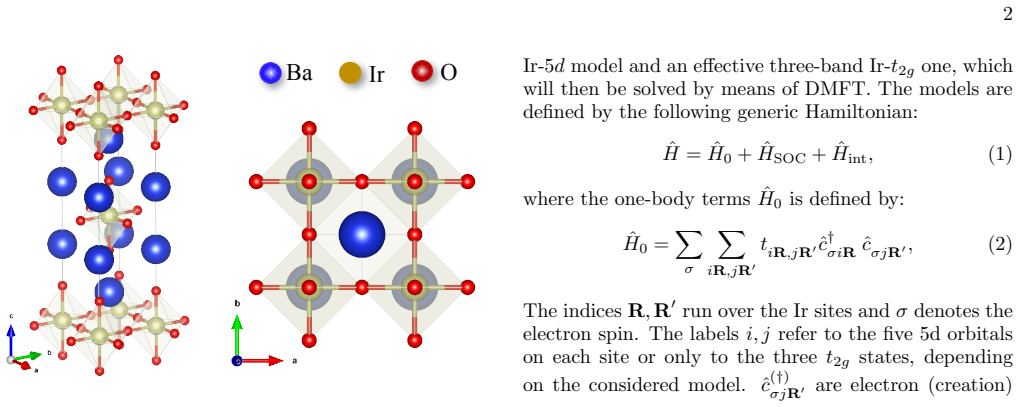
A three-band model in Ir j_eff states retains the low-energy physics of Ba2IrO4
A machine-rendered reading of the paper's core claim, the machinery that carries it, and where it could break.
Core claim
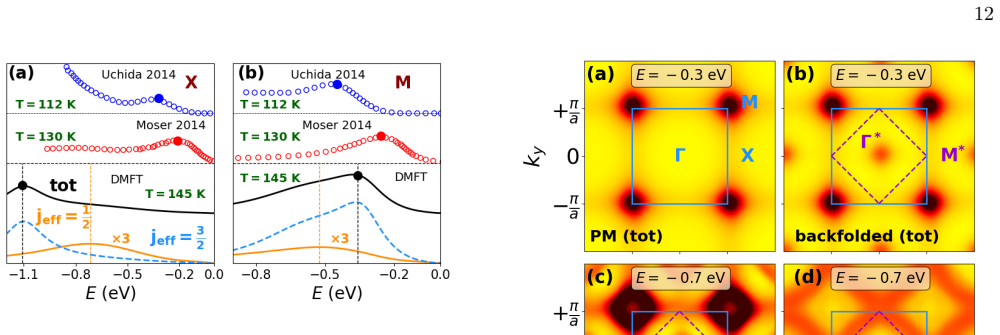
By means of a combination of different ab initio techniques with dynamical mean-field theory, a three-band model in terms of Ir-j_eff states fully retains the low-energy physics of the system as compared to a full Ir-5d model. Providing a detailed study of the three-band model in terms of spin-orbit coupling, Hund's coupling and Coulomb interactions, the authors map out a rich phase diagram and identify a region of effective one-band metal-insulator transition relevant to Ba2IrO4. Compared to available angle-resolved photoemission spectra, they find good agreement of salient aspects of the calculated spectral function.
What carries the argument
The three-band model in Ir-j_eff states, constructed via ab initio downfolding and solved with dynamical mean-field theory to map interaction-driven phases.
If this is right
- The three- and five-band models apply directly to studies of doped Ba2IrO4.
- The models help clarify similarities and differences with cuprate superconductors.
- An effective one-band metal-insulator transition regime exists in the parameter space relevant to the material.
- Certain spectral features require non-local fluctuations beyond the current approach.
Where Pith is reading between the lines
- The validated three-band model could simplify doping studies in other layered iridates with similar local physics.
- Extending the approach to include non-local effects might shift the identified metal-insulator boundaries.
- The one-band regime opens a route to test whether doped Ba2IrO4 exhibits cuprate-like pairing instabilities.
Load-bearing premise
Single-site dynamical mean-field theory is sufficient to capture the metal-insulator transition and spectral features without non-local fluctuations.
What would settle it
A calculation incorporating non-local fluctuations that produces a substantially different phase diagram or spectral function from the single-site DMFT results.
Figures



read the original abstract
In the quest of new exotic phases of matter due to the interplay of various interactions, iridates hosting a spin-orbit entangled $j_{\mathrm{eff}}=1/2$ ground state have been in the spotlight in recent years. Also in view of parallels with the low-energy physics of high-temperature superconducting cuprates, the validity of a single- or few-band picture in terms of the $j_{\mathrm{eff}}$ states is key. However, in particular for its structurally simple member Ba$_2$IrO$_4$, such a systematic construction and subsequent analysis of minimal low-energy models are still missing. Here we show by means of a combination of different ab initio techniques with dynamical mean-field theory that a three-band model in terms of Ir-$j_{\mathrm{eff}}$ states fully retains the low-energy physics of the system as compared to a full Ir-$5d$ model. Providing a detailed study of the three-band model in terms of spin-orbit coupling, Hund's coupling and Coulomb interactions, we map out a rich phase diagram and identify a region of effective one-band metal-insulator transition relevant to Ba$_2$IrO$_4$. Compared to available angle-resolved photoemission spectra, we find good agreement of salient aspects of the calculated spectral function and identify features which require the inclusion of non-local fluctuations. In a broader context, we envisage the three- and five-band models developed in this study to be relevant for the study of doped Ba$_2$IrO$_4$ and to clarify further the similarities and differences with cuprates.
Editorial analysis
A structured set of objections, weighed in public.
Referee Report
Summary. The manuscript uses ab initio downfolding combined with dynamical mean-field theory (DMFT) to construct effective models for Ba₂IrO₄. It demonstrates that a three-band model in the Ir j_eff basis fully retains the low-energy physics of the full five-band Ir-5d model under identical DMFT treatment. The work maps the phase diagram as a function of spin-orbit coupling, Hund's J, and Coulomb U, identifies a parameter region realizing an effective one-band metal-insulator transition relevant to the material, and reports good agreement between the calculated spectral function and available ARPES data on key features while noting that certain aspects require non-local fluctuations beyond single-site DMFT.
Significance. If the central equivalence holds, the validated three-band j_eff model provides a minimal, computationally tractable platform for studying doped iridates and their parallels to cuprates. The consistent ab initio + DMFT protocol applied to both the three- and five-band models, together with direct ARPES comparison, supplies independent experimental grounding and strengthens the claim that the low-energy physics is preserved. The mapped phase diagram in the space of SOC, J, and U constitutes a useful reference for interaction-driven phenomena in this class of materials.
minor comments (2)
- [§3] §3 (model construction): the precise definition of the Wannier functions and the energy window used for the j_eff projection should be stated explicitly to allow independent reproduction of the downfolding step.
- [Fig. 4] Fig. 4 (phase diagram): the boundaries of the one-band MIT region are shown for a fixed set of parameters; adding a brief statement on the sensitivity of these boundaries to small variations in the ab initio hoppings would strengthen the claim of relevance to Ba₂IrO₄.
Simulated Author's Rebuttal
We thank the referee for the positive assessment of our manuscript, including the summary of the ab initio + DMFT approach, the validation of the three-band j_eff model, the mapped phase diagram, and the comparison to ARPES data. The recommendation for minor revision is noted. No specific major comments were raised in the report.
Circularity Check
No significant circularity; model equivalence tested via independent ab initio + DMFT comparison
full rationale
The paper derives the three-band j_eff model from ab initio downfolding of the full 5d model and validates retention of low-energy physics by direct comparison of spectral features and MIT under identical single-site DMFT. This comparison is external to the fitting process itself and is further anchored by ARPES data. No self-definitional equations, fitted parameters renamed as predictions, or load-bearing self-citations appear in the derivation chain. The central claim therefore remains self-contained against external benchmarks.
Axiom & Free-Parameter Ledger
free parameters (1)
- Coulomb U and Hund J
axioms (1)
- domain assumption Single-site DMFT captures the essential low-energy physics
Reference graph
Works this paper leans on
-
[1]
and spectroscopic [15–17] properties, no supercon- ductivity has been reported to date for doped Sr 2IrO4. Possible explanations for this absence are twofold. First, rotations of the IrO 6 octahedra lead to a spin-canting of the Ir-momenta [18], which results in a Dzyaloshinsky- Moriya term in the effective pseudospin model [8, 19], absent in spin models ...
work page internal anchor Pith review Pith/arXiv arXiv 2023
-
[2]
for Ba 2IrO4. We used Optimized Norm Conserving Vanderbilt (ONCVPSP) pseudopotentials [76] from the PseudoDojo database [77] with (fully relativistic) scalar relativistic corrections for the (non) spin-orbit calcula- tions. The cRPA calculations were performed using RESPACK v20200103 [78]. The Wannier functions were obtained for the t2g subspace with a 0 ...
-
[3]
J. Kim, H. Ohsumi, T. Komesu, S. Sakai, T. Morita, H. Takagi, and T. Arima, Science 323, 1239 (2009)
work page 2009
-
[4]
S. Boseggia, R. Springell, H. C. Walker, H. M. Rønnow, C. R¨ uegg, H. Okabe, M. Isobe, R. S. Perry, S. P. Collins, and D. F. McMorrow, Phys. Rev. Lett. 110, 117207 (2013)
work page 2013
- [5]
-
[6]
X. Wan, A. M. Turner, A. Vishwanath, and S. Y. Savrasov, Phys. Rev. B 83, 205101 (2011)
work page 2011
-
[7]
Y. Zhou, P. A. Lee, T.-K. Ng, and F.-C. Zhang, Phys. Rev. Lett. 101, 197201 (2008)
work page 2008
-
[8]
Y. Okamoto, M. Nohara, H. Aruga-Katori, and H. Tak- agi, Phys. Rev. Lett. 99, 137207 (2007)
work page 2007
-
[9]
A. Dhingra, T. Komesu, S. Kumar, K. Shimada, L. Zhang, X. Hong, and P. A. Dowben, Mater. Horiz. 8, 2151 (2021)
work page 2021
- [10]
- [11]
- [12]
-
[13]
H. Jin, H. Jeong, T. Ozaki, and J. Yu, Phys. Rev. B 80, 075112 (2009)
work page 2009
- [14]
-
[15]
J. Bertinshaw, Y. Kim, G. Khaliullin, and B. Kim, An- nual Review of Condensed Matter Physics10, 315 (2019)
work page 2019
- [16]
-
[17]
A. de la Torre, S. McKeown Walker, F. Y. Bruno, S. Ricc´ o, Z. Wang, I. Gutierrez Lezama, G. Scheerer, G. Giriat, D. Jaccard, C. Berthod, T. K. Kim, M. Hoesch, E. C. Hunter, R. S. Perry, A. Tamai, and F. Baumberger, Phys. Rev. Lett. 115, 176402 (2015)
work page 2015
- [18]
-
[19]
S. Peng, C. Lane, Y. Hu, M. Guo, X. Chen, Z. Sun, M. Hashimoto, D. Lu, Z.-X. Shen, T. Wu, X. Chen, R. S. Markiewicz, Y. Wang, A. Bansil, S. D. Wilson, and J. He, npj Quantum Materials 7, 58 (2022)
work page 2022
-
[20]
M. K. Crawford, M. A. Subramanian, R. L. Harlow, J. A. Fernandez-Baca, Z. R. Wang, and D. C. Johnston, Phys. Rev. B 49, 9198 (1994)
work page 1994
-
[21]
N. B. Perkins, Y. Sizyuk, and P. W¨ olfle, Phys. Rev. B 89, 035143 (2014)
work page 2014
- [22]
- [23]
- [24]
-
[25]
V. M. Katukuri, V. Yushankhai, L. Siurakshina, J. van den Brink, L. Hozoi, and I. Rousochatzakis, Phys Rev X 4, 021051 (2014)
work page 2014
-
[26]
Y. S. Hou, H. J. Xiang, and X. G. Gong, New Journal of Physics 18, 043007 (2016)
work page 2016
-
[27]
J. J. Nichols, O. B. Korneta, J. Terzic, G. Cao, J. W. Brill, and S. S. A. Seo, Appl. Phys. Lett. 104, 121913 (2014)
work page 2014
- [28]
- [29]
- [30]
- [31]
- [32]
-
[33]
F. C. Zhang and T. M. Rice, Phys. Rev. B 37, 3759 (1988)
work page 1988
-
[34]
O. Andersen, A. Liechtenstein, O. Jepsen, and F. Paulsen, Journal of Physics and Chemistry of Solids 56, 1573 (1995), proceedings of the Conference on Spec- troscopies in Novel Superconductors
work page 1995
-
[35]
Kanamori, Progress of Theoretical Physics 30, 275 (1963)
J. Kanamori, Progress of Theoretical Physics 30, 275 (1963)
work page 1963
-
[36]
A. Georges, L. d. Medici, and J. Mravlje, Annual Review of Condensed Matter Physics 4, 137 (2013)
work page 2013
-
[37]
N. Marzari, A. A. Mostofi, J. R. Yates, I. Souza, and D. Vanderbilt, Rev. Mod. Phys. 84, 1419 (2012)
work page 2012
-
[38]
Q. Gu, S. K. Pandey, and R. Tiwari, Computational Materials Science 221, 112090 (2023)
work page 2023
-
[39]
F. Aryasetiawan, M. Imada, A. Georges, G. Kotliar, S. Biermann, and A. I. Lichtenstein, Phys. Rev. B 70, 195104 (2004)
work page 2004
-
[40]
J. P. Perdew, K. Burke, and M. Ernzerhof, Phys. Rev. Lett. 77, 3865 (1996)
work page 1996
- [41]
-
[42]
B. N. Figgis and M. A. Hitchman, Ligand Field Theory and Its Applications , Special Topics in Inorganic Chem- istry (John Wiley & Sons, Nashville, TN, 1999)
work page 1999
- [43]
-
[44]
B. J. Kim, H. Jin, S. J. Moon, J.-Y. Kim, B.-G. Park, C. S. Leem, J. Yu, T. W. Noh, C. Kim, S.-J. Oh, J.- H. Park, V. Durairaj, G. Cao, and E. Rotenberg, Phys. Rev. Lett. 101, 076402 (2008)
work page 2008
-
[45]
C. Martins, M. Aichhorn, and S. Biermann, Journal of Physics: Condensed Matter 29, 263001 (2017)
work page 2017
-
[46]
C. Martins, M. Aichhorn, L. Vaugier, and S. Biermann, Phys. Rev. Lett. 107, 266404 (2011)
work page 2011
-
[47]
M. Charlebois, J.-B. Mor´ ee, K. Nakamura, Y. Nomura, T. Tadano, Y. Yoshimoto, Y. Yamaji, T. Hasegawa, K. Matsuhira, and M. Imada, Phys. Rev. B 104, 075153 17 (2021)
work page 2021
-
[48]
O. Parcollet, M. Ferrero, T. Ayral, H. Hafermann, I. Krivenko, L. Messio, and P. Seth, Computer Physics Communications 196, 398 (2015)
work page 2015
-
[49]
P. Seth, I. Krivenko, M. Ferrero, and O. Parcollet, Com- puter Physics Communications 200, 274 (2016)
work page 2016
-
[50]
M. Aichhorn, L. Pourovskii, P. Seth, V. Vildosola, M. Zingl, O. E. Peil, X. Deng, J. Mravlje, G. J. Kraberger, C. Martins, M. Ferrero, and O. Parcollet, Computer Physics Communications 204, 200 (2016)
work page 2016
-
[51]
M. M. Sala, M. Rossi, S. Boseggia, J. Akimitsu, N. B. Brookes, M. Isobe, M. Minola, H. Okabe, H. M. Rønnow, L. Simonelli, D. F. McMorrow, and G. Monaco, Physical Review B 89, 121101 (2014)
work page 2014
-
[52]
V. M. Katukuri, H. Stoll, J. van den Brink, and L. Hozoi, Phys. Rev. B 85, 220402 (2012)
work page 2012
-
[53]
N. A. Bogdanov, V. M. Katukuri, J. Romh´ anyi, V. Yushankhai, V. Kataev, B. B¨ uchner, J. van den Brink, and L. Hozoi, Nature Communications 6, 7306 (2015)
work page 2015
- [54]
- [55]
- [56]
-
[57]
J. C. Slater, Quantum Theory of Atomic Structure, Vol. 1 (McGraw-Hill New York, 1960)
work page 1960
-
[58]
Lifshitz, Soviet Physics JETP 11, 1130 (1960)
I. Lifshitz, Soviet Physics JETP 11, 1130 (1960)
work page 1960
-
[59]
Kubo, Journal of the Physical Society of Japan 91, 124707 (2022)
K. Kubo, Journal of the Physical Society of Japan 91, 124707 (2022)
work page 2022
- [60]
- [61]
- [62]
-
[63]
H. Terletska, J. Vuˇ ciˇ cevi´ c, D. Tanaskovi´ c, and V. Do- brosavljevi´ c, Phys. Rev. Lett.107, 026401 (2011)
work page 2011
-
[64]
J. Vuˇ ciˇ cevi´ c, H. Terletska, D. Tanaskovi´ c, and V. Do- brosavljevi´ c, Phys. Rev. B88, 075143 (2013)
work page 2013
-
[65]
C. Martins, B. Lenz, L. Perfetti, V. Brouet, F. m. c. Bertran, and S. Biermann, Phys. Rev. Mater. 2, 032001 (2018)
work page 2018
-
[66]
B. Lenz, C. Martins, and S. Biermann, Journal of Physics: Condensed Matter 31, 293001 (2019)
work page 2019
-
[67]
C. Piovera, V. Brouet, E. Papalazarou, M. Caputo, M. Marsi, A. Taleb-Ibrahimi, B. J. Kim, and L. Per- fetti, Phys. Rev. B 93, 241114 (2016)
work page 2016
-
[68]
A. Tamai, M. Zingl, E. Rozbicki, E. Cappelli, S. Ricc` o, A. de la Torre, S. McKeown Walker, F. Y. Bruno, P. D. C. King, W. Meevasana, M. Shi, M. Radovi´ c, N. C. Plumb, A. S. Gibbs, A. P. Mackenzie, C. Berthod, H. U. R. Strand, M. Kim, A. Georges, and F. Baumberger, Phys. Rev. X 9, 021048 (2019)
work page 2019
-
[69]
B. Zwartsenberg, R. P. Day, E. Razzoli, M. Michiardi, N. Xu, M. Shi, J. D. Denlinger, G. Cao, S. Calder, K. Ueda, J. Bertinshaw, H. Takagi, B. J. Kim, I. S. Elfimov, and A. Damascelli, Nature Physics 16 (2020), 10.1038/s41567-019-0750-y
- [70]
-
[71]
B. Zwartsenberg, R. P. Day, E. Razzoli, M. Michiardi, M. X. Na, G. Zhang, J. D. Denlinger, I. Vobornik, C. Bigi, B. J. Kim, I. S. Elfimov, E. Pavarini, and A. Damascelli, Phys. Rev. B 105, 245130 (2022)
work page 2022
-
[72]
F. C. Zhang and T. M. Rice, Phys. Rev. B 41, 7243 (1990)
work page 1990
-
[73]
A. Macridin, M. Jarrell, T. Maier, and G. A. Sawatzky, Phys. Rev. B 71, 134527 (2005)
work page 2005
-
[74]
M. Hirayama, Y. Yamaji, T. Misawa, and M. Imada, Phys. Rev. B 98, 134501 (2018)
work page 2018
-
[75]
M. Hirayama, T. Misawa, T. Ohgoe, Y. Yamaji, and M. Imada, Phys. Rev. B 99, 245155 (2019)
work page 2019
-
[76]
P. Giannozzi, S. Baroni, N. Bonini, M. Calandra, R. Car, C. Cavazzoni, D. Ceresoli, G. L. Chiarotti, M. Cococ- cioni, I. Dabo, A. Dal Corso, S. de Gironcoli, S. Fabris, G. Fratesi, R. Gebauer, U. Gerstmann, C. Gougoussis, A. Kokalj, M. Lazzeri, L. Martin-Samos, N. Marzari, F. Mauri, R. Mazzarello, S. Paolini, A. Pasquarello, L. Paulatto, C. Sbraccia, S. S...
work page 2009
-
[77]
P. Giannozzi, O. Andreussi, T. Brumme, O. Bunau, M. Buongiorno Nardelli, M. Calandra, R. Car, C. Cavaz- zoni, D. Ceresoli, M. Cococcioni, N. Colonna, I. Carn- imeo, A. Dal Corso, S. de Gironcoli, P. Delugas, R. A. DiStasio, A. Ferretti, A. Floris, G. Fratesi, G. Fu- gallo, R. Gebauer, U. Gerstmann, F. Giustino, T. Gorni, J. Jia, M. Kawamura, H.-Y. Ko, A. ...
work page 2017
-
[78]
D. R. Hamann, Physical Review B 88, 085117 (2013)
work page 2013
-
[79]
M. J. van Setten, M. Giantomassi, E. Bousquet, M. J. Verstraete, D. R. Hamann, X. Gonze, and G. M. Rignanese, Computer Physics Communications 226, 39 (2018)
work page 2018
-
[80]
K. Nakamura, Y. Yoshimoto, Y. Nomura, T. Tadano, M. Kawamura, T. Kosugi, K. Yoshimi, T. Misawa, and Y. Motoyama, Computer Physics Communications 261, 107781 (2021)
work page 2021
discussion (0)
Sign in with ORCID, Apple, or X to comment. Anyone can read and Pith papers without signing in.