Compactifications of the Eisenstein ancestral Deligne-Mostow variety
Pith reviewed 2026-05-24 03:47 UTC · model grok-4.3
The pith
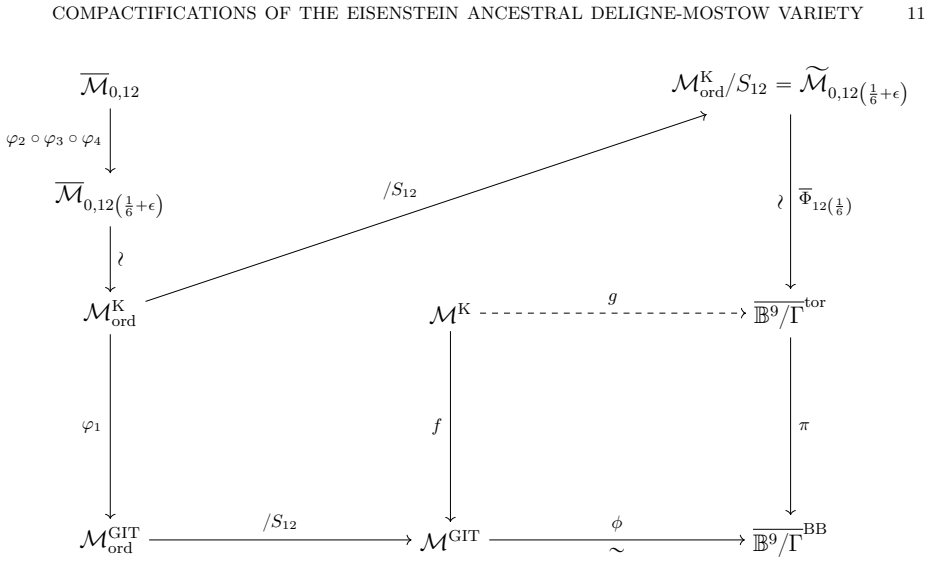
Kirwan's partial resolution of the 12-point moduli space is not semi-toroidal and the period map does not lift to the toroidal compactification.
A machine-rendered reading of the paper's core claim, the machinery that carries it, and where it could break.
Core claim
The Eisenstein ancestral Deligne-Mostow variety parametrizes arithmetic ball quotients and coincides with the moduli space of unordered 12 points on P^1. Kirwan's partial resolution of this moduli space is not a semi-toroidal compactification, and the Deligne-Mostow period map does not lift to the toroidal compactification. These facts are explained using the log minimal model program and automorphic forms, from which it follows that the compactifications are not stacky derived equivalent. An automorphic form is constructed on the isogenous moduli space of non-hyperelliptic genus-4 curves, supplying a lattice-independent proof of a result of Casalaina-Martin, Jensen and Laza.
What carries the argument
The period map of the Eisenstein ancestral Deligne-Mostow variety from the moduli space of 12 unordered points on P^1 to the associated ball quotient, together with its possible extensions to toroidal and semi-toroidal compactifications.
If this is right
- The two compactifications are not stacky derived equivalent.
- An automorphic form on the moduli space of non-hyperelliptic genus-4 curves exists and gives a lattice-independent proof of a known isomorphism result.
- The mismatch between algebraic and arithmetic compactifications admits interpretations via the log minimal model program and automorphic forms.
Where Pith is reading between the lines
- The failure of the period map to lift may point to similar mismatches in the Gaussian ancestral case or in other Deligne-Mostow ball quotients.
- The independent construction of the automorphic form suggests that isogenies between moduli spaces can be studied without explicit lattice embeddings in additional settings.
Load-bearing premise
The Eisenstein Deligne-Mostow variety is the ancestral case for the Eisenstein Hermitian form and can be identified with the moduli space of unordered 12 points on the projective line.
What would settle it
An explicit comparison of the boundary strata of Kirwan's partial resolution against those of the toroidal compactification, or a direct check whether the period map extends over a specific divisor in the moduli space, would confirm or refute the non-lifting statement.
Figures
read the original abstract
All arithmetic non-compact ball quotients by Deligne-Mostow's unitary monodromy group arise as sub-ball quotients of either of two spaces called ancestral cases, corresponding to Gaussian or Eisenstein Hermitian forms respectively. In a previous paper, we investigated the compactifications of the Gaussian Deligne-Mostow variety. Here we work on the remaining case, namely the ring of Eisenstein integers. This variety is related to the moduli space of unordered 12 points on $\mathbb{P}^1$. In particular, we show that Kirwan's partial resolution of the moduli space is not a semi-toroidal compactification and Deligne-Mostow's period map does not lift to the unique toroidal compactification. We give two interpretations of these phenomena in terms of the log minimal model program and automorphic forms. As an application, we prove that the above two compactifications are not (stacky) derived equivalent, as the $DK$-conjecture predicts. Furthermore, we construct an automorphic form on the moduli space of non-hyperelliptic curves of genus 4, which is isogenous to the Eisenstein Deligne-Mostow variety, giving another intrinsic proof, independent of lattice embeddings, of a result by Casalaina-Martin, Jensen and Laza.
Editorial analysis
A structured set of objections, weighed in public.
Referee Report
Summary. The paper examines compactifications of the Eisenstein ancestral Deligne-Mostow variety (arising from the Eisenstein Hermitian form), which is related to the moduli space of unordered 12 points on P^1. It asserts that Kirwan's partial resolution of this moduli space is not semi-toroidal and that the Deligne-Mostow period map does not lift to the unique toroidal compactification. The authors supply two interpretations of these facts via the log minimal model program and automorphic forms, prove that the two compactifications are not (stacky) derived equivalent (contrary to the DK-conjecture prediction), and construct an automorphic form on the moduli space of non-hyperelliptic genus-4 curves that yields an independent proof of a result of Casalaina-Martin-Jensen-Laza.
Significance. If the central identifications and non-lifting statements hold, the work clarifies the boundary behavior of arithmetic ball quotients in the Eisenstein case, supplies concrete counterexamples to expected derived equivalences, and gives a lattice-independent construction of an automorphic form on a related moduli space. These are substantive contributions to the study of compactifications of ball quotients and their relations to moduli problems.
major comments (2)
- [Abstract and Introduction] Abstract (paragraph beginning 'This variety is related to...') and the corresponding discussion in the introduction: the claim that Kirwan's partial resolution 'is not a semi-toroidal compactification' and that the period map 'does not lift to the unique toroidal compactification' is asserted 'in particular' from the relation to the moduli space of 12 unordered points on P^1. For these statements to follow, the paper must supply (or explicitly cite and verify) a birational map or isomorphism that identifies the relevant boundary divisors with the toroidal cusps and is compatible with the fans; if the identification is only sketched or relies on external references without re-deriving the necessary compatibility, the non-semi-toroidal and non-lifting conclusions rest on an unverified step.
- [Final section on automorphic forms] The application in the final section constructing the automorphic form on the genus-4 moduli space: while the independence from lattice embeddings is a strength, the proof that this form is isogenous to the Eisenstein DM variety requires a precise verification that the period map factors through the relevant quotient; any gap in the isogeny statement would affect the claimed independence of the Casalaina-Martin-Jensen-Laza result.
minor comments (2)
- [Introduction] Notation for the Eisenstein integers and the associated Hermitian form should be fixed early and used consistently; occasional shifts between 'Eisenstein DM variety' and 'ancestral case' can be clarified.
- [Throughout] References to prior work on the Gaussian case and to Kirwan's resolution should include explicit page or theorem numbers when invoking specific boundary descriptions.
Simulated Author's Rebuttal
We thank the referee for the careful reading and the recommendation of major revision. Below we respond point-by-point to the major comments, indicating the revisions we will make to strengthen the exposition while preserving the core arguments of the manuscript.
read point-by-point responses
-
Referee: [Abstract and Introduction] Abstract (paragraph beginning 'This variety is related to...') and the corresponding discussion in the introduction: the claim that Kirwan's partial resolution 'is not a semi-toroidal compactification' and that the period map 'does not lift to the unique toroidal compactification' is asserted 'in particular' from the relation to the moduli space of 12 unordered points on P^1. For these statements to follow, the paper must supply (or explicitly cite and verify) a birational map or isomorphism that identifies the relevant boundary divisors with the toroidal cusps and is compatible with the fans; if the identification is only sketched or relies on external references without re-deriving the necessary compatibility, the non-semi-toroidal and non-lifting conclusions rest on an unverified step.
Authors: We agree that the compatibility of the birational identification with the fans must be verified explicitly for the non-semi-toroidal and non-lifting claims to be fully rigorous. The manuscript establishes the relation to the moduli space of 12 unordered points via the standard Deligne-Mostow construction in Section 2, citing the known birational equivalence and the description of Kirwan's resolution. To address the concern, we will insert a new subsection (likely in Section 3) that explicitly constructs the birational map between the relevant boundary divisors and toroidal cusps, verifies the correspondence of strata, and checks compatibility with the fan structures using the explicit fan data already present in the paper. This will make the assertions self-contained. revision: yes
-
Referee: [Final section on automorphic forms] The application in the final section constructing the automorphic form on the genus-4 moduli space: while the independence from lattice embeddings is a strength, the proof that this form is isogenous to the Eisenstein DM variety requires a precise verification that the period map factors through the relevant quotient; any gap in the isogeny statement would affect the claimed independence of the Casalaina-Martin-Jensen-Laza result.
Authors: The isogeny is proved in the final section by exhibiting an explicit factorization of the period map through the quotient by the Eisenstein unitary group, using the lattice embedding and the known period map for non-hyperelliptic genus-4 curves. We regard the verification as complete, but we acknowledge that an additional clarifying step would remove any possible ambiguity. We will therefore add a short lemma (or expanded remark) that isolates the factorization step, includes the relevant commutative diagram, and confirms that the map descends to the quotient. This will strengthen the independence claim without altering the argument. revision: partial
Circularity Check
No circularity: geometric identification and period-map statements rest on independent constructions
full rationale
The abstract states the Eisenstein ancestral variety 'is related to' the moduli space of 12 unordered points and then derives the Kirwan and toroidal claims 'in particular' from that relation. No quoted equation or definition in the provided text reduces a claimed prediction or uniqueness result to a fitted parameter, self-citation chain, or ansatz smuggled from prior work by the same authors. The paper explicitly contrasts its proof with lattice-embedding methods and invokes the log minimal model program and automorphic forms as separate interpretations. These steps are standard geometric arguments in the Deligne-Mostow and ball-quotient literature and do not collapse by construction to the input data.
Axiom & Free-Parameter Ledger
axioms (2)
- domain assumption Deligne-Mostow unitary monodromy groups and their ball quotients for Eisenstein integers
- domain assumption Identification of the variety with moduli of 12 unordered points on P^1
Forward citations
Cited by 1 Pith paper
-
Remarks on two problems by Hassett
All moduli spaces of weighted pointed rational curves for five points arise as log canonical models of the unweighted space with suitable asymmetric boundary coefficients, generalizing prior results and relating to De...
Reference graph
Works this paper leans on
-
[1]
Log canonical singularities and complete moduli of stable pairs
[Ale96] V. Alexeev, Log canonical singularities and complete moduli of stable pairs, arXiv:alg-geom/9608013,
work page internal anchor Pith review Pith/arXiv arXiv
-
[2]
[AE21] V. Alexeev, P. Engel, Compact moduli of K3 surfaces, arXiv:2101.12186 to appear in Annals of Math. [AEH21] V. Alexeev, P. Engel, C. Han, Compact moduli of K3 surfaces with a nonsymplectic automorphism , arXiv:2110.13834v2. [All00] D. Allcock, The Leech lattice and complex hyperbolic reflections , Invent. Math., 140 (2000), no. 2, 283–301. [ACT11] D...
-
[3]
Springer. 36.80 (2002). [Bru14] J. Bruinier, On the converse theorem for Borcherds products , J. Algebra 397 (2014), 315–342. [CMGHL23a] S. Casalaina-Martin, S. Grushevsky, K. Hulek, R. Laza, Cohomology of the Moduli Space of Cubic Threefolds and Its Smooth Models , Mem. Amer. Math. Soc., 1395 (2023). [CMGHL23b] S. Casalaina-Martin, S. Grushevsky, K. Hule...
-
[4]
[CT20a] A. M. Castravet, J. Tevelev, Derived category of moduli of pointed curves. I , Algebr. Geom., 7 (2020), No. 6, 722–757. [CT20b] A. M. Castravet, J. Tevelev, Derived category of moduli of pointed curves. II , arXiv:2002.02889. [Con85] J. H. Conway et al., Atlas of finite groups , Oxford
-
[5]
[DM86] P. Deligne, G. D. Mostow, Monodromy of hypergeometric functions and nonlattice integral mon- odromy, Inst. Hautes Etudes Sci. Publ. Math., 63 (1986), 5–89. [DvGK05] I. Dolgachev, B. van Geemen, S. Kond¯ o, A complex ball uniformization of the moduli space of cubic surfaces via periods of K3 surfaces , J. Reine Angew. Math. 588, 99-148 (2005). [Fre0...
work page 1986
-
[6]
[GKS21] P. Gallardo, M. Kerr, L. Schaffler, Geometric interpretation of toroidal compactifications of moduli of points in the line and cubic surfaces , Adv. Math., 381 (2021), Paper No. 107632. [GHS08] V. Gritsenko, K. Hulek, G.K., Sankaran Hirzebruch-Mumford proportionality and locally symmetric varieties of orthogonal type , Doc. Math., 13 (2008), 1–19....
work page 2021
-
[7]
Hofmann, Borcherds products on unitary groups , Math
[Hof14] E. Hofmann, Borcherds products on unitary groups , Math. Ann., 358 (2014), No. 3–4, 799–832. [HM22] K. Hulek, Y. Maeda, Revisiting the moduli space of 8 points on P1, arXiv:2211.00052v2. [Kat84] P. I. Katsylo, The rationality of moduli spaces of hyperelliptic curves , Math. USSR, Izv. 25, 45-50 (1985). [Kaw02] Y. Kawamata, D-equivalence and K-equi...
-
[8]
[Kir85] F. C. Kirwan, Partial desingularisations of quotients of nonsingular varieties and their Betti numbers, Ann. of Math. (2) 122 (1985), no. 1, 41–85. [Kir89] F. C. Kirwan, Moduli spaces of degree d hypersurfaces in Pn, Duke Math. J., 58 (1989), no. 1, 39–78. [KLW87] F. C. Kirwan, R. Lee, S. H. Weintraub, Quotients of the complex ball by discrete gro...
work page 1985
-
[9]
[Kol13] J. Koll´ ar,Singularities of the minimal model program , With the collaboration of S´ andor Kov´ acs., Cambridge Tracts in Mathematics 200 (2013). [KM98] J. Koll´ ar, S. Mori,Birational geometry of algebraic varieties, With the collaboration of C. H. Clemens and A. Corti., Cambridge Tracts in Mathematics
work page 2013
- [10]
-
[11]
[Loo85] E. Looijenga, Semi-toric partial compactifications I, Report 8520 (1985), 72 pp., Catholic University Nijmegen. [Loo86] E. Looijenga, New compactifications of locally symmetric varieties, Proceedings of the 1984 Vancou- ver conference in algebraic geometry, 341–364. CMS Conf. Proc., 6, AMS Province (1986). [Loo03a] E. Looijenga, Compactifications ...
-
[12]
[Thu98] W. P. Thurston, Shapes of polyhedra and triangulations of the sphere , Geom. Topol. Monogr., 1 (1998), 511–549. K.H: Institut f ¨ur Algebraische Geometrie, Leibniz University Hannover, Welfengarten 1, 30060 Hannover, Germany Email address : hulek@math.uni-hannover.de S.K: Graduate School of Mathematics, Nagoya University, Nagoya, 464-8602, Japan E...
work page 1998
discussion (0)
Sign in with ORCID, Apple, or X to comment. Anyone can read and Pith papers without signing in.