Near-Inertial Pollard Waves Modeling the Arctic Halocline
Pith reviewed 2026-05-22 21:41 UTC · model grok-4.3
The pith
An exact solution models the Arctic Ocean vertical structure with three constant-density layers and near-inertial waves in the halocline.
A machine-rendered reading of the paper's core claim, the machinery that carries it, and where it could break.
Core claim
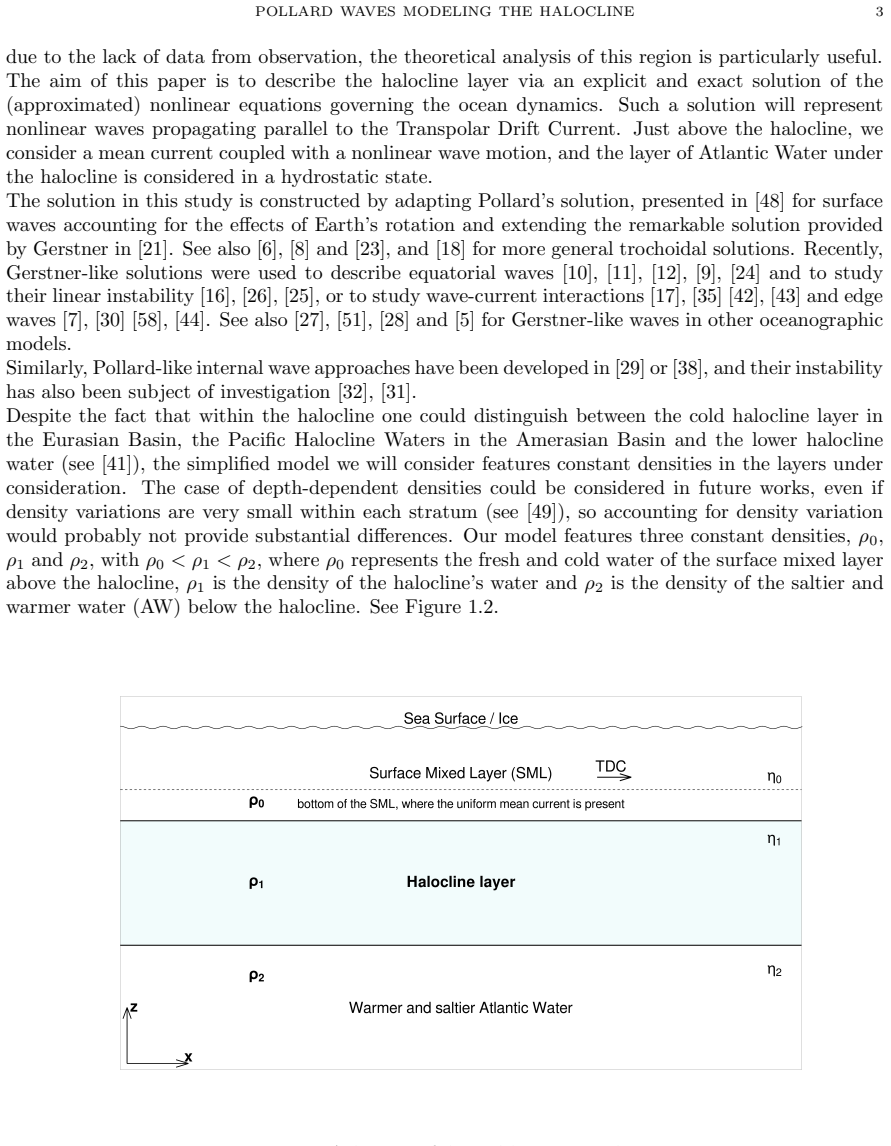
We present an explicit and exact solution to the governing equations describing the vertical structure of the Arctic Ocean region centred around the North Pole. The solution describes a stratified water column with three constant-density regions: a motionless bottom layer, a middle layer -- the halocline -- described by nonhydrostatic, near-inertial Pollard waves, and an upper layer presenting a mean current and a wave motion associated with the one in the halocline layer.
What carries the argument
Three-layer constant-density model with nonhydrostatic near-inertial Pollard waves confined to the middle halocline layer.
If this is right
- The bottom layer remains at rest while the upper layer carries both a steady current and waves whose motion matches the halocline waves.
- No internal forcing or density variation inside layers is required to satisfy the governing equations.
- The solution is exact once the three-layer geometry and constant densities are fixed.
- Wave motion is transmitted directly from the halocline into the upper layer through the interface conditions.
Where Pith is reading between the lines
- The analytical form could be inserted into larger-scale ocean models to supply an explicit halocline component without sub-grid parameterization.
- It suggests a direct way to relate observed near-inertial energy in the Arctic to the thickness and density jump of the halocline layer.
- Time-dependent extensions of the same layer structure might be used to track how changing surface stress alters the mean current in the upper layer.
Load-bearing premise
The ocean can be represented accurately by three layers of strictly constant density in which the middle halocline supports nonhydrostatic near-inertial Pollard waves without additional forcing or density changes inside any layer.
What would settle it
Vertical density profiles from the Arctic halocline that show continuous gradients instead of constant density, or observed wave periods that deviate from the predicted near-inertial band, would show the three-layer construction does not apply.
Figures


read the original abstract
We present an explicit and exact solution to the governing equations describing the vertical structure of the Arctic Ocean region centred around the North Pole. The solution describes a stratified water column with three constant-density regions: a motionless bottom layer, a middle layer -- the halocline -- described by nonhydrostatic, near-inertial Pollard waves, and an upper layer presenting a mean current and a wave motion associated with the one in the halocline layer.
Editorial analysis
A structured set of objections, weighed in public.
Referee Report
Summary. The manuscript claims to present an explicit and exact solution to the governing equations for the vertical structure of the Arctic Ocean near the North Pole. It describes a three-layer constant-density water column consisting of a motionless bottom layer, a middle halocline layer supporting nonhydrostatic near-inertial Pollard waves, and an upper layer with a mean current plus associated wave motion.
Significance. If the claimed exact solution is internally consistent and satisfies the full Euler equations plus density conservation while maintaining strictly uniform density in the wave-bearing layer, the result would provide a simple analytical idealization for near-inertial dynamics in the Arctic halocline. The explicit nature of the solution would be a strength if it avoids fitted parameters.
major comments (1)
- [Abstract] Abstract: the central claim of an exact solution for nonhydrostatic near-inertial Pollard waves in a strictly constant-density halocline layer requires explicit demonstration that the velocity field satisfies both the Euler equations and the density conservation equation without inducing any density perturbations. Nonhydrostatic terms permit vertical acceleration; in a wave context this normally produces isopycnal displacements, which would violate the constant-density assumption unless vertical velocity is identically zero. The associated wave motion described in the upper layer appears to contradict this requirement, making the interface-matching conditions load-bearing for the entire construction.
Simulated Author's Rebuttal
We thank the referee for their careful review and for highlighting the need to confirm consistency of the claimed exact solution with the full set of governing equations. We address the major comment below and will strengthen the presentation accordingly.
read point-by-point responses
-
Referee: [Abstract] Abstract: the central claim of an exact solution for nonhydrostatic near-inertial Pollard waves in a strictly constant-density halocline layer requires explicit demonstration that the velocity field satisfies both the Euler equations and the density conservation equation without inducing any density perturbations. Nonhydrostatic terms permit vertical acceleration; in a wave context this normally produces isopycnal displacements, which would violate the constant-density assumption unless vertical velocity is identically zero. The associated wave motion described in the upper layer appears to contradict this requirement, making the interface-matching conditions load-bearing for the entire construction.
Authors: The velocity and pressure fields in each layer are obtained by direct substitution into the nonhydrostatic Euler equations under the assumption of piecewise-constant density. In the halocline layer the density is uniform, so the density conservation equation is satisfied identically (the material derivative of a constant vanishes). Nonzero vertical velocity is an intrinsic part of the wave solution, but because the layer contains no internal density gradient, vertical motion produces no density perturbations and the layer remains homogeneous. The vertical momentum equation is satisfied by balancing the nonhydrostatic acceleration with the vertical pressure gradient. In the upper layer the associated wave is a matched evanescent mode whose amplitude is fixed by the interface conditions; its own constant density is likewise preserved. The kinematic and dynamic interface conditions (normal-velocity continuity and pressure continuity adjusted for the density jump) are imposed exactly, ensuring global consistency. We will add a dedicated verification subsection that substitutes the explicit fields into each equation and confirms satisfaction layer by layer. revision: partial
Circularity Check
No circularity; exact solution presented as independent construction from governing equations.
full rationale
The abstract and available text present the work as an explicit exact solution to the Euler equations under a three-layer constant-density ansatz with Pollard waves confined to the middle layer. No quoted equations, self-citations, fitted parameters renamed as predictions, or self-definitional reductions appear. The constant-density layers and wave form are stated inputs/assumptions, not outputs that loop back to themselves. The derivation chain is therefore self-contained against external benchmarks and does not reduce by construction to its own inputs.
Axiom & Free-Parameter Ledger
Lean theorems connected to this paper
-
IndisputableMonolith/Cost/FunctionalEquation.leanwashburn_uniqueness_aczel unclear?
unclearRelation between the paper passage and the cited Recognition theorem.
We present an explicit and exact solution to the governing equations describing the vertical structure of the Arctic Ocean region... three constant-density regions... nonhydrostatic, near-inertial Pollard waves
What do these tags mean?
- matches
- The paper's claim is directly supported by a theorem in the formal canon.
- supports
- The theorem supports part of the paper's argument, but the paper may add assumptions or extra steps.
- extends
- The paper goes beyond the formal theorem; the theorem is a base layer rather than the whole result.
- uses
- The paper appears to rely on the theorem as machinery.
- contradicts
- The paper's claim conflicts with a theorem or certificate in the canon.
- unclear
- Pith found a possible connection, but the passage is too broad, indirect, or ambiguous to say the theorem truly supports the claim.
Forward citations
Cited by 1 Pith paper
-
Instability of the halocline at the North Pole
Near-inertial Pollard waves modeling the Arctic halocline are linearly unstable above a steepness threshold derived via short-wavelength analysis of fluid trajectories.
Reference graph
Works this paper leans on
-
[1]
A. A. Abrashkin, E. N. Pelinovsky, Gerstner waves and their generalizations in hydrodynamics and geophysics, Phys. Usp., Vol. 65 (2022), 453–467
work page 2022
-
[2]
C. Bertosio, On the evolution of the halocline in the upper Arctic Ocean since 2007, PhD Thesis in Oceanography, Sorbonne Universit´ e, 2021
work page 2007
-
[3]
E. C. Carmack, The alpha/beta ocean distinction: A perspective on freshwater fluxes, convection, nutrients and productivity in high-latitude seas, Deep-Sea Res. II, Vol. 54 (2007), 2578–2598
work page 2007
-
[4]
W. Chinn, and N. Steenrod “First Concepts of Topology”, Mathematical Association of America, Washington DC, 1966
work page 1966
-
[5]
J. Chu, D. Ionescu-Kruse, and Y. Yang, Exact Solutions and Instability for Geophysical Waves with Centripetal Forces and at Arbitrary Latitude, J. Math. Fluid Mech., Vol. 21 (2019), 19
work page 2019
-
[6]
Constantin, On the deep water wave motion, J
A. Constantin, On the deep water wave motion, J. Phys. A: Math. Gen., Vol. 34 (2001), 1405-1417
work page 2001
-
[7]
Constantin, Edge waves along a sloping beach, J
A. Constantin, Edge waves along a sloping beach, J. Phys. A: Math. Gen., Vol. 34 (2001), 9723-9731
work page 2001
-
[8]
Nonlinear water waves with applications to wave-current interactions and tsunamis
A. Constantin, “Nonlinear water waves with applications to wave-current interactions and tsunamis”, Society for Industrial and Applied Mathematics, Philadelphia, 2011
work page 2011
-
[9]
Constantin, On the modelling of equatorial waves, Geophys
A. Constantin, On the modelling of equatorial waves, Geophys. Res. Lett., Vol. 39 (2012), L05602
work page 2012
-
[10]
Constantin, An exact solution for equatorially trapped waves, J
A. Constantin, An exact solution for equatorially trapped waves, J. Geophys. Res. Oceans, Vol. 117 (2012), C05029
work page 2012
-
[11]
Constantin, Some Three-Dimensional Nonlinear Equatorial Flows, J
A. Constantin, Some Three-Dimensional Nonlinear Equatorial Flows, J. Phys. Oceanogr., Vol. 43 (2013), 165–175
work page 2013
-
[12]
Constantin, Some Nonlinear, Equatorially Trapped, Nonhydrostatic Internal Geophysical Waves, J
A. Constantin, Some Nonlinear, Equatorially Trapped, Nonhydrostatic Internal Geophysical Waves, J. Phys. Oceanogr., Vol. 44 (2014), 781–789
work page 2014
-
[13]
A. Constantin, and R. S. Johnson, On the role of nonlinearity in geostrophic ocean flows on a sphere, In: N. Euler (Ed.), Nonlinear Systems and Their Remarkable Mathematical Structures: Volume I (pp 500-519 ). CRC Press Taylor & Francis Group, Boca Raton, 2019
work page 2019
-
[14]
A. Constantin, and R. S. Johnson, On the dynamics of the near-surface currents in the Arctic Ocean, Nonlinear Anal. Real World Appl., Vol. 73 (2023), 103894
work page 2023
-
[15]
A. Constantin, and R. S. Johnson, Spherical Coordinates for Arctic Ocean Flows, In: D. Henry (Ed.), Nonlinear Dispersive Waves. Advances in Mathematical Fluid Mechanics (pp 239-282). Birkh¨ auser, Cham, 2024
work page 2024
-
[16]
A. Constantin, and P. Germain, Instability of some equatorially trapped waves, J. Geophys. Res. Oceans, Vol. 118 (2013), 2802–2810
work page 2013
-
[17]
A. Constantin, and S. G. Monismith, Gerstner waves in the presence of mean currents and rotation, J. Fluid Mech., Vol. 820 (2017), 511-528
work page 2017
-
[18]
A. Constantin and W. A. Strauss, Trochoidal Solutions to the Incompressible Two-Dimensional Euler Equations, J. Math. Fluid Mech., Vol. 12 (2010), 181-201
work page 2010
-
[19]
C. J. Garrett, and W. H. Munk, Space-time scales of internal waves, Geophys. Fluid Dyn., Vol. 2 (1972), 225–264
work page 1972
-
[20]
C. J. Garrett, and W. H. Munk, Space-time scales of internal waves: A progress report, J. Geophys. Res., Vol. 80 (1975), 291–297
work page 1975
-
[21]
Gerstner, Theorie der Wellen, Ann
F. Gerstner, Theorie der Wellen, Ann. Phys., Vol. 32 (1809), 412-445
-
[22]
J. D. Guthrie, J. H. Morison, and I. Fer, Revisiting internal waves and mixing in the Arctic Ocean, J. Geophys. Res. Oceans, Vol. 118 (2013), 3966–3977
work page 2013
-
[23]
Henry, On Gerstner’s Water Wave, J
D. Henry, On Gerstner’s Water Wave, J. Nonlinear Math. Phys., Vol. 15 (2008), 87-95
work page 2008
-
[24]
Henry, Exact equatorial water waves in the f-plane, Nonlinear Anal
D. Henry, Exact equatorial water waves in the f-plane, Nonlinear Anal. Real World Appl., Vol. 28 (2016), 284-289
work page 2016
-
[25]
D. Henry, and H.-C. Hsu, Instability of internal equatorial water waves, J. Differ. Equ., Vol. 258 (2015), 1015-1024
work page 2015
-
[26]
D. Henry, and H.-C. Hsu, Instability of equatorial water waves in the f-plane, DCDS-A, Vol. 35 (2015), 909-916
work page 2015
-
[27]
Hsu, An Exact Solution for Nonlinear Internal Equatorial Waves in the f-Plane Approximation, J
H.-C. Hsu, An Exact Solution for Nonlinear Internal Equatorial Waves in the f-Plane Approximation, J. Math. Fluid Mech., Vol. 16 (2014), 463-471
work page 2014
-
[28]
Hsu, Exact Nonlinear Internal Equatorial Waves in the f-plane, J
H.-C. Hsu, Exact Nonlinear Internal Equatorial Waves in the f-plane, J. Math. Fluid Mech., Vol. 19 (2017), 367-374
work page 2017
-
[29]
Ionescu-Kruse, On Pollard’s wave solution at the Equator, J
D. Ionescu-Kruse, On Pollard’s wave solution at the Equator, J. Nonlinear Math. Phys., Vol. 22 (2015), 523-530
work page 2015
-
[30]
D. Ionescu-Kruse, An exact solution for geophysical edge waves in the f-plane approximation, Nonlinear Anal. Real World Appl., Vol. 24 (2015), 190-195
work page 2015
-
[31]
Ionescu-Kruse, Instability of Pollard’s exact solution for geophysical ocean flows, Phys
D. Ionescu-Kruse, Instability of Pollard’s exact solution for geophysical ocean flows, Phys. Fluids, Vol. 28 (2016), 086601
work page 2016
-
[32]
Ionescu-Kruse, On the short-wavelength stabilities of some geophysical flows., Phil
D. Ionescu-Kruse, On the short-wavelength stabilities of some geophysical flows., Phil. Trans. R. Soc. A, Vol. 376 (2017), 20170090
work page 2017
-
[33]
M. Jakobsson, et al., The International Bathymetric Chart of the Arctic Ocean (IBCAO) Version 3.0, Geophys. Res. Lett., Vol. 39 (2012), L12609
work page 2012
-
[34]
R. S. Johnson,An introduction to the mathematical fluid dynamics of oceanic and atmospheric flows, EMS Press, 2023
work page 2023
-
[35]
Kluczek, Exact and Explicit Internal Equatorial Water Waves with Underlying Currents, J
M. Kluczek, Exact and Explicit Internal Equatorial Water Waves with Underlying Currents, J. Math. Fluid Mech., Vol. 19 (2017), 305-314. POLLARD WAVES MODELING THE HALOCLINE 25
work page 2017
-
[36]
Kluczek, Physical flow properties for Pollard-like internal water waves, J
M. Kluczek, Physical flow properties for Pollard-like internal water waves, J. Math. Phys. Vol. 59 (2018), 123102
work page 2018
-
[37]
Kluczek, Nonhydrostatic Pollard-like internal geophysical waves, Discrete Continuous Dyn
M. Kluczek, Nonhydrostatic Pollard-like internal geophysical waves, Discrete Continuous Dyn. Syst., Vol. 39 (2019), 5171-5183
work page 2019
-
[38]
Kluczek, Exact Pollard-like internal water waves, J
M. Kluczek, Exact Pollard-like internal water waves, J. Nonlinear Math. Phys., Vol. 26 (2019), 133-146
work page 2019
-
[39]
M. Kluczek, and R. Stuhlmeier, Mass transport for Pollard waves, Appl. Anal., Vol. 101 (2020), 984–993
work page 2020
-
[40]
Atmosphere, Ocean and Climate Dynamics. An Introductory Text
J. Marshall, and R. A. Plumb, “Atmosphere, Ocean and Climate Dynamics. An Introductory Text”, Academic Press, Burlington, 2008
work page 2008
-
[41]
E. P. Metzner, and M. Salzmann, Technical note: Determining Arctic Ocean halocline and cold halostad depths based on vertical stability, Ocean Sci., Vol. 19 (2023), 1453–1464
work page 2023
-
[42]
McCarney, Exact internal waves in the presence of mean currents and rotation, J
J. McCarney, Exact internal waves in the presence of mean currents and rotation, J. Math. Phys., Vol. 64 (2023), 073101
work page 2023
-
[43]
McCarney, Nonhydrostatic internal waves in the presence of mean currents and rotation, J
J. McCarney, Nonhydrostatic internal waves in the presence of mean currents and rotation, J. Math. Phys., Vol. 65 (2024), 043101
work page 2024
-
[44]
F. Miao, M. Feˇ ckan, and J. Wang, Exact solution and instability for geophysical edge waves, Commun. Pure Appl. Anal., Vol. 21 (2022), 2447-2461
work page 2022
-
[45]
Morita,Classical Mechanics in Geophysical Fluid Dynamics, CRC Press, 2023
O. Morita,Classical Mechanics in Geophysical Fluid Dynamics, CRC Press, 2023
work page 2023
-
[46]
C. Peralta-Ferriz, and R. A. Woodgate, Seasonal and interannual variability of pan-Arctic surface mixed layer properties from 1979 to 2012 from hydrographic data, and the dominance of stratification for multiyear mixed layer depth shoaling, Progress in Oceanography, Vol. 134 (2015), 19–53
work page 1979
-
[47]
Models of Random Seas Based on the Lagrangian Equations of Motion
W. J. Pierson Jr., “Models of Random Seas Based on the Lagrangian Equations of Motion”, College of Eng., Res. Div., New York University, New York, 1961
work page 1961
-
[48]
R. T. Pollard, Surface waves with rotation: an exact solution, J. Geophys. Res., Vol. 75 (1970), 5895-5898
work page 1970
-
[49]
I. V. Polyakov, A. V. Pnyushkov, and E. C. Carmack, Stability of the arctic halocline: a new indicator of arctic climate change, Environ. Res. Lett., Vol. 13 (2018), 125008
work page 2018
-
[50]
Puntini, On the modeling of nonlinear wind-induced ice-drift ocean currents at the North Pole, J
C. Puntini, On the modeling of nonlinear wind-induced ice-drift ocean currents at the North Pole, J. Math. Fluid Mech., Vol. 27 (2025), 71
work page 2025
-
[51]
A. Rodr´ ıguez-Sanjurjo, Internal equatorial water waves and wave-current interactions in the f-plane, Monatsh. Math., Vol. 186 (2018), 685-701
work page 2018
-
[52]
B. Rudels, and E. Carmack, Arctic Ocean Water Mass Structure and Circulation, Oceanography, Vol. 35 (2022), 52-65
work page 2022
-
[53]
Lectures on Geophysical Fluid Dynamics
R. Salmon, “Lectures on Geophysical Fluid Dynamics”, Oxford University Press, New York, 1998
work page 1998
-
[54]
G. G. Stokes, On the Theory of Oscillatory Waves, Trans. Cambridge Philos. Soc., Vol. 8 (1847), 441-455
-
[55]
Descriptive Physical Oceanography: An Introduction
L. D. Talley, G. L. Pickard, W. J. Emery, and J. H. Swift, “Descriptive Physical Oceanography: An Introduction”, Elsevier, Amsterdam, 2011
work page 2011
-
[56]
M.-L. Timmermans, and J. Marshall, Understanding Arctic Ocean circulation: A review of ocean dynamics in a changing climate, J. Geophys. Res. Oceans, Vol. 125 (2020), e2018JC014378
work page 2020
-
[57]
Atmospheric and Oceanic Fluid Dynamics. Fundamentals and Large-Scale Circulation
G. K. Vallis, “Atmospheric and Oceanic Fluid Dynamics. Fundamentals and Large-Scale Circulation”, Cambridge University Press, Cambridge, 2017
work page 2017
-
[58]
J. E. H. Weber, A note on trapped Gerstner waves, J. Geophys. Res., Vol. 117 (2012), C03048
work page 2012
-
[59]
W. B. White, and R. G. Peterson, An Antarctic circumpolar wave in surface pressure, temperature and sea-ice extent, Nature, Vol. 380 (1996), 699-702
work page 1996
discussion (0)
Sign in with ORCID, Apple, or X to comment. Anyone can read and Pith papers without signing in.