REVIEW 3 major objections 3 minor 2 cited by
Global stability of the Atlantic overturning circulation: Edge state, long transients and boundary crisis under CO$_2$ forcing
T0 review · 3 major / 3 minor · reviewed 2026-08-16 · deepseek-v4-flash
Pith's one-line read The AMOC's strong state in the PlaSim-LSG model disappears between 360 and 460 ppm CO$_2$ through a boundary crisis: a collision with the chaotic edge state leaves only a long-lived transient before collapse.
desk verdict First explicit AMOC edge state in a fully coupled model is a solid computation, but the boundary-crisis headline is a hypothesis the evidence does not yet prove. read the letter →
The pith
A machine-rendered reading of the paper's core claim, the machinery that carries it, and where it could break.
The reading
What carries the argument
The carrying object is the edge state (Melancholia state): a non-attracting chaotic saddle embedded in the basin boundary between the strong and weak AMOC attractors, which is computed by an edge tracking algorithm that repeatedly bisects pairs of initial conditions interpolated along a straight line in the full roughly $10^5$-dimensional state space and then tracks the two trajectories until they diverge. Convergence, divergence, and bisection are all judged by a single observable — the difference in 10-year smoothed AMOC strength at 46-66°N — and the concatenated, averaged trajectory segments form a pseudotrajectory that populates the edge state's invariant measure. A reduced three-variable state space built from Atlantic salinity structure (meridional salinity gradient, vertical salinity gradient in the 46-66°N band, and deep North Atlantic salinity anomaly) separates the three objects and reveals that at 460 ppm the former ON and edge regions touch and interpenetrate, which is the state-space signature of the proposed boundary crisis. The Grebogi-Ott-Yorke boundary crisis concept supplies the mechanism: the ON attractor is annihilated by collision with the saddle, and the surviving union behaves as a ghost state whose long transient lifetimes explain millennial chaos and ensemble splitting.
What would settle it
Run the edge tracking at 360 ppm again with a different convergence observable — for instance the leading salinity EOF scores or a norm of the full Atlantic salinity field — and check whether the pseudotrajectory converges to the same region of the reduced state space with the same roughly 120-year oscillations; a substantially different 'edge state' would show that the AMOC-strength observable alone cannot locate the basin boundary. Independently, at 460 ppm one could measure the distribution of ghost-state lifetimes over many initial conditions and test whether it follows the exponential decay law of transient chaos expected after a boundary crisis, rather than the sharp threshold behaviour of a local saddle-node bifurcation.
Extended reading notes
Core claim
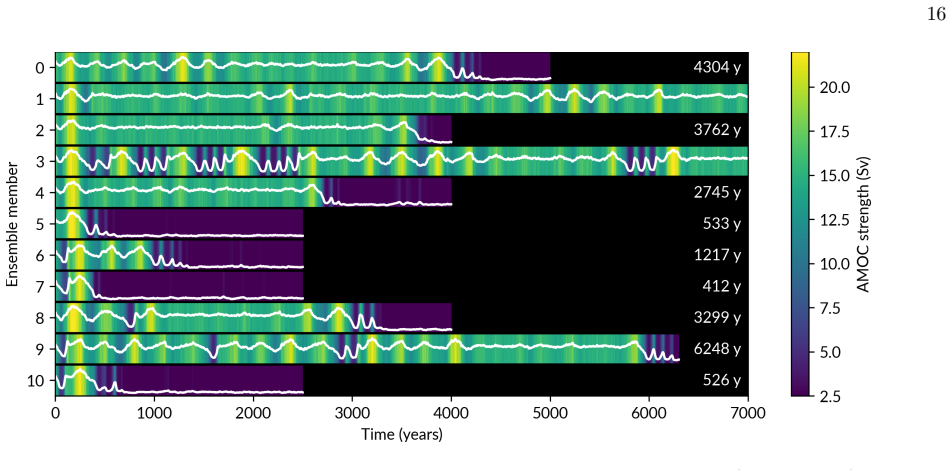
Using an edge tracking algorithm on a coupled intermediate-complexity model with roughly $10^5$ degrees of freedom, the paper constructs the AMOC edge state (Melancholia state) at 285 and 360 ppm CO$_2$: a chaotic saddle on the basin boundary whose pseudotrajectory shows large centennial oscillations (period about 118 years, amplitude up to 10 Sv) driven by interactions between sea ice, deep convection, and freshwater export in the North Atlantic, with the Labrador Sea leading the overturning strength by 6-8 years. When the CO$_2$ level is raised to 460 ppm, simulations initialised from the former ON state no longer settle: one 4000-year run maintains a strong but oscillating AMOC for roughly 1300 years, enters edge-like oscillations, briefly overshoots, and finally collapses to the OFF state, and the edge tracking pseudotrajectory itself loses the boundary and joins this transient. The paper interprets these observations as a boundary crisis: between 360 and 460 ppm the ON attractor collides with the edge state, and their union forms a ghost state in which trajectories chaotically switch between former ON and edge oscillatory modes before escaping to the OFF state, with some ensemble members persisting beyond 7000 years. In the reduced state space of Atlantic salinity gradients, the splitting of PlaSim-LSG ensemble members under SSP2-4.5 forcing occurs exactly in the region occupied by the edge state at 360 ppm and the ghost state at 460 ppm, and the same region is visited by the recovering and collapsing trajectories of the GISS model, which the paper offers as support for the claim that the observed 'stochastic bifurcation' is a signature of an AMOC edge state near a boundary crisis.
Load-bearing premise
The load-bearing premise is that the 10-year smoothed AMOC strength in the 46-66°N band is a faithful coordinate for separating the two sides of the basin boundary: the edge tracking algorithm decides convergence, divergence, and bisection solely from this one number, so if two trajectories with nearly identical AMOC strength can nevertheless lie on opposite sides of the boundary in the model's roughly $10^5$-dimensional state space, the computed 'edge state' may be an artifact of the chosen observable rather than the true saddle.
Editorial extensions
If this is right
- If the AMOC loses stability through a boundary crisis, critical slowing down near the ON state is not the right early-warning signature; instead the approach to the crisis should appear as longer and longer sojourns near the edge state ('sticky' behaviour), a global-stability analogue the paper proposes as an alternative, non-local view of early-warning.
- Under intermediate forcing scenarios such as SSP2-4.5, identical time-dependent CO$_2$ can produce qualitatively different AMOC outcomes purely through internal variability, because ghost-state chaos determines which ensemble members escape early and which persist.
- Popular stability indicators such as AMOC strength and Atlantic freshwater transport become poor indicators of stability out of equilibrium, since they oscillate strongly on the edge and ghost states even at fixed forcing.
- Transition paths passing near the edge state can show non-monotonic excursions in 'excursive' observables, meaning the first detectable signal of an impending collapse can have the opposite sign of the eventual change.
Reading between the lines
- A reader could test the method's central assumption by re-running the edge tracking at 360 ppm with a different convergence observable — say the leading salinity EOF scores or a norm of the Atlantic salinity field — to see whether the same edge state is recovered; the paper reports no such robustness check.
- If the boundary-crisis picture carries over to more complex models, AMOC risk assessment should target the crisis CO$_2$ level and the ghost-state lifetime distribution rather than a single tipping threshold, effectively replacing 'tipping point' with 'tipping window'.
- The millennial ghost-state lifetimes imply an attribution problem for observed AMOC behaviour: after the crisis threshold is crossed, a collapse could be delayed so long that its cause — external forcing versus internal chaotic escape — becomes empirically ambiguous.
- The GISS comparison could be made quantitative: using the same salinity-gradient coordinates in GISS output, one could test whether the probability of ensemble collapse matches the ghost-state escape statistics computed in PlaSim-LSG.
Signed reviews
Editorial analysis
A structured set of objections, weighed in public.
Referee Report
Summary. This paper studies the global stability landscape of the Atlantic Meridional Overturning Circulation (AMOC) in the intermediate-complexity climate model PlaSim-LSG. At 360 ppm CO2 the model is bistable with an ON and an OFF AMOC state; the authors apply edge tracking using the 10-year smoothed AMOC strength as the distance measure and obtain a roughly 1400-year edge trajectory that converges to an oscillatory edge state with a period of about 120 years. The edge state has a higher oceanic center of mass than either attractor, exhibits Labrador Sea sea-ice/convection oscillations, and lies in a distinct region of a reduced state space defined by meridional and vertical salinity gradients and deep North Atlantic salinity. At 285 ppm a similar edge state is found, while at 460 ppm a 4000-year run initialized from the former ON state collapses to OFF after a long transient, an 11-member ensemble initialized near the ghost state shows chaotic transients of 400 to over 7000 years, and the ON and edge regions appear to touch in a two-dimensional projection. The authors interpret this as a boundary crisis between 360 and 460 ppm, where the ON attractor collides with the edge state and forms a long-lived ghost state, and they use this framework to explain ensemble splitting under SSP2-4.5 forcing and to compare qualitatively with GISS-E2-1-G simulations.
Significance. If the central claim holds, this is the first explicit computation of an AMOC edge state in a fully coupled climate model, and the first proposal that AMOC collapse in a climate model occurs via a boundary crisis rather than a purely local bifurcation. The paper's strengths include the direct simulation-based edge tracking without fitted parameters, the 1400-year edge trajectory, the physically plausible oscillation mechanism, and the explicit comparison with the GISS ensemble splitting. The data and code availability are also commendable. However, the boundary-crisis claim currently rests on indirect evidence, and the edge-tracking observable is not validated; the significance is therefore conditional on these two points being resolved.
major comments (3)
- [Sec. V and Fig. 12] The claim that the ON attractor no longer exists at 460 ppm is not established by the presented evidence. The 4000-year run that collapses after 2700 years, the 11-member ensemble with two survivors beyond 7000 years, and the apparent touching in Fig. 11c are all consistent with alternative interpretations, in particular with a surviving ON attractor whose basin excludes the chosen initial conditions. Under the ghost-state hypothesis the survival probability should decay to zero, but a finite 11-member ensemble with two survivors at 7000 years can also be produced by an ON attractor occupying a modest basin fraction. Because the paper's abstract states that a boundary crisis is 'revealed', the authors should provide a more direct test, for example by continuing the two surviving ensemble members until collapse (or until a statistically significant bound on the ghost-state lifetime is obtained), or by quantifying the basin fraction of the ON state at 460 ppm in the full state space.
- [Sec. III B and Supplemental S3] The edge tracking algorithm uses the 10-year smoothed AMOC strength at 46-66 degrees N as the sole distance measure for bisection and divergence detection. In a roughly 10^5-dimensional system with a possibly fractal basin boundary, this scalar observable is not an injective function of the basin of attraction: two states with identical smoothed AMOC strength can lie on opposite sides of the boundary. The computed 'edge state' may therefore be an artifact of the observable rather than the true invariant set on the basin boundary. Since the boundary crisis is defined as a collision with this edge state, this is a load-bearing methodological choice. The authors should test robustness by repeating the edge tracking with an alternative distance measure, such as a normalized full-state norm or a salinity-based index, and report whether the edge state and its centennial oscillations persist.
- [Sec. V B and Fig. 11c] The evidence that the former ON and edge states 'touch' at 460 ppm is based on a two-dimensional projection onto the meridional and vertical salinity gradients. Disjoint sets in the full state space can overlap in a low-dimensional projection, so this touching cannot by itself establish the collision required for a boundary crisis. The authors should either compute distances between the two sets in a higher-dimensional representation of state space, or show that the apparent overlap is not a projection artifact, for example by measuring the minimal distance in a subspace spanned by more than two independent physical fields.
minor comments (3)
- [Sec. I and Sec. V B] The wording is inconsistent: the abstract and introduction say the results 'reveal a boundary crisis', while Section V B says 'we propose' and Section V C says the data 'suggests' a crisis. The level of certainty should be aligned with the evidence level throughout.
- [General] The manuscript contains several typographical errors, including 'greehnouse' in the Introduction, 'Ocillations' in Section V B, and 'Skodowska' in the Acknowledgements. These should be corrected in the final version.
- [Figures and text] Numerous encoding artifacts appear throughout the manuscript text and figure captions (for example, strings of the form '/uni0000008b/uni00000087...' and missing spaces such as 'statesat 360ppm CO 2'). The camera-ready version must be regenerated without these artifacts.
Circularity Check
No significant circularity: the edge state and boundary crisis are computed by direct simulation, not fitted or imported from self-citations.
full rationale
The central derivation is self-contained. The ON, OFF, and edge states are computed by forward integration of PlaSim-LSG (Sec. III), with the edge tracking algorithm selecting trajectories by their asymptotic AMOC behavior and full-state bisection; no parameter is fitted to the target result, and the boundary crisis at 460 ppm is an interpretation of finite-time simulations (Sec. V), not a quantity fixed by an input. The self-citations (e.g., Refs. [10,48,57,58]) provide methodology and prior context for edge tracking and ghost states, but the load-bearing evidence — the 2700-year collapse of the trajectory initialized from the former ON state, the 11-member ensemble of long chaotic transients, and the state-space overlap in the 2D projection — comes from simulations reported in this paper. The comparison with the GISS model uses external CMIP6 data. Methodological weaknesses such as the scalar-observable convergence criterion for edge tracking and the inference of attractor disappearance from finite-time transients are correctness and robustness concerns, not circularity.
Assumptions & free parameters
free parameters (3)
- vertical diffusivity parameters (astar, arange, lambda, zstar) =
astar=0.8714e-4, arange=0.2843e-4, lambda=4.5e-3 m^-1, zstar=2500 m
- edge tracking divergence threshold =
1 Sv (10-year smoothed AMOC strength)
- AMOC strength diagnostic =
maximum streamfunction in 46-66 N band, 10-year smoothing
assumptions (5)
- standard math Basin boundary separates basins and edge states are attracting on the boundary, so edge tracking converges.
- standard math Boundary crisis occurs when an attractor collides with a basin boundary saddle, forming a ghost state.
- domain assumption PlaSim-LSG is a deterministic model whose dynamics adequately represent AMOC bistability.
- ad hoc to paper Interpolated initial conditions between ON and OFF states are physically meaningful and relax to physical states due to convexity of the equations.
- ad hoc to paper The 10-year smoothed AMOC strength is a sufficient distance measure to locate the basin boundary in full state space.
Cite this review
Pith. "Pith review of Global stability of the Atlantic overturning circulation: Edge state, long transients and boundary crisis under CO$_2$ forcing." pith.science (2026). https://pith.science/paper/7B3SA3G3
@misc{pith2026250420002,
  author       = {Pith},
  title        = {Pith review of: Global stability of the Atlantic overturning circulation: Edge state, long transients and boundary crisis under CO$_2$ forcing},
  year         = {2026},
  howpublished = {\url{https://pith.science/paper/7B3SA3G3}},
  note         = {Machine review of arXiv:2504.20002}
}
abstract
The Atlantic Meridional Overturning Circulation (AMOC), a crucial ocean current system, could transition to a weak state. Despite severe associated climate impacts, assessing the AMOC's response under global warming and its proximity to possible critical thresholds remains difficult. To understand future Earth system stability, a global dynamical view is needed beyond the local stability analysis underlying classical early-warning methods. Using an intermediate-complexity climate model, we explore the stability landscape of the AMOC for different atmospheric CO$_2$ concentrations. We explicitly compute the edge state (or Melancholia state), a chaotic saddle on the basin boundary separating the strong and weak AMOC attractors found in the model. While being unstable, the edge state can govern the transient climate for centuries, supporting centennial AMOC oscillations driven by atmosphere-ice-ocean interactions in the North Atlantic. At increased CO$_2$ levels projected for the near future, we reveal a boundary crisis where the current AMOC attractor disappears by colliding with the edge state. Under crisis overshoot, long chaotic transients due to "ghost states" lead to diverging ensemble trajectories under time-varying forcing. Rooted in dynamical systems theory, our results offer an explanation of large ensemble variance and apparent "stochastic bifurcations" observed in earth system models under intermediate forcing scenarios.
Figures


Figures from the paper (11 more)




Forward citations
Cited by 2 Pith papers
-
Alternate states and intermingledness in complex high-dimensional systems
A new workflow detects multistable states in complex high-dimensional data via optimization of differentiating observables and defines an intermingledness indicator, tested on three climate datasets.
-
Self-Replication of Turbulent Puffs: On the edge between chaotic saddles
Self-replication of turbulent puffs proceeds through a newly identified split edge state, the tipping point between one-puff and two-puff chaotic saddles.
Reference graph
Works this paper leans on
-
[1]
K. L. Rossi, R. C. Budzinski, E. S. Medeiros, B. R. R. Boaretto, L. Muller, and U. Feudel, Dynamical properties and mechanisms of metastability: A perspective in neuroscience, Phys. Rev. E111, 021001 (2025), publisher: American Physical Society
2025
-
[2]
Westerhold, N
T. Westerhold, N. Marwan, A. J. Drury, D. Liebrand, C. Agnini, E. Anagnostou, J. S. K. Barnet, S. M. Bohaty, D. De Vleeschouwer, F. Florindo, T. Frederichs, D. A. Hodell, A. E. Holbourn, D. Kroon, V. Lauretano, K. Littler, L. J. Lourens, M. Lyle, H. P¨ alike, U. R¨ ohl, J. Tian, R. H. Wilkens, P. A. Wilson, and J. C. Zachos, An astronomically dated record...
2020
-
[3]
Dansgaard, S
W. Dansgaard, S. J. Johnsen, H. B. Clausen, D. Dahl-Jensen, N. S. Gundestrup, C. U. Hammer, C. S. Hvidberg, J. P. Steffensen, A. E. Sveinbj¨ ornsdottir, J. Jouzel, and G. Bond, Evidence for general instability of past climate from a 250-kyr ice-core record, Nature364, 218 (1993), publisher: Nature Publishing Group
1993
-
[4]
R. B. Alley, J. Marotzke, W. D. Nordhaus, J. T. Overpeck, D. M. Peteet, R. A. P. Jr, R. T. Pierrehumbert, P. B. Rhines, T. F. Stocker, L. D. Talley, and J. M. Wallace, Abrupt Climate Change, Science299(2003)
2003
-
[5]
Feudel, Complex dynamics in multistable systems, Int
U. Feudel, Complex dynamics in multistable systems, Int. J. Bifurcation Chaos18, 1607 (2008), publisher: World Scientific Publishing Co
2008
-
[6]
Margazoglou, T
G. Margazoglou, T. Grafke, A. Laio, and V. Lucarini, Dynamical landscape and multistability of a climate model, Proceedings of the Royal Society A: Mathematical, Physical and Engineering Sciences477, 20210019 (2021), publisher: Royal Society
2021
-
[7]
Graham and T
R. Graham and T. T´ el, Nonequilibrium potential for coexisting attractors, Physical Review A33, 1322 (1986), publisher: APS
1986
-
[8]
Graham, A
R. Graham, A. Hamm, and T. T´ el, Nonequilibrium potentials for dynamical systems with fractal attractors or repellers, Physical review letters66, 3089 (1991), publisher: APS
1991
Show all 120 references
-
[9]
Rousseau, W
D.-D. Rousseau, W. Bagniewski, and V. Lucarini, A punctuated equilibrium analysis of the climate evolution of cenozoic exhibits a hierarchy of abrupt transitions, Sci Rep13, 11290 (2023), number: 1 Publisher: Nature Publishing Group
2023
-
[10]
Lucarini and T
V. Lucarini and T. B´ odai, Edge states in the climate system: exploring global instabilities and critical transitions, Nonlinearity30, R32 (2017), publisher: IOP Publishing
2017
-
[11]
Lucarini and T
V. Lucarini and T. B´ odai, Global stability properties of the climate: Melancholia states, invariant measures, and phase transitions, Nonlinearity33, R59 (2020), publisher: IOP Publishing
2020
-
[12]
Lynch-Stieglitz, The Atlantic Meridional Overturning Circulation and Abrupt Climate Change, Annual Review of Marine Science9, 83 (2017), publisher: Annual Reviews
J. Lynch-Stieglitz, The Atlantic Meridional Overturning Circulation and Abrupt Climate Change, Annual Review of Marine Science9, 83 (2017), publisher: Annual Reviews
2017
-
[13]
Rahmstorf, Ocean circulation and climate during the past 120,000 years, Nature419, 207 (2002), publisher: Nature Publishing Group
S. Rahmstorf, Ocean circulation and climate during the past 120,000 years, Nature419, 207 (2002), publisher: Nature Publishing Group
2002
-
[14]
L. G. Henry, J. F. McManus, W. B. Curry, N. L. Roberts, A. M. Piotrowski, and L. D. Keigwin, North Atlantic ocean circulation and abrupt climate change during the last glaciation, Science353, 470 (2016), publisher: American Association for the Advancement of Science
2016
-
[15]
Weijer, W
W. Weijer, W. Cheng, S. S. Drijfhout, A. V. Fedorov, A. Hu, L. C. Jackson, W. Liu, E. L. McDonagh, J. V. Mecking, and J. Zhang, Stability of the Atlantic Meridional Overturning Circulation: A Review and Synthesis, Journal of Geophysical Research: Oceans124, 5336 (2019), eprint...
2019 doi
-
[16]
D. I. Armstrong McKay, A. Staal, J. F. Abrams, R. Winkelmann, B. Sakschewski, S. Loriani, I. Fetzer, S. E. Cornell, J. Rockstr¨ om, and T. M. Lenton, Exceeding 1.5°C global warming could trigger multiple climate tipping points, Science 377, eabn7950 (2022)
2022
-
[17]
Ashwin, S
P. Ashwin, S. Wieczorek, R. Vitolo, and P. Cox, Tipping points in open systems: bifurcation, noise-induced and rate- dependent examples in the climate system, Philosophical Transactions of the Royal Society A: Mathematical, Physical and Engineering Sciences370, 1166 (2012), pu...
2012
-
[18]
Masson-Delmotte, P
V. Masson-Delmotte, P. Zhai, A. Pirani, S. L. Connors, C. P´ ean, S. Berger, N. Caud, Y. Chen, L. Goldfarb, M. I. Gomis, M. Huang, K. Leitzell, E. Lonnoy, J. B. R. Matthews, T. K. Maycock, T. Waterfield, ¨O. Yelek¸ ci, R. Yu, and B. Zhou, eds.,Climate Change 2021: The Physical...
2021
-
[19]
T. M. Lenton, D. Armstrong McKay, S. Loriani, J. F. Abrams, J. F. Donges, M. Milkoreit, T. Powell, S. R. Smith, C. Zimm, J. E. Buxton, E. Bailey, L. Laybourn, A. Ghadiali, and J. G. Dyke,The Global Tipping Points Report 2023, Tech. Rep. (University of Exeter, Exeter, UK, 2023)
2023
-
[20]
Wunderling, A
N. Wunderling, A. S. von der Heydt, Y. Aksenov, S. Barker, R. Bastiaansen, V. Brovkin, M. Brunetti, V. Couplet, T. Kleinen, C. H. Lear, J. Lohmann, R. M. Roman-Cuesta, S. Sinet, D. Swingedouw, R. Winkelmann, P. Anand, J. Barichivich, S. Bathiany, M. Baudena, J. T. Bruun, C. M....
2024
-
[21]
Weijer, W
W. Weijer, W. Cheng, O. A. Garuba, A. Hu, and B. T. Nadiga, CMIP6 Models Predict Significant 21st Century Decline of the Atlantic Meridional Overturning Circulation, Geophysical Research Letters47, e2019GL086075 (2020), eprint: https://onlinelibrary.wiley.com/doi/pdf/10.1029/2...
2020 doi
-
[22]
Caesar, S
L. Caesar, S. Rahmstorf, A. Robinson, G. Feulner, and V. Saba, Observed fingerprint of a weakening Atlantic Ocean overturning circulation, Nature556, 191 (2018), publisher: Nature Publishing Group
2018
-
[23]
G. D. McCarthy, P. J. Brown, C. N. Flagg, G. Goni, L. Houpert, C. W. Hughes, R. Hummels, M. Inall, K. Jochumsen, K. M. H. Larsen, P. Lherminier, C. S. Meinen, B. I. Moat, D. Rayner, M. Rhein, A. Roessler, C. Schmid, and D. A. Smeed, Sustainable Observations of the AMOC: Method...
2020 doi
-
[24]
Liu, S.-P
W. Liu, S.-P. Xie, Z. Liu, and J. Zhu, Overlooked possibility of a collapsed Atlantic Meridional Overturning Circulation in warming climate, Science Advances3, e1601666 (2017), publisher: American Association for the Advancement of Science
2017
-
[25]
Bellomo, M
K. Bellomo, M. Angeloni, S. Corti, and J. von Hardenberg, Future climate change shaped by inter-model differences in Atlantic meridional overturning circulation response, Nat Commun12, 3659 (2021), number: 1 Publisher: Nature Publishing Group. 22
2021
-
[26]
Levermann and A
A. Levermann and A. Born, Bistability of the Atlantic subpolar gyre in a coarse-resolution climate model, Geophysical Research Letters34, 10.1029/2007GL031732 (2007), eprint: https://onlinelibrary.wiley.com/doi/pdf/10.1029/2007GL031732
2007 doi
-
[27]
Sgubin, D
G. Sgubin, D. Swingedouw, S. Drijfhout, Y. Mary, and A. Bennabi, Abrupt cooling over the North Atlantic in modern climate models, Nat Commun8, 14375 (2017), publisher: Nature Publishing Group
2017
-
[28]
Swingedouw, A
D. Swingedouw, A. Bily, C. Esquerdo, L. F. Borchert, G. Sgubin, J. Mignot, and M. Menary, On the risk of abrupt changes in the North Atlantic subpolar gyre in CMIP6 models, Annals of the New York Academy of Sciences1504, 187 (2021), eprint: https://onlinelibrary.wiley.com/doi/...
2021 doi
-
[29]
Stommel, Thermohaline Convection with Two Stable Regimes of Flow, Tellus13, 224 (1961), eprint: https://onlinelibrary.wiley.com/doi/pdf/10.1111/j.2153-3490.1961.tb00079.x
H. Stommel, Thermohaline Convection with Two Stable Regimes of Flow, Tellus13, 224 (1961), eprint: https://onlinelibrary.wiley.com/doi/pdf/10.1111/j.2153-3490.1961.tb00079.x
1961
-
[30]
Rahmstorf, M
S. Rahmstorf, M. Crucifix, A. Ganopolski, H. Goosse, I. Kamenkovich, R. Knutti, G. Lohmann, R. Marsh, L. A. Mysak, Z. Wang, and A. J. Weaver, Thermohaline circulation hysteresis: A model intercomparison, Geophysical Research Letters 32, 10.1029/2005GL023655 (2005), eprint: htt...
2005 doi
-
[31]
Hawkins, R
E. Hawkins, R. S. Smith, L. C. Allison, J. M. Gregory, T. J. Woollings, H. Pohlmann, and B. de Cuevas, Bistability of the Atlantic overturning circulation in a global climate model and links to ocean freshwater transport, Geophysical Research Letters38, 10.1029/2011GL047208 (2...
2011 doi
-
[32]
L. C. Jackson and R. A. Wood, Hysteresis and Resilience of the AMOC in an Eddy-Permitting GCM, Geophysical Research Letters45, 8547 (2018), eprint: https://onlinelibrary.wiley.com/doi/pdf/10.1029/2018GL078104
2018 doi
-
[33]
R. M. Van Westen and H. A. Dijkstra, Asymmetry of AMOC Hysteresis in a State-Of-The- Art Global Climate Model, Geophysical Research Letters50, e2023GL106088 (2023), eprint: https://onlinelibrary.wiley.com/doi/pdf/10.1029/2023GL106088
2023 doi
-
[34]
W. S. Broecker, D. M. Peteet, and D. Rind, Does the ocean–atmosphere system have more than one stable mode of operation?, Nature315, 21 (1985)
1985
-
[35]
Manabe and R
S. Manabe and R. J. Stouffer, Two Stable Equilibria of a Coupled Ocean-Atmosphere Model, Journal of Climate1, 841 (1988), publisher: American Meteorological Society Section: Journal of Climate
1988
-
[36]
Manabe and R
S. Manabe and R. J. Stouffer, Are two modes of thermohaline circulation stable?, Tellus A: Dynamic Meteorology and Oceanography51, 400 (1999), publisher: Taylor & Francis eprint: https://doi.org/10.3402/tellusa.v51i3.13461
1999 doi
-
[37]
Lohmann, H
J. Lohmann, H. A. Dijkstra, M. Jochum, V. Lucarini, and P. D. Ditlevsen, Multistability and intermediate tipping of the Atlantic Ocean circulation, Science Advances10, eadi4253 (2024), publisher: American Association for the Advancement of Science
2024
-
[38]
Kuhlbrodt, A
T. Kuhlbrodt, A. Griesel, M. Montoya, A. Levermann, M. Hofmann, and S. Rahmstorf, On the driving processes of the Atlantic meridional overturning circulation, Reviews of Geophysics45, 10.1029/2004RG000166 (2007), eprint: https://onlinelibrary.wiley.com/doi/pdf/10.1029/2004RG000166
2007 doi
-
[39]
Boers, Observation-based early-warning signals for a collapse of the Atlantic Meridional Overturning Circulation, Nat
N. Boers, Observation-based early-warning signals for a collapse of the Atlantic Meridional Overturning Circulation, Nat. Clim. Chang.11, 680 (2021), publisher: Nature Publishing Group
2021
-
[40]
S. L. L. Michel, D. Swingedouw, P. Ortega, G. Gastineau, J. Mignot, G. McCarthy, and M. Khodri, Early warning signal for a tipping point suggested by a millennial Atlantic Multidecadal Variability reconstruction, Nat Commun13, 5176 (2022), number: 1 Publisher: Nature Publishing Group
2022
-
[41]
Ditlevsen and S
P. Ditlevsen and S. Ditlevsen, Warning of a forthcoming collapse of the Atlantic meridional overturning circulation, Nat Commun14, 4254 (2023), number: 1 Publisher: Nature Publishing Group
2023
-
[42]
R. M. Van Westen, M. Kliphuis, and H. A. Dijkstra, Physics-based early warning signal shows that AMOC is on tipping course, Sci. Adv.10, eadk1189 (2024)
2024
-
[43]
Ben-Yami, A
M. Ben-Yami, A. Morr, S. Bathiany, and N. Boers, Uncertainties too large to predict tipping times of major Earth system components, arXiv preprint arXiv:2309.08521 (2023)
2023 arXiv
-
[44]
Wieczorek, C
S. Wieczorek, C. Xie, and P. Ashwin, Rate-induced tipping: thresholds, edge states and connecting orbits, Nonlinearity 36, 3238 (2023), publisher: IOP Publishing
2023
-
[45]
Huang, S
Y. Huang, S. Bathiany, P. Ashwin, and N. Boers, Deep learning for predicting rate-induced tipping, Nat Mach Intell6, 1556 (2024)
2024
-
[46]
E. N. Lorenz, Deterministic Nonperiodic Flow, Journal of the Atmospheric Sciences20, 130 (1963), publisher: American Meteorological Society Section: Journal of the Atmospheric Sciences
1963
-
[47]
E. N. Lorenz, Climatic predictability, GARP Publications series , 132 (1975)
1975
-
[48]
Mehling, R
O. Mehling, R. B¨ orner, and V. Lucarini, Limits to predictability of the asymptotic state of the Atlantic Meridional Overturning Circulation in a conceptual climate model, Physica D: Nonlinear Phenomena459, 134043 (2024)
2024
-
[49]
Knutti and T
R. Knutti and T. F. Stocker, Limited Predictability of the Future Thermohaline Circulation Close to an Instability Threshold, Journal of Climate15, 179 (2002), publisher: American Meteorological Society Section: Journal of Climate
2002
-
[50]
Lohmann, B
J. Lohmann, B. Wuyts, P. D. Ditlevsen, and P. Ashwin, On the predictability of possible storylines for forced complex systems, J. Phys. Complex.5, 035015 (2024), publisher: IOP Publishing
2024
-
[51]
Kasz´ as, T
B. Kasz´ as, T. Haszpra, and M. Herein, The snowball Earth transition in a climate model with drifting parameters: Splitting of the snapshot attractor, Chaos: An Interdisciplinary Journal of Nonlinear Science29, 113102 (2019)
2019
-
[52]
Romanou, D
A. Romanou, D. Rind, J. Jonas, R. Miller, M. Kelley, G. Russell, C. Orbe, L. Nazarenko, R. Latto, and G. A. Schmidt, Stochastic Bifurcation of the North Atlantic Circulation under a Midrange Future Climate Scenario with the NASA-GISS ModelE, Journal of Climate36, 6141 (2023), ...
2023
-
[53]
Q. Gu, M. Gervais, G. Danabasoglu, W. M. Kim, F. Castruccio, E. Maroon, and S.-P. Xie, Wide range of possible trajectories of North Atlantic climate in a warming world, Nat Commun15, 4221 (2024), publisher: Nature Publishing 23 Group
2024
-
[54]
Lai and T
Y.-C. Lai and T. T´ el,Transient chaos: complex dynamics on finite time scales, Vol. 173 (Springer Science & Business Media, 2011)
2011
-
[55]
Grebogi, E
C. Grebogi, E. Ott, and J. A. Yorke, Crises, sudden changes in chaotic attractors, and transient chaos, Physica D: Nonlinear Phenomena7, 181 (1983)
1983
-
[56]
U. Feudel, Rate-induced tipping in ecosystems and climate: the role of unstable states, basin boundaries and transient dynamics, Nonlinear Processes in Geophysics30, 481 (2023), publisher: Copernicus GmbH
2023
-
[57]
Lohmann and V
J. Lohmann and V. Lucarini, Melancholia states of the Atlantic Meridional Overturning Circulation, Phys. Rev. Fluids 9, 123801 (2024), publisher: American Physical Society
2024
-
[58]
B¨ orner,Climate on the Edge: Metastability, Melancholia States and Critical Transitions of the Ocean Circulation, Ph.D
R. B¨ orner,Climate on the Edge: Metastability, Melancholia States and Critical Transitions of the Ocean Circulation, Ph.D. thesis, University of Reading (2025)
2025
-
[59]
B¨ orner, R
R. B¨ orner, R. Deeley, R. R¨ omer, T. Grafke, V. Lucarini, and U. Feudel, Saddle avoidance of noise-induced transitions in multiscale systems, Phys. Rev. Res.6, L042053 (2024), publisher: American Physical Society
2024
-
[60]
P. M. Battelino, C. Grebogi, E. Ott, J. A. Yorke, and E. D. Yorke, Multiple coexisting attractors, basin boundaries and basic sets, Physica D: Nonlinear Phenomena32, 296 (1988), publisher: Elsevier
1988
-
[61]
J. D. Skufca, J. A. Yorke, and B. Eckhardt, Edge of Chaos in a Parallel Shear Flow, Phys. Rev. Lett.96, 174101 (2006)
2006
-
[62]
T. M. Schneider, J. F. Gibson, M. Lagha, F. De Lillo, and B. Eckhardt, Laminar-turbulent boundary in plane Couette flow, Phys. Rev. E78, 037301 (2008)
2008
-
[63]
B´ odai and V
T. B´ odai and V. Lucarini, Rough basin boundaries in high dimension: Can we classify them experimentally?, Chaos: An Interdisciplinary Journal of Nonlinear Science30, 103105 (2020)
2020
-
[64]
Ashwin, J
P. Ashwin, J. Newman, and R. R¨ omer, Contrasting Chaotic and Stochastic Forcing: Tipping Windows and Attractor Crises, SIAM J. Appl. Dyn. Syst. , 277 (2025), publisher: Society for Industrial and Applied Mathematics
2025
-
[65]
Drijfhout, J
S. Drijfhout, J. Angevaare, J. V. Mecking, R. van Westen, and S. Rahmstorf, Shutdown of northern Atlantic overturning af- ter 2100 following deep mixing collapse in CMIP6 projections, Environmental Research Letters 10.1088/1748-9326/adfa3b (2025)
2025 doi
-
[66]
Feudel, A
U. Feudel, A. N. Pisarchik, and K. Showalter, Multistability and tipping: From mathematics and physics to climate and brain—Minireview and preface to the focus issue, Chaos: An Interdisciplinary Journal of Nonlinear Science28, 033501 (2018)
2018
-
[67]
D. Koch, A. Nandan, G. Ramesan, I. Tyukin, A. Gorban, and A. Koseska, Ghost Channels and Ghost Cycles Guiding Long Transients in Dynamical Systems, Phys. Rev. Lett.133, 047202 (2024), publisher: American Physical Society
2024
-
[68]
The PlaSim-LSG model is available as open-source code athttps://github.com/jhardenberg/PLASIM
-
[69]
Fraedrich, H
K. Fraedrich, H. Jansen, E. Kirk, U. Luksch, and F. Lunkeit, The Planet Simulator: Towards a user friendly model, metz 14, 299 (2005)
2005
-
[70]
Maier-Reimer, U
E. Maier-Reimer, U. Mikolajewicz, and K. Hasselmann, Mean Circulation of the Hamburg LSG OGCM and Its Sen- sitivity to the Thermohaline Surface Forcing, Journal of Physical Oceanography23, 731 (1993), publisher: American Meteorological Society Section: Journal of Physical Oceanography
1993
-
[71]
Angeloni, E
M. Angeloni, E. Palazzi, and J. Von Hardenberg,Evaluation and climate sensitivity of the PlaSim v.17 Earth SystemModel coupled with ocean model components of different complexity, preprint (Climate and Earth system modeling, 2020)
2020
-
[72]
Claussen, L
M. Claussen, L. Mysak, A. Weaver, M. Crucifix, T. Fichefet, M.-F. Loutre, S. Weber, J. Alcamo, V. Alexeev, A. Berger, R. Calov, A. Ganopolski, H. Goosse, G. Lohmann, F. Lunkeit, I. Mokhov, V. Petoukhov, P. Stone, and Z. Wang, Earth system models of intermediate complexity: clo...
2002
-
[73]
M. Angeloni,Climate variability in an Earth system Model of Intermediate Complexity: from interannual to centennial timescales, Doctoral Thesis, Alma Mater Studiorum - Universit` a di Bologna (2022)
2022
-
[74]
Lucarini and M
V. Lucarini and M. D. Chekroun, Detecting and Attributing Change in Climate and Complex Systems: Foundations, Green’s Functions, and Nonlinear Fingerprints, Phys. Rev. Lett.133, 244201 (2024), publisher: American Physical Society
2024
-
[75]
D’Errico, F
M. D’Errico, F. Pons, P. Yiou, S. Tao, C. Nardini, F. Lunkeit, and D. Faranda, Present and future synoptic circulation patterns associated with cold and snowy spells over Italy, Earth System Dynamics13, 961 (2022), publisher: Copernicus GmbH
2022
-
[76]
Ragone, J
F. Ragone, J. Wouters, and F. Bouchet, Computation of extreme heat waves in climate models using a large deviation algorithm, Proceedings of the National Academy of Sciences115, 24 (2018), publisher: Proceedings of the National Academy of Sciences
2018
-
[77]
Wouters, R
J. Wouters, R. K. H. Schiemann, and L. C. Shaffrey, Rare Event Simulation of Extreme European Winter Rainfall in an Intermediate Complexity Climate Model, Journal of Advances in Modeling Earth Systems15, e2022MS003537 (2023), eprint: https://onlinelibrary.wiley.com/doi/pdf/10....
2023 doi
-
[78]
Sauer, J
J. Sauer, J. Demaeyer, G. Zappa, F. Massonnet, and F. Ragone, Extremes of summer Arctic sea ice reduction investigated with a rare event algorithm, Clim Dyn62, 5219 (2024)
2024
-
[79]
M. Cini, G. Zappa, F. Ragone, and S. Corti, Simulating AMOC tipping driven by internal climate variability with a rare event algorithm, npj Clim Atmos Sci7, 1 (2024), number: 1 Publisher: Nature Publishing Group
2024
-
[80]
Mehling, K
O. Mehling, K. Bellomo, M. Angeloni, C. Pasquero, and J. von Hardenberg, High-latitude precipitation as a driver of multicentennial variability of the AMOC in a climate model of intermediate complexity, Clim Dyn 10.1007/s00382-022- 06640-3 (2022)
2022 doi
-
[81]
Hasselmann, An ocean model for climate variability studies, Progress in Oceanography11, 69 (1982)
K. Hasselmann, An ocean model for climate variability studies, Progress in Oceanography11, 69 (1982). 24
1982
-
[82]
Arakawa and V
A. Arakawa and V. R. Lamb, Computational Design of the Basic Dynamical Processes of the UCLA General Circulation Model, inMethods in Computational Physics: Advances in Research and Applications, General Circulation Models of the Atmosphere, Vol. 17, edited by J. Chang (Elsevie...
1977
-
[83]
A. J. Semtner, A Model for the Thermodynamic Growth of Sea Ice in Numerical Investigations of Climate, Journal of Physical Oceanography6, 379 (1976), publisher: American Meteorological Society Section: Journal of Physical Oceanog- raphy
1976
-
[84]
M. D. Zelinka, T. A. Myers, D. T. McCoy, S. Po-Chedley, P. M. Caldwell, P. Ceppi, S. A. Klein, and K. E. Taylor, Causes of higher climate sensitivity in cmip6 models, Geophysical Research Letters47, e2019GL085782 (2020), e2019GL085782 10.1029/2019GL085782, https://agupubs.onli...
2020 doi
-
[85]
W. E. Johns, S. Elipot, D. A. Smeed, B. Moat, B. King, D. L. Volkov, and R. H. Smith, Towards two decades of Atlantic Ocean mass and heat transports at 26.5°N, Philosophical Transactions of the Royal Society A: Mathematical, Physical and Engineering Sciences381, 20220188 (2023...
2023
-
[86]
Meinshausen, Z
M. Meinshausen, Z. R. J. Nicholls, J. Lewis, M. J. Gidden, E. Vogel, M. Freund, U. Beyerle, C. Gessner, A. Nauels, N. Bauer, J. G. Canadell, J. S. Daniel, A. John, P. B. Krummel, G. Luderer, N. Meinshausen, S. A. Montzka, P. J. Rayner, S. Reimann, S. J. Smith, M. van den Berg,...
2020
-
[87]
C. Orbe, D. Rind, R. L. Miller, L. S. Nazarenko, A. Romanou, J. Jonas, G. L. Russell, M. Kelley, and G. A. Schmidt, Atmospheric Response to a Collapse of the North Atlantic Circulation under a Mid-Range Future Climate Scenario: A Regime Shift in Northern Hemisphere Dynamics, J...
2023
-
[88]
M. W. Buckley and J. Marshall, Observations, inferences, and mechanisms of the Atlantic Meridional Overturning Circulation: A review, Reviews of Geophysics54, 5 (2016), eprint: https://onlinelibrary.wiley.com/doi/pdf/10.1002/2015RG000493
2016 doi
-
[89]
L. C. Jackson, E. Alastru´ e De Asenjo, K. Bellomo, G. Danabasoglu, H. Haak, A. Hu, J. Jungclaus, W. Lee, V. L. Meccia, O. Saenko, A. Shao, and D. Swingedouw, Understanding AMOC stability: the North Atlantic Hosing Model Intercomparison Project, Geosci. Model Dev.16, 1975 (2023)
2023
-
[90]
More generally, stochastic parameterisations of unresolved processes change this picture and require a stochastic descrip- tion
-
[91]
Altman and M
N. Altman and M. Krzywinski, The curse(s) of dimensionality, Nature Methods15, 399 (2018), publisher: Nature Publishing Group
2018
-
[92]
Navarra and V
A. Navarra and V. Simoncini,A Guide to Empirical Orthogonal Functions for Climate Data Analysis(Springer Science & Business Media, 2010) google-Books-ID: MgVuGKsRIPoC
2010
-
[93]
J. P. Peixoto and A. H. Oort,Physics of climate(American Institute of Physics, 1992)
1992
-
[94]
Lucarini and F
V. Lucarini and F. Ragone, Energetics of Climate Models: Net Energy Balance and Merid- ional Enthalpy Transport, Reviews of Geophysics49, 10.1029/2009RG000323 (2011), eprint: https://onlinelibrary.wiley.com/doi/pdf/10.1029/2009RG000323
2011 doi
-
[95]
Knietzsch, A
M.-A. Knietzsch, A. Schr¨ oder, V. Lucarini, and F. Lunkeit, The impact of oceanic heat transport on the atmospheric circulation, Earth System Dynamics6, 591 (2015), publisher: Copernicus GmbH
2015
-
[96]
Bjerknes, Atlantic Air-Sea Interaction, Advances in Geophysics10, 1 (1964)
J. Bjerknes, Atlantic Air-Sea Interaction, Advances in Geophysics10, 1 (1964)
1964
-
[97]
P. H. Stone, Constraints on dynamical transports of energy on a spherical planet, Dynamics of Atmospheres and Oceans 2, 123 (1978)
1978
-
[98]
Povea-P´ erez, E
Y. Povea-P´ erez, E. Guilyardi, A. V. Fedorov, and B. Ferster, The central role of the Atlantic meridional overturning circulation in the Bjerknes compensation, Clim Dyn62, 575 (2024)
2024
-
[99]
Rosenthal and F
B. Rosenthal and F. Roquet, The Center of Mass of the Ocean as an Index of the General Stratification and Its Relation to the Overturning Circulation, Journal of Physical Oceanography55, 277 (2025)
2025
-
[100]
Lohmann, A
J. Lohmann, A. B. Hansen, A. Lovo, R. Chapman, F. Bouchet, and V. Lucarini, The role of edge states for early-warning of tipping points (2024), arXiv:2410.16277
2024 arXiv
-
[101]
Jacques-Dumas, R
V. Jacques-Dumas, R. M. v. Westen, and H. A. Dijkstra, Estimation of AMOC Transition Probabilities Using a Machine Learning–Based Rare-Event Algorithm, Artificial Intelligence for the Earth Systems3, 10.1175/AIES-D-24-0002.1 (2024)
2024 doi
-
[102]
Caraballo and X
T. Caraballo and X. Han,Applied Nonautonomous and Random Dynamical Systems, SpringerBriefs in Mathematics (Springer International Publishing, Cham, 2016)
2016
-
[103]
Hong and J
L. Hong and J. Xu, A chaotic crisis between chaotic saddle and attractor in forced Duffing oscillators, Communications in Nonlinear Science and Numerical Simulation9, 313 (2004)
2004
-
[104]
A. R. Axelsen, C. R. Quinn, and A. P. Bassom, Finite-Time Analysis of Crises in a Chaotically Forced Ocean Model, J Nonlinear Sci34, 97 (2024)
2024
-
[105]
Y.-C. Lai, M. Ding, C. Grebogi, and R. Bl¨ umel, Algebraic decay and fluctuations of the decay exponent in Hamiltonian systems, Phys. Rev. A46, 4661 (1992), publisher: American Physical Society
1992
-
[106]
Ying-Cheng Lai, personal communication
-
[107]
Willeit and A
M. Willeit and A. Ganopolski, Generalized stability landscape of the Atlantic Meridional Overturning Circulation, EGU- sphere , 1 (2024), publisher: Copernicus GmbH
2024
-
[108]
T. M. Lenton, J. F. Abrams, A. Bartsch, S. Bathiany, C. A. Boulton, J. E. Buxton, A. Conversi, A. M. Cunliffe, S. Hebden, T. Lavergne, B. Poulter, A. Shepherd, T. Smith, D. Swingedouw, R. Winkelmann, and N. Boers, Remotely sensing potential climate change tipping points across...
2024
-
[109]
Malmierca-Vallet, L
I. Malmierca-Vallet, L. C. Sime, P. J. Valdes, M. Klockmann, G. Vettoretti, and J. Slattery, The Impact of CO2 and Climate State on Whether Dansgaard–Oeschger Type Oscillations Occur in Climate Models, Geophysical Research Letters 51, e2024GL110068 (2024), publisher: John Wile...
2024
-
[110]
Li and A
C. Li and A. Born, Coupled atmosphere-ice-ocean dynamics in dansgaard-oeschger events, Quaternary Science Reviews 203, 1 (2019)
2019
-
[111]
Mehling, K
O. Mehling, K. Bellomo, and J. von Hardenberg, Centennial-scale variability of the atlantic merid- ional overturning circulation in cmip6 models shaped by arctic–north atlantic interactions and sea ice biases, Geophysical Research Letters51, e2024GL110791 (2024), e2024GL110791...
2024 doi
-
[112]
Y. M. Rom´ e, R. F. Ivanovic, L. J. Gregoire, D. Swingedouw, S. Sherriff-Tadano, and R. B¨ orner, Simulated millennial-scale climate variability driven by a convection–advection oscillator, Clim Dyn63, 150 (2025)
2025
-
[113]
G. K. Vallis,Atmospheric and Oceanic Fluid Dynamics(Cambridge University Press, 2017) google-Books-ID: BTgoD- wAAQBAJ
2017
-
[114]
Datseris, K
G. Datseris, K. Luiz Rossi, and A. Wagemakers, Framework for global stability analysis of dynamical systems, Chaos: An Interdisciplinary Journal of Nonlinear Science33, 073151 (2023)
2023
-
[115]
Dawson, eofs: A Library for EOF Analysis of Meteorological, Oceanographic, and Climate Data, Journal of Open Research Software4, 10.5334/jors.122 (2016)
A. Dawson, eofs: A Library for EOF Analysis of Meteorological, Oceanographic, and Climate Data, Journal of Open Research Software4, 10.5334/jors.122 (2016). 26 Supplemental Information S1. MODEL CONFIGURATION We use the version of PlaSim-LSG publicly available athttps://github...
2016 doi
-
[116]
Compute interpolated initial conditionsx (k) j =x (k−1) a + 0.1j x(k−1) b −x (k−1) a forj= 0,...,10
-
[117]
around 350 model years at 360 ppm CO 2)
Run parallel simulations fromx (k) j until every trajectory can be labelled as approaching either the ON or the OFF state (e.g. around 350 model years at 360 ppm CO 2)
-
[118]
Find new indicesm,n∈{0,...,10}such that the trajectories fromx (k) m andx (k) n stay close to each other (<1 Sv difference in smoothed AMOC strength) for as long as possible but evolve to different attractors. 27
-
[119]
Select the timet k at which the trajectories fromx (k) m andx (k) n first diverge by 1 Sv and use their states att k as new initial conditionsx (k) a andx (k) b
-
[120]
Increasekby 1 and repeat step 1. S4. DATA AND SOFTWARE Selected simulation data and source code for implementing the edge tracking algorithm in PlaSim-LSG are available athttps://doi.org/10.5281/zenodo.17053348. Further raw model simulation output can be provided by the author...
Reviewed August 16, 2026 · model on record in the stance chip above.
Discussion (0). Continue with ORCID to comment.