PhysGaia: A Physics-Aware Benchmark with Multi-Body Interactions for Dynamic Novel View Synthesis
Pith reviewed 2026-05-19 12:08 UTC · model grok-4.3
The pith
PhysGaia supplies ground-truth 3D particle trajectories and physical parameters for scenes with multi-body collisions and diverse materials to evaluate physics-consistent dynamic novel view synthesis.
A machine-rendered reading of the paper's core claim, the machinery that carries it, and where it could break.
Core claim
The paper introduces PhysGaia as a physics-aware benchmark for Dynamic Novel View Synthesis that encompasses both structured objects and unstructured physical phenomena through complex multi-body interactions. Scenes are generated by material-specific physics solvers that strictly follow fundamental physical laws, covering liquids, gases, textiles, and rheological substances beyond rigid-body limits. Comprehensive ground-truth information including 3D particle trajectories and physical parameters such as viscosity is supplied to enable quantitative evaluation of physical modeling in dynamic reconstructions, along with pipelines for 4D Gaussian Splatting models.
What carries the argument
The PhysGaia benchmark dataset, which supplies physics-generated scenes with multi-body interactions and ground-truth 3D particle trajectories plus physical parameters for quantitative evaluation of physical fidelity in novel view synthesis.
If this is right
- Quantitative metrics become available to measure how well dynamic novel view synthesis methods capture physical parameters and trajectories.
- Models can be trained and tested on interactions involving force exchanges between multiple bodies and non-rigid materials.
- Integration with 4D Gaussian Splatting enables direct assessment of current reconstruction techniques against physics-based references.
- Research can advance toward scene understanding that combines visual synthesis with adherence to physical laws.
Where Pith is reading between the lines
- The benchmark could support development of hybrid models that use view synthesis to predict future physical states rather than only interpolate observed motion.
- It might reveal cases where high visual quality in reconstructions hides violations of conservation laws that only trajectory checks detect.
- Future extensions could add real-world capture data to compare against the simulated ground truth for domain-gap analysis.
Load-bearing premise
Scenes produced by the chosen material-specific physics solvers accurately represent real-world physical behavior and the supplied ground-truth trajectories suffice to separate physically faithful reconstructions from those that are only visually plausible.
What would settle it
A test where a dynamic novel view synthesis model produces novel views that match visual ground truth yet its inferred particle trajectories deviate substantially from the provided 3D ground-truth paths on the same scenes.
Figures




read the original abstract
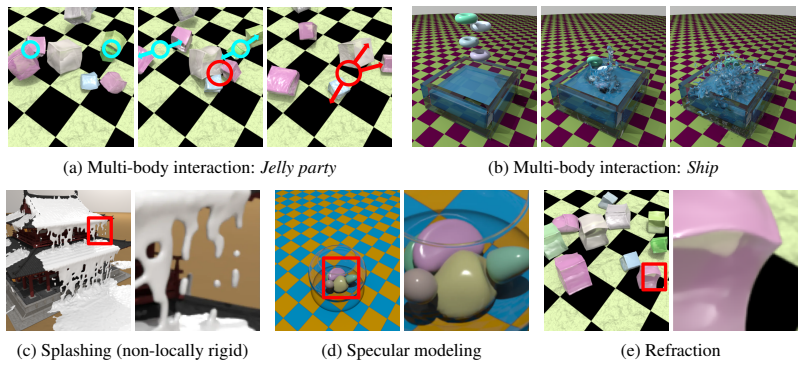
We introduce PhysGaia, a novel physics-aware benchmark for Dynamic Novel View Synthesis (DyNVS) that encompasses both structured objects and unstructured physical phenomena. While existing datasets primarily focus on photorealistic appearance, PhysGaia is specifically designed to support physics-consistent dynamic reconstruction. Our benchmark features complex scenarios with rich multi-body interactions, where objects realistically collide and exchange forces. Furthermore, it incorporates a diverse range of materials, including liquid, gas, textile, and rheological substance, moving beyond the rigid-body assumptions prevalent in prior work. To ensure physical fidelity, all scenes in PhysGaia are generated using material-specific physics solvers that strictly adhere to fundamental physical laws. We provide comprehensive ground-truth information, including 3D particle trajectories and physical parameters (e.g., viscosity), enabling the quantitative evaluation of physical modeling. To facilitate research adoption, we also provide integration pipelines for recent 4D Gaussian Splatting models along with our dataset and their results. By addressing the critical shortage of physics-aware benchmarks, PhysGaia can significantly advance research in dynamic view synthesis, physics-based scene understanding, and the integration of deep learning with physical simulation, ultimately enabling more faithful reconstruction and interpretation of complex dynamic scenes.
Editorial analysis
A structured set of objections, weighed in public.
Referee Report
Summary. The paper introduces PhysGaia, a benchmark dataset for dynamic novel view synthesis (DyNVS) featuring multi-body interactions across structured objects and unstructured phenomena. Scenes incorporate diverse materials (liquids, gases, textiles, rheological substances) generated via material-specific physics solvers, with provided ground-truth 3D particle trajectories and physical parameters (e.g., viscosity) to support quantitative evaluation of physical modeling. Integration pipelines for 4D Gaussian Splatting models and baseline results are also supplied.
Significance. A well-validated physics-aware benchmark could meaningfully advance DyNVS research by shifting evaluation from purely visual metrics toward physical consistency in reconstructions involving collisions, force exchanges, and non-rigid dynamics. The inclusion of integration pipelines and results for recent models is a concrete practical contribution that lowers barriers to adoption.
major comments (1)
- [Abstract] Abstract: The central claim that scenes are generated 'using material-specific physics solvers that strictly adhere to fundamental physical laws' and thereby enable 'quantitative evaluation of physical modeling' is not supported by any real-world validation. The manuscript provides no comparisons of simulated trajectories or force exchanges against independent measurements (high-speed video, motion capture, or sensor data) under matched conditions, so it remains unclear whether low reconstruction error on PhysGaia demonstrates physical fidelity or merely simulator consistency.
minor comments (2)
- Clarify in the dataset description whether the provided ground-truth trajectories include all solver-specific discretization artifacts or only idealized physical quantities.
- The abstract mentions 'rich multi-body interactions' but does not specify quantitative metrics (e.g., collision counts, force magnitudes) used to characterize interaction complexity; adding these would strengthen the benchmark's utility.
Simulated Author's Rebuttal
We thank the referee for the constructive feedback and positive assessment of the benchmark's potential impact. We address the major comment on the abstract's claims regarding physical validation below, with a commitment to revisions for clarity.
read point-by-point responses
-
Referee: [Abstract] Abstract: The central claim that scenes are generated 'using material-specific physics solvers that strictly adhere to fundamental physical laws' and thereby enable 'quantitative evaluation of physical modeling' is not supported by any real-world validation. The manuscript provides no comparisons of simulated trajectories or force exchanges against independent measurements (high-speed video, motion capture, or sensor data) under matched conditions, so it remains unclear whether low reconstruction error on PhysGaia demonstrates physical fidelity or merely simulator consistency.
Authors: We appreciate the referee's emphasis on distinguishing simulator-internal consistency from direct real-world physical fidelity. PhysGaia is explicitly a simulation-based benchmark: all scenes are generated by established material-specific solvers (e.g., MPM for fluids/rheology, cloth simulators for textiles) that enforce fundamental laws by construction, as described in Section 3. These solvers are standard tools in computational physics and have been validated against experiments in the literature; our ground-truth particle trajectories and parameters (viscosity, etc.) therefore provide a controlled, quantitative testbed for whether DyNVS methods recover physically plausible dynamics. We acknowledge that the manuscript does not include new side-by-side comparisons to real-world sensor data, which would be a separate experimental effort outside the scope of a benchmark paper. To prevent misinterpretation, we will revise the abstract to state that physical adherence is achieved through the use of validated physics simulators rather than claiming direct real-world validation. We will also add a limitations paragraph clarifying that PhysGaia evaluates consistency with physics-based simulation as a proxy for physical modeling. revision: yes
Circularity Check
No circularity in benchmark dataset presentation
full rationale
The paper introduces PhysGaia as an externally generated benchmark using material-specific physics solvers to produce scenes and ground-truth trajectories. No derivation chain is claimed that reduces a prediction or first-principles result to the paper's own fitted inputs or self-citations by construction. The abstract and description position the work as a data contribution for evaluating other methods, with simulator outputs serving as direct ground truth rather than a renamed fit or self-referential loop. This is the normal case of a self-contained benchmark paper with no load-bearing circular steps.
Axiom & Free-Parameter Ledger
axioms (1)
- domain assumption Material-specific physics solvers strictly adhere to fundamental physical laws.
Lean theorems connected to this paper
-
IndisputableMonolith/Foundation/RealityFromDistinction.leanreality_from_one_distinction unclear?
unclearRelation between the paper passage and the cited Recognition theorem.
All scenes in PhysGaia are faithfully generated to strictly adhere to physical laws, leveraging carefully selected material-specific physics solvers... 3D particle trajectories and physics parameters, e.g., viscosity.
-
IndisputableMonolith/Cost/FunctionalEquation.leanwashburn_uniqueness_aczel unclear?
unclearRelation between the paper passage and the cited Recognition theorem.
We select SideFX Houdini 20.5... FLIP for liquids, Pyro for gases, MPM for viscoelastic materials, and Vellum for textiles.
What do these tags mean?
- matches
- The paper's claim is directly supported by a theorem in the formal canon.
- supports
- The theorem supports part of the paper's argument, but the paper may add assumptions or extra steps.
- extends
- The paper goes beyond the formal theorem; the theorem is a base layer rather than the whole result.
- uses
- The paper appears to rely on the theorem as machinery.
- contradicts
- The paper's claim conflicts with a theorem or certificate in the canon.
- unclear
- Pith found a possible connection, but the passage is too broad, indirect, or ambiguous to say the theorem truly supports the claim.
Forward citations
Cited by 1 Pith paper
-
LMMs Meet Object-Centric Vision: Understanding, Segmentation, Editing and Generation
This review organizes literature on large multimodal models and object-centric vision into four themes—understanding, referring segmentation, editing, and generation—while summarizing paradigms, strategies, and challe...
Reference graph
Works this paper leans on
-
[1]
Mildenhall, B., Srinivasan, P.P., Tancik, M., Barron, J.T., Ramamoorthi, R., Ng, R.: Nerf: Representing scenes as neural radiance fields for view synthesis. In ECCV . (2020)
work page 2020
-
[2]
Li, T., Slavcheva, M., Zollhoefer, M., Green, S., Lassner, C., Kim, C., Schmidt, T., Lovegrove, S., Goesele, M., Newcombe, R., et al.: Neural 3d video synthesis from multi-view video. In CVPR. (2022)
work page 2022
-
[3]
Pumarola, A., Corona, E., Pons-Moll, G., Moreno-Noguer, F.: D-nerf: Neural radiance fields for dynamic scenes. In CVPR. (2021)
work page 2021
-
[4]
Yoon, J.S., Kim, K., Gallo, O., Park, H.S., Kautz, J.: Novel view synthesis of dynamic scenes with globally coherent depths from a monocular camera. In CVPR. (2020)
work page 2020
-
[5]
Gao, C., Saraf, A., Kopf, J., Huang, J.B.: Dynamic view synthesis from dynamic monocular video. In ICCV . (2021)
work page 2021
-
[6]
Du, Y ., Zhang, Y ., Yu, H.X., Tenenbaum, J.B., Wu, J.: Neural radiance flow for 4d view synthesis and video processing. In ICCV . (2021)
work page 2021
-
[7]
Park, K., Sinha, U., Barron, J.T., Bouaziz, S., Goldman, D.B., Seitz, S.M., Martin-Brualla, R.: Nerfies: Deformable neural radiance fields. In ICCV . (2021)
work page 2021
-
[8]
Cao, A., Johnson, J.: Hexplane: A fast representation for dynamic scenes. In CVPR. (2023)
work page 2023
-
[9]
Fridovich-Keil, S., Meanti, G., Warburg, F.R., Recht, B., Kanazawa, A.: K-planes: Explicit radiance fields in space, time, and appearance. In CVPR. (2023)
work page 2023
-
[10]
Shao, R., Zheng, Z., Tu, H., Liu, B., Zhang, H., Liu, Y .: Tensor4d: Efficient neural 4d decomposition for high-fidelity dynamic reconstruction and rendering. In CVPR. (2023)
work page 2023
-
[11]
Fang, J., Yi, T., Wang, X., Xie, L., Zhang, X., Liu, W., Nießner, M., Tian, Q.: Fast dynamic radiance fields with time-aware neural voxels. In SIGGRAPH Asia. (2022)
work page 2022
- [12]
-
[13]
Gao, H., Li, R., Tulsiani, S., Russell, B., Kanazawa, A.: Monocular dynamic view synthesis: A reality check. In NeurIPS. (2022)
work page 2022
-
[14]
Kim, M., Lim, J., Han, B.: Ua-4dgs: 4d gaussian splatting in the wild with uncertainty-aware regularization. In NeurIPS. (2024)
work page 2024
- [15]
-
[16]
Zhang, T., Gao, Q., Li, W., Liu, L., Chen, B.: Bags: Building animatable gaussian splatting from a monocular video with diffusion priors (2024)
work page 2024
-
[17]
Huang, Y .H., Sun, Y .T., Yang, Z., Lyu, X., Cao, Y .P., Qi, X.: Sc-gs: Sparse-controlled gaussian splatting for editable dynamic scenes. In CVPR. (2024)
work page 2024
- [18]
-
[19]
Kratimenos, A., Lei, J., Daniilidis, K.: Dynmf: Neural motion factorization for real-time dynamic view synthesis with 3d gaussian splatting. In ECCV . (2024)
work page 2024
- [20]
-
[21]
Kerbl, B., Kopanas, G., Leimkühler, T., Drettakis, G.: 3d gaussian splatting for real-time radiance field rendering. In ACM ToG. (2023) 11
work page 2023
-
[22]
Xie, T., Zong, Z., Qiu, Y ., Li, X., Feng, Y ., Yang, Y ., Jiang, C.: Physgaussian: Physics-integrated 3d gaussians for generative dynamics. In CVPR. (2024)
work page 2024
-
[23]
Zhang, T., Yu, H.X., Wu, R., Feng, B.Y ., Zheng, C., Snavely, N., Wu, J., Freeman, W.T.: Physdreamer: Physics-based interaction with 3d objects via video generation. In ECCV . (2024)
work page 2024
-
[24]
Liu, S., Ren, Z., Gupta, S., Wang, S.: Physgen: Rigid-body physics-grounded image-to-video generation. In ECCV . (2024)
work page 2024
- [25]
- [26]
-
[27]
Jiang, Y ., Yu, C., Xie, T., Li, X., Feng, Y ., Wang, H., Li, M., Lau, H., Gao, F., Yang, Y ., et al.: Vr-gs: A physical dynamics-aware interactive gaussian splatting system in virtual reality. In SIGGRAPH. (2024)
work page 2024
-
[28]
Lin, Y ., Lin, C., Xu, J., Mu, Y .: Omniphysgs: 3d constitutive gaussians for general physics-based dynamics generation. In ICLR. (2025)
work page 2025
-
[29]
Huang, T., Zhang, H., Zeng, Y ., Zhang, Z., Li, H., Zuo, W., Lau, R.W.: Dreamphysics: Learning physics-based 3d dynamics with video diffusion priors. In AAAI. (2025)
work page 2025
-
[30]
Qiu, R.Z., Yang, G., Zeng, W., Wang, X.: Feature splatting: Language-driven physics-based scene synthesis and editing. In ECCV . (2024)
work page 2024
-
[31]
Zhong, L., Yu, H.X., Wu, J., Li, Y .: Reconstruction and simulation of elastic objects with spring-mass 3d gaussians. In ECCV . (2024)
work page 2024
-
[32]
Chen, A., Xu, Z., Geiger, A., Yu, J., Su, H.: Tensorf: Tensorial radiance fields. In ECCV . (2022)
work page 2022
-
[33]
Garbin, S.J., Kowalski, M., Johnson, M., Shotton, J., Valentin, J.: Fastnerf: High-fidelity neural rendering at 200fps. In ICCV . (2021)
work page 2021
-
[34]
Wang, L., Zhang, J., Liu, X., Zhao, F., Zhang, Y ., Zhang, Y ., Wu, M., Yu, J., Xu, L.: Fourier plenoctrees for dynamic radiance field rendering in real-time. In CVPR. (2022)
work page 2022
-
[35]
Müller, T., Evans, A., Schied, C., Keller, A.: Instant neural graphics primitives with a multireso- lution hash encoding. In ACM TOG. (2022)
work page 2022
-
[36]
Yang, Z., Gao, X., Zhou, W., Jiao, S., Zhang, Y ., Jin, X.: Deformable 3d gaussians for high-fidelity monocular dynamic scene reconstruction. In CVPR. (2024)
work page 2024
-
[37]
Wu, G., Yi, T., Fang, J., Xie, L., Zhang, X., Wei, W., Liu, W., Tian, Q., Wang, X.: 4d gaussian splatting for real-time dynamic scene rendering. In CVPR. (2024)
work page 2024
-
[38]
Li, Z., Chen, Z., Li, Z., Xu, Y .: Spacetime gaussian feature splatting for real-time dynamic view synthesis. In CVPR. (2024)
work page 2024
-
[39]
Lin, Y ., Dai, Z., Zhu, S., Yao, Y .: Gaussian-flow: 4d reconstruction with dynamic 3d gaussian particle. In CVPR. (2024)
work page 2024
-
[40]
Lu, Z., Guo, X., Hui, L., Chen, T., Yang, M., Tang, X., Zhu, F., Dai, Y .: 3d geometry-aware deformable gaussian splatting for dynamic view synthesis. In CVPR. (2024)
work page 2024
- [41]
- [42]
- [43]
-
[44]
Duan, Y ., Wei, F., Dai, Q., He, Y ., Chen, W., Chen, B.: 4d-rotor gaussian splatting: towards efficient novel view synthesis for dynamic scenes. In SIGGRAPH. (2024)
work page 2024
-
[45]
Waczynska, J., Borycki, P., Kaleta, J., Tadeja, S., Spurek, P.: D-miso: Editing dynamic 3d scenes using multi-gaussians soup. In NeurIPS. (2024)
work page 2024
-
[46]
Liu, Q., Liu, Y ., Wang, J., Lyv, X., Wang, P., Wang, W., Hou, J.: Modgs: Dynamic gaussian splatting from casually-captured monocular videos. In ICLR. (2025)
work page 2025
-
[47]
Stearns, C., Harley, A., Uy, M., Dubost, F., Tombari, F., Wetzstein, G., Guibas, L.: Dynamic gaussian marbles for novel view synthesis of casual monocular videos. In SIGGRAPH. (2024)
work page 2024
-
[48]
Computer Methods in Applied Mechanics and Engineering (1994)
Sulsky, D., Chen, Z., Schreyer, H.L.: A particle method for history-dependent materials. Computer Methods in Applied Mechanics and Engineering (1994)
work page 1994
-
[49]
Yan, Z., Li, C., Lee, G.H.: Nerf-ds: Neural radiance fields for dynamic specular objects. In CVPR. (2023)
work page 2023
- [50]
-
[51]
In Multimedia Content Analysis in Sports
Lewin, S., Vandegar, M., Hoyoux, T., Barnich, O., Louppe, G.: Dynamic nerfs for soccer scenes. In Multimedia Content Analysis in Sports. (2023)
work page 2023
-
[52]
Wu, G., Yi, T., Fang, J., Liu, W., Wang, X.: Fast high dynamic range radiance fields for dynamic scenes. In 3DV . (2024)
work page 2024
-
[53]
Rombach, R., Blattmann, A., Lorenz, D., Esser, P., Ommer, B.: High-resolution image synthesis with latent diffusion models. In CVPR. (2022)
work page 2022
-
[54]
Yang, L., Kang, B., Huang, Z., Xu, X., Feng, J., Zhao, H.: Depth anything: Unleashing the power of large-scale unlabeled data. In CVPR. (2024)
work page 2024
-
[55]
(2023) arXiv preprint arXiv:2303.06583
Yang, Z., Du, Y ., Sun, D., Jampani, V ., Liu, C., Freeman, W.T., Tenenbaum, J.B., Wu, J.: Cotracker: Transformers for tracking any point. (2023) arXiv preprint arXiv:2303.06583
-
[56]
International Journal of Computer Vision (1992)
Tomasi, C., Kanade, T.: Shape and motion from image streams under orthography: A factoriza- tion method. International Journal of Computer Vision (1992)
work page 1992
- [57]
-
[58]
Zhang, M., Wang, T.Y ., Ceylan, D., Mitra, N.J.: Dynamic neural garments. TOG (2021)
work page 2021
-
[59]
Zou, X., Han, X., Wong, W.: Cloth4d: A dataset for clothed human reconstruction. In CVPR. (2023)
work page 2023
-
[60]
Wang, W., Ho, H.I., Guo, C., Rong, B., Grigorev, A., Song, J., Zarate, J.J., Hilliges, O.: 4D- DRESS: A 4d dataset of real-world human clothing with semantic annotations. In CVPR. (2024)
work page 2024
-
[61]
Rasheed, A.H., Romero, V ., Bertails-Descoubes, F., Wuhrer, S., Franco, J.S., Lazarus, A.: Learning to measure the static friction coefficient in cloth contact. In CVPR. (2020)
work page 2020
-
[62]
Deng, Y ., Yu, H.X., Wu, J., Zhu, B.: Learning vortex dynamics for fluid inference and prediction. In ICML. (2023)
work page 2023
-
[63]
Li, X., Qiao, Y .L., Chen, P.Y ., Jatavallabhula, K.M., Lin, M., Jiang, C., Gan, C.: Pac-nerf: Physics augmented continuum neural radiance fields for geometry-agnostic system identification. In ICLR. (2023)
work page 2023
-
[64]
Marie-Lena Eckert, Kiwon Um, N.T.: Scalarflow: A large-scale volumetric data set of real-world scalar transport flows for computer animation and machine learning. In TOG. (2019)
work page 2019
-
[65]
Hu, Y ., Li, T.M., Anderson, L., Ragan-Kelley, J., Durand, F.: Taichi: a language for high- performance computation on spatially sparse data structures. In TOG. (2019) 13
work page 2019
-
[66]
https://github.com/nvidia/warp (March 2022) NVIDIA GPU Technology Conference (GTC)
Macklin, M.: Warp: A high-performance python framework for gpu simulation and graph- ics. https://github.com/nvidia/warp (March 2022) NVIDIA GPU Technology Conference (GTC)
work page 2022
-
[67]
Authors, G.: Genesis: A universal and generative physics engine for robotics and beyond (2024)
work page 2024
-
[68]
Hu, Y ., Anderson, L., Li, T.M., Sun, Q., Carr, N., Ragan-Kelley, J., Durand, F.: Difftaichi: Differentiable programming for physical simulation. In ICLR. (2020)
work page 2020
-
[69]
Hu, Y ., Fang, Y ., Ge, Z., Qu, Z., Zhu, Y ., Pradhana, A., Jiang, C.: A moving least squares material point method with displacement discontinuity and two-way rigid body coupling. In TOG. (2018)
work page 2018
-
[70]
Computer Physics Communications (1988)
Brackbill, J.U., Kothe, D.B., Ruppel, H.M.: Flip: A low-dissipation, particle-in-cell method for fluid flow. Computer Physics Communications (1988)
work page 1988
-
[71]
Monthly Notices of the Royal Astronomical Society (1977)
Gingold, R.A., Monaghan, J.J.: Smoothed particle hydrodynamics: theory and application to non-spherical stars. Monthly Notices of the Royal Astronomical Society (1977)
work page 1977
-
[72]
https://www.sidefx.com/docs/houdini/pyro/ intro.html (2012)
SideFX Software: Pyro solver. https://www.sidefx.com/docs/houdini/pyro/ intro.html (2012)
work page 2012
-
[73]
Journal of Computational Physics (1986)
Brackbill, J.U.: Flip: A low-dissipation, particle-in-cell method for fluid flow. Journal of Computational Physics (1986)
work page 1986
-
[74]
https://www.sidefx.com/docs/houdini/ vellum/overview.html (2017)
SideFX Software: Vellum solver. https://www.sidefx.com/docs/houdini/ vellum/overview.html (2017)
work page 2017
-
[75]
In Proceedings of the 9th International Conference on Motion in Games
Macklin, M., Müller, M., Chentanez, N.: Xpbd: position-based simulation of compliant constrained dynamics. In Proceedings of the 9th International Conference on Motion in Games. (2016)
work page 2016
-
[76]
Journal of Visual Communication and Image Representation (2007)
Müller, M., Heidelberger, B., Hennix, M., Ratcliff, J.: Position based dynamics. Journal of Visual Communication and Image Representation (2007)
work page 2007
-
[77]
Wang, Z., Bovik, A.C., Sheikh, H.R., Simoncelli, E.P.: Image quality assessment: from error visibility to structural similarity. In TIP. (2004)
work page 2004
-
[78]
Zhang, R., Isola, P., Efros, A.A., Shechtman, E., Wang, O.: The unreasonable effectiveness of deep features as a perceptual metric. In CVPR. (2018)
work page 2018
-
[79]
Peng, X., Usman, B., Saito, K., Kaushik, N., Hoffman, J., Saenko, K.: Syn2real: A new benchmark forsynthetic-to-real visual domain adaptation. CoRR (2018) 14 A Details of PhysGaia A.1 Scene Lists Our dataset consists of 17 scenes divided into four categories: liquid, gas, viscoelastic substances, and textile. Each category contains 4 to 5 scenes, and the ...
work page 2018
discussion (0)
Sign in with ORCID, Apple, or X to comment. Anyone can read and Pith papers without signing in.