Recognition: 2 theorem links
· Lean TheoremUltraviolet spectroscopy reveals a hot and luminous companion to the Be star+black hole candidate MWC 656
Pith reviewed 2026-05-16 12:06 UTC · model grok-4.3
The pith
Ultraviolet spectra show the companion to MWC 656 is a hot stripped star, not a black hole
A machine-rendered reading of the paper's core claim, the machinery that carries it, and where it could break.
Core claim
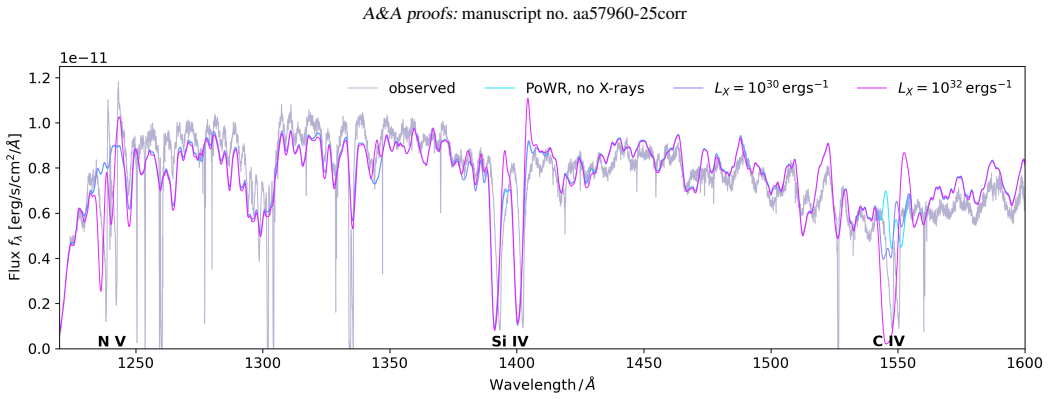
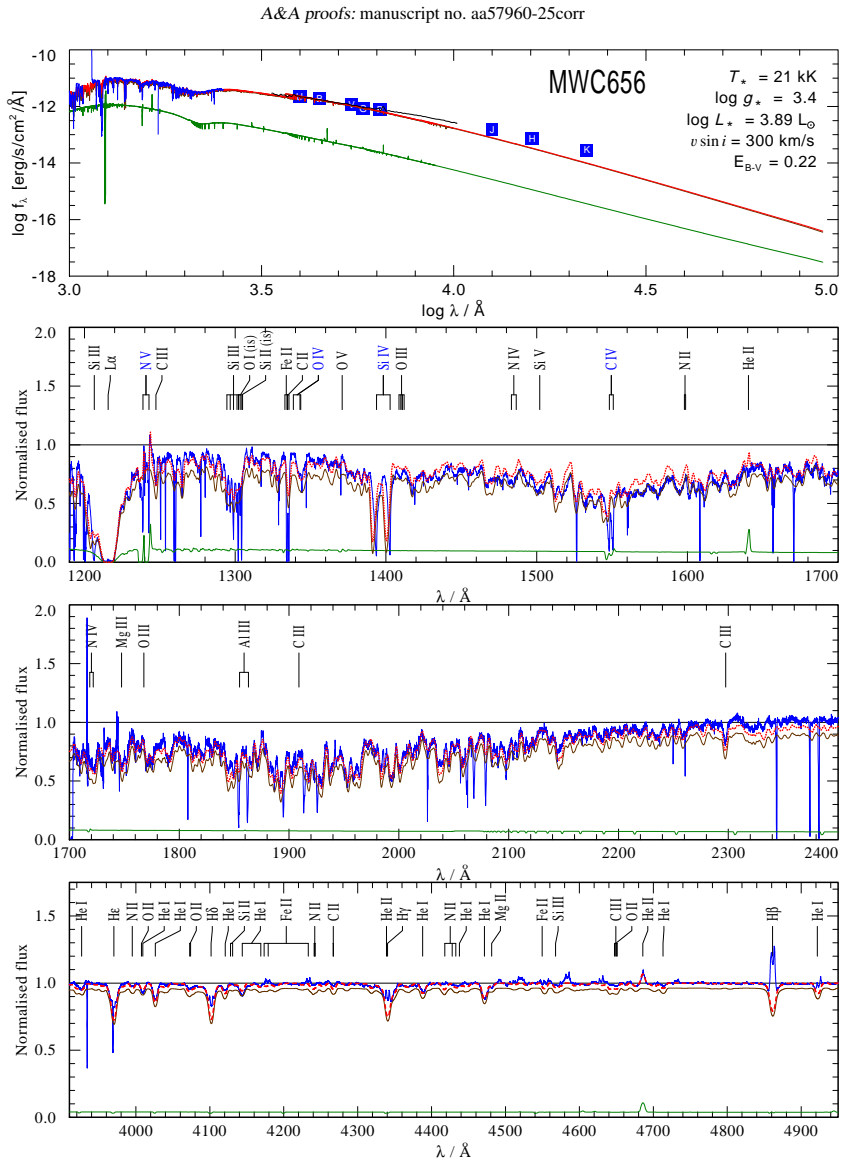
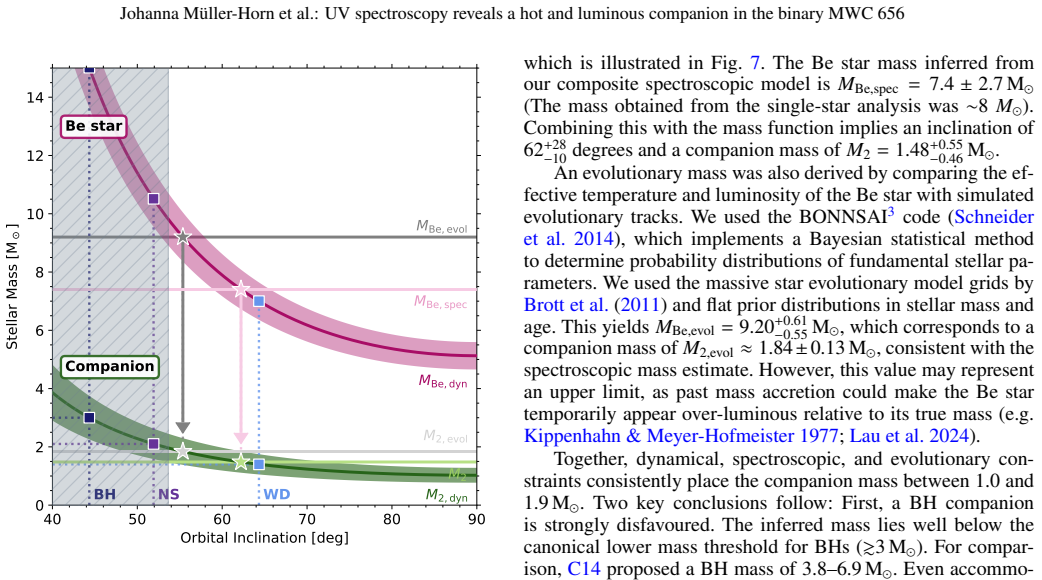
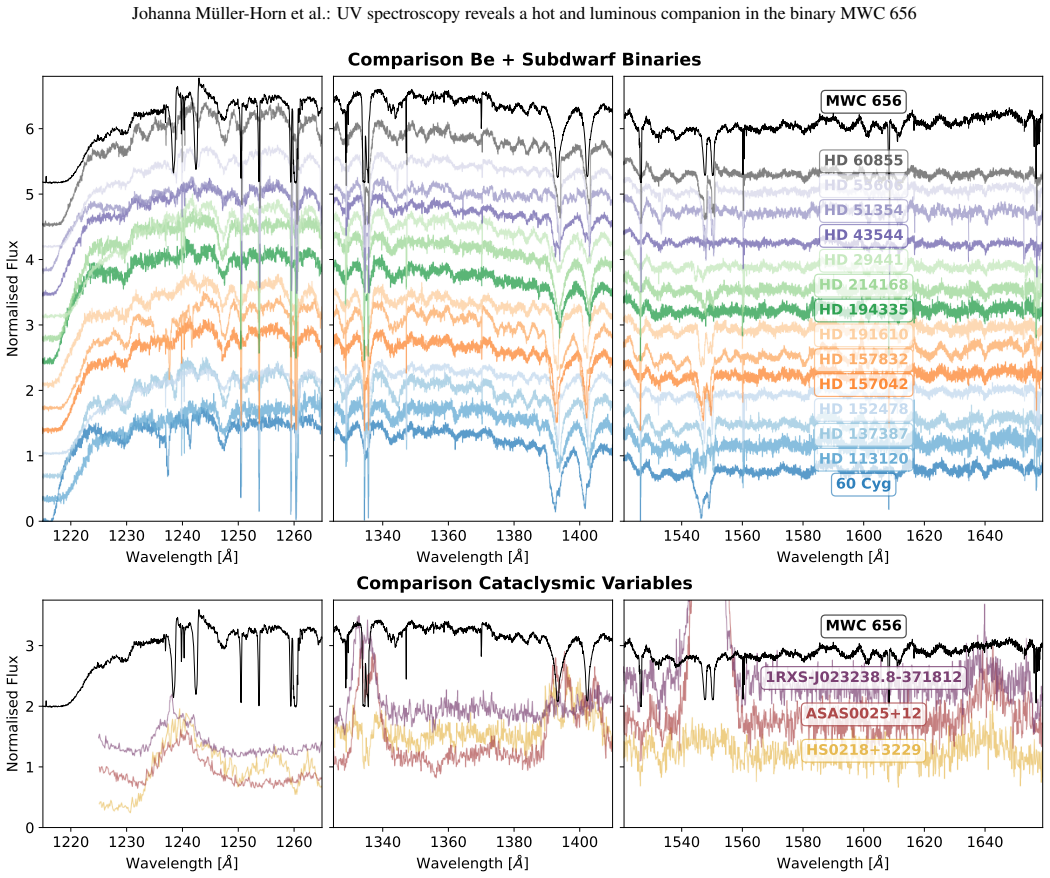
The far-ultraviolet spectra reveal high-ionisation N v and He ii features absent from normal Be stars. Spectral modelling demonstrates these lines arise from a hot (T_eff ≈ 85 kK), compact, hydrogen-deficient star exhibiting strong wind signatures, matching an intermediate-mass stripped star. Revised orbital parameters combined with composite modelling give a companion mass of 1.48 solar masses with uncertainties that exclude a black hole and disfavour a white dwarf.
What carries the argument
Composite spectroscopic modelling of UV and optical data using hot hydrogen-deficient star atmosphere models with wind signatures
If this is right
- MWC 656 is reclassified as a Be star plus intermediate-mass stripped star binary.
- The system broadens the observed range of companion temperatures and wind strengths among known stripped-star binaries.
- The continued absence of any confirmed Galactic Be star plus black hole binaries stands in tension with population synthesis predictions.
Where Pith is reading between the lines
- Other Be star systems previously flagged as black hole candidates may host similar stripped stars that produce detectable UV wind lines.
- Targeted ultraviolet observations could efficiently uncover additional stripped companions in Be binaries.
- Binary evolution models may require recalibration to match the observed frequency of stripped stars around Be primaries.
Load-bearing premise
The observed high-ionization N v and He ii lines cannot be produced by the Be star photosphere, its disc, or accretion around any compact object, and standard stripped-star models accurately match the spectrum without extra free parameters.
What would settle it
An independent radial-velocity mass measurement exceeding three solar masses or the detection of X-ray emission from accretion onto a black hole would falsify the stripped-star interpretation.
Figures



read the original abstract
The Galactic Be star binary MWC 656 was long considered the only known Be star+black hole (BH) system, making it a critical benchmark for models of massive binary evolution and for the expected X-ray emission of Be+BH binaries. However, recent dynamical measurements cast doubt on the presence of a BH companion. We present new multi-epoch ultraviolet spectroscopy from the Hubble Space Telescope, combined with high-resolution optical spectra, to reassess the nature of the companion. The far-ultraviolet spectra reveal high-ionisation features -- including prominent N v and He ii lines -- which are absent in the spectra of normal Be stars and are indicative of a hot, luminous companion. Spectral modelling shows that these features cannot originate from the Be star or from an accretion disc around a compact object. Instead, we find that the data are best explained by a hot ($T_\mathrm{eff} \approx 85$ kK), compact, hydrogen-deficient star with strong wind signatures, consistent with an intermediate-mass stripped star. Our revised orbital solution and composite spectroscopic modelling yield a companion mass of $M_2 = 1.48^{+0.55}_{-0.46}\,\mathrm{M}_\odot$, definitively ruling out a BH and disfavouring a white dwarf. MWC 656 thus joins the growing class of Be+stripped star binaries. The system's unusual properties -- including a high companion temperature and wind strength -- extend the known parameter space of such binaries. The continued absence of confirmed OBe+BH binaries in the Galaxy highlights a growing tension with population synthesis models.
Editorial analysis
A structured set of objections, weighed in public.
Referee Report
Summary. The paper presents multi-epoch HST UV spectroscopy of the Be star binary MWC 656, revealing prominent high-ionization N V and He II lines absent in normal Be stars. Spectral modeling excludes origins from the Be star photosphere, its disk, or an accretion disk around a compact object, instead attributing the features to a hot (T_eff ≈ 85 kK), compact, H-deficient stripped star with strong winds. Combined with a revised orbital solution, this yields a companion mass of 1.48^{+0.55}_{-0.46} M_⊙, ruling out a black hole and disfavoring a white dwarf, reclassifying the system as a Be+stripped-star binary and highlighting tension with population synthesis predictions for Be+BH systems.
Significance. If the spectral identification holds, the result is significant: it removes the only known Galactic Be+BH candidate, adding to the observed population of Be+stripped-star systems while exposing a discrepancy with binary evolution models that expect Be+BH binaries. The work provides new empirical constraints on the temperature, wind properties, and mass range of intermediate-mass stripped companions, extending the known parameter space.
major comments (1)
- [Spectral modelling] Spectral modelling section: the exclusion of accretion-disk origins for the observed N V and He II lines is load-bearing for the stripped-star identification and the subsequent mass interpretation that rules out a BH. The manuscript provides no explicit grid, parameter ranges, or tested values for disc models (e.g., T_eff, irradiation, accretion rate, or geometry), so it is unclear whether plausible high-temperature or irradiated disc configurations were fully explored and ruled out.
minor comments (2)
- The abstract states the companion mass with asymmetric errors but does not indicate the number of UV epochs or the specific HST instrument/grating used; adding these details would improve clarity for readers.
- Figure captions for the spectral fits should explicitly state the reduced chi-squared or residual statistics to allow quantitative assessment of model quality.
Simulated Author's Rebuttal
We thank the referee for their constructive comments and for highlighting the significance of our results. We address the major comment below and will revise the manuscript to strengthen the presentation of our spectral modeling.
read point-by-point responses
-
Referee: [Spectral modelling] Spectral modelling section: the exclusion of accretion-disk origins for the observed N V and He II lines is load-bearing for the stripped-star identification and the subsequent mass interpretation that rules out a BH. The manuscript provides no explicit grid, parameter ranges, or tested values for disc models (e.g., T_eff, irradiation, accretion rate, or geometry), so it is unclear whether plausible high-temperature or irradiated disc configurations were fully explored and ruled out.
Authors: We agree that an explicit presentation of the accretion-disk modeling grid would improve clarity and address this valid concern. In our analysis we employed standard accretion-disk models (including irradiated and non-irradiated cases) with effective temperatures ranging from 10 to 100 kK, accretion rates spanning 10^{-10} to 10^{-6} M_⊙ yr^{-1}, and a variety of disk geometries and irradiation prescriptions. These models were unable to reproduce the observed N V and He II line strengths and profiles without invoking unphysically high accretion rates or temperatures that would produce detectable X-ray emission, inconsistent with the system's observed quiescence. However, we acknowledge that the manuscript text did not tabulate the full parameter ranges or results. We will revise the spectral modelling section to include a summary table of tested disk parameters and key fitting outcomes, together with a brief description of the model assumptions and codes used, thereby making the exclusion explicit and reproducible. revision: yes
Circularity Check
No circularity: mass and companion identification derive from independent spectra and orbital solution
full rationale
The paper's central results follow from new HST UV spectra showing N V and He II lines, which are matched to standard stripped-star atmosphere models (T_eff ≈ 85 kK) after explicit comparison rules out Be-star photosphere and accretion-disc origins. The companion mass M2 = 1.48+0.55−0.46 M⊙ is obtained from a revised dynamical orbital solution combined with composite spectroscopic fitting; neither quantity is defined in terms of the other, nor does any equation reduce a claimed prediction to a fitted input by construction. No self-citation chain supplies a uniqueness theorem or ansatz that forces the conclusion. The derivation remains self-contained against external benchmarks (standard atmosphere codes and radial-velocity orbits) and does not exhibit any of the enumerated circularity patterns.
Axiom & Free-Parameter Ledger
free parameters (2)
- companion effective temperature
- companion mass
axioms (2)
- domain assumption High-ionization N v and He ii features cannot be produced by the Be star, its circumstellar disc, or an accretion disc around a compact object.
- domain assumption Standard non-LTE atmosphere models for hydrogen-deficient stars accurately reproduce the far-UV spectrum of the companion.
Lean theorems connected to this paper
-
IndisputableMonolith/Cost/FunctionalEquation.leanwashburn_uniqueness_aczel unclear?
unclearRelation between the paper passage and the cited Recognition theorem.
Spectral modelling shows that these features cannot originate from the Be star or from an accretion disc around a compact object. Instead, we find that the data are best explained by a hot (T_eff ≈ 85 kK), compact, hydrogen-deficient star...
-
IndisputableMonolith/Foundation/DimensionForcing.leanalexander_duality_circle_linking unclear?
unclearRelation between the paper passage and the cited Recognition theorem.
Our revised orbital solution and composite spectroscopic modelling yield a companion mass of M2 = 1.48+0.55−0.46 M⊙
What do these tags mean?
- matches
- The paper's claim is directly supported by a theorem in the formal canon.
- supports
- The theorem supports part of the paper's argument, but the paper may add assumptions or extra steps.
- extends
- The paper goes beyond the formal theorem; the theorem is a base layer rather than the whole result.
- uses
- The paper appears to rely on the theorem as machinery.
- contradicts
- The paper's claim conflicts with a theorem or certificate in the canon.
- unclear
- Pith found a possible connection, but the passage is too broad, indirect, or ambiguous to say the theorem truly supports the claim.
Forward citations
Cited by 1 Pith paper
-
HD3191, the high-mass X-ray binary that wasn't there
HD3191 is a single rapidly rotating B1 IV:nn star showing multi-mode non-radial pulsations, not a high-mass X-ray binary.
Reference graph
Works this paper leans on
-
[1]
Alexander, M. J. & McSwain, M. V . 2015, MNRAS, 449, 1686
work page 2015
-
[2]
Asplund, M., Grevesse, N., Sauval, A. J., & Scott, P. 2009, ARA&A, 47, 481
work page 2009
-
[3]
R., Koesterke, L., & Wessolowski, U
Baum, E., Hamann, W. R., Koesterke, L., & Wessolowski, U. 1992, A&A, 266, 402
work page 1992
- [4]
-
[5]
Bodensteiner, J., Shenar, T., Mahy, L., et al. 2020, A&A, 641, A43
work page 2020
-
[6]
Brott, I., de Mink, S. E., Cantiello, M., et al. 2011, A&A, 530, A115
work page 2011
- [7]
-
[8]
Buchhave, L. A., Bakos, G. Á., Hartman, J. D., et al. 2010, ApJ, 720, 1118
work page 2010
-
[9]
2016, Statistics and Computing, 26, 383
Buchner, J. 2016, Statistics and Computing, 26, 383
work page 2016
- [10]
-
[11]
2021, The Journal of Open Source Software, 6, 3001
Buchner, J. 2021, The Journal of Open Source Software, 6, 3001
work page 2021
-
[12]
2014, Nature, 505, 378 Castro Segura, N., Knigge, C., Long, K
Casares, J., Negueruela, I., Ribó, M., et al. 2014, Nature, 505, 378 Castro Segura, N., Knigge, C., Long, K. S., et al. 2022, Nature, 603, 52
work page 2014
-
[13]
D., Labadie-Bartz, J., Rivinius, T., et al
Chojnowski, S. D., Labadie-Bartz, J., Rivinius, T., et al. 2018, ApJ, 865, 76
work page 2018
-
[14]
Cutri, R. M., Skrutskie, M. F., van Dyk, S., et al. 2003, VizieR Online Data Catalog: 2MASS All-Sky Catalog of Point Sources (Cutri+2003), VizieR On-line Data Catalog: II/246. Originally published in: 2003yCat.2246....0C de Mink, S. E., Langer, N., Izzard, R. G., Sana, H., & de Koter, A. 2013, ApJ, 764, 166
work page 2003
-
[15]
Debnath, D., Sundqvist, J. O., Moens, N., et al. 2024, A&A, 684, A177
work page 2024
-
[16]
Donati, J. F. 2003, in Astronomical Society of the Pacific Conference Series, V ol. 307, Solar Polarization, ed. J. Trujillo-Bueno & J. Sanchez Almeida, 41
work page 2003
-
[17]
Drout, M. R., Götberg, Y ., Ludwig, B. A., et al. 2023, Science, 382, 1287
work page 2023
- [18]
- [19]
-
[20]
2025, The Open Journal of Astrophysics, 8, 128
El-Badry, K., Fabry, M., Sana, H., Shenar, T., & Seeburger, R. 2025, The Open Journal of Astrophysics, 8, 128
work page 2025
- [21]
- [22]
-
[23]
Fabricius, C., Høg, E., Makarov, V . V ., et al. 2002, A&A, 384, 180 F˝ urész, G. 2008, PhD thesis, Univ. Szeged, Hungary
work page 2002
-
[24]
Fijma, S., Castro Segura, N., Degenaar, N., et al. 2023, MNRAS, 526, L149
work page 2023
-
[25]
Fitzpatrick, E. L. 1999, PASP, 111, 63
work page 1999
-
[26]
2023, A&A, 671, A149 Gaia Collaboration, Vallenari, A., Brown, A
Fortin, F., García, F., Simaz Bunzel, A., & Chaty, S. 2023, A&A, 671, A149 Gaia Collaboration, Vallenari, A., Brown, A. G. A., et al. 2023, A&A, 674, A1
work page 2023
-
[27]
Gies, D. R., Wang, L., & Klement, R. 2023, ApJ, 942, L6 González, J. F. & Levato, H. 2006, A&A, 448, 283 Götberg, Y ., Drout, M. R., Ji, A. P., et al. 2023, ApJ, 959, 125
work page 2023
-
[28]
Grady, C. A., Bjorkman, K. S., & Snow, T. P. 1987, ApJ, 320, 376 Gräfener, G., Koesterke, L., & Hamann, W. R. 2002, A&A, 387, 244
work page 1987
-
[29]
Green, G. M. 2018, The Journal of Open Source Software, 3, 695
work page 2018
-
[30]
M., Schlafly, E., Zucker, C., Speagle, J
Green, G. M., Schlafly, E., Zucker, C., Speagle, J. S., & Finkbeiner, D. 2019, ApJ, 887, 93
work page 2019
-
[31]
Grundstrom, E. D. & Gies, D. R. 2006, ApJ, 651, L53
work page 2006
-
[32]
Hainich, R., Ramachandran, V ., Shenar, T., et al. 2019, A&A, 621, A85
work page 2019
-
[33]
Hamann, W. R. & Gräfener, G. 2003, A&A, 410, 993
work page 2003
-
[34]
Hamann, W. R. & Gräfener, G. 2004, A&A, 427, 697
work page 2004
-
[35]
R., Gräfener, G., & Liermann, A
Hamann, W. R., Gräfener, G., & Liermann, A. 2006, A&A, 457, 1015
work page 2006
-
[36]
Hastings, B., Langer, N., Wang, C., Schootemeijer, A., & Milone, A. P. 2021, A&A, 653, A144
work page 2021
- [37]
- [38]
-
[39]
Howard, A. W., Johnson, J. A., Marcy, G. W., et al. 2010, ApJ, 721, 1467
work page 2010
- [40]
- [41]
-
[42]
Jaschek, M. & Egret, D. 1982, in IAU Symposium, V ol. 98, Be Stars, ed. M. Jaschek & H. G. Groth, 261
work page 1982
- [43]
- [44]
- [45]
-
[46]
Klencki, J., Istrate, A., Nelemans, G., & Pols, O. 2022, A&A, 662, A56
work page 2022
-
[47]
Kogure, T. & Hirata, R. 1982, Bulletin of the Astronomical Society of India, 10, 281 Krtiˇcka, J., Krtiˇcková, I., Janík, J., et al. 2024, A&A, 683, A80
work page 1982
-
[48]
Langer, N., Cantiello, M., Yoon, S.-C., et al. 2008, in IAU Symposium, V ol. 250, Massive Stars as Cosmic Engines, ed. F. Bresolin, P. A. Crowther, & J. Puls, 167–178
work page 2008
-
[49]
Lau, M. Y . M., Hirai, R., Mandel, I., & Tout, C. A. 2024, ApJ, 966, L7
work page 2024
- [50]
- [51]
-
[52]
2010, The Astronomer’s Tele- gram, 2454, 1
Lucarelli, F., Striani, E., D’Ammando, F., et al. 2010, The Astronomer’s Tele- gram, 2454, 1
work page 2010
-
[53]
R., Gotberg, Y ., Lang, D., & Laroche, A
Ludwig, B., Drout, M. R., Gotberg, Y ., Lang, D., & Laroche, A. 2025, arXiv e-prints, submitted to ApJ, arXiv:2505.18632
- [54]
- [55]
-
[56]
2021, in Handbook of Gravitational Wave Astronomy, ed
Mapelli, M. 2021, in Handbook of Gravitational Wave Astronomy, ed. C. Bambi, S. Katsanevas, & K. D. Kokkotas, 16
work page 2021
- [57]
-
[58]
Marchenko, S. V ., Moffat, A. F. J., & Eenens, P. R. J. 1998, PASP, 110, 1416
work page 1998
-
[59]
Moens, N., Poniatowski, L. G., Hennicker, L., et al. 2022, A&A, 665, A42
work page 2022
-
[60]
Morales-Rueda, L., Carter, D., Steele, I. A., Charles, P. A., & Worswick, S. 2004, Astronomische Nachrichten, 325, 215
work page 2004
-
[61]
Mourard, D., Monnier, J. D., Meilland, A., et al. 2015, A&A, 577, A51 Müller-Horn, J., El-Badry, K., Rix, H.-W., et al. 2025, A&A, 701, A9
work page 2015
-
[62]
Orosz, J. A., McClintock, J. E., Narayan, R., et al. 2007, Nature, 449, 872
work page 2007
-
[63]
A., Steeghs, D., McClintock, J
Orosz, J. A., Steeghs, D., McClintock, J. E., et al. 2009, ApJ, 697, 573
work page 2009
-
[64]
Pala, A. F., Gänsicke, B. T., Belloni, D., et al. 2022, MNRAS, 510, 6110
work page 2022
-
[65]
Panoglou, D., Carciofi, A. C., Vieira, R. G., et al. 2016, MNRAS, 461, 2616
work page 2016
- [66]
- [67]
- [68]
- [69]
-
[70]
2019, ApJS, 243, 10 Article number, page 15 of 21 A&A proofs:manuscript no
Paxton, B., Smolec, R., Schwab, J., et al. 2019, ApJS, 243, 10 Article number, page 15 of 21 A&A proofs:manuscript no. aa57960-25corr
work page 2019
-
[71]
Peters, G. J., Pewett, T. D., Gies, D. R., Touhami, Y . N., & Grundstrom, E. D. 2013, ApJ, 765, 2
work page 2013
-
[72]
Peters, G. J. & Polidan, R. S. 1984, ApJ, 283, 745
work page 1984
-
[73]
Peters, G. J., Wang, L., Gies, D. R., & Grundstrom, E. D. 2016, ApJ, 828, 47
work page 2016
-
[74]
Picco, A., Marchant, P., Sana, H., & Nelemans, G. 2024, A&A, 681, A31
work page 2024
- [75]
-
[76]
Pols, O. R., Cote, J., Waters, L. B. F. M., & Heise, J. 1991, A&A, 241, 419
work page 1991
-
[77]
Prinja, R. K. 1989, MNRAS, 241, 721
work page 1989
- [78]
-
[79]
Ramachandran, V ., Klencki, J., Sander, A. A. C., et al. 2023, A&A, 674, L12
work page 2023
-
[80]
Ramachandran, V ., Oskinova, L. M., Hamann, W. R., et al. 2022, A&A, 667, A77
work page 2022
discussion (0)
Sign in with ORCID, Apple, or X to comment. Anyone can read and Pith papers without signing in.