Recognition: 2 theorem links
· Lean TheoremIs Flow Matching Just Trajectory Replay for Sequential Data?
Pith reviewed 2026-05-16 06:19 UTC · model grok-4.3
The pith
Flow matching on sequential data learns a nonparametric ODE that replays observed transitions via similarity-weighted velocity mixtures.
A machine-rendered reading of the paper's core claim, the machinery that carries it, and where it could break.
Core claim
In the limit of perfect function approximation the empirical flow matching objective on sequential data with Gaussian conditional paths targets a velocity field that defines an ODE dynamics equivalent to a nonparametric memory-augmented continuous-time dynamical system; the optimal field admits a closed-form expression as a similarity-weighted mixture of instantaneous velocities induced by observed transitions.
What carries the argument
The similarity-weighted mixture of instantaneous velocities from observed transitions, which carries the argument by making the dataset dependence of the optimal sampler explicit and interpretable.
Load-bearing premise
The analysis assumes the limit of perfect function approximation together with Gaussian conditional paths; if models have limited capacity or non-Gaussian paths are needed, the closed-form characterization may not hold.
What would settle it
Train a high-capacity neural flow matching model on a simple nonlinear dynamical system and compare its generated trajectories to those from the closed-form FreeFM sampler; large systematic differences in the distributions would falsify the claim that the neural model approximates the derived nonparametric solution.
Figures




read the original abstract
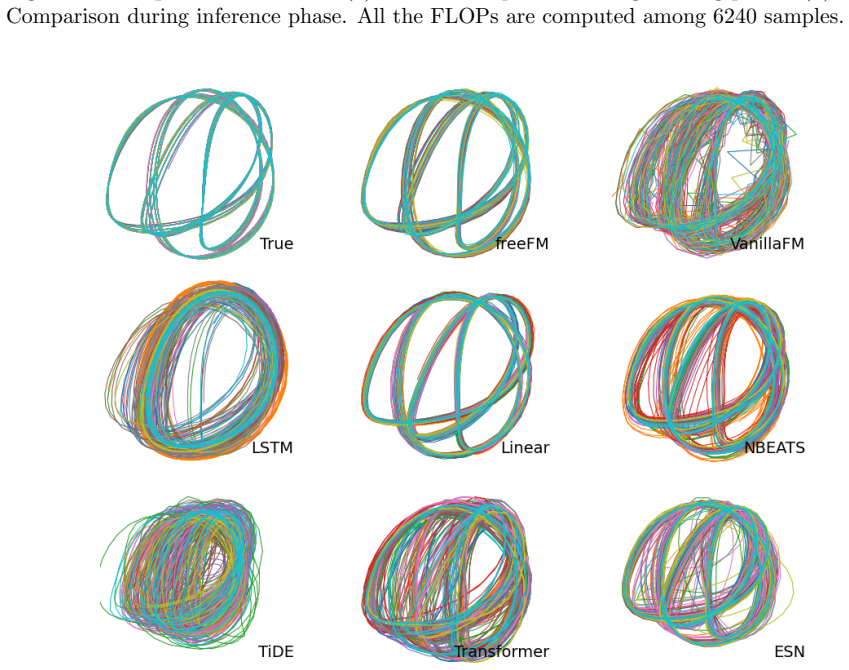
Flow matching (FM) is increasingly used in scientific domains for time series generation and forecasting, where data often arise from underlying dynamical systems. However, it is not well-understood whether it learns transferable dynamical structure or simply performs an effective "trajectory replay". We study this question by deriving the velocity field targeted by the empirical FM objective on sequential data in the limit of perfect function approximation. For the Gaussian conditional paths commonly used in practice, we show that the implied sampler is an ODE whose dynamics constitutes a nonparametric, memory-augmented continuous-time dynamical system. The optimal field admits a closed-form expression as a similarity-weighted mixture of instantaneous velocities induced by observed transitions, making the dataset dependence explicit and interpretable. This characterization positions neural FM models as parametric surrogates of an ideal nonparametric solution and suggests practical approximation schemes for robust ODE-based generation. As a byproduct of our analysis, the resulting closed-form sampler, FreeFM, provides strong probabilistic forecasts on nonlinear dynamical system benchmarks directly from historical transitions, without training.
Editorial analysis
A structured set of objections, weighed in public.
Referee Report
Summary. The paper derives the velocity field targeted by the empirical flow-matching objective on sequential data under perfect function approximation and Gaussian conditional paths. It shows that the implied ODE sampler is a nonparametric, memory-augmented continuous-time dynamical system whose optimal field is a closed-form similarity-weighted mixture of instantaneous velocities from observed transitions. This positions neural FM models as parametric surrogates of an ideal nonparametric solution and introduces the training-free FreeFM sampler, which is claimed to yield strong probabilistic forecasts on nonlinear dynamical system benchmarks directly from historical transitions.
Significance. If the derivation holds, the result supplies an explicit, interpretable characterization of flow matching for time-series data that connects it to dynamical systems theory and supplies a nonparametric baseline. The closed-form expression and the FreeFM byproduct are concrete strengths that could guide both theoretical understanding and practical approximation schemes for ODE-based generation on sequential data.
major comments (3)
- [§3] §3 (derivation of optimal field): the central claim that the velocity field equals the similarity-weighted mixture holds only in the limit of perfect function approximation. No approximation-error bounds or capacity analysis are supplied for finite neural networks, which is load-bearing for the claim that neural FM models act as parametric surrogates of the nonparametric solution.
- [§4] §4 (FreeFM benchmarks): the assertion of 'strong probabilistic forecasts' on nonlinear dynamical system benchmarks is presented without reported quantitative metrics, baseline comparisons, or error analysis. This weakens the empirical support for the practical utility of the closed-form sampler.
- [§2] Assumption of Gaussian conditional paths (stated in abstract and §2): the closed-form characterization is derived specifically for this choice. No discussion or counter-example is given for non-Gaussian paths that are sometimes used in practice, leaving open whether the memory-augmented interpretation generalizes.
minor comments (2)
- [§3] Notation for the similarity kernel and weighting function is introduced without an explicit equation reference in the main text; adding a numbered display equation would improve clarity.
- [§4] The abstract states that FreeFM 'provides strong probabilistic forecasts... without training,' yet the experimental section does not include a direct comparison table against standard FM or other baselines; a compact results table would strengthen the presentation.
Simulated Author's Rebuttal
We thank the referee for the constructive review and positive assessment of the paper's potential contribution. We address each major comment point by point below and describe the planned revisions.
read point-by-point responses
-
Referee: [§3] §3 (derivation of optimal field): the central claim that the velocity field equals the similarity-weighted mixture holds only in the limit of perfect function approximation. No approximation-error bounds or capacity analysis are supplied for finite neural networks, which is load-bearing for the claim that neural FM models act as parametric surrogates of the nonparametric solution.
Authors: We agree that the derivation in §3 is performed under the assumption of perfect function approximation, as stated at the beginning of that section. This limit yields the explicit closed-form target that neural networks are trained to match. No explicit error bounds for finite-capacity networks are derived. In the revision we will expand the discussion in §3 to clarify that neural FM models act as parametric surrogates to this ideal nonparametric field, reference relevant neural ODE approximation results, and note the lack of finite-sample bounds as a limitation and direction for future work. revision: partial
-
Referee: [§4] §4 (FreeFM benchmarks): the assertion of 'strong probabilistic forecasts' on nonlinear dynamical system benchmarks is presented without reported quantitative metrics, baseline comparisons, or error analysis. This weakens the empirical support for the practical utility of the closed-form sampler.
Authors: We accept that the current presentation of FreeFM results relies on qualitative description. To strengthen the empirical section, the revised manuscript will include a table of quantitative metrics (MSE, CRPS) on the nonlinear dynamical system benchmarks, direct comparisons against standard baselines (linear AR, RNN, trained flow matching), and error bars obtained from multiple random seeds. revision: yes
-
Referee: [§2] Assumption of Gaussian conditional paths (stated in abstract and §2): the closed-form characterization is derived specifically for this choice. No discussion or counter-example is given for non-Gaussian paths that are sometimes used in practice, leaving open whether the memory-augmented interpretation generalizes.
Authors: The derivation relies on the Gaussian property to obtain the closed-form similarity-weighted mixture. We will revise §2 to state explicitly that the memory-augmented dynamical-system interpretation is tied to the Gaussian conditional paths commonly used in flow matching, and to note that non-Gaussian paths generally do not admit the same closed-form expression, leaving generalization as an open question. revision: yes
Circularity Check
Derivation from empirical FM objective to closed-form mixture is direct and non-circular
full rationale
The paper starts from the standard empirical flow-matching objective and, under the stated limit of perfect function approximation with Gaussian conditional paths, algebraically obtains the optimal velocity field as a similarity-weighted mixture of observed transition velocities. This is a mathematical characterization of the nonparametric solution implied by the objective itself, not a redefinition, a fitted parameter renamed as prediction, or a result justified only by self-citation. No load-bearing step reduces to its own inputs by construction, and the central claim remains independent of any prior author work invoked for uniqueness or ansatz.
Axiom & Free-Parameter Ledger
axioms (2)
- domain assumption limit of perfect function approximation
- domain assumption Gaussian conditional paths are used
Lean theorems connected to this paper
-
IndisputableMonolith/Cost/FunctionalEquation.leanwashburn_uniqueness_aczel unclear?
unclearRelation between the paper passage and the cited Recognition theorem.
the optimal field admits a closed-form expression as a similarity-weighted mixture of instantaneous velocities induced by observed transitions
-
IndisputableMonolith/Foundation/AlphaCoordinateFixation.leancostAlphaLog_high_calibrated_iff unclear?
unclearRelation between the paper passage and the cited Recognition theorem.
Gaussian conditional paths... w_j(t,z) = softmax(−∥z−m_t^(j)∥²/(2c_t²))
What do these tags mean?
- matches
- The paper's claim is directly supported by a theorem in the formal canon.
- supports
- The theorem supports part of the paper's argument, but the paper may add assumptions or extra steps.
- extends
- The paper goes beyond the formal theorem; the theorem is a base layer rather than the whole result.
- uses
- The paper appears to rely on the theorem as machinery.
- contradicts
- The paper's claim conflicts with a theorem or certificate in the canon.
- unclear
- Pith found a possible connection, but the passage is too broad, indirect, or ambiguous to say the theorem truly supports the claim.
Forward citations
Cited by 1 Pith paper
-
Sharpen Your Flow: Sharpness-Aware Sampling for Flow Matching
SharpEuler estimates a sharpness profile via finite differences on calibration trajectories, smooths it, and applies a quantile transform to generate adaptive timestep grids that improve Euler sampling quality in flow...
Reference graph
Works this paper leans on
-
[1]
Stochastic Interpolants: A Unifying Framework for Flows and Diffusions
Michael S Albergo, Nicholas M Boffi, and Eric Vanden-Eijnden. Stochastic interpolants: A unifying framework for flows and diffusions.arXiv preprint arXiv:2303.08797, 2023
work page internal anchor Pith review Pith/arXiv arXiv 2023
-
[2]
Michael S Albergo and Eric Vanden-Eijnden. Learning to sample better.Journal of Statistical Mechanics: Theory and Experiment, 2024(10):104014, 2024
work page 2024
-
[3]
Chronos-2: From Univariate to Universal Forecasting
Abdul Fatir Ansari, Oleksandr Shchur, Jaris K¨ uken, Andreas Auer, Boran Han, Pedro Mercado, Syama Sundar Rangapuram, Huibin Shen, Lorenzo Stella, Xiyuan Zhang, et al. Chronos-2: From univariate to universal forecasting.arXiv preprint arXiv:2510.15821, 2025
work page internal anchor Pith review Pith/arXiv arXiv 2025
-
[4]
Andreas Auer, Patrick Podest, Daniel Klotz, Sebastian B¨ ock, G¨ unter Klambauer, and Sepp Hochreiter. TiRex: Zero-shot forecasting across long and short horizons with en- hanced in-context learning.arXiv preprint arXiv:2505.23719, 2025
-
[5]
O. Azencot, N. B. Erichson, V. Lin, and M. W. Mahoney. Forecasting sequential data using Consistent Koopman Autoencoders. Technical Report Preprint: arXiv:2003.02236, 2020
-
[6]
Springer Science & Business Media, 2013
Dominique Bakry, Ivan Gentil, and Michel Ledoux.Analysis and Geometry of Markov Diffusion Operators, volume 348. Springer Science & Business Media, 2013
work page 2013
-
[7]
Statistical Models: Theory and Practice, 2006
Karin Bammann. Statistical Models: Theory and Practice, 2006
work page 2006
-
[8]
Grigory Bartosh, Dmitry Vetrov, and Christian A Naesseth. SDE Matching: Scalable and simulation-free training of latent stochastic differential equations.arXiv preprint arXiv:2502.02472, 2025
- [9]
-
[10]
PhD thesis, Universit´ e Pierre et Marie Curie-Paris VI, 2012
Amel Bentata.Markovian Projection of Stochastic Processes. PhD thesis, Universit´ e Pierre et Marie Curie-Paris VI, 2012
work page 2012
-
[11]
Error bounds for flow matching methods.arXiv preprint arXiv:2305.16860, 2023
Joe Benton, George Deligiannidis, and Arnaud Doucet. Error bounds for flow matching methods.arXiv preprint arXiv:2305.16860, 2023
-
[12]
Limits of learning dynamical systems.SIAM Review, 67(1):107–137, 2025
Tyrus Berry and Suddhasattwa Das. Limits of learning dynamical systems.SIAM Review, 67(1):107–137, 2025
work page 2025
-
[13]
Tyrus Berry, Dimitrios Giannakis, and John Harlim. Nonparametric forecasting of low- dimensional dynamical systems.Physical Review E, 91(3):032915, 2015
work page 2015
-
[14]
Quentin Bertrand, Anne Gagneux, Mathurin Massias, and R´ emi Emonet. On the closed- form of flow matching: Generalization does not arise from target stochasticity.arXiv preprint arXiv:2506.03719, 2025
-
[15]
Modeling temporal data as continuous functions with stochastic process diffusion, 2023
Marin Biloˇ s, Kashif Rasul, Anderson Schneider, Yuriy Nevmyvaka, and Stephan G¨ unnemann. Modeling temporal data as continuous functions with stochastic process diffusion, 2023
work page 2023
-
[16]
Springer Science & Business Media, 2012
Denis Bosq.Nonparametric Statistics for Stochastic Processes: Estimation and Prediction, volume 110. Springer Science & Business Media, 2012
work page 2012
-
[17]
Gerard Brunick and Steven Shreve. Mimicking an Itˆ o process by a solution of a stochastic differential equation.The Annals of Applied Probability, 23(4):1584 – 1628, 2013. 13
work page 2013
-
[18]
Modern Koopman theory for dynamical systems.arXiv preprint arXiv:2102.12086, 2021
Steven L Brunton, Marko Budiˇ si´ c, Eurika Kaiser, and J Nathan Kutz. Modern Koopman theory for dynamical systems.arXiv preprint arXiv:2102.12086, 2021
-
[19]
Springer Science & Business Media, 2013
Kung-Sik Chan and Howell Tong.Chaos: A Statistical Perspective. Springer Science & Business Media, 2013
work page 2013
-
[20]
Neural ordinary differential equations.Advances in Neural Information Processing Systems, 31, 2018
Ricky TQ Chen, Yulia Rubanova, Jesse Bettencourt, and David K Duvenaud. Neural ordinary differential equations.Advances in Neural Information Processing Systems, 31, 2018
work page 2018
-
[21]
Yifan Chen, Mark Goldstein, Mengjian Hua, Michael S Albergo, Nicholas M Boffi, and Eric Vanden-Eijnden. Probabilistic forecasting with stochastic interpolants and F¨ ollmer processes.arXiv preprint arXiv:2403.13724, 2024
-
[22]
Diffusion maps.Applied and Computational Harmonic Analysis, 21(1):5–30, 2006
Ronald R Coifman and St´ ephane Lafon. Diffusion maps.Applied and Computational Harmonic Analysis, 21(1):5–30, 2006
work page 2006
-
[23]
Long-term forecasting with TiDe: Time-series dense encoder, 2024
Abhimanyu Das, Weihao Kong, Andrew Leach, Shaan Mathur, Rajat Sen, and Rose Yu. Long-term forecasting with TiDe: Time-series dense encoder, 2024
work page 2024
-
[24]
Manh Hong Duong, Carsten Hartmann, and Michela Ottobre. Coarse graining of stochastic differential equations: averaging and projection method.arXiv preprint arXiv:2506.14939, 2025
-
[25]
Pricing with a smile.Risk, 7(1):18–20, 1994
Bruno Dupire et al. Pricing with a smile.Risk, 7(1):18–20, 1994
work page 1994
-
[26]
Cambridge University Press, 5 edition, 2019
Rick Durrett.Probability: Theory and Examples. Cambridge University Press, 5 edition, 2019
work page 2019
-
[27]
Jianqing Fan and Qiwei Yao.Nonlinear Time Series: Nonparametric and Parametric Methods. Springer, 2003
work page 2003
-
[28]
Chaos as an interpretable benchmark for forecasting and data-driven modelling
William Gilpin. Chaos as an interpretable benchmark for forecasting and data-driven modelling. InThirty-fifth Conference on Neural Information Processing Systems Datasets and Benchmarks Track (Round 2), 2021
work page 2021
-
[29]
Chaos as an interpretable benchmark for forecasting and data-driven modelling, 2023
William Gilpin. Chaos as an interpretable benchmark for forecasting and data-driven modelling, 2023
work page 2023
-
[30]
Model scale versus domain knowledge in statistical forecasting of chaotic systems, 2023
William Gilpin. Model scale versus domain knowledge in statistical forecasting of chaotic systems, 2023
work page 2023
-
[31]
Generative learning for nonlinear dynamics.Nature Reviews Physics, 6(3):194–206, 2024
William Gilpin. Generative learning for nonlinear dynamics.Nature Reviews Physics, 6(3):194–206, 2024
work page 2024
-
[32]
Georg A Gottwald, Fengyi Li, Youssef Marzouk, and Sebastian Reich. Stable generative modelling using Schr¨ odinger bridges.Philosophical Transactions A, 383(2299):20240332, 2025
work page 2025
-
[33]
Measuring the strangeness of strange attractors
Peter Grassberger and Itamar Procaccia. Measuring the strangeness of strange attractors. Physica D: Nonlinear Phenomena, 9(1-2):189–208, 1983
work page 1983
-
[34]
Nate Gruver, Marc Finzi, Shikai Qiu, and Andrew G Wilson. Large language models are zero-shot time series forecasters.Advances in Neural Information Processing Systems, 36:19622–19635, 2023
work page 2023
-
[35]
Efficiently Modeling Long Sequences with Structured State Spaces
Albert Gu, Karan Goel, and Christopher R´ e. Efficiently modeling long sequences with structured state spaces.arXiv preprint arXiv:2111.00396, 2021. 14
work page internal anchor Pith review Pith/arXiv arXiv 2021
-
[36]
Istv´ an Gy¨ ongy. Mimicking the one-dimensional marginal distributions of processes having an Itˆ o differential.Probability Theory and Related Fields, 71(4):501–516, 1986
work page 1986
-
[37]
Out-of-domain generalization in dynamical systems reconstruction, 2024
Niclas G¨ oring, Florian Hess, Manuel Brenner, Zahra Monfared, and Daniel Durstewitz. Out-of-domain generalization in dynamical systems reconstruction, 2024
work page 2024
-
[38]
Hanyuan Hang, Ingo Steinwart, Yunlong Feng, and Johan AK Suykens. Kernel density estimation for dynamical systems.Journal of Machine Learning Research, 19(35):1–49, 2018
work page 2018
-
[39]
Cambridge University Press, 2018
John Harlim.Data-Driven Computational Methods: Parameter and Operator Estimations. Cambridge University Press, 2018
work page 2018
- [40]
-
[41]
Kernel density estimation for time series data
Andrew Harvey and Vitaliy Oryshchenko. Kernel density estimation for time series data. International Journal of Forecasting, 28(1):3–14, 2012
work page 2012
-
[42]
Generalized teacher forcing for learning chaotic dynamics, 2023
Florian Hess, Zahra Monfared, Manuel Brenner, and Daniel Durstewitz. Generalized teacher forcing for learning chaotic dynamics, 2023
work page 2023
-
[43]
Long short-term memory.Neural Computation, 9(8):1735–1780, 1997
Sepp Hochreiter and J¨ urgen Schmidhuber. Long short-term memory.Neural Computation, 9(8):1735–1780, 1997
work page 1997
-
[44]
John J Hopfield. Neurons with graded response have collective computational proper- ties like those of two-state neurons.Proceedings of the National Academy of Sciences, 81(10):3088–3092, 1984
work page 1984
-
[45]
Li, Sheng Wang, Jiheng Zhang, Ziyun Li, and Tianlong Chen
Yang Hu, Xiao Wang, Zezhen Ding, Lirong Wu, Huatian Zhang, Stan Z. Li, Sheng Wang, Jiheng Zhang, Ziyun Li, and Tianlong Chen. FlowTS: Time series generation via rectified flow, 2025
work page 2025
-
[46]
Embedding nonlinear dynamical systems: A guide to Takens’ theorem
Jeremy P Huke. Embedding nonlinear dynamical systems: A guide to Takens’ theorem. 2006
work page 2006
-
[47]
Deterministic and random dynamical systems: theory and numerics
AR Humphries and AM Stuart. Deterministic and random dynamical systems: theory and numerics. InModern Methods in Scientific Computing and Applications, pages 211–254. Springer, 2002
work page 2002
-
[48]
Longitudinal flow matching for trajectory modeling.arXiv preprint arXiv:2510.03569, 2025
Mohammad Mohaiminul Islam, Thijs P Kuipers, Sharvaree Vadgama, Coen de Vente, Afsana Khan, Clara I S´ anchez, and Erik J Bekkers. Longitudinal flow matching for trajectory modeling.arXiv preprint arXiv:2510.03569, 2025
-
[49]
Herbert Jaeger. The “echo state” approach to analysing and training recurrent neural networks-with an erratum note.Bonn, Germany: German national research center for information technology gmd technical report, 148(34):13, 2001
work page 2001
-
[50]
Herbert Jaeger and Harald Haas. Harnessing nonlinearity: Predicting chaotic systems and saving energy in wireless communication.Science, 304(5667):78–80, 2004
work page 2004
-
[51]
Trajectory generator matching for time series.arXiv preprint arXiv:2505.23215, 2025
T Jahn, J Chemseddine, P Hagemann, C Wald, and G Steidl. Trajectory generator matching for time series.arXiv preprint arXiv:2505.23215, 2025
-
[52]
Time-llm: Time series forecasting by reprogramming large language models,
Ming Jin, Shiyu Wang, Lintao Ma, Zhixuan Chu, James Y Zhang, Xiaoming Shi, Pin-Yu Chen, Yuxuan Liang, Yuan-Fang Li, Shirui Pan, et al. Time-LLM: Time series forecasting by reprogramming large language models.arXiv preprint arXiv:2310.01728, 2023
-
[53]
Diffusion geometry.arXiv preprint arXiv:2405.10858, 2024
Iolo Jones. Diffusion geometry.arXiv preprint arXiv:2405.10858, 2024
-
[54]
On neural differential equations.arXiv preprint arXiv:2202.02435,
Patrick Kidger. On neural differential equations.arXiv preprint arXiv:2202.02435, 2022. 15
-
[55]
Anne B Koehler. The asymmetry of the sAPE measure and other comments on the M3-competition.International Journal of Forecasting, 17(4):570–574, 2001
work page 2001
-
[56]
Marcel Kollovieh, Abdul Fatir Ansari, Michael Bohlke-Schneider, Jasper Zschiegner, Hao Wang, and Yuyang Bernie Wang. Predict, refine, synthesize: Self-guiding diffusion mod- els for probabilistic time series forecasting.Advances in Neural Information Processing Systems, 36, 2024
work page 2024
-
[57]
Marcel Kollovieh, Marten Lienen, David L¨ udke, Leo Schwinn, and Stephan G¨ unnemann. Flow matching with Gaussian process priors for probabilistic time series forecasting.arXiv preprint arXiv:2410.03024, 2024
-
[58]
Nikola Kovachki, Zongyi Li, Burigede Liu, Kamyar Azizzadenesheli, Kaushik Bhat- tacharya, Andrew Stuart, and Anima Anandkumar. Neural operator: Learning maps between function spaces with applications to PDEs.Journal of Machine Learning Re- search, 24(89):1–97, 2023
work page 2023
-
[59]
Learning continuous models for continuous physics.Communications Physics, 6(1):319, 2023
Aditi S Krishnapriyan, Alejandro F Queiruga, N Benjamin Erichson, and Michael W Mahoney. Learning continuous models for continuous physics.Communications Physics, 6(1):319, 2023
work page 2023
-
[60]
On information and sufficiency.The Annals of Mathematical Statistics, 22(1):79–86, 1951
Solomon Kullback and Richard A Leibler. On information and sufficiency.The Annals of Mathematical Statistics, 22(1):79–86, 1951
work page 1951
-
[61]
Lea Kunkel and Mathias Trabs. On the minimax optimality of flow matching through the connection to kernel density estimation.arXiv preprint arXiv:2504.13336, 2025
-
[62]
Claire Lacour. Nonparametric estimation of the stationary density and the transition density of a Markov chain.Stochastic Processes and their Applications, 118(2):232–260, 2008
work page 2008
-
[63]
St´ ephane S Lafon.Diffusion Maps and Geometric Harmonics. Yale University, 2004
work page 2004
-
[64]
The principles of diffusion models.arXiv preprint arXiv:2510.21890, 2025
Chieh-Hsin Lai, Yang Song, Dongjun Kim, Yuki Mitsufuji, and Stefano Ermon. The principles of diffusion models.arXiv preprint arXiv:2510.21890, 2025
-
[65]
Justin Lee, Behnaz Moradijamei, and Heman Shakeri. Multi-marginal stochastic flow matching for high-dimensional snapshot data at irregular time points.arXiv preprint arXiv:2508.04351, 2025
-
[66]
Christian L´ eonard. A survey of the Schr¨ odinger problem and some of its connections with optimal transport.arXiv preprint arXiv:1308.0215, 2013
-
[67]
Xin Li, Jingdong Zhang, Qunxi Zhu, Chengli Zhao, Xue Zhang, Xiaojun Duan, and Wei Lin. From Fourier to neural ODEs: Flow matching for modeling complex systems.arXiv preprint arXiv:2405.11542, 2024
-
[68]
Zongyi Li, Nikola Kovachki, Kamyar Azizzadenesheli, Burigede Liu, Kaushik Bhat- tacharya, Andrew Stuart, and Anima Anandkumar. Markov neural operators for learning chaotic systems.arXiv preprint arXiv:2106.06898, pages 2–3, 2021
-
[69]
On The Hidden Biases of Flow Matching Samplers
Soon Hoe Lim. On the hidden biases of flow matching samplers.arXiv preprint arXiv:2512.16768, 2025
work page internal anchor Pith review Pith/arXiv arXiv 2025
-
[70]
Soon Hoe Lim, Yijin Wang, Annan Yu, Emma Hart, Michael W Mahoney, Xiaoye S Li, and N Benjamin Erichson. Elucidating the design choice of probability paths in flow matching for forecasting.Transaction on Machine Learning Research, 2025. 16
work page 2025
-
[71]
Flow Matching for Generative Modeling
Yaron Lipman, Ricky TQ Chen, Heli Ben-Hamu, Maximilian Nickel, and Matt Le. Flow matching for generative modeling.arXiv preprint arXiv:2210.02747, 2022
work page internal anchor Pith review Pith/arXiv arXiv 2022
-
[72]
Yaron Lipman, Marton Havasi, Peter Holderrieth, Neta Shaul, Matt Le, Brian Karrer, Ricky TQ Chen, David Lopez-Paz, Heli Ben-Hamu, and Itai Gat. Flow matching guide and code.arXiv preprint arXiv:2412.06264, 2024
work page internal anchor Pith review Pith/arXiv arXiv 2024
-
[73]
Haoming Liu, Jinnuo Liu, Yanhao Li, Liuyang Bai, Yunkai Ji, Yuanhe Guo, Shenji Wan, and Hongyi Wen. From navigation to refinement: Revealing the two-stage nature of flow- based diffusion models through oracle velocity.arXiv preprint arXiv:2512.02826, 2025
work page internal anchor Pith review Pith/arXiv arXiv 2025
-
[74]
Flow Straight and Fast: Learning to Generate and Transfer Data with Rectified Flow
Xingchao Liu, Chengyue Gong, and Qiang Liu. Flow straight and fast: Learning to generate and transfer data with rectified flow.arXiv preprint arXiv:2209.03003, 2022
work page internal anchor Pith review Pith/arXiv arXiv 2022
-
[75]
Sundial: A Family of Highly Capable Time Series Foundation Models
Yong Liu, Guo Qin, Zhiyuan Shi, Zhi Chen, Caiyin Yang, Xiangdong Huang, Jianmin Wang, and Mingsheng Long. Sundial: A family of highly capable time series foundation models.arXiv preprint arXiv:2502.00816, 2025
work page internal anchor Pith review Pith/arXiv arXiv 2025
-
[76]
Lu Lu, Pengzhan Jin, and George Em Karniadakis. DeepOnet: Learning nonlinear oper- ators for identifying differential equations based on the universal approximation theorem of operators.arXiv preprint arXiv:1910.03193, 2019
work page internal anchor Pith review Pith/arXiv arXiv 1910
-
[77]
Lets forecast: Learning embedology for time series forecasting.arXiv preprint arXiv:2506.06454, 2025
Abrar Majeedi, Viswanatha Reddy Gajjala, Satya Sai Srinath Namburi GNVV, Nada Magdi Elkordi, and Yin Li. Lets forecast: Learning embedology for time series forecasting.arXiv preprint arXiv:2506.06454, 2025
-
[78]
Youssef Marzouk, Zhi Robert Ren, Sven Wang, and Jakob Zech. Distribution learning via neural differential equations: a nonparametric statistical perspective.Journal of Machine Learning Research, 25(232):1–61, 2024
work page 2024
-
[79]
Scoring rules for continuous probability dis- tributions.Management Science, 22(10):1087–1096, 1976
James E Matheson and Robert L Winkler. Scoring rules for continuous probability dis- tributions.Management Science, 22(10):1087–1096, 1976
work page 1976
-
[80]
Statistical inference for dynamical systems: A review
Kevin McGoff, Sayan Mukherjee, and Natesh Pillai. Statistical inference for dynamical systems: A review. 2015
work page 2015
discussion (0)
Sign in with ORCID, Apple, or X to comment. Anyone can read and Pith papers without signing in.