Recognition: 2 theorem links
· Lean TheoremRapidity dependence of mean transverse momentum fluctuation and decorrelation in baryon-dense medium
Pith reviewed 2026-05-15 21:21 UTC · model grok-4.3
The pith
Mean transverse momentum fluctuations in baryon-rich collisions arise from combined energy and net-baryon density variations, yielding a robust equation-of-state probe.
A machine-rendered reading of the paper's core claim, the machinery that carries it, and where it could break.
Core claim
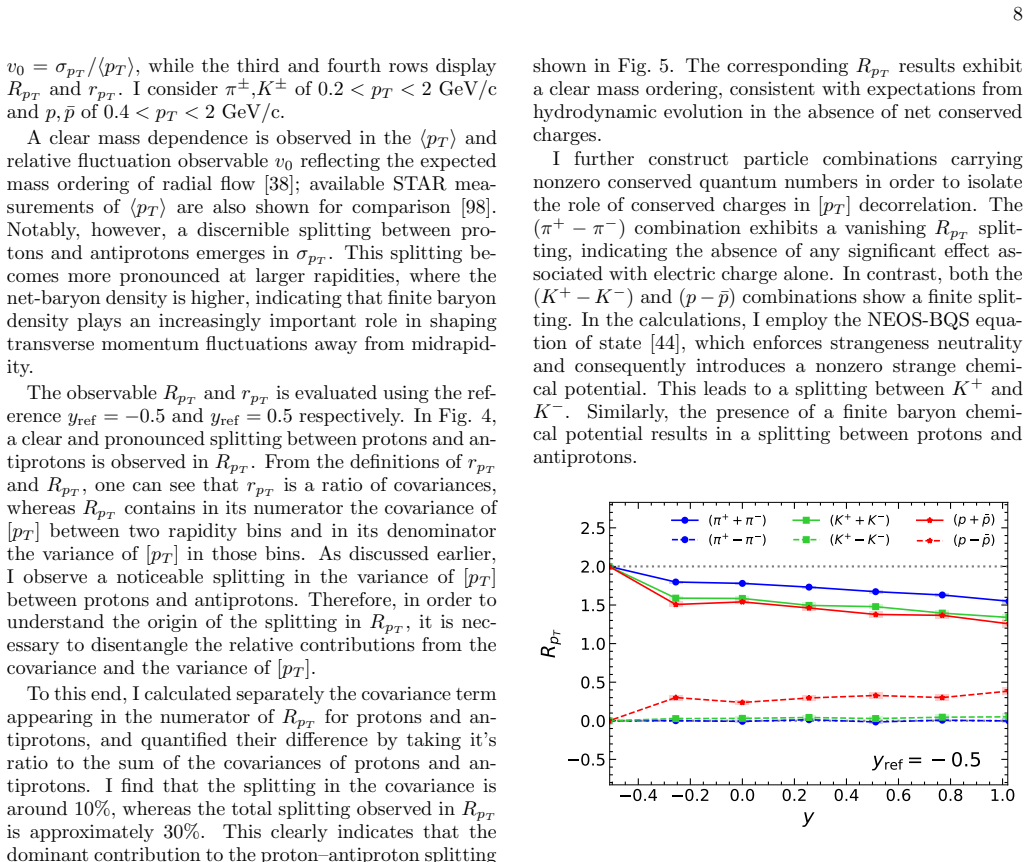
In a baryon-rich medium the event-by-event fluctuation of the mean transverse momentum is driven by the combined effects of energy-density and net-baryon-density fluctuations. Consequently the rapidity dependence of this observable provides a promising handle to probe the three-dimensional structure of both energy and baryon density profiles. Baryon diffusion has a negligible impact, establishing the observable as a robust probe of the equation of state. Predictions for identified hadrons show a pronounced splitting in the rapidity decorrelation of mean transverse momentum between protons and antiprotons.
What carries the argument
The rapidity dependence of mean transverse momentum fluctuation and decorrelation, generated by the joint energy-density and net-baryon-density fluctuations inside a hydrodynamic description of baryon-dense matter.
If this is right
- The rapidity pattern of the fluctuations can map the three-dimensional energy and baryon density profiles created in the collision.
- The observable remains a reliable probe of the equation of state even when baryon diffusion is present.
- A splitting between protons and antiprotons signals distinct transverse flow dynamics for baryons and antibaryons.
- Measurements of identified hadrons can separate baryon from antibaryon collective behavior in dense matter.
Where Pith is reading between the lines
- Data on the proton-antiproton splitting could constrain models of initial baryon stopping and transport.
- The same rapidity dependence might be combined with other flow observables to reduce uncertainties in the initial-state density profiles.
- Repeating the analysis at different beam energies could trace how the three-dimensional density structures evolve across the QCD phase diagram.
Load-bearing premise
That energy-density and net-baryon-density fluctuations fully account for the observed mean transverse momentum fluctuations inside the hydrodynamic framework without significant contributions from other unmodeled dynamics.
What would settle it
A measurement in which the rapidity decorrelation of mean transverse momentum changes substantially when the baryon diffusion coefficient is varied in hydrodynamic simulations compared with experimental data from baryon-rich collisions.
Figures


read the original abstract
I study the event-by-event fluctuation and rapidity decorrelation of the mean transverse momentum $\spt$, which has recently been proposed as a sensitive probe of the equation of state at finite baryon density. The investigation reveals that, in a baryon-rich medium, the event-by-event fluctuation of the mean transverse momentum is driven by the combined effects of energy-density and net-baryon-density fluctuations. Consequently, the rapidity dependence of this observable provides a promising handle to probe the three-dimensional structure of both energy and baryon density profiles. Previous studies have shown that $\spt$ decorrelation along rapidity is largely insensitive to shear and bulk viscosity; however, its dependence on baryon diffusion, another key transport coefficient in baryonic matter, has not been explored. I find that baryon diffusion has a negligible impact, establishing this observable as a robust probe of the equation of state. Furthermore, I present predictions for identified hadrons and observe a pronounced splitting in the rapidity decorrelation of mean transverse momentum between protons and antiprotons, indicating different transverse flow dynamics for baryons and antibaryons.
Editorial analysis
A structured set of objections, weighed in public.
Referee Report
Summary. The manuscript investigates event-by-event fluctuations and rapidity decorrelation of mean transverse momentum <pT> in baryon-rich heavy-ion collisions within a hydrodynamic framework. It claims that <pT> fluctuations are driven by the combined effects of energy-density and net-baryon-density fluctuations, that the rapidity dependence serves as a probe of the three-dimensional initial-state profiles, that baryon diffusion has negligible impact (rendering the observable robust against this transport coefficient), and that predictions for identified hadrons show a pronounced splitting in <pT> decorrelation between protons and antiprotons due to distinct transverse flow dynamics for baryons versus antibaryons.
Significance. If the central findings hold, the work would establish <pT> rapidity decorrelation as a robust, viscosity-insensitive probe of the equation of state and initial-state structure in the baryon-dense regime, with new predictions for identified-particle observables that could distinguish baryon versus antibaryon dynamics.
major comments (1)
- [Predictions for identified hadrons] In the section presenting predictions for identified hadrons, the pronounced splitting in rapidity decorrelation of mean transverse momentum between protons and antiprotons is attributed to different transverse flow dynamics for baryons and antibaryons. This interpretation assumes that hydrodynamic evolution plus Cooper-Frye freeze-out maps initial baryon-density fluctuations directly into the final-state observables without significant contamination from resonance decays; however, protons typically receive substantial feed-down from Delta and Lambda resonances (with different space-time emission points) while antiprotons receive less, and the calculation does not vary or disable resonance contributions to test this.
minor comments (1)
- [Abstract] The abstract provides no quantitative details on the magnitude of the reported fluctuations, the specific values of transport coefficients tested, or the model parameters (e.g., initial-state profiles or freeze-out conditions), which would strengthen the presentation of the claims.
Simulated Author's Rebuttal
We thank the referee for the careful reading of our manuscript and the constructive comment on the identified-hadron predictions. We address the point below.
read point-by-point responses
-
Referee: In the section presenting predictions for identified hadrons, the pronounced splitting in rapidity decorrelation of mean transverse momentum between protons and antiprotons is attributed to different transverse flow dynamics for baryons and antibaryons. This interpretation assumes that hydrodynamic evolution plus Cooper-Frye freeze-out maps initial baryon-density fluctuations directly into the final-state observables without significant contamination from resonance decays; however, protons typically receive substantial feed-down from Delta and Lambda resonances (with different space-time emission points) while antiprotons receive less, and the calculation does not vary or disable resonance contributions to test this.
Authors: We appreciate the referee's observation. Our hydrodynamic evolution with Cooper-Frye freeze-out includes resonance production according to the local thermodynamic conditions, followed by standard resonance decays. The splitting in rapidity decorrelation of <pT> between protons and antiprotons originates from the distinct coupling of net-baryon and net-antibaryon distributions to the transverse flow field in the baryon-rich regime; this difference is already present at chemical freeze-out. While resonance feed-down modifies the final yields and slightly shifts the effective emission points, it does not erase the rapidity-dependent correlation structure imprinted by the initial-state profiles. We did not perform an explicit calculation with resonances disabled, but the robustness of the splitting follows from the fact that both direct and decay contributions inherit the same underlying flow velocities. In the revised manuscript we will add a clarifying paragraph on this point and note that the main conclusions are insensitive to the precise treatment of resonance decays. revision: partial
Circularity Check
No significant circularity; results from hydrodynamic simulations
full rationale
The paper reports numerical results from event-by-event hydrodynamic evolution of energy and baryon density fluctuations, followed by Cooper-Frye freeze-out to compute mean-pT fluctuations and rapidity decorrelations. No analytical derivation reduces a claimed prediction to its own fitted inputs by construction. Baryon-diffusion insensitivity and proton-antiproton splitting are presented as simulation outputs, not as self-definitional identities or renamed fits. Self-citations, if present, are not load-bearing for the central claims.
Axiom & Free-Parameter Ledger
axioms (1)
- domain assumption Hydrodynamic evolution accurately captures event-by-event fluctuations of energy and baryon density in baryon-rich matter
Lean theorems connected to this paper
-
IndisputableMonolith/Cost/FunctionalEquationwashburn_uniqueness_aczel unclear?
unclearRelation between the paper passage and the cited Recognition theorem.
hybrid framework … MUSIC … UrQMD … Cooper–Frye … ε_SW = 0.26 GeV/fm³ … κ_B = C_B … NEoS-BQS … tilted fireball … ρ_B parametrization
-
IndisputableMonolith/Foundation/AlexanderDualityalexander_duality_circle_linking unclear?
unclearRelation between the paper passage and the cited Recognition theorem.
rapidity dependence of v0(η)/v0(η=0) … RpT … rpT … proton-antiproton splitting
What do these tags mean?
- matches
- The paper's claim is directly supported by a theorem in the formal canon.
- supports
- The theorem supports part of the paper's argument, but the paper may add assumptions or extra steps.
- extends
- The paper goes beyond the formal theorem; the theorem is a base layer rather than the whole result.
- uses
- The paper appears to rely on the theorem as machinery.
- contradicts
- The paper's claim conflicts with a theorem or certificate in the canon.
- unclear
- Pith found a possible connection, but the passage is too broad, indirect, or ambiguous to say the theorem truly supports the claim.
Forward citations
Cited by 1 Pith paper
-
Thermal and geometric normal modes of spectral fluctuations in heavy-ion collisions
Principal component analysis of spectral fluctuations in heavy-ion collisions yields thermal and geometric normal modes that explain 99.5% of variance and account for measured flow observables v0(pT) and v02(pT).
Reference graph
Works this paper leans on
-
[1]
a baseline case with the same normalization of en- ergy density and net-baryon density as in the fluc- tuating initial condition scenario
-
[2]
an increased energy density (ϵ) normalization by a factor of 1.1 while keeping the net-baryon density unchanged
-
[3]
an increased net-baryon density (ρB) normalization by a factor of 1.1 while keeping the energy density unchanged
-
[4]
a simultaneous increase of both energy density (ϵ) and net-baryon density (ρ B) normalizations by a factor of 1.1. 1.5 1.0 0.5 0.0 0.5 1.0 1.5 0.2 0.5 1 2 v0( ) v0( = 0) = pT/ pT ( pT/ pT )| = 0 Smooth IC Fluctuating IC varying varying B varying both FIG. 2. Pseudo-rapidity dependence of the mean-p T fluc- tuationv 0(η)/v0(η= 0), scaled by its respective ...
work page 2023
-
[5]
J. Y. Ollitrault, Eur. J. Phys.29(2008), 275- 302 doi:10.1088/0143-0807/29/2/010 [arXiv:0708.2433 [nucl-th]]
work page internal anchor Pith review Pith/arXiv arXiv doi:10.1088/0143-0807/29/2/010 2008
-
[6]
J. Y. Ollitrault, Phys. Rev. D46(1992), 229-245 doi:10.1103/PhysRevD.46.229
-
[7]
Alpha clusters and collective flow in ultra-relativistic carbon - heavy nucleus collisions
P. Bozek, W. Broniowski, E. Ruiz Arriola and M. Ry- bczynski, Phys. Rev. C90(2014) no.6, 064902 doi:10.1103/PhysRevC.90.064902 [arXiv:1410.7434 [nucl-th]]
work page internal anchor Pith review Pith/arXiv arXiv doi:10.1103/physrevc.90.064902 2014
-
[8]
H. Song, S. A. Bass, U. Heinz, T. Hirano and C. Shen, Phys. Rev. Lett.106(2011), 192301 [erratum: Phys. Rev. Lett.109(2012), 139904] doi:10.1103/PhysRevLett.106.192301 [arXiv:1011.2783 [nucl-th]]
work page internal anchor Pith review Pith/arXiv arXiv doi:10.1103/physrevlett.106.192301 2011
-
[9]
Bulk and shear viscosities of matter created in relativistic heavy-ion collisions
P. Bozek, Phys. Rev. C81(2010), 034909 doi:10.1103/PhysRevC.81.034909 [arXiv:0911.2397 [nucl-th]]
work page internal anchor Pith review Pith/arXiv arXiv doi:10.1103/physrevc.81.034909 2010
-
[10]
Flow and interferometry in 3+1 dimensional viscous hydrodynamics
P. Bozek, Phys. Rev. C85(2012), 034901 doi:10.1103/PhysRevC.85.034901 [arXiv:1110.6742 [nucl-th]]
work page internal anchor Pith review Pith/arXiv arXiv doi:10.1103/physrevc.85.034901 2012
-
[11]
I. A. Karpenko, P. Huovinen, H. Petersen and M. Bleicher, Phys. Rev. C91(2015) no.6, 064901 doi:10.1103/PhysRevC.91.064901 [arXiv:1502.01978 [nucl-th]]
work page internal anchor Pith review Pith/arXiv arXiv doi:10.1103/physrevc.91.064901 2015
-
[12]
C. Shen and U. Heinz, Nucl. Phys. News25 (2015) no.2, 6-11 doi:10.1080/10619127.2015.1006502 [arXiv:1507.01558 [nucl-th]]
-
[13]
S. Ryu, J. F. Paquet, C. Shen, G. S. Denicol, B. Schenke, S. Jeon and C. Gale, Phys. Rev. Lett.115(2015) no.13, 132301 doi:10.1103/PhysRevLett.115.132301 [arXiv:1502.01675 [nucl-th]]
work page internal anchor Pith review Pith/arXiv arXiv doi:10.1103/physrevlett.115.132301 2015
-
[14]
C. Shen and S. Alzhrani, Phys. Rev. C102 (2020) no.1, 014909 doi:10.1103/PhysRevC.102.014909 [arXiv:2003.05852 [nucl-th]]
-
[15]
M. Omana Kuttan, J. Steinheimer, K. Zhou and H. Stoecker, Phys. Rev. Lett.131(2023) no.20, 202303 doi:10.1103/PhysRevLett.131.202303 [arXiv:2211.11670 [hep-ph]]
-
[16]
J. Gong, H. Roch and C. Shen, Phys. Rev. C111 (2025) no.4, 044912 doi:10.1103/PhysRevC.111.044912 [arXiv:2410.22160 [nucl-th]]
-
[17]
K. H. Ackermannet al.[STAR], Phys. Rev. Lett. 86(2001), 402-407 doi:10.1103/PhysRevLett.86.402 [arXiv:nucl-ex/0009011 [nucl-ex]]
work page internal anchor Pith review Pith/arXiv arXiv doi:10.1103/physrevlett.86.402 2001
-
[18]
Higher harmonic anisotropic flow measurements of charged particles in Pb-Pb collisions at 2.76 TeV
K. Aamodtet al.[ALICE], Phys. Rev. Lett.107 (2011), 032301 doi:10.1103/PhysRevLett.107.032301 [arXiv:1105.3865 [nucl-ex]]
work page internal anchor Pith review Pith/arXiv arXiv doi:10.1103/physrevlett.107.032301 2011
-
[19]
L. Adamczyket al.[STAR], Phys. Rev. C93 (2016) no.1, 014907 doi:10.1103/PhysRevC.93.014907 [arXiv:1509.08397 [nucl-ex]]
work page internal anchor Pith review Pith/arXiv arXiv doi:10.1103/physrevc.93.014907 2016
-
[20]
S. S. Adleret al.[PHENIX], Phys. Rev. Lett. 91(2003), 182301 doi:10.1103/PhysRevLett.91.182301 [arXiv:nucl-ex/0305013 [nucl-ex]]
work page internal anchor Pith review Pith/arXiv arXiv doi:10.1103/physrevlett.91.182301 2003
-
[21]
J. E. Bernhard, J. S. Moreland, S. A. Bass, J. Liu and U. Heinz, Phys. Rev. C94(2016) no.2, 024907 doi:10.1103/PhysRevC.94.024907 [arXiv:1605.03954 [nucl-th]]
work page internal anchor Pith review Pith/arXiv arXiv doi:10.1103/physrevc.94.024907 2016
-
[22]
J. E. Bernhard, J. S. Moreland and S. A. Bass, Nature Phys.15(2019) no.11, 1113-1117 doi:10.1038/s41567- 019-0611-8
-
[23]
G. Nijs, W. van der Schee, U. G¨ ursoy and R. Snellings, Phys. Rev. Lett.126(2021) no.20, 202301 doi:10.1103/PhysRevLett.126.202301 [arXiv:2010.15130 [nucl-th]]
-
[24]
D. Everettet al.[JETSCAPE], Phys. Rev. C103 (2021) no.5, 054904 doi:10.1103/PhysRevC.103.054904 [arXiv:2011.01430 [hep-ph]]
-
[25]
S. A. Jahan, H. Roch and C. Shen, Phys. Rev. C110 (2024) no.5, 054905 doi:10.1103/PhysRevC.110.054905 [arXiv:2408.00537 [nucl-th]]
-
[26]
B. Schenke, C. Shen and D. Teaney, Phys. Rev. C102 (2020) no.3, 034905 [arXiv:2004.00690 [nucl-th]]
-
[27]
R. Samanta and T. Parida, J. Subatomic Part. Cos- mol.4(2025), 100100 doi:10.1016/j.jspc.2025.100100 [arXiv:2505.02706 [nucl-th]]
-
[29]
R. Samanta, S. Bhatta, J. Jia, M. Luzum and J. Y. Ol- litrault, Phys. Rev. C109(2024) no.5, L051902 doi:10.1103/PhysRevC.109.L051902 [arXiv:2303.15323 [nucl-th]]
- [30]
-
[31]
S. Bhatta, A. Dimri and J. Jia, [arXiv:2504.20008 [nucl- th]]
work page internal anchor Pith review Pith/arXiv arXiv
-
[32]
F. Zhou, G. Giacalone and J. Y. Ollitrault, [arXiv:2511.04605 [nucl-th]]
work page internal anchor Pith review Pith/arXiv arXiv
-
[33]
G. Giacalone, F. G. Gardim, J. Noronha-Hostler and J. Y. Ollitrault, Phys. Rev. C103(2021) no.2, 024910 doi:10.1103/PhysRevC.103.024910 [arXiv:2004.09799 [nucl-th]]
-
[35]
S. Saha, R. Singh and B. Mohanty, Phys. Rev. C112(2025) no.2, 024902 doi:10.1103/83zq-kdjg [arXiv:2505.19697 [nucl-ex]]
-
[36]
W. Broniowski, M. Chojnacki and L. Obara, Phys. Rev. C80(2009), 051902 doi:10.1103/PhysRevC.80.051902 [arXiv:0907.3216 [nucl-th]]
work page internal anchor Pith review Pith/arXiv arXiv doi:10.1103/physrevc.80.051902 2009
-
[37]
Transverse momentum fluctuations in ultrarelativistic Pb+Pb and p+Pb collisions with wounded quarks
P. Bo˙ zek and W. Broniowski, Phys. Rev. C96 (2017) no.1, 014904 doi:10.1103/PhysRevC.96.014904 [arXiv:1701.09105 [nucl-th]]
work page internal anchor Pith review Pith/arXiv arXiv doi:10.1103/physrevc.96.014904 2017
-
[38]
Y. S. Mu, J. A. Sun, L. Yan and X. G. Huang, Phys. Rev. Lett.135(2025) no.16, 162301 doi:10.1103/skhj- cj9p [arXiv:2501.02777 [nucl-th]]
-
[39]
F. G. Gardim, G. Giacalone, M. Luzum and J. Y. Ol- litrault, Nature Phys.16(2020) no.6, 615-619 doi:10.1038/s41567-020-0846-4 [arXiv:1908.09728 [nucl- th]]
-
[40]
F. G. Gardim, G. Giacalone and J. Y. Ol- litrault, Phys. Lett. B809(2020), 135749 doi:10.1016/j.physletb.2020.135749 [arXiv:1909.11609 [nucl-th]]
-
[41]
[CMS], CMS-PAS-HIN-23-003
-
[42]
T. Parida, R. Samanta and J. Y. Olli- trault, Phys. Lett. B857(2024), 138985 doi:10.1016/j.physletb.2024.138985 [arXiv:2407.17313 [nucl-th]]. 11
-
[43]
Acharyaet al.[ALICE], [arXiv:2504.04796 [nucl-ex]]
S. Acharyaet al.[ALICE], [arXiv:2504.04796 [nucl-ex]]
-
[44]
Aadet al.[ATLAS], [arXiv:2503.24125 [nucl-ex]]
G. Aadet al.[ATLAS], [arXiv:2503.24125 [nucl-ex]]
- [45]
- [46]
-
[47]
Lattice QCD and heavy ion collisions: a review of recent progress
C. Ratti, Rept. Prog. Phys.81(2018) no.8, 084301 doi:10.1088/1361-6633/aabb97 [arXiv:1804.07810 [hep- lat]]
work page internal anchor Pith review Pith/arXiv arXiv doi:10.1088/1361-6633/aabb97 2018
-
[48]
A. Monnai, B. Schenke and C. Shen, Phys. Rev. C100 (2019) no.2, 024907 doi:10.1103/PhysRevC.100.024907 [arXiv:1902.05095 [nucl-th]]
-
[49]
A. Monnai, G. Pihan, B. Schenke and C. Shen, Phys. Rev. C110(2024) no.4, 044905 doi:10.1103/PhysRevC.110.044905 [arXiv:2406.11610 [nucl-th]]
-
[50]
J. Noronha-Hostler, P. Parotto, C. Ratti and J. M. Stafford, Phys. Rev. C100(2019) no.6, 064910 doi:10.1103/PhysRevC.100.064910 [arXiv:1902.06723 [hep-ph]]
-
[51]
S. Mondal, S. Mukherjee and P. Hegde, Phys. Rev. Lett.128(2022) no.2, 022001 doi:10.1103/PhysRevLett.128.022001 [arXiv:2106.03165 [hep-lat]]
-
[52]
J. D. Bjorken, Phys. Rev. D27(1983), 140-151 doi:10.1103/PhysRevD.27.140
-
[53]
Glasma flux tubes and the near side ridge phenomenon at RHIC
A. Dumitru, F. Gelis, L. McLerran and R. Venu- gopalan, Nucl. Phys. A810(2008), 91-108 doi:10.1016/j.nuclphysa.2008.06.012 [arXiv:0804.3858 [hep-ph]]
work page internal anchor Pith review Pith/arXiv arXiv doi:10.1016/j.nuclphysa.2008.06.012 2008
- [54]
-
[55]
R. S. Bhalerao, G. Giacalone and J. Y. Ol- litrault, Phys. Rev. C100(2019) no.1, 014909 doi:10.1103/PhysRevC.100.014909 [arXiv:1904.10350 [nucl-th]]
-
[56]
Primordial fluctuations in heavy-ion collisions
F. Gelis, G. Giacalone, P. Guerrero-Rodr´ ıguez, C. Mar- quet and J. Y. Ollitrault, [arXiv:1907.10948 [nucl-th]]
work page internal anchor Pith review Pith/arXiv arXiv 1907
- [57]
-
[58]
Causal Viscous Hydrodynamics for Relativistic Heavy Ion Collisions
H. Song, [arXiv:0908.3656 [nucl-th]]
work page internal anchor Pith review Pith/arXiv arXiv
-
[59]
Relativistic Heavy Ion Collisions: Viscous Hydrodynamic Simulations and Final State Interactions
M. Luzum, [arXiv:0908.4100 [nucl-th]]
work page internal anchor Pith review Pith/arXiv arXiv
-
[60]
Bulk Viscosity Effects in Event-by-Event Relativistic Hydrodynamics
J. Noronha-Hostler, G. S. Denicol, J. Noronha, R. P. G. Andrade and F. Grassi, Phys. Rev. C88 (2013) no.4, 044916 doi:10.1103/PhysRevC.88.044916 [arXiv:1305.1981 [nucl-th]]
work page internal anchor Pith review Pith/arXiv arXiv doi:10.1103/physrevc.88.044916 2013
-
[61]
J. E. Bernhard, [arXiv:1804.06469 [nucl-th]]
work page internal anchor Pith review Pith/arXiv arXiv
-
[62]
V. Roy, A. K. Chaudhuri and B. Mohanty, Phys. Rev. C86(2012), 014902 doi:10.1103/PhysRevC.86.014902 [arXiv:1204.2347 [nucl-th]]
work page internal anchor Pith review Pith/arXiv arXiv doi:10.1103/physrevc.86.014902 2012
-
[63]
H. Song, S. A. Bass, U. Heinz, T. Hirano and C. Shen, Phys. Rev. C83(2011), 054910 [erratum: Phys. Rev. C86(2012), 059903] doi:10.1103/PhysRevC.83.054910 [arXiv:1101.4638 [nucl-th]]
work page internal anchor Pith review Pith/arXiv arXiv doi:10.1103/physrevc.83.054910 2011
-
[64]
L. G. Pang, G. Y. Qin, V. Roy, X. N. Wang and G. L. Ma, Phys. Rev. C91(2015) no.4, 044904 doi:10.1103/PhysRevC.91.044904 [arXiv:1410.8690 [nucl-th]]
work page internal anchor Pith review Pith/arXiv arXiv doi:10.1103/physrevc.91.044904 2015
-
[65]
L. G. Pang, H. Petersen, G. Y. Qin, V. Roy and X. N. Wang, Eur. Phys. J. A52(2016) no.4, 97 doi:10.1140/epja/i2016-16097-x [arXiv:1511.04131 [nucl-th]]
work page internal anchor Pith review Pith/arXiv arXiv doi:10.1140/epja/i2016-16097-x 2016
-
[66]
M. Nie, C. Zhang, Z. Chen, L. Yi and J. Jia, Phys. Lett. B845(2023), 138177 doi:10.1016/j.physletb.2023.138177 [arXiv:2208.05416 [nucl-th]]
-
[67]
Pseudorapidity profile of transverse momentum fluctuations in heavy ion collisions
S. Chatterjee and P. Bozek, Phys. Rev. C96 (2017) no.1, 014906 doi:10.1103/PhysRevC.96.014906 [arXiv:1704.02777 [nucl-th]]
work page internal anchor Pith review Pith/arXiv arXiv doi:10.1103/physrevc.96.014906 2017
-
[68]
P. Bo˙ zek, W. Broniowski and A. Olszewski, Phys. Rev. C91(2015), 054912 doi:10.1103/PhysRevC.91.054912 [arXiv:1503.07425 [nucl-th]]
work page internal anchor Pith review Pith/arXiv arXiv doi:10.1103/physrevc.91.054912 2015
-
[69]
P. Bozek and W. Broniowski, Phys. Lett. B 752(2016), 206-211 doi:10.1016/j.physletb.2015.11.054 [arXiv:1506.02817 [nucl-th]]
work page internal anchor Pith review Pith/arXiv arXiv doi:10.1016/j.physletb.2015.11.054 2016
-
[70]
G. Aadet al.[ATLAS], Phys. Rev. Lett.126(2021) no.12, 122301 doi:10.1103/PhysRevLett.126.122301 [arXiv:2001.04201 [nucl-ex]]
-
[71]
M. Aaboudet al.[ATLAS], Eur. Phys. J. C78 (2018) no.2, 142 doi:10.1140/epjc/s10052-018-5605-7 [arXiv:1709.02301 [nucl-ex]]
work page internal anchor Pith review Pith/arXiv arXiv doi:10.1140/epjc/s10052-018-5605-7 2018
-
[72]
V. Khachatryanet al.[CMS], Phys. Rev. C92 (2015) no.3, 034911 doi:10.1103/PhysRevC.92.034911 [arXiv:1503.01692 [nucl-ex]]
work page internal anchor Pith review Pith/arXiv arXiv doi:10.1103/physrevc.92.034911 2015
-
[73]
J. Jia and P. Huo, Phys. Rev. C90(2014) no.3, 034915 doi:10.1103/PhysRevC.90.034915 [arXiv:1403.6077 [nucl-th]]
work page internal anchor Pith review Pith/arXiv arXiv doi:10.1103/physrevc.90.034915 2014
-
[74]
P. Huo, J. Jia and S. Mohapatra, Phys. Rev. C90 (2014) no.2, 024910 doi:10.1103/PhysRevC.90.024910 [arXiv:1311.7091 [nucl-ex]]
work page internal anchor Pith review Pith/arXiv arXiv doi:10.1103/physrevc.90.024910 2014
-
[75]
K. Xiao, F. Liu and F. Wang, Phys. Rev. C87 (2013) no.1, 011901 doi:10.1103/PhysRevC.87.011901 [arXiv:1208.1195 [nucl-th]]
work page internal anchor Pith review Pith/arXiv arXiv doi:10.1103/physrevc.87.011901 2013
-
[76]
Longitudinal fluctuations of the fireball density in heavy-ion collisions
A. Bzdak and D. Teaney, Phys. Rev. C87 (2013) no.2, 024906 doi:10.1103/PhysRevC.87.024906 [arXiv:1210.1965 [nucl-th]]
work page internal anchor Pith review Pith/arXiv arXiv doi:10.1103/physrevc.87.024906 2013
-
[77]
Torqued fireballs in relativistic heavy-ion collisions
P. Bozek, W. Broniowski and J. Moreira, Phys. Rev. C83(2011), 034911 doi:10.1103/PhysRevC.83.034911 [arXiv:1011.3354 [nucl-th]]
work page internal anchor Pith review Pith/arXiv arXiv doi:10.1103/physrevc.83.034911 2011
-
[78]
Beam-Energy Dependence of Directed Flow of Protons, Antiprotons and Pions in Au+Au Collisions
L. Adamczyket al.[STAR], Phys. Rev. Lett.112(2014) no.16, 162301 doi:10.1103/PhysRevLett.112.162301 [arXiv:1401.3043 [nucl-ex]]
work page internal anchor Pith review Pith/arXiv arXiv doi:10.1103/physrevlett.112.162301 2014
-
[79]
J. Adamet al.[STAR], Phys. Rev. C101(2020) no.2, 024905 doi:10.1103/PhysRevC.101.024905 [arXiv:1908.03585 [nucl-ex]]
-
[80]
M. Nie [STAR], Nucl. Phys. A1005(2021), 121783 doi:10.1016/j.nuclphysa.2020.121783 [arXiv:2005.03252 [nucl-ex]]
-
[81]
J. Cimerman, I. Karpenko, B. Tom´ aˇ sik and B. A. Trze- ciak, Phys. Rev. C104(2021) no.1, 014904 doi:10.1103/PhysRevC.104.014904 [arXiv:2104.08022 [nucl-th]]
-
[82]
B. B. Back, M. D. Baker, D. S. Barton, R. R. Betts, M. Ballintijn, A. A. Bickley, R. Bindel, A. Budzanowski, W. Busza and A. Carroll,et al.Phys. Rev. Lett. 91(2003), 052303 doi:10.1103/PhysRevLett.91.052303 [arXiv:nucl-ex/0210015 [nucl-ex]]
work page internal anchor Pith review Pith/arXiv arXiv doi:10.1103/physrevlett.91.052303 2003
discussion (0)
Sign in with ORCID, Apple, or X to comment. Anyone can read and Pith papers without signing in.