Recognition: unknown
Thermal and geometric normal modes of spectral fluctuations in heavy-ion collisions
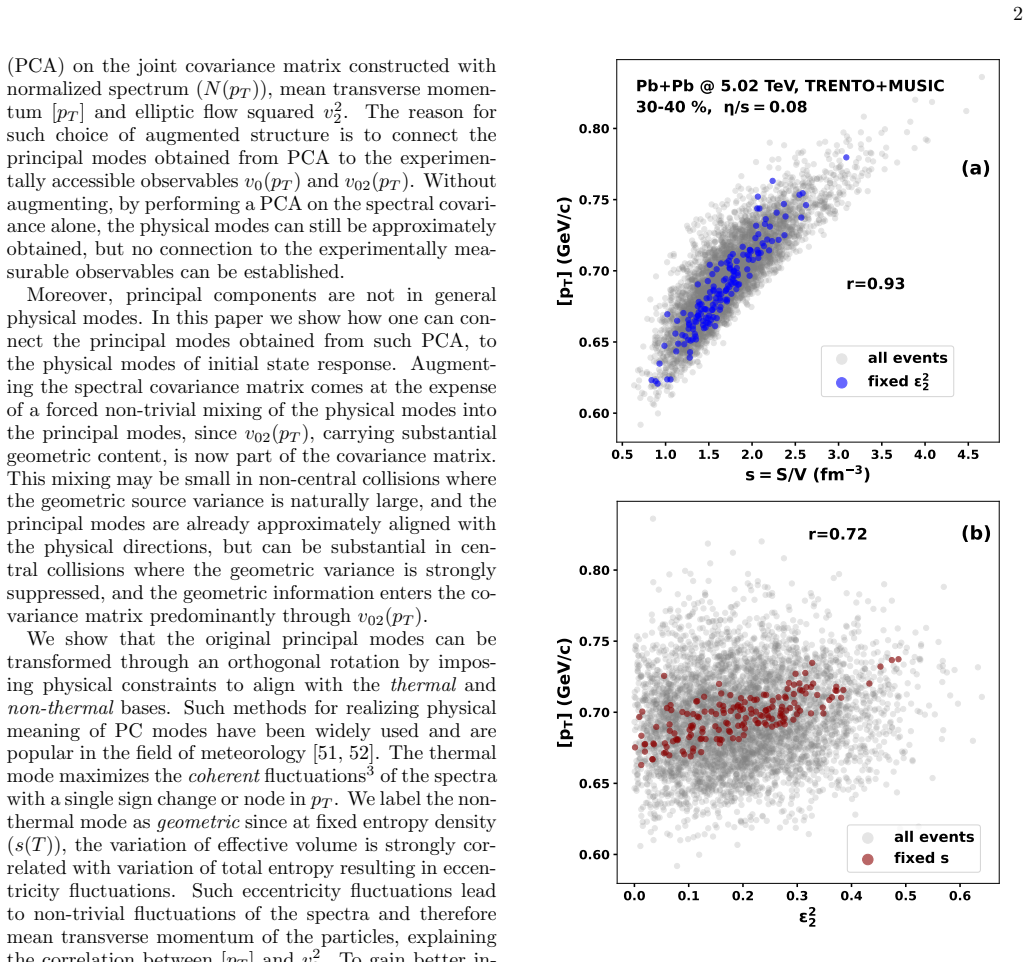
Pith reviewed 2026-05-07 11:42 UTC · model grok-4.3
The pith
Principal component analysis decomposes heavy-ion spectral fluctuations into two dominant thermal and geometric modes.
A machine-rendered reading of the paper's core claim, the machinery that carries it, and where it could break.
Core claim
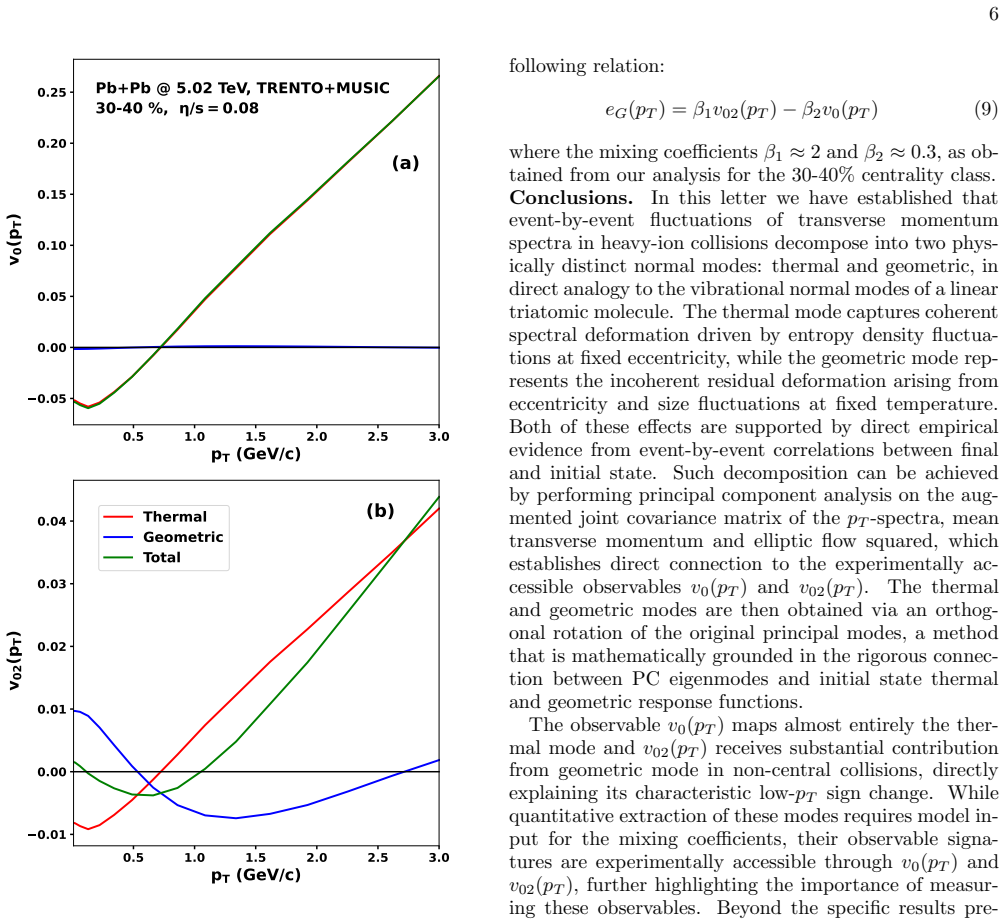
Principal component analysis applied to the joint covariance structure of the normalized transverse-momentum spectrum, mean transverse momentum, and elliptic flow squared isolates two leading modes that together explain 99.5 percent of the total variance. Orthogonal rotation of these modes, performed under constraints motivated by the initial-state thermal and geometric responses, produces normal modes directly analogous to the vibrational modes of a linear triatomic molecule. The resulting thermal mode fully accounts for the experimentally measured v0(pT), while the geometric mode supplies the dominant contribution to v02(pT) in non-central collisions and explains its characteristic low-pT
What carries the argument
Principal component analysis on the joint covariance matrix of normalized spectrum, mean pT and v2 squared, followed by orthogonal rotation constrained by initial-state thermal and geometric responses.
If this is right
- The thermal mode accounts entirely for the pT dependence of the measured v0 coefficient.
- The geometric mode supplies the dominant part of v02(pT) in non-central collisions and explains its low-pT sign change.
- The two-mode decomposition provides a transparent experimental window into the separate thermal and geometric structure of the initial state.
- The normal-mode analogy to a linear triatomic molecule supplies a simple physical picture for how thermal and geometric fluctuations combine.
Where Pith is reading between the lines
- The same covariance-based decomposition could be extended to higher-order flow harmonics to separate additional fluctuation sources.
- If the separation holds, hydrodynamic simulations could be validated by checking whether their predicted thermal and geometric mode contributions match the data-driven ones.
- This framework suggests a route to constrain initial-state models by demanding consistency with both the variance captured and the flow observables reproduced.
Load-bearing premise
The physical constraints used to rotate the PCA modes correctly isolate independent thermal and geometric responses without circular dependence on the fluctuation data itself.
What would settle it
Experimental data in which the rotated thermal mode fails to reproduce the full measured pT dependence of v0 or the geometric mode fails to reproduce the sign change and magnitude of v02 in non-central collisions.
Figures
read the original abstract
The transverse momentum spectrum of charged particles in ultra-relativistic heavy-ion collisions fluctuates event-by-event, encoding signatures of underlying collective dynamics. Such fluctuations originate from a combined effect of thermal and geometric fluctuations in the initial state. We present a direct decomposition of these spectral fluctuations through principal component analysis performed on the joint covariance structure of normalized spectrum, mean transverse momentum and elliptic flow squared. The first two leading modes explain 99.5\% of the total variance, and are orthogonally rotated by imposing physical constraints motivated by the initial state thermal and geometric response. The resulting thermal and geometric modes bear direct analogy with the vibrational normal modes of a linear triatomic molecule. The thermal mode entirely drives the experimentally measured $v_0(p_T)$, while the geometric mode contributes substantially to $v_{02}(p_T)$ in non-central collisions, providing a transparent explanation of its characteristic low-$p_T$ sign change. The study establishes the first physically motivated interpretation of principal component modes in the field of heavy-ion collisions and provides an experimental window into the thermo-geometric structure of the QGP initial state.
Editorial analysis
A structured set of objections, weighed in public.
Referee Report
Summary. The manuscript applies principal component analysis to the joint covariance matrix constructed from binned normalized p_T spectra, event-wise mean p_T, and v_2^2 in heavy-ion collisions. It reports that the first two eigenvectors capture 99.5% of the total variance; these are then subjected to an orthogonal rotation whose angle is determined by two physical constraints motivated by initial-state thermal (isotropic) and geometric (anisotropic) responses. The resulting rotated modes are interpreted as thermal and geometric normal modes analogous to the vibrational modes of a linear triatomic molecule. The thermal mode is stated to fully account for the measured v_0(p_T), while the geometric mode contributes substantially to v_{02}(p_T) in non-central collisions and explains its characteristic low-p_T sign change.
Significance. If the rotation constraints can be shown to be independent of the analyzed covariance data, the work would provide the first physically motivated interpretation of PCA modes in heavy-ion collisions. It would establish a direct link between spectral fluctuations and the thermo-geometric structure of the initial state, furnish a transparent explanation for observed features in v_0 and v_{02}, and introduce a useful molecular-vibration analogy that could guide further modeling and experimental tests.
major comments (1)
- [Section on orthogonal rotation of PCA modes] The section describing the orthogonal rotation (following the PCA decomposition): the two physical constraints used to fix the rotation angle are motivated by expected thermal and geometric initial-state responses, yet the manuscript does not demonstrate that these constraints can be derived from independent first-principles initial-state models without reference to the same covariance structure. Consequently, it remains possible that an alternative rotation angle or constraint set would produce equally valid but differently labeled modes, undermining the uniqueness of the thermal/geometric identification.
minor comments (1)
- [Abstract and results discussion] The analogy to the vibrational normal modes of a linear triatomic molecule is stated but would be strengthened by an explicit mapping (e.g., a figure or table) showing the correspondence between the rotated eigenvectors and the molecular degrees of freedom.
Simulated Author's Rebuttal
We thank the referee for their careful reading and constructive feedback on our manuscript. We address the major comment below.
read point-by-point responses
-
Referee: The section describing the orthogonal rotation (following the PCA decomposition): the two physical constraints used to fix the rotation angle are motivated by expected thermal and geometric initial-state responses, yet the manuscript does not demonstrate that these constraints can be derived from independent first-principles initial-state models without reference to the same covariance structure. Consequently, it remains possible that an alternative rotation angle or constraint set would produce equally valid but differently labeled modes, undermining the uniqueness of the thermal/geometric identification.
Authors: We thank the referee for this observation. The rotation angle is fixed by two constraints that encode general physical expectations: the thermal mode must be isotropic (vanishing elliptic anisotropy by symmetry, as it arises from uniform temperature fluctuations without preferred direction), while the geometric mode encodes the anisotropic shape response. These conditions follow from standard hydrodynamic response theory and initial-state symmetry considerations, without any dependence on the numerical entries or eigenvectors of the covariance matrix. They are therefore independent of the analyzed data structure. We will revise the relevant section to explicitly demonstrate this independence via symmetry arguments and consistency with hydrodynamic expectations, thereby confirming that alternative rotations would violate these physical requirements and that the thermal/geometric identification is unique under the stated constraints. revision: yes
Circularity Check
No significant circularity: PCA decomposition and physical interpretation remain independent.
full rationale
The paper applies standard PCA to the joint covariance matrix of normalized p_T spectra, event-wise mean p_T, and v_2^2, directly yielding the leading eigenvectors that capture 99.5% variance as a data-driven result. The subsequent orthogonal rotation is described as imposed by physical constraints motivated by independent initial-state thermal and geometric responses (e.g., isotropic vs. anisotropic fluctuations), not derived from or fitted to the same covariance structure. No equation reduces the rotated modes to the input eigenvectors by construction, nor does any self-citation chain or ansatz smuggle in the target interpretation. The assignment of thermal mode to v_0(p_T) and geometric mode to v_{02}(p_T) features is presented as an interpretive outcome supported by the rotated basis, not a tautological re-labeling of fitted quantities. The derivation chain is therefore self-contained against external initial-state benchmarks.
Axiom & Free-Parameter Ledger
axioms (1)
- standard math Principal component analysis applied to the joint covariance matrix of normalized transverse momentum spectrum, mean pT, and elliptic flow squared yields interpretable modes after rotation.
Reference graph
Works this paper leans on
-
[1]
on the other hand is primarily driven by fluctuations of event-by-event participant eccentricity squared (ϵ 2
-
[2]
of the fireball [31– 37] which is strongly correlated with the collision impact parameter. Pearson correlation coefficient between [p T ] and the elliptic flow squared (v 2 2), called the Bo˙ zek’s cor- relator [38], can therefore serve as an excellent probe of ∗ rupam.samanta@ifj.edu.pl the thermo-geometric coupling in the initial state at fixed initial ...
-
[3]
Thermal and geometric normal modes of spectral fluctuations in heavy-ion collisions
As shown in reference [47],v 02 can be decomposed into two components: one part cor- responding to the fluctuations ofN(p T ) associated with [pT ] fluctuations at fixedv 2 2, while the other part cap- tures the fluctuation of spectra associated withv 2 2 at fixed [p T ]. These two components can be regarded as response coefficients or modes, and could be...
work page internal anchor Pith review Pith/arXiv arXiv 2026
-
[4]
The reason for such choice of augmented structure is to connect the principal modes obtained from PCA to the experimen- tally accessible observablesv 0(pT ) andv 02(pT ). Without augmenting, by performing a PCA on the spectral covari- ance alone, the physical modes can still be approximately obtained, but no connection to the experimentally mea- surable o...
-
[5]
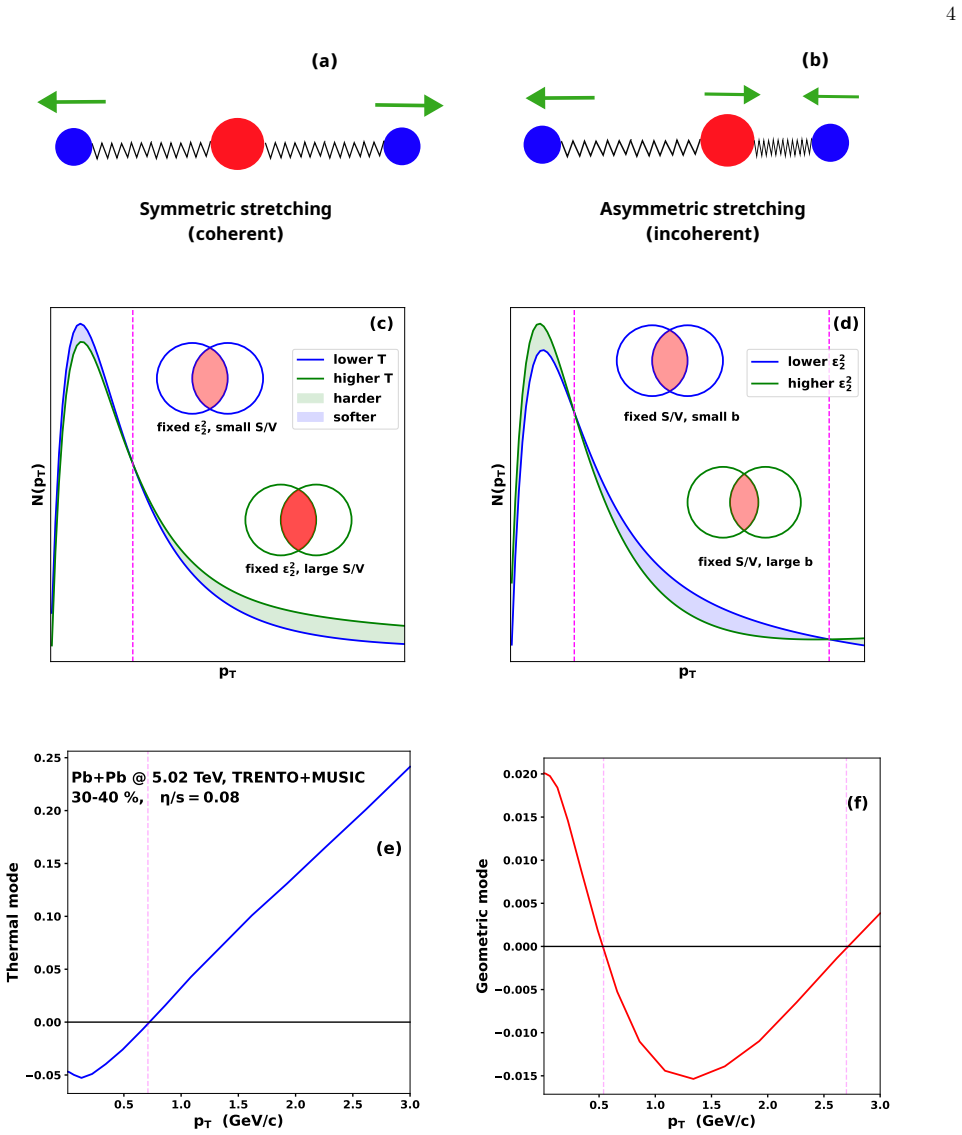
To gain better in- sights about these physical modes we draw an analogy to thenormalmodes of a coupled oscillator, in particular with the case of a linear triatomic molecule. Further- more, we show that thermal and geometric modes can be experimentally accessed via the observablesv 0(pT ) and v02(pT ) by quantifying the mixing coefficients based on our an...
-
[6]
The events at fixed entropy density are shown in dark red andrdenotes the Pearson correlation coefficient between [pT ] andϵ 2 2 for those events correlations [48–50, 53–56]
(b) Similar scat- ter plot between mean transverse momentum and eccentric- ity squared. The events at fixed entropy density are shown in dark red andrdenotes the Pearson correlation coefficient between [pT ] andϵ 2 2 for those events correlations [48–50, 53–56]. In reference [49], the princi- pal components of the flow fluctuations were related to the ini...
-
[7]
We choose normalizations in such a way that theN(p T )−[p T ] andN(p T )−v 2 2 blocks match the precise definitions ofv0(pT ) andv 02(pT ) as used in [22, 47]. In particular, we normalize the pT -spectrum and elliptic flow squared by their event- averages, whereas the mean transverse momentum is nor- malized by its standard deviation over events. With thi...
-
[8]
(e) Thermal normal mode of spectral fluctuation in Pb+Pb collision at 5.02 TeV for 30-40 % centrality, plotted as a function ofp T having a single node. (f) Geometric normal mode having characteristic double sign change in same centrality class 5 original modes such that the event-by-event coherent changes in the spectra is maximized, hence called the max...
-
[9]
Such rotation is expected to play most consequential role in cen- tral collisions where the mixing is substantial
The effect 4 It should be noted that such orthogonal rotation is a general requirement according to the rigorous relationship between final and initial state fluctuations shown in Appendix A, irrespective of the mixing between the physical modes into principal modes. Such rotation is expected to play most consequential role in cen- tral collisions where t...
2023
-
[10]
Hydrodynamic Models for Heavy Ion Collisions,
P. Huovinen and P. V. Ruuskanen, Hydrodynamic Mod- els for Heavy Ion Collisions, Ann. Rev. Nucl. Part. Sci. 56, 163 (2006), arXiv:nucl-th/0605008
-
[11]
J.-Y. Ollitrault, Relativistic hydrodynamics for heavy-ion collisions, Eur. J. Phys.29, 275 (2008), arXiv:0708.2433 [nucl-th]
- [12]
-
[13]
Collective flow and viscosity in relativistic heavy-ion collisions
U. Heinz and R. Snellings, Collective flow and viscosity in relativistic heavy-ion collisions, Ann. Rev. Nucl. Part. Sci.63, 123 (2013), arXiv:1301.2826 [nucl-th]
work page Pith review arXiv 2013
-
[14]
Heavy Ion Collisions: The Big Picture, and the Big Questions
W. Busza, K. Rajagopal, and W. van der Schee, Heavy Ion Collisions: The Big Picture, and the Big Questions, Ann. Rev. Nucl. Part. Sci.68, 339 (2018), arXiv:1802.04801 [hep-ph]
work page Pith review arXiv 2018
-
[15]
W. Broniowski, M. Chojnacki, and L. Obara, Size fluctuations of the initial source and the event-by- event transverse momentum fluctuations in relativistic heavy-ion collisions, Phys. Rev. C80, 051902 (2009), arXiv:0907.3216 [nucl-th]
-
[16]
P. Bozek and W. Broniowski, Transverse-momentum fluctuations in relativistic heavy-ion collisions from event-by-event viscous hydrodynamics, Phys. Rev. C85, 044910 (2012), arXiv:1203.1810 [nucl-th]
-
[17]
P. Bo˙ zek and W. Broniowski, Transverse momentum fluc- tuations in ultrarelativistic Pb + Pb and p + Pb colli- sions with “wounded” quarks, Phys. Rev. C96, 014904 (2017), arXiv:1701.09105 [nucl-th]
- [18]
-
[19]
R. Samanta, S. Bhatta, J. Jia, M. Luzum, and J.-Y. Ol- litrault, Thermalization at the femtoscale seen in high- energy Pb+Pb collisions, Phys. Rev. C109, L051902 (2024), arXiv:2303.15323 [nucl-th]
-
[20]
Ollitrault, Anisotropy as a signature of transverse collective flow, Phys
J.-Y. Ollitrault, Anisotropy as a signature of transverse collective flow, Phys. Rev. D46, 229 (1992)
1992
-
[21]
S. Voloshin and Y. Zhang, Flow study in relativistic nu- clear collisions by Fourier expansion of Azimuthal parti- cle distributions, Z. Phys. C70, 665 (1996), arXiv:hep- ph/9407282
-
[22]
H. Sorge, Highly sensitive centrality dependence of el- liptic flow: A novel signature of the phase transition in QCD, Phys. Rev. Lett.82, 2048 (1999), arXiv:nucl- th/9812057
-
[23]
Ollitrault, Measures of azimuthal anisotropy in high-energy collisions, Eur
J.-Y. Ollitrault, Measures of azimuthal anisotropy in high-energy collisions, Eur. Phys. J. A59, 236 (2023), arXiv:2308.11674 [nucl-ex]
-
[24]
J. Adams et al. (STAR), Azimuthal anisotropy in Au+Au collisions at s(NN)**(1/2) = 200-GeV, Phys. Rev. C72, 014904 (2005), arXiv:nucl-ex/0409033
-
[25]
K. Aamodt et al. (ALICE), Elliptic flow of charged par- ticles in Pb-Pb collisions at 2.76 TeV, Phys. Rev. Lett. 105, 252302 (2010), arXiv:1011.3914 [nucl-ex]
- [26]
- [27]
-
[28]
R. Samanta, J. P. Picchetti, M. Luzum, and J.-Y. Olli- trault, Non-Gaussian transverse momentum fluctuations from impact parameter fluctuations, Phys. Rev. C108, 024908 (2023), arXiv:2306.09294 [nucl-th]
-
[29]
M. Alqahtani, T. Parida, and J.-Y. Ollitrault, Extracting the speed of sound of QCD from transverse momentum fluctuations, (2026), arXiv:2603.09647 [hep-ph]
-
[30]
B. Schenke, C. Shen, and D. Teaney, Transverse momen- tum fluctuations and their correlation with elliptic flow in nuclear collision, Phys. Rev. C102, 034905 (2020), arXiv:2004.00690 [nucl-th]
- [31]
-
[32]
S. Bhatta, A. Dimri, and J. Jia, Disentangling the global multiplicity and spectral shape fluctuations in radial flow, (2025), arXiv:2504.20008 [nucl-th]
work page internal anchor Pith review Pith/arXiv arXiv 2025
- [33]
-
[34]
Jia, Sources of Radial-Flow Fluctuations in the Quark- Gluon Plasma, Phys
J. Jia, Sources of Radial-Flow Fluctuations in the Quark- Gluon Plasma, Phys. Rev. Lett.136, 112301 (2026), arXiv:2507.14399 [nucl-th]
- [35]
-
[36]
R. Agarwala, D. Basak, and K. Dey, Observation of par- tonic collectivity viap T-differential radial flow fluctua- tions in Au+Au collisions at √sNN = 200 GeV, (2025), arXiv:2512.15026 [nucl-ex]
-
[37]
Rapidity dependence of mean transverse momentum fluctuation and decorrelation in baryon-dense medium
T. Parida, Rapidity dependence of mean transverse mo- mentum fluctuation and decorrelation in baryon-dense medium, (2026), arXiv:2602.16369 [nucl-th]
work page internal anchor Pith review arXiv 2026
-
[38]
G. Aad et al. (ATLAS), Evidence for the Collective Na- ture of Radial Flow in Pb+Pb Collisions with the AT- LAS Detector, Phys. Rev. Lett.136, 032301 (2026), arXiv:2503.24125 [nucl-ex]
-
[39]
S. Acharya et al. (ALICE), Long-range transverse mo- mentum correlations and radial flow in Pb−Pb colli- sions at the LHC, Phys. Rev. Lett.136, 032302 (2026), arXiv:2504.04796 [nucl-ex]
- [40]
-
[41]
W. Broniowski, P. Bozek, and M. Rybczynski, Fluctu- ating initial conditions in heavy-ion collisions from the Glauber approach, Phys. Rev. C76, 054905 (2007), arXiv:0706.4266 [nucl-th]
-
[42]
B. Alver and G. Roland, Collision geometry fluctuations and triangular flow in heavy-ion collisions, Phys. Rev. C81, 054905 (2010), [Erratum: Phys.Rev.C 82, 039903 (2010)], arXiv:1003.0194 [nucl-th]
-
[43]
H. Holopainen, H. Niemi, and K. J. Eskola, Event- by-event hydrodynamics and elliptic flow from fluctu- ating initial state, Phys. Rev. C83, 034901 (2011), 8 arXiv:1007.0368 [hep-ph]
- [44]
- [45]
-
[46]
Initial State Fluctuations and Final State Correlations in Relativistic Heavy-Ion Collisions
M. Luzum and H. Petersen, Initial State Fluctuations and Final State Correlations in Relativistic Heavy-Ion Collisions, J. Phys. G41, 063102 (2014), arXiv:1312.5503 [nucl-th]
work page Pith review arXiv 2014
-
[47]
Bozek, Transverse-momentum–flow correlations in rel- ativistic heavy-ion collisions, Phys
P. Bozek, Transverse-momentum–flow correlations in rel- ativistic heavy-ion collisions, Phys. Rev. C93, 044908 (2016), arXiv:1601.04513 [nucl-th]
-
[48]
P. Bozek and H. Mehrabpour, Correlation coefficient between harmonic flow and transverse momentum in heavy-ion collisions, Phys. Rev. C101, 064902 (2020), arXiv:2002.08832 [nucl-th]
-
[49]
Correlation between mean transverse momen- tum and anisotropic flow in heavy-ion collisions
G. Giacalone, B. Schenke, and C. Shen, Observable sig- natures of initial state momentum anisotropies in nu- clear collisions, Phys. Rev. Lett.125, 192301 (2020), arXiv:2006.15721 [nucl-th]
-
[50]
G. Giacalone, F. G. Gardim, J. Noronha-Hostler, and J.-Y. Ollitrault, Correlation between mean transverse momentum and anisotropic flow in heavy-ion collisions, Phys. Rev. C103, 024909 (2021), arXiv:2004.01765 [nucl-th]
-
[51]
P. Bozek and R. Samanta, Higher order cumulants of transverse momentum and harmonic flow in relativistic heavy ion collisions, Phys. Rev. C104, 014905 (2021), arXiv:2103.15338 [nucl-th]
-
[52]
R. Samanta and P. Bozek, Momentum-dependent mea- sures of correlations between mean transverse momentum and harmonic flow in heavy-ion collisions, Phys. Rev. C 109, 064910 (2024), arXiv:2308.11565 [nucl-th]
-
[53]
S. Acharya et al. (ALICE), Characterizing the initial con- ditions of heavy-ion collisions at the LHC with mean transverse momentum and anisotropic flow correlations, Phys. Lett. B834, 137393 (2022), arXiv:2111.06106 [nucl-ex]
- [54]
- [55]
- [56]
- [57]
-
[58]
A. Mazeliauskas and D. Teaney, Fluctuations of har- monic and radial flow in heavy ion collisions with prin- cipal components, Phys. Rev. C93, 024913 (2016), arXiv:1509.07492 [nucl-th]
- [59]
-
[60]
M. B. Richman, Rotation of principal components, Jour- nal of Climatology6, 293
-
[61]
I. T. Jolliffe, Rotation of ill-defined principal components, Journal of the Royal Statistical Society. Series C (Applied Statistics)38, 139 (1989)
1989
-
[62]
A. Mazeliauskas and D. Teaney, Subleading harmonic flows in hydrodynamic simulations of heavy ion collisions, Phys. Rev. C91, 044902 (2015), arXiv:1501.03138 [nucl- th]
-
[63]
Bo˙ zek, Angle and magnitude decorrelation in the fac- torization breaking of collective flow, Phys
P. Bo˙ zek, Angle and magnitude decorrelation in the fac- torization breaking of collective flow, Phys. Rev. C98, 064906 (2018), arXiv:1808.04248 [nucl-th]
- [64]
- [65]
- [66]
-
[67]
B. Schenke, S. Jeon, and C. Gale, (3+1)D hydrodynamic simulation of relativistic heavy-ion collisions, Phys. Rev. C82, 014903 (2010), arXiv:1004.1408 [hep-ph]
-
[68]
P. Bozek and R. Samanta, Factorization breaking for higher moments of harmonic flow, Phys. Rev. C105, 034904 (2022), arXiv:2109.07781 [nucl-th]. Appendix A: Relation between final and initial state In our analysis the event-by-event fluctuation of final state observables can be written in matrix form: δX= δN(p T1). . . δN(p Ti). . . δp T δv 2 2 (A1) where...
discussion (0)
Sign in with ORCID, Apple, or X to comment. Anyone can read and Pith papers without signing in.