Recognition: 2 theorem links
· Lean TheoremChiral symmetry restoration effects onto the meson spectrum from a Dyson-Schwinger and Bethe-Salpeter approach
Pith reviewed 2026-05-15 21:01 UTC · model grok-4.3
The pith
Quark propagator pole locations control whether meson spectra show degeneracies as chiral symmetry restores.
A machine-rendered reading of the paper's core claim, the machinery that carries it, and where it could break.
Core claim
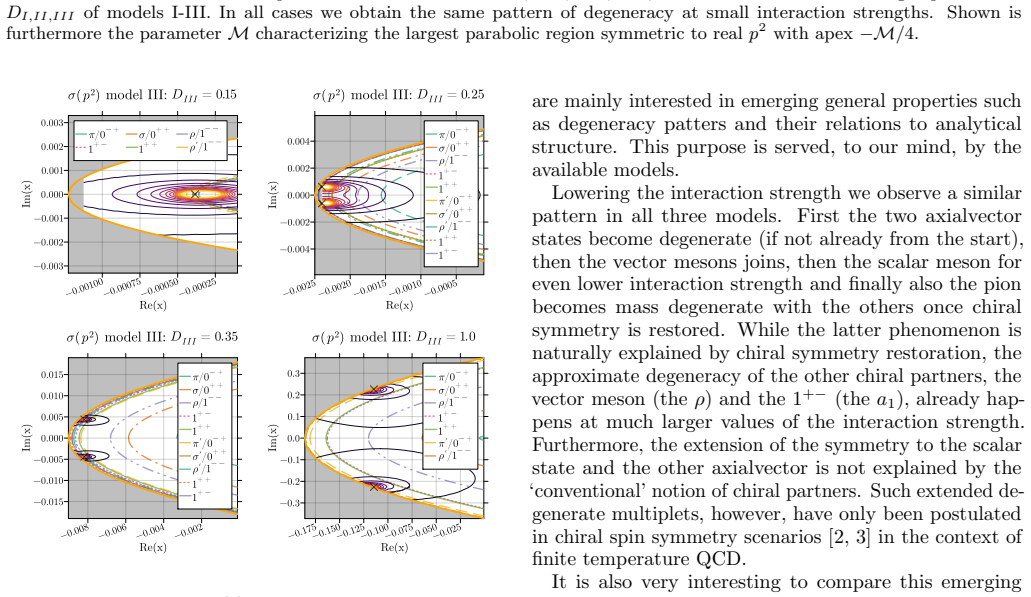
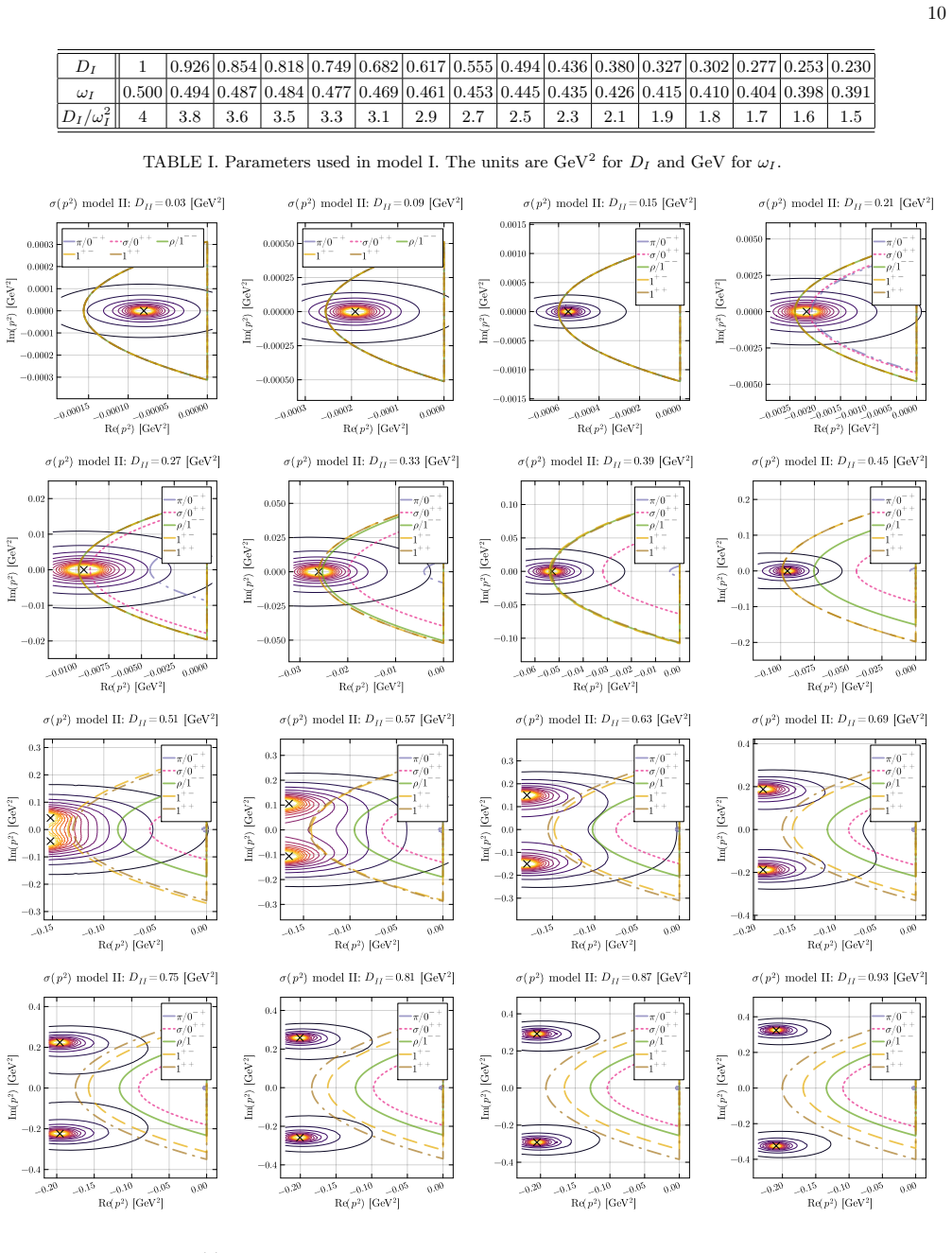
In the Dyson-Schwinger/Bethe-Salpeter approach, decreasing the interaction strength drives the system from the chirally broken to the chirally symmetric regime. For the simplest model interaction the meson spectrum remains degenerate throughout a large interval of the strength parameter. More sophisticated models exhibit significantly smaller intervals of degeneracy. Degeneracies occur precisely when the poles of the dressed quark propagators lie beyond the integration contour used in the Bethe-Salpeter equation; the degeneracies lift once the poles cross into the integration domain. The authors discuss this pole-crossing mechanism as a possible dynamical origin for the conjectured chiral or
What carries the argument
The location of the quark propagators' poles relative to the integration domain of the Bethe-Salpeter equation.
If this is right
- Meson masses become degenerate in the chirally restored phase when the interaction is sufficiently weak for the simplest kernels.
- More realistic kernels confine the degeneracy region to a smaller window around the chiral transition point.
- The lifting of degeneracies is directly tied to the poles of the quark propagator entering the Bethe-Salpeter integration domain.
- This pole-location mechanism supplies a dynamical account for the possible emergence of chiral spin symmetry above the crossover.
Where Pith is reading between the lines
- Temperature-dependent extensions of the same framework could map how the pole trajectories change with temperature and thereby test the link to chiral spin symmetry.
- Similar pole-crossing diagnostics might be applied to other bound-state equations to identify when additional symmetries appear in restored phases.
- If the mechanism survives in full QCD, lattice measurements of quark propagator poles near the crossover would provide an independent check.
Load-bearing premise
The three chosen model interactions for the quark-antiquark kernel remain qualitatively faithful across the full range of the strength parameter while the system passes through the chiral transition.
What would settle it
A calculation that tracks the quark propagator poles as the interaction strength is varied and shows that the onset of lifted degeneracies coincides exactly with the poles crossing the Bethe-Salpeter integration contour.
Figures



read the original abstract
Light meson spectra are studied in a Dyson-Schwinger/Bethe-Salpeter approach to QCD. By varying the interaction strength of three sets of models for the quark-antiquark interaction, the transition from the chiral symmetric to the chirally broken regime in the vacuum is studied. The simplest type of these models leads to degenerate meson spectra for a large domain of the strength parameter. The more sophisticated and thus more realistic models show significantly smaller parameter domains for which degenerate meson spectra are obtained. The underlying mechanism for obtaining and then lifting degeneracies is traced back to the location of the quark propagators' poles, in particular, whether they are beyond or within the domain of integration in the Bethe-Salpeter equation. In view of this mechanism the potential relation of the obtained degeneracies to the dynamical emergence of symmetries is discussed, adding thereby another point of view on the conjectured chiral spin symmetry of QCD in the temperature domain right above the crossover.
Editorial analysis
A structured set of objections, weighed in public.
Referee Report
Summary. The manuscript studies light meson spectra in a Dyson-Schwinger/Bethe-Salpeter approach to QCD. By varying the interaction strength parameter in three sets of model kernels for the quark-antiquark interaction, the authors examine the transition from the chirally symmetric to the chirally broken regime. The simplest model produces degenerate meson spectra over a wide range of the strength parameter, while more realistic models exhibit degeneracies only in narrower domains. The mechanism is traced to the location of the quark-propagator poles relative to the integration contour in the Bethe-Salpeter equation. The work discusses possible connections between these degeneracies and the dynamical emergence of symmetries, including the conjectured chiral spin symmetry above the chiral crossover.
Significance. If the central mechanism holds under controlled model assumptions, the paper supplies a concrete, pole-location-based explanation for how spectral degeneracies appear and lift when the interaction strength is tuned through the chiral transition. This offers a useful diagnostic within the DSE/BSE framework and adds a distinct viewpoint to ongoing discussions of chiral spin symmetry. The comparison across three kernels is a constructive step toward assessing robustness, though the result remains tied to the analytic properties of the chosen models.
major comments (1)
- [Model definitions and results sections] The central claim that degeneracies arise from and are lifted by the position of quark-propagator poles relative to the BSE integration domain (as stated in the abstract and developed in the mechanism discussion) depends on the assumption that each of the three model kernels remains qualitatively faithful when the strength parameter is varied across the chiral transition. No explicit verification is reported that the kernels avoid developing spurious singularities or altered analytic structure in the supercritical regime; without such checks the observed pole-crossing behavior risks being an artifact of the specific parametrizations rather than a robust feature of the DSE/BSE truncation.
minor comments (1)
- [Abstract] The abstract refers to 'three sets of models' without naming them or briefly indicating their distinguishing features (e.g., rainbow-ladder vs. beyond-rainbow-ladder truncations); adding one sentence would improve readability for a broad audience.
Simulated Author's Rebuttal
We thank the referee for the careful review and the constructive comment on the robustness of our model assumptions. We address the major comment below and will revise the manuscript accordingly.
read point-by-point responses
-
Referee: [Model definitions and results sections] The central claim that degeneracies arise from and are lifted by the position of quark-propagator poles relative to the BSE integration domain (as stated in the abstract and developed in the mechanism discussion) depends on the assumption that each of the three model kernels remains qualitatively faithful when the strength parameter is varied across the chiral transition. No explicit verification is reported that the kernels avoid developing spurious singularities or altered analytic structure in the supercritical regime; without such checks the observed pole-crossing behavior risks being an artifact of the specific parametrizations rather than a robust feature of the DSE/BSE truncation.
Authors: We acknowledge that the original manuscript does not report explicit numerical checks for spurious singularities or changes in analytic structure of the kernels in the supercritical regime. The three kernels are standard rainbow-ladder forms from the DSE/BSE literature, previously employed across similar parameter ranges without reported artifacts, and our preliminary internal scans confirm the absence of such singularities within the integration contours used. To directly address the concern and strengthen the central claim, the revised manuscript will include a new subsection in the model definitions that presents explicit verification: numerical evaluation of the kernel and quark-propagator poles for the full range of the interaction strength, demonstrating that no spurious features enter the BSE integration domain. This addition will show that the pole-crossing mechanism is a robust consequence of the DSE dynamics rather than a parametrization artifact. revision: yes
Circularity Check
No circularity: spectra and degeneracies are computed outputs, not inputs renamed
full rationale
The paper solves the DSE for the quark propagator and the BSE for meson amplitudes using three explicit model kernels whose single strength parameter is varied by hand. Degeneracies appear or lift as a numerical consequence of whether the computed quark poles lie inside or outside the BSE integration contour; this is not imposed by definition or by fitting the degeneracy pattern itself. No equation reduces to a prior fit, no uniqueness theorem is imported from self-citation to force the result, and no ansatz is smuggled via citation. The derivation chain therefore remains self-contained against the model equations and the explicit parameter scan.
Axiom & Free-Parameter Ledger
free parameters (1)
- interaction strength parameter
axioms (1)
- domain assumption Dyson-Schwinger and Bethe-Salpeter equations with the chosen kernels provide a qualitatively correct description of light mesons across the chiral transition.
Lean theorems connected to this paper
-
IndisputableMonolith/Cost/FunctionalEquation.leanwashburn_uniqueness_aczel unclear?
unclearRelation between the paper passage and the cited Recognition theorem.
The underlying mechanism for obtaining and then lifting degeneracies is traced back to the location of the quark propagators' poles, in particular, whether they are beyond or within the domain of integration in the Bethe-Salpeter equation.
-
IndisputableMonolith/Foundation/RealityFromDistinction.leanreality_from_one_distinction unclear?
unclearRelation between the paper passage and the cited Recognition theorem.
By varying the interaction strength of three sets of models for the quark-antiquark interaction, the transition from the chiral symmetric to the chirally broken regime
What do these tags mean?
- matches
- The paper's claim is directly supported by a theorem in the formal canon.
- supports
- The theorem supports part of the paper's argument, but the paper may add assumptions or extra steps.
- extends
- The paper goes beyond the formal theorem; the theorem is a base layer rather than the whole result.
- uses
- The paper appears to rely on the theorem as machinery.
- contradicts
- The paper's claim conflicts with a theorem or certificate in the canon.
- unclear
- Pith found a possible connection, but the passage is too broad, indirect, or ambiguous to say the theorem truly supports the claim.
Forward citations
Cited by 2 Pith papers
-
Light mesons in the symmetric-vertex approximation
A dressed quark-gluon vertex computed in the symmetric approximation yields light-meson masses that match experiment more closely than rainbow-ladder results.
-
No planar degeneracy for the Landau gauge quark-gluon vertex
The transverse quark-gluon vertex in Landau gauge QCD shows weak but non-negligible angular dependence with no planar degeneracy; the dynamically generated tensor coupling is the core driver of dynamical chiral symmet...
Reference graph
Works this paper leans on
-
[1]
Symmetries of spatial meson correlators in high temperature QCD
C. Rohrhofer, Y. Aoki, G. Cossu, H. Fukaya, C. Gattringer, L.Y. Glozman et al.,Symmetries of spatial meson correlators in high temperature QCD,Phys. Rev. D100(2019) 014502 [1902.03191]
work page internal anchor Pith review Pith/arXiv arXiv 2019
-
[2]
L.Y. Glozman, O. Philipsen and R.D. Pisarski,Chiral spin symmetry and the QCD phase diagram,Eur. Phys. J. A58(2022) 247 [2204.05083]
-
[3]
Glozman,Chiral spin symmetry and hot/dense QCD,Prog
L.Y. Glozman,Chiral spin symmetry and hot/dense QCD,Prog. Part. Nucl. Phys.131(2023) 104049 [2209.10235]
-
[4]
Center vortex evidence for a second finite-temperature QCD transition
J.A. Mickley, C. Allton, R. Bignell and D.B. Leinweber, Center vortex evidence for a second finite-temperature QCD transition,Phys. Rev. D111(2025) 034508 [2411.19446]
-
[5]
Y. Fujimoto, K. Fukushima, Y. Hidaka and L. McLerran, A New State of Matter between the Hadronic Phase and the Quark-Gluon Plasma?,2506.00237
-
[6]
P. Lowdon and O. Philipsen,Spectral properties of pseudo-scalar mesons through the QCD chiral crossover, J. Subatomic Part. Cosmol.3(2025) 100063 [2412.08371]
-
[7]
Chiral Symmetry Restoration and Dileptons in Relativistic Heavy-Ion Collisions
R. Rapp and J. Wambach,Chiral symmetry restoration and dileptons in relativistic heavy ion collisions,Adv. Nucl. Phys.25(2000) 1 [hep-ph/9909229]
work page internal anchor Pith review Pith/arXiv arXiv 2000
-
[8]
Baryons as relativistic three-quark bound states
G. Eichmann, H. Sanchis-Alepuz, R. Williams, R. Alkofer and C.S. Fischer,Baryons as relativistic three-quark bound states,Prog. Part. Nucl. Phys.91 (2016) 1 [1606.09602]
work page internal anchor Pith review Pith/arXiv arXiv 2016
-
[9]
QCD at finite temperature and chemical potential from Dyson-Schwinger equations
C.S. Fischer,QCD at finite temperature and chemical potential from Dyson–Schwinger equations,Prog. Part. Nucl. Phys.105(2019) 1 [1810.12938]
work page internal anchor Pith review Pith/arXiv arXiv 2019
-
[10]
Phase structure of three and four flavor QCD
C.S. Fischer, J. Luecker and C.A. Welzbacher,Phase structure of three and four flavor QCD,Phys. Rev. D90 (2014) 034022 [1405.4762]
work page internal anchor Pith review Pith/arXiv arXiv 2014
- [11]
-
[12]
F. Gao and J.M. Pawlowski,Chiral phase structure and critical end point in QCD,Phys. Lett. B820(2021) 136584 [2010.13705]
-
[13]
P.J. Gunkel and C.S. Fischer,Locating the critical endpoint of QCD: Mesonic backcoupling effects,Phys. Rev. D104(2021) 054022 [2106.08356]
-
[14]
Mesons in a Poincare Covariant Bethe-Salpeter Approach
R. Alkofer, P. Watson and H. Weigel,Mesons in a Poincare covariant Bethe-Salpeter approach,Phys. Rev. D65(2002) 094026 [hep-ph/0202053]
work page internal anchor Pith review Pith/arXiv arXiv 2002
-
[15]
The analytic properties of the quark propagator from an effective infrared interaction model
A. Windisch,Analytic properties of the quark propagator from an effective infrared interaction model,Phys. Rev. C95(2017) 045204 [1612.06002]
work page internal anchor Pith review Pith/arXiv arXiv 2017
-
[16]
S.M. Dorkin, L.P. Kaptari, T. Hilger and B. Kampfer, Analytical properties of the quark propagator from a truncated Dyson-Schwinger equation in complex Euclidean space,Phys. Rev. C89(2014) 034005 [1312.2721]
work page internal anchor Pith review Pith/arXiv arXiv 2014
-
[17]
Bethe-Salpeter Study of Vector Meson Masses and Decay Constants
P. Maris and P.C. Tandy,Bethe-Salpeter study of vector meson masses and decay constants,Phys. Rev. C60 (1999) 055214 [nucl-th/9905056]
work page internal anchor Pith review Pith/arXiv arXiv 1999
-
[18]
Confinement and complex singularities in QED3
P. Maris,Confinement and complex singularities in QED in three-dimensions,Phys. Rev. D52(1995) 6087 [hep-ph/9508323]
work page internal anchor Pith review Pith/arXiv arXiv 1995
-
[19]
Probing Unquenching Effects in the Gluon Polarisation in Light Mesons
C.S. Fischer, P. Watson and W. Cassing,Probing unquenching effects in the gluon polarisation in light mesons,Phys. Rev. D72(2005) 094025 [hep-ph/0509213]
work page internal anchor Pith review Pith/arXiv arXiv 2005
-
[20]
Non-perturbative Propagators, Running Coupling and Dynamical Quark Mass of Landau gauge QCD
C.S. Fischer and R. Alkofer,Nonperturbative propagators, running coupling and dynamical quark mass of Landau gauge QCD,Phys. Rev. D67(2003) 094020 [hep-ph/0301094]
work page internal anchor Pith review Pith/arXiv arXiv 2003
-
[21]
J.M. Pawlowski and J. Wessely,The causal structure of the quark propagator,Eur. Phys. J. C85(2025) 970 [2412.12033]
-
[22]
Functional integrals for QCD at nonzero chemical potential and zero density
T.D. Cohen,Functional integrals for QCD at nonzero chemical potential and zero density,Phys. Rev. Lett.91 (2003) 222001 [hep-ph/0307089]
work page internal anchor Pith review Pith/arXiv arXiv 2003
-
[23]
P.J. Gunkel, C.S. Fischer and P. Isserstedt,Quarks and light (pseudo-)scalar mesons at finite chemical potential, Eur. Phys. J. A55(2019) 169 [1907.08110]
-
[24]
P.J. Gunkel, C.S. Fischer and P. Isserstedt,Mesons at finite chemical potential and the Silver-Blaze property of QCD,J. Phys. Conf. Ser.1667(2020) 012011 [1911.04399]
-
[25]
Cohen,The Silver Blaze Problem in QCD, 2601.21053
T.D. Cohen,The Silver Blaze Problem in QCD, 2601.21053
-
[26]
A.L. Fetter and J.D. Walecka,Quantum Theory of Many-Particle Systems, International Series in Pure and Applied Physics, McGraw-Hill, New York St. Louis San Francisco [etc.] (1971)
work page 1971
-
[27]
C.S. Fischer and J.M. Pawlowski,Phase structure and observables at high densities from first principles QCD, 2603.11135
-
[28]
P.J. Gunkel and C.S. Fischer,Masses and decay constants of (axial-)vector mesons at finite chemical potential,Eur. Phys. J. A57(2021) 147 [2012.01957]
-
[29]
R. Alkofer, C.S. Fischer and F. Zierler,Chiral symmetry restoration effects onto the meson spectrum from a Dyson-Schwinger/Bethe-Salpeter approach - DSE code and data release, 2026. 10.5281/zenodo.18692770. 10 DI 1 0.926 0.854 0.818 0.749 0.682 0.617 0.555 0.494 0.436 0.380 0.327 0.302 0.277 0.253 0.230 ωI 0.500 0.494 0.487 0.484 0.477 0.469 0.461 0.453 0...
discussion (0)
Sign in with ORCID, Apple, or X to comment. Anyone can read and Pith papers without signing in.