Recognition: 2 theorem links
· Lean TheoremWarm dark matter from freeze-in at stronger coupling
Pith reviewed 2026-05-15 19:45 UTC · model grok-4.3
The pith
Freeze-in at stronger coupling produces warm Higgs-portal dark matter excluded below 50-100 keV by Lyman-alpha data.
A machine-rendered reading of the paper's core claim, the machinery that carries it, and where it could break.
Core claim
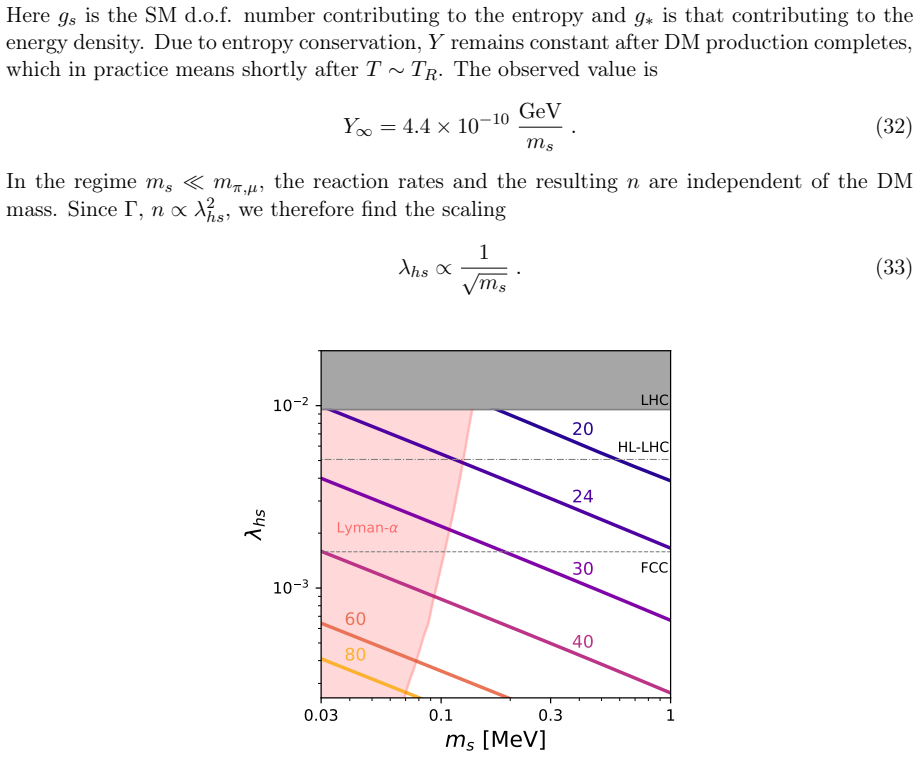
In the freeze-in scenario with a persistently low Standard Model bath temperature, dark matter production is suppressed, allowing stronger DM-Higgs couplings. This yields warm dark matter whose momentum distribution is highly non-thermal with low momenta effectively cut off, and the Lyman-alpha bound excludes masses below 50-100 keV.
What carries the argument
Freeze-in production of dark matter at stronger coupling, made possible by the assumption of a low-temperature Standard Model thermal bath that suppresses the production rate.
If this is right
- Stronger DM-Higgs coupling makes detection via Higgs boson decays feasible at colliders.
- The Lyman-alpha bound is especially tight and excludes masses below 50-100 keV.
- The momentum distribution requires a description beyond the common alpha-beta-gamma parametrization.
Where Pith is reading between the lines
- The cutoff in low momenta may relax or alter other structure-formation bounds on warm dark matter.
- Invisible Higgs decay searches at future colliders could directly test the allowed coupling range.
- Similar low-temperature bath assumptions could be applied to other portal models to enable stronger couplings.
Load-bearing premise
The Standard Model thermal bath temperature has always been relatively low, which suppresses dark matter production.
What would settle it
A direct cosmological measurement showing dark matter particles below 50 keV with a thermal-like low-momentum tail, or a collider observation of Higgs decays to dark matter inconsistent with the mass bound.
Figures




read the original abstract
We study warm Higgs portal dark matter (DM) in the framework of freeze-in at stronger coupling. This scenario assumes that the Standard Model thermal bath temperature has always been relatively low, which suppresses dark matter production. As a result, a significant DM-Higgs coupling is allowed, enabling warm dark matter detection via Higgs decay at colliders. We find that the Lyman-{\alpha} bound on the DM mass is particularly strong, excluding masses below 50-100 keV, depending on further details. The shape of the DM momentum distribution is highly non-thermal, with low momenta being effectively cut off, and not captured by the common {\alpha}{\beta}{\gamma}-parametrization.
Editorial analysis
A structured set of objections, weighed in public.
Referee Report
Summary. The manuscript studies warm Higgs-portal dark matter produced via freeze-in at stronger coupling. It assumes the Standard Model thermal bath has always remained at relatively low temperature, suppressing DM production and thereby permitting a larger DM-Higgs coupling. The central claims are that Lyman-α data impose a strong lower bound on the DM mass (50–100 keV, depending on details) and that the resulting DM momentum distribution is highly non-thermal, featuring an effective low-momentum cutoff that cannot be reproduced by the conventional αβγ parametrization.
Significance. If the Boltzmann-equation solution and the Lyman-α analysis hold, the work supplies a concrete, collider-accessible realization of warm dark matter whose non-thermal spectrum differs qualitatively from standard thermal or αβγ forms. The scenario links a low-temperature bath assumption directly to observable Higgs-decay signatures while remaining consistent with existing cosmological bounds.
major comments (2)
- [Results section (Lyman-α analysis)] The abstract states that the Lyman-α bound excludes masses below 50–100 keV, but the manuscript must show explicitly how this bound is obtained from the computed non-thermal distribution (e.g., via the transfer function or free-streaming length). Without that derivation the numerical range cannot be verified.
- [Momentum distribution subsection] The claim that the momentum distribution is not captured by the αβγ parametrization requires a quantitative comparison—e.g., best-fit α,β,γ values and the resulting χ² or residual plot—rather than a qualitative statement. This comparison is load-bearing for the assertion that the spectrum is “highly non-thermal.”
minor comments (2)
- [Abstract and conclusions] The phrase “depending on further details” for the 50–100 keV range should be replaced by an explicit list of the parameters (e.g., coupling strength, bath temperature cutoff) that shift the bound.
- [Model setup] Notation for the DM-Higgs coupling and the freeze-in yield should be defined once at first use and used consistently; the current text introduces symbols without prior definition.
Simulated Author's Rebuttal
We thank the referee for their careful reading of the manuscript and for the constructive comments, which have helped us improve the clarity and rigor of our presentation. We have revised the manuscript to explicitly derive the Lyman-α bound from the non-thermal distribution and to provide a quantitative comparison with the αβγ parametrization. Our point-by-point responses follow.
read point-by-point responses
-
Referee: [Results section (Lyman-α analysis)] The abstract states that the Lyman-α bound excludes masses below 50–100 keV, but the manuscript must show explicitly how this bound is obtained from the computed non-thermal distribution (e.g., via the transfer function or free-streaming length). Without that derivation the numerical range cannot be verified.
Authors: We agree that an explicit derivation is necessary for verifiability. In the revised manuscript we have added a dedicated paragraph in the Results section that computes the transfer function and free-streaming length directly from the momentum distribution obtained by solving the Boltzmann equation. The resulting mass lower bound of 50–100 keV (depending on the precise low-temperature bath assumption) is now shown step by step, including the relevant integrals and the comparison to the standard thermal case. revision: yes
-
Referee: [Momentum distribution subsection] The claim that the momentum distribution is not captured by the αβγ parametrization requires a quantitative comparison—e.g., best-fit α,β,γ values and the resulting χ² or residual plot—rather than a qualitative statement. This comparison is load-bearing for the assertion that the spectrum is “highly non-thermal.”
Authors: We accept that a qualitative statement alone is insufficient. We have performed a least-squares fit of the αβγ form to our numerically computed distribution and added the best-fit parameters (α ≈ 1.8, β ≈ 0.9, γ ≈ 2.1), the associated χ²/dof value (≈ 45), and a residual plot in the revised Momentum distribution subsection. The large residuals at low momenta confirm that the parametrization cannot reproduce the effective cutoff present in our freeze-in spectrum. revision: yes
Circularity Check
No significant circularity in derivation chain
full rationale
The paper's central results—the Lyman-α mass bound of 50-100 keV and the non-thermal momentum distribution with low-momentum cutoff—are obtained by solving the Boltzmann equation for freeze-in production under the explicit low-temperature bath assumption, using external Lyman-α data as input. No step reduces by construction to a fitted parameter, self-definition, or load-bearing self-citation; the derivation remains independent of its inputs and does not match any enumerated circularity pattern.
Axiom & Free-Parameter Ledger
free parameters (2)
- DM-Higgs coupling strength
- DM mass lower bound
axioms (1)
- domain assumption Standard Model thermal bath temperature has always been relatively low
Lean theorems connected to this paper
-
IndisputableMonolith/Cost/FunctionalEquation.leanwashburn_uniqueness_aczel echoes?
echoesECHOES: this paper passage has the same mathematical shape or conceptual pattern as the Recognition theorem, but is not a direct formal dependency.
the reaction rate contains the usual Boltzmann factors ... E1 + E2 → min ... E1 + E2 = p0 + m_π²/p0 ... exp(−p0/T − m_π²/(p0 T))
-
IndisputableMonolith/Foundation/LogicAsFunctionalEquation.leanTranslation Theorem / J-uniqueness corollary echoes?
echoesECHOES: this paper passage has the same mathematical shape or conceptual pattern as the Recognition theorem, but is not a direct formal dependency.
C(p) ≃ c T e^{-p/T}/p ∫ ds ... asymptotic limits ... exp(−p/T − m_π²/(p T))
What do these tags mean?
- matches
- The paper's claim is directly supported by a theorem in the formal canon.
- supports
- The theorem supports part of the paper's argument, but the paper may add assumptions or extra steps.
- extends
- The paper goes beyond the formal theorem; the theorem is a base layer rather than the whole result.
- uses
- The paper appears to rely on the theorem as machinery.
- contradicts
- The paper's claim conflicts with a theorem or certificate in the canon.
- unclear
- Pith found a possible connection, but the passage is too broad, indirect, or ambiguous to say the theorem truly supports the claim.
Forward citations
Cited by 2 Pith papers
-
Exploring non-equilibrium effects in sequential freeze-in
In a two-scalar dark sector, non-equilibrium phase-space evolution during sequential freeze-in alters the dark matter relic abundance by up to an order of magnitude relative to the standard number-density treatment.
-
The 3-3-1 Model: a natural framework for sub-MeV dark matter
The 3-3-1 model with right-handed neutrinos supplies a natural sub-MeV dark matter candidate as a gravitationally massive pseudo-Goldstone boson whose relic density is set by freeze-in at low reheating temperatures.
Reference graph
Works this paper leans on
- [1]
-
[2]
L. J. Hall, K. Jedamzik, J. March-Russell and S. M. West, JHEP03, 080 (2010)
work page 2010
- [3]
- [4]
- [5]
- [6]
- [7]
-
[8]
Gravitational scalar production with a generic reheating scenario
F. Costa and J. Kim, [arXiv:2602.10215 [hep-ph]]
work page internal anchor Pith review Pith/arXiv arXiv
-
[9]
D. Feiteira, F. Koutroulis, O. Lebedev and S. Pokorski, [arXiv:2509.01673 [hep-ph]],to appear inJCAP
- [10]
- [11]
- [12]
- [13]
-
[14]
N. Koivunen, O. Lebedev and M. Raidal, Eur. Phys. J. C84, no.11, 1234 (2024)
work page 2024
- [15]
-
[16]
S. Khan, J. Kim and H. M. Lee, JCAP06, 040 (2025)
work page 2025
- [17]
-
[18]
H. M. Lee, M. Park and V. Sanz, JHEP05, 126 (2025)
work page 2025
- [19]
-
[20]
K. K. Boddy, K. Freese, G. Montefalcone and B. Shams Es Haghi, Phys. Rev. D111, no.6, 6 (2025)
work page 2025
- [21]
-
[22]
S. E. Henrich, Y. Mambrini and K. A. Olive, Phys. Rev. D111, no.8, 083501 (2025)
work page 2025
-
[23]
Higgs-field Portal into Hidden Sectors
B. Patt and F. Wilczek, [arXiv:hep-ph/0605188 [hep-ph]]
work page internal anchor Pith review Pith/arXiv arXiv
- [24]
- [25]
-
[26]
O. Lebedev, A. P. Morais, V. Oliveira and R. Pasechnik, JHEP04, 136 (2025)
work page 2025
- [27]
- [28]
- [29]
- [30]
-
[31]
E. W. Kolb and M. S. Turner, Front. Phys.69, 1-547 (1990)
work page 1990
- [32]
- [33]
-
[34]
M. W. Winkler, Phys. Rev. D99, no.1, 015018 (2019)
work page 2019
- [35]
- [36]
-
[37]
Seasons of Dark Matter Freeze-In Shaped by the Weather of the Early Universe
F. D’Eramo, A. Lenoci and T. Sassi, [arXiv:2511.07511 [hep-ph]]
work page internal anchor Pith review Pith/arXiv arXiv
- [38]
-
[39]
K. J. Bae, A. Kamada, S. P. Liew and K. Yanagi, JCAP01, 054 (2018)
work page 2018
-
[40]
M. Viel, J. Lesgourgues, M. G. Haehnelt, S. Matarrese and A. Riotto, Phys. Rev. D71, 063534 (2005)
work page 2005
-
[41]
A. I. Vainshtein, V. I. Zakharov and M. A. Shifman, Sov. Phys. Usp.23, 429-449 (1980)
work page 1980
-
[42]
M. B. Voloshin, Sov. J. Nucl. Phys.45, 122 (1987)
work page 1987
- [43]
-
[44]
D. Blas, J. Lesgourgues and T. Tram, JCAP07, 034 (2011)
work page 2011
- [45]
- [46]
-
[47]
P. A. Rivadeneira Bracho, “Search for invisible decays of the Higgs boson produced via vector boson fusion at the ATLAS detector with 139 fb−1 of integrated luminosity,”PhD thesis, University of Hamburg, 2022
work page 2022
- [48]
- [49]
discussion (0)
Sign in with ORCID, Apple, or X to comment. Anyone can read and Pith papers without signing in.