REVIEW 4 major objections 5 minor 1 cited by
PROCLAIM claims that structuring LLM fact-checking as a courtroom-style adversarial debate with progressive retrieval raises Check-COVID accuracy to 81.7%, 10 points above standard multi-agent debate, with the dynamic retrieval module drivi
Reviewed by Pith at T0; open to challenge. T0 means a machine referee read the full paper against a public rubric. the ladder, T0–T4 →
T0 review · deepseek-v4-flash
2026-08-04 05:37 UTC pith:SX2HOT3C
load-bearing objection A genuinely integrated courtroom-style debate framework with open code and a rich audit trail, but the headline accuracy numbers rest on a non-standard scoring rule and a confounded P-RAG ablation, so treat the +10pp as not yet established. the 4 major comments →
Courtroom-Style Multi-Agent Debate with Progressive RAG and Role-Switching for Controversial Claim Verification
The pith
A machine-rendered reading of the paper's core claim, the machinery that carries it, and where it could break.
Core claim
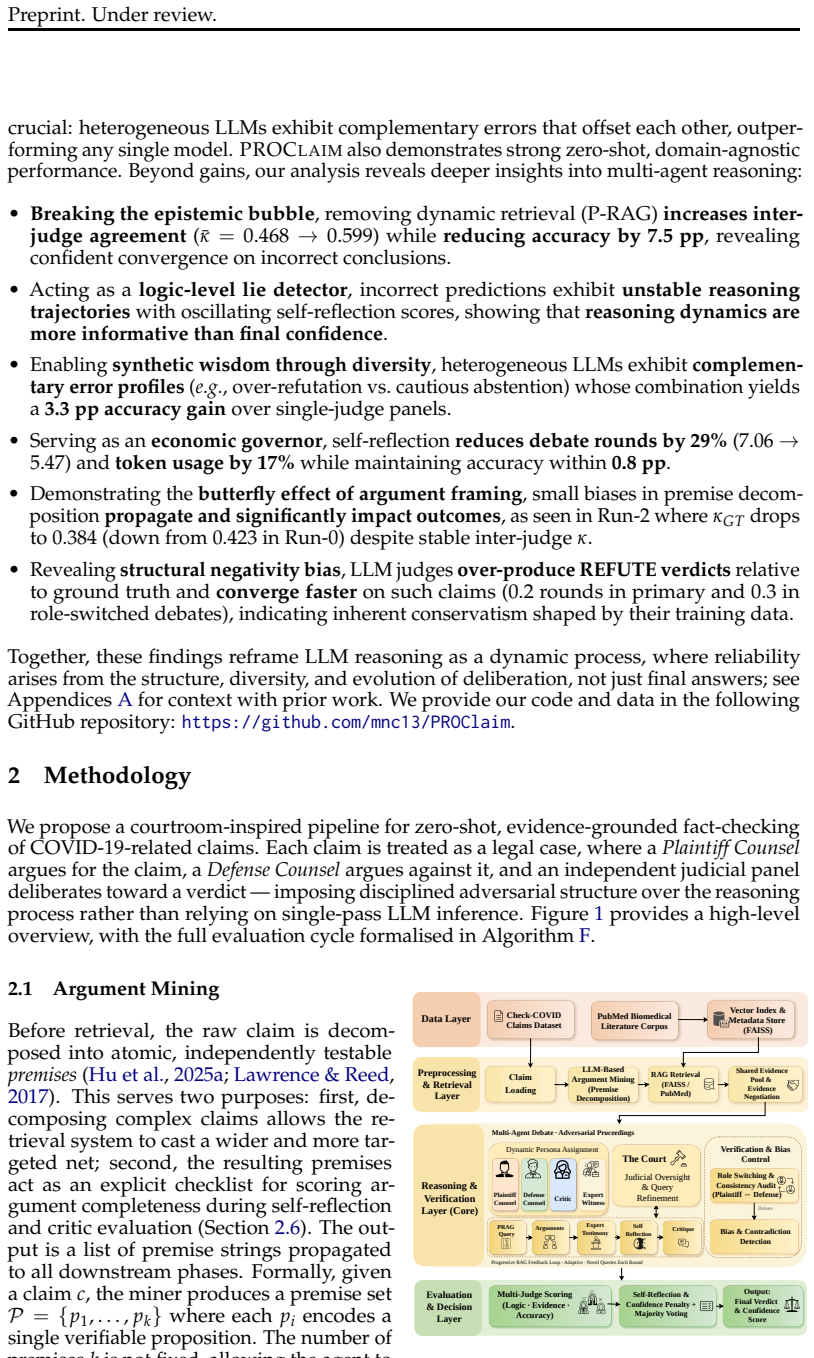
On its own terms, the paper claims that a structured, adversarial courtroom protocol reshapes LLM claim verification: instead of one retrieval pass and a free-form exchange, each claim is decomposed into premises, support and opposition counsel retrieve and negotiate evidence, a critic and self-reflection expose gaps, P-RAG iteratively expands the evidence pool with novelty-filtered documents, and a three-judge panel delivers a verdict. The measurable discovery is that the dynamic retrieval loop is doing the heavy lifting: ablating P-RAG costs 7.5 accuracy points and makes the judges agree more often, while ablating role-switching, the multi-judge panel, or self-reflection costs less. The pa
What carries the argument
Progressive Retrieval-Augmented Generation (P-RAG): an iterative retrieval module that, each debate round, combines the last four debate messages, the counsel's self-identified evidence gap, and the prior round's reflection-driven discovery need into a single query, sends it through a presiding judge for refinement, then admits only documents whose embedding novelty relative to the current pool is at least 0.20. It drives the primary performance gain (+7.5 pp) and prevents 'epistemic bubble' convergence by forcing genuinely new evidence to enter the debate.
Load-bearing premise
The load-bearing premise is that mapping every 'inconclusive' judge verdict to 'supported' is a fair scoring rule on a subset of claims that already has definitive binary labels; if judges abstain on a biased slice of claims, the 81.7% accuracy and the 10-point gain over standard multi-agent debate are inflated.
What would settle it
On the 120 claims used for ablations and the Check-COVID binary subset, recompute accuracy under three verdict mappings—INCONCLUSIVE counted as SUPPORT, as REFUTE, and excluded—and report per-class results. If the INCONCLUSIVE-to-SUPPORT mapping accounts for most of the 10-point gap over standard MAD, or if true REFUTE claims are over-represented among the inconclusive verdicts that get converted, the central claim fails.
If this is right
- If P-RAG is removed, accuracy falls by 7.5 pp while inter-judge agreement rises from kappa 0.468 to 0.599; the authors read this as confident convergence on wrong conclusions.
- Role-switching contributes 4.2 pp and adds 20% more evidence, indicating that the second debate pass uncovers missed evidence rather than serving only as a consistency check.
- A heterogeneous three-judge panel beats any single judge by 3.3 pp; the individual judges show complementary error profiles that majority voting corrects.
- Self-reflection has minimal impact on accuracy (-0.8 pp) but cuts debate rounds by 29% and token usage by 17%, acting as an economic governor.
- Accuracy stays within roughly 9 pp across HealthVer, FEVEROUS, and Check-COVID with no domain-specific tuning, suggesting the deliberation architecture transfers.
Where Pith is reading between the lines
- Our inference: because P-RAG accounts for 7.5 of the 10-point gain, a cheaper system that keeps P-RAG and drops role-switching plus the second debate might retain much of the accuracy at a fraction of the token cost; the paper does not test this configuration.
- Our inference: the 'inconclusive becomes support' rule, combined with evaluation only on claims that have definite binary labels, means the reported 81.7% is not directly comparable to standard fact-checking accuracy and could shift materially under different verdict-mapping conventions.
- Our inference: the reported instability of reflection trajectories on wrong answers suggests a deployable early-warning signal, but only for systems that log per-round internal reasoning; single-call models cannot generate that signal.
- Our inference: a testable extension would apply the same progressive retrieval protocol to claim verification outside health domains, where evidence corpora are less centralized, to see whether the P-RAG gain persists when retrieval quality drops.
Editorial analysis
A structured set of objections, weighed in public.
Referee Report
Summary. The paper proposes PROCLAIM, a courtroom-style multi-agent framework for claim verification that combines progressive RAG, role-switching consistency tests, self-reflection, and a heterogeneous three-judge panel. On a binary-labeled subset of Check-COVID, it reports 81.7% majority-vote accuracy, a +10.0 pp gain over a standard multi-agent debate baseline, and attributes the largest share of the gain (+7.5 pp) to P-RAG. The paper also presents analyses of debate dynamics, termination behavior, token cost, and panel bias, and releases code and prompts.
Significance. If the headline comparisons were established, the paper would make a useful contribution: structured adversarial deliberation with dynamic retrieval is a plausible route to more auditable and robust claim verification. The paper is unusually transparent in shipping prompts, pseudo-code, per-run results, and an ablation matrix, and the 'epistemic bubble' observation (removing P-RAG raises inter-judge agreement while lowering accuracy) is a genuinely interesting phenomenon. However, the accuracy claims rest on a non-standard evaluation mapping and on a confounded ablation, and the strongest reported baseline is a single-call RAG model that already exceeds PROCLAIM. The core contribution is therefore not yet convincingly quantified.
major comments (4)
- [Section 3 / Appendix C] The evaluation metric is not standard claim-verification accuracy. The binary Check-COVID subset excludes non-definitive labels, and every INCONCLUSIVE judicial verdict is recoded as SUPPORT under the 'Burden of Refutation'. This makes 'not refuted' equivalent to 'verified'. No SUPPORT/REFUTE balance or confusion matrix for the 120-claim subset is reported, and Section 4.1 itself describes Run-2 as having class-asymmetric degradation suppressing REFUTE recall — exactly the failure mode this mapping can hide. The 81.7% figure and the +10.0 pp gain over MAD are therefore not comparable to conventional fact-checking results until standard-scoring accuracy and label-wise breakdowns are reported.
- [Section 4.4 / Table 6, A3] The +7.5 pp attribution to P-RAG is confounded. The w/o-P-RAG ablation (A3) simultaneously sets Max Rounds to 3 (from 10), disables Reflection->P-RAG, and disables Adaptive Convergence. Any of these changes alone could explain part or all of the accuracy drop. To substantiate the abstract's claim that 'P-RAG driv[es] the primary performance gains', an ablation must isolate the novelty-filtered progressive retrieval mechanism while keeping max rounds and stopping rules fixed, or must vary these factors independently.
- [Section 4.3 / Table 4] The paper's headline 'outperform[ing] standard multi-agent debate by 10.0 percentage points' is technically true, but the same table shows a single-call GPT-5-mini + RAG baseline at 85.8% accuracy — 4.1 pp above the full PROCLAIM pipeline. The claim that the courtroom architecture is a strong accuracy driver is undercut by the fact that its own simplest baseline beats it. The narrative in the abstract and Section 5 should be reconciled with this result, or additional stronger baselines and a significance test should be provided.
- [Section 4.1 / Table 3] Run-level variability is large and unreported in the summary statistics: Run-0 accuracy is 95.0%, Run-1 is 81.7%, and Run-2 is 79.0%. The majority-vote figure of 81.7% equals one of the three runs and can vary with stochastic seed selection. No confidence intervals or significance tests are given for the 81.7% figure or for the 10.0 pp/7.5 pp deltas. Given the 120-claim sample, these differences may not be statistically robust; the paper should report variance, significance (e.g., bootstrap or paired tests), and the number of runs used for the headline comparison.
minor comments (5)
- [Appendix L.1] The confidence-weight calibration (W_consensus=0.8) is performed on a held-out development subset and the ECE improvement is reported; please clarify whether the final test-set ECE of 0.034 is computed on claims used for weight selection or on fully held-out claims.
- [Section B.4] The novelty threshold tau=0.20 was selected via grid search on only 20 development claims. This is a very small tuning set; the sensitivity of downstream accuracy to tau should be reported.
- [Appendix M] The 'Chief Justice priority-weighting' edge-case rule (DeepSeek-R1 breaks a three-way split) is presented as a design decision but no sensitivity analysis is given. Since this rule can decide the final verdict, its effect on accuracy should be quantified.
- [Figure 4] The 'Trajectory Instability Signal' claim is supported only by representative trajectories with n=10 per panel. A quantitative measure (e.g., variance of reflection scores for correct vs. incorrect predictions) would strengthen the claim.
- [General] Several references are cited with future/in-preparation dates (e.g., 2026) that may not be verifiable; please update or mark them appropriately.
Circularity Check
No circular derivation; evaluation is empirical, though the non-standard Burden-of-Refutation scoring and confounded P-RAG ablation are validity concerns, not circularity.
full rationale
The paper proposes an empirical pipeline and evaluates it on Check-COVID; there is no derivation chain in which a predicted quantity is defined by its input. The closest definitional choice is the 'Burden of Refutation' mapping (Section 4 and Appendix C) that recodes INCONCLUSIVE judge verdicts as SUPPORT. This is a transparent scoring rule rather than a fitted parameter or an equation-level identity: the system still must produce REFUTE verdicts and can be wrong on both classes, so accuracy is not forced by construction. The P-RAG ablation (Table 6) is confounded — w/o P-RAG also lowers Max Rounds to 3 and disables reflection-driven retrieval — so the +7.5 pp attribution is not cleanly isolated, but this is an experimental soundness issue, not circular reasoning. Self-citations (CircuitLM, PhysicsEval) appear only in related-work lists and are not load-bearing. No uniqueness theorems or ansatz-smuggling citations are used. Thus no circular step meets the evidence bar.
Axiom & Free-Parameter Ledger
free parameters (7)
- P-RAG novelty threshold τ =
0.20
- Consensus weight W_consensus =
0.8
- Admissibility thresholds =
admit >0.5; disputed 0.1–0.5; discard ≤0.1
- Self-reflection weights =
logic 0.4, novelty 0.3, rebuttal 0.3
- Self-reflection adjustment multiplier and floor =
multiplier 0.6; floor -0.15
- Role-switch consistency mapping thresholds =
+0.10 if γ≥7; 0.0 if 5≤γ<7; -0.05 if γ<5
- Stopping criteria thresholds =
redundancy ratio 0.70; relevance gain 0.05; iteration cap 10; plateau 0.05
axioms (6)
- domain assumption Ground-truth labels in the binary Check-COVID subset are correct and the subset is representative of controversial claim verification.
- ad hoc to paper INCONCLUSIVE judicial verdicts should be counted as SUPPORT under the 'Burden of Refutation' standard.
- domain assumption Cosine similarity in all-MiniLM-L6-v2 embedding space is a valid measure of evidential novelty and relevance for biomedical abstracts.
- domain assumption Majority voting across three heterogeneous LLM judges corrects complementary errors rather than compounding bias.
- ad hoc to paper Reflection scores and their trajectories reflect argument quality and can serve as a lie detector.
- standard math Standard statistical measures (Cohen's κ, Fleiss' κ, ECE) are appropriate for these categorical judgments.
invented entities (3)
-
Trajectory Instability Signal ('Logic Lie Detector')
no independent evidence
-
Epistemic bubble effect
no independent evidence
-
Chief Justice priority-weighting
no independent evidence
read the original abstract
Large language models (LLMs) remain unreliable for high-stakes claim verification due to hallucinations and shallow reasoning. While retrieval-augmented generation (RAG) and multi-agent debate (MAD) address this, they are limited by one-pass retrieval and unstructured debate dynamics. We propose a courtroom-style multi-agent framework, PROClaim, that reformulates verification as a structured, adversarial deliberation. Our approach integrates specialized roles (e.g., Plaintiff, Defense, Judge) with Progressive RAG (P-RAG) to dynamically expand and refine the evidence pool during the debate. Furthermore, we employ evidence negotiation, self-reflection, and heterogeneous multi-judge aggregation to enforce calibration, robustness, and diversity. In zero-shot evaluations on the Check-COVID benchmark, PROClaim achieves 81.7% accuracy, outperforming standard multi-agent debate by 10.0 percentage points, with P-RAG driving the primary performance gains (+7.5 pp). We ultimately demonstrate that structural deliberation and model heterogeneity effectively mitigate systematic biases, providing a robust foundation for reliable claim verification. Our code and data are publicly available at https://github.com/mnc13/PROClaim.
Figures


Forward citations
Cited by 1 Pith paper
-
Automatic Hard Example Synthesis with Multi-Level Agentic Data Curation
Test-time retrieval of committee-disagreement-mined synthetic images cuts a safety classifier's false-negative rate on a hard HoliSafe subset from 41.2% to 24.5%.
Reference graph
Works this paper leans on
-
[1]
Relevance: How directly does this evidence address the premises of the claim? (0.0 - 1.0)
-
[2]
Shuzhi Gong, Richard O Sinnott, Jianzhong Qi, Cecile Paris, Preslav Nakov, and Zhuohan Xie
URLhttps://arxiv.org/abs/2505.17762. Shuzhi Gong, Richard O Sinnott, Jianzhong Qi, Cecile Paris, Preslav Nakov, and Zhuohan Xie. Multi-sourced, multi-agent evidence retrieval for fact-checking.arXiv preprint arXiv:2603.00267, 2026. Jiawei Gu, Xuhui Jiang, Zhichao Shi, Hexiang Tan, Xuehao Zhai, Chengjin Xu, Wei Li, Yinghan Shen, Shengjie Ma, Honghao Liu, S...
Pith/arXiv arXiv 2026
-
[3]
unresolved
Rebuttal Coverage: Did they address the opponent’s strongest points? Identify any premises that remain "unresolved" or under-supported. Provide actionable recommendations for both sides to improve their discovery and arguments. Respond ONLY in valid JSON format: { "plaintiff": { "logic": 0.0, "evidence": 0.0, "rebuttal": 0.0, "reasoning": "..." }, "defens...
-
[4]
23 Preprint
Clinical studies on hospitalized COVID-19 patients do not report significant occur- rences of heart muscle cell damage. 23 Preprint. Under review
-
[5]
There is no statistical association between COVID-19 infection severity and markers of heart muscle cell damage in hospitalized patients
-
[6]
Autopsy findings of deceased hospitalized COVID-19 patients do not show evidence of heart muscle cell damage
-
[7]
thinking
Credibility: Does the evidence come from a reliable scientific context or contain high-quality data? (0.0 - 1.0) G.3 Plaintiff Counsel Prompt Agent:GPT-5-mini System Prompt: You are the Plaintiff Counsel in a legal proceeding. Your role is to present arguments supporting the claim, interpret evidence favorably, challenge opposing arguments, and conduct ex...
-
[8]
Logical Coherence: Argument flow and structure
-
[9]
Evidence Coverage: How well they used admitted exhibits
-
[11]
Logical Coherence: Evaluate the flow and structural integrity of your arguments
-
[12]
Evidence Novelty: Have you introduced truly new information or just repeated old points?
-
[13]
scores": { 20 Preprint. Under review
Rebuttal Coverage: How effectively did you address the{opp side} counsel’s latest points? Identify: - Critical gaps in your current evidence base. - Premises you haven’t sufficiently supported. Respond ONLY in valid JSON format: { "scores": { 20 Preprint. Under review. "logic": 0.0-1.0, "novelty": 0.0-1.0, "rebuttal": 0.0-1.0 }, "flaws_identified": ["..."...
-
[14]
Hospitalized COVID-19 patients have detectable levels of cardiac biomarkers in- dicative of heart muscle cell damage
-
[15]
The prevalence of elevated cardiac biomarkers in hospitalized COVID-19 patients is comparable to a control group without COVID-19
-
[16]
Incidence rates of heart muscle cell damage in hospitalized COVID-19 patients are not higher than in patients with other viral respiratory infections
-
[20]
not an associated condition
Hospitalized COVID-19 patients with pre-existing cardiac conditions do not have higher rates of heart muscle cell damage compared to those without pre-existing conditions. Evidence Negotiation & Admission Initial RAG retrieved 5 candidate documents; negotiation and arbitration admitted21 ex- hibits(weights ranging 0.54–0.81), including: Source 32517963 (J...
2022
-
[21]
Role-Play Consistency (0–10) During the role-switching consistency test (Section 2.7), an independent consistency ana- lyzer evaluates whether an agent successfully argues the opposing position using identical evidence without logically contradicting its prior arguments. The score reflects adherence to the persona constraints on a 10-point scale; lower sc...
-
[22]
I concede,
Concession Rate We programmatically track explicit linguistic markers of concession and conversational yielding (e.g.,“I concede,” “you make a good point,” “I partially agree”) within the counsel transcripts. To normalize for varying debate lengths, the metric is reported as the frequency of such triggers per 1,000 generated words. A near-zero rate indica...
-
[23]
The early-stopping criterion conservatively halts the debate if ∆S< 0.05 (stagnation)
Reflection Plateau (∆S) It is computed as the average absolute change in the cumulative self-reflection score (Stotal) between consecutive debate rounds: ∆S=|S (t) total −S (t−1) total | For a given round, the maximum possible change is ∼ 1.0 (depending on reflection ad- justments). The early-stopping criterion conservatively halts the debate if ∆S< 0.05 ...
-
[24]
rubber- stamping
Judicial Conformity (Fleiss’κ) To measure whether the three structurally heterogeneous LLM judges exhibit “rubber- stamping” or independent evaluation, we calculate Fleiss’ Kappa (κ) over their final verdicts (SUPPORTED, NOT SUPPORTED, INCONCLUSIVE). A κ≈ 0.4513 indicates moderate, au- thentic agreement. While confirming they reach consensus on clear-cut ...
-
[297]
Zhihong Shao, Yeyun Gong, Yelong Shen, Minlie Huang, Nan Duan, and Weizhu Chen
URLhttps://aclanthology.org/2021.findings-emnlp.297/. Zhihong Shao, Yeyun Gong, Yelong Shen, Minlie Huang, Nan Duan, and Weizhu Chen. Enhancing retrieval-augmented large language models with iterative retrieval-generation synergy. In Houda Bouamor, Juan Pino, and Kalika Bali (eds.),Findings of the Association for Computational Linguistics: EMNLP 2023, pp....
Pith/arXiv arXiv 2021
-
[2021]
doi: 10.18653/v1/2021.findings-emnlp
Association for Computational Linguistics. doi: 10.18653/v1/2021.findings-emnlp
-
[2023]
URLhttps://arxiv.org/abs/2212.10509. Pat Verga, Sebastian Hofstatter, Sophia Althammer, Yixuan Su, Aleksandra Piktus, Arkady Arkhangorodsky, Minjie Xu, Naomi White, and Patrick Lewis. Replacing judges with juries: Evaluating llm generations with a panel of diverse models, 2024. URL https: //arxiv.org/abs/2404.18796. Gengyu Wang, Kate Harwood, Lawrence Chi...
Pith/arXiv arXiv 2024
-
[2025]
Yilun Du, Shuang Li, Antonio Torralba, Joshua B Tenenbaum, and Igor Mordatch
URLhttps://arxiv.org/abs/2401.08281. Yilun Du, Shuang Li, Antonio Torralba, Joshua B Tenenbaum, and Igor Mordatch. Improving factuality and reasoning in language models through multiagent debate. InForty-first international conference on machine learning, 2024. Wei Fan, JinYi Yoon, and Bo Ji. imad: Intelligent multi-agent debate for efficient and accurate...
Pith/arXiv arXiv 2024
discussion (0)
Sign in with ORCID, Apple, or X to comment. Anyone can read and Pith papers without signing in.