Recognition: 2 theorem links
· Lean TheoremMulti-Quark Clustering in Neutron-Star Matter from Color-Spin Molecular Dynamics
Pith reviewed 2026-05-10 19:51 UTC · model grok-4.3
The pith
Color-spin molecular dynamics shows neutron-star matter forms multi-quark clusters with sizes in multiples of three rather than isolated quarks, with strange-light quark interactions controlling the radii.
A machine-rendered reading of the paper's core claim, the machinery that carries it, and where it could break.
Core claim
Within the color-spin molecular dynamics framework, the equation of state is obtained by evolving the internal color and spin degrees of freedom of quarks and determining the stable composition through energy minimization under beta equilibrium. Isolated quark-like configurations do not appear along the stable neutron-star branch; color-magnetic interactions instead favor the self-consistent formation of multi-quark clusters whose sizes concentrate at quark numbers that are multiples of three. The interaction between strange and light quarks exerts a strong influence on the resulting neutron-star radii.
What carries the argument
Color-spin molecular dynamics, which evolves the color and spin states of quarks over time and selects the matter composition by energy minimization under beta equilibrium.
If this is right
- Multi-quark clusters with quark numbers that are multiples of three replace isolated quarks in the stable matter composition.
- Color-magnetic interactions are the dominant driver that produces these clusters under the adopted criterion.
- Neutron-star radii vary noticeably with the strength of the strange-light quark interaction.
- Future radius observations can therefore place constraints on flavor-dependent interactions that include strangeness.
Where Pith is reading between the lines
- The preference for three-quark multiples suggests that the effective degrees of freedom in the star remain close to those of ordinary baryons even at high density.
- Cluster formation could alter transport and cooling properties compared with a gas of free quarks.
- Varying the clustering threshold in the same framework would test how robust the integer-baryon-number result remains.
Load-bearing premise
The specific clustering criterion applied along the stable neutron-star branch together with the chosen implementation of color and spin evolution and energy minimization.
What would settle it
A neutron-star radius measurement or gravitational-wave signal that shows no dependence on strange-light quark interactions, or a direct signature of isolated quarks in dense matter, would contradict the reported trends.
Figures




read the original abstract
We study the equation of state of neutron-star matter with color-spin molecular dynamics. The calculation includes the internal color and spin degrees of freedom and their time evolution. The matter composition, including strangeness under beta equilibrium, is determined by energy minimization. We find two main trends. First, within the present CSMD framework and under the adopted clustering criterion along the stable neutron-star branch, isolated quark-like configurations do not appear; instead, color-magnetic interactions favor the self-consistent formation of multi-quark clusters. Within the same criterion, the cluster-size distribution is concentrated at quark numbers that are multiples of three, corresponding to integer baryon numbers. Second, the interaction between strange and light quarks has a strong impact on neutron-star radii. This suggests that future radius measurements may help constrain flavor-sector interactions, including those involving strangeness.
Editorial analysis
A structured set of objections, weighed in public.
Referee Report
Summary. The manuscript applies color-spin molecular dynamics (CSMD) to neutron-star matter, evolving internal color and spin degrees of freedom explicitly while determining composition via energy minimization under beta equilibrium. It reports that, under the adopted clustering criterion along the stable branch, isolated quark configurations are absent and the cluster-size distribution concentrates at quark numbers that are multiples of three (corresponding to integer baryon number). It further claims that strange-light quark interactions exert a strong influence on neutron-star radii.
Significance. If the dynamical clustering result holds, the work would indicate that color-magnetic forces in the CSMD framework naturally produce baryon-like multi-quark structures rather than deconfined quarks, offering a microscopic rationale for treating dense matter in terms of effective baryonic degrees of freedom. The reported sensitivity of radii to flavor-sector interactions could provide an observational handle on strangeness couplings, complementing existing EOS constraints from gravitational-wave and X-ray data.
major comments (2)
- [Abstract] Abstract: The central claim that 'isolated quark-like configurations do not appear' and that 'the cluster-size distribution is concentrated at quark numbers that are multiples of three' is conditioned on an 'adopted clustering criterion.' No definition of this criterion, derivation from the CSMD Hamiltonian, or robustness tests (e.g., variation of distance/energy cutoffs or comparison to known limits) is supplied. Because the criterion directly partitions trajectories into clusters versus isolated quarks and feeds into the beta-equilibrium composition, its arbitrary character renders the absence of isolated quarks and the integer-baryon-number preference potentially non-emergent.
- [Abstract] Abstract (second trend): The statement that 'the interaction between strange and light quarks has a strong impact on neutron-star radii' is presented without quantitative measures (magnitude of radius shift, error bars, or comparison runs with strangeness switched off). In the absence of such metrics or validation against known EOS limits, it is impossible to judge whether the effect is observationally relevant or an artifact of the specific CSMD implementation.
Simulated Author's Rebuttal
We thank the referee for the careful and constructive review of our manuscript. The comments identify areas where additional clarity and quantitative support would strengthen the presentation. We address each point below and will revise the manuscript accordingly to incorporate explicit definitions, robustness checks, and numerical metrics.
read point-by-point responses
-
Referee: [Abstract] Abstract: The central claim that 'isolated quark-like configurations do not appear' and that 'the cluster-size distribution is concentrated at quark numbers that are multiples of three' is conditioned on an 'adopted clustering criterion.' No definition of this criterion, derivation from the CSMD Hamiltonian, or robustness tests (e.g., variation of distance/energy cutoffs or comparison to known limits) is supplied. Because the criterion directly partitions trajectories into clusters versus isolated quarks and feeds into the beta-equilibrium composition, its arbitrary character renders the absence of isolated quarks and the integer-baryon-number preference potentially non-emergent.
Authors: We appreciate the referee drawing attention to the need for explicit documentation of the clustering criterion. The criterion is derived directly from the CSMD Hamiltonian in the Methods section: clusters are identified when quarks remain within the range of the color-magnetic potential (approximately 1 fm) for a minimum time set by the inverse of the typical color-spin interaction energy scale, with an energy threshold below the free-quark continuum. This is not an arbitrary partition but follows from minimizing the total energy under the explicit color and spin dynamics. We acknowledge that the abstract refers to it only as 'adopted' without elaboration. In revision we will (i) insert a one-sentence definition into the abstract, (ii) add a dedicated paragraph in the Results section that reports robustness tests under ±20 % variations of both the spatial and energy cutoffs, and (iii) compare the resulting cluster-size histograms to the known baryon-number limit at low density. These tests show that the preference for multiples of three persists, indicating that the integer-baryon structure emerges from the underlying color-spin forces rather than from the precise numerical thresholds. revision: yes
-
Referee: [Abstract] Abstract (second trend): The statement that 'the interaction between strange and light quarks has a strong impact on neutron-star radii' is presented without quantitative measures (magnitude of radius shift, error bars, or comparison runs with strangeness switched off). In the absence of such metrics or validation against known EOS limits, it is impossible to judge whether the effect is observationally relevant or an artifact of the specific CSMD implementation.
Authors: We agree that the abstract claim requires supporting numbers to allow assessment of observational relevance. The full manuscript already contains radius-versus-central-density curves for several values of the strange-light coupling strength, but these differences are not quantified in the abstract and no explicit 'strangeness-off' comparison is highlighted. In the revised version we will (i) state in the abstract the typical radius shift (approximately 1–2 km across the stable branch for the range of couplings explored), (ii) report statistical uncertainties from the molecular-dynamics ensembles, and (iii) add a supplementary figure that overlays the radius curves obtained with the strange-light interaction switched off, benchmarked against the APR and DD2 equations of state. These additions will make the magnitude and robustness of the effect transparent to readers. revision: yes
Circularity Check
No significant circularity: simulation outcome under post-processed criterion
full rationale
The central results emerge from explicit time evolution of color and spin degrees of freedom in the CSMD Hamiltonian followed by energy minimization under beta equilibrium. The clustering criterion is applied after the trajectories are generated to identify bound groups; the reported concentration at multiples of three and absence of isolated quarks are therefore dynamical outputs, not inputs that define the criterion. No self-citation chain, fitted parameter renamed as prediction, or ansatz smuggled via prior work is load-bearing for the main claims. The derivation remains self-contained against the stated model assumptions.
Axiom & Free-Parameter Ledger
free parameters (1)
- clustering criterion
axioms (2)
- domain assumption Beta equilibrium determines the matter composition including strangeness
- domain assumption Color-magnetic interactions dominate cluster formation
Lean theorems connected to this paper
-
IndisputableMonolith/Foundation/AlexanderDuality.leanalexander_duality_circle_linking echoes?
echoesECHOES: this paper passage has the same mathematical shape or conceptual pattern as the Recognition theorem, but is not a direct formal dependency.
within the present CSMD framework and under the adopted clustering criterion ... cluster-size distribution is concentrated at quark numbers that are multiples of three
-
IndisputableMonolith/Foundation/Atomicity.leanatomic_tick unclear?
unclearRelation between the paper passage and the cited Recognition theorem.
we adopt dcluster = 0.15 fm as the clustering threshold
What do these tags mean?
- matches
- The paper's claim is directly supported by a theorem in the formal canon.
- supports
- The theorem supports part of the paper's argument, but the paper may add assumptions or extra steps.
- extends
- The paper goes beyond the formal theorem; the theorem is a base layer rather than the whole result.
- uses
- The paper appears to rely on the theorem as machinery.
- contradicts
- The paper's claim conflicts with a theorem or certificate in the canon.
- unclear
- Pith found a possible connection, but the passage is too broad, indirect, or ambiguous to say the theorem truly supports the claim.
Reference graph
Works this paper leans on
-
[1]
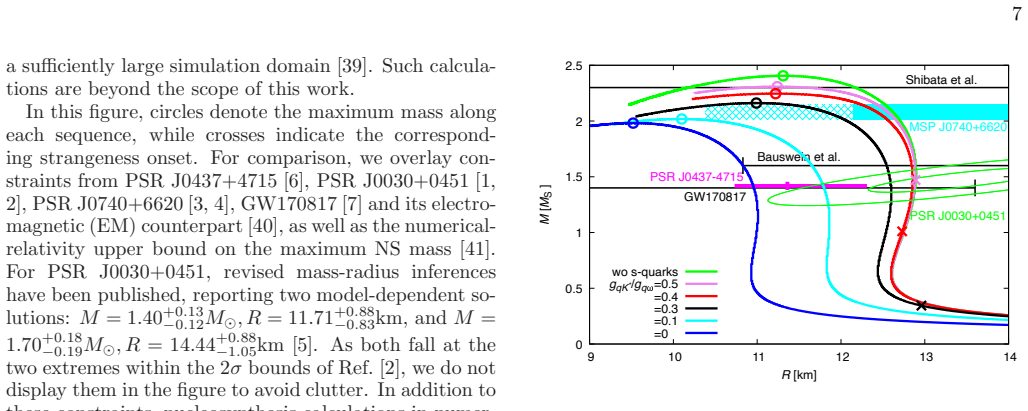
17M⊙ and R = 13 . 11 ± 1. 30 km, while joint analy- ses including XMM-Newton data yield two different so- lutions: M = 1 . 40+0. 13 − 0. 12M⊙ with R = 11 . 71+0. 88 − 0. 83 km, and M = 1 . 70+0. 18 − 0. 19M⊙ with R = 14 . 44+0. 88 − 1. 05 km [5]. For PSR J0437-4715, NICER infers M = 1 . 418 ± 0. 037M⊙ and R = 11 . 36+0. 95 − 0. 63 km [6]. Because the stell...
work page internal anchor Pith review Pith/arXiv arXiv 2026
-
[2]
β -eq.+e
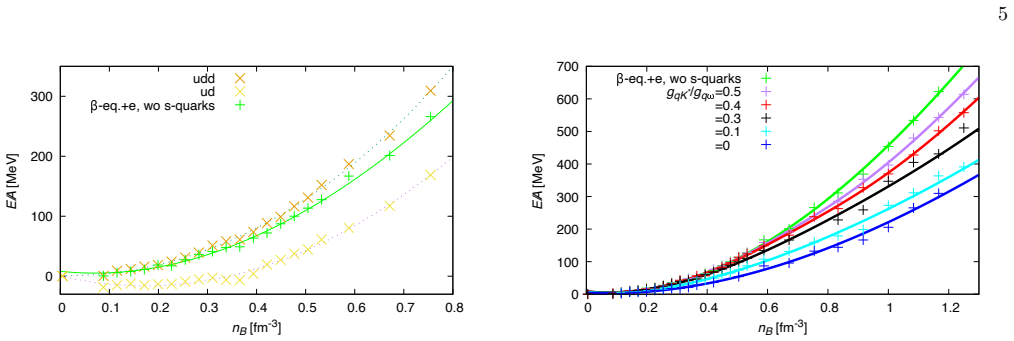
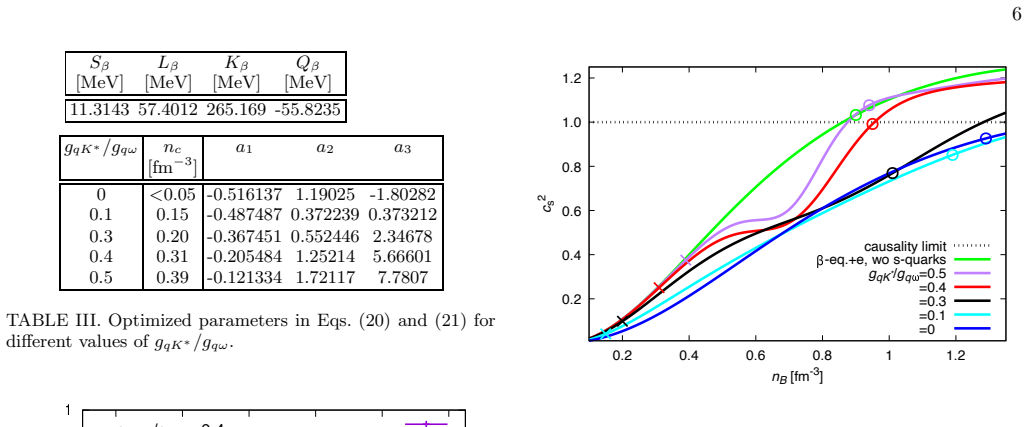
68, and gqρ = 5. 15. These values are based on the sim- ple assumption gqi = gN i/ 3. Following previous studies, we set gsφ = √ 2gqω [21]. As discussed, gqK ∗ is newly introduced here; its cou- pling strength is not fixed, and mapping realistic bary- onic interactions onto a qs channel is inherently non- trivial. Accordingly, we sample five choices, gqK ∗ ...
-
[3]
70+0. 18 − 0. 19M⊙ , R = 14 . 44+0. 88 − 1. 05km [5]. As both fall at the two extremes within the 2 σ bounds of Ref. [2], we do not display them in the figure to avoid clutter. In addition to these constraints, nucleosynthesis calculations in numer- ical relativity for black hole-neutron star merger ejecta favor a DD2-like EOS [23], which yields R = 13. 2 ...
-
[4]
10 < g qK ∗ /g qω < 0. 50. (24) Table IV summarizes these results. The table also reports the tidal deformability at 1 . 4M⊙ , Λ 1. 4M⊙ ; none of the sampled models is ruled out by this observable. In summary, among the sampled values explored, one sampled case provides the best overall consistency with all three criteria—(i) strangeness onset at ∼ 2n0, (...
-
[5]
T. E. Riley et al. , Astrophys. J. Lett. 887, L21 (2019)
2019
-
[6]
M. C. Miller et al. , Astrophys. J. Lett. 887, L24 (2019)
2019
-
[7]
T. E. Riley et al. , Astrophys. J. Lett. 918, L27 (2021)
2021
-
[8]
M. C. Miller et al. , Astrophys. J. Lett. 918, L28 (2021)
2021
-
[9]
Vinciguerra et al
S. Vinciguerra et al. , Astrophys. J. 961, 62 (2024)
2024
-
[10]
Choudhury et al
D. Choudhury et al. , Astrophys. J. 971, L20 (2024)
2024
-
[11]
B. P. Abbott et al. , Phys. Rev. Lett. 119, 161101 (2017)
2017
-
[12]
Antoniadis et al
J. Antoniadis et al. , Science 340, 1233232 (2013)
2013
-
[13]
Nishizaki, Y
S. Nishizaki, Y. Yamamoto, and T. Takatsuka, Prog. Theor. Phys. 108, 703 (2002)
2002
-
[14]
Vida˜ na, D
I. Vida˜ na, D. Logoteta, C. Providˆ encia, A. Polls, and I. Bombaci, Eur. Phys. J. A 47, 80 (2011)
2011
-
[15]
Yamamoto, T
Y. Yamamoto, T. Furumoto, N. Yasutake, and T. A. Ri- jken, Phys. Rev. C 90, 045805 (2014)
2014
-
[16]
Lonardoni, A
D. Lonardoni, A. Lovato, S. Gandolfi, and F. Pederiva, Phys. Rev. Lett. 114, 092301 (2015)
2015
-
[17]
Togashi, E
H. Togashi, E. Hiyama, Y. Yamamoto, and M. Takano, Phys. Rev. C 93, 035808 (2016)
2016
-
[18]
Bednarek, P
I. Bednarek, P. Haensel, J. L. Zdunik, M. Bejger, and R. Ma´ nka, A&A543, A157 (2012)
2012
-
[19]
Weissenborn, D
S. Weissenborn, D. Chatterjee, and J. Schaffner-Bielich, Phys. Rev. C 85, 065802 (2012)
2012
-
[20]
T. Muto, T. Maruyama, and T. Tatsumi, Prog. Theor. Exp. Phys. , 093D0 (2022)
2022
-
[21]
F. Ma, C. Wu, and W. Guo, Phys. Rev. C 107, 045804 (2023)
2023
-
[22]
Huang, L
C. Huang, L. Tolos, C. Providˆ encia, and A. Watts, Mon. Not. R. Astron. Soc. 536, 3262 (2025)
2025
-
[23]
G. F. Burgio, H.-J. Schulze, I. Vida˜ na, and J.-B. Wei, Prog. Part. Nucl. Phys. 120, 103879 (2021)
2021
-
[24]
Vida˜ na, V
I. Vida˜ na, V. M. Sarti, J. Haidenbauer, D. L. Mihaylov, and L. Fabbietti, Eur. Phys. J. A 61, 59 (2025)
2025
-
[25]
Akimura, T
Y. Akimura, T. Maruyama, N. Yoshinaga, and S. Chiba, Eur. Phys. J. A 25, 405 (2005)
2005
-
[26]
Yasutake and T
N. Yasutake and T. Maruyama, Phys. Rev. D 109, 043056 (2024)
2024
-
[27]
Wanajo, S
S. Wanajo, S. Fujibayashi, K. Hayashi, K. Kiuchi, Y. Sekiguchi, and M. Shibata, Phys. Rev. Lett. 133, 241201 (2024)
2024
-
[28]
Typel, G
S. Typel, G. R¨ opke, T. Kl¨ ahn, D. Blaschke, and H. H. Wolter, Phys. Rev. C 81, 015803 (2010)
2010
-
[29]
Chatziioannou et al
K. Chatziioannou et al. , Rev. Mod. Phys. 97, 045007 (2025)
2025
-
[30]
Yamamoto, N
Y. Yamamoto, N. Yasutake, and T. A. Rijken, Phys. Rev. C 105, 015804 (2022)
2022
-
[31]
Nanamura et al
T. Nanamura et al. , Prog. Theor. Exp. Phys. , 093D01 (2022)
2022
- [32]
-
[33]
Maruyama and T
T. Maruyama and T. Hatsuda, Phys. Rev. C 61, 062201 (2000)
2000
-
[34]
Yasutake and T
N. Yasutake and T. Maruyama, Nucl. Phys. Rev. 41, 801 (2024)
2024
-
[35]
Maruyama and N
T. Maruyama and N. Yasutake, Nucl. Phys. Rev. 41, 806 (2024)
2024
-
[36]
Park, S.-H
A. Park, S.-H. Lee, T. Inoue, and T. Hatsuda, Eur. Phys. J. A 56, 93 (2020)
2020
-
[37]
Wu and W
C. Wu and W. Guo, Eur. Phys. J. Plus 140, 193 (2025)
2025
-
[38]
Vi˜ nas, M
X. Vi˜ nas, M. Centelles, X. Roca-Maza, and M. Warda, Eur. Phys. J. A 50, 27 (2014)
2014
-
[39]
B.-A. Li, P. G. Krastev, D.-H. Wen, and N.-B. Zhang, Eur. Phys. J. A 55, 117 (2019)
2019
-
[40]
Danielewicz, P
P. Danielewicz, P. Singh, and J. Lee, Nucl. Phys. A 958, 147 (2017). 13
2017
-
[41]
Est´ eeet al
J. Est´ eeet al. , Phys. Rev. Lett. 126, 162701 (2021)
2021
-
[42]
G. Baym, C. Pethick, and P. Sutherland, Astrophys. J. 170, 299 (1971)
1971
-
[43]
M. E. Caplan, A. S. Schneider, and C. J. Horowitz, Phys. Rev. Lett. 121, 132701 (2018)
2018
-
[44]
Bauswein, O
A. Bauswein, O. Just, H.-T. Janka, and N. Stergioulas, Astrophys. J. Lett. 850, L34 (2017)
2017
-
[45]
Shibata, E
M. Shibata, E. Zhou, K. Kiuchi, and S. Fujibayashi, Phys. Rev. D 100, 023015 (2019)
2019
-
[46]
Shahrbaf, D
M. Shahrbaf, D. Blaschke, S. Typel, G. R. Farrar, and D. E. Alvarez-Castillo, Phys. Rev. D 105, 103005 (2022)
2022
-
[47]
C. Xia, X. Lai, and R. Xu, Int. J. Mod. Phys. A 40, 2550180 (2025)
2025
-
[48]
T. Muto, T. Maruyama, and T. Tatsumi, Phys. Lett. B 820, 136587 (2021)
2021
-
[49]
T. A. Rijken (2024), report THEF-NIJM 24.03, unpub- lished, https://nn-online.org/eprints
2024
-
[50]
V. D. Burkert, L. Elouadrhiri, and F. X. Girod, Nature 557, 396 (2018)
2018
-
[51]
P. E. Shanahan and W. Detmold, Phys. Rev. Lett. 122, 072003 (2019)
2019
-
[52]
Steinheimer, M
J. Steinheimer, M. Bleicher, H. Petersen, S. Schramm, H. St¨ ocker, and D. Zschiesche, Phys. Rev. C 77, 034901 (2008)
2008
-
[53]
Petersen, J
H. Petersen, J. Steinheimer, G. Burau, M. Bleicher, and H. St¨ ocker, Phys. Rev. C 78, 044901 (2008)
2008
-
[54]
Akamatsu, M
Y. Akamatsu, M. Asakawa, T. Hirano, M. Kitazawa, K. Morita, K. Murase, Y. Nara, C. Nonaka, and A. Ohnishi, Phys. Rev. C 98, 024909 (2018)
2018
-
[55]
Kanada-En’yo, O
Y. Kanada-En’yo, O. Morimatsu, and T. Nishikawa, Phys. Rev. C 71, 045202 (2005)
2005
-
[56]
Kanada-En’yo, O
Y. Kanada-En’yo, O. Morimatsu, and T. Nishikawa, Prog. Theor. Phys. Suppl. 168, 194 (2007)
2007
discussion (0)
Sign in with ORCID, Apple, or X to comment. Anyone can read and Pith papers without signing in.