Neural Stringology Based Cryptanalysis of EChaCha20
Pith reviewed 2026-05-10 14:39 UTC · model grok-4.3
The pith
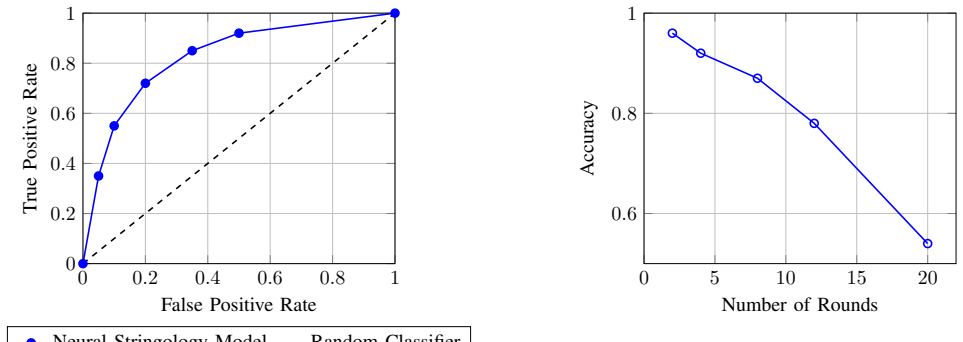
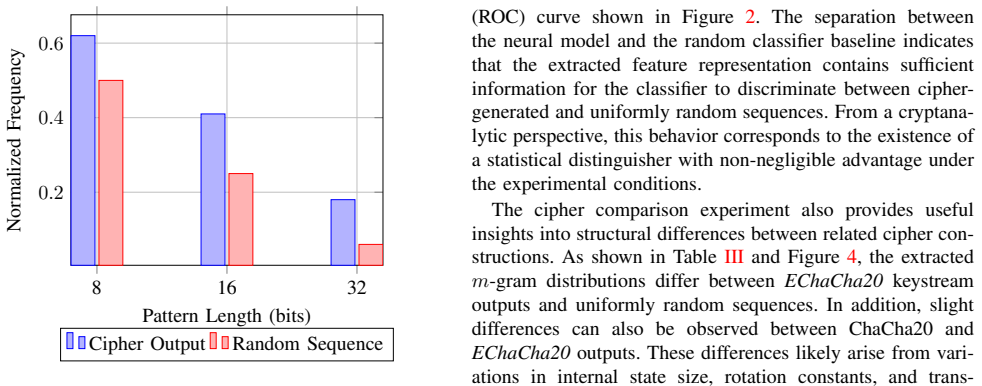
A neural stringology framework detects structural patterns in EChaCha20 keystreams that standard tests miss.
A machine-rendered reading of the paper's core claim, the machinery that carries it, and where it could break.
Core claim
The NSC framework combines stringology-inspired feature extraction with neural learning to identify structural anomalies in EChaCha20 keystream data under controlled conditions, demonstrating that machine learning augmented by classical pattern analysis can reveal characteristics not captured by traditional randomness tests.
What carries the argument
The NSC framework, which extracts m-gram frequencies, substring recurrence counts, and positional pattern statistics from ARX-aligned keystream segments and classifies them with a neural model to detect non-random structure.
Load-bearing premise
The neural model, when trained on the stringology features, is detecting genuine structural properties linked to the cipher's internal state rather than artifacts from feature extraction, model design, or ordinary variation in random data.
What would settle it
If the same NSC pipeline flags true random bitstrings at the same rate and with the same feature signatures as the EChaCha20 outputs, the claim that it isolates cipher-specific structure would be refuted.
Figures

read the original abstract
Modern stream ciphers rely on strong diffusion and pseudorandom keystream generation (PKG) to resist cryptanalysis. While conventional evaluation methods such as statistical randomness tests and differential analysis provide important security assurances, they may fail to detect localized structural patterns embedded within cipher outputs. In this paper, a Neural Stringology Cryptanalysis (NSC) framework that combines classical string pattern analysis with machine learning techniques to investigate potential structural anomalies in stream cipher keystreams is introduced. The proposed approach first applies stringology-inspired feature extraction methods such as m-gram frequency analysis, substring recurrence detection, and positional pattern statistics aligned with the internal operations of Add-Rotate-XOR (ARX) based stream ciphers. These extracted features are then analyzed using a neural learning model to identify deviations from expected random behavior and to detect subtle structural patterns that may not be captured by traditional statistical tests. Experimental evaluation is conducted on keystream outputs generated by the EChaCha20 stream cipher under multiple configurations, including reduced round variants. The results demonstrate that the proposed NSC framework can identify distinguishable structural characteristics in the keystream data under controlled conditions, suggesting that integrating machine learning with stringology-based analysis provides a promising complementary methodology for evaluating the structural robustness of modern ARX-based stream cipher designs.
Editorial analysis
A structured set of objections, weighed in public.
Referee Report
Summary. The paper introduces a Neural Stringology Cryptanalysis (NSC) framework that extracts stringology-inspired features (m-gram frequencies, substring recurrences, and positional statistics aligned with ARX operations) from EChaCha20 keystreams and feeds them to a neural model to detect deviations from randomness. Experiments on full and reduced-round variants are claimed to show that the framework identifies distinguishable structural characteristics, positioning the approach as a complementary tool to traditional statistical tests for evaluating ARX stream ciphers.
Significance. If the results hold and the detected patterns prove to be cipher-specific rather than artifacts of feature choice or training, the work would provide a novel integration of classical string pattern analysis with machine learning for cryptanalysis. This could strengthen evaluation of modern ARX designs by revealing localized structural weaknesses missed by standard randomness suites, though the current description supplies no evidence of such robustness.
major comments (2)
- Abstract: the central claim that the NSC framework 'can identify distinguishable structural characteristics' and 'demonstrate distinguishability' is unsupported because the abstract (and available text) supplies no neural architecture, training procedure, dataset sizes, loss functions, or statistical tests (e.g., p-values, ROC curves, or comparison to NIST/Dieharder baselines). Without these, the data-to-claim link cannot be verified and the experimental evaluation is not reproducible.
- Experimental section (implied by results summary): the weakest assumption—that detected patterns reflect genuine cipher internals rather than feature-extraction artifacts or random variation—is not addressed by any ablation, control experiment on pure random strings, or analysis of feature importance. This directly undermines the claim that the method evaluates 'structural robustness' of EChaCha20.
minor comments (2)
- Abstract: clarify whether 'EChaCha20' denotes a specific variant, a reduced-round configuration, or a notational variant of ChaCha20; the current usage is ambiguous.
- Notation and presentation: define the exact feature vector dimensionality and the neural model input format explicitly; the description of 'positional pattern statistics aligned with internal operations' remains too high-level for replication.
Simulated Author's Rebuttal
We thank the referee for the constructive and detailed feedback on our manuscript. The comments highlight important aspects of reproducibility and validation that we will address through targeted revisions. Below we respond point by point to the major comments.
read point-by-point responses
-
Referee: Abstract: the central claim that the NSC framework 'can identify distinguishable structural characteristics' and 'demonstrate distinguishability' is unsupported because the abstract (and available text) supplies no neural architecture, training procedure, dataset sizes, loss functions, or statistical tests (e.g., p-values, ROC curves, or comparison to NIST/Dieharder baselines). Without these, the data-to-claim link cannot be verified and the experimental evaluation is not reproducible.
Authors: We agree that the current abstract is too concise and does not supply the technical details needed to substantiate the claims or support reproducibility. In the revised manuscript we will expand the abstract to include a brief description of the neural architecture, the supervised training procedure and loss function employed, the dataset sizes and generation process for full-round and reduced-round EChaCha20 keystreams, and the primary evaluation metrics (including ROC-AUC, statistical significance tests, and direct comparisons against NIST and Dieharder suites). These additions will make the data-to-claim linkage explicit while preserving the abstract's length constraints. revision: yes
-
Referee: Experimental section (implied by results summary): the weakest assumption—that detected patterns reflect genuine cipher internals rather than feature-extraction artifacts or random variation—is not addressed by any ablation, control experiment on pure random strings, or analysis of feature importance. This directly undermines the claim that the method evaluates 'structural robustness' of EChaCha20.
Authors: This is a valid and important observation. The present manuscript does not contain explicit ablation studies, control experiments on purely random strings, or feature-importance analysis. We will add a new subsection to the experimental evaluation that reports: (i) ablation results isolating the contribution of m-gram frequencies, substring recurrences, and ARX-aligned positional statistics; (ii) control experiments on keystreams generated by a cryptographically secure random number generator; and (iii) feature-importance rankings (via permutation importance or SHAP values) demonstrating that the discriminative patterns align with the internal Add-Rotate-XOR structure rather than generic artifacts. These additions will directly support the claim that the framework evaluates structural robustness. revision: yes
Circularity Check
No significant circularity; experimental pipeline is self-contained
full rationale
The paper introduces an NSC framework that applies stringology feature extraction (m-gram frequencies, substring recurrences, positional statistics) to EChaCha20 keystreams and passes the results to a neural model for detecting deviations from randomness. No mathematical derivations, equations, or predictions appear that reduce to the inputs by construction. Claims are limited to experimental identification of distinguishable characteristics under controlled conditions on generated data, with no load-bearing self-citations, fitted-input predictions, or ansatz smuggling. The approach is therefore self-contained as a methodological pipeline rather than a closed-form derivation.
Axiom & Free-Parameter Ledger
free parameters (1)
- neural network hyperparameters
axioms (1)
- domain assumption Stringology-derived features capture internal ARX diffusion properties
invented entities (1)
-
Neural Stringology Cryptanalysis (NSC) framework
no independent evidence
Forward citations
Cited by 1 Pith paper
-
Structural Analysis of Cryptographic Sequences using Stringology-Based Fingerprinting
Introduces SBF framework that extracts structural string patterns from cryptographic sequences to produce measurable fingerprints distinguishing different generators.
Reference graph
Works this paper leans on
-
[1]
High-speed stream ciphers for wireless communication systems: Design and simulation,
O. Kuznetsov, E. Frontoni, N. Kryvinska, M. Mormul, and O. Poplavskiy, “High-speed stream ciphers for wireless communication systems: Design and simulation,” inComputational Modeling and Sim- ulation of Advanced Wireless Communication Systems. CRC Press, 2024, pp. 195–228
work page 2024
-
[2]
D. J. Bernsteinet al., “Chacha, a variant of salsa20,” inWorkshop record of SASC, vol. 8, no. 1. Lausanne, Switzerland, 2008, pp. 3–5
work page 2008
-
[3]
J. Song and S. C. Seo, “Secure and fast implementation of arx-based block ciphers using asimd instructions in armv8 platforms,”IEEE Access, vol. 8, pp. 193 138–193 153, 2020
work page 2020
-
[4]
Extended-chacha20 stream cipher with enhanced quar- ter round function,
V . R. Kebande, “Extended-chacha20 stream cipher with enhanced quar- ter round function,”IEEE Access, vol. 11, pp. 114 220–114 237, 2023
work page 2023
-
[5]
Testu01 and practrand: Tools for a random- ness evaluation for famous multimedia ciphers,
L. Sleem and R. Couturier, “Testu01 and practrand: Tools for a random- ness evaluation for famous multimedia ciphers,”Multimedia Tools and Applications, vol. 79, no. 33, pp. 24 075–24 088, 2020
work page 2020
-
[6]
Testing the nist statistical test suite on artificial pseudorandom sequences,
A. M. Zubkov and A. A. Serov, “Testing the nist statistical test suite on artificial pseudorandom sequences,”Matematicheskie voprosy kriptografii, vol. 10, no. 2, pp. 89–96, 2019
work page 2019
-
[7]
Correctness-by-construction in stringology
B. W. Watson, “Correctness-by-construction in stringology.” inStringol- ogy, 2012, pp. 1–2
work page 2012
-
[8]
Adapting the knuth–morris–pratt al- gorithm for pattern matching in huffman encoded texts,
D. Shapira and A. Daptardar, “Adapting the knuth–morris–pratt al- gorithm for pattern matching in huffman encoded texts,”Information processing & management, vol. 42, no. 2, pp. 429–439, 2006
work page 2006
-
[9]
H. Hyyr ¨o, “On boyer-moore preprocessing,”Department of Computer Sciences, University of Tampere, Series of Publications, D-NET Publi- cations, D-2004-1, 2004
work page 2004
-
[10]
A boyer–moore-style algorithm for regular expression pattern matching,
B. W. Watson and R. E. Watson, “A boyer–moore-style algorithm for regular expression pattern matching,”Science of Computer Program- ming, vol. 48, no. 2-3, pp. 99–117, 2003
work page 2003
-
[11]
Learning high-dimensional data,
M. Verleysenet al., “Learning high-dimensional data,”Nato Science Series Sub Series III Computer And Systems Sciences, vol. 186, pp. 141–162, 2003
work page 2003
-
[12]
Stream cipher designs: a review,
L. Jiao, Y . Hao, and D. Feng, “Stream cipher designs: a review,”Science China Information Sciences, vol. 63, no. 3, pp. 1–25, 2020
work page 2020
-
[13]
L. Perrin, “Addition, rotation, xor,”Symmetric Cryptography, Volume 2: Cryptanalysis and Future Directions, p. 155, 2024
work page 2024
-
[14]
A survey on security threats and defensive techniques of machine learning: A data driven view,
Q. Liu, P. Li, W. Zhao, W. Cai, S. Yu, and V . C. Leung, “A survey on security threats and defensive techniques of machine learning: A data driven view,”IEEE access, vol. 6, pp. 12 103–12 117, 2018
work page 2018
-
[15]
Machine learning for cryptographic algorithm identification,
F. Barbosa, A. Vidal, and F. Mello, “Machine learning for cryptographic algorithm identification,”Journal of Information Security and Cryptog- raphy (Enigma), vol. 3, no. 1, pp. 3–8, 2016
work page 2016
-
[16]
Faster randomness testing with the nist statistical test suite,
M. S `ys and Z. ˇR´ıha, “Faster randomness testing with the nist statistical test suite,” inSecurity, Privacy, and Applied Cryptography Engineering: 4th International Conference, SPACE 2014, Pune, India, October 18-22,
work page 2014
- [17]
-
[18]
An overview on cryptanalysis of arx ciphers,
S. Barbero, “An overview on cryptanalysis of arx ciphers,”DE CIFRIS KOINE, p. 10, 2024
work page 2024
-
[19]
Rotational cryptanalysis on chacha stream cipher,
S. Barbero, D. Bazzanella, and E. Bellini, “Rotational cryptanalysis on chacha stream cipher,”Symmetry, vol. 14, no. 6, p. 1087, 2022
work page 2022
-
[20]
On compile time knuth- morris-pratt precomputation,
J. Kourie, L. Cleophas, and B. Watson, “On compile time knuth- morris-pratt precomputation,” inProceedings of the Prague Stringology Conference 2011 (PSC’11, Prague, Czech Republic, August 29-31, 2011). Czech Technical University in Prague, 2011, pp. 15–29
work page 2011
-
[21]
Stringology-Based Cryptanalysis for EChaCha20 Stream Cipher
V . Kebande, “Stringology-based cryptanalysis for echacha20 stream cipher,” 2026. [Online]. Available: https://arxiv.org/abs/2604.08862
work page internal anchor Pith review Pith/arXiv arXiv 2026
-
[22]
Quad: A practical stream cipher with provable security,
C. Berbain, H. Gilbert, and J. Patarin, “Quad: A practical stream cipher with provable security,” inAnnual International Conference on the Theory and Applications of Cryptographic Techniques. Springer, 2006, pp. 109–128
work page 2006
-
[23]
Distinguishing attacks on rc4 and a new improvement of the cipher,
J. Lv, B. Zhang, and D. Lin, “Distinguishing attacks on rc4 and a new improvement of the cipher,”Cryptology ePrint Archive, 2013
work page 2013
discussion (0)
Sign in with ORCID, Apple, or X to comment. Anyone can read and Pith papers without signing in.